Sizewell C Nuclear : too destructive, too costly, too late

The Article, by IAN LINDEN, 14 Apr 24
Joan Girling grew up near the Suffolk coast, with its little terns, barn owls, harebells, ladies bedstraw, sedums, blue butterflies and acid grassland. There was no nuclear power station. “It was perfect, a nature lover’s paradise,” she told me.
In 1959, Joan’s father, faced with compulsory purchase, was forced to sell off a corner of their front garden, with its large pond full of water lilies and wildlife. It was to make way for workers’ traffic to the site of Sizewell A, a nuclear power station. Sizewell A is today a great, ugly, Stalinist-looking excrescence looming above the seashore. Her grandmother, who lived next door, watched as they filled in the pond. “The worst part was to hear my Grandma crying. I remember it as if it was yesterday.”
In the late 1980s it all happened again: Sizewell B. This time Joan moved house with her family to escape construction traffic. From 1993-2005 she served on Suffolk County Council. Fifteen years ago, Joan Girling became a founding and deeply dedicated member of Community against Nuclear Expansion, later renamed Together Against Sizewell C (TASC).
The human and environmental costs ought not be underestimated. The disruption and destruction accompanying years of building accounts for the level and persistence of local protest. Stop Sizewell C, originally a parish of Theberton and Eastbridge action group, alongside the local Friends of the Earth, joined TASC in a long-running legal campaign. Crowdfunding helped finance three rounds of court action seeking judicial review of the Sizewell C project. The last one challenged the Business Secretary (then Kwasi Kwarteng) over his 2022 Development Consent Order giving the green light to start construction. Kwateng rejected the Planning Inspectorate’s conclusion (part of the process required by the 2008 Planning Act) that in the absence of an assessed, permanent, potable water supply for the project, “the case for the grant of development consent is not yet made”. Sizewell C will be forced to use a desalination plant during construction. The Court of Appeal found for the Government in December 2023.
The construction of Sizewell C means heavy truck traffic. New roads, a large park and ride facility, as well as a railway branch line, will have a major impact over a large area. Much of it is designated by Natural England — sponsored, incidentally, by the Department of Environment, Food and Rural Affairs (DEFRA) — as a Suffolk Coast and Heaths National Landscape (formerly Area of Outstanding Natural Beauty). A small bite comes out of reed beds and marsh land, designated a Site of Special Scientific Interest. The new reactors will lie right next to Minsmere, a popular RSPB reserve where the drain-pipe boom of the bittern can be heard. Building Sizewell C will blight tourism for two decades, though it will boost other aspects of the local economy. But before dismissing protest as Nimbyism, it is as well to evaluate what lies in the backyard………………………………………………………………………….. more https://www.thearticle.com/sizewell-c-too-destructive-too-costly-too-late
Israel’s Latest Lie Is That It Has ‘No Choice’ But To Attack Iran
CAITLIN JOHNSTONE, APR 16, 2024, https://www.caitlinjohnst.one/p/israels-latest-lie-is-that-it-has?utm_source=post-email-title&publication_id=82124&post_id=143625696&utm_campaign=email-post-title&isFreemail=true&r=1ise1&triedRedirect=true&utm_medium=email
In an article titled “Israel vows to retaliate against Iran for missile attacks,” Axios reports that the Israeli defense minister has informed his American counterpart that Israel “has no choice” but to attack Iran for the retaliatory strike it launched in response to Israel’s deadly attack on the Iranian embassy in Damascus.
“Israeli Minister of Defense Yoav Gallant told Defense Secretary Lloyd Austin Sunday that Israel has no choice but to respond to the unprecedented missile and drone attack launched by Iran over the weekend,” reports Axios, citing an anonymous US official and another unnamed source.
The state of Israel has been churning out massive lies on a daily basis for the last six months, but this whopper could wind up being the most consequential.
Obviously Israel has a choice as to whether it continues to escalate a conflict it initiated with an extreme act of aggression. This fraudulent apartheid ethnostate is so accustomed to crying victim every minute of every day that it will even pretend to be the victim of its own conscious decisions.
As professor Jason Hickel put it on Twitter, “People need to understand that Israel *does not* need to retaliate. Iran’s action was a telegraphed response to Israel’s bombing of its consulate, which killed 16 people and violated the Vienna Convention. Iran says they now consider the matter closed. Israel must de-escalate.”
Iran’s deputy foreign minister Ali Bagheri has made it clear that if Israel launches another attack against Iran, this time Iran’s response will be instantaneous instead of a twelve-day grace period with Tehran giving neighboring countries and the United States a 72-hour advance warning to ensure minimal damage to Israel.
Predictably, the Biden administration is doing its usual phony schtick where it pretends to be a passive witness to all this, with National Security spokesman John Kirby telling the press that the White House plans to just “wait and see what the Israelis decide to do.”
But as foreign policy analyst Tariq Kenney-Shawa noted of Kirby’s statement, “Israel will be using US-supplied weapons, will have to coordinate with US forces throughout the region, and will depend on the US for missile defense when Iran responds.” So the fact that the US won’t be actively planning the attack with Israel doesn’t mean the US won’t be involved in it on a fundamental level.
If Israel’s escalatory attack happens, it will be because Washington allowed it to. If the US informed Israel that it will instantly lose its pricey US weapons supplies and Pentagon support if it attacks Iran, Israel would discover very quickly that it does in fact have a choice as to whether or not to proceed.
In an article for Foreign Policy titled “Netanyahu Wants War With Iran. Biden Can Prevent It.”, Quincy Institute’s Trita Parsi argues that while Biden’s unconditional support for Israel is often described as a continuation of longstanding US policy, it has actually been a rather dramatic break from the norm. Presidents like Reagan, both Bushes, and Obama have not hesitated to give Israel’s arm a twist whenever they found it necessary to advance US interests in the region; this new policy of just letting Tel Aviv do whatever it wants while providing unconditional support is actually without precedent in the White House.
Both Israel and the US are pretending to be powerless in this situation, when in reality they’re both anything but. They’re like two muggers getting ready to mug someone and saying “If only there was something we could do to stop this terrible mugging!”
Israel absolutely can choose not to accelerate toward a terrifying war between extremely powerful militaries, and the US absolutely can choose to pump the brakes. The fact that neither of them are doing so is just what it looks like when you live under a globe-spanning empire that is fueled by human blood.
Stop Pretending Biden Is Some Passive Witness To Israel’s Warmongering
CAITLIN JOHNSTONE, APR 15, 2024, https://www.caitlinjohnst.one/p/stop-pretending-biden-is-some-passive?utm_source=post-email-title&publication_id=82124&post_id=143599351&utm_campaign=email-post-title&isFreemail=true&r=1ise1&triedRedirect=true&utm_medium=email
The more I think about it the more obnoxious I find the Biden administration’s “Gee whiz, I sure hope Israel doesn’t drag us into a giant war in the middle east” posturing and the imperial media’s facilitation of it.
CNN has a new article out titled “As Iran attacks Israel, Biden confronts an escalating Middle East crisis he had hoped to avoid,” which is a genre of story that has been coming out in slightly different iterations again and again for the past six months. Every time Israel does something that makes things more dangerous in the middle east with the assistance of the United States, the American press fall all over themselves to inform the world that the president really doesn’t want this to happen and that his feelings are very upset about it.
“For President Joe Biden, an attack on Israel launched from Iranian soil amounts to a scenario he’d greatly sought to avoid since the start of the current Middle East conflict,” writes CNN, saying the strikes “heighten the risk of a wider regional conflict that could directly draw in the United States, along with other countries.”
“Israel will respond to Iran’s attack, but the scope of that response has yet to be determined,” CNN reports, citing an anonymous Israeli official.
And it’s just such an obscene insult to our intelligence to suggest that the Biden administration is some kind of passive witness to all this, sitting around wringing its hands hoping Israel doesn’t do something so horrible that the United States will have no choice but to leap into World War Three in defense of its dear ally. It’s insulting in that it asks us to believe the US would have no choice but to enter into a war of unimaginable horror if Israel acts belligerently enough, and it’s insulting in that it asks us to ignore the fact that Biden could have ended this insane cycle of escalation with one phone call to Israel at any time over the last six months.
Being asked to accept that the Biden administration is just standing there hoping Israel doesn’t ignite the worst war in middle eastern history is like seeing a dog owner letting their rottweiler run around biting people all over the neighborhood and saying “Yeah he just does what he likes, I just hope he doesn’t kill anybody.”
It’s like, no. Stop that. You’re not just crossing your fingers and hoping Israel doesn’t do something monstrous, you’re letting them do whatever they want because that’s what you’re choosing to do. Israel’s entire existence is as dependent on US support as a scuba diver is on their oxygen tank, and as such the White House has essentially limitless leverage it can use to make Israel do as it pleases — and it has done so in the past. Hell it’s done so during this very Gaza assault, successfully commanding Israel to stop cutting off Gazan telecommunications and to start letting more aid trucks in to the enclave.
If Biden truly didn’t want Israel to be turning the middle east into a hurricane of death and fire, he would stop it. He would put the damn dog on a leash.
The western press have a well-established track record of consistently framing US wars as these traps that Washington just clumsily stumbles its way into, like there’s some giant Macaulay Culkin-like deity sneaking around laying tripwires to force the Pentagon to regime change Libya or whatever. After a certain number of wars you have to figure that a regime is starting a bunch of wars because it’s just a warmongering regime, though — and the US has been involved in a whole, whole lot of wars. Nobody’s that clumsy or that unlucky; it’s like believing your husband when he tells you he keeps slipping and falling with his man parts inside the lady parts of various coworkers.
The most powerful empire that has ever existed is not just passively sitting there praying that big bad Israel doesn’t force it to go to war with Iran. That is not happening. All the violence and chaos that’s happening in the middle east right now is happening because the US empire wants it to happen, and because the people who steer that empire are psychopathic ghouls. And don’t let the crooked manipulators of the western mass media tell you otherwise.
Sizewell C Fiasco Part 4. Much more expensive than renewables- Unknown cost or period for Investors
Sizewell C Fiasco Part 4 Much more expensive than renewables- Unknown cost or period for Investors
Sizewell C was given the go ahead against the advice of the Planning
Inspectorate by politicians who have since mainly been discredited. They do
not have the finance in place yet – a staggering £30 billion plus?
Yet the Government have been chucking hard pressed taxpayers’ money at the project
and Sizewell C Project have started massive pre-construction works. If they
can cause this much Eco/ Landscape devastation even now, what will they do
if they get the go ahead on construction?
Sizewell C would be a disaster
for the Environment and the Landscape. Taxpayers and Investors will be
financing a bottomless pit. Locked in for decades to paying much more than
the cost of wind or solar energy. Even if finished on time – which is very
unlikely – it would be far too late for any energy crisis. Which would be
caused by the current bad or lack of – planning and management for energy
production and a hopeless so-called National Grid (run for shareholders not
UK Taxpayers).
If built Sizewell C would be too late to contribute to net
zero and its construction would produce vast amounts of carbon and other
pollution for well over a decade at least. Not to mention the much more
radioactive waste from this unproven EPR type of reactor which is too hot
to move until the next century – so has to be stored on site on an eroding
coastline! The whole thing is bonkers!
Stop Sizewell C 8th April 2024 https://www.youtube.com/watch?v=o4ICw23iYY0
Nuclear – the not so wonderful news this week

Some bits of good news. The Beautiful Place that Stopped Big Bottled Water. A Tidal Wetland Restoration of Epic Proportions.
TOP STORIES.
Annie Jacobsen: ‘What if we had a nuclear war?’
What are the risks at Zaporizhzhia nuclear power plant after drone attack? –ALSO AT … https://nuclear-news.net/2024/04/10/3-a-what-are-the-risks-at-zaporizhzhia-nuclear-power-plant-after-drone-attack/
What’s Inside the President’s Nuclear Football?
Climate. Heatwaves now last much longer than they did in the 1980s. What if global emissions went down instead of up?- ALSO AT …… https://nuclear-news.net/2024/04/12/2-b1-what-if-global-emissions-went-down-instead-of-up/ Swiss women win landmark climate victory at European Court of Human Rights.
Nuclear. I’m quite fascinated that the UK is using Fujitsu’s software in its nuclear lab – after the total scandal and shemozzle of Fujitsu’s software in the UK Post Offices – more about that next week.
Noel’s notes. Australia is EVER so grateful to the global nuclear lobby! The nuclear lobby’s new “prime wheeze” – Community Interest Companies.
****************************************
AUSTRALIA.
- Coalition nuclear plan flips back to SMRs after latest meeting with lobbyists. Dutton’s decaying nuclear energy plans have the briefest half-life. Dutton proposes higher nuclear energy bills. Nuclear lobby manipulates ABC’s 7.30 Report. Coalition nuclear plan would force consumers to wait 20 years longer for 30% higher electricity bills. Cook by-election candidate Simon Kennedy says locals are ‘comfortable’ living near nuclear reactors.
- Former PM Paul Keating on a craven acceptance of US strategic hegemony in Asia.
- The cost of needless secrecy on nuclear. What’s the scam?
- No decisions on site for nuclear waste dump as spin doctor sought – ALSO AT…https://antinuclear.net/2024/04/15/1-a-no-decisions-on-site-for-nuclear-waste-dump-as-spin-doctor-sought/
- Secret Agreements: The Australian-Israel Defence Memorandum of Understanding.
NUCLEAR ISSUES
| CLIMATE. Nuclear energy ‘now an obstacle to delivering net zero’ – Greenpeace. | CIVIL LIBERTIES. Flicker of Hope: Biden’s Throwaway Lines on Assange. |
ECONOMICS.
- Banks Unwilling To Finance $5 Trillion Global Nuclear Development.
- Fresh blow for UK nuclear as the City snubs Sizewell C. Sizewell C Fiasco Part 4: Much more expensive than renewables- Unknown cost or period for Investors – https://www.youtube.com/watch?v=o4ICw23iYY0
- Rolls Royce misses out on government funding for their small nuclear reactors.
- Hinkley Point C Nuclear joins Community Interest Company “Passion for Somerset”. Why you probably shouldn’t become a Community Interest Company.
| EDUCATION. U.S. adds to the $1billion already granted to education for the nuclear industry. | ENERGY. Finland: Grid Limitations Force Olkiluoto-3 to Curtail Output. | HEALTH. St. Louis Residents Seek Compensation for Illnesses Tied to Nuclear Contamination. |
| LEGAL. Kevin Gosztola: Correcting the Record on the Assange Case. https://www.youtube.com/watch?v=k2xPL230qCY UK Government decision to withhold nuclear power plant information unlawful. | MEDIA. Books. Nuclear Lies, Cover-Ups and Secrecy |
| OPPOSITION to NUCLEAR . Past anti-nuclear activists in Europe speak out against current plans. Non-proliferation experts urge US to not support nuclear fuel project. Tax day and war resistance. Sizewell C Nuclear : too destructive, too costly, too late. | PERSONAL STORIES. Five Years At Belmarsh: A Chronicle Of Julian Assange’s Imprisonment. |
| POLITICS.UK government could still replace Fujitsu in key nuclear contract.UK revamps Sizewell C nuclear funding to avoid delays.Hunterston: Scottish National Party see no nuclear future due to terrorism risk – ALSO AT …https://nuclear-news.net/2024/04/13/1-b1-hunterston-scottish-national-party-see-no-nuclear-future-due-to-terrorism-risk/Keir Starmer slammed over staunch defence of nuclear weapons.The Scottish National Party support signing an international treaty banning nuclear weapons, post independence.In an Ontario town split over a nuclear dump site, the fallout is over how they’ll vote on the future. Ballooning costs and secret projects at Canada’s federal nuclear labs | POLITICS INTERNATIONAL and DIPLOMACY.US Declines Israel’s Invitation To Start WW3 (For Now).There Is No Grudge That Cannot Be Resolved, China’s Xi Jinping Tells Former Taiwan President Ma Ying-jeou in Momentous Beijing Meeting. The Mutually Reinforcing U.S. and Israeli Empires. The US and Japan’s Mission to Push Next Generation Nuclear Power . Former Australian PM Paul Keating on a craven acceptance of US strategic hegemony in Asia. |
| PUBLIC OPINION. Ukraine fatigue: Kiev and the West are tiring of war and each other | SAFETY. Zaporizhzhia: Russia claims Ukrainian drone hit dome of nuclear powerplant. Nuclear power plants in war zones: Lessons learned from the war in Ukraine. Attacks on Ukrainian nuclear facilities ‘must cease immediately’: UN atomic watchdog. UN nuclear watchdog’s board sets emergency meeting after Zaporizhzhia attacks. Ukraine: Briefing on the Zaporizhzhia Nuclear Power Plant. Zaporizhzhia Nuclear Power Plant: The ‘Sum Of All Fears’. Towards an international regulatory framework for AI safety: lessons from the IAEA’s nuclear safety regulations. |
| SPACE. EXPLORATION, WEAPONS. Not enough war on the ground, the US is taking it to space. U.S. Space Command adopts multipronged approach to prepare for ‘a conflict that has never happened’. Rolls Royce taps funding for nuclear-powered space missions. | TECHNOLOGY. Getting bigger but not safer or cheaper – the myth of Rolls Royce and its very big non-modular reactor.U.S. nuclear industry upbeat on small reactors, despite setback. Death by Algorithm: Israel’s AI War in Gaza. | URANIUM. Production of Highly Enriched Uranium (HEU) threatens our environment, health, and safety. | WASTES. First Images Inside Fukushima’s Nuclear Reactor Show “Icicle-Like”Structures |
| WAR and CONFLICT. Amid Serious Iran-Israel Tension, The Nuclear Elephant Is In The Room. US, Philippines, Japan, and Australia Conduct First Joint Military Exercise in South China Sea. Brutal, chaotic war – norms, conventions and laws of conduct are being erased. Israel Prepares For Potential Strike On Iranian Nuclear Sites. Will Biden’s zero sum game approach to foreign conflict bumble US into regional/nuclear war in Europe and Middle East? The Longer it Takes the West to Accept that Ukraine is Losing, the Worse Things Will Get for Ukraine. | WEAPONS and WEAPONS SALES.Civil and military nuclear mutuality.Increased activity at nuclear test site in northern Russia: expert. Patrick Lawrence: ‘Automated Murder’: Israel’s ‘AI’ in Gaza. ‘Lavender’: The AI machine directing Israel’s bombing spree in Gaza. Israel’s ‘Where’s Daddy?’ AI system helps target suspected Hamas militants when they’re at home with their families, report says. BUSINESS AS USUAL FOR BRITAIN’S WEAPONS EXPORTS. The Math on Ukraine Doesn’t Add Up Secret Agreements: The Australian-Israel Defence Memorandum of Understanding. |
Civil and military nuclear mutuality

‘The UK government is pursuing an uneconomic nuclear programme in large part so as to maintain & renew military nuclear capabilities’.
Rishi Sunak backs both civil and military nuclear: ‘Safeguarding the future of our nuclear deterrent and nuclear energy industry is a critical national endeavour’. French president Emmanuel Macron is even more upfront about it all: ‘Without civil nuclear power, no military nuclear power, without military nuclear, no civil nuclear.’ With the USA, China and Russia also evidently locked into similar paths, the global future doesn’t look too good.
‘The UK government is pursuing an uneconomic nuclear programme in large part so as to maintain & renew military nuclear capabilities’.
backs both civil and military nuclear: ‘Safeguarding the future of our nuclear deterrent and nuclear energy industry is a critical national endeavour’. French president Emmanuel Macron is even more upfront about it all: ‘Without civil nuclear power, no military nuclear power, without military nuclear, no civil nuclear.’ With the USA, China and Russia also evidently locked into similar paths, the global future doesn’t look too good.
Renew Extra Weekly, 13 Apr 24
Until recently, the UK government has always said that civil and military nuclear technologies were separate things, for example in response to claims that expansion of civil nuclear power capacity could lead to proliferation of nuclear weapons making capacity. But, as researchers at the University of Sussex have relentlessly catalogued, there seems to have been a change of view underway, culminating formally in March in a new policy document from No. 10 Downing Street. Entitled ‘Building the Nuclear Workforce of Tomorrow’ it claims that ‘domestic [civil] nuclear capability is vital to our national defence and energy security, underpinning our nuclear deterrent and securing cheaper, more reliable energy for UK consumers’. So they are intertwined and mutually beneficial- we need both!
UK Prime Minister Sunak says that ‘in a more dangerous and contested world, the UK’s continuous at-sea nuclear deterrent is more vital than ever’ and that civil nuclear power is the ‘perfect antidote to the energy challenges facing Britain- it’s green, cheaper in the long term and will ensure the UK’s energy security for the long term’.
There are many issues raised by these claims. Leaving aside all the major moral and political issues associated with nuclear weapons, it is not at all clear that new nuclear reactors will be as costs effective as renewables. Indeed, the cost of renewables has fallen dramatically in recent years while the cost of nuclear projects has continued to escalate. It could be that, recognising this imbalance in cost, what we are now seeing is the government trying to provide a compensating justification for new civil nuclear- it will aid defence. Even if, arguably, it makes little economic sense as Business Green argued: ‘The UK government is pursuing an uneconomic nuclear programme in large part so as to maintain & renew military nuclear capabilities’.
Basically, as the Sussex University researchers have argued, it does seem that the government is just responding to military pressures. More specifically though, it’s a matter of rapidly expanding skill requirements- and shortages. Matthew Lay, Head of EDF Nuclear Skills Alliance, says that ‘the UK Government’s commitment to nuclear power must be seen in the context of a steady increase of nuclear capacity worldwide as well as growth in defence expenditure,’ and especially the growth in the ‘defence industry’s demand for nuclear skills, to deliver established and new nuclear submarine programmes’. So it’s about expanding nuclear skills for building nuclear sub power plants and civil reactors, including possibly Small Modular Reactors (SMRs), which have some similarities. Presumably also about making fuels for them both too.
Some may be happy about civil-military skill sharing, but it’s a long way from the old rhetoric about ‘atoms for peace’. In 1953 President Eisenhower called for nuclear bomb technology to be turned to peaceful ends around the world, with US help e.g. in transferring nuclear plant technology to developing countries. That had floundered due, in part, to the high cost of nuclear plants. According to a review by Drogan, a State Department Intelligence Report, circulated in January 1954, ‘Economic Implications of Nuclear Power in Foreign Countries’, noted that ‘nuclear power plants may cost twice as much to operate and as much as 50 percent more to build and equip than conventional thermal plants’. So it warned that the introduction of nuclear power would ‘not usher in a new era of plenty and rapid economic development as is commonly believed’. You could say that we are still waiting!
There were also potential conflicts between the ‘atoms for peace’ idea and proliferation issues. Indeed that is now even more of a problem, with some newly developing countries, following the UAE’s lead, looking to have nuclear plants, which, in theory, could give them the ability to make bombs. And (the Nuclear Proliferation Treaty apart!) why not, if nuclear weapons states like the UK are seen as no longer maintaining a clear separation between civil and military nuclear technology? Except of course the high cost of civil nuclear may make renewables a much better deal- especially solar, of which many countries (in the Middle East and Africa for example) have plenty. ……………………………………………………………………………..
Clearly UK Prime Minister Sunak doesn’t see it this way- he backs both civil and military nuclear: ‘Safeguarding the future of our nuclear deterrent and nuclear energy industry is a critical national endeavour’. French president Emmanuel Macron is even more upfront about it all: ‘Without civil nuclear power, no military nuclear power, without military nuclear, no civil nuclear.’ With the USA, China and Russia also evidently locked into similar paths, the global future doesn’t look too good.
Do we really have to continue with all this? In 1995, Sir Michael Atiyah, then retiring as President of the Royal Society, said ‘I believe history will show that insistence on a UK nuclear capability [weapons and energy] was fundamentally misguided, a total waste of resources and a significant factor in our relative economic decline over the past 50 years’. He may have been right. https://renewextraweekly.blogspot.com/2024/04/civil-and-military-nuclear-mutuality.html
Not enough war on the ground, the US is taking it to space

The military industrial complex is suiting up for a new arms race, far beyond the stratosphere
STAVROULA PABST, APR 05, 2024, https://responsiblestatecraft.org/u-s-space-race/
Elon Musk’s space company SpaceX recently secured a classified contract to build an extensive network of “spy satellites” for an undisclosed U.S. intelligence agency, with one source telling Reuters that “no one can hide” under the prospective network’s reach.
While the deal suggests the space company, which currently operates over half the active satellites orbiting Earth, has warmed to U.S. national security agencies, it’s not the first Washington investment in conflict-forward space machinery. Rather, the U.S. is funding or otherwise supporting a range of defense contractors and startups working to create a new generation of space-bound weapons, surveillance systems, and adjacent technologies.
In other words, America is hell-bent on a new arms race — in space.
Space arms, then and now
Attempts to regulate weapons’ presence and use in space span decades. Responding to an intense, Cold War-era arms race between the U.S. and Soviet Union, the 1967 Outer Space Treaty established that space, while free for all countries to explore and use, was limited to peaceful endeavors. Almost 60 years later, the Outer Space Treaty’s vague language regarding military limitations in space, as space policy experts Michelle L.D. Hanlon and Greg Autry highlight, “leave more than enough room for interpretation to result in conflict.”
Stonewalling subsequent international efforts to limit the militarization of space (though the U.S. is participating in a new U.N. working group on the subject), Washington’s interest in space exploration and adjacent weapons technologies also goes back decades. Many may recall President Ronald Reagan’s 1983 Strategic Defense Initiative (SDI), which was established to develop land-, air-, and space-based missile defense systems to deter missile or nuclear weapons attacks against the U.S. Cynically referred to by critics as the “Star Wars” program, many SDI initiatives were ultimately canned due to prohibitive costs and technological limitations.
And while the Pentagon established Space Command in 1985, the Space Force, an entirely new branch of the military “focused solely on pursuing superiority in the space domain,” was launched in 2019, signaling renewed emphasis on space militarization as U.S. policy.
Weapons contractors cash in

Long-term American interest in space war tech now manifests in ambitious projects, where defense companies and startups are lining up for military contracts to create a new generation of space weaponry and adjacent tech, including space vehicles, hypersonic rockets, and extensive surveillance and communications projects.
For starters, Space Force’s Space Development Agency recently granted defense contractors L3Harris and Lockheed Martin and space company Sierra Space contracts worth $2.5 billion to build satellites for the U.S. military’s Proliferated Warfighter Space Architecture (PWSA), a constellation of hundreds of satellites, built out on tranches, that provide various warfighting capabilities, including the collection and transmission of critical wartime communications, into low-Earth orbit.
The PWSA will serve as the backbone of the Pentagon’s Joint All-Domain Command and Control project, an effort to bolster warfighting capacities and decision-making processes by facilitating “information advantage at the speed of relevance.”
Other efforts are just as sci-fi-esque. Zoning in on hypersonic weapons systems and parts, for example, RTX (formerly Raytheon) and Northrop Grumman have collaborated to secure a DARPA contract for a Hypersonic Air-breathing Weapons Concept, where scramjet-powered missiles can travel at hypersonic speeds (Mach 5 or faster) for offensive purposes.
And Aerospace startup True Anomaly, which was founded by military officers and has received funding from the U.S. Space Force to the tune of over $17 million, is developing space weapons and adjacent conflict-forward tools. An example is True Anomaly’s Jackal Autonomous Orbital Vehicle, an imaging satellite able to take on, according to True Anomaly CEO Even Rogers, “rendezvous and proximity operations missions” with “uncooperative” targets.
As True Anomaly finds fiscal success, accruing over $100 million in a December 2023 series B fundraising round from venture capitalists including Eclipse Ventures and ACME Capital, other aerospace start-ups are flooding the market with the assistance of the U.S. government, both in funding and other critical partnerships.
Take how Firehawk Aerospace — which wants to “create the rocket system of the future” to “enab[le] the next generation of aerospace and defense systems” — partnered with NASA in 2021 to test rocket engines at NASA’s Stennis Space Center in Mississippi. It recently secured Army Applications Laboratory and U.S. Air Force Small Business Innovation Research Awards to advance developments in its rocket motors and engines.
And data and satellite-focused American space tech company Capella Space, a contractor for federal agencies including the Air and Space Forces, specializes in reconnaissance and powerful surveillance tools, including geospatial intelligence and Synthetic Aperture Radar monitoring that help national security officials identify myriad security risks. In early 2023, Capella Space even formed a subsidiary, Capella Federal, to provide federal clients with additional access to Synthetic Aperture Radar imagery services.
We need diplomacy, not space superiority
The funding of expensive, futuristic space surveillance and weapons projects indicates the U.S.’s eagerness to maintain superiority, where military personnel posit such advancements are critical within the context of both a “space race” and an increasingly tumultuous geopolitical climate, if not the possibility of war in space outright.
As Space Force General Chance Saltzman declared at the recent Mitchell Institute Spacepower Security Forum: “if we do not have space, we lose.” Testifying before the Senate Armed Services Committee in late February, U.S. Space Force General Stephen N. Whiting explained that the U.S. Space Command must bolster its military capacities through increased personnel training and investments in relevant technologies so that the U.S. is “ready if deterrence fails.”
While upping its own military capacities, however, Washington is simultaneously pushing against other countries’ anti-satellite weapons testing, a capability the U.S. already has.
In any case, such pointing fingers, when coupled with ongoing space deterrence and weapons proliferation efforts, does little to advance genuine diplomacy, where states could instead discuss, on equal terms, how space should be used and shared amongst nations.
Ultimately, weapons and aerospace companies’ efforts have launched a new generation of weaponry and adjacent tech — buoyed by consistent support from a “deterrence”-focused U.S. As a result, the military industrial complex has further expanded into the domain of space, where defense companies have new opportunities to score lucrative weapons contracts and theoretically even push for more conflict.
Will Biden’s zero sum game approach to foreign conflict bumble US into regional/nuclear war in Europe and Middle East?

Walt Zlotow, West Suburban Peace Coalition, Glen Ellyn IL, 14 Apr 24, https://heartlandprogressive.blogspot.com/
President Biden continues on his astonishing and disheartening path to regional/nuclear war in both Europe and the Middle East.
In Europe, he plows ahead with his foolish demand to squandering another $61 billion in weapons for the lost cause in Ukraine. Any weapons manufactured will not reach Ukraine before their impending collapse, turning Ukraine into a rump state of abject poverty requiring endless US/NATO assistance.
Biden views the Russo Ukraine war as a zero sum game: US must win, Russia must lose. That requires endless US efforts to reclaim all Russian held Ukraine territory and bring Ukraine into NATO. Biden’s approach? Assisting Ukraine attacks on Russian territory.
Ukraine President Zelensky’s only hope is to widen the war to obtain direct US intervention. He almost provoked that 2 years ago when he claimed an errant Ukraine missile that killed 2 Poles in neighboring NATO Poland, was a Russian strike requiring immediate NATO response. Every day this 26 month long war continues represents another chance for US belligerence to make that happen. But Biden pushes on to possible all out war with his refusal to pivot from military provocation to diplomacy. That would require Biden dropping his zero sum game. Not likely.
The Middle East is more precarious still. The US has been Israel’s go to weapons and diplomatic supporter in their grotesque genocidal ethnic cleansing of 2,300,000 Palestinians in Gaza. That has turned both Israel and America in pariah states worldwide.
Besides the genocide, the possibility of all out regional war between Israel and its Arab neighbors looms daily. Biden remained silent when Israel launched its dastardly bombing of the Iranian consulate in Syria, killing 7. But when Iran signaled its intent to reply militarily, Biden invoked his standard zero sum game view that Israel can do no wrong. Iran? They can do no right. That’s a recipe for all out war.
President Biden only learned one thing from his six decades of political leadership: America is 100% right in foreign affairs; our imagined enemies 100% wrong. History is filled with empires that disappeared from that zero sum game.
Will Biden’s America be next?
The Longer it Takes the West to Accept that Ukraine is Losing, the Worse Things Will Get for Ukraine

Our leaders keep warning us that Putin will roll his tanks into the Baltic States and maybe even Poland should the Russians be successful in beating the Ukrainians. France’s President Macron is even telling us that we may have to send NATO troops to fight in Ukraine. Everyone seems to automatically assume that Putin’s ambition is still to conquer all of Ukraine and incorporate it in the Russian Federation. This is despite the fact that he said that it was to keep Ukraine out of NATO and to safeguard the Russian-speaking areas of Ukraine from Ukrainian nationalist militias.
Well, we do seem to have got ourselves into a bit of a pickle in Ukraine. How we get out of it is not immediately obvious.
Like many wars, this one seems to have started due to catastrophic blunders by the ruling elites on both sides. To simplify a rather complex situation, I believe that there were two massive blunders.
The West’s blunder – for several years Putin has warned NATO “not one inch further” – that he would not accept further NATO expansion eastwards and would not allow countries like Ukraine and Georgia, both with long borders with Russia, to join NATO. In 2008, Putin even attended a NATO summit during which he gave a speech warning NATO that Russia would not accept Ukraine’s and Georgia’s admission to NATO. To me that seems reasonable. After all, the U.S. would hardly accept Russia doing a deal with, say, Mexico which would allow Russia to establish bases close to the U.S.-Mexico border (although it’s also understandable that Ukraine and Georgia wanted to join NATO, given Putin’s sabre-rattling). And, of course, there was the 1962 Cuban Missile Crisis when the USA was not too pleased about Russian missiles being situated close to the American mainland. Probably due to stupidity, hubris or a belief that Putin was bluffing, NATO delivered a diplomatic note to the Kremlin reiterating NATO’s view that countries like Ukraine and Georgia could join the Alliance if they wished. The result – Russia’s invasion of Ukraine.
Putin’s blunder – Putin seems to have believed that it would only take a couple of weeks for the Russian army to get to Kiev, overthrow and murder the Zelensky Government and install a Russian-friendly regime. He got that one wrong and several hundred thousand Russians have been wounded or killed as a result. Moreover, Russia’s invasion of Ukraine has prompted Sweden and Finland to join NATO – another consequence Putin seems to have failed to foresee.
The war seemed to have started well for Ukraine. The Ukrainian army surprised the Russians and the world by fighting off the initial Russian invasion. Then the success of the summer 2022 Ukrainian offensive appeared to suggest that Ukraine might even be able to push the Russians out of Eastern Ukraine, retake Crimea and, by humiliating Putin, maybe even cause a coup in Russia which could overthrow Putin and his mafia cronies.
But after the 2022 Ukraine summer offensive, the Russians built formidable defensive lines protected by miles of minefields, dragon’s teeth and trench systems. So, when the 2023 Ukrainian combined operations offensive was launched, the Ukrainians were caught in a death trap and suffered huge losses of personnel and equipment while making little progress
We are now in a third phase of the war – the war of attrition – in which Russia is gaining the upper hand. Russia can massively out-produce Ukraine (and the quivering West) in terms of munitions, tanks, planes, missiles, artillery systems, drones and numbers of soldiers. Moreover, Russia has also received military material from North Korea, Iran, Syria and probably China. Meanwhile, Ukraine is running out of ammunition and troops. Some sources have suggested that the average age of Ukrainian forces is a worrying 43. And Ukraine doesn’t have time to mobilise, equip and train the numbers necessary to stem the Russian advance. In a war of attrition, the side with the greatest resources usually wins by grinding down its opponent. And that’s what we’re seeing now with small but continual Russian advances and Ukrainian retreats.
Our leaders keep warning us that Putin will roll his tanks into the Baltic States and maybe even Poland should the Russians be successful in beating the Ukrainians. France’s President Macron is even telling us that we may have to send NATO troops to fight in Ukraine. Everyone seems to automatically assume that Putin’s ambition is still to conquer all of Ukraine and incorporate it in the Russian Federation. This is despite the fact that he said that it was to keep Ukraine out of NATO and to safeguard the Russian-speaking areas of Ukraine from Ukrainian nationalist militias.
By the end of the 2008 Russia-Georgia war, Putin’s forces could have walked into the Georgian capital Tbilisi. Instead, they withdrew and merely stayed on to guard the Russian-speaking enclaves of South Ossetia and Abkhazia – the equivalent of the similar enclaves in Ukraine.
Putin has the habit of doing exactly what he says he’s going to do. This is a concept which contemporary Western politicians find so alien to their natures, of course, that they’re totally unable to grasp it (although their distrust of Putin is understandable).
Moreover, if we look at military budgets, you might wonder who is actually threatening whom. The USA’s military budget is around $877 billion. The total NATO military budget in 2023 (including the USA) a cool $1.3 trillion. The Russian Federation military budget prior to the Ukraine invasion? Just $86 billion a year.
Our rulers have repeatedly told us that we must “do whatever it takes” to stop Putin and that the West will support Ukraine for “however long is necessary”. But it seems to be becoming clear to everyone except our rulers that Ukraine is losing and can now never win if winning means expelling all Russian troops from Ukrainian territory.
The best Ukraine can now hope for is an untidy truce which involves a loss of the Russian-speaking parts of Ukraine – at least 20% of Ukrainian territory. Though the longer this war goes on, the more territory Ukraine will lose.
So, what will our rulers choose – humiliation or annihilation?
Will our rulers accept total humiliation by pushing Ukraine to do a deal with Russia in which Ukraine will have to hand over at least 20% of its land area to the Russian Federation and agree that what little is left of Ukraine will be a neutral country and never join NATO? And how will our rulers explain this defeat to us, their electorates? Moreover, what will the West’s defeat do to the global balance of power? It will, of course, embolden those in the anti-Western bloc – Russia, China, Iran and North Korea – who wish to do us harm. Moreover, it will convince many non-aligned countries that their future lies in alliances with the resurgent and increasingly powerful autocratic anti-Western bloc rather than with the declining, defeated, war-weary, supposedly democratic West.
Or will our rulers decide to try and save face and their own careers by ‘upping the ante’ – getting us more involved in helping Ukraine? Thanks to the incompetence of the head of the German air force, whose unsecured phone conference was recorded by Russian spies, we now know that British troops are apparently in Ukraine already, possibly helping with the loading and targeting of Storm Shadow missiles. It’s a pity our politicians ‘forgot’ to tell us that British troops are actually operating in Ukraine. Moreover, the New York Times recently revealed that the CIA has between 12 and 14 bases in Ukraine where it trains Ukrainian soldiers. If our rulers do get Western troops directly involved in killing Russians, as France’s President Macron has repeatedly proposed, we would risk the possibility of a nuclear war between Russia and the West.
I’m no military strategist. But it seems obvious to me that our rulers have blundered into a situation without any plan for how to extricate us in the event of things not turning out as they planned, thus forgetting the most basic rule of war – that no plan survives contact with the enemy. Or, as boxer Mike Tyson explained, “Everybody has a plan till they get punched in the face.”
It will be interesting to see whether our rulers choose humiliation by accepting Ukraine’s and, by extension, NATO’s defeat, or instead go for escalation which could lead to nuclear annihilation.
Ballooning costs and secret projects at Canada’s federal nuclear labs
by Ole Hendrickson, March 5, 2024, https://rabble.ca/columnists/ballooning-costs-and-secret-projects-at-canadas-federal-nuclear-labs/—
What does Canada get from its nuclear power corporation for its $1.54 billion budget?
Canada’s national nuclear power corporation – Atomic Energy of Canada Limited (AECL) – has no functioning nuclear reactors, unlike similar state-owned bodies in China, Russia, France, Korea, and the United Arab Emirates, and despite a $1.54 billion annual budget.
AECL’s three “prototype” CANDU reactors haven’t produced electricity for 37 years. Its three main research reactors are also shut down. Yet they must be maintained to protect nearby water bodies.
Section 9 of Canada’s 2023 Public Accounts indicates that AECL’s liability will require ongoing public expenditures for the next 162 years. It records “decommissioning of nuclear facilities” as a $9.3 billion “asset retirement obligation.”
In 2011, the Harper government sold AECL’s flagship CANDU division to SNC-Lavalin for a piddling $15 million. Then, in 2015 it contracted a multinational consortium to reduce AECL’s nuclear liabilities more quickly.
Under a “Government-owned, Contractor-operated” (GoCo) model, the public retains ownership of AECL’s federal lands, including the shut-down reactors and other radioactive waste. AECL funnels ever-increasing amounts of tax dollars to the “Canadian National Energy Alliance,” currently made up of Texas-based Fluor and Jacobs, and SNC-Lavalin (now rebranded as “AtkinsRéalis”).
The 2023-24 Main Estimates give AECL $1,541,555,307, with $1,140,509,721 earmarked for “Nuclear decommissioning and radioactive waste management.” For comparison, the current Parliamentary appropriation for the Canadian Broadcasting Corporation (CBC) is $1,287,169,435.
Despite billion-dollar annual cash outlays, AECL’s liabilities grew from $6.5 billion in 2015 to the current $9.3 billion figure.
AECL seems more interested in adding liabilities than reducing them. Its former Canadian Nuclear Laboratories (CNL) subsidiary – now owned by the consortium – is building new “Class 1” nuclear facilities at the Chalk River Laboratories, 150 km west of Ottawa. AECL boasts that these laboratories are “Canada’s largest science and technology complex.”
One Chalk River facility (the ANMRC) would enable research on “advanced” reactor fuels, including those made by extracting plutonium from high-level waste fuel rods. Another (the MCECE) would extract tritium, a radioactive form of hydrogen that builds up in the heavy water of CANDU reactors.
Despite concerns about costs and liabilities, both facilities are proceeding without Parliamentary or regulatory oversight. In 2018, Canada’s complacent nuclear “regulator”, the Canadian Nuclear Safety Commission, issued a licence authorizing CNL to “prepare a site for, construct, operate, modify, decommission or abandon” any nuclear facility on the Chalk River site. This effectively bypasses the normal licensing processes and regulations that govern Class 1 facilities.
Production of plutonium, tritium, and “clean” heavy water raises serious national security concerns. All are used in making nuclear weapons. Fluor and Jacobs are heavily involved in the weapons industry. They were prominent sponsors of the recent 16th Annual Nuclear Deterrence Summit in Washington DC – a “Global Warfare Summit.” As pillars of the military-industrial complex, they promote a new nuclear arms race. Canada has become an unwitting partner in this. Chalk River is an ideal location for training a new generation of weapons scientists, given its origins as a Cold War weapons plutonium production facility.
The only way for the public to find out and comment on what’s happening at Chalk River is through the Impact Assessment Act. AECL is a “federal authority” under sections 81 to 91 of the Act, it must determine that a project on federal lands “is not likely to cause significant adverse environmental effects.” But AECL lets CNL post uninformative project descriptions on the Canadian Impact Assessment Registry and make its own determinations after a perfunctory 30-day comment period.
In the case of the MCECE project, CNL began site preparation without an AECL determination. The billion-dollar ANMRC project, which started before the Impact Assessment Act came into force, was never even posted as a project, even though section 67 of the previous Canadian Environmental Assessment Act, 2012 also required an AECL determination.
These questionable processes may be coming to an end. Section 84 of the Impact Assessment Act requires the federal authority to consider “any adverse impact that the project may have on the rights of the Indigenous peoples of Canada recognized and affirmed by section 35 of the Constitution Act, 1982.”
Kebaowek First Nation recently held a joint press conference with the Bloc Quebecois to oppose a massive radioactive waste dump on unceded Algonquin territory at Chalk River. It is also intervening in the MCECE project, aided by a report from Dr. Gordon Edwards of the Canadian Coalition for Nuclear Responsibility that concludes “there is no justification for the proposed facility.”
There has been far too much secrecy surrounding the goings on at AECL and Canada’s nuclear laboratories under the GoCo model. Parliament should scrutinize the $1.5 billion annual outlay to AECL, and determine who is benefiting – Canadians, or unregulated multinational corporations.
J.D. Vance – New York Times: The Math on Ukraine Doesn’t Add Up

The notion that we should prolong a bloody and gruesome war because it’s been good for American business is grotesque.
Mr. Zelensky’s stated goal for the war — a return to 1991 boundaries — is fantastical.
J.D.Vance, The New York Times, Fri, 12 Apr 2024 , https://www.nytimes.com/2024/04/12/opinion/jd-vance-ukraine.html
President Biden wants the world to believe that the biggest obstacle facing Ukraine is Republicans and our lack of commitment to the global community. This is wrong.
Ukraine’s challenge is not the G.O.P.; it’s math. Ukraine needs more soldiers than it can field, even with draconian conscription policies. And it needs more matériel than the United States can provide. This reality must inform any future Ukraine policy, from further congressional aid to the diplomatic course set by the president.
The Biden administration has applied increasing pressure on Republicans to pass a supplemental aid package of more than $60 billion to Ukraine. I voted against this package in the Senate and remain opposed to virtually any proposal for the United States to continue funding this war. Mr. Biden has failed to articulate even basic facts about what Ukraine needs and how this aid will change the reality on the ground.
The most fundamental question: How much does Ukraine need and how much can we actually provide? Mr. Biden suggests that a $60 billion supplemental means the difference between victory and defeat in a major war between Russia and Ukraine. That is also wrong. This $60 billion is a fraction of what it would take to turn the tide in Ukraine’s favor. But this is not just a matter of dollars. Fundamentally, we lack the capacity to manufacture the amount of weapons Ukraine needs us to supply to win the war.
Consider our ability to produce 155-millimeter artillery shells. Last year, Ukraine’s defense minister estimated that the country’s base-line requirement for these shells was over four million per year but that it could fire up to seven million if that many were available. Since the start of the conflict, the United States has gone to great lengths to ramp up production of 155-millimeter shells. We’ve roughly doubled our capacity and can now produce 360,000 per year — less than a tenth of what Ukraine says it needs. The administration’s goal is to get this to 1.2 million — 30 percent of what’s needed — by the end of 2025. This would cost the American taxpayers dearly while yielding an unpleasantly familiar result: failure abroad.
Just this week, the top American military commander in Europe argued that absent further security assistance, Russia could soon have a 10-to-1 artillery advantage over Ukraine. What didn’t gather as many headlines is that Russia’s current advantage is at least 5 to 1, even after all the money we have poured into the conflict. Neither of these ratios plausibly leads to Ukrainian victory.
Proponents of American aid to Ukraine have argued that our approach has been a boon to our own economy, creating jobs here in the factories that manufacture weapons. But our national security interests can be — and often are — separate from our economic interests.The notion that we should prolong a bloody and gruesome war because it’s been good for American business is grotesque. We can and should rebuild our industrial base without shipping its products to a foreign conflict.
The story is the same when we look at other munitions. Take the Patriot missile system — our premier air defense weapon. It’s of such importance in this war that Ukraine’s foreign minister has specifically demanded them. That’s because in March alone, Russia reportedly launched over 3,000 guided aerial bombs, 600 drones and 400 missiles at Ukraine. To fend off these attacks, the Ukrainian president, Volodymyr Zelensky, and others have indicated they need thousands of Patriot interceptors per year. The problem is this: The United States only manufactures 550 every year. If we pass the supplemental aid package currently being considered in Congress, we could potentially increase annual production to 650, but that’s still less than a third of what Ukraine requires.
These weapons are not only needed by Ukraine. If China were to set its sights on Taiwan, the Patriot missile system would be critical to its defense. In fact, the United States has promised to send Taiwan nearly $900 million worth of Patriot missiles, but delivery of those weapons and other essential resources has been severely delayed, partly because of shortages caused by the war in Ukraine.
If that sounds bad, Ukraine’s manpower situation is even worse. Here are the basics:Russia has nearly four times the population of Ukraine. Ukraine needs upward of half a million new recruits, but hundreds of thousands of fighting-age men have already fled the country. The average Ukrainian soldier is roughly 43 years old, and many soldiers have already served two years at the front with few, if any, opportunities to stop fighting. After two years of conflict, there are some villages with almost no men left. The Ukrainian military has resorted to coercing men into service, and women have staged protests to demand the return of their husbands and fathers after long years of service at the front. This newspaper reported one instance in which the Ukrainian military attempted to conscript a man with a diagnosed mental disability.
Many in Washington seem to think that hundreds of thousands of young Ukrainians have gone to war with a song in their heart and are happy to label any thought to the contrary Russian propaganda. But major newspapers on both sides of the Atlantic are reporting that the situation on the ground in Ukraine is grim.
These basic mathematical realities were true, but contestable, at the outset of the war. They were obvious and incontestable a year ago, when American leadership worked closely with Mr. Zelensky to undertake a disastrous counteroffensive. The bad news is that accepting brute reality would have been most useful last spring, before the Ukrainians launched that extremely costly and unsuccessful military campaign. The good news is that even now, a defensive strategy can work. Digging in with old-fashioned ditches, cement and land mines are what enabled Russia to weather Ukraine’s 2023 counteroffensive. Our allies in Europe could better support such a strategy, as well. While some European countries have provided considerable resources, the burden of military support has thus far fallen heaviest on the United States.
By committing to a defensive strategy, Ukraine can preserve its precious military manpower, stop the bleeding and provide time for negotiations to commence. But this would require both the American and Ukrainian leadership to accept that Mr. Zelensky’s stated goal for the war — a return to 1991 boundaries — is fantastical.
The White House has said time and again that it can’t negotiate with President Vladimir Putin of Russia. This is absurd. The Biden administration has no viable plan for the Ukrainians to win this war. The sooner Americans confront this truth, the sooner we can fix this mess and broker for peace.
The Scottish National Party support signing an international treaty banning nuclear weapons, post independence

THE SNP support signing an international treaty banning nuclear weapons
after independence – despite External Affairs Secretary Angus Robertson
refusing to say as much, The Sunday National understands. The news comes
after Robertson repeatedly declined to commit an independent Scotland to
signing the UN Treaty on the Prohibition of Nuclear Weapons (TPNW) at the
launch of a government white paper on Scotland’s place in the world in
March. The SNP have been clear that the UK’s nuclear weaponry, which is
based on the River Clyde, would have to leave the country after a Yes vote.
Former first minister Nicola Sturgeon had said in 2021 that an independent
Scotland “would be a keen signatory” to the TPNW.
The National 14th April 2024
Production of Highly Enriched Uranium (HEU) threatens our environment, health, and safety.

The nuclear industry is pushing for mass production of HALEU, which poses
significant risks to our environment, health, and safety. This form of
enriched uranium for new types of nuclear power reactors could perpetuate
the cycle of nuclear proliferation here in the US and worldwide.
Here’s the problem: HALEU requires producing uranium that is close enough to
weapons-grade that it could be used as cover to develop nuclear weapons.
Making it produces more radioactive pollution, and using it would generate
waste that is more hazardous and difficult to manage. And if the U.S.
starts making HALEU for nuclear power plants, other countries will believe
they should have the right to do so–opening the floodgates to weapons
proliferation and forever compromising the U.S. in standing against that.
We must voice our opposition to this reckless endeavor and demand
accountability from decision-makers. Your comment can make a difference in
shaping policy and preventing the acquisition of HALEU.
NIRS 13th April 2024
https://nirs.salsalabs.org/HALEUCommentsApril2024/index.html
Tax day and war resistance
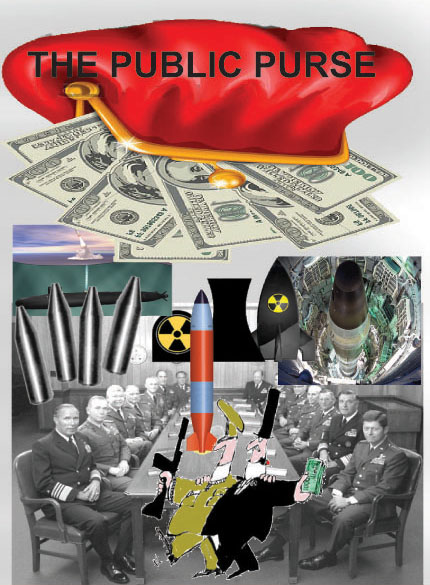
For U.S. citizens, the well-known waste and fraud of the Pentagon should be one outrage. The Pentagon remains the only federal department to never pass a required federal audit. The Pentagon cannot account for 63% of the tax money it receives. That’s our money. Gone. Unaccounted for. Lining the pockets of weapons manufacturers.
by beyondnuclearinternational, By Brad Wolf, https://beyondnuclearinternational.org/2024/04/14/tax-day-and-war-resistance/
What can we learn from Philip Berrigan’s quest for peace?
It is April 15 and we can reflect on the life and work of Philip Berrigan and undertake our own ministry of risk for peace—to ease the suffering, to restore human dignity, and to challenge our doomed policy of warmaking.
Each year Americans forfeit a sizable slice of their income to the United States Treasury to fund the government. Tax Day is dreaded. No one likes surrendering their hard-earned cash. But rather than a resigned shrug, Americans should look closely at what they are getting for their money when it comes to government services and policy.
In fiscal year 2023, the Pentagon received $858 billion for the preparation of war. This doesn’t include hidden costs for intelligence services, veterans’ benefits, Homeland Security, or the Department of Energy, which oversees the nation’s nuclear arsenal. All totaled, over $1 trillion a year is allotted for warmaking. By comparison, the 2023 budget for the U.S. Department of State, this nation’s department tasked with making peace across the globe, was a relatively miniscule $63 billion.
One way to register resistance to this profligate spending on warmaking is that of renowned peace activist and then Catholic priest Philip Berrigan. During the Vietnam War, Phil initiated the destruction of U.S. military draft files in Baltimore and Catonsville, Maryland, to save the lives of both Vietnamese and Americans, actions for which he received lengthy prison sentences.
These draft file actions by Phil initiated a new form of resistance to the Vietnam War, since no copies were kept of the draft files. Hundreds of similar actions followed at draft board offices across the country with hundreds of thousands of draft files destroyed, all stopping young men from being conscripted to kill or be killed.

In 1980, Phil initiated the Plowshares movement—which continues to this day—as he and others entered the General Electric nuclear weapons facility in King of Prussia, Pennsylvania, pouring blood on weapons blueprints and symbolically hammering on the nosecones of missiles, “Beating swords into plowshares.” A Christian metaphor indeed, but a universal message. Since that first action, there have been over 70 Plowshares actions around the world.
Phil strongly objected to the notion that U.S. citizens should fund needless death and destruction abroad through their taxes, or possibly fund their own destruction by nuclear war. He repeated nonviolent actions time and again, serving a total of 11 years in prison to stop the slaughter of innocents and protest the use of U.S. tax dollars for arms proliferation, nuclear warmaking, and endless wars of choice.
For U.S. citizens, the well-known waste and fraud of the Pentagon should be one outrage. The Pentagon remains the only federal department to never pass a required federal audit. The Pentagon cannot account for 63% of the tax money it receives. That’s our money. Gone. Unaccounted for. Lining the pockets of weapons manufacturers.
But the more pressing concern with these war dollars is their use to initiate wars of choice, often against impoverished countries, because those countries have natural resources beneath the soil that the U.S seems to think belong to them. The cruel joke is, “How dare they put their country over our oil.” And so, we take it. With extreme violence and death.
The U.S. currently has soldiers in northern Syria where massive quantities of oil is extracted for Western fossil fuel companies. The war in Iraq was for oil. We are building new bases in Somalia where oil fields have been found. These wars for corporate profit have gone on for over a century. As decorated war hero Smedley Butler said in the 1930s about his many years in the U.S. military, “I was a racketeer, a gangster for capitalism… Looking back on it, I might have given Al Capone a few hints.”
Whether it be gold, fruit, rubber, or sugar in Latin America; oil in the Middle East; or rare earth minerals in Africa, the U.S. taxpayer has long funded the corporate theft of natural resources from Indigenous lands for the benefit of U.S corporations and their wealthy shareholders. Innocents in foreign lands die as a result, while U.S. taxpayers struggle to pay mortgages, rent, healthcare bills, and food costs.
According to Brown University’s Costs of War Project, the United States spent some $8 trillion in the last 23 years for the Wars on Terror. Four-and-a-half to 4.7 million people in foreign lands died because of those wars, most of them innocent civilians. Mothers and fathers and children.
And so, as this Tax Day approaches, perhaps we can reflect on the life and work of Philip Berrigan and undertake our own ministry of risk for peace in whatever form that may take, to ease the suffering, to restore human dignity, to challenge our doomed policy of warmaking. Only in this way can we reconcile ourselves with justice and democracy. Only in this way can we save ourselves, our country, and perhaps the world.
As Phil said, “These blind leading the blind have done more than threaten us with doomsday scenarios. They have, with a devilish ingenuity, convinced us that we ought to pay, through taxes, for our own destruction.”
Hinkley nuclear becomes ever more costly to EDF, but for Sizewell, the taxpayer will pick up the tab
Old Sparky: From the start of EDF’s development at Hinkley we were
promised efficiencies thanks to EDF’s experiences at Flamanville and
Olkiluoto. Yet every year EDF announces Hinkley will cost even more and
start later.
Contractors are browbeaten to get on with pipework that in
some cases will need to be replaced. As they get paid by the metre they
have no incentive to raise issues they notice at the outset. There’s one
saving grace – EDF picks up the tab for cost overruns. But for Sizewell
it will be the taxpayer that picks up the tab.
Private Eye 12th April 2024
1 This Month
23 April – WEBINAR – Why new nuclear reactors are the wrong tools for decarbonization Thursday, April 23 • 1 AM – 2 AM AEST
World Nuclear Power. Reactors 1951-2026, 75 Years of Nuclear Power.
Interactive Map– https://dv.worldnuclearreport.org/

Chernobyl: The Lost Tapes – A good documentary on Chernobyl on SBS available On Demand for the next 3 weeks– https://www.sbs.com.au/ondemand/tv-program/chernobyl-the-lost-tapes/2352741955560

of the week–London Campaign for Nuclear Disarmament

Tell the Ukrainian Government to Drop Prosecution of Peace Activist Yurii Sheliazhenko
To see nuclear-related stories in greater depth and intensity – go to https://nuclearinformation.wordpress.com
-
Archives
- April 2026 (220)
- March 2026 (251)
- February 2026 (268)
- January 2026 (308)
- December 2025 (358)
- November 2025 (359)
- October 2025 (376)
- September 2025 (257)
- August 2025 (319)
- July 2025 (230)
- June 2025 (348)
- May 2025 (261)
-
Categories
- 1
- 1 NUCLEAR ISSUES
- business and costs
- climate change
- culture and arts
- ENERGY
- environment
- health
- history
- indigenous issues
- Legal
- marketing of nuclear
- media
- opposition to nuclear
- PERSONAL STORIES
- politics
- politics international
- Religion and ethics
- safety
- secrets,lies and civil liberties
- spinbuster
- technology
- Uranium
- wastes
- weapons and war
- Women
- 2 WORLD
- ACTION
- AFRICA
- Atrocities
- AUSTRALIA
- Christina's notes
- Christina's themes
- culture and arts
- Events
- Fuk 2022
- Fuk 2023
- Fukushima 2017
- Fukushima 2018
- fukushima 2019
- Fukushima 2020
- Fukushima 2021
- general
- global warming
- Humour (God we need it)
- Nuclear
- RARE EARTHS
- Reference
- resources – print
- Resources -audiovicual
- Weekly Newsletter
- World
- World Nuclear
- YouTube
-
RSS
Entries RSS
Comments RSS
 nuclear-news