Iran Closes Nuclear Sites Fearing Israeli Attack: IAEA Chief
Tuesday, 04/16/2024 Iran International Newsroom, https://www.iranintl.com/en/202404162504
Iran shut down its nuclear facilities last Sunday over “security considerations,” UN nuclear chief Rafael Grossi has said, expressing concern over the “possibility” of an Israeli attack on Iran’s nuclear sites.
Speaking to reporters in New York on Monday, IAEA Director General confirmed that the facilities had reopened within 24 hours, but with no IAEA supervision, as the agency has decided to keep its inspectors away until the situation is “completely calm.”
Grossi was referring to rising tensions between Israel and Iran, which many fear may lead to an all-out war between the two countries and potentially engulf the whole Middle East.
Israel bombed Iran’s consulate in Damascus on 1 April, killing seven members of the Islamic Revolution’s Guards Corpse (IRGC), including a high-ranking commander and his deputy. Iran retaliated on 13 April, launching more than 300 missiles and drones towards Israel –all but a few of which were intercepted by Israel and its allies.
On Monday, Israeli officials vowed to respond to the attack. When asked about the possibility of Israel hitting Iran’s nuclear sites, Grossi said, “We are always concerned about this possibility.” He urged both sides to show “extreme restraint”.
Grossi also reiterated the IAEA’s concerns about Iran’s nuclear program.
“A bit more than a year ago, I went to Tehran and signed a joint declaration with the Iranian government indicating a number of actions that we will be taking together with Iran,” Grossi said. “We started that process and that process was interrupted. And I have been insisting that we need to go back to that understanding that we had in March 2023.”
In September 2023, Iran withdrew the designation of several inspectors assigned to conduct verification activities in Iran under the Non-Proliferation Treaty Safeguards Agreement. Iran’s nuclear chief Mohammad Eslami later claimed that those expelled had had a history of “extremist political behavior”.
“We are always urging, asking and requiring Iran to cooperate with us in full,” Grossi told Iran International’s Maryam Rahmati. “It’s not that we are not there, but we are not there at the level that we consider we should be.”
The IAEA reported in February that Iran is enriching and stockpiling near-weapons-grade uranium, warning that such elevated purity cannot be explained by civilian applications.
When asked about Iran’s enrichment levels by Iran International, Grossi siad, “the fact that there is an accumulation of uranium enriched at very, very high levels does not automatically mean you’re having a weapon…but it raises questions in the international community.”
Iran has always denied seeking nuclear weapons, but no other state has enriched to that level without producing them.
A report published last month by the Institute for Science and International Security claimed that Iran is moving ahead with building a nuclear site deep underground near Natanz.
“This Iranian nuclear weapons-making facility could be impervious to Israeli and perhaps even American bombs,” Foundation for Defense of Democracies CEO Mark Dubowitz said at the time. “Time is quickly running out, as Iran moves into a zone of nuclear immunity, to deny the regime permanent use of this deadly site.”
Faulty Assurances: The Judicial Torture of Assange Continues

April 17, 2024, Dr Binoy Kampmark, https://theaimn.com/faulty-assurances-the-judicial-torture-of-assange-continues/
Only this month, the near comatose US President, Joe Biden, made a casual, castaway remark that his administration was “considering” the request by Australia that the case against Julian Assange be concluded. The WikiLeaks founder has already spent five gruelling years in London’s Belmarsh prison, where he continues a remarkable, if draining campaign against the US extradition request on 18 charges, 17 incongruously and outrageously based on the US Espionage Act of 1917.
Like readings of coffee grinds, his defenders took the remark as a sign of progress. Jennifer Robinson, a longtime member of Assange’s legal team, told Sky News Australia that Biden’s “response, this is what we have been asking for over five years. Since 2010 we’ve been saying this is a dangerous precedent that’s being set. So, we certainly hope it was a serious remark and the US will act on it.” WikiLeaks editor-in-chief Kristinn Hrafnsson found the mumbled comment from the president “extraordinary”, hoping “to see in the coming days” whether “clarification of what this means” would be offered by the powerful.
On April 14, the Wall Street Journal reported that Canberra had asked their US counterparts whether a felony plea deal could be reached, enabling the publisher to return to Australia. “Prosecutors and a lawyer for Assange have discussed a range of potential deals, including those that include pleading guilty to a felony under the espionage law under which he was indicted, and those of conspiring to mishandle classified information, which would be a misdemeanor, people familiar with the matter have said.”
Last month, the UK High Court gave what can only be regarded as an absurd prescription to the prosecution should they wish to succeed. Extradition would be unlikely to be refused if Assange was availed of protections offered by the First Amendment (though rejecting claims that he was a legitimate journalist), was guaranteed not to be prejudiced, both during the trial and in sentence on account of his nationality, and not be subject to the death penalty. That such directions were even countenanced shows the somewhat delusionary nature of British justices towards their US counterparts.
On April 16, Assange’s supporters received confirmation that the extradition battle, far from ending, would continue in its tormenting grind. Not wishing to see the prospect of a full hearing of Assange’s already hobbled arguments, the US State Department, almost to the hour, filed the assurances in a diplomatic note to the Crown Prosecution Service (CPS). “Assange,” the US Embassy in London claimed with aping fidelity to the formula proposed by the High Court, “will not be prejudiced by reason of nationality with respect to which defenses he may seek to raise at trial and at sentencing.”
Were he to be extradited, “Assange will have the ability to raise and seek to rely upon at trial (which includes any sentencing hearing) the rights and protections given under the First Amendment of the Constitution of the United States.” An obvious caveat, and one that should be observed with wary consideration by the High Court judges, followed. “A decision as to the applicability of the First Amendment is exclusively within the purview of the US Courts.”
The US embassy also promised that, “A sentence of death will neither be sought nor imposed on Assange. The United States is able to provide such assurance as Assange is not charged with a death-penalty eligible offense, and the United States assures that he will not be tried for a death-eligible offense.” This undertaking does not dispel the threat of Assange being charged with additional offences such as traditional espionage, let alone aiding or abetting treason, which would carry the death penalty.
In 2020, Gordon Kromberg, the chief Department of Justice prosecutor behind the case, told the Central Criminal Court of England and Wales that the US “could argue that foreign nationals are not entitled to protections under the First Amendment, at least as it concerns national defense information.” There was also the likelihood that Assange, in allegedly revealing the names of US intelligence sources thereby putting them at risk of harm, would also preclude the possibility of him relying on such protections.
-ADVERTISEMENT-
That the zealous Kromberg will be fronting matters should Assange reach US shores is more than troubling. Lawyers and civil rights activists have accused him of using the Eastern District Court of Virginia for selective and malicious prosecutions. As Murtaza Hussain of The Intercept observed with bleak accuracy in July 2021, “[r]ather than being pushed into obscurity by these efforts, today he is serving as a key figure in one of the most important civil liberties cases in the world.”
The High Court also acknowledged Kromberg’s views at trial regarding the possibility that the First Amendment did not cover foreign nationals. “It can fairly be assumed that [Kromberg] would not have said that the prosecution ‘could argue that foreign nationals are not entitled to protections under the First Amendment’ unless that was a tenable argument that the prosecution was entitled to deploy with real prospect of success.” These latest assurances do nothing to change that fact.
A post from Assange’s wife, Stella, provided a neat and damning summary of the embassy note. “The United States has issued a non-assurance in relation to the First Amendment, and a standard assurance in relation to the death penalty. It makes no undertaking to withdraw the prosecution’s previous assertion that Julian has no First Amendment rights because he is not a US citizen. Instead, the US has limited itself to blatant weasel words claiming that Julian can ‘seek to raise’ the First Amendment if extradited.”
Iran President Warns of ‘Massive’ Response if Israel Launches ‘Tiniest Invasion’
Iranian President Ebrahim Raisi warned on Wednesday that the “tiniest invasion” by Israel would bring a “massive and harsh” response, as the region braces for potential Israeli retaliation after Iran’s attack over the weekend.
Raisi spoke at an annual army parade that was relocated to a barracks north of the capital, Tehran, from its usual venue on a highway in the city’s southern outskirts. Iranian authorities gave no explanation for its relocation, and state TV did not broadcast it live, as it has in previous years.
Iran launched hundreds of missiles and drones at Israel over the weekend in response to an Israeli strike on Iran’s embassy compound in Syria on April 1 that killed 12 people, including two Iranian generals.
Israel successfully intercepted nearly all the missiles and drones.
It has vowed to respond, without saying when or how, while its allies have urged all sides to avoid further escalation.
Raisi said Saturday’s attack was a limited one, and that if Iran had wanted to carry out a bigger attack, “nothing would remain from the Zionist regime.” His remarks were carried by the official IRNA news agency.
Attacks on Ukraine’s nuclear plant put world at risk, IAEA warns
By Euronews with AP, 16/04/2024
https://www.euronews.com/2024/04/16/attacks-on-ukraines-nuclear-plant-put-world-at-risk-iaea-warns
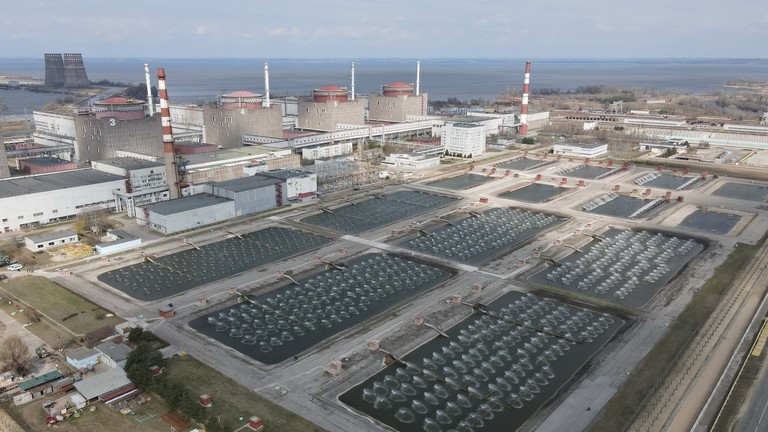
“We’re getting dangerously close to a nuclear accident,” IAEA Director General Rafael Mariano Grossi said following multiple attacks against the Zaporizhzhia Nuclear Power Plant in Ukraine.
The head of the International Atomic Energy Agency said attacks against Europe’s largest nuclear power plant have put the world “dangerously close to a nuclear accident”.
Without attributing blame, IAEA Director General Rafael Mariano Grossi said his agency has been able to confirm three attacks against the Zaporizhzhia Nuclear Power Plant since 7 April.
“These reckless attacks must cease immediately,” he told the Security Council on Monday. “Though, fortunately, they have not led to a radiological incident this time, they significantly increase the risk … where nuclear safety is already compromised.”
The remote-controlled nature of the drones that have attacked the plant means that it is not possible to determine who launched them, Grossi told reporters after the meeting.
“In order to say something like that, we must have proof,” he said. “These attacks have been performed with a multitude of drones”.
Zaporizhzhia sits in Russian-controlled territory in southeastern Ukraine and has six nuclear reactors.
Fears of a nuclear catastrophe have been at the forefront since Russian troops occupied the plant shortly after invading in February 2022. Continued fighting between Russian and Ukrainian forces – as well as the tense supply situation at the plant – have raised the risk of a disaster.
Ukraine and its allies on Monday blamed Russia for dangers at the site. Russia, for its part, said Ukraine was to blame for the attacks.
“The IAEA’s report does not pinpoint which side is behind the attacks,” Russia’s UN Ambassador Vassily Nebenzia said. “We know full well who it is.”
AI-assisted genocide’: Israel reportedly used database for Gaza kill lists

“Israel is currently trying to sell these tools to foreign entities, to governments that are looking to what Israel’s doing in Gaza, not with disgust, but actually with admiration,” said Antony Loewenstein, an Australian journalist and author of The Palestine Laboratory: How Israel Exports the Technology of Occupation Around the World.
Aljazeera, 4 April 24
Two Israeli media outlets report the Israeli military’s use of an AI-assisted system called Lavender to identify Gaza targets.
The Israeli military’s reported use of an untested and undisclosed artificial intelligence-powered database to identify targets for its bombing campaign in Gaza has alarmed human rights and technology experts who said it could amount to “war crimes”.
The Israeli-Palestinian publication +972 Magazine and Hebrew-language media outlet Local Call reported recently that the Israeli army was isolating and identifying thousands of Palestinians as potential bombing targets using an AI-assisted targeting system called Lavender.
“That database is responsible for drawing up kill lists of as many as 37,000 targets,” Al Jazeera’s Rory Challands, reporting from occupied East Jerusalem, said on Thursday.
The unnamed Israeli intelligence officials who spoke to the media outlets said Lavender had an error rate of about 10 percent. “But that didn’t stop the Israelis from using it to fast-track the identification of often low-level Hamas operatives in Gaza and bombing them,” Challands said.
It is becoming clear the Israeli army is “deploying untested AI systems … to help make decisions about the life and death of civilians”, Marc Owen Jones, an assistant professor in Middle East Studies and digital humanities at Hamid Bin Khalifa University, told Al Jazeera.
“Let’s be clear: This is an AI-assisted genocide, and going forward, there needs to be a call for a moratorium on the use of AI in the war,” he added.
The Israeli publications reported that this method led to many of the thousands of civilian deaths in Gaza.
On Thursday, Gaza’s Ministry of Health said at least 33,037 Palestinians have been killed and 75,668 wounded in Israeli attacks since October 7.
AI use ‘violates’ humanitarian law
“The humans that were interacting with the AI database were often just a rubber stamp. They would scrutinise this kill list for perhaps 20 seconds before deciding whether or not to give the go-ahead for an air strike,” Challands reported……………….
……………the fact that there were “five to 10 acceptable civilian deaths” for every single Palestinian fighter who was an intended target shows why there are so many civilian deaths in Gaza, according to Challands.
Professor Toby Walsh, an AI expert at the University of New South Wales in Sydney, said legal scholars will likely argue that the use of AI targeting violates international humanitarian law.
“From a technical perspective, this latest news shows how hard it is to keep a human in the loop, providing meaningful oversight to AI systems that scale warfare terribly and tragically,” he told Al Jazeera.
‘War crimes’
The media outlets cited sources who said the Israeli army made decisions during the first weeks of the current conflict that “for every junior Hamas operative that Lavender marked, it was permissible to kill up to 15 or 20 civilians”.
“Israel is currently trying to sell these tools to foreign entities, to governments that are looking to what Israel’s doing in Gaza, not with disgust, but actually with admiration,” said Antony Loewenstein, an Australian journalist and author of The Palestine Laboratory: How Israel Exports the Technology of Occupation Around the World.
“We’ll find out in the coming months and years who they may be … my sense is it’s gonna be countries that are currently saying they’re opposed to what Israel is doing.” https://www.aljazeera.com/news/2024/4/4/ai-assisted-genocide-israel-reportedly-used-database-for-gaza-kill-lists?fbclid=IwAR2e7Fms0mKy-8_MLuH_jj6aY6fWgr9FO4dFU2Hf3a0m4GtBFAbJofKhGV0
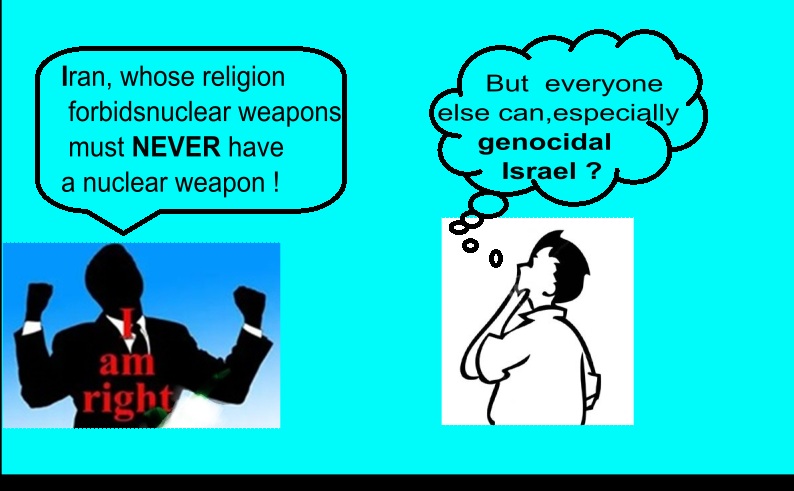
Israel attacking Iran ‘could prompt it to develop nuclear bomb in months’
‘Any Israeli strike inside Iran will take this risk,’ said one regional security analyst
. ‘Any Israeli strike inside Iran will take this risk,’ said one
regional security analyst. ‘If Iran’s general deterrence goes down, we
are at risk of the weaponisation of Iran’s nuclear programme’.
iNews 17th April 2024
https://inews.co.uk/news/world/israel-attack-iran-nuclear-bomb-months-3009662
‘Pakistan advanced nuclear weapons programme despite economic challenges’
Pakistan is reported to have 170 nuclear warheads as of January 2023
By: Pramod Thomas, 17 Apr 24, https://www.easterneye.biz/pakistan-nuclear-programme-india-us/
DESPITE economic challenges, Pakistan continued upgrading its nuclear capabilities, driven by its ongoing tensions with India, top US intelligence official told Congress.
The remarks by Lt Gen Jeffrey Kruse, director of the Defence Intelligence Agency came during a Congressional hearing on China on Monday (15).
Kruse told lawmakers that Pakistan has sought international support, including from the UN security council, to resolve its dispute with India about Kashmir.
Separately, Islamabad and New Delhi have maintained an uneasy ceasefire along the shared Line of Control since February 2021, he said.
“Pakistan has sustained its nuclear modernisation efforts despite its economic turmoil. Terrorist violence against Pakistani security forces and civilians also rose last year,” he said.
According to the Stockholm International Peace Research Institute, Pakistan is reported to have 170 nuclear warheads as of January 2023.
Cash-strapped Pakistan is banking on close allies like China and Saudi Arabia for loans to tide over its economic woes. Moreover, Pakistan’s finance minister Muhammad Aurangzeb is now in Washington to discuss a new loan package with the International Monetary Fund.
Pakistan’s contentious relationship with India continues to drive its defence policy, Kruse told US lawmakers.
However, cross-border violence between the countries has decreased since their February 2021 recommitment to a ceasefire, he said.
“Islamabad is modernising its nuclear arsenal and improving the security of its nuclear materials and nuclear C2 (command and control). In October, Pakistan successfully tested its Ababeel medium-range ballistic missile,” he said.
In 2023, militants killed around 400 security forces, a nine-year high, and Pakistani security forces have conducted almost daily counterterrorism operations during the past year.
Islamabad and New Delhi have a long history of strained relations, primarily due to the Kashmir issue as well as the cross-border terrorism emanating from Pakistan.
In 2019, Pakistan downgraded its diplomatic ties with New Delhi after the Indian government abrogated Article 370 of the constitution, revoking the special status of Jammu and Kashmir and bifurcating the state into two union territories.
India has been maintaining that it desires normal neighbourly relations with Pakistan while insisting that the onus is on Islamabad to create an environment that is free of terror and hostility for such an engagement.
New Delhi has also asserted that the constitutional measures taken by the Indian government to ensure socio-economic development and good governance in the Union Territory of Jammu and Kashmir are matters internal to India.
New Hinkley nuclear power plant expected to kill 46 tonnes of fish a year.

EDF building £50m nature reserve near Hinkley Point to compensate for loss of life
Jonathan Leake, 16 April 2024
A nature reserve is to be flooded by the developer of the Hinkley Point C nuclear plant at a cost of £50m to compensate for the death of fish in its cooling pipes…
An 840 acre swathe of land along the Parrett
estuary in Somerset will be transformed into salt marsh as a habitat for
marine life to replace fish sucked in by the new power station’s cooling
ducts. The area affected – part of the Somerset levels, where Saxon king
Alfred the Great is said to have hidden from the Vikings – includes
farmers’ fields used for grazing, as well as a nature reserve.
EDF, the French company building Hinkley Point, will create a new nature reserve
nearby to replace the land being lost. The overall changes are expected to
cost it £50m. The massive water intakes used to suck water from the
Bristol Channel to cool Hinkley Point C’s reactors are expected to kill
up to 46 tonnes of fish a year when the plant opens in 2031.
EDF also explored installing an acoustic fish deterrent, effectively a loud noise to
ward away animals, but concluded this would cause more harm than it
prevented. Chris Fayers, the company’s head of environment at Hinkley,
said: “An acoustic fish deterrent would use 280 speakers to make noise
louder than a jumbo jet 24-hours a day for 60 years with unknown impacts on
other species like porpoises, seals, whales. “It offers a very
small potential benefit to protected fish species and would also risk the
safety of divers in the fast-flowing tides of the Bristol Channel. New
natural habitat is a better solution.”
EDF said it was working with
Natural England, the Environment Agency, and other conservation
bodies to develop the new natural habitats. It plans to take out
compulsory purchase orders to acquire the land and then destroy its
protective dykes so that saltwater can flood in, according to planning
documents.
Dozens of farmers around Pawlett Hams, north of Bridgwater in
Somerset, have been told their grazing land is likely to become salt marsh.
One said: “It’s an existential threat to farmers’ livelihoods.” EDF
has told local people: “We are proposing to create 340 hectares of salt
marsh habitat. Will Barnard, chair of the Pawlett Parish Council, who also
works as an environmental land manager on some of the affected land, said
no-one was happy with the scheme.
Telegraph 16th April 2024
Wabigoon Lake planning nuclear willingness vote
Wabigoon Lake Ojibway Nation will hold their vote on whether the Treaty 3 community is willing to host a repository for spent nuclear fuel in the fall.
Mike Stimpson, Local Journalism Initiative Reporter, April 17, 2024 https://www.nwonewswatch.com/local-news/wabigoon-lake-planning-nuclear-willingness-vote-8609650
WABIGOON LAKE – Ignace residents’ vote on a proposed underground storage site for nuclear waste is set for April 26-30, but its partner community to the northwest won’t be voting until autumn.
Wabigoon Lake Ojibway Nation will hold their vote on whether the Treaty 3 community is willing to host a repository for spent nuclear fuel in the fall, Chief Clayton Wetelainen said this week.
A referendum is “targeted for the fall” but neither the precise date nor the question have been determined, he said.
The Nuclear Waste Management Organization had requested a decision from potential host communities by the end of July, but Wetelainen said Wabigoon Lake members need more time to consider the issues.
NWMO regional spokesperson Vince Ponka said Tuesday the organization still intends to choose a site for the repository by the end of 2024.
Wetelainen said the First Nation is in talks with the nuclear organization on a hosting agreement similar to the one the Township of Ignace ratified and signed in March.
“We are just in the process of discussing different items in that agreement, and that’s what we have to do,” Wetelainen said.
A hosting agreement needs to be settled before Wabigoon Lake members vote on their support for the project, he said.
The chief said he and councillors have heard “concerns on both sides” within his nation’s membership.
“There is a strong pro side and there’s a strong negative or strong opposition. And there also is a strong ‘not decided, need more information.’”
Wetelainen would not say whether he is for or against Wabigoon Lake allowing nuclear waste to be kept within its traditional territory.
“My strong feeling is that this generation should be looking at a solution (for nuclear waste),” he said. “I don’t believe we should hold it off to future generations.”
About 800 members are eligible to vote in the referendum, whenever it happens. Most live off-reserve, as just 200 or so live on the reserve southeast of Dryden.
The dispersed membership is why Wabigoon Lake has held information meetings in Winnipeg to which all members aged 17 and up were invited.
One gathering held in the Manitoba capital last fall drew about 500 members, according to Danine Chief, Wabigoon Lake’s Adaptive Phased Management project manager.
Adaptive phased management is the NWMO’s term for a plan that includes the long-term storage of spent fuel in a deep geological repository.
The industry-funded NWMO has a spot between Ignace and Wabigoon Lake on its list of two finalists for where to build the underground facility.
The other finalist site is near Lake Huron in southern Ontario, with the Municipality of South Bruce and Saugeen Ojibway Nation as potential host communities.
A key criterion in the siting decision is host communities’ willingness to participate.
Ignace committed in its hosting agreement to give the NWMO a yes or no on community willingness by July 31.
Ponka said the timing of Wabigoon Lake’s vote won’t impact the NWMO’s plan to choose a site before year-end.
South Bruce also likely won’t be holding its referendum until autumn, he said.
That municipality’s council recently accepted a referendum question asking voters if they are “in favour of the Municipality of South Bruce declaring South Bruce to be a willing host” for a deep geological repository. No date has been set for the referendum.
New Fujitsu security research center in Israel to further develop digital identity tools
Biometric, Nov 30, 2022, Ayang Macdonald
Japanese tech giant Fujitsu has announced plans to set up a research center for data and security in Israel as part of efforts to strengthen its Research and Development (R&D) strategy as well as increase its presence in the country.
The center, which will go operational from April 2023 according to the announcement, highlights Fujitsu’s objectives of meeting the data security and trust requirements of companies and businesses at a time when many people are performing more transactions online.
Fujitsu says the center, to be based in Tel Aviv, will bring together about 10 research experts from Israel, Japan and Europe and their work will be focused on improving security technology for communications networks as part of its global strategy for data and security – a key area in its global R&D strategy.
Research at the center will focus on two main areas, namely developing technology that can ensure and enhance trust for network security, and technologies which can be used for a wide range of real-life situations like autonomous driving, self-checkout, as well as public safety, including anti-attack technologies for object detection AI…………
The company is also planning to develop its IDYX (or “IDentitY eXchange”) technology, which is intended to enable secure distribution of digital identity and attribute information between companies and individuals………………………………. https://www.biometricupdate.com/202211/new-fujitsu-security-research-center-in-israel-to-further-develop-digital-identity-tools?fbclid=IwZXh0bgNhZW0CMTAAAR0JsxUA-U2OxTaWJA0wn9bVwz6ZrES6Ud3yJbBiyJ7-0pgqbW6TaOodx50_aem_AUNuP6qXKQDr6xEGOrL9tLaha_3Jq5bni6IsXT-5B63IYytKZyPOG_gwYYdcMStOmz7Fcy3mf3NxTz4PKcttQPiC
Safety probe at Cheshire-based nuclear cargo firm
By Sophie Zeldin-O’Neill, Senior Journalist, BBC News, 17 Apr 24
A company that transports uranium overseas has been told it must improve the safety of its operations.
Urenco UK Ltd (UUK), based in Capenhurst, Cheshire, had not made proper safety checks or made sure its shipments were correctly approved, industry watchdog the Office for Nuclear Regulation (ONR) said.
The problems were identified during inspections by the ONR.
UUK has until 31 May to comply with the improvement notice……………….
Nick Blackburn, principal inspector from ONR’s Transport Competent Authority, said all
companies involved in transporting radioactive materials needed to make
sure they were working within the law.
BBC 16th April 2024
Bombs and viruses: The shadowy history of Israel’s attacks on Iranian soil
From cyberattacks and assassinations to drone strikes, Israel-linked plots have targeted Iran and its nuclear programme for years.
Israel’s leaders have signalled that they are weighing their options on how to respond to Iran’s attack early Sunday morning, when Tehran targeted its archenemy with more than 300 missiles and drones.
Iran’s attack, which followed an Israeli strike last week on the Iranian consulate in Damascus, Syria, that killed 13 people was historic: It was the first time Tehran had directly targeted Israeli soil, despite decades of hostility. Until Sunday, many of Iran’s allies in the so-called axis of resistance — especially the Palestinian group Hamas, the Lebanese group Hezbollah, Yemen’s Houthis and armed groups in Iraq and Syria — were the ones who launched missiles and drones at Israel.
But if Israel were to hit back militarily inside Iran, it wouldn’t be the first time. Far from it.
For years, Israel has focused on one target within Iran in particular: the country’s nuclear programme. Israel has long accused Iran of clandestinely building a nuclear bomb that could threaten its existence — and has publicly, and frequently, spoken of its diplomatic and intelligence-driven efforts to derail those alleged efforts. Iran denies that it has had a military nuclear programme, while arguing that it has the right to access civil nuclear energy.
As Israel prepares its response, here’s a look at the range of attacks in Iran — from drone strikes and cyberattacks to assassinations of scientists and the theft of secrets — that Israel has either accepted it was behind or is accused of having orchestrated.
Assassinations of Iranian scientists
- January 2010: A physics professor at Tehran University, Masoud Ali-Mohammadi, was killed through a remote-controlled bomb planted in his motorcycle. Iranian state media claimed that the US and Israel were behind the attack. The Iranian government described Ali-Mohammadi as a nuclear scientist.
- November 2010: A professor at the nuclear engineering faculty at Shahid Beheshti University in Tehran, Majid Shahriari, was killed in a car explosion on his way to work. His wife was also wounded. The president of Iran at the time, Mahmoud Ahmadinejad, blamed the United States and Israel for the attacks.
- January 2012: Mostafa Ahmadi Roshan, a chemical engineering graduate, was killed by a bomb placed on his car by a motorcyclist in Tehran. Iran blamed Israel and the US for the attack and said Ahmadi Roshan was a nuclear scientist who supervised a department at Iran’s primary uranium enrichment facility, in the city of Natanz.
- November 2020:Prominent nuclear scientist Mohsen Fakhrizadeh was killed in a roadside attack outside Tehran. Western and Israeli intelligence had long suspected that Fakhrizadeh was the father of an Iranian nuclear weapons programme. He was sanctioned by the United Nations in 2007 and the US in 2008.
- May 2022: Colonel Hassan Sayyad Khodaei of the Islamic Revolutionary Guard Corps (IRGC) was shot five times outside of his home in Tehran. Majid Mirahmadi, a member of Iran’s Supreme National Security Council, alleged the assassination was “definitely the work of Israel”.
Israel’s cyberattacks on Iran
- June 2010:The Stuxnet virus was found in computers at the nuclear plant in Iran’s Bushehr city, and it spread from there to other facilities. As many as 30,000 computers across at least 14 facilities were impacted by September 2010. At least 1,000 out of 9,000 centrifuges in Iran’s Natanz enrichment facility were destroyed, according to an estimate by the Institute for Science and International Security. Upon investigation, Iran blamed Israel and the US for the virus attack.
- April 2011: A virus called Stars was discovered by the Iranian cyberdefence agency which said the malware was designed to infiltrate and damage Iran’s nuclear facilities. The virus mimicked official government files and inflicted “minor damage” on computer systems, according to Gholamreza Jalali, the head of Iran’s Passive Defense Organization. Iran blamed Israel and the US.
November 2011: Iran said it discovered a new virus called Duqu, based on Stuxnet. Experts said Duqu was intended to gather data for future cyberattacks. The Iranian government announced it was checking computers at main nuclear sites. The Duqu spyware was widely believed by experts to have been linked to Israel.- April 2012: Iran blamed the US and Israel for malware called Wiper, which erased the hard drives of computers owned by the Ministry of Petroleum and the National Iranian Oil Company.
- May 2012: Iran announced that a virus called Flame had tried to steal government data from government computers. The Washington Post reported that Israel and the US had used it to collect intelligence. Then-Israeli Vice Prime Minister Moshe Yaalon did not confirm the nation’s involvement but acknowledged that Israel would use all means to “harm the Iranian nuclear system”.
- October 2018: The Iranian government said that it had blocked an invasion by a new generation of Stuxnet, blaming Israel for the attack.
- October 2021: A cyberattack hit the system that allows Iranians to use government-issued cards to purchase fuel at a subsidised rate, affecting all 4,300 petrol stations in Iran. Consumers had to either pay the regular price, more than double the subsidised one, or wait for stations to reconnect to the central
- distribution system. Iran blamed Israel and the US.
- May 2020: A cyberattack impacted computers that control maritime traffic at Shahid Rajaee port on Iran’s southern coast in the Gulf, creating a hold-up of ships that waited to dock. The Washington Post quoted US officials as saying that Israel was behind the attack, though Israel did not claim responsibility.
Israel’s drone strikes and raids on Iran
- January 2018: Mossad agents raided a secure Tehran facility, stealing classified nuclear archives. In April 2018, Israeli Prime Minister Benjamin Netanyahu announced that Israel discovered 100,000 “secret files that prove” Iran lied about never having a nuclear weapons programme.
- February 2022: Former Israeli Prime Minister Naftali Bennett admitted in an op-ed published in The Wall Street Journal in December 2023, that Israel carried out an attack on an unmanned aerial vehicle, and assassinated a senior IRGC commander in February of the previous year.
- May 2022: Explosives-laden quadcopter suicide drones hit the Parchin military complex southeast of Tehran, killing an engineer and damaging a building where drones had been developed by the Ministry of Defence and Armed Forces. IRGC Commander Hossein Salami pledged retaliation against unspecified “enemies”.
- February 2024: A natural gas pipeline in Iran was attacked. Iran’s Oil Minister Javad Owji alleged that the “explosion of the gas pipeline was an Israeli plot”.
- January 2023: Several suicide drones struck a military facility in central Isfahan, but they were thwarted and caused no damage. While Iran did not immediately place blame for the attacks, Iran’s UN envoy, Amir Saeid Iravani, wrote a letter to the UN chief saying that “primary investigation suggested Israel was responsible”.
Fujitsup-ing UK ‘s Post Office IT system, – and now its Nuclear Lab?

The UK government’s National Nuclear Laboratory has given Fujitsu a £155k contract for ‘software support’ IT – for nuclear science and experimental programmes in nuclear power and weapons.
Fujitsu? The Japanese software company that supplied, and apparently is still supplying, the British Post office with software – its bodgy Horizon IT programme being at the root of one of the most widespread miscarriages of justice in UK history.. Yes, that one!
It doesn’t fill you with confidence about the safety of the UK’s nuclear lab activities, does it?
The Post Office’s contract with Fujitsu was, (is) extremely complex, with the Post Office lacking the expertise to understand how the IT system works. Does the nuclear lab have the same problem?
These types of contracts deliberately lock the buyer in, with the supplier having control of all upgrades, fixing of any technical problems. The Post Office contract also limited the amount of information they could get from the system.
This created a dependance by the Post Office on the company Fujitsu. Is the British military and nuclear system also locked into dependance on Fujitsu? A source told the i newspaper that the Japanese firm has been managing a secretive computer system facilitating the “strategic command and control of UK Armed Forces” for decades.
The contract for the National Nuclear Laboratory is the first government contract with Fujitsu in 2024, – to the anger and frustration of many, as the inquiry into the Post Office software scandal is still underway, with more litigation likely to come.
Environmental impacts of underground nuclear weapons testing

While underground nuclear tests were chosen to limit atmospheric radioactive fallout, each test still caused dynamic and complex responses within crustal formations. Mechanical effects of underground nuclear tests span from the prompt post-detonation responses to the enduring impacts resulting in radionuclide release, dispersion, and migration through the geosphere. Every test of nuclear weapons adds to a global burden of released radioactivity (Ewing 1999).
Bulletin, By Sulgiye Park, Rodney C. Ewing, March 7, 2024
Since Trinity—the first atomic bomb test on the morning of July 16, 1945, near Alamogordo, New Mexico—the nuclear-armed states have conducted 2,056 nuclear tests (Kimball 2023). The United States led the way with 1,030 nuclear tests, or almost half of the total, between 1945 and 1992. Second is the former Soviet Union, with 715 tests between 1949 and 1990, and then France, with 210 tests between 1960 and 1996. Globally, nuclear tests culminated in a cumulative yield of over 500 megatons, which is equivalent to 500 million tons of TNT (Pravalie 2014). This surpasses by over 30,000 times the yield of the first atomic bomb dropped on Hiroshima on August 6, 1945.
Atmospheric nuclear tests prevailed until the early 1960s, with bombs tested by various means: aircraft drops, rocket launches, suspension from balloons, and detonation atop towers above ground. Between 1945 and 1963, the Soviet Union conducted 219 atmospheric tests, followed by the United States (215), the United Kingdom (21), and France (3) (Kimball 2023).
In the early days of the nuclear age, little was known about the impacts of radioactive “fallout —the residual and activated radioactive material that falls to the ground after a nuclear explosion. The impacts became clearer in the 1950s, when the Kodak chemical company detected radioactive contamination on their film, which was linked to radiation resulting from the atmospheric nuclear tests (Sato et al. 2022). American scientists, like Barry Commoner, also discovered the presence of strontium 90 in children’s teeth originating from nuclear fallout thousands of kilometers from the original test site (Commoner 1959; Commoner 1958; Reiss 1961). These discoveries alerted scientists and the public to the consequences of radioactive fallout from underwater and atmospheric nuclear tests, particularly tests of powerful thermonuclear weapons that had single event yields of one megaton or greater.
Public concerns for the effects of radioactive contamination led to the Limited (or Partial) Test Ban Treaty, signed on August 5, 1963. The treaty restricted nuclear tests from air, space, and underwater (Atomic Heritage Foundation 2016; Loeb 1991; Rubinson 2011). And while the treaty was imperfect with only three signatories at the beginning (the United States, the United Kingdom, and the Soviet Union), the ban succeeded in significantly curbing atmospheric release of radioactive isotopes.
After the entry into force of the partial test ban, almost 1,500 underground nuclear tests were conducted globally. Of the 1,030 US nuclear tests, nearly 80 percent, or 815 tests (See Table 1 on original ), were conducted underground, primarily at the Nevada Test Site.[1] As for other nuclear powers, the Soviet Union conducted 496 underground tests, mostly in the Semipalatinsk region of Kazakhstan, France conducted 160 underground tests, the United Kingdom conducted 24, and China 22. These underground nuclear tests were in a variety of geologic formations (e.g., basalt, alluvium, rhyolite, sandstone, shale) to depths up to 2,400 meters.
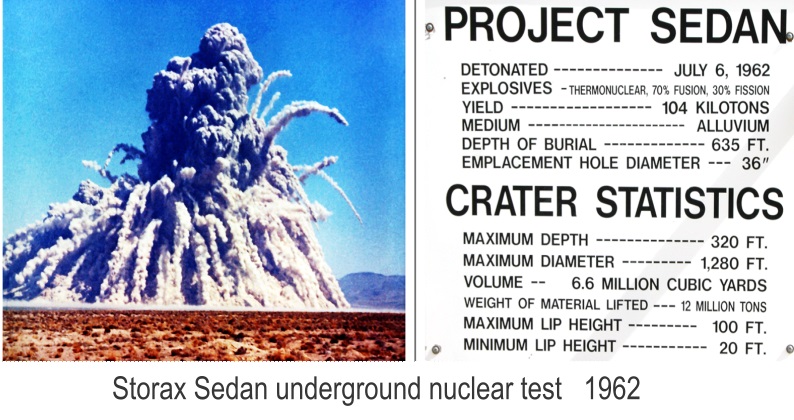
In 1996, after some international efforts to curb nuclear testing and promote disarmament, the Comprehensive Test Ban Treaty (CTBT) was negotiated, which prohibited all nuclear explosions (General Assembly 1996). Since the negotiation of the CTBT, India and Pakistan conducted three and two underground nuclear tests, respectively, in 1998. And today, North Korea stands as the only country to have tested nuclear weapons in the 21st century.
While underground nuclear tests were chosen to limit atmospheric radioactive fallout, each test still caused dynamic and complex responses within crustal formations. Mechanical effects of underground nuclear tests span from the prompt post-detonation responses to the enduring impacts resulting in radionuclide release, dispersion, and migration through the geosphere. Every test of nuclear weapons adds to a global burden of released radioactivity (Ewing 1999)…………………………………………………………………………
………………………………………………………………….. Containment failures and nuclear accidents
Underground nuclear tests are designed to limit radioactive fallout and surface effects. However, containment methods are not foolproof, and radioisotopes, which are elements with neutrons in excess making them unstable and radioactive, can leak into the surrounding environment and atmosphere, posing potential risks to ecosystems and human health.
Instances of radiation leaks were not uncommon…………………………………..
Unintended radioactive releases from underground nuclear tests occurred through venting or seeps, where fission products and radioactive materials were uncontrollably released, driven by pressure from shockwave-induced steam or gas. In rare cases, more serious nuclear accidents occurred due to incomplete geological assessments of the surrounding medium in preparation for the test. A notable example of accidental release is the Baneberry underground nuclear test on December 18, 1970, which, according to the federal government, resulted in an “unexpected and unrecognized abnormally high water content in the medium surrounding the detonation point” ……………………………………………………………………………………………
Mechanical and radiation effects of underground nuclear tests
Three main factors affect the mechanical responses of underground nuclear tests: the yield, the device placement (i.e., depth of burial, chamber geometry, and size), and the emplacement medium (i.e., rock type, water content, mineral compositions, physical properties, and tectonic structure). These factors influence the physical response of the surrounding geological formations and the extent of ground displacement, which, in turn, determine the radiation effects by influencing the timing and fate of the radioactive gas release.
Every kiloton of explosive yield produces approximately 60 grams (3 × 10¹² fission product atoms) of radionuclides (Smith 1995; Glasstone and Dolan 1977). Between 1962 and 1992, underground nuclear tests had a total explosive yield of approximately 90 megatons (Pravalie 2014), producing nearly 5.4 metric tons of radionuclides. ……………………………………………….
……………………………..The partitioning of radionuclides between the melt glass and rubble significantly impacts the subsequent transfer of radioactivity to groundwater.
…………………………Temperatures produced by large explosions can change the permeability, porosity, and water storage capacity by creating new fractures, cavities, and chimneys……………………. The explosion also affects the porosity of the surrounding rock. For example, a fully contained explosion of 12.5-kiloton yield in Degelen Mountain at the former Soviet Union’s Semipalatinsk test site resulted in up to a six-fold increase in porosity within the crush zone surrounding the cavity (Adushkin and Spivak 2015). Increased permeability and porosity of the surrounding rock can lead to more radionuclides being released, as more groundwater can pass through the geologic formation.
Hydrogeology and release of radioactivity
The main way contaminants can be moved from underground test areas to the more accessible environment is through groundwater flow. …………………………………………..
Given their long half-lives (Table 2 on original ), the ability of plutonium isotopes to migrate over time raises concerns about the long-term impacts and challenges in managing radioactive contamination.
In all these cases, colloid-facilitated transport allowed for the migration of radioactive particles through groundwater flow over an extended period—long after the nuclear tests or discharge occurred (Novikov et al. 2006). ………………………
The risks associated with the environmental contamination from underground nuclear tests have often been considered low due to the slow movement of the groundwater and the long distance that separates it from publicly accessible groundwater supplies. But these studies demonstrate that apart from prompt effect of radioactive gas releases from instantaneous changes in geologic formations, long-term effects persist due to the evolving properties of the surrounding rocks long after the tests. Long-lived radionuclides can be remarkably mobile in the geosphere. Such findings underscore the necessity for sustained long-term monitoring efforts at and around nuclear test sites to evaluate the delayed impacts of underground nuclear testing on the environment and public health.
Enduring legacy
Nearly three decades after the five nuclear-armed states under the CTBT stopped testing nuclear weapons both in the atmosphere and underground, the effects of past tests persist in various forms—including environmental contamination, radiation exposure, and socio-economic repercussions—which continue to impact populations at and near closed nuclear test sites (Blume 2022). The concerns are greater when the test sites are abandoned without adequate environmental remediation. This was the case with the Semipalatinsk test site in Kazakhstan that was left unattended after the fall of the Soviet Union in 1991, before a secret multi-million effort was made by the United States, Russia, and Kazakhstan to secure the site (Hecker 2013). The abandonment resulted in heavy contamination of soil, water, and vegetation, posing significant risks to the local populations (Kassenova 2009).
In 1990, the US Congress acknowledged the health risks from nuclear testing by establishing the Radiation Exposure Compensation Act (RECA), which provides compensation to those affected by radioactive fallout from nuclear tests and uranium mining. Still, there are limitations and gaps in coverage that leave many impacted individuals, including the “downwinders” from the Trinity test site without compensation for their radiation exposure (Blume, 2023). The Act is set to expire in July 2024, potentially depriving many individuals without essential assistance. Over the past 30 years, the RECA fund paid out approximately $2.5 billion to impacted populations (Congressional Research Service 2022). For comparison, the US federal government spends $60 billion per year to maintain its nuclear forces (Congressional Budget Office 2021).
As the effects of nuclear testing still linger, today’s generations are witnessing an increasing concern at the possibility of a new arms race and potential resumption of nuclear testing (Drozdenko 2023; Diaz-Maurin 2023). The concern is heightened by activities in China and North Korea and with Russia rescinding its ratification of the CTBT. Even though the United States maintains a moratorium on non-subcritical nuclear tests, its decision not to ratify the test ban treaty shows a lack of international leadership and commitment. As global tensions and uncertainties arise, it is critical to ensure global security and minimize the risks to humans and the environment by enforcing comprehensive treaties like the CTBT. Transparency at nuclear test sites should be promoted, including those conducting very-low-yield subcritical tests, and the enduring impacts of past nuclear tests should be assessed and addressed.
Endnotes………………………………………………………………more https://thebulletin.org/premium/2024-03/environmental-impacts-of-underground-nuclear-weapons-testing/?utm_source=Newsletter&utm_medium=Email&utm_campaign=MondayNewsletter04152024&utm_content=NuclearRisk_EnvironmentalImpactsNuclearTests_03072024
Abrdn and two more City giants shun Sizewell C nuclear project
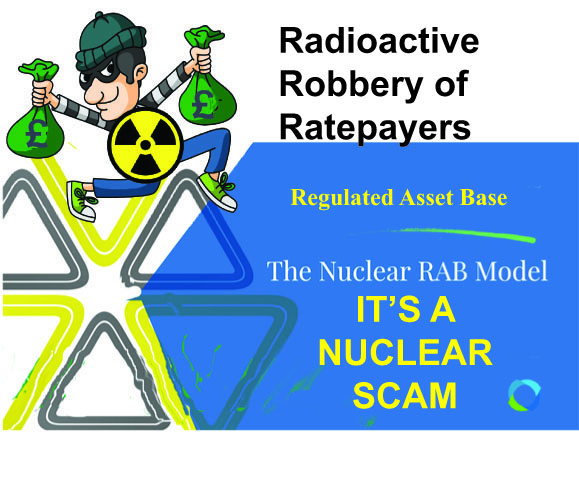
Three of the City’s largest investment firms have confirmed they are not buying into the delay-stricken Sizewell C nuclear project.
City AM, RHODRI MORGAN, 15 Apr 24,
Emails seen by City A.M. show that representatives from Abrdn, Aviva and Phoenix Group each told anti-Sizewell C campaign group, Stop Sizewell C, that they were not looking to bankroll the project, which is expected to reach around £20bn in costs.
Phoenix Group, which has around £280bn in assets under management, has previously expressed interest in nuclear projects.
The decisions mark a further blow against the UK government’s struggling nuclear programme.
In an effort to shore up cash flows to rescue the delay-ridden Sizewell and Hinkley Point C projects, the government revealed a framework, many years in the making: The Regulated Asset Base (RAB), which would allow institutional lenders to buy into nuclear development.
But Abrdn, Aviva and Phoenix Group’s failure to get onboard adds to a growing list of major financial houses, including pension funds of BT, Natwest and Nest, to snub the project.
“The strategy has not succeeded,” said Stop Sizewell C’s executive director Alison Downes.
“It is hardly a surprise considering the many uncertainties, including what the project will actually cost and we congratulate those pension funds that have steered clear of Sizewell C’s capital raise, and urge the handful that have not decided to hotfoot it out immediately.”
The government is currently the majority shareholder and is currently investing a total of £2.5bn in financial support for the project…………………………
Sizewell is not the only major reactor project hampered by sky-rocketing costs and time delays.
Hinkley Point C, initially due to be operational in 2017 with a £18bn bill is now expected to be completed by 2031 and cost up to £35bn.
Accounting for inflation, this could potentially rise to £46bn and France’s state energy company EDF is on the hook for an £11bn impairment charge on the project. https://www.cityam.com/abrdn-and-two-more-city-giants-shun-sizewell-c-nuclear-project/
1 This Month
23 April – WEBINAR – Why new nuclear reactors are the wrong tools for decarbonization Thursday, April 23 • 1 AM – 2 AM AEST
World Nuclear Power. Reactors 1951-2026, 75 Years of Nuclear Power.
Interactive Map– https://dv.worldnuclearreport.org/
Chernobyl: The Lost Tapes – A good documentary on Chernobyl on SBS available On Demand for the next 3 weeks– https://www.sbs.com.au/ondemand/tv-program/chernobyl-the-lost-tapes/2352741955560

of the week–London Campaign for Nuclear Disarmament

Tell the Ukrainian Government to Drop Prosecution of Peace Activist Yurii Sheliazhenko
To see nuclear-related stories in greater depth and intensity – go to https://nuclearinformation.wordpress.com
-
Archives
- April 2026 (220)
- March 2026 (251)
- February 2026 (268)
- January 2026 (308)
- December 2025 (358)
- November 2025 (359)
- October 2025 (376)
- September 2025 (257)
- August 2025 (319)
- July 2025 (230)
- June 2025 (348)
- May 2025 (261)
-
Categories
- 1
- 1 NUCLEAR ISSUES
- business and costs
- climate change
- culture and arts
- ENERGY
- environment
- health
- history
- indigenous issues
- Legal
- marketing of nuclear
- media
- opposition to nuclear
- PERSONAL STORIES
- politics
- politics international
- Religion and ethics
- safety
- secrets,lies and civil liberties
- spinbuster
- technology
- Uranium
- wastes
- weapons and war
- Women
- 2 WORLD
- ACTION
- AFRICA
- Atrocities
- AUSTRALIA
- Christina's notes
- Christina's themes
- culture and arts
- Events
- Fuk 2022
- Fuk 2023
- Fukushima 2017
- Fukushima 2018
- fukushima 2019
- Fukushima 2020
- Fukushima 2021
- general
- global warming
- Humour (God we need it)
- Nuclear
- RARE EARTHS
- Reference
- resources – print
- Resources -audiovicual
- Weekly Newsletter
- World
- World Nuclear
- YouTube
-
RSS
Entries RSS
Comments RSS
 nuclear-news