Biodiversity: the first ever State of the World’s Migratory Species report released

The first-ever State of the World’s Migratory Species. report was
launched today by the Convention on the Conservation of Migratory Species
of Wild Animals (CMS), a UN biodiversity treaty, at the opening of a major
UN wildlife conservation conference (CMS COP14). The landmark report
reveals: While some migratory species listed under CMS are improving,
nearly half (44 per cent) are showing population declines. More than
one-in-five (22 per cent) of CMS-listed species are threatened with
extinction. Nearly all (97 per cent) of CMS-listed fish are threatened with
extinction.
Convention on Migratory Species 12th Feb 2024
Nuclear weapons and poison pills: Washington, Beijing warily circle AI talks

SCMP 13 Feb 24
- Bilateral dialogue on automated weapons and artificial intelligence is expected to take place this spring, with parameters yet to be established
- Both China and the US are wary of giving their adversary an advantage by limiting their own capability
The United States and China have a shared interest in sitting down to discuss automated weapons, artificial intelligence and its many potential and unforeseen abuses. Less clear is whether the two global AI superpowers and their huge militaries have common interests or goals coming into the talks, which are expected to take place this spring, according to analysts and experts involved in informal sessions between the two nations.
“The good news, which has been a really, really rare thing these days, is that the AI dialogue is seeing some hope,” said Xiaomeng Lu, director of with Eurasia Group’s geo-technology practice, who is involved with US-China “Track 2” talks among former government officials, experts and analysts. “Both sides have an interest in preventing unintended consequences.”
Washington and Beijing have agreed to sit down in the next few months and discuss AI issues, National Security Adviser Jake Sullivan said in late January after meeting with top Chinese diplomat Wang Yi in Thailand. Non-official Track 2 and semi-official Track 1.5 talks often act as a preamble to formal negotiations. The decision to establish a working group on AI was reached during the November summit between Presidents Xi Jinping and Joe Biden in northern California.
Beijing and Washington have both become increasingly uneasy about the effect that artificial intelligence could have on warfare, governance and society as the technology threatens to eclipse mankind’s ability to control or fully understand it, even as they are wary of giving their adversary an advantage by limiting their own capability.
Lu said both sides in the discussions she has participated in appear engaged and intent on defining what constitutes an autonomous weapon and what it means to have a human in the loop for weapons of mass destruction.
“I can sense the energy; we’re all trying to throw ideas at this,” she said. “The common threat to the US and China these days is what AI can unleash, let’s say nuclear weapons, like a nuclear missile. That’s a very dangerous threshold, and both sides have an interest in preventing unintended consequences.”
Less clear is how that would translate…………………………………………………………………………………………………..
So far, there’s no evidence of any army worldwide using or planning to use frontier AI models for military use, analysts said.
Separately, the world’s two largest economies – key to any meaningful global deal – are also circling around a framework for AI control in the commercial sphere, an issue former secretary of state Henry Kissinger raised last summer on a trip to Beijing four months before his death, reportedly in close consultation with former Google chief executive Eric Schmidt.
Track 2 talks in the commercial area have seen extremely limited progress, with the Chinese side arguing that the best way to ensure safety is for both sides to fully share their technology and halt export restrictions on key AI technologies.
“That’s a non-starter, a poison pill for the US,” said Lu.
This comes as Washington released a proposed rule in late January requiring cloud service providers such as Microsoft and Amazon to identify and actively investigate foreign clients developing AI applications on their platforms, seen as targeting China………………………………………………………….
Among the participants in recent AI Track 2 discussions were representatives from the Carnegie Endowment for International Peace, George Washington University, the Brookings Institution, several other US think tanks, Tsinghua University, and Chinese think tanks affiliated with the Ministry of Science and Technology and the Ministry of Industry.
Both sides have very different core interests, and also are competing for third-country support for their global AI security blueprints……………………………………………………………………
now both sides are scrambling trying to figure out what it is they are going to talk about.”
Also weighing on the talks are very different views of transparency, decision-making and centralised authority. In the past with the advance of new technologies, from mobile phones and fax machines to the internet and cryptocurrency, Beijing has moved slowly to study and control their use and ensure they do not represent a threat to the Communist Party.
The US, with its more decentralised system, has more often allowed companies and individuals to explore and exploit their uses, regulating their use after problems and abuses surface………………………………………….
hinese companies, which are reluctant to engage in international meetings without more guidance from Beijing, even as it remains unclear who has authority over international engagement on AI within the government. Beijing sent Wu Zhaohui, a vice-minister of science and technology, to the UK AI Summit, but the lead regulator is the cyberspace administration of China, which does not have much of an international presence, complicating efforts to engage on AI outside China……………………………………………………….
The Xi-Biden summit represented a bid to stem the rapid slide in bilateral relations and lower the temperature. “AI safety is not a bad place to figure out, can we establish some kind of dialogue,” said Rasser, a former intelligence analyst. “There’s so much distrust on both sides that it’s a very steep hill to climb to some sort of agreement.
“But if at minimum they’re having discussions, dialogue is better than no dialogue. All in all, it’s not a bad thing that they’re exploring the potential.” https://www.scmp.com/news/china/article/3251605/nuclear-weapons-and-poison-pills-washington-beijing-warily-circle-ai-talks
‘Holderness nuclear waste site seems ludicrous’ – expert warns of ‘significant’ risks

“Over the next 50 to 100 years the issue is sea level rise, but in the nearer term it’s storm surge risk. So why on earth are they looking at this location?
Dr Paul Dorfman is astonished that a Geological Disposal Facility is being considered for South Holderness
By Joseph Gerrard, Local Democracy Reporter 12 Feb 24
An expert has warned against proposals to build an underground radioactive nuclear waste site under Holderness.
Dr Paul Dorfman, an academic and former government adviser, told LDRS he was astonished that a Geological Disposal Facility (GDF) had been proposed for south Holderness. The researcher, who specialises in nuclear waste management, said the risks included flooding and rising sea levels. He also claimed that GDFs were decades away from being proven as a concept………………………………
Under the proposals, radioactive waste would be put into containers and stored hundreds of metres underground at a site which would operate for 175 years. The network of underground vaults and tunnels built within natural geological formations would then be back-filled and the surface site would be given over to other uses.
The establishment of the South Holderness Working Group, which includes East Riding Council, could see funding of up to £2.5m granted if the proposals progress. A facility would only be built if the majority of people in the affected area were shown to want it through a “Test of Support” – though the form that this would take has yet to be decided.
Since the announcement, opposition has been growing to the proposals including with the formation of a local GDF Action Group vowed to oppose it. Beverley and Holderness MP Graham Stuart has also backed a call from South East Holderness councillors Lyn Healing and Sean McMaster for the council to withdraw from the project.
‘Significant risks’
Dr Dorfman is a fellow of the University of Sussex’s Science Policy Research Unit and chairs the Greenpeace-backed Nuclear Consulting Group. His work has included advising the Government, including the Ministry of Defence, on nuclear waste management
Dr Dorfman said the proposals threw up problem after problem and the case for a GDF in south Holderness was knocked out of court when stacked against the evidence. The academic said: “There’s lots of discussions around nuclear energy, but that’s beside the point in this case, it’s about the site itself.
“This is an appalling site, it seems ludicrous, the area seems to have a socially disadvantaged community, and all that implies for why this location has been chosen. There’s lots of models, including the Environment Agency’s, which show this area is at risk of flooding.
“That’s because of sea levels and future sea level rises, there’s some uncertainty over how that will play out. But what there isn’t uncertainty over is the risk of storm surges.
“Over the next 50 to 100 years the issue is sea level rise, but in the nearer term it’s storm surge risk. So why on earth are they looking at this location?
“The other issue is that GDFs are largely conceptual. Yes, one’s been constructed in Sweden, but it’s still an ongoing experiment due to sets of ongoing questions around the containment, the backfill, and most importantly whether the highly radioactive waste can be securely isolated from the wider environment for tens of thousands of years.
“What would happen if there is an accident or incident at a GDF? Significant key underlying research hasn’t been completed, so the question remains, how you can start something like this before you know what you’re doing?
“The current European consensus supports the GDF concept. We have this shared problem of nuclear waste, and we must find a way of managing this extraordinarily toxic stuff. France has also been trying to build a GDF, but they’ve also had significant problems with community acceptance.
“It’s all very well saying let’s do this, but what if deep emplacement makes matters worse? The UK has an existential nuclear waste burden. What are we going to do with it? Well, at the end of the day, no one really knows.
“There may be no final solution, we may have to store it. With a GDF, there’s a huge amount of uncertainty around the underlying geology, would it remain stable for millennia? Then there’s a security issue. Once a GDF is operational, there’s still going to be an opening somewhere.
“And there’s going to be years of trying to emplace this highly radioactive stuff under the ground in containers. It has to be restated that high and mid-level radioactive waste is hugely toxic, and once emplaced, if something goes wrong, then we have a whole set of new problems.
“So, you’ve got problem after problem, and then on top of that you’ve got the issue in south Holderness of the significant risk of flooding. At that point we should just say forget it. This raises the question as to why this site was selected and all that implies for those who have been doing the site selection.
“As for me, I’m astonished the site is being considered. Clearly there will have been preliminary discussions on planning gain for the wider area, with the investment and jobs it would create.
“At a time when money is tight for local people and the local authority, any new money would be welcome. There’s always an upside to any new development, but this has to be weighed against the downside, which in this case is building a high-level nuclear waste site in an area of flooding risk, and the potential hazard to the local community over generations.
“I can’t put into words how amazed I am by this choice of location. As if there weren’t enough problems with a GDF already, south Holderness is a deeply problematic location.”……………………………………………………………………………… https://www.hulldailymail.co.uk/news/hull-east-yorkshire-news/holderness-nuclear-waste-site-seems-9090538
Law not War global meeting of participating organizations.

Online. February 20, 2024
Contact LAW not War if you are interested in participating in the meeting.
LAW not War is a global coalition and campaign to enhance the jurisdiction and use of the International Court of Justice (ICJ) in order to assist countries in resolving international disputes peacefully rather than through recourse to the threat or use of force.
The authority of the ICJ within the United Nations system, and the unique contribution the ICJ plays with respect to the application of the law, ensures that its decisions exert considerable influence and impact on the parties and other stakeholders in its cases. Better use of this authority should be made to end the scourge of war, as envisaged in the UN Charter.
LAW not War was launched in October 2023 by a coalition of seven co-sponsoring organizations and more than 80 participating organizations (see LAW not War for the list of organizations). This meeting will provide opportunities to learn more about the role of the ICJ and discuss strategies to encourage greater acceptance and use of ICJ jurisdiction.
The meeting is open for representatives of LAW not War participating organizations and organizations that are considering joining LAW not War.
Contact LAW not War if you are interested in participating in the meeting. It will be held in two sessions – one timed to suit participants from Asia/Pacific, the other timed to suit participants from the Americas/Africa/Europe/Middle East.
Public hearings on the International Court of Justice Advisory Opinion on Israel and Palestine February 19-26, 2024

On February 9, 2024, the ICJ announced that from February 19-26 it will hold public hearings on the request for an Advisory Opinion in respect of the Legal Consequences arising from the Policies and Practices of Israel in the Occupied Palestinian Territory, including East Jerusalem. Fifty-two States and three international organizations have expressed their intention to participate in the oral proceedings before the Court.
In it’s request for the Advisory Opinion, the UN General Assembly asks the ICJ:
- (a) What are the legal consequences arising from the ongoing violation by Israel of the right of the Palestinian people to self-determination, from its prolonged occupation, settlement and annexation of the Palestinian territory occupied since 1967, including measures aimed at altering the demographic composition, character and status of the Holy City of Jerusalem, and from its adoption of related discriminatory legislation and measures?
- (b) How do the policies and practices of Israel referred to in paragraph 18 (a) above affect the legal status of the occupation, and what are the legal consequences that arise for all States and the United Nations from this status?”
The hearings will be streamed live and on demand (VOD) in the two official languages of the Court on the Court’s website and on UN Web TV.
Congress takes aim at the Nuclear Regulatory Commission

By Victor Gilinsky | February 12, 2024, Victor Gilinsky is a physicist and was a commissioner of the US Nuclear Regulatory Commission during the Ford, Carter, and Reagan administrations. https://thebulletin.org/2024/02/congress-takes-aim-at-the-nuclear-regulatory-commission-its-a-deja-vu-all-over-again/?utm_source=Newsletter&utm_medium=Email&utm_campaign=MondayNewsletter02122024&utm_content=NuclearRisk_NuclearRegulartoryCommission_02122024
Politico reports that congressional promoters of “advanced” nuclear plants are blaming the Nuclear Regulatory Commission (NRC) as the main obstacle to their deployment. The report singles out Senate Energy and Natural Resources Committee Chairman Joe Manchin (D-WV) and cites his and his colleagues blocking the reappointment to the commission of Jeff Baran, who tended to lean toward safety more than his fellow commissioners, as the start of a campaign to bring the agency to heel. Such crude bullying of a safety agency, especially by people who don’t understand what it involves, is so obviously improper as not to need further comment. But there is more to the story.
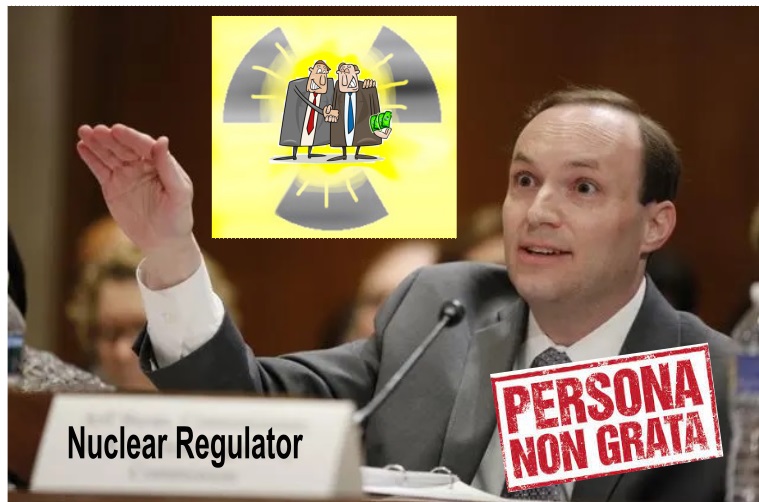
The triggering event for Sen. Manchin’s ire appears to be the faltering of NuScale, the leading firm touting the development of small modular reactors (SMRs), and the most likely to succeed commercially. The NuScale reactor design had some hiccups in satisfying the NRC’s requirements for a license, but its fundamental problem was its inability to attract customers. That commercial failure darkens the prospects of the rest of the nuclear industry’s stable of “advanced” designs, whose variety makes licensing more difficult. Safety is a subtle business (think of the Boeing door problem) and depends on design details.

More fundamentally, at risk is the dream of the nuclear industry and the US Energy Department—spun out in hearings before the Senate Energy Committee—of building large numbers of such reactors and exporting them around the world, with the United States regaining undisputed global leadership in nuclear technology.
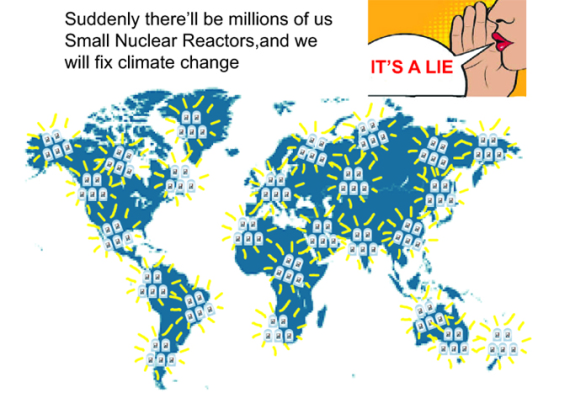
If this beautiful dream isn’t working out, somebody must be at fault, and who better to blame than the nuclear licensing authorities for paying too much attention to safety. If you think this way, the obvious fix is to reorient the NRC. Legislation to do that (ADVANCE Act, S-1111) has passed the Senate with strong bipartisan support. As Sen. Shelley Capito (R-WV), the act’s chief sponsor, put it: “we must establish regulatory pathways for next-generation nuclear designs to be approved quickly and without burdensome unnecessary costs.”
There is a sense here of “deja vu all over again.” The most prominent in the pipeline of “advanced” reactor designs are fast reactors. (Sidebar: They rely on fast neutrons and are cooled by liquid sodium, whereas all currently operating US power reactors rely on slow neutrons and are cooled by water.)

The most prominent design of this type is TerraPower’s (Bill Gates’s) Natrium reactor. Despite its “advanced” label, this type of power reactor was developed by the US Atomic Energy Commission in the 1960s and 1970s. The prototype Clinch River plant, about the same size as Natrium, was then the country’s largest energy project. The AEC’s central goal, backed at the time by the powerful Joint Committee on Atomic Energy, was to shift US electricity generation to such reactors, starting around 1980. The advantage of these reactors is that, fueled with plutonium, there are enough excess neutrons to convert uranium in the reactor into more plutonium than is being consumed; thus it is possible to “breed” plutonium, hence the name “breeder reactor.” Natrium can be fueled in this way and likely would be if it gained wide acceptability.
Just as supporters of new “advanced” reactors see NRC safety licensing as a threat, so the AEC’s fast reactor developers saw that agency’s semi-independent reactor licensing division as standing in the way and sought to undermine it. (“Regulatory,” as it was called then, was split off from the AEC in 1975 and became the NRC. In time, the rest of the AEC became the Energy Department.) The licensing division was treated by the AEC commissioners as a stepchild and kept weak so as not to threaten the big-budget reactor project.
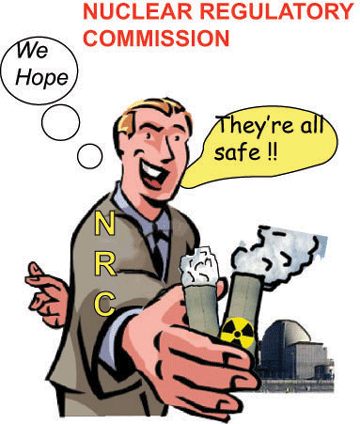
In the end, this strategy didn’t help the fast breeder reactor project. It got canceled because it didn’t make sense economically. But the weakness of the AEC regulatory organization had important consequences affecting the safety of the power reactors utilities bought in large numbers starting in the mid-1960s. Under pressure from the industry and commissioners, plants got licensed after rather skimpy safety reviews. So as not to constrain the licensing process, the AEC commissioners did not approve any safety regulations for power reactors until 1971. All but two of today’s 94 US operating power reactors were ordered before 1974. When it later became evident the early power reactors needed important safety upgrades, especially after the 1979 Three Mile Island accident, the nuclear industry resisted them.
In the late 1990s, it became evident that some of the plants’ safety documents—necessary for operation—were a mess. Then-NRC Chair Shirley Jackson tried to apply the NRC regulations strictly. The plant owners didn’t like this kind of oversight and got to New Mexico Sen. Pete Domenici, their senatorial godfather, who, in a private meeting, threatened Jackson with a huge budget cut. She got the point quickly, fired offending staff, hired Arthur Anderson management consultants to “improve” the licensing process, and ended the detailed public rating of nuclear power plants that the companies hated because Wall Street used the ratings for bond issues. After those changes, Domenici said he was happy. He boasted about coercing her in his book, A Brighter Tomorrow: “Since that meeting with Chairman Jackson, I have been very impressed with the NRC. They are now a solid, predictable regulatory agency.” There haven’t been many industry complaints since NRC fell into line—that is, until recently.
While the historical industry attacks on the NRC put self-interest above public safety, the agency, after its accommodating responses, didn’t come out looking good, either. A more recent change in the way the commission describes its responsibilities raises further questions about its priorities. It concerns the safety standard in the Atomic Energy Act (Sec. 182): “adequate protection of the public health and safety.” That phrase was cited by the agency for decades as the source of its authority and was the safety standard applied in commission actions.
Perhaps a dozen years ago, for reasons unknown but guessable, the commissioners began to use a modified version of the statutory standard, which now reads (for example, Strategic Plan 2022-2026) “reasonable assurance of adequate protection of public health and safety.” There is no denying that the added phrase waters down the Sec. 182 standard, which itself has not changed.
Do Nuclear Regulatory Commission actions under that modified standard even conform with the Atomic Energy Act? The Senate energy committee might usefully address itself to that question before it undertakes any more brow-beating of the already-timid NRC.
Planned UK nuclear reactors unlikely to help hit green target, say MPs
Guardian 13 Feb 24
Government plans to deliver SMRs ‘lack clarity’ say environmental committee, and will likely fail to meet clean-energy goal of 2035
MPs have warned that a planned fleet of small nuclear reactors are unlikely to contribute to hitting a key target in decarbonising Britain’s electricity generation, as the government opened talks to buy a site in Wales for a new power station.
The Environmental Audit Committee (EAC) said that ministers’ approach to developing factory-built nuclear power plants “lacks clarity” and their role in hitting a goal of moving the grid to clean energy by 2035 was unclear.
Last year a body, Great British Nuclear, was launched with the aim of delivering new power stations, including a fleet of small modular reactors (SMRs). The government has spent £215m on developing SMR design and is running a competition for companies to bid for government contracts.
However, in examining the role of SMRs, the EAC heard that a final investment decision on the first station in the UK is not expected until 2029. The timeline means it is unlikely to contribute to the 2035 target, or Labour’s pledge to run the grid on clean energy by 2030……………………..
The EAC said that the government plans to create as much as 24 gigawatts of nuclear power by 2050, but this figure could be as low as 12GW. Critics of nuclear power argue that it is costly and slow to build, and that projects to store wind and solar power in large batteries could undermine the need for it as a reliable power source.
…………….. despite pledging hundreds of millions of pounds in support for SMR projects and undertaking to invest in the construction of the UK’s first SMR, the government’s overall vision for the sector at this stage lacks clarity.
“The first SMR is unlikely to be in operation by 2035, the date ministers have set for decarbonising the electricity supply: so what role will SMRs have in an energy mix dominated by renewables and supplemented by existing and emerging large-scale nuclear?”…………………………………………………… https://www.theguardian.com/environment/2024/feb/13/planned-uk-nuclear-reactors-unlikely-to-help-hit-green-target-say-mps
Ohio Attorney General announces new indictments in FirstEnergy nuclear plant bailout scandal
Two former FirstEnergy executives and the former chairman of the Ohio Public Utilities Commission face 27 felony counts for their role in the House Bill 6 bribery scheme.
KEVIN KOENINGER / February 12, 2024, https://www.courthousenews.com/ohio-ag-announces-new-indictments-in-firstenergy-nuclear-plant-bailout-scandal/—
COLUMBUS (CN) — Ohio Attorney General Dave Yost promised to hold “the checkwriters and the masterminds accountable” Monday as he announced indictments against executives over a bribery scandal surrounding the taxpayer-funded bailout of several failing nuclear power plants.
Yost said the FirstEnergy executives — Chuck Jones, the former CEO, and Michael Dowling, former vice president of external affairs — worked with attorney Sam Randazzo, former chairman of the Public Utilities Commission of Ohio, or PUCO, to further their legislative interests and ensure their employer was not targeted by the commission.
The charges, filed in Summit County, are the first for Jones and Dowling, while Randazzo was previously indicted by the federal government and pleaded not guilty to multiple wire fraud charges in December 2023.
Jones and Dowling are expected to surrender to authorities later Monday.
“This indictment is about more than one piece of legislation,” Yost said at a news conference announcing the indictments. “It is about the hostile capture of a significant portion of Ohio’s state government by deception, betrayal and dishonesty.
“There can be no justice without holding the checkwriters and the masterminds accountable. Shout it from the public square to the boardroom, from Wall Street and Broad and High: Those who perversely seek to turn the government to their own private ends will face the destruction of everything they worked for,” he said.
The indictment names two shell companies run by Randazzo, alongside Jones, Dowling, and the former utilities commission chairman, and were integral to the defendants’ scheme, according to Yost.
The attorney general’s office writes in the charging document that Randazzo negotiated settlements with FirstEnergy on behalf of several clients associated with the Industrial Energy Users-Ohio trade association, but then used legal assignments to transfer those settlements to his shell companies, including Sustainability Funding Alliance of Ohio Inc.
According to Yost, Randazzo earned millions of dollars for consulting services at FirstEnergy — without his clients’ knowledge — and lobbied for the energy provider to secure subsidies eventually included in the ill-fated House Bill 6.
That legislation included a bailout of over $1 billion to save two struggling nuclear power plants owned by FirstEnergy in northern Ohio, and eventually resulted in the indictment, trial and conviction of former Ohio House Speaker Larry Householder.
The Republican politician was convicted of a single RICO charge in March 2023 and is serving a 20-year sentence in federal prison while his appeal is pending before the Sixth Circuit.
Matt Borges, former Ohio Republican Party Chairman, was convicted alongside Householder, and is serving a five-year sentence in federal prison.
FirstEnergy paid Randazzo over $13 million through his shell companies between 2016 and 2019, and he pocketed over $5.3 million of that money for himself, the attorney general writes in the indictment.
Jones and Dowling then agreed to make a one-time payment of $4.3 million from FirstEnergy to Randazzo on Jan. 2, 2019, weeks before the attorney became chairman, a position he abused to “bend the PUCO around FirstEnergy’s will,” according to Yost.
To conduct the investigation, the Ohio Organized Crime Commission organized a task force at the behest of Summit County Prosecutor Sherri Bevan Walsh.
“These individuals used FirstEnergy to break the law and betray the public’s trust,” Walsh said at Monday’s news conference. “This indictment is another step toward bringing justice for the residents of Summit County and Ohio.”
Randazzo was indicted on 22 felony counts, including engaging in a pattern of corrupt activity, aggravated theft, bribery and eight counts of money laundering, among others, while Jones and Dowling face 10 and 12 felony counts, respectively.
Environmental Audit Committee urges UK Government to clarify nuclear SMR strategy
Energy Live News.13 Feb 24
The Environmental Audit Committee has expressed concerns over the lack of clarity in the UK Government’s approach to small modular reactors, despite pledging significant funds.
The Environmental Audit Committee (EAC) has expressed concerns regarding the UK Government’s stance on small modular reactors (SMRs).
Despite allocating £215 million towards SMR technology, the committee highlights unclear policy direction regarding SMRs’ role in the country’s energy mix.
The EAC stresses the necessity of government clarity, especially concerning investment decisions and SMR project commissioning.
As the first SMR is not projected to contribute to the grid until 2035, questions arise regarding its integration with renewable energy sources for achieving decarbonisation goals.
Moreover, evidence presented to the committee indicates potential challenges concerning waste management and regulatory processes…………..
“The first SMR is unlikely to be in operation by 2035, the date Ministers have set for decarbonising the electricity supply: so what role will SMRs have in an energy mix dominated by renewables and supplemented by existing and emerging large scale nuclear………………… https://www.energylivenews.com/2024/02/13/government-urged-to-clarify-nuclear-smr-strategy/
Oxfam reaction to the Dutch court’s decision to stop military exports to Israel
February 13, 2024, by: The AIM Network, https://theaimn.com/oxfam-reaction-to-the-dutch-courts-decision-to-stop-military-exports-to-israel/—
Oxfam Novib, together with PAX, and the Rights Forum organisations, has won a lawsuit against the Dutch Government for exporting arms to Israel that are being used in the war in Gaza. The Dutch Court ordered the government of Netherlands to stop supplying F35 fighter jet parts to Israel within seven days, due to the clear risk of serious violations of international humanitarian law. The decision comes following the three organisations’ appeal to the court case against the Dutch government for supplying Israel with military equipment despite knowing they are used to commit war crimes in Gaza. The judge concluded, based on reports from Amnesty and the UN, that many civilians, including children, are being targeted.
In response to the ruling, Michiel Servaes – Oxfam Novib Executive Director – said:
“This positive ruling by the judge is very good news, especially for civilians in Gaza. It is an important step to force the Dutch government to adhere to international law, which the Netherlands has strongly advocated for in the past. Israel has just launched an attack against the city of Rafah, where more than half of Gaza’s population are sheltering, the Netherlands must take immediate steps.”
“It is a pity that this legal action was necessary and, unfortunately, has taken four months to come to this conclusion. The judge had ruled that the Dutch Minister of Foreign Trade and Development Cooperation was obliged to re-examine the arms export license to Israel, and that his decision was taken incorrectly. We hope that this verdict can encourage other countries to follow suit, so that civilians in Gaza are protected by international law.”
Latest Fukushima leak exposes failures in nuclear crisis management
Xinhua 2024-02-12, https://www.chinadaily.com.cn/a/202402/12/WS65c9eda7a3104efcbdaeab75.html
In a chilling revelation that sent shockwaves through the world, a new nuclear waste leak has unearthed the gaping crack in Japan’s professed claim of responsible handling the accident at the Fukushima Daiichi nuclear power plant.
The leakage of about 5.5 tons of water containing radioactive materials from the plant also highlights the need for international supervision of Japan’s controversial discharge of the Fukushima nuclear-contaminated water into the ocean.
It is estimated that 22 billion becquerels of radioactive materials such as cesium and strontium are contained in the leaked water, and the plant’s operator, Tokyo Electric Power Company (TEPCO), claimed on Wednesday that monitoring of a nearby drainage channel did not show any significant radiation level changes.
This begs the question: What constitutes a “significant” level?
Nearly 13 years after the catastrophic earthquake and tsunami, recurring leaking incidents still hint at the utility’s mismanagement and the Japanese government’s inadequacy in overseeing it.
On Oct. 26, 2023, just one week before Japan started the third round of release, two men were hospitalized after being accidentally splashed with radioactive liquid at the plant. On Aug. 11, 2023, days before the first round of discharge started, TEPCO found leaks in a hose used to transfer nuclear-contaminated water, which, as it said, would not affect the discharge plan.
Even more concerning, the causes of these incidents have fully exposed the chaos and disorder of TEPCO’s internal management. The leak on Wednesday stemmed from a valve left open during cleaning operations, while the October incident resulted from a loose hose channeling contaminated solutions. In August, TEPCO attributed a leak to cracks approximately four centimeters in length found in a hose.
The deficiencies in the fundamental equipment raise questions about the potential for similar occurrences and whether TEPCO conducts regular inspections of its equipment.
While TEPCO this time claimed that there is no risk to the public and that the surrounding environment remains unaffected by the leak, its history of cover-ups and opacity has eroded public trust.
For instance, it took TEPCO over two years after the 2011 tsunami to acknowledge that radioactive tritium had leaked into the Pacific Ocean, contradicting its initial assertions that the toxic water had been contained within the plant’s premises.
Also, in February 2015, TEPCO admitted that since April 2014, it had been aware of radioactive substances from a rainwater drainage ditch linked to one of its buildings being leaked into the sea when it rained.
Until meaningful reforms are enacted, the specter of Fukushima will continue to haunt Japan, serving as a sober reminder of the country’s failure to protect its citizens and the broader environment.
UK government keen to take control of Anglesey site for Westinghouse to build Wylfa nuclear power station

The British government is seeking to take control of a key site in Wales
earmarked for a nuclear power plant as part of wider plans to revamp
nuclear technology for the UK.
State-owned Great British Nuclear is in
early-stage discussions with Hitachi, owner of the land in Wylfa in
Anglesey, an island off north Wales, to buy the site with a view to finding
a new private sector partner to develop a station there.
The site has been
in limbo since Hitachi abandoned plans to build a new reactor there in
January 2019 after failing to strike a financial agreement with the British
government. The Japanese industrial group eventually wrote off £2.1bn on
the project. It also stopped work at a second site in Oldbury, South
Gloucestershire.
Ministers are now determined to revive plans to use the
Wylfa site for new nuclear power to help replace Britain’s current ageing
fleet of nuclear reactors. One minister confirmed that tentative
negotiations with Hitachi had already begun although they acknowledged the
deal might not be finalised until after the election later this year.
The land is thought to be worth about £200mn, but there are expectations that
Hitachi could settle for a lower price given the site is fallow. A
consortium led by the US nuclear company Westinghouse and construction
group Bechtel has proposed building a new plant there using
Westinghouse’s AP1000 reactor technology. It is thought the site could
also host small modular reactors.
FT 11th Feb 2024
https://www.ft.com/content/2e7928c7-ad7f-4ac4-88d8-8cde95ee1a00
Telegraph 11th Feb 2024
Bloomberg 11th Feb 2024
https://www.bnnbloomberg.ca/uk-in-talks-with-hitachi-over-welsh-nuclear-plant-site-ft-says-1.2033580
Energy Voice 12th Feb 2024
City AM 12th Feb 2024
Final public meeting to discuss South Holderness nuclear waste plan
The final public meeting to discuss plans to bury nuclear waste in East
Yorkshire takes place later. The drop-in session at Burstwick Village Hall
is the last of five organised by Nuclear Waste Services (NWS).
The government agency has named South Holderness as having potential for a
Geological Disposal Facility (GDF). Chief executive Corhyn Parr previously
said the scheme would only go ahead with community support. The GDF would
see waste stored up to 3,280ft (1,000m) underground until its radioactivity
had naturally decayed. Officials from NWS said the project could create
thousands of jobs and investment in local infrastructure in the area. The
proposed South Holderness site is one of three areas in England being
considered.
However, the plan has attracted opposition, with two local
councillors calling on East Riding of Yorkshire Council to end talks with
NWS. Beverley and Holderness Conservative MP Graham Stuart, who is also the
Minister for Energy Security, has backed the councillors’ motion saying
“Our community says no”.
BBC 12th Feb 2024
Ukraine v Russia genocide case: ICJ delivers judgment on preliminary objections
On February 2, the ICJ delivered its judgment on preliminary objections from Russia in the case Allegations of Genocide under the Convention on the Prevention and Punishment of the Crime of Genocide (Ukraine v. Russian Federation: 32 States intervening).
Ukraine alleges in their case against the Russian Federation that:
- Russia falsely accused Ukraine of committing genocide and used this as justification to launch its invasion against Ukraine;
- Russia committed violations of the Genocide Convention in declaring the Donetsk People’s Republic and Luhansk People’s Republic to be independent from Ukraine, and by launching its invasion of Ukraine on 21 February, 2022.
The Russian Federation argued that the ICJ did not have jurisdiction to consider the allegations and that they were inadmissible.
In its judgment, the ICJ concluded that it had jurisdiction to consider the first allegation of Ukraine and that this was admissible, but that it does not have jurisdiction under the Genocide Convention to consider the second allegation of Ukraine and that this was inadmissible. See Summary of the Judgment.
In turning down the second allegation of Ukraine, the ICJ explained that in this case they are constrained by the obligations under the Genocide convention, and cannot apply law extrinsic to the Convention, including law governing the use of force.
This demonstrates one of the key differences between ICJ cases based on jurisdiction found in treaties, where the Court can only consider the obligations under the treaty concerned, and jurisdiction found under the Declarations of Acceptance of ICJ Jurisdiction (under Article 36 of the ICJ Statute). In the latter case, the ICJ is generally able to apply all law relevant to a dispute between the parties. This is one of the reasons why the primary goal of the LAW not War campaign is to work for the acceptance by all States of ICJ jurisdiction under Article 36.
‘Operation Al-Aqsa Flood’ Day 127: Growing international alarm over Israeli plans to invade Rafah

Israel has announced its intention to push ahead with its plans to invade Rafah in the southernmost Gaza Strip, where 1.3 million Palestinians are sheltering. Rafah’s mayor, Ahmed al-Sufi, warns any military action there would result in a “massacre”.
By Mondoweiss Palestine Bureau / Mondoweiss, 10 Feb 24 https://mondoweiss.net/2024/02/operation-al-aqsa-flood-day-127-growing-international-alarm-over-israeli-plans-to-invade-rafah/
Casualties:
- At least 28,064 people have been killed and 67,611 wounded in the Gaza Strip*
- More than 380 Palestinians have been killed in the occupied West Bank and East Jerusalem
- The death toll in Israel from the October 7th attacks stands at 1,139, according to Al Jazeera
- 564 Israeli soldiers killed since October 7, and at least 3,221 injured.**
*This figure was confirmed by Gaza’s Ministry of Health on its Telegram channel. Some rights groups put the death toll number at more than 35,000 when accounting for those presumed dead.
** This figure is released by the Israeli military, showing the soldiers whose names “were allowed to be published.”
Key Developments
- Israel has committed 16 massacres, killing 117 Palestinians and injuring 152 in Gaza over the past 24 hours, according to the Gaza Ministry of Health
- Despite U.S. criticisms, Netanyahu pushes ahead with planned invasion of Rafah to “take out four remaining [Hamas] battalions” in the southernmost Gaza Strip city, Haaretz reported.
- As Netanyahu allegedly makes plans for “civilian evacuation” in Rafah in preparation for Israeli ground invasion, Israeli army kills 28 Palestinians in Gaza in raid on residential homes in Rafah, including 10 children, the youngest of whom was a three-year-old child, Al Jazeera reported.
- The body has been found of missing 6-year-old Palestinian girl Hind Rajab, who made headlines after her desperate calls to be rescued after her family came under attack by an Israeli tank. The Palestinian medics who were dispatched to rescue her were also declared dead.
- UN relief chief expresses outcry over planned invasion of Rafah: “Many of the well over 1 million people who make up Rafah’s population today have endured unthinkable suffering. Where are they supposed to go? How are they supposed to stay safe?”
- Mayor of Rafah warns any invasion of the city “will lead to a massacre.”
- Biden to send CIA director to Egypt to continue negotiations on ceasefire deal and potential exchange of captives. This comes on the heels of Israel rejected a proposed ceasefire deal by Hamas, which Netanyahu called ‘crazy’ and Biden dubbed as ‘over the top’.
- Biden issues new directive requiring countries receiving U.S. military aid to prove that they are “in compliance with international humanitarian law and human rights law and other standards,” AP reported.
- Israeli forces and snipers are firing at civilians and medical personnel in and outside of the Nasser Medical Complex in Khan Younis, in southern Gaza. Doctors Without Borders says two people have been killed and five others have been injured over the past 48 hours.
- Claims surface of abducted Palestinian doctor and Director of Al-Shifa’ Hospital Muhammad Abu Salmiya is being tortured by Israeli forces and treated ‘like a dog’.
- Israeli forces kill a 17-year-old Palestinian boy in the northern occupied West Bank district of Nablus during a raid on the town of Beita.
- Israel conducts airstrikes and artillery shelling in southern Lebanon, no injuries were reported.
- Senior Biden administration aide reportedly apologizes for “missteps” in the administration’s handling of Israel’s war on Gaza in closed-door meeting with Arab-American political leaders in Michigan.
Growing chorus of international alarm over Israel’s plans to invade Rafah
Despite warnings and criticisms from the Biden administration, Israel is announcing its intention to push ahead with its plans to invade Rafah, the southernmost part of the Gaza Strip where an estimated 1 million Palestinians, half of Gaza’s population, are sheltering.
Israeli news daily Haaretz reported that Israeli Prime Minister Benjamin Netanyahu ordered the army and defense establishment on Friday to “present plans to defeat the Hamas battalions” that are allegedly operating in Rafah.
Quoting a statement from the Prime Minister, Haaretz reported Netanyahu as saying: “It is impossible to achieve the goal of the war of eliminating Hamas while leaving four Hamas battalions in Rafah.”
In an effort seemingly meant to appease vocal warnings from the Biden administration that the U.S. wouldn’t support an “unplanned” military operation in Rafah without considerations to “protect civilians,” Netanyahu also said that a military operation in Rafah would “require the evacuation of the civilian population from combat zones.”
It is not clear how Israel plans to evacuate the hundreds of thousands of Palestinians who have sought shelter in Rafah due to Israeli bombardment and Israeli orders to evacuate the north, central, and other areas of southern Gaza.
Inside Rafah’s city center, tens of thousands of displaced Palestinians shelter in buildings, schools, and hospitals. Meanwhile, on the outskirts of Rafah, near the Egyptian border, entire tent cities have been erected to house the growing population of displaced Palestinians.
According to Save the Children, an estimated 1.3 million Palestinians, including 610,000 children are currently displaced and sheltering in the Rafah area.
Given the current reality that Israel has destroyed its way through the rest of Gaza, obliterating more than half of Gaza’s infrastructure in the process, the question remains: where will the 1.3 million Palestinians in Rafah go if the army invades?
Since the start of the genocidal Israeli campaign on Gaza, Palestinians have been warning of Israeli desires to ethnically cleanse them, and push Palestinians from the small besieged enclave into Egypt. Those fears were intensified when, in late October, documents were leaked from the Israeli Ministry of Intelligence outlining plans to push the Palestinian civilian population in Gaza into the Egyptian Sinai Peninsula, which borders Gaza to the south.
Egypt’s borders, however, have remained firmly closed, save the entry and exit of minimal humanitarian aid. The Egyptian government and other Arab nations have also remained firmly opposed to Israeli ideations of mass expulsion of Palestinians from Gaza.
Despite the growing threat of an invasion in Rafah, many Palestinians sheltering there say they will not leave their shelters. “We have come to the border area with Egypt because we thought it would be the safest place, the last place where Israel would push the residents. Now it is not possible to push them any farther, it is not possible for us to move anywhere else. We will only move from here to the grave. This is our last resort,” a Palestinian woman in Rafah told Middle East Eye.
As Israel continues to promote its plans of an invasion into Rafah, a growing chorus of outcry is emerging both locally and on the international stage.
According to Al Jazeera, the mayor of Rafah, Ahmed al-Sufi, has warned that any military action in Rafah would result in a “massacre”.
Martin Griffiths, the UN Under-Secretary-General for Humanitarian Affairs and Emergency Relief Coordinator, posted on X warning that Palestinians in Rafah would have nowhere to go in the case of an Israeli invasion.
“Many of the well over 1 million people who make up Rafah’s population today have endured unthinkable suffering. Their homes have been destroyed, their streets mined, their neighborhoods shelled. They’ve been on the move for months, braving bombs, disease and hunger.
Where are they supposed to go? How are they supposed to stay safe? There’s nowhere left to go in Gaza. Civilians must be protected and their essential needs, including shelter, food and health must be met,” Griffiths wrote.
UN Secretary-General Antonio Guterres also posted on X, saying: “Half of Gaza’s population is now crammed into Rafah with nowhere to go. Reports that the Israeli military intends to focus next on Rafah are alarming.
Such an action would exponentially increase what is already a humanitarian nightmare with untold regional consequences.”
Amnesty International posted satellite images showing vast displacement camps in Rafah, saying” “Many have already faced successive waves of displacement. If these mass ‘evacuation orders’ are indeed issued they may amount to the crime of forcible transfer.”
UNICEF also warned against a ground invasion in Rafah, saying it would “mark another devastating turn. The agency’s director also called for an “immediate humanitarian ceasefire,” saying it would save lives.
Avril Benoit, the executive director of Doctors Without Borders (MSF)-USA also responded to Israel’s planned invasion of Rafah, saying it would be “catastrophic and must not proceed.”
“As aerial bombardment of the area continues, more than a million people—many living in tents and makeshift shelters—now face a dramatic escalation in this ongoing massacre.”
“Nowhere in Gaza is safe,” she continued, “and repeated forced displacements have pushed people to Rafah, where they are trapped in a tiny patch of land and have no options.”
Jordan’s Ministry of Foreign Affairs alo issued a statement, saying it “rejects the displacement of Palestinians inside or outside their territories and stresses the need to end the war on the Gaza Strip.”
As Israel mulls over plans to ‘protect civilians’, Israel kills more civilians in Gaza
Just hours after Prime Minister Benjamin Netanyahu announced his intentions to evacuate civilians in Rafah, Israeli forces killed 28 Palestinians in air attacks on residential homes in Rafah.
Continue reading1 This Month

petition to oppose the rapid increase of space-military industry threatening Jeju Island and the region.
[Petition by April 19th (KST)] Stop the joint military-Hanwha Systems-Jeju Provincial Government Sea Launch!
World Nuclear Power. Reactors 1951-2026, 75 Years of Nuclear Power.
Interactive Map– https://dv.worldnuclearreport.org/

Chernobyl: The Lost Tapes – A good documentary on Chernobyl on SBS available On Demand for the next 3 weeks– https://www.sbs.com.au/ondemand/tv-program/chernobyl-the-lost-tapes/2352741955560

of the week–London Campaign for Nuclear Disarmament


Tell the Ukrainian Government to Drop Prosecution of Peace Activist Yurii Sheliazhenko
To see nuclear-related stories in greater depth and intensity – go to https://nuclearinformation.wordpress.com
-
Archives
- April 2026 (211)
- March 2026 (251)
- February 2026 (268)
- January 2026 (308)
- December 2025 (358)
- November 2025 (359)
- October 2025 (376)
- September 2025 (257)
- August 2025 (319)
- July 2025 (230)
- June 2025 (348)
- May 2025 (261)
-
Categories
- 1
- 1 NUCLEAR ISSUES
- business and costs
- climate change
- culture and arts
- ENERGY
- environment
- health
- history
- indigenous issues
- Legal
- marketing of nuclear
- media
- opposition to nuclear
- PERSONAL STORIES
- politics
- politics international
- Religion and ethics
- safety
- secrets,lies and civil liberties
- spinbuster
- technology
- Uranium
- wastes
- weapons and war
- Women
- 2 WORLD
- ACTION
- AFRICA
- Atrocities
- AUSTRALIA
- Christina's notes
- Christina's themes
- culture and arts
- Events
- Fuk 2022
- Fuk 2023
- Fukushima 2017
- Fukushima 2018
- fukushima 2019
- Fukushima 2020
- Fukushima 2021
- general
- global warming
- Humour (God we need it)
- Nuclear
- RARE EARTHS
- Reference
- resources – print
- Resources -audiovicual
- Weekly Newsletter
- World
- World Nuclear
- YouTube
-
RSS
Entries RSS
Comments RSS
 nuclear-news