The folly of Ontario’s nuclear power play
MARK WINFIELD, THE GLOBE AND MAIL, 5 Feb 24
Mark Winfield is a professor of environmental and urban change at York University and co-chair of the faculty’s Sustainable Energy Initiative. He is also co-editor of Sustainable Energy Transitions in Canada (UBC Press, 2023).
The Ontario government’s announcement last week of its intention to pursue the refurbishment of the Pickering B nuclear power plant on the shore of Lake Ontario between Toronto and Pickering represents a strategic triumph for the provincially owned Ontario Power Generation utility. The project would significantly reinforce the utility’s already dominant position in the province’s electricity system.
How well the decision serves the interests of Ontario residents, taxpayers and electricity ratepayers, and advances the sustainable decarbonization of the province’s electricity system, is another question altogether.
A Pickering B refurbishmenthad been assessed as uneconomic in 2010 and the plant scheduled to close in 2018. The facility is located in what is now a densely populated urban area where approval of a new plant would be unlikely.
New plans for that refurbishment are part of larger nuclear expansion strategy being pursued by OPG and the province. The plans include the refurbishment of six reactors at the Bruce Nuclear facility (also owned by OPG) and four reactors at the OPG Darlington facility. There are also proposals for four large new reactors totalling 4,800 MW in capacity at Bruce and four new 300 MW reactors at Darlington.
The total costs of these plans are unknown at this point, but an overall estimate in excess of $100-billion ($13-billion Darlington refurbishment; $25-billion Bruce refurbishment; $15-billion Pickering B refurbishment; $50-billion for Bruce new build; Darlington new build $10-billion or more) would not be unrealistic. Even that figure would assume that things go according to plan, which they rarely do with nuclear construction and refurbishment projects. This could constitute the largest nuclear construction program in the Americas or Europe.
Under the current legislative and policy regime for electricity in Ontario, none of these plans are subject to any external review or regulatory oversight in terms of costs, economic and environmental rationality, or availability of lower-cost and lower-risk pathways for meeting the province’s electricity needs and decarbonizing its electricity system. Rather, the system now runs entirely on the basis of ministerial directives that agencies in the sector – including the putative regulator, the Ontario Energy Board – are mandated to implement.
The government has justified its plans on the expectation of dramatic growth in electricity demand over the next few decades. This would be the result of population and economic growth, the widespread adoption of electric vehicles, the electrification of space heating – principally via heat pumps – and expectations of industrial development in areas like the hydrogen economy
There are serious grounds on which to question these projections. Growth in electricity demand in the province has been virtually flat these past two decades despite sustained population and economic growth. The province has no plans of its own for the electrification of transportation or space heating. In fact, it is currently proposing legislation to facilitate the expansion of natural gas service to new housing developments. Many of the anticipated industrial developments, particularly around things like hydrogen, are speculative at best……………………………………..
While nuclear energy may offer a low-carbon energy source, it fails in virtually every other dimension of sustainability: costs; the production of high-volume, toxic and radioactive waste streams that require management on timescales of hundreds, if not thousands, of millennia; and security, catastrophic accident and weapons proliferation risks that simply do not exist in relation to other energy technologies.
These considerations mean that nuclear projects need to be options of last resort in efforts to decarbonize energy systems. This is precisely the opposite of the approach now being taken by Ontario. These are choices that Ontarians and Canadians may come to regret for decades, if not centuries, if they are not subject to some form of serious external review before it is too late to reconsider https://www.theglobeandmail.com/business/commentary/article-ontario-pickering-nuclear-power-plant-refurbishment/
2 Comments »
Leave a reply to Bill Noll Cancel reply
1 This Month
26 April – Chernobyl: Inside the Meltdown airs on National Geographic on Sunday 26th April from 4pm

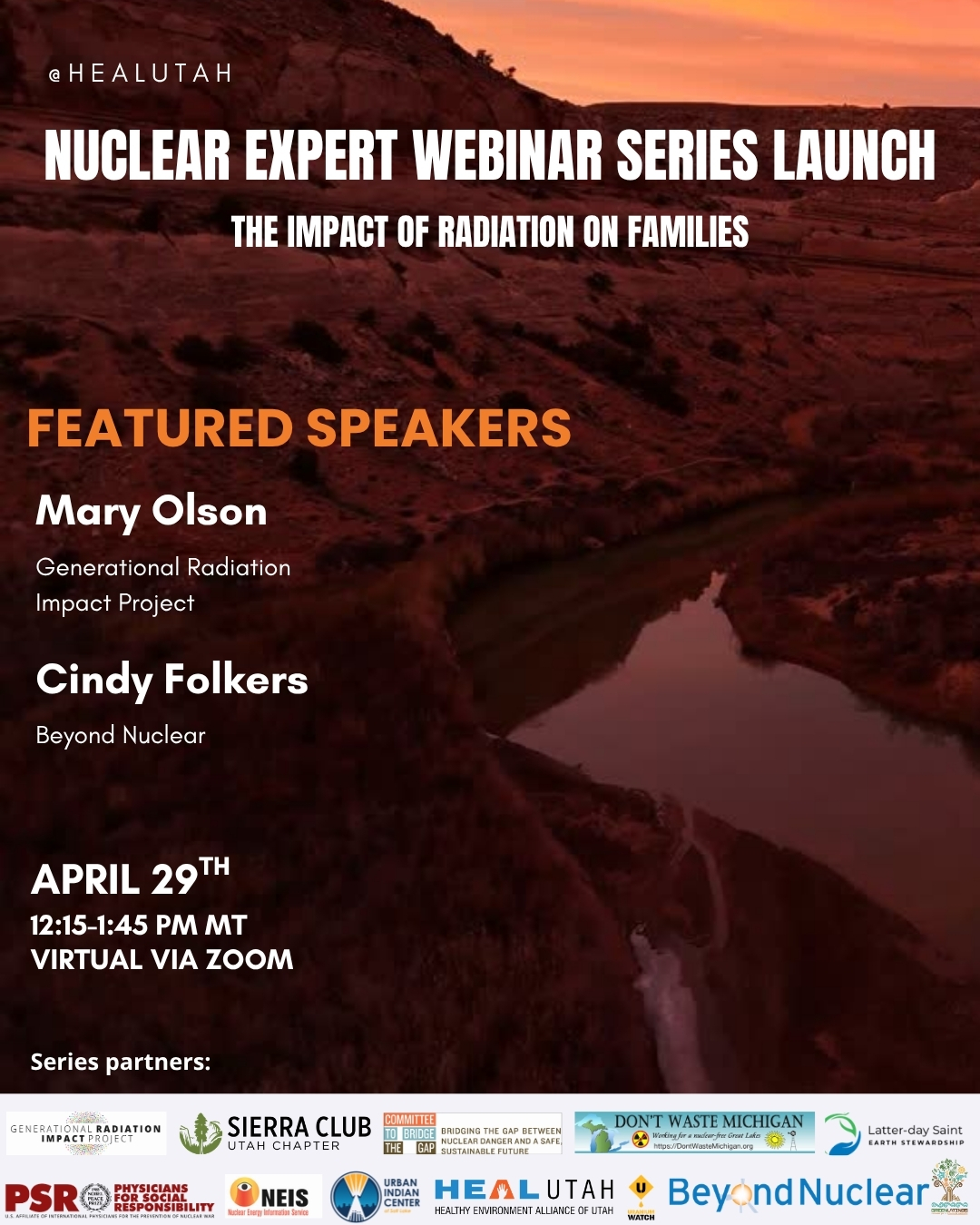
29 April – Nuclear Expert Webinar #1 – Radiation Impacts on Families with Mary Olson and Cindy Folkers
- 12:15 PM MT – 1:45 PM MT
- Location: Virtual – REGISTER TODAY

4 May -West Suburban Peace Coalition to discuss Iran war at May Educational Forum
Monday, May 4, 7:00 – 8:00 PM Central Standard Time
Title: : How Trump’s Narrative Tries to Shape the Reality of the War on Iran.
Contact Walt Zlotow, zlotow@hotmail.com 630 442 3045 for further information
14 May – online event From Bombs to Data Centres: the Face of Nuclear Colonialism

Pine Ridge Uranium is the real threat, not Tehran- Tell Burgum: Stop the Extraction.
Chernobyl: The Lost Tapes – A good documentary on Chernobyl on SBS available On Demand for the next 3 weeks– https://www.sbs.com.au/ondemand/tv-program/chernobyl-the-lost-tapes/2352741955560
To see nuclear-related stories in greater depth and intensity – go to https://nuclearinformation.wordpress.com
-
Archives
- April 2026 (356)
- March 2026 (251)
- February 2026 (268)
- January 2026 (308)
- December 2025 (358)
- November 2025 (359)
- October 2025 (376)
- September 2025 (257)
- August 2025 (319)
- July 2025 (230)
- June 2025 (348)
- May 2025 (261)
-
Categories
- 1
- 1 NUCLEAR ISSUES
- business and costs
- climate change
- culture and arts
- ENERGY
- environment
- health
- history
- indigenous issues
- Legal
- marketing of nuclear
- media
- opposition to nuclear
- PERSONAL STORIES
- politics
- politics international
- Religion and ethics
- safety
- secrets,lies and civil liberties
- spinbuster
- technology
- Uranium
- wastes
- weapons and war
- Women
- 2 WORLD
- ACTION
- AFRICA
- Atrocities
- AUSTRALIA
- Christina's notes
- Christina's themes
- culture and arts
- Events
- Fuk 2022
- Fuk 2023
- Fukushima 2017
- Fukushima 2018
- fukushima 2019
- Fukushima 2020
- Fukushima 2021
- general
- global warming
- Humour (God we need it)
- Nuclear
- RARE EARTHS
- Reference
- resources – print
- Resources -audiovicual
- Weekly Newsletter
- World
- World Nuclear
- YouTube
-
RSS
Entries RSS
Comments RSS
 nuclear-news
Nuclear power will not be the panacea to “decarbonization.” It is too damn expensive, too dangerous and totally unnecessary for our energy needs. Read the plans for 146 countries all over the world at https://thesolutionsproject.org/ We will not “starve and freeze in the dark,” nor “wreck our economy by transitioning to a renewable energy economy,” NOW! Get nuclear power off the dole. Stop the subsidies and the the insurance liability limit of laws like the Price-Anderson Act. Start an “Apollo Moon Landing” Mission Project to go 100 per cent renewable energy now. No more drilling, no more refining, no more pipelines, no more refineries, LNG gas terminals tankers or trucks.
You can add to the $ 100 B another $ 25 to 30 B for a dgr implementation .The $25 B is an NWMO number without including all the expansion plans for SMR s ,the Pickering refurbishment plans and Bruce Power’s intention to increase the reactor capability by 75 %at Bruce
Billl