TODAY. What’s the connection between the UK Post Office scandal and Soviet Lt. Col. Stanislav Petrov?

Well, nothing really. But we need to remember what Stanislav Petrov did. On September 26, 1983, Petrov, in charge of the Soviet Union’s nuclear missile system, received the computer screen order to “Launch”. The system reported that a total of five Minuteman ICBMs had been launched by the USA. Soviet nuclear doctrine called for a full nuclear retaliation. Petrov had to make an instant decision. But he feared that it was a false alarm. He disobeyed the order.
The outcome proved that Petrov was correct, and nuclear armageddon was avoided.
So, faulty technology caused a terrible danger – and one man had the integrity to doubt the digital message, and to act on his doubt.
Contrast this with the actions of Post Office and Fujitsu authorities who covered up and lied about the faulty Horizon IT system. That resulted in 900 false convictions, 4 suicides, and hundreds, perhaps thousands, of lives ruined.
In both cases, it was a failure of digital technology.
Now, as we plunge in to the Age of Artificial Intelligence, there is the frightening potential for more digital failures, – and worse, for human error, or even malevolence, in setting up AI programmes.
We need, as never before, people like Stanislav Petrov – people with the scepticism and the integrity - to not blindly comply with technocratic wizardry. The very recent, and still ongoing British Post Office scandal is a worrying reminder of the prevailing view about “not rocking the boat”. The boat may be sinking.
A Radically Different World Since Assange’s Indictment
Biden would have hell to pay from the DNC and the C.I.A. if he dropped the case.
Still, he’s probably not so foolish to want a shackled journalist showing up on U.S. shores to stand trial in the midst of his re-election campaign.
Leniency towards Assange would win back some respect the United States has lost, which would mean it couldn’t suffer another blow and had finally woken to the new world it inhabits. Crushing him would be yet another step towards its demise.
The Assange case is a centerpiece of an emerging, global challenge to U.S. dominance that did not exist in 2010 when the U.S. began its legal pursuit of the publisher, says Joe Lauria.
By Joe Lauria, Consortium News, 29 Jan 24
The world has changed dramatically since the United States began its legal pursuit of WikiLeaks publisher Julian Assange, bringing new risks to the U.S. if it persists in pursuing him to the end.
The geo-strategic situation and the state of the media are today nearly unrecognizable from 2010, when the U.S. empaneled a grand jury to indict Assange. Conditions have changed significantly since even 2019, when he was dragged from the embassy and the indictment was unveiled.
The United States is in the midst of suffering its third major, strategic defeat since the process against Assange began, bringing potentially significant consequences for the U.S., the world and possibly Assange.
In just the past three years, the United States has experienced humiliating defeats in Afghanistan, Ukraine, and now Gaza.
Afghanistan hurt Americans’ sensitivities about their precious “prestige,” which American elites care so much about. The rest of the world takes it into its geo-strategic calculations.
The U.S. instigation of war in Ukraine, intended to weaken Russia and bring down its government, has instead turned into a debacle for the United States and Europe of world historical proportions.
A new commercial, financial and diplomatic system has emerged in opposition to the U.S.-dominated West. This had been slowly developing but was accelerated by Washington’s provocation in Ukraine. It is a way more serious problem for the United States than the mere loss of “prestige.”
Add to this the worldwide disapproval and condemnation the U.S. is facing for its blatant complicity in Israel’s ongoing genocide in Gaza during a war the U.S. and Israel are not winning. The result is U.S. legitimacy has significantly weakened around the world. And at home.
Is this the moment to bring a journalist to the United States in chains to stand trial for publishing truthful material that exposed earlier crimes by the United States?
The risks of doing so at this moment — a very different moment from 2010 — are serious for the U.S, at home and abroad. Domestically the Bill of Rights is at risk. Internationally the bully is losing credibility.
This is seen in the forthrightness of some world leaders, particularly in Latin America, who in the spirit of this new, non-U.S. world, have confronted the United States on its treatment of Assange and have demanded his release.
The established media, which by definition runs cover for the U.S. to commit crimes and abuses wherever its interests are challenged, is suffering its own precipitous loss of legitimacy. The spectacular growth of both social and independent media’s influence since 2010 has helped create a worldwide movement in defense of Assange and the basic principle of a free press.
The question is how aware is the Biden administration of this new world and how will it react?
At a certain point U.S. hubris and intransigence would seem to be headed for collapse. But until then, Washington will no doubt double down in denial and in vengeance. It’s not giving up in Ukraine nor in Gaza — the neocon grip on power in Washington over the realists remains. Will the extremists remain ascendant on Assange too?
In December 2010, Vice President Joe Biden told the television news show Meet the Press that the Obama administration could only indict Assange if they caught him red-handed stealing government secrets and not receiving them passively as a journalist. The Obama administration concluded he was acting as a journalist, even if they refused to call him one, and didn’t indict him.
So what changed for Biden? Why does he persist in this prosecution begun by his mortal enemy Donald Trump and Trump’s C.I.A. director, Mike Pompeo?
The indictment until today still only deals with events in 2010. Nothing has changed legally. But everything changed politically for President Biden, the head of the Democratic Party, with the 2016 DNC leaks, and the C.I.A. Vault 7 releases the following year.
Biden would have hell to pay from the DNC and the C.I.A. if he dropped the case.
Still, he’s probably not so foolish to want a shackled journalist showing up on U.S. shores to stand trial in the midst of his re-election campaign. The High Court here in London has been good at dragging things out and could easily do so until after November.
The Assange case is a centerpiece of this global challenge to U.S. dominance that did not exist in 2010.
To the extent that U.S. leaders are aware of what is happening to U.S. standing in the world, their propensity is to lash out with the only argument they have left – lethal force. In Assange’s case it is legal force, with lethal consequences.
Leniency towards Assange would win back some respect the United States has lost, which would mean it couldn’t suffer another blow and had finally woken to the new world it inhabits. Crushing him would be yet another step towards its demise.
The U.S. does not really need him. It has enough blood on its hands.
This is the text of an address Joe Lauria made by video on Monday to a conference in Sydney, Australia.
Joe Lauria is editor-in-chief of Consortium News and a former U.N. correspondent for The Wall Street Journal, Boston Globe, and other newspapers, including The Montreal Gazette, the London Daily Mail and The Star of Johannesburg. He was an investigative reporter for the Sunday Times of London, a financial reporter for Bloomberg News and began his professional work as a 19-year old stringer for The New York Times. He is the author of two books, A Political Odyssey, with Sen. Mike Gravel, foreword by Daniel Ellsberg; and How I Lost By Hillary Clinton, foreword by Julian Assange. He can be reached at joelauria@consortiumnews.com and followed on Twitter @unjoe
Military-Intelligence Corruption Information Center.

WANT TO KNOW INFO, 31 Jan 24
Over the last 20+ years, WantToKnow.info has summarized over a thousand news articles on deep corruption within our military and intelligence systems. Going deeper, we have gathered a comprehensive collection of verifiable resources, videos, books, and declassified government documents. In this information center, we’ll present a sobering investigation into the US war machine: what it is, who benefits, and who pays the price. The true impacts of US military-intelligence activities in countries all over the world are examined, from World War II to our present moment in time.
Conflict, war, and perceived national security threats provide a common focus for military and CIA partnership. Military activity is heavily informed by CIA intelligence, and public support for this activity is secured by pro-war narratives and voices flooding our media system. What is really going on behind closed doors and on the battlefields is rarely covered in the news, if only for a brief glimpse.
The mainstream press often downplays how ineffective, harmful, and wasteful our current national security strategy is. Over the past century, the CIA’s covert actions have led to countless deaths, human rights abuses, and the undemocratic toppling of numerous foreign governments. While entrenched bureaucracy may be responsible for some of these government agency failings, deeper covert actions within our government have led to chaos and suffering in America and all over the world. Major cover-ups and horrific crimes within the military-intelligence complex continue to remain largely hidden from public awareness.
What is presented in this information center will likely be challenging, sad, and shocking for those who want to know. Yet real information can be empowering. It helps us understand the root causes of human and environmental suffering: the money, players, and belief systems that drive the machine. It invites us to question authority in healthy ways, across political differences. Yet most importantly, challenging information can paradoxically remind us of the greater good. It is the courage of the people and the love for the common good that bring these injustices to light—fueling open dialogue and constructive action.
Unaccountable Military Spending
The military keeps a lot of little things secret. Most people know the phrase “follow the money.” Unfortunately, following the money is impossible when it comes to keeping track of the flow of US taxpayer dollars at the Pentagon. The US military has consistently failed to keep track of the money it spends. As the defense budget speeds towards $1 trillion, the Pentagon failed an independent audit of its accounting systems for the sixth consecutive year in 2023.
In 2022, the Pentagon couldn’t properly account for 61% of its $3.5 trillion in assets. That figure increased in 2023, with the department insufficiently documenting 63% of its now $3.8 trillion in assets. We’ve covered the shocking extent of military waste and trillions missing from US DoD accounts since 2003, as documented here.
In 2021, President Joe Biden declared that the United States was “not at war” for the first time in 20 years. However, this is far from the case. Even members of Congress are uninformed about the presence of US military forces in countries all over the world. This is partly due to the post-9/11 Authorization for Use of Military Force enacted in 2001, which allows for secret operations primarily conducted by the CIA. Investigations have indicated that the United States has pumped millions into fighting more than a dozen “secret wars” over the last two decades. Since 2008, the US has supported at least nine coups in African countries, with a vast network of military bases scattered across the continent.
Going deeper, military black budgets are even more challenging to calculate. Military black budgets fund classified government programs, psychological operations, special forces operations, occult shoulder patches created for top secret programs, and other clandestine military activities. Former intelligence contractor and NSA whistleblower Edward Snowden revealed a vast network of over a dozen spy agencies that make up the U.S. intelligence community, funded by a $52.6 billion “black budget” for fiscal 2013. When the US Space Force was created in 2019, an investigation by Forbes revealed how much of the US Air Force budget was shrouded in secrecy, where “literally hundreds of line items in the proposed budget” were classified.
Arms Industry Corruption
Once weapons were manufactured to fight wars. Now wars are manufactured to sell weapons.
— Arundhati Roy
The US dominates the global arms sales industry. Data released in 2023 indicates that the U.S. sold weapons to nearly 60 percent of the world’s authoritarian nations in 2022. Year after year, half of the Pentagon budget doesn’t go to those fighting on the battlegrounds. It goes to corporate weapons contractors who profit lavishly from war. As one defense executive flat-out told Reuters at Europe’s biggest arms fair, “war is good for business.”
From the Middle East, Ukraine, China, Saudi Arabia, and to Nigeria, US arms sales have done little to promote stability and democracy in geopolitically impacted regions. Read an incredibly comprehensive report by The Quincy Institute for Responsible Statecraft, which illustrates how US arms sales have only fueled unnecessary conflict and war.
Powerful banks like JP Morgan Chase and asset management firms like Blackrock and Vanguard have emerged as major players in the business of war. Some of the world’s biggest banks fund the deadly cluster bomb trade, even as more than 100 countries have banned the unethical use of cluster bombs.
These powerful financial entities are top shareholders of weapons manufacturers like Lockheed Martin and Boeing. Together, the arms industry and the elite financial sector receive more federal money than most federal agencies. In 2022, Lockheed Martin received $106 from the average taxpayer, which is four times more than what taxpayers spent on primary and secondary education. Few Americans would support these war profiteers if they knew where their tax money was going.
Roughly two-thirds of current conflicts — 34 out of 46 — involve one or more parties armed by the United States. In some cases U.S. arms sales to combatants in these wars are modest, while in others they play a major role in fueling and sustaining the conflict. Of the U.S.-supplied nations at war, 15 received $50 million or more worth of U.S. arms between 2017 and 2021. This contradicts the longstanding argument that U.S. arms routinely promote stability and deter conflict. ………………………………………………………………………………………………………..more https://www.wanttoknow.info/military-intelligence-corruption-information
Nuclear Waste: Changing Conditions May Affect Future Management of Contamination Deposited Abroad During U.S. Cold War Activities
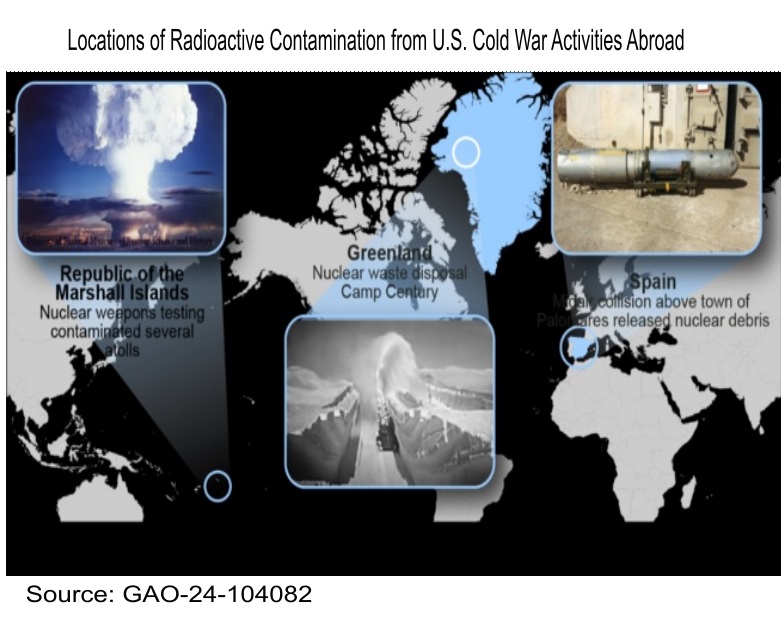
GAO-24-104082 U.S. Government Accountability Office Jan 31, 2024.
U.S. Cold War activities caused radioactive contamination in three other countries.
The contamination in Greenland—from a closed nuclear reactor—and in Spain—from an aircraft accident—is being monitored. But changing climate and economic conditions have raised concerns about future effects on local areas.
In the Marshall Islands—where the U.S. tested nuclear weapons—local officials are worried that rising sea levels may impact contaminated sites. The Department of Energy believes the health risk is low but has struggled to explain this to the community. We recommended DOE develop a communication strategy on the contamination for the islands.
The U.S. built Runit Dome in the 1970s to contain radioactive debris in the Marshall Islands.
Highlights
What GAO Found
U.S. Cold War activities resulted in radioactive contamination in three locations: Greenland (part of the Kingdom of Denmark), Spain, and the Republic of the Marshall Islands (RMI) (see fig.). In Greenland, radioactive liquid—generated by a small nuclear reactor that powered the U.S. Camp Century base—remains entombed under ice. In Spain, a mid-air collision resulted in radioactive contamination around Palomares. The United States and Spain cleaned up much of the radioactive material and have monitored the remaining material since. In RMI, contamination from nuclear weapons tests and the resulting fallout remains measurable on several atolls, some of which are still uninhabitable.
Conditions have changed in all three locations since the original contamination. Most affected are the environment and inhabitants of RMI, where the Department of Energy (DOE) has ongoing responsibilities. Specifically:
- Greenland. At Camp Century, Denmark instituted permanent ice sheet monitoring to address concerns that climate change could release contamination. However, a 2021 study reported that contamination likely would remain immobile through 2100.
- Spain. In Palomares, Spanish officials reevaluated the radioactive contamination in the 1990s and found it exceeded European Union standards. In 2015, U.S. and Spanish authorities signed a statement of intent to further remediate Palomares but have not reached a final agreement.
- RMI. In RMI, people are concerned that climate change could mobilize radiological contamination, posing risks to fresh water and food sources. DOE assesses human radiation exposure and monitors environmental contamination in RMI. DOE considers human health risk to be low, but RMI officials believe DOE has downplayed the risk. This and other disagreements fuel distrust of DOE’s information. By implementing a sustainable communication strategy in RMI, DOE could improve the Marshallese people’s access to, and trust in, information on contamination as environmental conditions change.
Why GAO Did This Study
The United States conducted defense activities in many countries during the Cold War. These activities resulted in radioactive contamination in three countries: Greenland, Spain, and RMI. During the 1960s, the United States buried radioactive liquid in Greenland’s ice while operating the experimental Camp Century base to study the feasibility of installing nuclear missiles there. In 1966, in Spain, two U.S. defense aircraft collided, dispersing radioactive debris over the town of Palomares. From 1946 to 1958, the United States conducted 67 nuclear weapons tests in RMI, and the resulting radioactive fallout contaminated several atolls.
This report examines (1) the amount and type of radioactive contamination in Greenland, Spain, and RMI; and (2) how conditions have changed at these sites, and the extent to which the environment and inhabitants have been affected by these changed conditions. GAO reviewed key literature on the contamination and interviewed U.S. and foreign government officials.
Recommendations
The Secretary of Energy, as a part of the agency’s ongoing efforts to address the legacy of U.S. nuclear testing in RMI, should develop and document a strategy for communications on radioactive contamination that is sustained, understandable, transparent, engages the RMI government, and builds on lessons learned. DOE concurred with GAO’s recommendation.
Recommendations for Executive Action
Agency Affected RecommendationStatus Department of Energy
The Secretary of Energy, as a part of the agency’s ongoing efforts to address the legacy of U.S. nuclear testing in the Republic of the Marshall Islands, should develop and document a strategy for communications on radioactive contamination that is sustained, understandable, and transparent; engages the RMI government; and builds on lessons learned. (Recommendation 1)
When we confirm what actions the agency has taken in response to this recommendation, we will provide updated information.
Full Report…………………………………………………………….. https://www.gao.gov/products/gao-24-104082
What Happens Now That the ICJ Has Ordered Israel Not to Engage in Genocide?

The ICJ ruling was a victory for Palestinians and for international law. Here are possible avenues for enforcement.
By Marjorie Cohn , TRUTHOUT, January 29, 2024
What comes next, now that the International Court of Justice (ICJ), also known as the World Court, has handed down its near unanimous ruling that South Africa presented a “plausible” case that Israel was violating the Genocide Convention?
The January 26 provisional ruling – which was a landmark victory for the Palestinian people, and indeed, for international law itself — now goes to the United Nations Security Council for enforcement. It would be within the Security Council’s purview to order economic or trade sanctions, arms embargoes, travel bans or even military force.
But in the likely event that the United States vetoes enforcement measures from the Security Council, the UN General Assembly can still act independently in materially significant ways.
The ICJ’s final decision in this case could take several years. But given the urgency of the mass death and humanitarian crisis currently unfolding, the court has in the meantime ordered six “provisional measures” to protect the Palestinians in Gaza from genocidal acts while the court finishes considering the merits of the case.
In its ruling, the court said it is “acutely aware of the extent of the human tragedy that is unfolding in the region and is deeply concerned about the continuing loss of life and human suffering.” It described the civilian population in Gaza as “extremely vulnerable,” noting “tens of thousands of deaths and injuries and the destruction of homes, schools, medical facilities and other vital infrastructure, as well as displacement on a massive scale.” The court added that the “operation is ongoing” and that Israeli Prime Minister Benjamin Netanyahu had stated it “will take many more long months.” The court noted, “At present, many Palestinians in the Gaza Strip have no access to the most basic foodstuffs, potable water, electricity, essential medicines or heating.”
Provisional Measures the ICJ Has Ordered Israel to Immediately Implement
The ICJ ordered Israel not to commit genocidal acts against Palestinians in Gaza immediately, even as the ICJ continues its slow process of officially considering the merits of the genocide case.
The court concluded that “the catastrophic humanitarian situation” in Gaza “is at serious risk of deteriorating further before the Court renders its final judgment.” Moreover, the court said that the right of the Palestinians to be protected against genocidal acts and South Africa’s right (as a party to the Genocide Convention) to ensure Israel’s compliance with the convention could be safeguarded by provisional measures.
The ICJ found “a real and imminent risk that irreparable prejudice will be caused to the rights found by the Court to be plausible.” The court wrote, “It is therefore necessary, pending its final decision, for the Court to indicate certain measures in order to protect the rights claimed by South Africa that the Court has found to be plausible.” They are:
- Israel shall take all measures within its power to prevent the commission of all genocidal acts, particularly (a) killing members of the group; (b) causing serious bodily or mental harm to members of the group; (c) deliberately inflicting on the group conditions of life calculated to bring about its physical destruction in whole or in part; and (d) imposing measures intended to prevent births within the group.
- Israel shall ensure with immediate effect that its military does not commit any acts described in point 1 above.
- Israel shall take all measures within its power to prevent and punish the direct and public incitement to commit genocide.
- Israel shall take immediate and effective measures to enable the provision of urgently needed basic services and humanitarian assistance to address the adverse conditions of life faced by Palestinians in Gaza.
- Israel shall take effective measures to prevent the destruction and ensure the preservation of evidence.
- Israel shall submit a report to the Court on all measures taken to give effect to this Order within one month from the date of this Order.
The court affirmed that “all parties to the conflict in the Gaza Strip are bound by international humanitarian law.” It said it is “gravely concerned about the fate of the hostages abducted during the attack in Israel on 7 October 2023 and held since then by Hamas and other armed groups” and called for “their immediate and unconditional release.”
Votes on the provisional measures were 15-2 or 16-1. Ugandan Judge Julia Sebutinde dissented from all of them. Israeli ad hoc Judge Aharon Barak dissented from all except the measures requiring Israel to prevent and punish incitement to commit genocide and to allow humanitarian aid into Gaza.
Now that the ICJ has ordered provisional measures, how will its order be enforced?
Actions the UN General Assembly Can Take If US Vetoes Enforcement by Security Council
If the U.S. vetoes enforcement actions via the Security Council, the General Assembly can convene under Uniting for Peace, a resolution passed by the General Assembly to bypass the Soviet Union’s veto during the Korean War. The General Assembly can recommend that its member states impose arms and trade embargoes on Israel and organize a military force to intervene in Gaza. The General Assembly could also suspend Israel from its ranks. These decisions would require a vote of two-thirds of the 193 member states of the General Assembly…………………………………………………………………………………………………………………………………more https://truthout.org/articles/what-happens-now-that-the-icj-has-ordered-israel-not-to-engage-in-genocide/#:~:text=The%20General%20Assembly%20can%20recommend,states%20of%20the%20General%20Assembly.
UK’s Nuclear “money pit” tops $59 billion.

What a turkey! by beyondnuclearinternational, https://beyondnuclearinternational.org/2024/01/31/what-a-turkey/
Hinkley Point C costs hit a new high but nuclear plant still isn’t roasting Christmas turkeys
By Linda Pentz Gunter
The Great Mosque of Mecca is considered the most expensive building in the world at $115.2 billion. Right behind it comes….a nuclear power plant! The two-reactor 3,260MW Hinkley Point C nuclear site still under construction in the UK will now cost at least £46 billion ($59 billion) according to the latest figures released by its developer, the French energy giant, EDF.
As such, Hinkley Point C has now earned the dubious honor of becoming the second most expensive building in the world. And it’s not even finished. The price could soar still higher.
EDF originally bragged that Britons would be baking their Christmas turkeys powered by Hinkley Point C by 2017. The completion date has now been pushed to “after 2029”.
The nuclear power industry is very good at tripling things. Perhaps not global nuclear installations by 2050 as it bragged would happen during an announcement at the COP28 climate summit last December. But the price tag for a new reactor? Timelines for new reactor construction? Straight A grades all around!
That’s almost what’s happening at Hinkley Point C where the new price is more than double the original estimated cost of £18 billion ($23 billion). Getting to triple the cost still seems eminently achievable given the new completion date.
This not-so-shocking news, given nuclear power’s track record, comes after the recent, overblown announcement by Rishi Sunak’s Conservative government that Britain would launch its “biggest expansion of nuclear power for 70 years to create jobs, reduce bills and strengthen Britain’s energy security.” The plan will of course achieve none of these things.
Far from reducing electricity bills for British consumers, the Hinkley nuclear project will in fact increase them “far above the market electricity price,” predicted Dr Norbert Allnoch, CEO of the International Economic Forum for Renewable Energies (IWR), based in Münster, Germany.
According to estimates by IWR, the cost of the electricity generated by Hinkley Point C will be “significantly higher than the 15 cents/kWh mark” and will continue to rise. This is because the UK government agreed a “state-guaranteed price for nuclear power being paid to EDF, which is linked to the inflation rate,” says IWR.
All of this came after the recent announcement that UK authorities had granted a Development Consent Order (DCO) to EDF’s identical twin EPR reactor project on the Suffolk Coast at Sizewell, while committing £1.3 billion ($1.6 billion) in funding for the project. The French company has already been tearing up pristine countryside there, destroying habitat and disturbing wildlife at the adjacent Minsmere Nature Reserve.
Meanwhile, France is pushing the UK to pay for the cost-overruns at Hinkley and the expected ballooning bills at Sizewell once work begins. France reportedly blames Britain for prompting the Chinese firm CGN to withdraw its 33.5% share from the Hinkley plant after Britain booted China out of the Sizewell C nuclear project.
Chinese investment in UK nuclear projects has been a hot political potato for some time, and came to be viewed as “an unacceptable national security risk.” A proposed new reactor project at Bradwell in Essex, a joint project between China and France, looks unlikely to go forward, at least in part due to security concerns about Chinese involvement.
These challenges prompted the UK government to seek alternative sources of funding, inevitably settling on ratepayers using something called a Regulated Asset Base (RAB). RAB effectively funds future nuclear projects by charging ratepayers up front in their electricity bills for the anticipated costs of nuclear plant design, construction, commissioning, and operation.
“Hinkley Point C has been a shambolic money pit,” said a spokesperson from Together Against Sizewell C on X (formerly Twitter). “It’s been hit by delay after delay and the costs are escalating at an alarming rate. Nobody can say with any confidence when it will go live or how much money will have been wasted on it.”
The story of Hinkley C illustrates that the nuclear sector is “out of control economically,” said Paul Gunter, director of the Reactor Oversight Project at Beyond Nuclear. The cost of EDF’s EPR reactor being built in France at Flamanville and still incomplete, has more than quadrupled to close to $15 billion. Another EPR, at Olkiluoto in Finland, went from $3.2 billion to more than $12 billion and launched 12 years late.
On U.S. soil, two AP1000 reactors at the Vogtle nuclear power plant site in Georgia, will likely come in at a total price tag of at least $35 billion, $20 billion more than originally estimated, with the second of the two reactors still not on line.
Man suffered most painful death imaginable after horror accident made him ‘cry blood’ and ‘skin melted’

Joshua Nair 30 Jan 24, https://www.ladbible.com/news/world-news/tokaimura-nuclear-disaster-japan-366945-20240130
A man died in excruciating pain, ‘crying blood’ as his ‘skin melted’, reportedly begging doctors to stop treating him.
Hisashi Ouchi was a technician at the Tokaimura Nuclear Power Plant, about 90 miles northwest of Tokyo.
Disaster struck in 1999 when three workers attempted to pour uranium into a huge metal vat.
Ouchi was helping a colleague with the dangerous task, but due to a miscalculation, the harmful liquid reached ‘critical point’, releasing dangerous neutron radiation and gamma rays into the building.
Unfortunately, none of the men involved in the delicate process were trained to carry it out, as it was later discovered that it involved 16kg of uranium, 13.6kg over the limit.
Reports state that, due to the fact that workers were manually carrying out the procedure, there was no way of measuring how much was being transferred.
Ouchi got exposed to more radiation than the other workers, suffering burns, becoming dizzy, and violently vomiting.
The 35-year-old’s nightmare was only getting started though.
It was discovered that Ouchi had absorbed 17 Sieverts (sv) of radiation, which is still the highest amount of radiation taken on by a single living person, around twice the amount that should kill someone.
For comparison, emergency responders at Chernobyl were exposed to just 0.25 sv.
After he was rushed to the University of Tokyo Hospital, the area surrounding the plant was put into lockdown.
Doctors discovered that there were no white blood cells in Ouchi’s body, and that he was in desperate need of extensive skin grafts and multiple blood transfusions.
Exposure to the dangerous substance reportedly left him ‘crying blood’, bleeding from his eyeballs.
Doctors desperately tried to keep him alive, but Ouchi begged them to stop just a week into treatment.
Ouchi reportedly yelled: “I can’t take it any more! I am not a guinea pig!”
However, at the request of his family, doctors were able to get it started again.
But on 21 December that year, Ouchi’s body eventually gave out and he died as a result of multiple organ failure.
The technicians’ supervisor, Yutaka Yokokawa, also received treatment, but was released after three months with minor radiation sickness, before going on to face charges of negligence in October 2000.
Nuclear fuel company JCO later paid $121 million to settle 6,875 compensation claims from people and businesses who had suffered from or been exposed to radiation from the accident.
UK govt awards Hitachi £33.6 m to design small nuclear reactors

GE Hitachi awarded nuclear design funding, 30 January 2024
GE Vernova’s nuclear business, GE Hitachi Nuclear Energy, was on 25
January awarded a £33.6 m Future Nuclear Enabling Fund grant from the
UK’s Department for Energy Security & Net Zero. The UK government has
ambitions for 24 GW of nuclear generation by 2050 to help in providing
energy security for the UK and for meeting net zero. The grant will help GE
Hitachi develop its small nuclear reactor design.
Modern Power Systems 30th Jan 2024
https://www.modernpowersystems.com/news/newsge-hitachi-awarded-nuclear-design-funding-11474778
Australia’s State governments fight each other to avoid having to store nuclear wastes
Expect weapons-grade NIMBYism as leaders fight over where to store AUKUS nuclear waste

Given that proposals for even low-level nuclear waste sites have been rejected by communities, who is going to take on the radioactive waste created by our new military pact?
ANTON NILSSON, FEB 01, 2024, Crikey,
here should Australia store the waste created by its investment in nuclear-driven submarines? It’s a question no-one knows the answer to yet — although we do know a couple of places where the radioactive waste won’t be stored. As the search for a solution continues, expect politicians to try to kick the radioactive can further down the road — and expect some weapons-grade NIMBYism from state and territory leaders if they’re asked to help out.
In August last year, plans to build a new nuclear waste storage facility in Kimba in South Australia were scrapped. As Griffith University emeritus professor and nuclear expert Ian Lowe put it in a Conversation piece, “the plan was doomed from the start” — because the government didn’t do adequate community consultation before deciding on the spot.
Resources Minister Madeleine King acknowledged as much when she told Parliament the government wouldn’t challenge a court decision that sided with traditional owners in Kimba, who opposed the dump: “We have said all along that a National Radioactive Waste Facility requires broad community support … which includes the whole community, including the traditional owners of the land. This is not the case at Kimba.”
Kimba wasn’t even supposed to store the high-level waste that will be created by AUKUS submarines — it was meant to store low-level and intermediate-level waste, the kind generated from nuclear medicine, scientific research, and industrial technologies. As King told Parliament, Australia already has enough low-level waste to fill five Olympic swimming pools, and enough intermediate-level waste for two more pools.
Where the waste from AUKUS will go is a question without answer. Deputy Prime Minister Richard Marles said in March last year the first reactor from a nuclear-powered submarine won’t have to be disposed of until the 2050s. He added the government will set out its process for finding dump sites within a year — which means Marles has until March this year to spill the details.
“The final storage site of high-level waste resulting from AUKUS remains a mystery,” ANU environmental historian Jessica Urwin told Crikey. “Considering the historical controversies wrought by low- and intermediate-level waste disposal in Australia over many decades, it is hard to see how any Australian government, current or future, will get a high-level waste disposal facility off the ground.”
In his comments last year, Marles gave a hint as to the government’s intentions: he said it would search for sites “on the current or future Defence estate”.
One such Defence estate site that’s been the focus of some speculation is Woomera in South Australia. “A federal government decision to scrap plans for a nuclear waste dump outside the South Australian town of Kimba has increased speculation it will instead build a bigger facility on Defence land at Woomera that could also accommodate high-level waste from the AUKUS submarines,” the Australian Financial Review reported last year.
Urwin said such a proposal could trigger local opposition as well.
Due to Woomera’s proximity to the former Maralinga and Emu Field nuclear testing sites, and therefore its connections to some of the darkest episodes in Australia’s nuclear history, communities impacted by the tests and other nuclear impositions (such as uranium mining) have historically pushed back against the siting of nuclear waste at Woomera,” she said.
Australian Submarine Agency documents released under freedom of information laws in December last year show there is little appetite among state leaders to help solve the conundrum.
A briefing note to Defence secretary Greg Moriarty informed him that “state premiers (Victoria, Western Australia, Queensland, and South Australia) [have sought] to distance their states from being considered as potential locations”. ………………………………………………….. more https://www.crikey.com.au/2024/02/01/aukus-nuclear-waste-storage-australia/
UK govt designates British Nuclear Fuels Ltd as Great British Nuclear (…..whatever this means)
Section 317 of the Energy Act 2023 provides that the Secretary of State
may by notice designate a company as Great British Nuclear. In exercise of
the powers in that section the Secretary of State hereby gives notice
designating British Nuclear Fuels Limited (Company Number: 05027024) as
Great British Nuclear. This notice of designation was given on 29 January
2024 and has effect from 00:01 on 31 January 2024. It has been published
above in accordance with section 317(3) of the Energy Act 2023.
DESNZ 31st Jan 2024
Several killed in new Ukrainian shelling of Donetsk – mayor
https://www.rt.com/russia/591468-ukraine-shelling-donetsk-mayor/ 31 Jan 24
Kiev’s forces have attacked the Kalininsky District of the capital of Russia’s Donetsk People’s Republic, Aleksey Kulemzin has said
At least three people have been killed and one other wounded in a Ukrainian strike on the Russian city of Donetsk, Aleksey Kulemzin, the mayor of the capital of the Donetsk People’s Republic, has said.
The Kalininsky District in the eastern part of the city was targeted on Monday, Kulemzin wrote on Telegram.
Footage allegedly shot at the scene captured several bodies on the ground and the burning debris of a car that had been destroyed in the attack.
According to the republic’s Joint Center for Control and Coordination, eight missiles from a multiple rocket launch system were fired at Kalininsky District at around 3pm local time.
Donetsk, which is located close to Russia’s front line, has frequently been a target of Ukrainian strikes amid the conflict between Moscow and Kiev. But, earlier this month, the city of some 600,000 came under one of the worst attacks when 25 civilians were killed and 20 others wounded during a weekend bombardment of a busy market.
Moscow described the strike as “a barbaric terrorist act” carried out by Ukraine with support from the West, as it relied on weapons supplied by the US and its allies. Kiev’s actions have once again proven that the goal of Russia’s military operation in Ukraine must be achieved, the Russian Foreign Ministry has said.
1 This Month

of the week – Shut Down Drone Warfare!


Tell the Ukrainian Government to Drop Prosecution of Peace Activist Yurii Sheliazhenko

Petition to revoke the licensing of the Near Surface Nuclear Disposal Facility (NSDF) at Chalk River. https://www.ourcommons.ca/petitions/en/Petition/Details?Petition=e-7247
To see nuclear-related stories in greater depth and intensity – go to https://nuclearinformation.wordpress.com
-
Archives
- March 2026 (251)
- February 2026 (268)
- January 2026 (308)
- December 2025 (358)
- November 2025 (359)
- October 2025 (376)
- September 2025 (257)
- August 2025 (319)
- July 2025 (230)
- June 2025 (348)
- May 2025 (261)
- April 2025 (305)
-
Categories
- 1
- 1 NUCLEAR ISSUES
- business and costs
- climate change
- culture and arts
- ENERGY
- environment
- health
- history
- indigenous issues
- Legal
- marketing of nuclear
- media
- opposition to nuclear
- PERSONAL STORIES
- politics
- politics international
- Religion and ethics
- safety
- secrets,lies and civil liberties
- spinbuster
- technology
- Uranium
- wastes
- weapons and war
- Women
- 2 WORLD
- ACTION
- AFRICA
- Atrocities
- AUSTRALIA
- Christina's notes
- Christina's themes
- culture and arts
- Events
- Fuk 2022
- Fuk 2023
- Fukushima 2017
- Fukushima 2018
- fukushima 2019
- Fukushima 2020
- Fukushima 2021
- general
- global warming
- Humour (God we need it)
- Nuclear
- RARE EARTHS
- Reference
- resources – print
- Resources -audiovicual
- Weekly Newsletter
- World
- World Nuclear
- YouTube
-
RSS
Entries RSS
Comments RSS
 nuclear-news