I Can’t Sleep
Peace and Planet News, by Paul Biggar | Fall 2023 Edition 20 Dec 23
I can’t sleep. I’m lying in bed every night, and images of Gaza are running through my head……………………………………………………………………………………………………………………………………………………….
Is this what Israel is? The tech outpost, the U.S. ally, the beacon of democracy in the Middle East? A country that kills journalists [30] and writers in surgical strikes [31]. That forces doctors away from ICU babies, leaving them to die and rot in their incubators [32]. Whose snipers shoot children and grannies in the head [33]………………………………………………………………………………………………………
When you read about the Holocaust and the Nazis, you like to imagine you’d be the good guy. You’d fight the Nazis, you’d free the concentration camps. But apparently I wouldn’t. Apparently I would have just sat there paralyzed, incapable of doing anything about the genocide I see every day. Unable to think of any way to help. All I can do is retweet and protest and write a stupid blog post. I feel so stupid.
I wasn’t ready to see that my friends are Brownshirts [34]. That they actively cheer on the genocide [35]. The anger, the desire – the need even – for retribution against innocent civilians. I wasn’t ready for my friends being camp guards, party officials, propagandists.
The propaganda is real, and organized [36], and obvious [37]. Posting about antisemitism in universities to cover indiscriminate bombing of civilians — have you no shame? Repeating Israeli claims which have no proof, and no credibility [38]. Keeping the discussion anywhere except on Palestinians being murdered in Gaza. Denying the number of dead because the numbers are reported by Hamas [39].
Of course, everyone is Hamas now. The child ripped in two by an MK-84 [40] is Hamas. The woman screaming for her sister, digging at the rubble – she’s Hamas. The orphaned 9-year-old, now the sole parent of her 4-year-old brother. Both are Hamas……………………………………………………………
My investors keep posting. How unsafe the kids feel at Harvard [42]. Railing against “From the river to the sea” as they conveniently omit “Palestine will be free” [43]. Cancelling Tiktok for teaching the kids history instead of U.S. and Israeli propaganda [44].
Anything to keep your eyes off the rubble that Gaza has become [45]. The trail of tears to an empty desert, bombed and shot as they go [46]. Anything to avoid their own culpability in this genocide. They are Hess. They post Israeli flags on twitter as Israel drops bombs on Gaza. They protest a ceasefire. THEY PROTEST A FUCKING CEASEFIRE.
I don’t know what to do, but I know these are not my people. Who can work with people whitewashing genocide? Are we supposed to pretend it’s business as usual as we send our friends’ intros, frolic at conferences, discuss monetization strategy?………………………………………………………………
Oct. 7 was an atrocity, and so was every day since then. 20,000 Palestinians have been killed by indiscriminate, deliberate Israeli bombs……………………………………………….
Actions
Pro-Israeli investors have created a culture of fear in tech where supporters of Palestinian freedom feel unable to raise their voices. I have spoken to many people in tech who are afraid that if they speak up, they’ll be unable to raise their next round, and lose 5-10 years of work on their venture, for their families and for their employees.
We must break the silence around the genocide in Gaza. I know this is a big ask. I know there are significant risks involved, and that’s not your fault. But all the same, we cannot continue to be complicit in this genocide.
Above all, name it. Say publicly what you see happening, and say that what Israel and the United States are doing is wrong.
- Feel silenced? Say that!
- Just like most in tech made Black Lives Matter statements in 2020, come out and say #FreePalestine. Put a banner on your website.
Secondly, don’t make money for investors who whitewash genocide, namely partners at Boldstart, DCVC, Harrison Metal, Redpoint, Bessemer, Sequoia, or First Round.
- Tech workers: Don’t work for companies who take funding from these firms. If you already work there, contact management and the founders, ask difficult questions in all-hands, anonymously if you need to. Threaten to get a new job – actually do get a new job.
- Founders: Don’t take money from these firms. If you already have, contact your partner to register your discomfort, and ask them to divest. Prevent them from investing in later rounds.
- Attend a protest. Find your local (US) Jewish Voice For Peace or international protest.
- Call your representative and senator
- Follow Palestinian journalists and sources to follow what’s happening in Gaza through their eyes: 1, 2, 3, 4, 5, 6, 7, 8, 9, 10
- Finally, please share this post or my post on Twitter, Mastodon, Threads, Bluesky, Linkedin.
Notes……………………………………………………………………………………………………………………………………………….. https://peaceandplanetnews.org/i-cant-sleep/
Cost update blasts nuclear out of energy mix

Canberra Times, By Marion Rae, December 21 2023
A surge in the cost of small nuclear reactors has forced the national science agency to change its calculations for Australia.
The latest modelling of all energy sources, released by CSIRO on Thursday, includes data from a recently scrapped project in the United States that was showcasing nuclear small modular reactors (SMRs) as a way to fight climate change.
The draft GenCost 2023-24 report, out for consultation over summer, shows that while inflation pressures are easing there has been a recalculation on SMRs that puts them out of reach.
Real data on a high-profile six-reactor power plant in the United States has confirmed that the contentious technology costs more than any energy consumer wants to pay.
Project costs for the Utah project were estimated at $18,200 per kilowatt, but the company has since disclosed a whopping capital cost of $31,100/kW, prompting its cancellation in November.
In contrast, under existing policies the cost of new offshore wind in Australia in 2023 would be $5545/kW (fixed) and $6856/kW (floating), while rooftop solar panels are calculated at a modest $1505/kW………………………………………………………………………………………………………………..
A small but vocal group of industry backers have been calling for nuclear SMRs for some years, citing the emerging low-emission technology as being suitable for Australia’s vast and geologically stable landmass.
The coalition recently pledged to reopen the nuclear debate in Australia, where laws ban any research or use of nuclear energy despite the country having the world’s largest uranium reserves.
Regulators estimate it would be around 15 years to first production from a decision to build nuclear SMR in Australia, given the scale of legislative change required.
But even if a decision to pursue a nuclear SMR project in Australia were taken today, with political backing for new laws, it is “very unlikely” a project would be up and running as quickly as 2038, CSIRO said.
Further, CSIRO warned nuclear electricity costs put forward by proponents may be for technology that is not appropriate for Australia, or calculated from Russian and Chinese government-backed projects that don’t operate commercially. https://www.canberratimes.com.au/story/8467236/cost-update-blasts-nuclear-out-of-energy-mix/
Geopolitics has already doomed the second nuclear renaissance

The remaining hope is that of “small modular reactors”. But the number of such reactors required to triple nuclear capacity is immense, running well into the thousands.
The announcement is better seen as a piece of theatre, driven by the domestic political needs of the governments concerned (particularly the UK and France) than as a serious commitment.
JOHN QUIGGIN, DEC 21, 2023, https://johnquigginblog.substack.com/p/geopolitics-has-already-doomed-the?utm_source=post-email-title&publication_id=806934&post_id=139962407&utm_campaign=email-post-title&isFreemail=true&r=1ise1&utm_medium=email

The announcement is better seen as a piece of theatre, driven by the domestic political needs of the governments concerned (particularly the UK and France) than as a serious commitment
At the COP28 meeting, 22 countries including U.S., Canada, the UK, France, South Korea, and the UAE pledged to triple nuclear capacity by 2050. But it will be impossible to meet this pledge, or even to maintain currently nuclear capacity, while decoupling from Russian and Chinese suppliers, most notably Rosatom and China General Nuclear. Of 60 nuclear plants currently under construction, more than 40 are being built by Russian and Chinese firms.
The difficulties with the pledge can be illustrated by the abandonment of Finland’s proposed Hanhikivi 1 project, which was to be built by Rosatom and the difficulties being faced by the UK government in funding the proposed Sizewell C and Bradwell B projects, after forcing out CGN. CGNs recent withdrawal from the Hinkley C project has thrown this project, already under construction, into doubt. The remaining firm involved, state-owned French firm EDF, is massively indebted, and is also being pressed to support new construction in France.
The ability of the remaining Western large-scale nuclear firms to ramp up production capacity is very limited. Westinghouse has already been bankrupted by the Vogtle and VC Summer projects, while Kepco is in severe financial difficulty. Once the remaining handful of projects under construction by these firms is completed, they are likely to leave the business altogether.
The remaining hope is that of “small modular reactors”. But the number of such reactors required to triple nuclear capacity is immense, running well into the thousands. The abandonment of the Nuscale project (originally projected for 12 reactors, then 6) makes it highly unlikely that even pilot projects will be in operation until well into the 2030s.

The announcement is better seen as a piece of theatre, driven by the domestic political needs of the governments concerned (particularly the UK and France) than as a serious commitment. In this context, it is worth noting that the target of tripling capacity exactly matches the aspirational policy of the UK, announced under former PM Boris Johnson.
Compare the case of solar, where the commitment to decouple from China has already led to a large expansion of US capacity. Since the passage of the Inflation Reduction Act (IRA), more than 240 GW of manufacturing capacity has been announced across the solar supply chain. To summarise: decoupling will necessitate a huge expansion in renewables, while making growth in nuclear capacity virtually impossible.
Blood Money: The Top Ten Politicians Taking the Most Israel Lobby Cash
SCHEERPOST, By Alan MacLeod / MintPress News 20 Dec 23
As the Israeli attack on Gaza, Lebanon and Syria intensifies, the U.S. public watch on aghast. A new poll finds that Americans support a permanent ceasefire by a more than 2:1 ratio (including the vast majority of Democrats and a plurality of Republicans).
And yet, despite this, only 4% of elected members of the House support even a temporary ceasefire, and the United States continues to veto U.N. resolutions working towards ending the violence. Walter Hixson, a historian concentrating on U.S. foreign relations, told MintPress News:
“Unfettered support for Israel and the lobby consistently puts the United States at odds with international human rights organizations and the vast majority of nations over Israel’s war crimes and blatant violations of international law. The current U.N. vote on a ceasefire in Gaza [which the U.S. vetoed] is just the latest example.”
Here, Hixson is referring to the pro-Israel lobby, a loose connection of influential groups that spend millions on pressure campaigns, outreach programs, and donations to American politicians, all with one goal in mind: making sure the United States supports the Israeli government’s policies full stop, including backing Israeli expansion, blocking Palestinian statehood and opposing a growing boycott divestment and sanctions movement (BDS) at home.
Internationally, Israel has lost virtually all its support. But it still has one major backer: the United States government. Part of this is undoubtedly down to the extraordinary lengths the lobby goes to secure backing, including showering U.S. politicians with millions of dollars in contributions.
In this investigation, MintPress News breaks down the top ten currently serving politicians who have taken the most pro-Israel cash since 1990.
1 JOE BIDEN, $4,346,264
The largest recipient of Israel lobby money is President Joe Biden. From the beginning of his political career, Biden, according to his biographer Branko Marcetic, “established himself as an implacable friend of Israel,” spending his Senate career “showering Israel with unquestioning support, even when its behavior elicited bipartisan outrage.” The future president was a key figure in securing record sums of U.S. aid to the Jewish state and helped block a 1998 peace proposal with Palestine.
The support for Israeli policies has continued into the present, with his administration insisting that there are “no red lines” that it could cross that would cause it to lose American support. In essence, Biden has given Prime Minister Benjamin Netanyahu a carte blanche to break any rules, norms or laws he wishes to.
This has included ethnic cleansing and war crimes such as the bombing of schools, hospitals and places of worship using banned weapons like white phosphorous munitions. The arms Israel is using come supplied directly by the U.S. In November, the Biden administration rubber-stamped another $14.5 billion military aid package to Israel, ensuring the carnage would continue.
For his staunch support, Biden has received more than $4.3 million from pro-Israel groups since 1990.
2 ROBERT MENÉNDEZ, $2,483,205
The New Jersey senator has received nearly $2.5 million in contributions and, in the wake of the Hamas attack on October 7, has been a key figure in drumming up support for Israel. Describing Operation Al-Aqsa Flood as “barbaric atrocities” that were an “affront to humankind itself,” Menéndez gave an impassioned speech on the Senate floor where he addressed Biden directly, stating:
“33
He went on to claim that Israel and the United States are intrinsically linked and were founded on the same principles.
Menéndez also courted controversy after he demanded that the U.S. help Israel “wipe Hamas from the face of the Earth,” even as Israel was leveling Gaza by carpet bombing it.
In October, he co-sponsored a Senate resolution “standing with Israel against terrorism” that passed unanimously, without dissent.
3 MITCH MCCONNELL, $1,953,160
The Senate Minority Leader is one of the most powerful politicians in America and has used his influence to attempt to force through legislation criminalizing BDS. He has described the peaceful tactic as “an economic form of anti-Semitism that targets Israel.”
McConnell is known to be very close to Prime Minister Netanyahu and supported a bill condemning the United Nations and calling on the U.S. to continue to veto any U.N. resolution critical of Israel. Last month, he strongly opposed steps taken towards applying basic U.S. and international law on weapons shipments to Israel.
Under current U.S. law, Washington is duty-bound to stop supplying arms to nations committing serious human rights violations. McConnell, however, said that applying these standards to Israel would be “ridiculous,” explaining that:
“Our relationship with Israel is the closest national security relationship we have with any country in the world, and to condition, in effect, our assistance to Israel to their meeting our standards it seems to me is totally unnecessary… This is a democracy, a great ally of ours, and I do not think we need to condition the support that hopefully we will give to Israel very soon.”
McConnell has received nearly $2 million from pro-Israel groups.
4 CHUCK SCHUMER, $1,725,324
“Next on the list is McConnell’s Democratic opponent, Senate Majority Leader Chuck Schumer, who had taken over $1.7 million from Israel lobbying groups. In recent weeks, Schumer has taken the lead in steering the public conversation away from Israel’s crimes and towards a supposed rise in anti-Semitism across America. “To us, the Jewish people, the rise in anti-semitism is a crisis. A five-alarm fire that must be extinguished,” the New York Senator said, adding that “Jewish-Americans are feeling singled out, targeted and isolated. In many ways, we feel alone.”
The idea that anti-Semitic hate is exploding across the United States comes largely from a report published by the Anti-Defamation League (ADL), which claims that anti-Semitic incidents have risen by 337% since October 7. Buried in the small print, however, is the fact that 45% of these “anti-Semitic” incidents the ADL has tallied are pro-Palestine, pro-peace marches calling for ceasefires, including ones led by Jewish groups like If Not Now or Jewish Voice for Peace. (MintPress recently published an investigation into the ADL’s fudged numbers and its history of working for Israel and spying on progressive American groups.)
Schumer, however, has deliberately tried to conflate opposition to Israel’s bombardment of its neighbors with anti-Jewish racism, ……………………………………………………………………………………………………………
5 STENY HOYER, $1,620,294………………………………………………..
TED CRUZ, $1,299,194………………………………………………………………….
7 RON WYDEN, $1,279,376…………………………………………………………….
8 DICK DURBIN, $1,126,020…………………………………………………
9 JOSH GOTTHEIMER, $1,109,370………………………………………….
10 SHONTEL BROWN, $1,028,686…………………………………….
A DARK FORCE IN US POLITICS
The most well-known and likely most influential group in the loose coalition referred to as the Israel lobby is AIPAC, American Israel Public Affairs Committee. With a staff of around 400 people and annual revenues that frequently top over $100 million, the organization is a huge, conservative force in American politics, flooding the system with gigantic amounts of money. Worse still, the group does not disclose the sources of its funding.
AIPAC’s stated goal is:
“To make America’s friendship with Israel so robust, so certain, so broadly based, and so dependable that even the deep divisions of American politics can never imperil that relationship and the ability of the Jewish state to defend itself.”
Yet Israel is widely recognized by international bodies such as the United Nations and human rights groups like Amnesty Internationaland Human Rights Watch as an apartheid state. It has near total control over the Gaza Strip, which, even before the latest attack, was an “unlivable” “open-air prison.” It is this state and these injustices that AIPAC and others seek U.S. support for.
American intransigence on Israel has helped make it a pariah nation, one that constantly has to veto U.N. resolutions and has lost its voting rights at UNESCO.
Not only does it give more money to Republicans than Democrats, but AIPAC also floods conservative Democrats’ coffers with funds, especially when they are up against progressive, pro-Palestine challengers……………………………………………………………….
IS THE TAIL WAGGING THE DOG?
As such, AIPAC acts as a bulwark against progressive political change. In such a divisive political environment, few political issues unite Democrats and Republicans, as well as Israel and shutting down anti-establishment figures. As Hixson told MintPress:
Other than a handful of progressives (Bernie Sanders, Rashida Tlaib, Ilhan Omar, etc.), the U.S. Congress invariably gives the lobby everything it wants, namely massive regular funding for Israeli militarism and an endless series of resolutions condemning Israel’s international foes and domestic critics.”
The question that arises from this is why? Why does Israel always seem to receive full support from Washington? Is the lobby really that effective? Why do so many U.S. politicians go along with it? Mazin Qumsiyeh, a professor at Bethlehem University, characterized Washington as full of amoral careerists, telling MintPress that:
“”They [Senators and Congresspersons] do not buy the Zionist argument. It is strictly personal interest: money and good media coverage and avoiding blackmail, as the Zionists have their dirty secrets which they could expose if they step out of line.”
Yet Israel also serves a vital purpose for the American empire. The region is not only geographically strategic but home to the world’s largest resources of hydrocarbons. Washington has always made it a top priority to control the flow of oil around the world, and Israel helps them do this. Militarily, Israel serves as a conduit the U.S. can work through, farming out its dirty work to Tel Aviv. It, therefore, represents an unofficial and beneficial “51st state.” As Joe Biden said in 1986 and has regularly repeated, Israel is the best investment the U.S. makes. “Were there not an Israel, the United States of America would have to invent an Israel to protect our interests in the region,” he added.
Many other nations or industries have lobbied in Washington, D.C. But few have proven to be as organized or effective as the pro-Israel one. Nevertheless, public opinion, particularly among young people, has begun to drift away from it.
The Overton Window is shifting; Professor Qumsiyeh told MintPress. “When I first went to the U.S. in 1979, the average citizen did not know anything about Palestine or knew only a negative, distorted picture driven by Hollywood and biased media. Things [have] changed,” he said.
Things have indeed changed. The streets of America have been filled with demonstrations against Israeli aggression. Millions of Americans have participated in Palestine solidarity protests, including hundreds of thousands in Washington, D.C. alone. Celebrities have spoken out against injustice. And social media is filled with posts showing sympathy for Gazans. There, too, Israel and pro-Israel groups have attempted to use their financial clout to influence the conversation, but to limited effect.
Fortunately for Israel, for now, at least, they can still rely on the unwavering support of senior American politicians, their pockets filled with AIPAC money, turning the other way as Israel carries out another genocide against Palestine. https://scheerpost.com/2023/12/20/blood-money-the-top-ten-politicians-taking-the-most-israel-lobby-cash/
Buried secrets, plutonium poisoned bodies

Why did a Truchas woman die with extraordinary amounts of plutonium in her body — and why was she illegally autopsied? For this reporter, the answers hit close to home.
Searchlight, by Alicia Inez Guzmán, December 20, 2023
The first reference to her comes, of all places, on an airplane. It’s the end of April and sitting next to me is Jay Coghlan, the executive director of Nuclear Watch New Mexico. Both of us are on our way back to Santa Fe from Washington, D.C., after the Alliance for Nuclear Accountability’s weeklong annual gathering. Coghlan, galvanized by the last several days of activities, spends most of the flight ticking down his list of Los Alamos National Laboratory’s most recent sins. But suddenly he turns to the past.
“Did you know that the person with the highest levels of plutonium in her body after the atomic detonation at Trinity Site was a woman from Truchas?” he asks me. The remark, more hearsay than fact, piques my interest. As Coghlan knows, that’s my pueblito, the place in northern New Mexico where I grew up on land passed down through many generations of women. Tina Cordova — co-founder of the Tularosa Basin Downwinders Consortium — would know more, he adds. “Ask her.”
Truchas, short for Nuestra Señora del Rosario, San Fernando y Santiago del Río de las Truchas, sits on a ridge in the Sangre de Cristo mountains, 8,000 feet above sea level. With some 370 people in town, most everybody keeps up with the latest mitote, or gossip, at the local post office. A regional variation of Spanish is still spoken by elders. Bloodlines go back centuries. And neighbors might also be relatives. If she is from this tiny, but remarkable, speck on the map, I must at least know of her. My mom, a deft weaver of family trees, definitely would.
Truchas is also 225 miles north of the Trinity Site, the location of the world’s first atomic blast. On July 16, 1945, at the peak of monsoon season, a clandestine group of scientists lit up the skies of the Chihuahuan Desert with the equivalent of 24.8 kilotons of TNT. In the first 10 days, wind would carry the radioactive fallout across 46 states — so far, in fact, that the Eastman Kodak Company in Rochester, New York, traced spots on film to radioactive material released by the bomb.
It’s plausible, given such an expansive reach, that this Trucheña who Coghlan casually mentions is among a wave of Trinity’s first unknowing victims. Historically, she signals a profound rupture in time — before nuclear weapons and after. But at the moment, his comment seems impossible to grasp. It’s only in hindsight that the single most important question takes form, one that will dog me for more than six months: Who is she?
Incomprehensible autopsies
Just over a month later, I hear about her for the second time, at a journalism conference…………………………………………………. this time adding the original source of the information: the Los Alamos Historical Document Retrieval and Assessment project, known as the LAHDRA report.
Published in 2010 by the Centers for Disease Control and Prevention — and based on millions of classified and unclassified documents from the earliest years of the Manhattan Project to the late 1990s — the report’s stated purpose was to identify “all available information” concerning radioactive materials and chemicals released at Los Alamos National Laboratory (known as the Los Alamos Scientific Library from 1947 to 1981).
Some of the documents are autopsy records, I come to find. The lab routinely released plutonium into the air from several facilities on its campus, but it wasn’t until 1978 that it began to measure those releases consistently. One question that preoccupied researchers was whether data culled from the autopsies would reveal higher rates of plutonium in people who lived near or worked in those nuclear facilities.
There is another cache of autopsies, too, for the scientific equivalent of a control group — randomly selected people who simply lived and died in northern New Mexico. Cases from the control group were also analyzed, the report added, “in an effort to review the possible plutonium exposure from the July 16, 1945 Trinity test.”
I quickly scroll down to see which person in this group had the highest plutonium levels. And there it is: The highest levels do indeed belong to an unnamed woman from Truchas, alive at the time of the Trinity detonation.
But what comes next in the report will preoccupy me for months: “The plutonium concentration in her liver was 60 times higher than that of the average New Mexico resident.”
The number is incomprehensible to me. First, the actual amount is never stated, nor is the amount for the average New Mexican. But there is also a glaring contradiction that I detect only after reading the paragraph’s final cryptic line many times over. Fallout from Trinity, it essentially explains, didn’t cascade over Truchas until 12 hours after the initial blast. At that distance, there was no telling whether fallout could be inhaled or ingested — the most direct and harmful paths of entry.
It’s a paradox. Trinity stood out as the most obvious culprit — she was, after all, alive when it was detonated — but even the researchers weren’t certain. The only fact is the plutonium itself. Somewhere, somehow it entered her body in the form of barely visible specks of alpha radiation. And once there, those particles began a long migration, from her bloodstream to her kidneys and, ultimately, to her liver. The question is how?
The entry is most striking for its brevity, no more than a paragraph amid the report’s 638 pages. Partly, this has to do with the expansive scope of the LAHDRA project, which covers far more than these autopsies, and partly because of the secrecy and laws that protect personal privacy.
Through the prism of science, this Trucheña is a single, mysterious data point. From this same prism, the unwritten parts of her life look like negative space. But when I imagine who she is, I also imagine what would fill that space — all the parts of her story that must exist but have been left out.
For now, I don’t even know her name.
Exotic poison
In an interview with the Atomic Heritage Foundation in 1965, chemist Glenn Seaborg described plutonium as “one of the most exotic metals in the periodic table — maybe the most.” Seaborg had created plutonium out of uranium in 1940 and still, 25 years later, at least some of its properties were anomalous.
How plutonium poisoned the body was also largely unknown. The survivors in Nagasaki, Japan, where U.S. forces dropped a plutonium bomb on August 9, 1945, began to see increased rates of leukemia in the years immediately following the blast, most notably among children. Twelve years later, tumor registries were founded to track the cancer incidences in both Nagasaki and Hiroshima, where the United States detonated “Little Boy,” a uranium bomb, on Aug. 6, 1945.
But in Los Alamos, there were only three instances of acute radiation poisoning — Harry Daghlian in 1945, Louis Slotin, in 1946, and Cecil Kelley, in 1958. Daghlian and Slotin both received a fatal blast of radiation while handling the same core of plutonium, the “demon core” as it was later dubbed. Daghlian died 25 days after the accident; Slotin survived for only nine. Kelley died within 35 hours of performing an operation to purify and concentrate plutonium in a large mixing tank. As the tank swirled, the plutonium inside it assumed the right shape and size to produce a brief nuclear chain reaction. The injuries the men suffered were ghastly.
Besides those were the less dramatic cases: Nuclear workers who were routinely exposed to much smaller amounts of plutonium on the job, and citizens exposed through atmospheric testing, which began in Nevada in 1951 and didn’t end in America until 1963. By the time of Kelley’s death, data on those other groups had yet to be collected, much less analyzed.
When I email Joseph Shonka, the primary author of the LAHDRA report, I get my first insights about the Human Tissue Analysis Program, a landmark project that gathered data about how plutonium exposure affected people’s health long-term.
“During the concerns about global fallout in the late 1950s and 1960s, the Atomic Energy Commission conducted a research program to measure the levels of plutonium in US residents,” he replied by email in August. The research was based on “plutonium workers who voluntarily agreed to contribute their bodies to research, as well as appropriately obtained tissues from autopsies from nearby residents of AEC facilities and from random individuals across the US, including New Mexico.”
I can’t help but obsess over two words: “appropriately obtained.” History tells of doctors performing grisly acts in the name of science, but that was before the dawn of biomedical ethics. I’d assumed that those ethics had become self-evident in modern-day autopsy practices and that tissues were always “appropriately obtained.” That’s not the case here, I realize after an Internet search. How the tissues for this research program were obtained was, in fact, deeply controversial, if not unlawful.
Autopsy authority from ‘God’
In 1996, Cecil Kelley’s wife and daughter filed a class-action lawsuit against the Regents of the University of California, the school that had managed the lab since 1943, and 10 other defendants, including former lab director Norris E. Bradbury. The autopsies, unlawful and fraudulent, were conducted on both lab employees and the general public “without the knowledge, informed consent, or permission of the families involved,” the complaint asserted. What occurred, it went on, was the “unauthorized and illegal research and experimentation” on the corpses of hundreds of New Mexico residents and others around the country. And plaintiffs only became aware of it, “to their extreme shock and horror,” many decades after the fact. In the press, it was known as the case of the “body snatchers.”
The human tissue program began on Jan. 1, 1959, a day after Cecil Kelley’s horrific death. Clarence Lushbaugh, who worked for the lab and was also the pathologist and chief of staff at Los Alamos Medical Center, had long been waiting for “an employee with known exposure to radioactive substances to die so that the body could be autopsied and the radioactivity of the lungs could be counted,” legal filings said. “Mr. Kelley’s accident and subsequent death provided Defendant Lushbaugh with the opportunity he’d been waiting for.”
By the program’s end in 1985, 271 lab workers and 1,825 members of the general population, from New Mexico and across the country, had been secretly autopsied and their organs sent to the lab to be studied for plutonium content. Besides the obvious transgressions, the project had a number of other yawning flaws, including 489 tissue samples that were lost when a freezer failed.
Participating pathologists, first at Los Alamos Medical Center, the program’s unofficial headquarters in New Mexico, and then in other cities, ostensibly performed the autopsies to determine a person’s cause of death. But that was just a cover for the real motive, which was to entirely remove and analyze lungs, kidneys, spleen, vertebrae, lymph nodes and, in men, gonads, the class action asserted.
The pathologists “exercised a clause in their autopsy permit form that allowed collection of tissues for ‘scientific research,’ a U.S. General Accounting Office report later said. “As a result, Los Alamos officials did not feel it was necessary to obtain their own informed consent documentation.” Families, in other words, were never asked for permission.
Among the records, I read about Kelley’s particularly ghoulish autopsy; Lushbaugh stored his entire nervous system in a mayonnaise jar and sent his brain to Washington, D.C., for study. When asked in his deposition who granted him the authority to do so, Lushbaugh said “God.”
Clues without names
A kind of armor protects the lab’s nuclear secrets. For that reason alone, I have little faith that I will be able to identify her — the anonymous Trucheña with 60 times more plutonium in her body than any other New Mexican autopsied in this hair-raising study. But I keep looking. Maybe it’s that I believe finding her can reaffirm, in some small measure, her humanity. All I know is that I need a tangible public record. And the class-action lawsuit is the best and only place to start.
……………………………………………………………………………………………. volume 37 of “Health Physics,” a medical journal devoted to radiation safety. Published in 1979, it contains the biggest lead yet — a list of the Human Tissue Analysis Program’s decedents in New Mexico and across the country, all unnamed.
Each entry reads like a bullet point: Case number, occupation, residence, state and cause of death. A separate column includes sex, age, years of living in Los Alamos — if they did live there — and year of death. The columns reveal, in clinical and unnerving detail, each organ by weight and radioactivity, if any.
Here, there is no whole greater than the sum of its parts. In fact, it’s the parts that so preoccupied researchers — line after line of organs measured down to the gram, and line after line of radioactivity measured down to disintegrations per minute. But the story I glean is more complicated than these facts and figures alone. It’s about the scientific desire to reduce people into mere objects of study and the violence of that reduction.
…………………………………………………………………………..“Epifania S. Trujillo, a lifelong resident of Truchas died at the age of 91, September 26, in the Los Alamos Medical Center following a long illness,” reads the October 1972 obituary in the Rio Grande Sun. “She is survived by two daughters, Mrs. Cosme Romero of Truchas and Mrs. Glenn Manges of Gallup; a sister Veronice Padilla of Truchas, 25 grandchildren and 35 great-grandchildren.”
…………………………………………….I tell them (descendants of Epifania Trujillo), she had by far the most plutonium in her body of any other New Mexico resident who was autopsied as part of that macabre program.
…………………It might explain, she (Cecilia Romero, granddaughter) continues, “why so many in the family have gotten cancer.” She begins to run down the list.
“My oldest brother, Sam, died of multiple myeloma. Susie had pancreatic cancer. My mom died of pancreatic cancer. Nora got pancreatic cancer, which is metastatic, so she now suffers from lung cancer. Mary Helen and I have both had breast cancer. And Henry had prostate cancer.” Only one sibling, Bernice, was spared. (Cecilia and Nora said they had genetic testing for both pancreatic and breast cancer risk that showed those cancers were not hereditary.)
I’m shocked. The only time I’ve heard of such a pervasive history of cancer is in conversations with Tina Cordova, Bernice Gutierrez and Mary Martinez White, all members of the Tularosa Basin Downwinders Consortium, who lived within 50 miles of the Trinity Site, where the world’s first atomic bomb was detonated. But this is different. Truchas is 225 miles from Trinity. How did a woman living at that distance end up with such an extraordinary amount of plutonium in her liver?
As I keep talking to the two sisters, I realize the answer might lie closer to home — Los Alamos.
Cosme (Cecilia’s father) was the only one in the family who worked at the lab. That he could have unwittingly carried home undetectable radioactive particles on his clothing and boots and trigger illness throughout the family had long flickered in the Romeros’ minds. But they never could have guessed that Epifania might be the bellwether. She lived to the age of 91 — no small feat — and did not suffer from cancer herself. But over the long arc of time, almost everyone around her did.
…………………………………………………. Cosme worked at Technical Area 8, a “hot site.”
Rare photos from TA-8
Technical Area 8, also known as Gun Site, was named after the gun-type design used in Little Boy, the bomb dropped on Hiroshima. The War Department built the facility off of Los Alamos’s West Jemez Road, complete with three “bombproof” concrete buildings and a firing range for scientists to study projectiles and ballistics. Research there involved “high explosives, plutonium, uranium, arsenic, lithium hydride, and titanium oxide,” as one lab document read.
……………………………………………………… What, precisely, did Cosme do at the lab? And could he have brought home the plutonium that affected Epifania?
……………………….Safety measures at LANL have changed since Cosme’s time and today include shielding, protective clothing, air sampling, radiation safety evaluations and other precautions, all aimed at safeguarding workers, the environment and the community, according to LANL spokespeople.
………. The Nuclear Regulatory Commission itself has recorded instances of radioactive “take-home toxins.” How many times might workers have taken toxins home and never known?
“I’ve visited hundreds of nuclear workers’ homes over the years, possibly thousands,” says Marco Kaltofen, a specialist in nuclear forensics at Worcester Polytechnic Institute in Massachusetts, who wrote a 2018 report on nuclear workers’ house dust.
…………………………………….. The kind of plutonium used to make nuclear weapons, plutonium 239, has a 24,000-year radioactive half-life. With that lifespan, the particles could still be present today in a forgotten corner of an attic, cellar or basement, Kaltofen says. Radioactive dust is not only a “potential source of internal radiation exposure to nuclear site workers,” his report warned: It could also expose their families “via secondary contamination.”
Plutonium and cancer
Health studies have shown that residents downwind of the Hanford Nuclear Site in Washington state, where plutonium was first produced at full-scale, have high incidences of all cancers, including uterine, ovarian, cervical and breast.
There is also evidence suggesting that exposure to ionizing radiation, which includes alpha particles emitted by plutonium, is linked to an increase in pancreatic cancer. Additional research at LANL — the unpublished Zia Study — posits that increased radiation exposure among male employees between 1946 and 1978 led to increased rates of pancreatic cancer deaths. Any cumulative exposure to low doses of radiation is associated with higher risks of death by cancer, recent research shows.
………………………………………..It’s almost too easy to think of all the ways the Romero children, and the cousins who occasionally lived with them, could have come into contact with radioactive dust, and how their bodies, still growing, could have been poisoned.
The last clue
…………………………………………………………………………. Seeing her name among the court records is definite proof — Epifania was unlawfully autopsied as part of the Human Tissue Analysis Program.
……………………………………Indeed, it’s not until over a decade after the suit was settled that the Romeros get all the wrenching news at once: Their father might have brought home toxic plutonium on his work clothes; their grandmother was unlawfully autopsied; the family was left out of the settlement altogether; and Los Alamos had a hand in all of it. Epifania, emblematic of so much, fell through the cracks in every way possible…………………………………………………………………………………………………………………………………………………
Alicia Inez Guzmán
Raised in the northern New Mexican village of Truchas, Alicia Inez Guzmán has written about histories of place, identity, and land use in New Mexico. She brings this knowledge to her current role at Searchlight. https://searchlightnm.org/buried-secrets-poisoned-bodies/?utm_source=Searchlight+New+Mexico&utm_campaign=c42014a33e-12%2F20%2F2023+-+Buried+secrets%2C+poisoned+bodies&utm_medium=email&utm_term=0_8e05fb0467-c42014a33e-395610620&mc_cid=c42014a33e&mc_eid=a70296a261
Sweden, France strengthen cooperation on nuclear
EurActive, By Paul Messad | Euractiv France | translated by Daniel Eck 20 Dec 23
France could soon build several nuclear reactors in Sweden, according to a letter of intent signed by the two countries’ energy ministers on the sidelines of the EU’s Energy Council on Tuesday (19 December).
The agreement comes after French President Emmanuel Macron and Swedish Prime Minister Ulf Kristersson signed a joint declaration in January to give nuclear energy a prominent place in bilateral cooperation between the two countries.
On the domestic front, the French government has decided to build six new reactors by 2035 and a possible eight more by 2050, while Sweden also has plans to revive its nuclear industry.
Sweden’s new right-wing government has managed, by a very narrow majority in parliament, to give the go-ahead for the construction of two new reactors by 2035 and 10 more by 2045.
…………………………………………………………….. Lobbying in Brussels
“Nuclear power is back in Europe,” said Pannier-Runacher after signing the letter on Tuesday (19 December).
In this context, France and Sweden reiterated the importance of the “technological neutrality” principle “with the objective of strengthening Europe’s sovereignty and energy security”.
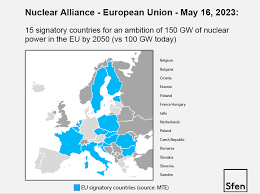
To convey this message, the two governments are counting on the Nuclear Alliance launched in Stockholm in February 2023, which now brings together more than 10 EU countries, including France and Sweden. https://www.euractiv.com/section/energy-environment/news/france-and-sweden-strengthen-cooperation-on-nuclear/
Let’s Talk About Why Nuclear Won’t Work in Australia
Zachariah Kelly 21 Dec 23, Gizmodo
The CSIRO has just put out the latest draft of its GenCost report, a report that delves into the cost of electricity in Australia and what energy types would work in the Australian market. Over the past years, CSIRO has gotten behind onshore wind and solar as the cheapest energy generation methods, and stresses that these energy sources will be instrumental to the future of Australia’s grid, but nuclear energy is something that the science body has shunned for some time now, and this latest report draft seems pretty definite on why.
In tandem with the release of the draft report, the CSIRO has released a blog post directly addressing why nuclear won’t work down under. Put simply, the CSIRO references the collapse of a Small Modular Reactor (SMR) program in the U.S. in November, the Coal Free Power Project, where project costs were estimated at 70 per cent above what was initially projected. It’s a pretty good example of why we can’t just simply introduce nuclear in Australia.
“We don’t disagree with the principle of SMRs.They are an attempt to speed up the building process of nuclear plants using standardised components in a modular system, and it may well be possible to achieve cost reductions over time. However, for now, the technology is yet to be deployed commercially,” GenCost author Paul Graham said.
Put simply, it’s far too expensive and takes too long to set up, according to the CSIRO. With the timeline of projects shown above, the CSIRO is confident that nuclear just won’t work as well for Australia right now, or at least it won’t work as well as onshore wind or solar………………………………………………………………………………….
economist Professor John Quiggin told Gizmodo Australia in September that it’s a very hyped thing, like crypto or AI, and that arguments around nuclear in Australia have been formed from a political place.
“I think the obvious point that people are making is ‘why is Dutton talking about this now? the government was in office for nine years’, because if they started doing something about it in 2013, for example, repealed the ban on nuclear and started establishing an authority, by the time they went out 10 years later, nine years later, then the thing would have been an obvious goal,” Quiggin said.
“It always has to be kept at this stage of ‘why don’t we have the vote?’ because it is just a debating point.”
You can view the GenCost consultation draft here. https://gizmodo.com.au/2023/12/csiro-nuclear-australia/
Atlas Network strategies: how fossil fuel is using “think” tanks to delay action

December 21, 2023, by: Lucy Hamilton, https://theaimn.com/author/lucy-hamilton/
Australians should be wondering why the Centre for Independent Studies (CIS), one of the country’s proudest think tanks, has just established a body promoting nuclear energy that appears to have little to justify it. If the CIS truly believes in the project, surely it would have sought a leader with a stellar resumé?
Earlier this year, environmental journalist George Monbiot warned that the chance of simultaneous harvest failures in the world’s major breadbaskets was “much worse than we thought.” He poured his fury onto the old industries deploying as many Atlas Network-style “junktanks (‘thinktanks’), troll farms, marketing gurus, psychologists and micro-targeters as they need to drag our eyes away from what counts, and leave us talking about trivia and concocted bullshit instead.”
The 500+ global “partner” bodies of the Atlas Network have, for decades, been forming metastasising entities such as “think” tanks to create the sense of a chorus of academic or public support for the junk science and junk political economies that serve their funders. The primary goals have been to liberate plutocrats from any tax or regulation, and fossil fuel bodies have been amongst their most prolific donors.
By contrast with the billions spent to “stop collapse from being prevented,” the effort to prevent Earth systems collapse is led by people “working mostly in their own time with a fraction of the capacity.”
The Atlas strategy involves networking promising ultra-free market spruikers with the astonishing sums of money that fossil fuel and similar industries spend to promote their goals. The spruikers can be trained and cross-connected. Some are helped to create benign-named bodies that describe themselves as think tanks or academic institutes (beachheads) in universities. They found fake grass roots bodies (astroturfing) to pressure politicians into believing that there is public support for a policy. Youthful scholars or strategists co-opted and funded by the machine go on to export the work into politics and the media.
One Australian example is the founder of the Australian Taxpayer Alliance, Tim Andrews. He was a graduate of the Koch Associate Program, a year-long training program at the Charles Koch institute, and worked at the Atlas-partner Americans for Tax Reform for two years. Koch is one of the most significant figures in the Atlas Network’s spread. Andrews is now a member of the UK Atlas Partner, the Taxpayer Alliance Advisory Council.
High profile mining figures in particular unite many of these bodies. In Australia, Hugh Morgan’s name, for example, is present in many of their histories. He assisted Greg Lindsay in turning the CIS from a “part-time hobby” into the more serious institution that it became. Morgan was described in the Sydney Morning Herald in 1985 as “the most important conservative figure in Australia. He is not merely an outspoken captain of industry, he is at the centre of a large and growing network of activists who are seeking to reshape the political agenda in this country.”
In America there is an extensive web of such networks and bodies that interact together. The Atlas Network is important for its international forays into 100 countries, working to infect debate with this American ideology that overwhelmingly promotes the right of corporations to extract resources at any cost to the nation exploited.
Continue readingRegulators approve deal for ratepayers to pay for Georgia Power’s new nuclear reactors

Almost 15 years of wrangling over who should pay for two new nuclear
reactors in Georgia and who should be accountable for cost overruns came
down to one vote Tuesday, with the Georgia Public Service Commission
unanimously approving an additional 6% rate increase to pay for $7.56
billion in remaining costs at Georgia Power Co.’s Plant Vogtle.
The rate increase is projected to add $8.95 a month to a typical residential
customer’s current monthly bill of $157. It would take effect in the
first month after Vogtle’s Unit 4 begins commercial operation, projected
to be sometime in March. A $5.42 rate increase already took effect when
Unit 3 began operating over the summer.
Bryan Jacob of the Southern Alliance for Clean Energy called the vote “disappointing.” He said residential and small business customers paid a disproportionate share of a financing charge that Georgia Power collected during construction, but Tuesday’s vote parceled out additional costs without giving customers credit for heavier shares of earlier contributions.
Independent 19th Dec 2023
https://www.independent.co.uk/news/ap-atlanta-georgia-westinghouse-augusta-b2466797.html
Time to shelve Hinkley Point C?

Alan Debenham: December 19, 2023, https://somersetapple.co.uk/news/time-to-shelve-hinkley-point-c
SEASONAL old TV films could well remind us of the 1990s popular sit-com Drop the Dead Donkey about a fictional national newspaper’s forever squabbling journalists, where it was imperative to drop all stories past their sell-by date. Very much like the growing absurdity of the little-mentioned massive overspend and time delay over the enormous Hinkley C nuclear power station construction project on the Severn estuary. Would be good if last week’s putting a roof on the first reactor was matched with putting a roof on nuclear nonsenses.
The arguments against Hinkley C, from all sides of the media, NGOs and professional experts, definitely have been loud and sustained enough to label it a ‘dead donkey’ which should have ‘died’ at reviews in 2012 and 2015. The enormous cost overrun, going from an original £16bn in 2012 to double that figure announced recently, and an enormous completion time delay, going from first forecast 2017 to now only a single reactor operating by 2027 – both reactors a year later – should have killed off the whole project long time ago.
However, as we all know, big billions of investment have colossal lobbying power – especially with this millionaire-led Tory government regarding its daft nuclear mania around proven existential linkage between nuclear bombs and nuclear power. With our essential public services collapsing around hardworking families now driven to food banks, Tory spending hundreds of billions on maintaining our so-called submarine-based nuclear deterrent and planning to build eight new nuclear power stations – with Labour not far behind – it’s as obscene and broken as parliamentary democracy gets.
Sadly, if ever Hinkley C satisfactorily operates – unlike EDF’s other wonky EPR reactors – it’s likely to be both a miracle and another very big increase in electricity prices for us consumers because of 2013 Coalition’s agreeing far too high an index-linked “strike price” ( £92.50 Mw/hr, uplifted 2022 to £128 ) likely to be 50% above the then ‘global market’ price, unless reduced by some big hidden ‘nuclear levy’ put on all bills.
However, it’s not too late to scrap Sizewell C etc, PLUS join GREEN LEFT policies for: no nuclear, new wealth taxes, funded public services, democracy reform ( inc. PR voting ), de-growth for climate help etc.
Nuclear folks are exaggerating their “win” at COP 28

There was no COP28 pledge to triple nuclear.
After a fight, nuclear got listed as one of a number of possible technologies to use in accelerating transition from fossil fuels.
22 countries, including Canada tried to drive the triple nukes “pledge” but over 200 countries signed on to triple renewables and double energy efficiency ” the renewables pledge is IN the final GST decisions.
Shuttering the Nuclear Weapons Sites: There’s Gold in Those Warheads but the Scrap Metal is Radioactive

by Robert Alvarez, Dec 18, 2023, https://washingtonspectator.org/shuttering-the-nuclear-weapons-sites-theres-gold-in-those-warheads-but-the-scrap-metal-is-radioactive/
As one of my first tasks early in the first Clinton Administration as the newly appointed Deputy Assistant Secretary for Policy, I conducted the first (and only) asset inventory of the U.S. Department of Energy (DOE). In carrying it out, we departed from the usual reliance on DOE contractors, and established a team of federal employees throughout the DOE complex to scour the system for data. In doing this we saved a lot of money and time that would otherwise be consumed by DOE contractors that had perfected the art of cost maximization.
After six months we briefed Energy Secretary O’Leary on what we found. With real estate holdings of more than 2.4 million acres–an area larger than Rhode Island and Delaware combined–the DOE was the largest government-owned industrial energy supply and research enterprise in the country, responsible for:
- More than 20,700 specialized facilities and buildings, including 5,000 warehouses, 7,000 administrative buildings, 1,600 laboratories, 89 nuclear reactors, 208 particle accelerators, and 665 production and manufacturing facilities.
- More than 130,000 metric tons of chemicals, a quantity roughly equivalent to the annual output of a large chemical manufacturer.
- More than 270,000 metric tons of scrap metal—equivalent to more than two modern aircraft carriers in weight. (The dismantlement of three gaseous diffusion plants will generate about 1.4 million metric tons of additional scrap.)
- More than 17,000 pieces of large industrial equipment.
- More than 40,000 metric tons of base metals and more than 10,000 pounds of precious metals, such as gold, silver, and platinum.
- About 700,000 metric tons of nuclear materials, mostly depleted uranium but also including weapons-grade and fuel-grade plutonium, thorium, and natural and enriched uranium.
- About 320,000 metric tons of stockpiled fuel oil and coal for 67 power plants.
- About 600 million barrels of crude oil stored at the Strategic Petroleum Reserve.
- Electrical distribution systems for the Bonneville, Western Area, Southwestern, Southeastern, and Alaska power administrations.
If the Energy Department were a private concern with more than 100,000 employees, it would be one of the nation’s largest and most powerful corporations. And, we determined, if it were privately held, it would be filing for bankruptcy.
Major elements of Energy’s complex were closing down, leaving a huge unfunded and dangerous mess. After more than a half century of making nuclear weapons, the DOE possessed one of the world’s largest inventories of dangerous nuclear materials and it has created several of the most contaminated areas in the Western hemisphere.
We discovered that a significant percentage of overhead expenses at several shuttered sites were from hoarding fungible assets that were no longer needed. The challenge was to empty these warehouses and to generate an income for the U.S. government by selling off valuable excess materials.
Our first effort was aimed at the large amount of uncontaminated precious metals contained in nuclear weapons that would generate millions-of-dollars in revenue from warheads scheduled for dismantlement under the 1991 Strategic Arms Reduction Treaty (START). For the first time, nuclear disarmament would actually make money for the taxpayer.
We were astounded to find that for decades intact weapons components containing large amounts of precious metals were being disposed at great expense in a classified landfill under heavy guard. It took a direct order from the Secretary for DOE’s PANTEX weapons assembly and dismantlement facility near Amarillo, TX to obtain an industrial scale hydraulic hammer to smash non-nuclear components into little pieces so that the gold and other metals can be recovered without revealing design secrets.
Further complicating the process for dismantling weapons, the DOE had failed to properly maintain its system for assessing and evaluating each nuclear weapon for reliability, aging problems, and safe dismantlement. Known as configuration management (CM), this system is a fundamental element in the control of the nuclear stockpile and is based on careful documentation of “as built” drawings and product definitions made during the design, manufacture, assembly, and deployment of a nuclear weapons.
My staff discovered that DOE could not find nearly 60 percent of the “as built” drawings that document all changes made to active weapons selected for dismantlement. I threw a fit and reported it to the front office, which promptly took action.
Over the ensuing decade, we wound up sending about $50 million from the sale of precious metals extracted from dismantled weapons back to the treasury. As a side benefit, we also set up the DOE’s first electronic recycling center to recover fungible materials from DOE’s huge inventory of excess computers.
After receiving a Secretarial Gold Medal for our asset management program, I became increasingly isolated from the DOE front office, and spent most of my time involved with environment, safety and health problems afflicting the DOE nuclear weapons complex. As soon as Secretary O’Leary departed in late 1996, our asset inventory was buried and barred from public disclosure.
However, I drew the line when it came to the disposition of radiologically contaminated materials, such as the vast amount of scrap metal resulting from the decommissioning of nuclear weapons facilities.
In 1994, I blocked a deal that would have allowed some 10,000 tons of radiation-contaminated nickel from nuclear weapons operations to be recycled into the civilian metal supply, where some percentage of it would inevitably wind up in stainless steel items such as intrauterine devices, surgical tools, children’s orthodontic braces, kitchen sinks, zippers, and flatware. However, that confrontation was not to be the end of the scrap metal gambit.
The pressures to recycle 1.7 million metric tons of contaminated metal scrap (equivalent to 17 U.S. aircraft carriers in weight) at nuclear weapons facilities in Tennessee, Kentucky and Ohio were enormous.
I dug in my heels and opposed an effort, supported by Vice President Gore’s office, to release tens of thousands of tons of radiologically contaminated metals into commerce. By claiming cost savings associated with foregoing landfill disposal, DOE contractors would be able to pocket the profits from the sale of scrap. Going forward however, I was seen as obstructionist and was effectively shunned from decision-making circles.
After Hazel O’Leary left as Energy Secretary in late 1996, I lost my political “air cover” and was perceived in the words of a colleague by the incoming leadership of the agency (Secretary Frederico Pena’s team) as “too radioactive.”
Even though I was being excluded from policy decisions, I still persisted.
As a former environmental activist, I had no compunctions about going outside of the Department to convince an old friend at the Natural Defense Resource Council to file a lawsuit to block the free release of the contaminated metal.
I knew that if DOE and its contractors got their way, this practice would lead to a major public backlash. Not to mention the market impacts the contaminated material would create for the U.S. steel industry, which was almost totally dependent on recycled metal for its feedstock. Steel makers had been burned before by errant radiation sources and the last thing they wanted was for the public to realize that the stainless-steel fork on the dinner table had some plutonium in it from a nuclear weapons plant. But consideration of these consequences could easily get overlooked in the DOE, where decisions were made in isolation and secrecy.
The lawsuit stopped the train temporarily. Judge Gladys Kessler, in a strongly worded opinion, stated: “It is . . . startling and worrisome that from an early point on, there has been no opportunity at all for public scrutiny or input in a matter of such grave importance.” Calling the recycling effort “entirely experimental at this stage,” she concluded, “The potential for environmental harm is great, especially given the unprecedented amount of hazardous materials which the defendants seek to recycle.”
In the summer of 1998, I received a call from the White House indicating that I was being fired within the next 30 days. This was the third time my detractors sought to end my tenure as a senior political appointee in DOE’s Policy office. This time, it seemed to be final.
A week before my departure, I was summoned to meet with Bill Richarson – the newly installed Secretary of Energy. He was slouched on the sofa and disheveled after a long day. “I don’t know why you got on the list. You must have pissed-off quite a few people,” he said with a devilish smile. “But you have a lot of folks that want to keep you around. When I visited DOE sites, members of Congress, union officials, Indian tribes, and environmental activists, would ask me about this Alvarez guy.”
He then pulled out a news clipping from the Seattle Times about a walk-out staged by the members of a DOE advisory panel at the Hanford facility in protest to my sacking. “You must be a fighter, I like fighters,” he said approvingly. Richardson reversed the White House decision and appointed me as his Senior Policy Advisor, where I was tasked among other things to end the “hot scrap” recycling scam.
A senior scholar at the Institute for Policy Studies, Robert Alvarez served as senior policy adviser to the Energy Department’s secretary and deputy assistant secretary for national security and the environment from 1993 to 1999.
Catholic activists arrested for anti-nuclear protest outside UN
BY LIAM MYERS, National Catholic Reporter 18 Dec 23
Agroup of Catholic activists blocked the entrance to the United States Mission to the United Nations in New York City on Nov. 30, drawing attention to its lack of participation in UN meetings discussing nuclear disarmament that week.
This nonviolent direct action took place during the Nov. 27-Dec. 1 meeting of the nations who are party to the UN’s Treaty on the Prohibition of Nuclear Weapons, the first legally binding international agreement to prohibit nuclear arms.
Those gathered for the action included the Atlantic Life Community, Catholic Worker communities, NukeWatch, and War Resisters League.
The group met together at the Isaiah Wall — a monument near the UN headquarters inscribed with the famous quotation “They shall beat their swords into plowshares” — before processing toward the U.S. Mission to the UN. At the front of the group, they held aloft a sign that read “Everything to do with nuclear weapons now illegal,” referencing the 50-plus countries who have ratified the nuclear prohibition treaty.
The activists clearly called upon their Catholic faith throughout the action, as another sign featured a quote from Pope Francis: “The use of Nuclear Weapons as well as their mere possession is immoral.”
Upon arrival at the U.S. Mission, these groups created a human blockade of all three public entrances to the building. …………………………………………………………………………………………………………………………………………………………………
Throughout the blockade, which lasted over two hours, there were a number of people standing alongside the sidewalk and supporting those doing the blockade. These people were leafleting, shouting “Sign the Treaty!,” “No More Nukes,” and singing songs.
As the New York Police Department began to move in to make arrests, Bud Courtney, a member of the New York Catholic Worker, led everyone in song playing his guitar as they were being arrested, singing “All we are saying is give peace a chance.” https://www.ncronline.org/news/catholic-activists-arrested-anti-nuclear-protest-outside-un
GMB union says urgent action needed to tackle safety concerns at Sellafield

Guardian investigation has revealed areas that need attention at nuclear site in Cumbria
Guardian, Alex Lawson and Anna Isaac, 19 Dec 23
The GMB trade union has called on the government and nuclear authorities to take “urgent action” to address concerns over safety at Sellafield.
The union has written to the energy minister, the Nuclear Decommissioning Authority (NDA) and Sellafield’s chief executive to demand greater investment into keeping the 11,000 employees at the vast nuclear rubbish dump in Cumbria safe.
Earlier this month, the Guardian revealed a catalogue of concerns over safety at the sprawling 6 sq km (2 sq mile) site in north-west England.
Sources familiar with risk reports at the site have said they showed that more than 100 safety problems are a matter of serious regulatory concern. They include fire safety deficiencies such as a lack of functioning alarms in parts of the site that contain radioactive material. There have been work stoppages due to a lack of suitably qualified staff trained in nuclear safety and increasing numbers of contamination and radiation protection incidents
The issues emerged in Nuclear Leaks, a year-long Guardian investigation into problems spanning cyber hacking and toxic workplace culture at Sellafield, which also revealed the site has a worsening leak from a huge silo of radioactive waste.
The issues emerged in Nuclear Leaks, a year-long Guardian investigation into problems spanning cyber hacking and toxic workplace culture at Sellafield, which also revealed the site has a worsening leak from a huge silo of radioactive waste.
GMB, which represents tens of thousands of workers across the energy industry, said it was “deeply concerned” by the reports of leaks and cybersecurity failings at the site.
GMB national secretary Andy Prendergast said that its members at Sellafield had been raising concerns over a string of problems for years. These included a “lack of training and competence among staff, inadequate safety procedures and a culture of fear and intimidation”.
“GMB has repeatedly raised concerns over safety and staffing levels, which are mainly due to turnover and the age and demographic of the workforce,” Prendergast wrote.
A senior industry source has said that a hardcore of longstanding Sellafield employees who are resistant to change have been nicknamed “We Bees” – short for “we be here when you be gone”. Several sources have cited the area’s insular community and reliance on Sellafield for well-paid employment as a barrier to change.
In his letter to Claire Coutinho, secretary of state for energy security and net zero, which was also sent to Sellafield’s chief executive, Euan Hutton, and the NDA chief, David Peattie, Prendergast called for the trio to take “urgent action to address these concerns”.
In response to the Guardian’s reports, Coutinho wrote to Peattie this month saying allegations about failings in cybersecurity, site safety and workplace culture at Sellafield were “serious and concerning” and needed “urgent attention”.
Her intervention followed the revelation that Sellafield was hacked by groups linked to China and Russia and that the industry regulator, the Office for Nuclear Regulation, had put the site into “significantly enhanced attention” for cybersecurity……………………………………. more https://www.theguardian.com/business/2023/dec/19/gmb-union-says-urgent-action-needed-to-tackle-safety-concerns-at-sellafield
U.S. Nuclear Sector Set for Major Transformation
By ZeroHedge – Dec 18, 2023, https://oilprice.com/Alternative-Energy/Nuclear-Power/US-Nuclear-Sector-Set-for-Major-Transformation.html
- Suggests reducing government intervention in commercial nuclear operations and focusing on public health and safety regulation.
- Calls for the Department of Energy to exit the commercialization of nuclear technology and for states to play a larger role in nuclear regulation.
- Recommends private sector management of nuclear waste and potential insurance coverage options for nuclear reactor accidents outside the federal Price-Anderson program.
The silver lining of this month’s United Nations COP28 global warming conference is the growing consensus that nuclear energy is critical to meeting national carbon dioxide reduction goals.
Denying the world access to clean, affordable fuels like gas, oil, and coal is a real problem. But recognizing that nuclear energy must play a pivotal role in our energy future is a major step forward—one that should enjoy widespread support, regardless of one’s views on CO2 reductions.
But to go big on nuclear requires thinking big on nuclear energy policy, and that means questioning the subsidize-first mentality that has defined U.S. energy policy for decades
The goal should not be to build a few nuclear power plants. Rather, we should strive to create an economically sustainable, competitive, innovative and uniquely American nuclear industry.
This will require a realignment of responsibility. The government’s role should be to protect public health and safety. The private sector’s role should be to operate a competitive commercial nuclear sector.
That means getting rid of the subsidies, rethinking regulation and getting Washington out of nuclear waste management. Washington should have a regulatory role, but not its current role as Nuclear CEO.
The reason is simple: Governments are not good at business, because they make decisions based on politics rather than on good economic sense. This never yields a successful industry.
Some argue that nuclear energy requires more governmental control, suggesting that nuclear presents more financial, technical, and political risks than other industries.
But all big projects have financial risk. Private oil refineries can cost billions of dollars, and projects like skyscrapers, liquid natural gas export terminals and other large industrial projects all require massive capital outlays. Companies and individuals regularly take big financial risks.
Then there is technological risk. But nuclear is not really that different from other industries. With 440 nuclear reactors operating globally, technical risk for existing technology is relatively low. Industry knows how to build and operate nuclear plants.
Possible technological risks with new designs are not beyond the realm of those posed by innovation in other cutting-edge businesses, such as fracking or offshore energy exploration. e. Beyond that, as it pertains to nuclear energy, there is a vast federal research infrastructure in place that the private sector can access to help mitigate that risk.
Political risk, however, is real and uniquely high when it comes to nuclear energy, and it exacerbates financial and technical risk calculations.
Any justification for government intervention is based on mitigating government-imposed risk.
But here is the problem.
When government intervenes to mitigate a risk that it has created, it adds another layer of political risk. Worse, it creates dependence, distorts capital flows, incentivizes rent-seeking and lobbying, and forces firms to allocate resources to satisfy politicians and bureaucrats rather than improve its business.
This creates misalignments between responsibility and authorities and undermines economic efficiency.
Even worse, politics often changes, making it difficult to build a sustainable business model around political preferences. At best, this approach could yield a couple of reactors or keep some firms above water, but it won’t produce a robust, competitive, innovative nuclear industry. Failure is likely.
The major question is: How does America minimize political risk and allow the private sector to manage other risks, so that a robust industry can emerge?
It will require changing the Department of Energy’s role, bold regulatory reforms, and solving the problem of nuclear waste management.
We need to get the Energy Department totally out of the nuclear commercialization business. The problem is not that people are not doing their jobs, the problem is the nature of government.
The Department should not be funding grants, loans, or demonstration projects. Nor should it be attempting to improve operations or economics of existing plants or new technologies. The private sector can do these better than government.
The Energy Department has an important role to play in nuclear research and scientific discovery, but it needs to get as far from any commercialization or commercial operations as possible.
What about regulation?
Worthwhile attempts are being made to improve the Nuclear Regulatory Commission. An efficient, predictable, and affordable regulatory process for new reactor technologies is essential.
But America needs to think bigger.
For example, states could be authorized to take a larger role in nuclear power plant regulation. The Atomic Energy Act of 1954 already allows states to regulate some nuclear materials. That should be expanded. States could regulate existing reactor technology, and the NRC could focus on new technologies. Not all states will use this opportunity, but some will.
This is a reasonable proposition because U.S. utilities have been safely operating large light water reactors for over 50 years. America should not be regulating large light water reactors as new, scary technology, because it is neither new nor scary. The regulatory burden should be significantly lifted on those reactors.
NRC personnel should not be the only ones who can review permit applications and other regulatory review work. Private firms should be able to compete for this business. They would lighten the NRC’s load and likely do a quicker job at lower cost.
Lastly, companies should be allowed to build reactors outside the existing NRC regulatory regime if they obtain their own liability insurance against accidents. In exchange they would forgo participation in the federal Price-Anderson program that currently provides liability coverage.
Some might question whether private insurers would cover a nuclear reactor absent a government backstop. But given outstanding safety records of existing reactors and promises that new technologies are safer, this should be an option. Insurance comes in many forms, and no one can predict what could ultimately emerge.
Either way, the insurance industry is extraordinarily sophisticated and does a tremendous job at pricing risk. It will be effective at ensuring that only the safest nuclear plants are built.
Finally, there is the question of what to do with nuclear waste—or, more accurately, spent nuclear fuel.
The federal government took responsibility for managing the nation’s spent nuclear fuel in 1982. By removing responsibility from the spent fuel producers, the 1982 Nuclear Waste Policy Act removed any incentive for the nuclear industry to integrate spent fuel management into its long-term business planning and left it instead to Washington bureaucrats. It should surprise no one that the plan has failed.
Reforms are needed to reconnect the nuclear industry to waste management. Reforms would allow for a private spent fuel industry to emerge that would drive innovation in reactor technologies and spent fuel processing. They would allow the nuclear industry and communities to engage in real negotiations, bound by legal contracts, to build and operate spent fuel management facilities.
There is no question that these proposed reforms are a major departure from the status quo, but they are reasonable, not radical. They would foster good governance and economic progress in the industry. As COP28 representatives discuss how to reduce carbon while raising global living standards, nuclear energy should be on the front burner.
1 This Month

petition to oppose the rapid increase of space-military industry threatening Jeju Island and the region.
[Petition by April 19th (KST)] Stop the joint military-Hanwha Systems-Jeju Provincial Government Sea Launch!
World Nuclear Power. Reactors 1951-2026, 75 Years of Nuclear Power.
Interactive Map– https://dv.worldnuclearreport.org/

Chernobyl: The Lost Tapes – A good documentary on Chernobyl on SBS available On Demand for the next 3 weeks– https://www.sbs.com.au/ondemand/tv-program/chernobyl-the-lost-tapes/2352741955560

of the week–London Campaign for Nuclear Disarmament


Tell the Ukrainian Government to Drop Prosecution of Peace Activist Yurii Sheliazhenko
To see nuclear-related stories in greater depth and intensity – go to https://nuclearinformation.wordpress.com
-
Archives
- April 2026 (211)
- March 2026 (251)
- February 2026 (268)
- January 2026 (308)
- December 2025 (358)
- November 2025 (359)
- October 2025 (376)
- September 2025 (257)
- August 2025 (319)
- July 2025 (230)
- June 2025 (348)
- May 2025 (261)
-
Categories
- 1
- 1 NUCLEAR ISSUES
- business and costs
- climate change
- culture and arts
- ENERGY
- environment
- health
- history
- indigenous issues
- Legal
- marketing of nuclear
- media
- opposition to nuclear
- PERSONAL STORIES
- politics
- politics international
- Religion and ethics
- safety
- secrets,lies and civil liberties
- spinbuster
- technology
- Uranium
- wastes
- weapons and war
- Women
- 2 WORLD
- ACTION
- AFRICA
- Atrocities
- AUSTRALIA
- Christina's notes
- Christina's themes
- culture and arts
- Events
- Fuk 2022
- Fuk 2023
- Fukushima 2017
- Fukushima 2018
- fukushima 2019
- Fukushima 2020
- Fukushima 2021
- general
- global warming
- Humour (God we need it)
- Nuclear
- RARE EARTHS
- Reference
- resources – print
- Resources -audiovicual
- Weekly Newsletter
- World
- World Nuclear
- YouTube
-
RSS
Entries RSS
Comments RSS
 nuclear-news