Nuclear, and climate, news to 4th December

Some bits of good news. England’s rainforests breathed easier. Treaty on the Prohibition of Nuclear Weapons: A Bright Constellation in a Very Dark Sky.
TOP STORIES
Plot to Triple Nuclear Power by 2050 Decried as ‘Dangerous Distraction’ at COP28.
Ralph Nader -on Israel’s Genocidal Antisemitism Against the Arab Civilians of Gaza.
Small modular nuclear reactors: a history of failure.
Drones Target Ukrainian, Russian Nuclear Facilities.
******************
Climate. “We cannot afford to have a bad COP” – Mary Robinson. COP28: UAE planned to use climate talks to make oil deals. Climate summit in an oil state: can COP28 change anything?Bah Humbug!– to COP Climate Conference sponsored by Dubai, an oil & natural gas nation. COP28: Hopes of fossil fuel ‘phase out’ hit by revelations of Saudi plan to boost oil demand. Cop28: what to expect from the Dubai climate change conference- (behind a pay wall, but read it on nuclear-news.net) How wealthy countries, l(ike U.S., Canada, Australia, and Norway), evade responsibility for their fossil fuel exports. Why the UN Report is right to say we’re heading for at least 3 degrees of warming. ‘Progress this decade is critical’: Why a 1.5C world hinges on doubling down on energy efficiency.
Christina notes. Have you noticed? The nuclear lobby is swamping the news media with its false “nuclear for climate”message. COP 28 A sorry tale of climate hypocrisy.
Nuclear. It’s full on nuclear propaganda time. It’s all in the wording. At COP 28, 20 countries signed up to promote nuclear. 179 COUNTRIES DID NOT SIGN UP TO PROMOTE NUCLEAR.
******************
CLIMATE. DOUBLING DOWN ON NUCLEAR POWER IS NO SOLUTION TO CLIMATE CRISIS. Nuclear vs. Climate: Is nuclear power needed to contain the climate crisis? John Kerry at Cop28 to lobby for the nuclear industry. Nuclear lobby’s big push to ‘shine’ at COP28.
ECONOMICS.
- The nuclear power renaissance has some way to run.
- France goes for its own costly small nuclear reactor, following the USA NuScale flop, and UK’s lagging Rolls Royce one. French nuclear tax is leap into the dark – analysts. EDF to “build 1 reactor a year in 2030s” – CEO.
- The President of the Canadian Nuclear Safety Commission spent $288,000 on travel in 19 months. Hydro- Quebec decides against restarting Gentilly 2 nuclear station.
- NuScale cancels first planned SMR nuclear project due to lack of interest.
- Why Britain’s mini-nukes dream is hanging by a thread. Failure of USA’s NuScale small nuclear reactors (SMRs) not a good omen for Rolls Royce and other UK SMR developers. UK’s first small nuclear reactor deal ‘poised’ for signing but not with Rolls-Royce.
- Operators extend Finnish, Swedish nuclear reactor outages.
EMPLOYMENT. Swiss nuclear power plants are running out of staff.
ETHICS and RELIGION. Holy See advocates collaboration on nuclear disarmament.
LEGAL. Musk’s Lawsuit Is About Destroying Free Speech. Portland nuclear power startup NuScale hit with investor lawsuit.
NUCLEAR TECHNOLOGY. Nuclear Power Expansion Predictions Failed. SMRs two examples: NuScale in the US, NUWARD in France . Can thorium solve the nuclear problem? That’s doubtful.
OPPOSITION to NUCLEAR . Halt the US-Philippines Nuclear Deal –Sign on to Letter to US Congress – Full statement and sign on: tinyurl.com/haltUSPHdeal
PERSONAL STORIES. ‘Let us be a lesson’, say Kazakhs wary of return to nuclear testing.
POLITICS. UK government hopes that United Arab Emirates will invest in Sizewell C nuclear power plan. Energy-rich Scotland does not require any nuclear power stations. Nuclear energy in Philippines? Group says there’s not even a Filipino expert on safety, radiation. Sweden to slug tax-payers for the costs of small nuclear reactors, and big ones. Sovereignty Surrendered: Subordinating Australia’s Defence Industry
POLITICS INTERNATIONAL and DIPLOMACY. Second meeting of states parties agrees nuclear deterrence is the problem. UK’s Sizewell C Nuclear stake seized from China may go to United Arab Emirates. (behind a pay wall, but read it on nuclear-news.net) TELL THE UNITED ARAB EMIRATES NOT TO INVEST IN SIZEWELL C.
PUBLIC OPINION. Renewable or nuclear? What your energy preference says about you – public opinion.
SAFETY. Closer to nuclear plant than ever, latest Korean quake renews calls to retire aging reactors. Olkiluoto 3 nuclear power station shuts down again. Incidents. IAEA experts record explosions near two Ukrainian nuclear power plants. Zaporizhzhia nuclear plant suffered power outage, energy ministry says. Freezing consequences for Mississippi River as nuclear units down.
SPACE. EXPLORATION, WEAPONS. SpaceX rockets keep tearing blood-red ‘atmospheric holes’ in the sky, and scientists are concerned.
SPINBUSTER. Nuclear lobby’s latest gimmick – making nuclear BEAUTIFUL !
WASTES. A blank cheque for France’s Industrial Centre for Geological Disposal (Cigéo) does not prove that it is safe. How to Scrap the First-Ever Nuclear-Powered Aircraft Carrier: USS Enterprise? A sobering analysis of the Canadian plan for small modular nuclear reactors (SMRs) and their toxic waste problem..
WAR and CONFLICT. President Biden has morphed into the Murder Monster. The New York Times Reports Gaza Civilians ‘Are Being Killed at Historic Pace’. Israel’s Savagery Is So Shocking It’s Sometimes Hard To Take In.
A Nuclear Attack by Design — or by Accident — Must Never Happen. A planned US-Israeli attack on Iran is contemplated. AI and the Bomb: Nuclear Strategy and Risk in the Digital Age. URANIUM WARHEAD POISONING IS THE SPECIALTY OF US AGAINST RUSSIANS, ISRAEL AGAINST PALESTINIANS.
WEAPONS and WEAPONS SALES. US nuclear bombs ‘set to return to UK‘ for first time in 15 years – making Lakenheath a “nuclear target”. U.S. to Develop Unanticipated New Nuclear Bomb. Pentagon struggling to pay for Middle East buildup – Politico. The Military’s Big Bet on Artificial Intelligence. ‘The Gospel’: how Israel uses AI to select bombing targets in Gaza. US Sent Israel 15,000 Bombs Since October 7. Australia’s AUKUS nuclear submarines could fuel regional arms race despite assurance.
Plot to Triple Nuclear Power by 2050 Decried as ‘Dangerous Distraction’ at COP28

“Investing now in nuclear energy is an inefficient route to take to reduce emissions at the scale and pace needed to tackle climate change,” said one campaigner.
JON QUEALLY, Dec 02, 2023
Climate campaigners scoffed Saturday at a 22-nation pledge to triple nuclear power capacity by mid-century as a way to ward off the increasing damage of warming temperatures, with opponents calling it a costly and “dangerous” distraction from the urgent need for a fossil fuel phaseout alongside a rapid increase in more affordable and scaleable renewable sources such as wind and solar.
The Declaration to Triple Nuclear Energy—backed by the United States, Canada, France, the Czech Republic, and others—was announced as part of the Climate Action Summit taking place in Dubai as a part of the two-week U.N. climate talks known as COP28.
While the document claims a “key role” for nuclear energy to keep “a 1.5°C limit on temperature rise within reach” by 2050 and to help attain the so-called “net-zero emissions” goal that governments and the fossil fuel industry deploy to justify the continued burning of coal, oil, and gas, critics say the false solution of atomic power actually harms the effort to reduce emissions by wasting precious time and money that could be spent better and faster elsewhere.
“There is no space for dangerous nuclear power to accelerate the decarbonization needed to achieve the Paris climate goal,” said Masayoshi Iyoda, a 350.org campaigner in Japan who cited the 2011 Fukushima disaster as evidence of the inherent dangers of nuclear power.
Nuclear energy, said Iyoda, “is nothing more than a dangerous distraction. The attempt of a ‘nuclear renaissance’ led by nuclear industries’ lobbyists since the 2000s has never been successful—it is simply too costly, too risky, too undemocratic, and too time-consuming. We already have cheaper, safer, democratic, and faster solutions to the climate crisis, and they are renewable energy and energy efficiency.”
When word of the multi-nation pledge emerged last month, Mark Jacobson, professor of civil and environmental engineering at Stanford University and co-founder of The Solutions Project which offers a roadmap for 100% renewable energy that excludes nuclear energy, called the proposal the “stupidest policy proposal I’ve ever seen.”
Jacobson said the plan to boost nuclear capacity in a manner to avert the worst impacts of the climate crisis “will never happen no matter how many goals are set” and added that President Joe Biden was getting “bad advice in the White House” for supporting it.
In comments from Dubai, U.S. climate envoy John Kerry said that while he agrees nuclear will be a “sweeping alternative to every other energy source,” but claimed that “science and the reality of facts” shows the world cannot “get to net-zero by 2050 with some nuclear.”
Numerous studies and blueprints towards a renewable energy future, however, have shown this is not established fact, but rather the position taken by both the nuclear power industry itself and those who would otherwise like to slow the transition to a truly renewable energy system.
Pauline Boyer, energy transition campaign manager with Greenpeace France, said the scientific evidence is clear and it is not in favor of a surge in nuclear power.
“If we wish to maintain a chance of a trajectory of 1.5°C, we must massively reduce greenhouse gas emissions over the coming years, but nuclear power is too slow to deploy in the face of the climate emergency,” she said.
Climate campaigners scoffed Saturday at a 22-nation pledge to triple nuclear power capacity by mid-century as a way to ward off the increasing damage of warming temperatures, with opponents calling it a costly and “dangerous” distraction from the urgent need for a fossil fuel phaseout alongside a rapid increase in more affordable and scaleable renewable sources such as wind and solar.
The Declaration to Triple Nuclear Energy—backed by the United States, Canada, France, the Czech Republic, and others—was announced as part of the Climate Action Summit taking place in Dubai as a part of the two-week U.N. climate talks known as COP28.
While the document claims a “key role” for nuclear energy to keep “a 1.5°C limit on temperature rise within reach” by 2050 and to help attain the so-called “net-zero emissions” goal that governments and the fossil fuel industry deploy to justify the continued burning of coal, oil, and gas, critics say the false solution of atomic power actually harms the effort to reduce emissions by wasting precious time and money that could be spent better and faster elsewhere.
“There is no space for dangerous nuclear power to accelerate the decarbonization needed to achieve the Paris climate goal,” said Masayoshi Iyoda, a 350.org campaigner in Japan who cited the 2011 Fukushima disaster as evidence of the inherent dangers of nuclear power.
“There is no space for dangerous nuclear power to accelerate the decarbonization needed to achieve the Paris climate goal.”
Nuclear energy, said Iyoda, “is nothing more than a dangerous distraction. The attempt of a ‘nuclear renaissance’ led by nuclear industries’ lobbyists since the 2000s has never been successful—it is simply too costly, too risky, too undemocratic, and too time-consuming. We already have cheaper, safer, democratic, and faster solutions to the climate crisis, and they are renewable energy and energy efficiency.”
When word of the multi-nation pledge emerged last month, Mark Jacobson, professor of civil and environmental engineering at Stanford University and co-founder of The Solutions Project which offers a roadmap for 100% renewable energy that excludes nuclear energy, called the proposal the “stupidest policy proposal I’ve ever seen.”
Jacobson said the plan to boost nuclear capacity in a manner to avert the worst impacts of the climate crisis “will never happen no matter how many goals are set” and added that President Joe Biden was getting “bad advice in the White House” for supporting it.
In comments from Dubai, U.S. climate envoy John Kerry said that while he agrees nuclear will be a “sweeping alternative to every other energy source,” but claimed that “science and the reality of facts” shows the world cannot “get to net-zero by 2050 with some nuclear.”
Numerous studies and blueprints towards a renewable energy future, however, have shown this is not established fact, but rather the position taken by both the nuclear power industry itself and those who would otherwise like to slow the transition to a truly renewable energy system.
Pauline Boyer, energy transition campaign manager with Greenpeace France, said the scientific evidence is clear and it is not in favor of a surge in nuclear power.
“If we wish to maintain a chance of a trajectory of 1.5°C, we must massively reduce greenhouse gas emissions over the coming years, but nuclear power is too slow to deploy in the face of the climate emergency,” she said.
“The announcement of a tripling of capacities is disconnected from reality,” Boyer continued. Citing delays and soaring costs, she said the nuclear industry “is losing ground in the global energy mix every day” in favor of renewable energy options that are cheaper, quicker to deploy, and more accessible to developing countries.
Climate campaigners scoffed Saturday at a 22-nation pledge to triple nuclear power capacity by mid-century as a way to ward off the increasing damage of warming temperatures, with opponents calling it a costly and “dangerous” distraction from the urgent need for a fossil fuel phaseout alongside a rapid increase in more affordable and scaleable renewable sources such as wind and solar.
The Declaration to Triple Nuclear Energy—backed by the United States, Canada, France, the Czech Republic, and others—was announced as part of the Climate Action Summit taking place in Dubai as a part of the two-week U.N. climate talks known as COP28.
While the document claims a “key role” for nuclear energy to keep “a 1.5°C limit on temperature rise within reach” by 2050 and to help attain the so-called “net-zero emissions” goal that governments and the fossil fuel industry deploy to justify the continued burning of coal, oil, and gas, critics say the false solution of atomic power actually harms the effort to reduce emissions by wasting precious time and money that could be spent better and faster elsewhere.
“There is no space for dangerous nuclear power to accelerate the decarbonization needed to achieve the Paris climate goal,” said Masayoshi Iyoda, a 350.org campaigner in Japan who cited the 2011 Fukushima disaster as evidence of the inherent dangers of nuclear power.
“There is no space for dangerous nuclear power to accelerate the decarbonization needed to achieve the Paris climate goal.”
Nuclear energy, said Iyoda, “is nothing more than a dangerous distraction. The attempt of a ‘nuclear renaissance’ led by nuclear industries’ lobbyists since the 2000s has never been successful—it is simply too costly, too risky, too undemocratic, and too time-consuming. We already have cheaper, safer, democratic, and faster solutions to the climate crisis, and they are renewable energy and energy efficiency.”
When word of the multi-nation pledge emerged last month, Mark Jacobson, professor of civil and environmental engineering at Stanford University and co-founder of The Solutions Project which offers a roadmap for 100% renewable energy that excludes nuclear energy, called the proposal the “stupidest policy proposal I’ve ever seen.”
Jacobson said the plan to boost nuclear capacity in a manner to avert the worst impacts of the climate crisis “will never happen no matter how many goals are set” and added that President Joe Biden was getting “bad advice in the White House” for supporting it.
In comments from Dubai, U.S. climate envoy John Kerry said that while he agrees nuclear will be a “sweeping alternative to every other energy source,” but claimed that “science and the reality of facts” shows the world cannot “get to net-zero by 2050 with some nuclear.”
Numerous studies and blueprints towards a renewable energy future, however, have shown this is not established fact, but rather the position taken by both the nuclear power industry itself and those who would otherwise like to slow the transition to a truly renewable energy system.
Pauline Boyer, energy transition campaign manager with Greenpeace France, said the scientific evidence is clear and it is not in favor of a surge in nuclear power.
“If we wish to maintain a chance of a trajectory of 1.5°C, we must massively reduce greenhouse gas emissions over the coming years, but nuclear power is too slow to deploy in the face of the climate emergency,” she said.
“The announcement of a tripling of capacities is disconnected from reality,” Boyer continued. Citing delays and soaring costs, she said the nuclear industry “is losing ground in the global energy mix every day” in favor of renewable energy options that are cheaper, quicker to deploy, and more accessible to developing countries.
In 2016, researchers at the University of Sussex and the Vienna School of International Studies showed that “entrenched commitments to nuclear power” were likely “counterproductive” towards achieving renewable energy targets, especially as “better ways to meet climate goals”—namely solar, wind, geothermal, and hydropower–were suppressed.
In response to Saturday’s announcement, Soraya Fettih, a 350.org campaigner from France, which relies heavily on nuclear power, said it’s simply a move in the wrong direction. “Investing now in nuclear energy is an inefficient route to take to reduce emissions at the scale and pace needed to tackle climate change,” said Fettih. “Nuclear energy takes much longer than renewable energy to be operational.”
Climate campaigners scoffed Saturday at a 22-nation pledge to triple nuclear power capacity by mid-century as a way to ward off the increasing damage of warming temperatures, with opponents calling it a costly and “dangerous” distraction from the urgent need for a fossil fuel phaseout alongside a rapid increase in more affordable and scaleable renewable sources such as wind and solar.
The Declaration to Triple Nuclear Energy—backed by the United States, Canada, France, the Czech Republic, and others—was announced as part of the Climate Action Summit taking place in Dubai as a part of the two-week U.N. climate talks known as COP28.
While the document claims a “key role” for nuclear energy to keep “a 1.5°C limit on temperature rise within reach” by 2050 and to help attain the so-called “net-zero emissions” goal that governments and the fossil fuel industry deploy to justify the continued burning of coal, oil, and gas, critics say the false solution of atomic power actually harms the effort to reduce emissions by wasting precious time and money that could be spent better and faster elsewhere.
“There is no space for dangerous nuclear power to accelerate the decarbonization needed to achieve the Paris climate goal,” said Masayoshi Iyoda, a 350.org campaigner in Japan who cited the 2011 Fukushima disaster as evidence of the inherent dangers of nuclear power.
“There is no space for dangerous nuclear power to accelerate the decarbonization needed to achieve the Paris climate goal.”
Nuclear energy, said Iyoda, “is nothing more than a dangerous distraction. The attempt of a ‘nuclear renaissance’ led by nuclear industries’ lobbyists since the 2000s has never been successful—it is simply too costly, too risky, too undemocratic, and too time-consuming. We already have cheaper, safer, democratic, and faster solutions to the climate crisis, and they are renewable energy and energy efficiency.”
When word of the multi-nation pledge emerged last month, Mark Jacobson, professor of civil and environmental engineering at Stanford University and co-founder of The Solutions Project which offers a roadmap for 100% renewable energy that excludes nuclear energy, called the proposal the “stupidest policy proposal I’ve ever seen.”
Jacobson said the plan to boost nuclear capacity in a manner to avert the worst impacts of the climate crisis “will never happen no matter how many goals are set” and added that President Joe Biden was getting “bad advice in the White House” for supporting it.
In comments from Dubai, U.S. climate envoy John Kerry said that while he agrees nuclear will be a “sweeping alternative to every other energy source,” but claimed that “science and the reality of facts” shows the world cannot “get to net-zero by 2050 with some nuclear.”
Numerous studies and blueprints towards a renewable energy future, however, have shown this is not established fact, but rather the position taken by both the nuclear power industry itself and those who would otherwise like to slow the transition to a truly renewable energy system.
Pauline Boyer, energy transition campaign manager with Greenpeace France, said the scientific evidence is clear and it is not in favor of a surge in nuclear power.
“If we wish to maintain a chance of a trajectory of 1.5°C, we must massively reduce greenhouse gas emissions over the coming years, but nuclear power is too slow to deploy in the face of the climate emergency,” she said.
“The announcement of a tripling of capacities is disconnected from reality,” Boyer continued. Citing delays and soaring costs, she said the nuclear industry “is losing ground in the global energy mix every day” in favor of renewable energy options that are cheaper, quicker to deploy, and more accessible to developing countries.
In 2016, researchers at the University of Sussex and the Vienna School of International Studies showed that “entrenched commitments to nuclear power” were likely “counterproductive” towards achieving renewable energy targets, especially as “better ways to meet climate goals”—namely solar, wind, geothermal, and hydropower–were suppressed.
In response to Saturday’s announcement, Soraya Fettih, a 350.org campaigner from France, which relies heavily on nuclear power, said it’s simply a move in the wrong direction. “Investing now in nuclear energy is an inefficient route to take to reduce emissions at the scale and pace needed to tackle climate change,” said Fettih. “Nuclear energy takes much longer than renewable energy to be operational.”
Writing on the subject in 2019, Harvard University professor Naomi Orseskes and renowned author and psychohistorian Robert Jay Lifton observed how advocates of nuclear power declare the technology “clean, efficient, economical, and safe” while in reality “it is none of these. It is expensive and poses grave dangers to our physical and psychological well-being.”
“There are now more than 450 nuclear reactors throughout the world,” they wrote at the time. “If nuclear power is embraced as a rescue technology, there would be many times that number, creating a worldwide chain of nuclear danger zones—a planetary system of potential self-annihilation.”
SMRs two examples. NuScale in the US, NUWARD in France
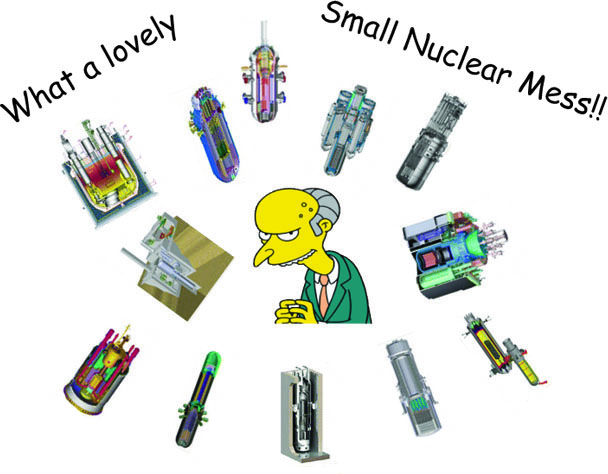
Samedi 2 décembre 2023, par Bernard Laponche, Jean-Luc Thierry, https://global-chance.org/SMRs-two-examples-NuScale-in-the-US-NUWARD-in-France
In recent years, a new type of reactor has appeared on the world stage, the SMR – Small Modular Reactor. Historically, a number of “small reactors” of very different types have been in operation – small in terms of power compared with the reactors of nuclear power plants currently in operation around the world – notably for use in ship propulsion, such as the nuclear submarines of the pressurized water/enriched uranium type.
The “modular” feature of an SMR is achieved by mass production in a dedicated plant. It would then be transported to the operating site, where it would be connected to the heat or electricity production system to form a “module” and then a “power plant”, known as an “SMR”. The hope of SMR promoters rests on the hoped-for gain in unit reactor cost due to the series effect, as they are rightly aware that the cost of a site-built model is far too high.
At present, according to the International Atomic Energy Agency (IAEA), there are almost a hundred “candidate” SMR projects/designs, some of them based on existing prototypes (“small” but not “modular”), most of them existing only on paper, of various power ratings, from enriched uranium and pressurized water reactors, a well-known technology, to plutonium fast neutron reactors, thorium or molten salt reactors, etc. There are no existing SMRs at present.

In addition to a general presentation of the SMR issue and a selection of IAEA projects, this report examines two “SMR candidate” reactor projects in the enriched uranium and pressurized water (PWR) family of reactors : NuScale in the USA and NUWARD in France. Numerous safety-related questions remain unanswered about the NuSCale model, and the Safety Options File for the NUWARD reactor, studied by the French, Czech and Finnish safety authorities, is not yet available. The technical challenges to be met to guarantee SMR safety are not qualitatively different from those of large reactors.

These challenges are compounded by the uncertainties brought about by the reactor’s novel “compact” design, which contains the reactor core (the site of the nuclear fission reaction), the control rods, the steam generator(s) and the pressurizer in a single enclosure. The SMR gamble is not only risky in terms of the bill, but also in terms of the climate, technical and safety agendas, as well as entailing the negative externalities of nuclear installations such as the risk of nuclear accidents and the production of waste that we are relegating to future generations, at least for the next 100,000 years. These reactors also entail other risks, including proliferation.
The complete text is available here : https://global-chance.org/Les-SMR-Deux-exemples-NuScale-et-NUWARD
Holy See advocates collaboration on nuclear disarmament
Archbishop Gabriele Cacccia, the Holy See’s Permanent observer to the United Nations, highlights the disproportionate impact of nuclear weapons on women and girls, and urges synergy between the Treaty on the Prohibition of Nuclear Weapons and existing disarmament measures.
By Francesca Merlo, https://www.vaticannews.va/en/vatican-city/news/2023-12/archbishop-caccia-united-nations-nuclear-weapons-disarmament.html—
Nuclear weapons have catastrophic humanitarian and environmental consequences, multiply risks and offer only ‘an illusion of peace’.
Thus, the the Treaty on the Prohibition of Nuclear Weapons reminds us that a world free of atomic weapons “is possible and necessary and offers us a means to achieve this goal through dialogue”.
These were the points made by Archbishop Gabriele Caccia, Permanent Observer of the Holy See to the United Nations, at the second Meeting of States Parties to the Treaty, signed in 2017 and ratified by 56 countries around the world.
The Archbishop focused on two addresses concerning two fundamental aspects of the Treaty on the Prohibition of Nuclear Weapons: “Implementing the gender provisions of the treaty” and “Complementarity of the Treaty with the existing nuclear disarmament and non-proliferation regime”.
Gender disparity
Speaking on the issue of gender disparity, Archbishop Caccia noted that, for a long time, it was believed that nuclear weapons affected those exposed equally through blast, heat and radiation. However, he said, “newer scientific evidence has shown that this is not the case, and that the radiation effects of nuclear weapon detonations are disproportionately affecting women and girls”.
Archbishop Caccia noted that the Treaty rightly recognises this and “calls for the provision of assistance to victims to be provided in a manner that takes into account the particular needs of each individual”.
The effects on women
Girls exposed to radiation from birth to age five are almost ten times more likely to develop cancer compared to the typical European male. Further research into the factors causing this disproportionate impact on women and children, such as on intergenerational consequences like maternal and fetal health, is essential, said Archbishop Caccia.
This understanding is crucial “to ensure that women exposed to ionizing radiation receive adequate care to preserve their health and the health of their babies”.
The Archbishop went on to stress that “The absence of a solid scientific foundation will hinder States Parties’ effective implementation of the Treaty’s positive obligations, especially those concerning women and girls”, before going on to highlight some queries the Holy See has with the same Treaty.
Use of language
These are the use of unclear language regarding gender, using non-legal terms in discussing assistance for victims, divisive language concerning medical care, and referencing a UN text that hasn’t been negotiated. Because of these issues, “the Holy See cannot support the recommendations outlined in the Report”, said Archbishop Caccia.
Concluding his speech on the implementation of gender provisions in the Treaty, Archbishop Caccia stressed that, due to these significant concerns, “the Holy See considers that the inclusion of a Gender Focal Point in the intersessional structure of the Treaty may need to be reconsidered in the future.”
Relationship between Treaty and existing non-proliferation regime
Addressing the relationship between the Treaty and existing nuclear disarmament and non-proliferation regime, Archbishop Caccia noted that the Treaty on the Prohibition of Nuclear Weapons (TPNW) bolsters Article VI of the Nuclear Non-Proliferation Treaty (NPT) by enforcing the Additional Protocol and the Revised Small Quantities Protocol for states that have signed them. “Despite the NPT’s lagging implementation efforts, particularly under the disarmament pillar, it remains the cornerstone of the disarmament and non-proliferation regime”, he said.
All treaties together
Archbishop Caccia went on to emphasise the potential synergy between the Comprehensive Nuclear-Test-Ban Treaty (CTBT) and the TPNW. He highlighted the importance of leveraging data from the International Monitoring System (IMS) to support the TPNW’s obligations, urging collaboration between TPNW States Parties and CTBT Signatories. “Since the objects and purposes of the TPNW and the CTBT complement and advance one another, it follows that they should be promoted in parallel”, he explained.
Archbishop Caccia concluded that “the Holy See supports greater engagement between TPNW States Parties and the United Nations Scientific Committee on the Effects of Atomic Radiation (UNSCEAR)”, explaining that this could advance understanding of the human and environmental harms caused by nuclear weapons activities “and contribute to efforts to address such harms”.
Nuclear lobby’s latest gimmick – making nuclear BEAUTIFUL !

Making nuclear power plants look great, World Nuclear News, 01 December 2023

They must be desperate. They’ve tried – renewable, -clean, – safe – cheap, – nothing-to-do-with weapons
They’re still lying their heads off about –fixes climate change
Nobody believes them. Now they’re going for beautiful and feel-good.
Good luck with that.
Amber Rudd, a previous UK Minister for Energy tried that, years ago, and it went down like a lead balloon.
We hear from an award-winning architect on the benefits of designing nuclear power plants that make people feel good ....
Technology and function, ensuring their reliable and safe operation have long been the priorities when designing nuclear power plants. But why can’t they look beautiful too? Dutch architect and designer Erick van Egeraat says that part of the way to continue to build public support for nuclear energy is to make nuclear power plants look good, “to make people feel good” when they see them.
The award-winning professor and director of Design Erick van Egeraat outlined his thinking at World Nuclear Symposium, explaining the background to the work he is doing at Akkuyu nuclear power plant, which is being built in Turkey.
Israel Planning for Gaza War To Last Over a Year
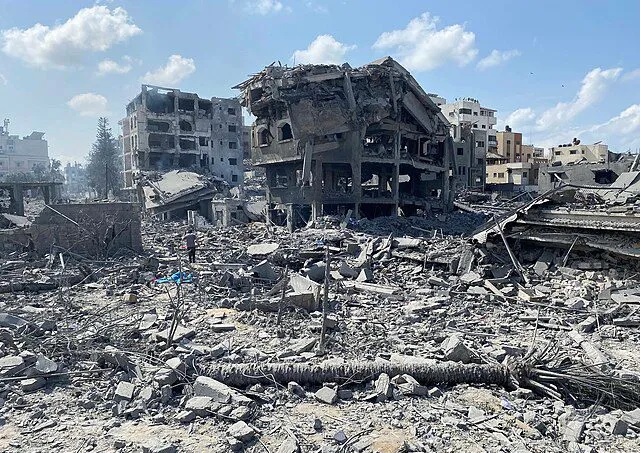
In either case, the Israeli military operations have killed more children, at least 6,000, than members of Hamas.
https://news.antiwar.com/2023/12/01/israel-planning-for-gaza-war-to-last-over-a-year/
One source said, “This will be a very long war . . . We’re currently not near halfway to achieving our objectives.”
The Financial Times reported speaking with sources who said that Israel plans to wage war on Gaza for over a year. In a little less than two months, Israel has killed at least 15,000 people, damaged 100,000 buildings, displaced 1.7 million Palestinians, and destroyed most of Gaza’s medical facilities.
On Friday, FT reported sources said Israel was preparing for a multi-phase conflict in Gaza that will last at least a year. “This will be a very long war…We’re currently not near halfway to achieving our objectives,” said one person familiar with the Israeli war plans.
According to the sources, Israel’s goals include “killing the three top Hamas leaders — Yahya Sinwar, Mohammed Deif, and Marwan Issa — while securing a decisive military victory against the group’s 24 battalions and underground tunnel network and destroying its governing capability in Gaza.”
Israel does not appear close to achieving these goals. US sources have said that Israel’s military operations in Gaza have failed to impact high or even mid-level Hamas members. On Sunday, the Guardian reported that Israeli officials estimated that 1,000 – 2,000 Hamas members had been killed. However, FT spoke with an Israeli military source who gave an estimate of 5,000 dead Hamas members. It is unclear why there is such a large discrepancy in the numbers, as both were given during the week-long pause in fighting.
In either case, the Israeli military operations have killed more children, at least 6,000, than members of Hamas. The massive civilian toll has led to mounting world opinion against Israeli military operations.

Secretary of State Antony Blinken attended a meeting of the Israeli war cabinet on Thursday and warned that Tel Aviv will lose more international support as the conflict continues. Gen. Herzi Halevi, the Israeli Defense Forces (IDF) chief of staff, said military operations in Gaza will take “more than a few additional weeks,” suggesting Tel Aviv did not plan to follow Washington’s advice. Still, America’s top diplomat said Washington was still firmly committed to arming Tel Aviv.
The first phase of the war, an intense bombing campaign and ground invasion, is expected to last well into 2024. One source said the first phase of the war is about 40% complete. “Gaza City isn’t finished yet, nor fully conquered. It’s probably 40% done,” the person explained. “For the north as a whole, it will probably require another two weeks to a month.”
The second phase will be an operation with fewer military operations aimed at stabilizing Gaza. While the sources told FT that the second phase is projected to continue until late 2024, Israeli officials say they cannot predict a firm endpoint to the conflict.
The Biden administration has pushed Israeli Prime Minister Benjamin Netanyahu to agree to allow the Palestinian Authority to control Gaza after Hamas is defeated. However, one source told FT that Tel Aviv will not listen to Washington, even as the US provides Israel with billions of dollars in weapons. “No one, not even the US, can talk to them about this,” said one of the sources familiar with the matter. That person emphasized that this point was crucial to Netanyahu keeping his far-right war cabinet together.
Why the UN Report is right to say we’re heading for at least 3 degrees of warming

100% Renewables 2nd Dec 2023
Despite a flurry of headline-jerking agreements at Dubai’s COP28 a UN Report suggests that global warming will reach 3 degrees. This conclusion, issued by the UN Environment Programme’s ‘Emissions Gap Report’, is based on the continuation of current policies. This assumes, for instance that in the UK and the USA, the targets for net zero greenhouse gas emissions by 2050 not achieved. This, by the way, is by no means an unreasonable assumption. In fact, as things stand at the moment, it’s dead right!
Achieving the 2050 net zero target means that all heating, transport and industrial energy uses need to be decarbonised. Then the production of electricity will have to be greatly expanded. That, actually, is the easier task eg if you consider that the whole of the UK’s energy supply could be supplied by electricity from offshore windfarms occupying less than 10 per cent of the UK’s seawaters……………………………………………….
it does seem likely (on the basis of the UN analysis) that we are facing a temperature increase of 3 degrees above industrial levels. Temperatures have now risen by 1 degree and the effects are apparent. Yes, these COP events are, as Greta Thunberg said, by and large, just ‘blah blah blah’. https://100percentrenewableuk.org/why-the-un-report-is-right-to-say-were-heading-for-at-least-3-degrees-of-warming
A blank cheque for France’s Industrial Centre for Geological Disposal (Cigéo) does not prove that it is safe.
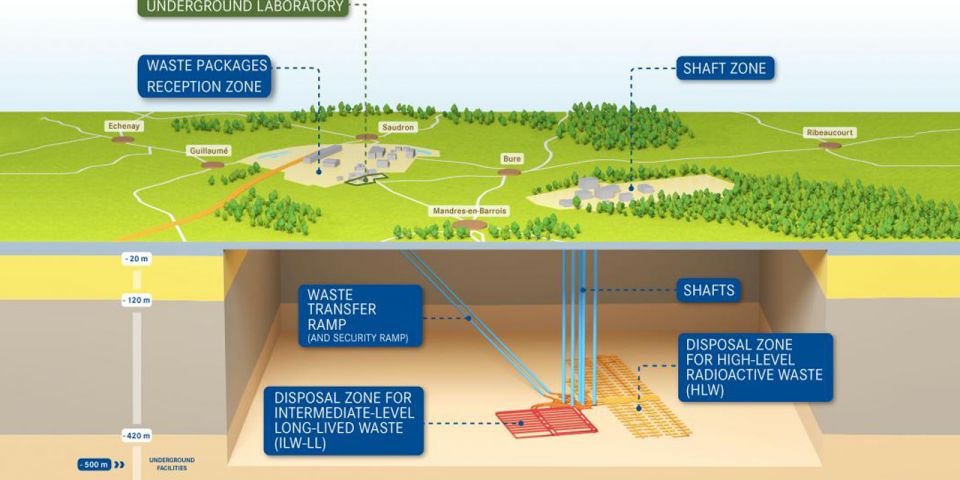
In September 2022, 32 organizations and 30 residents jointly filed an
appeal contesting the declaration of public utility (DUP) which was granted
to the Cigéo project (deep geological burial project for the most
radioactive waste) by decree on July 7, 2022.
This decision allowed the
National Agency for Radioactive Waste Management (ANDRA) to acquire the
missing land control for surface installations and the plumbness of
underground works, i.e. approximately 3,500 hectares (the equivalent of the
surface area of Lille) and to expropriate if necessary.
More than a year
later, on December 1, 2023, the Council of State rendered its decision.
Despite all the uncertainties and inaccuracies of the impact study of the
Cigéo project, ANDRA has succeeded in painting with scientific virtues the
fact that it is unable to provide precise evaluations, even with a
Declaration of ‘Public Utility (DUP) of 6,000 pages and almost 30 years of
studies.
It was enough for the Agency to affirm that it will do its best to
precisely identify the impacts of its project and to analyze and counter,
as the construction of Cigéo progresses, all their consequences. We do not
understand how such a project was able to obtain a DUP when it lacks so
much precise “basic” information. Let us remember: the declaration of
public utility facilitates land control, or even the start of work on other
so-called “preparatory” developments for Cigéo and allows the
industrial site to be physically anchored in the territory.
But for those
who read this decision a little too quickly, no, Cigéo is still not
“validated”. The project still needs to pass the stages of creation
authorization which, without giving up, we will attack by all means when
the time comes. We will at least have warned current decision-makers and
present generations and left messages for future generations, engraved in
stone in the archives of the Republic and its Councils.
Sortir du Nucleaire 1st Dec 2023
https://www.sortirdunucleaire.org/CIGEO-un-blanc-seing-qui-ne-signifie-pas-son
US Sent Israel 15,000 Bombs Since October 7
The transfer has included thousands of 2,000-pound bombs that have been used to devastate Gaza.
By Kyle Anzalone / Antiwar.com, https://scheerpost.com/2023/12/03/us-sent-israel-15000-bombs-since-october-7/
The Wall Street Journal published details about the White House’s secretive arms transfers to Israel since October 7. The US has provided Israel with 57,000 artillery shells and 15,000 bombs, including over 5,000 with 2,000-pound warheads.
According to a list of weapons obtained by the Journal, the US has shipped Israel “more than 5,000 Mk82 unguided or ‘dumb’ bombs, more than 5,400 Mk84 2,000-pound warhead bombs, around 1,000 GBU-39 small diameter bombs, and approximately 3,000 JDAMs.”
The US has additionally shipped 57,000 155 MM shells to Israel. NBC News previously reported in October that Washington sent Tel Aviv artillery rounds that are cluster munitions.
Mick Mulroy, a former deputy assistant secretary of defense and officer in the Marine Corps, described the weapons as those the US would use in non-urban areas. “They are kind of the weapons of choice for the fights we had in Afghanistan and Syria in open, non-urban areas,” he said. “The US may use them in more urban areas, but first it would do a lot of target analysis to make sure the attack was proportional and based on military necessity.”
By contrast, Gaza is about 140 sqare miles and home to 2.3 million people—one of the most densely packed regions on earth. Additionally, Israel has relied on an AI program to rapidly generate lists of suspected low-level Hamas members to target, without respect to civilians in proximity.
The Israeli policy has led to the widespread devastation of Gaza. At least 15,000 civilians have been killed. The number of dead Palestinian children exceeds the number of Hamas fighters Israel has claimed to kill by many thousands. Nearly 100,000 buildings in Gaza have been damaged by Israel’s bombing campaign, including the destruction of universities, hospitals, schools, and entire residential neighborhoods.
On Saturday, the New York Times reported that Israel was killing civilians in Gaza at a “historic pace.” The outlet added that part of the explanation for the huge death toll was Tel Aviv’s willingness to drop 2,000-pound American-made bombs on various civilian centers.
Marc Garlasco, a former Pentagon analyst who advises the Dutch organization PAX, told the Times that he’s never seen anything like it. “It’s beyond anything that I’ve seen in my career,” he said. Garlasco added that to find a historical comparison for so many large bombs in such a small area, one would have to “go back to Vietnam or the Second World War.”
Israeli officials and American politicians have attempted to justify Tel Aviv’s slaughter of Palestinians in Gaza by referring to the allied bombings of Tokyo during World War II. In a single night during the bombing of Tokyo, more than 100,000 people were burned to death by American napalm bombs.
The White House has made some requests to Tel Aviv to try to curb civilian casualties. However, the Biden administration has refused to condition future weapons shipments to Israel on reducing the civilian death toll.
The US has primarily relied on aircraft for quick shipment to Israel hundreds of millions of dollars in arms during the past two months. Unlike weapons shipments to Ukraine, the Biden administration has refused to provide the public with information on the arms it is providing to Tel Aviv.
More explosive power used against Gaza in a month than on Hiroshima
https://www.rt.com/news/588318-israel-gaza-bombing-report/ 3 Dec 23
Israel’s offensive against Hamas has also been deadlier than years of US assaults on Afghanistan and Iraq, according to a UN report
RT’s Steve Sweeney takes a look at the overall statistics from Israel’s relentless assault on Gaza as it seeks to eliminate the militant group Hamas. The damage sustained by the Palestinian enclave has already been described by the UN as “the darkest chapter in Palestinian history.”
According to a new UN report, the combined explosive power unleashed by the IDF in Gaza since October 7 already exceeds that of the atomic bomb dropped on Hiroshima by the US at the end of WWII. The Palestinian death toll is now higher than the count following several years of US strikes on Afghanistan and Iraq.
The Israeli bombardment campaign was launched following the surprise Hamas attack on Israel, in which 1,200 people were killed. Israel’s response has so far claimed the lives of over 15,000 Gazans, including some 6,000 children, according to the enclave’s health officials.
Watch the full report here: on original
The Nakba 2.0: Issa Amro’s Insider Account of Israeli Torture in Hebron
By Alan Macleod and Mnar Adley / MintPress News
Coming back to his house on October 7, world-renowned activist Issa Amro was dragged away by 15 armed Israelis, blindfolded, gagged, and cuffed so tightly he now needs an operation on his hands. The settlers and soldiers kept him imprisoned for days, beating and torturing him, constantly simulating his execution.
Speaking with MintPress News, Amro told the story of what life is like for Palestinians living in the West Bank city of Hebron. “In my city where I live now, since October 7, there is a curfew,” he told Mnar Adley and Alan MacLeod.
But this curfew is far more restrictive than others. Palestinian families – those who have not already fled the genocidal Israeli violence – are given only six hours a week to leave their homes. They are not even allowed out into their own yards. This means that school has stopped, work has ended, and life is on pause.
In those six hours, Palestinian families must buy all their food, pick up essentials such as medicine and conduct any social activities. But being outside is dangerous, as they have to pass though multiple checkpoints with armed guards and AI smart shooters pointing guns at them. Violence from vigilante settler groups is also a danger.
“It’s scary to walk alone between armed soldiers and armed settlers, all of them pointing their guns at you. Then, when you come back, it takes them five to ten minutes to search every person,” Amro said, revealing that the guards wanted to go so far as to cut open his potatoes and tomatoes to check for “weapons.”
“It’s a kind of jail” right now, Amro said, although he notes that being in jail is considerably safer than being a Palestinian in Hebron right now.
Issa Amro is an activist and the co-founder of the grassroots group Youth Against Settlements. He has led campaigns of non-violent civil disobedience against apartheid and Israeli occupation and has been recognized and given awards by international organizations, including the United Nations. He joins MintPress to chronicle recent Israeli attempts to force Palestinians from their homes and their ancestral land.
While leaving the house is extremely dangerous, staying inside is barely safer. Amro and others have experienced Israeli raids where troops tell Palestinians that they have 24 hours to leave or they will be murdered.
“History is repeating itself,” Amro told Adley and MacLeod today, “Now I understand why my people left in 1948,” referencing the Israeli genocide of three-quarters of a million Palestinians from their land in order to create the state of Israel.
It is no exaggeration to call the current Israeli actions genocidal. Indeed, senior Israeli politicians are directly comparing it to the events of 1948. Agriculture Minister Avi Dichter, for example, described his country’s actions as the “Gaza Nakba 2023.” “We are now rolling out the Gaza Nakba,” he told local outlet Channel 12 on Saturday. “From an operational point of view, there is no way to wage a war – as the Israeli army seeks to do in Gaza – with masses between the tanks and the soldiers,” he added.
In this conversation, Amro provides a crucial first-hand perspective rarely heard in corporate media. Watch the full interview only at MintPress News.
1 This Month
Chernobyl: The Lost Tapes – A good documentary on Chernobyl on SBS available On Demand for the next 3 weeks– https://www.sbs.com.au/ondemand/tv-program/chernobyl-the-lost-tapes/2352741955560

of the week–London Campaign for Nuclear Disarmament

Tell the Ukrainian Government to Drop Prosecution of Peace Activist Yurii Sheliazhenko
To see nuclear-related stories in greater depth and intensity – go to https://nuclearinformation.wordpress.com
-
Archives
- April 2026 (126)
- March 2026 (251)
- February 2026 (268)
- January 2026 (308)
- December 2025 (358)
- November 2025 (359)
- October 2025 (376)
- September 2025 (257)
- August 2025 (319)
- July 2025 (230)
- June 2025 (348)
- May 2025 (261)
-
Categories
- 1
- 1 NUCLEAR ISSUES
- business and costs
- climate change
- culture and arts
- ENERGY
- environment
- health
- history
- indigenous issues
- Legal
- marketing of nuclear
- media
- opposition to nuclear
- PERSONAL STORIES
- politics
- politics international
- Religion and ethics
- safety
- secrets,lies and civil liberties
- spinbuster
- technology
- Uranium
- wastes
- weapons and war
- Women
- 2 WORLD
- ACTION
- AFRICA
- Atrocities
- AUSTRALIA
- Christina's notes
- Christina's themes
- culture and arts
- Events
- Fuk 2022
- Fuk 2023
- Fukushima 2017
- Fukushima 2018
- fukushima 2019
- Fukushima 2020
- Fukushima 2021
- general
- global warming
- Humour (God we need it)
- Nuclear
- RARE EARTHS
- Reference
- resources – print
- Resources -audiovicual
- Weekly Newsletter
- World
- World Nuclear
- YouTube
-
RSS
Entries RSS
Comments RSS
 nuclear-news