The blockbuster movie ‘Oppenheimer’ leaves out the real story’s main characters: New Mexicans

The terrible emptiness of “Oppenheimer” Searchlight New Mexico, by Alicia Inez Guzmán, August 8, 2023
Bernice Gutierrez was eight days old when a light 10,000 times hotter than the surface of the sun cracked open the predawn sky. No one in south-central New Mexico knew where it came from, or that the tiniest units of matter could be split to unleash such energy. Nor could they know that when the cloud that followed bloomed some 50,000 feet into the sky, it was surrounded for the briefest of seconds by a blue halo, the “glow of ionized air,” as the Manhattan Project physicist Otto Frisch described it.
The impacts of that unholy halo were all too apparent in the years after, when her great-grandfather died of stomach cancer. One person after another would receive their own wrenching cancer diagnoses — 41 people in her immediate family, spanning five generations. Every one of them had lived in the Tularosa Basin and within 50 miles of the Trinity Site, where the first atomic bomb, nicknamed “Gadget,” was detonated on the northern edge of the Chihuahuan Desert.
Gutierrez was one of a group of downwinders, including Mary Martinez White and Tina Cordova, cofounder of the Tularosa Basin Downwinders Consortium, who watched the movie “Oppenheimer” together when it opened. In one scene after another, New Mexico’s landscapes unfurled — all painfully beautiful and all, it appeared, empty and unpeopled.
In New Mexico, we have lived in the blind spot of a national narrative for eight decades, repeated once again in this box office hit. Over its exhaustive three-hour run-time, it managed to avoid mentioning what we here have been sharing with loved ones at kitchen tables for decades: the violent evictions that took place on the Pajarito Plateau to build Los Alamos, the Pueblo and Hispanic men and women who did essential work for the Manhattan Project, or the thousands of New Mexicans affected to this day by the Trinity test.
To watch J. Robert Oppenheimer’s character instead create and destroy in the state’s big, beautiful and ostensibly barren lands is to deny the presence of so many people whose lives were indelibly transformed by the dawn of the atomic era and continue to be shaped by the juggernaut that is today’s nuclear industrial complex.
Oppenheimer, the son of a wealthy businessman, had come here as part of a cultural moment. He hiked, rode horses and camped. He stayed at a dude ranch in Pecos. He fell in love with and then changed New Mexico forever.
“I am responsible for ruining a beautiful place,” he would later confess.
The film, Gutierrez said, skipped blithely over the ruin. “They leave out the fact that in those isolated areas lived ranchers whose lands they took away and who were never compensated for it.”
The blast was so hot it liquified sand and pieces of the bomb into hunks of green glass. Lead-lined tanks were dispatched to take soil samples at ground zero as fallout cascaded across 46 states. Ash fell from the sky like snow for days afterward, contaminating cisterns, acequias, crops, livestock, clothing and people. At the time of the detonation, 13,000 people lived within a 50-mile radius.
‘Love-struck’ with the beauty
Oppenheimer initially arrived in New Mexico among a wave of smitten travelers. Artists, writers, dancers, anthropologists, museum boosters, health seekers and at least one psychoanalyst (Carl Jung), all had come as well-to-do tourists in search of the ineffable — landscapes, light, exotic cultures, “a patch of America that didn’t feel American,” in the words of writer Rachel Syme.
Long before he became the father of the atomic bomb, Oppenheimer was “love-struck” with the stark beauty of New Mexico, as Kai Bird and Martin J. Sherwin wrote in “American Prometheus,” the biography upon which the movie is based. He would later lease and then buy a home in the Sangre de Cristo Mountains with his brother, Frank. Like so many others, he’d been mesmerized by the West.
New Mexico and the Southwest had long been lodged in America’s psyche. Landscape painting and photography pictured this new and alien frontier to incoming settlers and tourists as early as 1848, the year the United States annexed the region from Mexico. The art forms ended up serving the nation’s gospel, Manifest Destiny, by portraying “uninhabited” landscapes open to settlement. At the same time, U.S. forces brutally removed Indigenous peoples and others of mixed descent from their ancestral lands.
That aesthetic was at work in “Oppenheimer,” a movie that not only played up the romance of the landscape but also made it appear that the atomic bomb test only affected an elite group of scientists watching raptly in cars and bunkers.
“That’s the thing about the white supremacist imagination, right? They create alternate realities for our lives and communities and we have to live with the consequences,” said Mia Montoya Hammersley, an environmental attorney and member of the Piro-Manso-Tiwa tribe whose ancestry includes the earliest stewards of the Tularosa Basin, where the first bomb was detonated.
“This narrative that New Mexico is this empty barren place, people still really buy into that and believe it.”………………………………………………………………………………………………
There is nothing to suggest during any of that storytelling that New Mexico was essentially poisoned, its residents never warned, evacuated or educated about the health hazards of the July 16, 1945 Trinity test.
“It was,” as artist Medina put it, “a great act of desecration.”
Some geologists propose that this moment marks the start of a new epoch of geologic time, the Anthropocene. In New Mexico, it marks a new epoch of our own — when we became a nuclear colony. We are the only “cradle-to-grave” state in the nation, home to uranium mining, nuclear weapon manufacturing and waste storage. Two of the nation’s three weapons labs — Los Alamos and Sandia — are located here, and some 2,500 warheads are buried in an underground munitions complex spitting distance from the Albuquerque Sunport.
Los Alamos National Laboratory is currently undergoing a multi-billion-dollar expansion to create plutonium pits on an industrial scale — the “new Manhattan Project,” as Ted Wyka, the National Nuclear Security Administration’s field office manager, recently said in an aside before a media tour. Wyka told me he imagined himself in the role of Lt. Gen. Leslie Groves, the director of the Manhattan Project; LANL’s current director Thomas Mason was his Oppenheimer, he said.
The film gestures obliquely toward a future world irrevocably changed by the spectacle of nuclear military might. That future — our present — is now a global arms race. ………………………………………………………………………………………………………………………………………………………………………………
in the film, there are only two references to Indigenous peoples. In the first, Oppenheimer is selecting the Pajarito Plateau for the Manhattan Project. The second arrives after the U.S. decimates Hiroshima and Nagasaki. A scene in the oval office shows a crass Harry Truman asking Oppenheimer what to do with the site now that the bombs have been dropped.
Oppenheimer’s response? “Give it back to the Indians.”
Instead, the nuclear arms race was born……………………………………………………………………………………………………………
What remains is a persistent belief that the creation of atomic weapons ended World War II and made for “one of the greatest scientific achievements of all time,” as a plaque near the Santa Fe Plaza reads…………………………………………………………………………………………………………………………..
Gutierrez, White and Cordova, all three on the Tularosa Basin Downwinders Consortium’s steering committee, left the film no less resolved. Days after seeing the movie, Gutierrez was back at work, researching all the infants that died the summer of the Trinity test. Cordova was busy writing about the movie and pushing for compensation for New Mexico’s downwinders, her mission for the past 18 years. And White had helped organize a photography exhibition in Las Cruces on the legacy of Trinity from a local perspective.
The movie’s over, but the battle goes on.
Antarctica could become ‘global radiator’ if ice loss continues at the current rate .

UK homes could be at risk of flooding if Antarctica becomes ‘global
radiator’ and ice melts. Scientists have warned that the Antarctic could
start to absorb solar heat rather than reflect it if ice loss continues at
the current rate, further accelerating global warming. Antarctica is at
risk of becoming a “global radiator”, with the current rate of ice loss
at the upper bounds of previous forecasts, scientists have warned. The
southern continent currently acts to cool the global climate by reflecting
large amounts of solar radiation with its pure white surface. The melting
of ice, and loss of that surface, means it could begin to absorb heat
instead. Melting ice also means that 16 million more people, including in
the UK, could be exposed to flooding every year. The warning came alongside
the publication of a major synthesis paper pulling together Antarctic
scientific research from the last several years to paint a continent-wide
picture.
iNews 8th Aug 2023
Times 8th Aug 2023
https://www.thetimes.co.uk/article/antarctica-global-warming-climate-change-effects-2023-6m7fstwmd
‘Virtually certain’ extreme Antarctic events will get worse without drastic action, scientists warn
It is “virtually certain” that future extreme events in Antarctica
will be worse than the extraordinary changes already observed, according to
a new scientific warning that stresses the case for immediate and drastic
action to limit global heating.
A new review draws together evidence on the
vulnerability of Antarctic systems, highlighting recent extremes such as
record low sea ice levels, the collapse of ice shelves, and surface
temperatures up to 38.5C above average over East Antarctica in 2022 – the
world’s largest ever recorded heatwave.
Guardian 8th Aug 2023
Nippon Life bans investments in nuclear arms firms, tobacco companies

The company’s ESG investment list already excludes cluster munitions and landmine manufacturers and coal power programs.
By Kenneth Araullo, Aug 10, 2023
https://www.insurancebusinessmag.com/asia/news/life-insurance/nippon-life-bans-investments-in-nuclear-arms-firms-tobacco-companies-455734.aspx
Nippon Life, Japan’s largest life insurer, will not invest in nuclear weapons manufacturers as part of its new environmental, social, and governance (ESG) policy.
In addition to nuclear arms, tobacco-related companies – a first for a major insurer in the country – and palm-oil related businesses are also off its investment list. Nippon Life’s exclusion list already includes manufacturers of inhumane weapons like cluster munitions and landmines, in addition to coal-fired power generation programs.
With this change, Nippon Life is affirming its commitment to nuclear disarmament and abolition, an idea that is beginning to see huge strides ever since the G7 leaders’ “Hiroshima Vision on Nuclear Disarmament.” According to The Mainichi, Nippon Life decided that it should “clarify a corporate policy of not investing in or financing nuclear weapons manufacturers, based on the mission of the life insurance business and its public nature.”
In addition to Nippon Life, Dai-ichi Life already bans investments or loans to nuclear arms firms; this makes two of the largest insurers in the country now following the same ESG policy regarding such weapons.
Elsewhere, the Japan Fair Trade Commission (JFTC) has started its probe into four nonlife insurers which were alleged to have taken part in price fixing activities.
Small nuclear Reactor (SMR) Stock Analysis Overview
Investors Observer 10 Aug 23
What this means: InvestorsObserver gives Nuscale Power Corp (SMR) an overall rank of 40, which is below average. Nuscale Power Corp is in the bottom half of stocks based on the fundamental outlook for the stock and an analysis of the stock’s chart. A rank of 40 means that 60% of stocks appear more favorable to our system………. https://www.investorsobserver.com/symbols/smr—
Should You Sell Nuscale Power Corp (SMR) Stock Wednesday Morning?
Wednesday, August 09, 2023 08:08 AM | InvestorsObserver Analysts https://www.investorsobserver.com/news/stock-update/should-you-sell-nuscale-power-corp-smr-stock-wednesday-morning
Nuscale Power Corp (SMR) is up Wednesday morning, with the stock increasing 1.45% in pre-market trading to 7.01. SMR’s short-term technical score of 5 indicates that the stock has traded less bullishly over the last month than 95% of stocks on the market.
In the Specialty Industrial Machinery industry, which ranks 18 out of 146 industries, Nuscale Power Corp ranks higher than 1% of stocks. Nuscale Power Corp has fallen 4.82% over the past month, closing at $7.63 on July 12. During this period of time, the stock fell as low as $6.85 and as high as $8.05. SMR has an average analyst recommendation of Buy. The company has an average price target of $15.63.
Nuscale Power Corp has a Long-Term Technical rank of 2. This means that trading over the last 200 trading days has placed the company in the lower half of stocks with 98% of the market scoring higher. In the Specialty Industrial Machinery industry which is number 51 by this metric, SMR ranks better than 51% of stocks.
Redundancies made as loss-making nuclear services firm sold for just £3 enters administration
The business employed hundreds of people
Jon Robinson,North West Business Editor, 9 AUG 2023
A loss-making nuclear decommissioning services firm that was sold earlier this year for just £3 has entered administration.
JFN Limited was acquired by UK private equity firm Rcapital from Cumbria-based James Fisher & Sons in March.
Biden vows to compensate New Mexico residents sickened by nuclear weapons radiation after 1945 testing
The state’s place in American history as a testing ground has gotten more attention recently with the release of “Oppenheimer,” a movie about physicist J. Robert Oppenheimer and the top-secret Manhattan Project
August 9, 2023 https://www.nbcdfw.com/news/national-international/biden-vows-to-compensate-new-mexico-residents-sickened-by-nuclear-weapons-radiation-after-1945-testing/3313610/
President Joe Biden said Wednesday that he’s open to granting assistance for people sickened by exposure to radiation during nuclear weapons testing, including in New Mexico, where the world’s first atomic bomb was tested in 1945.
Biden brought up the issue while speaking Wednesday in Belen at a factory that produces wind towers.
“I’m prepared to help in terms of making sure that those folks are taken care of,” he said.
The state’s place in American history as a testing ground has gotten more attention recently with the release of “Oppenheimer,” a movie about physicist J. Robert Oppenheimer and the top-secret Manhattan Project.
Biden watched the film last week while on vacation in Rehoboth Beach, Delaware.
Democratic Sen. Ben Ray Lujan of New Mexico spoke of how the first bomb was tested on soil just south of where the event was. The senator also discussed getting an amendment into the Radiation Exposure Compensation Act, which gives payments to people become ill from nuclear weapons tests or uranium mining during the Cold War.
“And those families did not get the help that they deserved. They were left out of the original legislation,” Lujan added. “We’re fighting with everything that we have” to keep the amendment in the National Defense Authorization Act.
Last month, the U.S. Senate voted to expand compensation. The provisions would extend health care coverage and compensation to so-called downwinders exposed to radiation during weapons testing to several new regions stretching from New Mexico to Guam.
Biden said he told Lujan that he’s “prepared to help in terms of making sure that those folks are taken care of.”
UK government backs Sizewell C nuclear, but their target investors are backing away.

Sizewell C was dealt another blow this weekend when The People’s Pension,
which has six million members, said it has no plans to back the plant. I
In a letter seen by The Mail on Sunday, the group said: ‘Direct investment into
nuclear power infrastructure projects is not part of The People’s Pension
investment strategy and we will not be investing directly into Sizewell C.’
Alison Downes of the Stop Sizewell C campaign group said: ‘The Government
may be throwing money at Sizewell C, but their target investors are rapidly
backing away. The People’s Pension has seen the writing on the wall and
won’t let their savers anywhere near this expensive, risky project.’
This is Money (at the end) 6th Aug 2023
https://www.thisismoney.co.uk/money/markets/article-12376007/Rolls-Royce-win-nuclear-power-race.html
Ukraine biggest recipient of US aid since WWII – Washington Post
7 Aug, 2023 https://www.rt.com/news/580960-us-ukraine-military-aid/
Washington has contributed more than $60 billion to Kiev since the beginning of its conflict with Russia, estimates suggest
The United States has committed in excess of $60 billion in aid to Ukraine since the beginning of Moscow’s military operation last year, according to the Washington Post.
A recent analysis has shown that various US aid packages to Kiev have included $43 billion in direct military aid, making it the US’ biggest investment in a country since World War II, according to the paper.
“These are off-the-charts numbers,” Michael O’Hanlon of the think tank Brookings Institution told the WP
He added that Washington’s financial assistance to Ukraine could only be historically compared to the Marshall Plan – a US foreign aid package issued to Western Europe after the end of World War II. Adjusted for inflation, that initiative funded war recovery efforts to the tune of around $150 billion over three years.
The paper notes that Washington’s aid to Ukraine vastly surpasses the financial support issued to some of the US’ more traditional foreign partners, such as Israel, which was sent $8.6 billion in 2022 and 2023, and the $6.2 billion that was sent to Egypt and Jordan combined during the same period. It also significantly eclipses US financial support for Taiwan.
The US Department of Defense has an annual budget of $1.77 trillion, according to government data.
Some signs have shown that public support in the US for continued military assistance is weakening as the conflict enters its 18th month. Research in June found that 44% of Republicans or right-leaning independents believed that Joe Biden’s administration was spending too much on Ukraine aid.
However, O’Hanlon pointed out that the US could continue to fund Ukraine indefinitely. “We could do it forever,” he said. “It’s not economically unsustainable. But it’s probably politically unsustainable.”
Moscow has frequently cited Western support for Ukraine as a primary factor in prolonging the conflict. Anatoly Antonov, Russia’s ambassador to the US, responded to a renewed military package from the US to Ukraine last month by saying it is “beyond morality and common sense.” He claimed that while Washington seeks to portray itself as Kiev’s “selfless benefactor,” in practice it only strives for “more human suffering and deaths.”
Russian officials have repeatedly warned that shipments of heavy weapons and other military aid to Ukraine make NATO members de facto direct participants in Moscow’s conflict with Kiev. Moscow also insisted that Western support would not change the course of the outcome.
Hinkley nuclear site workers win after unofficial walkouts
Hinkley nuclear site workers win after unofficial walkouts. “It’s a
rank and file thing, it’s not the unions that are pushing for it,” said
one Hinkley worker. Rank and file workers in construction are fighting
significant battles on major projects this summer—and winning. Workers at
Hinkley Point C nuclear power plant construction site in Somerset have
launched effective, and unofficial, resistance as bosses prepare to bring
in thousands of extra workers.
Socialist Worker 8th Aug 2023 https://socialistworker.co.uk/news/hinkley-nuclear-site-workers-win-after-unofficial-walkouts/
Still more information about Tritium

Many citizens do not realize that SMNRs (Small Modular Nuclear Reactors) produce all of the same kinds of radioactive wastes that traditional larger reactors do – high-level waste (irradiated nuclear fuel), medium-level waste (e.g. decommissioning waste resulting from the dismantling of reactor structures), and low-level waste. This particular post is about tritium.
by Gordon Edwards, 9 Aug 23
By far the most radioactive objects produced by any nuclear reactor, large or small, are the intensely radioactive used nuclear fuel elements. A used nuclear fuel bundle is one of the most dangerous objects on Earth. It can give a lethal gamma radiation dose to any unshielded human being in a short time, even after “cooling off” for several decades.
But even after all the irradiated nuclear fuel (high-level radioactive waste) has been removed from the reactor there is still a large volume of dangerous radioactive waste left behind – including the activation products that are created in the core area of the reactor. Two of the most biologically and environmentally mobile radioactive activation products are tritium (radioactive hydrogen) and carbon-14 (radioactive carbon).
(1) Tritium is radioactive hydrogen. A tritium atom is three times heavier than a normal hydrogen atom, but the two are otherwise chemically identical. Any chemical compounds formed with ordinary hydrogen can equally well use tritium instead. The only fundamental difference is that tritium atoms disintegrate (explode), while other hydrogen atoms do not disintegrate. When a tritium atom explodes it gives off a beta particle, but there are no gamma rays. It is a “pure” beta emitter.
(2) For example, a normal water molecule H2O is not radioactive. Tritiated water is radioactive because one or both of the hydrogen atoms in H2O has been replaced by a tritium atom. So when you drink or inhale or otherwise absorb tritiated water, the tritium atoms are disintegrating inside your body. Your cells are being bombarded with beta particles from disintegrating tritium atoms.
(3) Chemically, radioactive water molecules are no different than ordinary water molecules. It is not possible to separate out the tritiated water molecules by filtration or any normal chemical processes. Tritiated water is chemically identical to ordinary water. Municipal water treatment plants cannot remove tritium from drinking water. You can’t filter water from water.
(4) Evaporation of tritiated water will produce radioactive water vapour. Tritiated water vapour will condense to form radioactive dew drops, and can precipitate as radioactive raindrops or radioactive snowflakes. To contain tritiated water therefore it is important to prevent evaporation. Sealed drums or water tanks are suitable for the task.
At Fukushima Daiichi there are about 1.3 million tonnes of tritiated water stored in over 1000 large steel tanks. This inventory is constantly growing because of the continual cooling of the molten cores with ordinary water which becomes heavily contaminated with two dozen radioactive waste materials on contact with the molten core material, including tritium. The main reason that TEPCO has given for dumping this huge amount of stored tritiated water into the Pacific Ocean is simply because the site is running out of space to accommodate more tanks. This is a lame excuse – more space can be found if needed. The tritiated water at Fukushima is also contaminated with other radioactive materials, even though much of these other varieties has been greatly reduced by decontamination equipment called ALPS — which in no way reduces the tritium content. Since no removal process is 100%, other radionuclides remain in the tritiated water, in some cases to a very significant degree.
This problem of a growing inventory of tritiated water will not occur at Indian Point or any other shut down nuclear reactor. In such a situation, the volume of tritiated water is a constant and can be stored for many decades in drums. These drums would have to be inspected and repaired or replaced when necessary.
(5) All organic molecules (including DNA) incorporate carbon atoms and hydrogen atoms. Tritium atoms can and do replace some of the non-radioactive hydrogen atoms in the organic molecules in your body. This is called “organically bound tritium” or OBT. Whereas tritiated water, like ordinary water, passes through the body easily, OBT stays around for a lot longer. The “biological half-life” is how long it takes the body to get rid of half of the tritium; evidently it depends a lot on whether it is OBT or not. Tritium and carbon-14 are unique in their ability to become a part of our very own DNA molecules; most radionuclides do not have this possibility.
(6) It has been shown in animal experiments that tritium causes genetic damage of almost all kinds, both chromosomal and non-chromosomal. Tritium ingested by a pregnant female passes through the umbilical cord to the embryo and the developing fetus in fact gets a larger radiation dose than the mother. Tritium has been shown to cause physical deformities and more subtle developmental abnormalities in embryos of experimental animals – for example, loss of the “righting reflex” in mammalian juveniles.
(7) Tritium gives off a non-penetrating form of beta radiation and so it is relatively harmless outside the body – unless it is in contact with bare skin. It can be absorbed directly through the skin. However once inside the body it goes everywhere (all organs) and is known to be at least 2-3 times more biologically damaging (per unit of absorbed energy) than gamma radiation. IMPORTANT: Although this “discrepancy” has been known for decades, and is not disputed, NONE of the regulatory bodies take it into account! After careful study, the UK Committee Examining Radiation Risks of Internal Emitters (CERRIE) published a report showing that the biological damage of tritium (per unit of absorbed energy) may be as much as 15 times greater than the damage from gamma radiation. See www.ccnr.org/tritium_paper_CERRIE.pdf .
(1) Resources on tritium can be found at “Troubles with Tritium” www.ccnr.org/#tr For general background on tritium, this article is easy to read: http://www.ccnr.org/GE_ODWAC_2009_e.pdf(2) Other resources can be found at Tritium Awareness Project (TAP Canada) http://tapcanada.orgHere is a brief reference to OBT (organically-bound tritium) from TAP Canada.
Nuclear fusion – a step forward, but is it in a sensible direction?
It was, most scientists accepted, a step towards nuclear fusion. Where
they differed was in what sort of step it was. Late last year the Lawrence
Livermore National Laboratory (LLNL) in the United States announced it had
achieved “ignition”. One hundred and ninety-two lasers had focused on a
single pellet of fuel. Inside that pellet hydrogen had become helium and
released energy using the same reaction that occurs in the sun. Crucially,
they got more energy out than they put in. In an announcement this week
they have repeated the feat and got even more energy. But what does it
mean? When the first success was revealed, one scientist called it a
“historic step”, another a “momentous step”. It was, variously, a
“significant step” and a “critical” one but also, another noted,
merely a “tentative step”. Now we have a second step towards fusion. Is
it momentous or tentative? And is it, equally importantly, a step in the
most sensible direction?
Times 7th Aug 2023
https://www.thetimes.co.uk/article/nuclear-fusion-power-energy-future-us-breakthrough-hdqhqhqdb
At Nagasaki Memorial, Guterres Cautions of Nuclear Disaster Risk

https://www.miragenews.com/guterres-cautions-of-nuclear-disaster-risk-at-1062602/ 09 Aug 23
UN Secretary-General António Guterres called for countries to recommit to eliminating nuclear weapons in his message to mark the 78th anniversary of the atomic bombing of the Japanese city of Nagasaki, observed on Wednesday.
“We mourn those killed, whose memory will never fade. We remember the terrible destruction wrought upon this city and Hiroshima. We honour the unrelenting strength and resilience of the people of Nagasaki to rebuild,” he said.
New arms race
Yet despite the terrible lessons of 1945, humanity is now facing a new arms race as nuclear weapons are being used as tools of coercion, he noted.
He said weapons systems are being upgraded, and placed at the centre of national security strategies, making these devices of death faster, more accurate, and stealthier at a time of division and mistrust among countries and regions.
“The risk of nuclear catastrophe is now at its highest level since the Cold War,” he warned.
“In the face of these threats, the global community must speak as one. Any use of nuclear weapons is unacceptable. We will not sit idly by as nuclear-armed States race to create even more dangerous weapons.”
Strengthening disarmament efforts
Mr. Guterres stressed that disarmament is at the heart of his Policy Brief on a New Agenda for Peace, launched last month. It calls on Member States to urgently recommit to pursuing a world free of nuclear weapons, and to reinforce the global norms against their use and proliferation.
“Pending their total elimination, States possessing nuclear weapons must commit to never use them. The only way to eliminate the nuclear risk is to eliminate nuclear weapons,” he said.
The Secretary-General added that the UN will continue working with world leaders to strengthen the global efforts towards disarmament and non-proliferation, including through the Treaty on Non-Proliferation of Nuclear Weapons (NPT) and the Treaty on the Prohibition of Nuclear Weapons.
NPT talks have been taking place at the UN in Vienna this month and will conclude on Friday. The treaty entered into force in 1970 and aims to prevent the spread of nuclear weapons and further the goal of nuclear disarmament.
Tribute to survivors
Mr. Guterres also paid tribute to the survivors of the atomic bombings, known as hibakusha. He said their powerful and harrowing testimonies will forever serve as a reminder of the need to achieve a world free of nuclear weapons.
“I have pledged to do everything in my power to ensure that the voices and testimonies of the hibakusha continue to be heard,” he said.
He called on young people – the world’s future leaders and decision makers – “to carry their torch forward”, saying “we can never forget what happened here. We must lift the shadow of nuclear annihilation, once and for all.”
1 This Month
26 April – Chernobyl: Inside the Meltdown airs on National Geographic on Sunday 26th April from 4pm

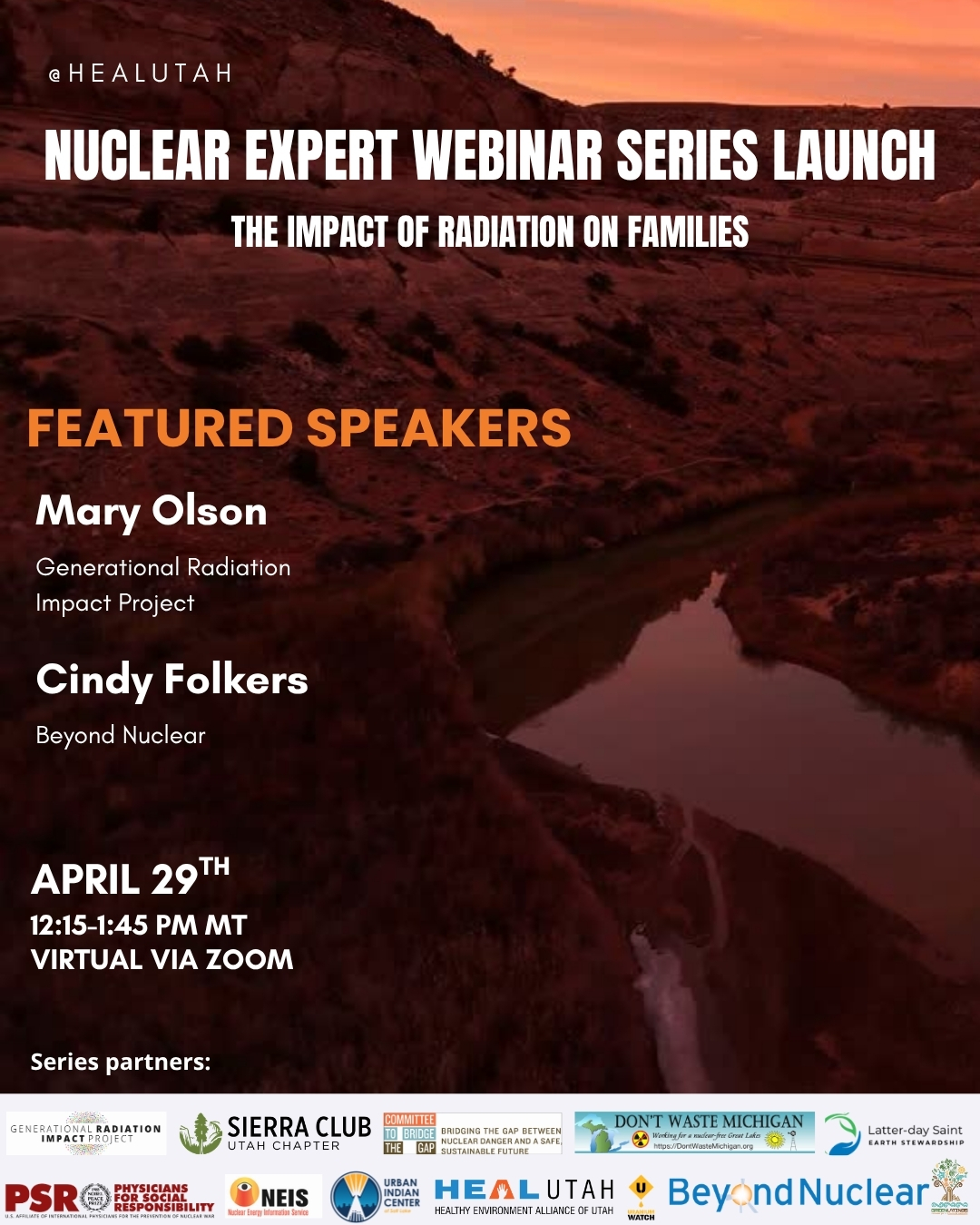
29 April – Nuclear Expert Webinar #1 – Radiation Impacts on Families with Mary Olson and Cindy Folkers
- 12:15 PM MT – 1:45 PM MT
- Location: Virtual – REGISTER TODAY

4 May -West Suburban Peace Coalition to discuss Iran war at May Educational Forum
Monday, May 4, 7:00 – 8:00 PM Central Standard Time
Title: : How Trump’s Narrative Tries to Shape the Reality of the War on Iran.
Contact Walt Zlotow, zlotow@hotmail.com 630 442 3045 for further information
14 May – online event From Bombs to Data Centres: the Face of Nuclear Colonialism

Pine Ridge Uranium is the real threat, not Tehran- Tell Burgum: Stop the Extraction.
Chernobyl: The Lost Tapes – A good documentary on Chernobyl on SBS available On Demand for the next 3 weeks– https://www.sbs.com.au/ondemand/tv-program/chernobyl-the-lost-tapes/2352741955560
To see nuclear-related stories in greater depth and intensity – go to https://nuclearinformation.wordpress.com
-
Archives
- April 2026 (288)
- March 2026 (251)
- February 2026 (268)
- January 2026 (308)
- December 2025 (358)
- November 2025 (359)
- October 2025 (376)
- September 2025 (257)
- August 2025 (319)
- July 2025 (230)
- June 2025 (348)
- May 2025 (261)
-
Categories
- 1
- 1 NUCLEAR ISSUES
- business and costs
- climate change
- culture and arts
- ENERGY
- environment
- health
- history
- indigenous issues
- Legal
- marketing of nuclear
- media
- opposition to nuclear
- PERSONAL STORIES
- politics
- politics international
- Religion and ethics
- safety
- secrets,lies and civil liberties
- spinbuster
- technology
- Uranium
- wastes
- weapons and war
- Women
- 2 WORLD
- ACTION
- AFRICA
- Atrocities
- AUSTRALIA
- Christina's notes
- Christina's themes
- culture and arts
- Events
- Fuk 2022
- Fuk 2023
- Fukushima 2017
- Fukushima 2018
- fukushima 2019
- Fukushima 2020
- Fukushima 2021
- general
- global warming
- Humour (God we need it)
- Nuclear
- RARE EARTHS
- Reference
- resources – print
- Resources -audiovicual
- Weekly Newsletter
- World
- World Nuclear
- YouTube
-
RSS
Entries RSS
Comments RSS
 nuclear-news