Power-Line Cut Raises Alarm Over Russian-Held Nuclear Plant In Ukraine, But Expert Says Little Has Changed

Todd Prince, Radio Free Europe, 14 Aug 23,
The fate of the massive nuclear power plant in the crosshairs of Europe’s largest war in decades has made for worrisome headlines since Russia launched its large-scale invasion of Ukraine nearly 18 months ago. As fighting intensifies not far from the plant, fears of a disaster have not abated.
On August 10, the main power line delivering electricity to the Zaporizhzhya nuclear power plant was disconnected twice, forcing it to rely on its last remaining off-site power line.
The main line was reconnected by evening. In the meantime, though, Ukraine’s energy minister raised the prospect of a meltdown.
Is Russia’s invasion of Ukraine about to cause a nuclear catastrophe?
Steven Nesbit, a nuclear power industry veteran who was president of the American Nuclear Society in 2021-22, told RFE/RL that the Zaporizhzhya plant has been in a precarious position since the start of Russia’s full-scale invasion. But the failure of the off-site power line did not make his assessment of the situation any more dire than it had been.
“I don’t see anything really new right now that should have people extremely concerned relative to the already undesirable situation,” he said, adding that the plant’s offsite power sources have been interrupted before due to the war.
“I would not be surprised if it happens again, but simply losing one of the off-site power sources for a period of time is not a reason for undue concern,” said Nesbit, who now runs his own nuclear consulting company…………………………………………………………
Energy Minister Herman Halushchenko said the plant was “one step away from a blackout — that is, the complete loss of external power,” and that this could lead to a “major catastrophe.”
Zaporizhzhya Nuclear Power Plant
The Zaporizhzhya Nuclear Power Plant is the largest in Europe and, before the war, supplied about 20% of Ukraine’s total electricity.
The plant would resort to diesel generators if all external power was lost, but if the generators were damaged by a Russian attack, he said, “the cooling of the plant would stop and the irreversible process of heating and melting of nuclear fuel” would begin.
“I think that’s a little alarmist,” Nesbit said in a phone interview on August 11.
The same day, Enerhoatom said on Telegram that the main power line had been reconnected the previous evening after being knocked out by Russian fire.
The diesel generators are well protected and have enough fuel to provide power to keep the cooling system going for an extended period of time while external sources are being restored, Nesbit said.
“The six units can share power among them. It’s a flexible and safe system,” he said.
The Zaporizhzhya plant has lost all external power at least twice in the past year.
…………………………………..The plant and the surrounding area are controlled by Russia, but it is being run by its Ukrainian engineers. In September 2022, Ukraine shut the station down to minimize risk of a catastrophe.
Five of the six reactors are in what is known as cold shutdown mode while one unit is being maintained at an elevated temperature — hot shutdown mode — to provide auxiliary steam and heating, the American Nuclear Society, which is monitoring information about the plant, said in July.
As a result, the level of heat production has been low and on-site equipment can provide enough of the water needed for cooling, the society, an international organization of engineers and scientists, said in a statement.
It called the threat of a large-scale release of radioactive material “speculative” but said that assessment does “not constitute an ‘all clear’ for safety risks at the plant site.”
Nesbit said it is of crucial importance that the reactors at the Zaporizhzhya plant have not been generating power for months, allowing the heating level associated with the reactor fuel to fall. The shutdown cuts by many orders of magnitude the amount of radioactivity that could potentially be released in the event of a major incident involving the reactors.
Still, tension is high.
The plant is located in the Zaporizhzhya region in southeastern Ukraine, where fighting is intense amid a counteroffensive that Kyiv launched in early June, seeking to push Russian forces back from territory they have taken and eventually expel them from the country altogether.
Zaporizhzhya is one of four regions of Ukraine that Moscow claimed last year had become part of Russia but does not hold in their entirety. The plant stands on the south bank of a wide stretch of the Dnieper River that was largely drained by the breach of the Kakhovka dam downstream, while Ukraine controls the north bank.
Ukraine and Russia have accused each other of planning to sabotage the plant, warning of the possibility of a nuclear disaster that could threaten millions of people and poison the environment………………………………………………. more https://www.rferl.org/a/power-cut-ukraine-nuclear-plant-expert-opinion/32547684.html
Nuclear Regulatory Commission’s Risky Rule Change Ignores History. More Nuclear Emergency Planning Needed, Not Less.

Statement by Dr. Edwin Lyman at the Union of Concerned Scientists Aug 14, 2023 https://www.ucsusa.org/about/news/nrcs-risky-rule-change-ignores-history-more-nuclear-emergency-planning-needed-not-less
WASHINGTON—The U.S. Nuclear Regulatory Commission (NRC) approved a rule today that will allow for the licensing of new nuclear reactors without requiring those reactors to have offsite emergency plans in place should disaster strike.
Below is a statement by Dr. Edwin Lyman, the director of nuclear power safety at the Union of Concerned Scientists (UCS).
“Past natural and human-made disasters have taught us that having a robust and workable emergency plan in place is the key to minimizing human suffering and loss of life if the unthinkable happens. The NRC’s reckless decision today flies in the face of that experience. Concerns with the rule expressed by the Federal Emergency Management Agency and other authorities demonstrate how out of step the NRC is with experts on this issue.
Coupled with other troubling regulatory changes that the NRC has already made or is considering, this new rule will only increase dangers for the public from the next generation of nuclear plants. Additionally, the absence of offsite emergency planning will create burdens in the aftermath of a nuclear plant accident, extreme weather event, or terrorist attack that will fall disproportionately on those people and communities with the fewest resources.
“Some nuclear power advocates downplay the health risks of ionizing radiation, asserting that emergency evacuations following nuclear disasters are more harmful than exposure to the radiation itself and pointing to the casualties following the 2011 Fukushima disaster evacuations in Japan as an example. But the remedy for poorly executed evacuations is better emergency planning, not the elimination of emergency planning altogether.
“The cost of preparing for emergencies is relatively modest. And yet nuclear industry proponents have pushed to change the rules to facilitate constructing new nuclear reactors anywhere, even in densely populated areas where timely emergency evacuations might be extremely difficult or even impossible. People everywhere need to be aware of the NRC’s dangerous decision and its implications for their health and safety.”
Iran says it is committed to resolving nuclear dispute through diplomacy
Reuters, August 14, 2023 https://www.reuters.com/world/iran-says-it-is-committed-resolving-nuclear-dispute-through-diplomacy-2023-08-14/
– Iran is committed to resolving its nuclear dispute with world powers through diplomacy, the country’s Foreign Minister Hossein Amirabdollahian told reporters in a televised news conference on Monday.
“We have always wanted a return of all parties to full compliance of the 2015 nuclear deal,” Amirabdollahian said.
Indirect talks between Washington and Tehran to revive the nuclear agreement have stalled since last September.
Having failed to revive the pact, Tehran and Washington said on Thursday they had reached an understanding under which $6 billion in Iranian funds will be unfrozen from South Korea while five American nationals detained in Iran will be released.
The United States would also release some Iranians from U.S. prisons as part of the deal, Iran said.
Reporting by Dubai Newsroom; Editing by Toby Chopra
Pritzker was right to keep moratorium on new Illinois nuclear plants
The bill the governor vetoed would have opened the door to negative environmental impacts and higher costs for consumers while jeopardizing progress toward Illinois’ clean energy future.
Gov. J.B. Pritzker’s veto of Senate Bill 76 on Friday solidifies his national reputation as an environmental leader. SB 76, which would have removed the ban on new nuclear power in Illinois, was moved forward without careful consideration, and signing it would have opened the door to increased risk, negative environmental impacts and higher costs for consumers, all while jeopardizing our progress toward Illinois’ clean energy future.
The original concerns about constructing new nuclear power plants that led the General Assembly to impose the current moratorium remain today and, in fact, those concerns are arguably greater now than they were in 1987.
We are no closer to a national solution for the disposal of dangerous high-level nuclear wastes. Illinois already has the most nuclear reactors in the country and bears the burden of storing this waste in our communities, including along the shores of Lake Michigan and the Mississippi River. These wastes have significant safety risks and threaten our drinking water and communities. We should not add to the growing stockpiles of hazardous waste.
Nuclear power is also extremely expensive. Efforts in other states to build new nuclear plants are plagued with high-cost overruns and extensive delays. These exorbitant costs not only dwarf those associated with readily available clean energy technologies, but they also threaten to derail the progress Illinois is now making to deploy win-win solutions like clean energy, storage and energy efficiency programs.
Illinois should continue prioritizing these investments, which support good union jobs and pathways to prosperity for our marginalized communities, rather than encourage highly speculative proposals for new nuclear energy.
Illinois does not need the massive, decades-long rate hikes it would take to attempt to site and build new nuclear power plants that wouldn’t be available for over a decade. Illinois does need action and investment now in transmission, storage, energy efficiency and demand response solutions to ensure adequate capacity and protect consumers from spikes in fossil fuel prices.
Keep the focus on clean energy
While Illinois hosts roughly 11 gigawatts of nuclear power, over 700 gigawatts of additional power are awaiting interconnection approval from regional energy markets across the country. The majority of these resources waiting in line are solar, wind and battery storage — proven technologies that are already creating good jobs and delivering consumer savings. These smart solutions should remain our focus.
The rules, regulations and oversight for all nuclear plants are not up to date. SB 76 would have removed the moratorium on nuclear power without a full study and review of whether current rules and regulations are sufficient to site, build and operate a nuclear power plant safely. In addition, the siting laws for nuclear are completely insufficient. Any plant could be built anywhere at any time, with only approval at the federal level. The issue is even worse in the case of Small Modular Nuclear Reactors — small units that have been proposed to be deployed inside shipping containers within communities. Projects could, in theory, be deployed near residences, for example.
Our community is proud of the work we did together with Pritzker and the General Assembly to enact the Climate and Equitable Jobs Act in 2021. CEJA gives Illinois a roadmap to a clean energy future that generates high-quality jobs equitably and attracts global investments in our communities. To sustain that progress, we must stay the course in implementing that vision and reject proposals that would distract our resources from this framework. The veto of SB 76 will help Illinois implement this clean energy vision, and Pritzker’s veto should be upheld by the General Assembly.
Jen Walling is the executive director of the Illinois Environmental Council. Jack Darin is director of the Illinois chapter of the Sierra Club.
South Korea’s opposition party to file UN complaint against Japan over nuclear waste
Democratic Party plans to visit Tokyo to oppose release of treated water from crippled Fukushima nuclear plant
Esra Tekin |14.08.2023 -ISTANBUL, https://www.aa.com.tr/en/asia-pacific/south-koreas-opposition-party-to-file-un-complaint-against-japan-over-nuclear-waste/2967294
South Korea’s main opposition party announced on Monday its intention to lodge a formal grievance with the United Nations Human Rights Council (UNHRC) in the upcoming week, regarding Japan’s proposed strategy to release water from the Fukushima site.
According to representative Woo Won-shik, who leads the Democratic Party (DP) committee that opposes Tokyo’s proposal to discharge treated water from the damaged Fukushima nuclear plant into the ocean, the complaint will be formally submitted on Thursday, Seoul-based Yonhap News reported.
The DP asserts that the planned release, set to start as soon as late August, breaches several international agreements and lacks verified scientific safeguards.
The UNHRC assesses grievances originating from individuals, entities, or nations pertaining to instances of ongoing and severe human rights transgressions.
Alongside submitting the complaint, the DP intends to collect signatures from roughly 1.5 million citizens and deliver them to the office of the president.
Furthermore, DP members are making preparations for a visit to Japan by the end of this month to express their opposition to Tokyo’s scheme, subsequent to two prior visits made in April and July.
Japan is expected to release treated nuclear waste from the crippled Fukushima nuclear power plant this month or early next month.
Japan’s water discharge plan, announced in April 2021, faced significant criticism from China, South Korea, North Korea, Taiwan, and international organizations, including the UN.
The US supported the proposal, following years of discussions on dealing with over 1 million tons of water stored at the Fukushima nuclear complex since the 2011 disaster.
Japanese and US Bishops pledge partnership for a nuclear-free world
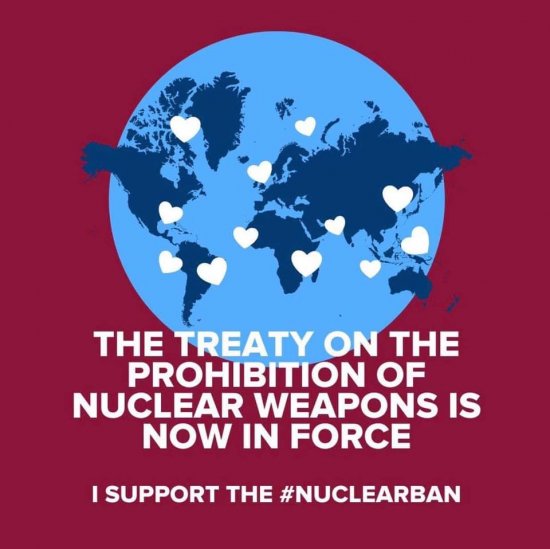
Five Japanese and US bishops pledge to work together towards a “world without nuclear weapons” and call for concrete progress in this effort by August 2025, the 80th anniversary of the Hiroshima and Nagasaki bombings.
Vatican News, By Lisa Zengarini 14 Aug 23,
On the 78th anniversary of the atomic bombing of Nagasaki, on 9 August 1945, a group of five Catholic bishops from Japan and the United States from areas impacted by atomic weapons have joined in a formal pledge to concretely work toward “a world without nuclear weapons”.
Pilgrimage of Peace to Japan
The partnership declaration was signed by Archbishop Peter Michiaki Nakamura of Nagasaki, Bishop Alexis Mitsuru Shirahama of Hiroshima, and Archbishop Emeritus of Nagasaki, Joseph Mitsuaki Takami, and by Archbishops John Wester of Santa Fe (New Mexico) and Paul Etienne of Seattle (Washington).
Their declaration came at the conclusion of a 1-9 August Pilgrimage of Peace to Japan which the two US Archbishops made to mark the annual commemoration of the 1945 bombings of the Japanese cities of Hiroshima and Nagasaki.
Both US archdioceses are situated in areas that have close ties to the production and deployment of nuclear weapons, since the United States houses its major nuclear arsenal in western Washington state, and New Mexico, where Santa Fe is located, is considered to be the birthplace of the atomic bomb.
During the pilgrimage, the two US archbishops participated in memorial ceremonies, and spoke about the need to abolish nuclear weapons.
In the declaration, the group called for “concrete progress” in this effort by August 2025, the 80th anniversary of the Hiroshima and Nagasaki bombings.
Appeal to world leaders
Echoing Pope Francis’ condemnation of the mere “possession” of nuclear weapons, they urged world leaders to take specific steps toward their complete abolition of nuclear weapons.
Their call included the acknowledgment of the long-lasting suffering inflicted by the Hiroshima and Nagasaki atomic bombings, and of the environmental impacts of uranium mining and production of nuclear weapons; an effective commitment to prevent a new arms race, safeguards against nuclear weapons use and advance nuclear disarmament; and, the reaffirmation that a nuclear war cannot be won and must never be fought.
………………………………………………….Protecting
Finally, to protect, the signatories said they will continue advocacy for countries to sign the Treaty on the Prohibition of Nuclear Weapons, and for world leaders to redirect money spent on their development and maintenance toward helping vulnerable populations and addressing environmental issues.
So far, not one of the Group of Seven (G7) countries, including United States, Canada, France, Germany, Italy, Japan, and the United Kingdom, has subscribed the Treaty, which was first signed by the Holy See.
The five US and Japanese bishops invited other dioceses and religious traditions to join them in these efforts…….. https://www.vaticannews.va/en/church/news/2023-08/japanese-us-bishops-joint-declaration-for-nuclear-free-world.html
Risks of further delays at Hinkley Point C, EDF warns
EDF has admitted there is a risk of further delays to two nuclear reactors
at Hinkley Point C due to construction setbacks. The French energy giants
behind the new nuclear power station along the Somerset coast remarked last
year that the plants may start 15 months late. In an earnings presentation
in late July, EDF said the increased risk of a 15-month delay is due to
“performances on civil works and challenges on mechanical, electrical,
heating, ventilation and air conditioning” and “progress is below the
planned trajectory and action plans have been set”.
EDF has targeted June
2027 as the first operation of Unit 1, also known as Hinkley Point C, and
has already factored in construction delays and other factors. Originally
scheduled to be generating energy in 2025, Hinkley Point C has faced
several delays due to reduced workforce and workflow challenges caused by
the Covid-19 pandemic, as well as increasing costs.
Somerset Live 14th Aug 2023
https://www.somersetlive.co.uk/news/somerset-news/risks-further-delays-hinkley-point-8663204
US, Finland Negotiating Defense Agreement That Would See Deployment of American Troops
August 14, 2023 https://wordpress.com/post/nuclear-news.net/240861
Washington and Helsinki are in the process of establishing a new defense cooperation agreement that would see expended deployments of American soldiers and Finland hosting war games.
By Kyle Anzalone / Antiwar.com
Washington and Helsinki are working on a new deal to govern the military relationship between the two nations. Finland recently became the thirty-first member of NATO, doubling the alliance’s border with Russia.
According to YLE News, Finnish state media, Helsinki and Washington are negotiating a new Defense Cooperation Agreement (DCA). YLE said the new deal would be a “significant departure from its previous” DCA with the US.
Finland held a prolonged policy of official neutrality prior to joining NATO earlier this year. However, Helsinki established deep ties with the bloc over recent decades. The new DCA will expand America’s military presence to several Finnish bases, including ports and airports.
The outlet reports the new DCA will “permit the presence of foreign troops for extended periods, specifically for conventional military exercises…[and] grant US military personnel access to facilities and areas within Finland for training, weapons storage, and equipment maintenance.”
The war games and NATO soldiers will be viewed as a provocation by Russia, which shares an 800 miles border with Finland. Helsinki already hosts NATO troops for military drills near the Russian border.
When Helsinki announced its intention to join the North Atlantic bloc last year, the Kremlin warned about additional international troop deployments in Finland. Last week, Moscow announced it would deploy additional military assets to its border with NATO members.
Finnish negotiations have expressed some reservations about expanding the DCA with the US. YLE explains, “noting that the agreement excludes nuclear weapons,” and Helsinki wants all integration troops deployments to be labeled as temporary.
Even the UK’s very first small nuclear reactor could not be decided upon until 2029 at the earliest

Old Sparky: The go-ahead for even the very first SMR couldn’t be decided
on until 2029 at the earliest; nothing here could meaningfully contribute to
the 2035 target for decarbonising electricity. No wonder so little is being
spent – it’s just a costly way to keep options open.
Private Eye 4th Aug 2023
Amid ‘staggering’ Ukrainian toll and souring US polls, Biden seeks billions more for war

the Zelensky government does appear to be a willing partner in McConnell’s sacrifice ritual. Ukrainian defence minister Oleksiy Reznikov is said to have told US officials that flooding Ukraine with weapons allows NATO allies to “actually see if their weapons work, how efficiently they work and if they need to be upgraded. For the military industry of the world, you can’t invent a better testing ground.”
As Ukraine faces “staggering” losses and US public mood shifts, the Biden administration seeks billions more to prolong the war.
| Aaron Maté, AUG 15, 2023, https://mate.substack.com/p/unlocked-amid-staggering-ukrainian?utm_source=post-email-title&publication_id=100118&post_id=135995766&isFreemail=true&utm_medium=email— |
The Biden administration is asking Congress for an additional $24 billion for the Ukraine proxy war, more than half of it in military aid. The request comes one week after a CNN poll showed, for the first time, that a majority of Americans oppose additional funding to Kiev.
For a White House committed to ensuring a Russian “quagmire” in Ukraine, public opinion is of secondary importance. Two months into a widely hyped yet now faltering Ukrainian counteroffensive, a fresh influx of NATO weaponry appears necessary to prolong the war. In one of several gloomy assessments to appear in US establishment media, a senior western diplomat tells CNN that the prospect that Ukrainian forces can “make progress that would change the balance of this conflict” is “extremely, highly unlikely.” Ukraine’s “primary challenge” is breaking through Russia’s heavily fortified defensive lines, where “Ukrainian forces have incurred staggering losses.” According to Democratic Rep. Mike Quigley, US military assessments of the war are “sobering,” with Ukraine now facing “the most difficult time of the war.”
This picture, CNN’s Jim Sciutto observes, represents “a marked change from the optimism at the start of the counteroffensive,” with Western officials now acknowledging that “those expectations were ‘unrealistic.’” The battlefield reality is so dire that it is even “now contributing to pressure on Ukraine from some in the West to begin peace negotiations, including considering the possibility of territorial concessions.”
But as Biden’s new spending request suggests, there is no sign that the US is among those Western states applying pressure for peace. After all, the stated US aim, as top officials have made clear, is not to defend Ukraine and its long-term future but to instead “weaken” Russia (Lloyd Austin) and ensure “a strategic failure for Putin,” so that Russian can “pay a longer-term price in terms of the elements of its national power.” (Jake Sullivan)
Whereas CNN’s Western sources now allow themselves to admit that their publicly voiced “optimism at the start of the counteroffensive,” was “unrealistic”, it was in fact, dishonest. As Pentagon leaks and subsequent disclosures have confirmed, US officials were well aware that Ukraine was not prepared to take on Russia’s heavily fortified defenses, but kept that assessment under wraps. Accordingly, while Ukraine’s battlefield losses are indeed “staggering”, what is perhaps most “sobering” is the fact that the Biden administration both anticipated and encouraged them.
But just like souring US public opinion, Ukrainian casualties are also a secondary concern, as the Biden administration’s more candid neoconservative proxy war partners continue to make clear.
To push through the new spending package , the White House is “counting on help from Senator Mitch McConnell of Kentucky, the Republican minority leader,” the New York Times reports. At a public event, McConnell detailed his rationale: The US, he explained, hasn’t “lost a single American in this war,” – not accurate if one counts mercenaries and private citizens, but correct in its implicit recognition that Ukraine has lost tens of thousands of lives on its American sponsors’ behalf. According to McConnell, there are additional benefits of the war that do not extend to ordinary Ukrainians: “Most of the money that we spend related to Ukraine is actually spent in the US, replenishing weapons, more modern weapons. So it’s actually employing people here and improving our own military for what may lie ahead.”
Therefore, according to prevailing Biden-McConnell policy, the US must continue to fund a war that will sacrifice many more Ukrainian lives, all so that domestic war profiteers can reap taxpayer largesse for “replenishing weapons”, and so that the US – not having its soldiers die in Ukraine – can use the opportunity for “improving our own military” for a war that it might actually fight.
Although US officials have reportedly “expressed frustration” at Ukraine’s efforts to minimize military casualties, the Zelensky government does appear to be a willing partner in McConnell’s sacrifice ritual. Ukrainian defence minister Oleksiy Reznikov is said to have told US officials that flooding Ukraine with weapons allows NATO allies to “actually see if their weapons work, how efficiently they work and if they need to be upgraded. For the military industry of the world, you can’t invent a better testing ground.”
For the benefit of weakening Russia, enriching US military contractors and serving as a NATO “testing ground,” Ukrainian lives are not the only staggering sacrifice. According to the Wall Street Journal, “20,000 and 50,000 Ukrainians who have lost one or more limbs since the start of the war,” a scale unseen for a Western military since the First World War, and a potential undercount “because it takes time to register patients after they undergo” surgery.
According to veteran State Department bureaucrat Aaron David Miller, the Biden administration has no other choice but to continue sacrificing Ukrainians. The US, he explained, “is in an investment trap in Ukraine with no clear way out. Chances of a military breakthrough or a diplomatic solution are slim to none; and slim may have already left town. We’re in deep and lack the ability to do much more than react to events.” The key term here is “investment trap”: having invested in a proxy war aimed at bleeding Russia, the US is therefore obliged to continue it.
But if the US were driven by other concerns – such as Ukrainian well-being – it could consider supporting the diplomatic opportunities that it has blocked to date. Prior to Russia’s invasion, the Biden administration encouraged the Ukrainian government to crack down on political opponents; further integrate its military into NATO; avoid implementing the Minsk accords for ending its post-2014 civil war; and assault the Russian-allied Donbas. When Russia submitted detailed proposals in December 2021 to address its concerns, the White House effectively balked. And after Russia’s invasion, the US blocked a tentative peace deal that would have seen Russia withdrew to its pre-February 2022 lines. More recently, the US has pushed Ukraine into a counteroffensive that it knew had no chance, and rejected a Ukrainian NATO bid that it had long encouraged for the apparent purpose of baiting Moscow.
In short, the Biden administration has provoked this war and is now seeking a new influx of taxpayer money to prolong it. Even the latter goal is now openly admitted. At last month’s NATO summit in Lithuania, the New York Times reported, “several American and European officials acknowledged” that their “commitments” to Ukraine “make it all the more difficult to begin any real cease-fire or armistice negotiations.” Additionally, US-led “promises of Ukraine’s eventual accession to NATO — after the war is over —create a strong incentive for Moscow to hang onto any Ukrainian territory it can and to keep the conflict alive.”
So long as keeping the conflict alive comes predominantly at the cost of Ukrainian lives, then Washington’s bipartisan proxy warriors clearly have no qualms about forcing a war-weary public to foot the bill.
Small Modular reactors- a US view

we now have ‘an echo chamber, with each outlet clambering over the next to crow about the great benefits of nuclear power in misleading language that suggests this technology is already entirely proven out’.
It all fits into what see she see as an emerging pro-SMR mind set, with there being a lot of speculative investment venture cash still around- and a lot of press support. She says that though ‘very few of the proposed SMRs have been demonstrated and none are commercially available, let alone licensed by a nuclear regulator’, the media has been promoting them as the way ahead.
August 12, 2023 https://renewextraweekly.blogspot.com/2023/08/small-modular-reactors-us-view.html

Allison Macfarlane, who was Chair of the US Nuclear Regulatory Commission (NRC) from 2012-2014, has been looking at Small Modular Reactors in the USA and elsewhere. She thinks they are likely to be uneconomic, much like the their larger brethren, which, as she describes, have recently been doing very poorly in the USA.
Indeed, just like the EPR story in the EU, it makes for a sorry saga: ‘The two units under construction in South Carolina were abandoned in 2017, after an investment of US$9 billion. The two AP-1000 units in Georgia were to start in 2016/2017 for a price of US$14 billion. One unit started in April, 2023, the second unit promises to start later in 2023. The total cost is now over US$30 billion.’
Big reactors do look increasingly hard to fund and build on time and budget, while it is argued that smaller ones could be mass produced in factories at lower unit costs and finished units installed on site more rapidly. However, that would mean foregoing conventional economies of (large) scale, and, overall, Macfarlane claims that SMRs may end up being worse that large plants in operational and economic terms.
For example, she says ‘one of the reasons SMRs will cost more has to do with fuel costs’ with some designs requiring ‘high-assay low enriched uranium fuel (HALEU), in other words, fuel enriched in the isotope uranium-235 between 10-19.99%, just below the level of what is termed “highly enriched uranium,” suitable for nuclear bombs.’ She notes that ‘currently, there are no enrichment companies outside of Russia that can produce HALEU, and thus the chicken-and-egg problem: an enrichment company wants assurance from reactor vendors to invest in developing HALEU production. But since commercial-scale SMRs are likely decades away, if they are at all viable, there is risk to doing so.’

She also notes that the use of HALEU, so as to offset the smaller size of the reactor core, will ‘result in increased security and safeguards requirements that will add to the price tag’. As she has explored in a PNAS paper with others, smaller cores mean more neutron escapes and so a need for more shielding, which will become activated, adding to the waste burden to be dealt. Indeed she says, overall, some SMRs may produce ‘significantly more high-level waste by volume that current light water reactors.’ That view did not go down well with SMR promoters, who sometimes portray SMRs as being cleaner than standard reactors.
Some advanced SMRs may use molten salt fluids as a reactant and also coolant, and the waste chemistry then is different, although there will still be wastes to deal with. But for the moment, the focus is on simpler technology – just scaled down versions of the standard Pressurised Water Reactor (PWR). Macfarlane notes that one of these, NuScale, is the only SMR design to received ‘design certification’ for its 50MW unit from the NRC

However, the company has now decided to submit a new application to the NRC to build a larger version, presumably in the expectation that this would be more economic. It’s also proposed to have multiple units on one site, sharing some common services. That might offset some of the extra costs of small systems, but not much. Macfarlane says ‘cost estimates for the reactor have risen from US$55/megawatt electric (MWe) in 2016 to $89/MWe in 2023, according to the Institute for Energy Economics and Financial Analysis.’
Arguably, to be economic, they need to be bigger. That seems to have been the logic behind another mini-PWR, the Rolls Royce SMR being developed in the UK by Rolls Royce. Although at 470MW, that one is hardly ‘small’.
By contrast, Oklo, another US company, is going in the opposite direction. It has been developing Auora, an advanced micro-nuclear power plant. It’s a tiny (1.5 MW) liquid sodium cooled fast neutron reactor. However, it was outright rejected by the NRC. Macfarlane says that ‘the NRC rarely outright rejects an application, instead working with licensees until they either get the application right or decide to walk away. In this case, Oklo refused to fill “information gaps” related to “safety systems and components.’ But Oklo persevered. And she notes it has gone for public finance via a merger with AltC Acquisition Corporation.
It all fits into what see she see as an emerging pro-SMR mind set, with there being a lot of speculative investment venture cash still around- and a lot of press support. She says that though ‘very few of the proposed SMRs have been demonstrated and none are commercially available, let alone licensed by a nuclear regulator’, the media has been promoting them as the way ahead.
Even usually sane US outlets like the Atlantic Policy journal seem to have joined in. She says we now have ‘an echo chamber, with each outlet clambering over the next to crow about the great benefits of nuclear power in misleading language that suggests this technology is already entirely proven out’.
So she concludes, a bit pessimistically, that, in the USA, ‘in the nuclear celebratory mood of the moment, there is little patience or political will for sober voices to discuss the reality that new nuclear power is actually many decades away from having any measurable impact on climate change – if at all’.
The situation in Europe is a bit different. Although nuclear is also being supported in some countries, like the UK and France, anti-nuclear views are also apparent. For example a recent academic paper in Joule claims that ‘relying on nuclear new-builds to achieve the EU climate targets is virtually impossible.’ And overall it concludes ‘in solving the climate crisis, new nuclear is a costly and dangerous distraction.’ Whereas SMRs will be any better is unclear. There are quite few speculative SMR ventures around the word, as a UK review noted, but a recent study of 19 proposed SMR designs found that they were likely to be generally more expensive than conventional nuclear, and even more so than renewables. So, why bother?
As Macfarlane says, the battle lines are drawn on this issue around the world, with much of it being a PR battle – there is no real hardware yet. While the likes of Forbes magazine are pushing SMRs as the ‘go-to energy source’, in a hard hitting article in Fortune, Stephanie Cookes says ‘the billions currently being spent on nuclear are crowding out viable, less costly solutions for decarbonizing the power sector.’
Place your bets…but, for some, the outcome already looks clear. As David Schlissel said in US trade journal Utility Drive, ‘an old adage is that anything that sounds too good to be true probably is. Given the history of the nuclear power industry, everyone – utilities, ratepayers, legislators, federal officials and the general public – should be very skeptical about the industry’s current claim the new SMRs will cost less and be built faster than previous designs.’
Australia: Civil Society faces imposition of an AUKUS military High Level nuclear waste dump

https://nuclear.foe.org.au/wp-content/uploads/AUKUS-nuclear-waste-David-Noonan-brief-13Aug2023.pdf Updated Briefing by David Noonan, Independent Environment Campaigner 13 August 2023
The Federal ALP belatedly disclosed a secret pre-condition in AUKUS plans to buy existing US nuclear submarines: for Australia to keep the US subs military High Level nuclear waste forever.
In a breach of trust the ALP is seeking to ‘normalise’ High Level nuclear waste in Australia. Claims of
‘nuclear stewardship’ in taking on US nuclear subs and in retaining the US sub wastes are a farce.
Disposal of High Level nuclear waste is globally unprecedented, with our AUKUS ‘partners’ the US
and UK having proven unable to do so in over 60 years since first putting nuclear submarines to sea.
New military Agencies are being set up with an ‘Australian Submarine Agency’ (ASA) set up to:
“enable the necessary policy, legal, non-proliferation, workforce, security and safety arrangements”.
A new military nuclear regulator, the statutory ‘Australian Nuclear-Powered Submarine Safety
Regulator’ is to be established. Both Agencies will report directly to the Minister for Defence.
An array of federal legislation is required to manage nuclear submarines, supporting infrastructure
and facilities, from acquisition through to disposal. The Reforming Defence Legislation Review
proposes to take on Defence Act powers to override State and Territory legislation to ‘provide
certainty’ to Defence roles, operations and facilities.

Minister for Defence Richard Marles MP has stated there will be ‘an announcement’ by early 2024 on
a process to manage High Level nuclear waste and to site a waste disposal facility, saying “obviously
that facility will be remote from populations” (ABC News 15 March 2023).
Defence is already working to identify potential nuclear waste disposal sites. Political leaders in WA,
Queensland and Victoria have rejected a High Level nuclear waste disposal site. The SA Labor
Premier has so far only said it should go to a safe ‘remote’ location in the national interest.
AUKUS compromises public confidence in government and sets up a serious clash with
hcivil society:
- Defence must be transparent and made accountable over AUKUS policy, associated rights and
legal issues, and the proposed High Level nuclear waste dump siting process; - Defence must commit to comply with the United Nations Declaration on the Rights of Indigenous
Peoples Article 29 provision of Indigenous People’s rights to “Free, Prior and Informed Consent”
over storage or disposal of hazardous materials on their lands. - Defence must declare whether the SA Nuclear Waste Storage (Prohibition) Act 2000 is intended
to be over-ridden to impose an AUKUS dump on lands and unwilling community in SA.
The public has a right to know who is targeted and a right to Say No to imposition of nuclear wastes.
The ALP National Platform (2021, Uranium p.96-98) makes a commitment to oppose overseas waste:
- Labor will: 8. d. Remain strongly opposed to the importation and storage of nuclear waste
that is sourced from overseas in Australia.
In contrast, AUKUS proposes Australia buy existing US military nuclear reactors in subs that are to be
up to 10-12 years old, loaded with intractable US origin weapons grade High Level nuclear wastes.
An AUKUS military nuclear dump is likely to be imposed on community in SA or in NT, with override
of State laws, compulsory land acquisition, and disregard for Indigenous Peoples rights to Say No.
Woomera is being targeted as a ‘favoured location’ for an AUKUS nuclear dump, in an
untenable affront to democratic rights in SA and to Indigenous People’s rights
SA community and the Barngarla People have just overcome federal plans to store ANSTO nuclear
fuel wastes and ILW on agricultural land near Kimba that had divided community on Eyre Peninsula.
The Bargarla People won a hard fought court case against the Federal Government that set aside the
Kimba dump siting decision by Coalition Minister Pitt as affected by bias and pre-judgement.
In response, Labor Minister Hon Madeleine King MP decided to not appeal the Judge’s finding of
apprehended bias, saying “The judgement was clear, and the Government is listening.”
The next day the national press reports: “Woomera looms as national nuclear waste dump site
including for AUKUS submarine high-level waste (afr.com) (11 August 2023). The article states the
AFR understands the Woomera rocket range is the ‘favoured location’ for the submarine waste.
The federal gov may also decide to ‘co-locate’ AUKUS submarine waste with ANSTO nuclear fuel
wastes and long lived ILW. However, the regulator says ANSTO wastes can be securely retained at the
Lucas Heights reactor site for decades. An imposed AUKUS dump will discredit any associated plans.
A suite of public interests are already at stake. For instance, which Ports will be requisitioned for
roles in AUKUS nuclear waste plans? (the federal gov previously targeted the Port of Whyalla).
AUKUS nuclear waste dump plans trigger the United Nations Declaration on the Rights of Indigenous
Peoples (adopted by United Nations, Sept 2007) in Indigenous People’s Article 29 rights to “Free,
Prior and Informed Consent” over storage or disposal of hazardous materials on their lands.
Traditional owners must have a right to Say No to nuclear wastes, see “AUKUS nuclear waste dump
must be subject to Indigenous veto” (By Michelle Fahy May 2023): “Bipartisan secrecy and Defence’s
poor record with Indigenous groups at Woomera are red flags for consultations over an AUKUS
nuclear waste dump. Human rights experts say government must establish an Indigenous veto right.”
The “Woomera Protected Area” (WPA) a large Defence weapon testing range in SA had already been
flagged by other State Premiers as a site for a military High Level nuclear waste disposal facility.
Most of the WPA is State owned Crown land and not federal owned Defence lands. Siting a nuclear
dump on the WPA would be imposed through compulsory land acquisition and over-ride of SA laws.
Storage and disposal of nuclear wastes compromises the safety and welfare of the people of South
Australia, that is why it is prohibited by the SA Nuclear Waste Storage (Prohibition) Act 2000.
The Objects of this Act cover public interest issues at stake, to protect our health, safety and welfare:
“The Objects of this Act are to protect the health, safety and welfare of the people of South
Australia and to protect the environment in which they live by prohibiting the establishment
of certain nuclear waste storage facilities in this State.”
Defence are already ignoring Aboriginal Heritage law and contravening protections in SA, see
“Defence bombing Indigenous site in Woomera” (May 2023). Defence is now further ‘angling for
exemption from State laws it admits serve important public purposes’.
The SA Premier is yet to say if he will support an Indigenous right to Say No to an AUKUS dump in SA.
South Australians have a democratic right to decide their own future and to reject an AUKUS dump.
2 minor earthquakes strike near North Korea’s nuclear test site
Sunday’s tremors latest in series of earthquakes to hit Kilju region in recent months
By Anadolu staff 13.08.2023 https://www.aa.com.tr/en/asia-pacific/2-minor-earthquakes-strike-near-north-koreas-nuclear-test-site/2966671
ANKARA
Two minor earthquakes struck on Sunday near North Korea’s nuclear test site, the latest in a series of natural earthquakes to hit the region in recent months, South Korea’s state weather agency said.
There were no reports of any damage.
The first earthquake of 2.7 magnitude struck about 40 kilometers (24.8 miles) north-northwest of Kilju, North Hamgyong Province, at 3:13 a.m. (local time), while the second of 2.3 magnitude struck 42 km (26 m) north-northwest of Kilju at 7:55 a.m, Seoul-based Yonhap News reported.
Kilju is home to the Punggye-ri nuclear test site, where North Korea conducted all six of its nuclear tests.
Eight natural earthquakes were reported to have struck the area in 2022 alone.
Who decides whether Bataan should go nuclear?

The plant is located near to not one but four volcanoes, in an area prone to earthquakes’
Rappler.com, AUG 13, 2023 LOLITA CASTILLO
Bataan, a beautiful peninsula located west of the Philippine capital, Manila, is most famous for a couple of things. One, it was where the Death March began following the defeat of the allied forces of American and Filipino soldiers led by Gen. Douglas McArthur against the Japanese Imperial Army during World War II. Two, it is where the mothballed Bataan Nuclear Power Plant (BNPP) with a price tag of $2.3 billion idly resides, unoperated for nearly four decades.
Bataan residents did not have any sort of control or say in these two circumstances that brought their province to prominence. The former, BNPP’s construction amid opposition, was decided without their consent, and the latter a byproduct of the irrationalities of war and the fight for democracy.
Bataan is my birthplace and remains dear to my heart. Although I have been away for a few decades, I keep abreast of the potential threats to its security and stability. BNPP’s construction began when I was in grade school, and most people in Bataan were not even aware of it until cause-oriented groups outside of Bataan and the local informal leaders bravely protested against its operation in a militarized, political climate. Now, it’s an issue that has resurfaced, and it will test how democracy is manifested and mediated in local and national settings, and how crucial decisions and trade-offs will be made regarding safety, equity, and sustainable development.
Each year, the government allocates more than $1 million for the BNPP’s upkeep and maintenance. It remains a losing and wasteful investment that does not give back. It is important that a decision is made about the white elephant as delays in the decision come with opportunity costs.
The plant, the first of its kind in Southeast Asia, was designed to provide 620 megawatts of electricity, and was completed in 1984 in response to the oil crisis in the ’70s – but has never produced any single watt of electricity due to a combination of factors. The biggest of these factors are safety concerns.
The administration of Aquino and Ramos had ordered it mothballed in spite of its extremely high costs based on the findings from the technical audit conducted by the National Union of Scientists (NUS) in 1986, 1988, and 1990, citing over 4,000 technical defects concerning cover design, construction, quality assurance, workmanship, etc.
The plant is located near to not one but four volcanoes, in an area prone to earthquakes. Fear and uncertainty about the location, and the wake of the Three Mile Island accident in the US in 1979, the Chernobyl disaster in 1986, and the more recent 2011 Fukushima nuclear disaster restrained efforts to revive it.
As the Philippines seeks to retire its coal plants to meet its pledge and climate goals, as the impact of climate change around the globe, especially among the most vulnerable island countries, intensifies, and as demand for electricity increases, the discussions and debates whether to revive the BNPP or not, or whether to repurpose it, continues.
Nuclear energy is depicted as “cleaner” than coal, and Bataan’s power plants that send electricity to the Luzon grid rely heavily on fossil fuel. As of November 30, 2022, the total capacity of existing power plants in Bataan equals 3,676.7 MW. Renewable energy accounts only for 92.4 MW while fossil fuel-fired plants account for 3,528 MW. More solar and wind farms are slated for construction and operation by 2026, which will increase the output to 4,920.7 MW.
……………………………………… there are compelling dangers or risks as well: the plant is nearly 40 years old and would need substantial rehabilitation that require further spending. Rigorous safety protocols are imperative to ensure safety, as it is sitting on earthquake-prone area. It generates radioactive waste, and the disposal of waste is expensive, as well as poses potential environmental risks. The cost of repair, maintenance, and operation might be higher than if the government were to build and operate renewable sources of energy. In 2017, a South Korean firm estimated that rehabilitation and upgrade of BNPP would be up to $1.19 billion.
………………………….The residents of Bataan must always be included in decision-making on the path to development, as they are the ones who directly suffer from the consequences of bad economic and environmental policies. Moreover, Bataan is already disproportionally carrying the heavy burden of supplying energy to Luzon. It will be unequitable to force it to host an old nuclear plant that faces considerable uncertainties.
Whatever Bataan decides, the following questions loom: Would the national government respect its decision and local autonomy? Would it allow Bataan the right to self-determination? If Bataan were to demand the national government to fund the rapid expansion of renewable sources of energy and repurpose BNPP, would the current president support it or would he follow the path of his father? – Rappler.com https://www.rappler.com/voices/imho/opinion-who-decides-whether-bataan-should-go-nuclear/
Egypt rejects multiple US requests to arm Ukraine: Report
PRESS TV , 12 August 2023
Egyptian President Abdel Fattah el-Sisi has reportedly rejected multiple requests from the United States to send arms and military equipment to Ukraine.
The New York-based Wall Street Journal reported on Friday that US Secretary of Defense Lloyd Austin received a “noncommittal” reply in March when he asked Sisi to send weapons to Ukraine.
The American daily said Washington had asked Cairo to provide Kiev with artillery shells, antitank missiles, air defense systems and small arms, but Egyptian officials privately said they had no intention of sending arms to Ukraine.
It added that since Austin’s meeting with the Egyptian president, senior US officials have made multiple requests for Cairo to follow through on the request to no avail……………………………………………………………………………………………………………………. more https://www.presstv.ir/Detail/2023/08/12/708774/Egyptian-President-Abdel-Fattah-el-Sisi-multiple-requests-US-arms-military-equipment-Wall-Street-Journal-
1 This Month
23 April – WEBINAR – Why new nuclear reactors are the wrong tools for decarbonization Thursday, April 23 • 1 AM – 2 AM AEST


Pine Ridge Uranium is the real threat, not Tehran- Tell Burgum: Stop the Extraction.
Chernobyl: The Lost Tapes – A good documentary on Chernobyl on SBS available On Demand for the next 3 weeks– https://www.sbs.com.au/ondemand/tv-program/chernobyl-the-lost-tapes/2352741955560
To see nuclear-related stories in greater depth and intensity – go to https://nuclearinformation.wordpress.com
-
Archives
- April 2026 (275)
- March 2026 (251)
- February 2026 (268)
- January 2026 (308)
- December 2025 (358)
- November 2025 (359)
- October 2025 (376)
- September 2025 (257)
- August 2025 (319)
- July 2025 (230)
- June 2025 (348)
- May 2025 (261)
-
Categories
- 1
- 1 NUCLEAR ISSUES
- business and costs
- climate change
- culture and arts
- ENERGY
- environment
- health
- history
- indigenous issues
- Legal
- marketing of nuclear
- media
- opposition to nuclear
- PERSONAL STORIES
- politics
- politics international
- Religion and ethics
- safety
- secrets,lies and civil liberties
- spinbuster
- technology
- Uranium
- wastes
- weapons and war
- Women
- 2 WORLD
- ACTION
- AFRICA
- Atrocities
- AUSTRALIA
- Christina's notes
- Christina's themes
- culture and arts
- Events
- Fuk 2022
- Fuk 2023
- Fukushima 2017
- Fukushima 2018
- fukushima 2019
- Fukushima 2020
- Fukushima 2021
- general
- global warming
- Humour (God we need it)
- Nuclear
- RARE EARTHS
- Reference
- resources – print
- Resources -audiovicual
- Weekly Newsletter
- World
- World Nuclear
- YouTube
-
RSS
Entries RSS
Comments RSS
 nuclear-news