It is slowly and reluctantly dawning on Western officials and their servile media that the Ukraine counteroffensive is failing. Not only the two-month-old counteroffensive but indeed the entire conflict. Ukraine hasn’t a chance of prevailing against Russia’s superior forces.
Still, the violence and killing go on. No diplomacy, peace, or sanity. Why?
Only a couple of months ago, the Western media were full of bravado claims that the United States’ and NATO’s weapons and training would turn the tide for a “stunning victory” against Russia. Today, those same media are meekly reporting on a “grinding counteroffensive” (Washington Post, New York Times, CNN) and “failed expectations” (London Times).
How to explain the glaring conundrum? The United States and its European NATO allies have supplied the Kiev regime with up to $100 billion worth of weaponry over the past year, ranging from battlefield tanks to Patriot missiles. And the military gifts keep coming, with the Biden administration requesting another $12 billion for Ukraine last week. In the coming months, the U.S. and its allies are planning to supply F-16 fighter jets.
And yet all this mind-boggling largesse won’t make a difference to the outcome of an eventual Russian victory. Tens of thousands more Ukrainian soldiers will be killed of course and a wider all-out nuclear war with Russia is a reprehensible risk. But why does the insanity continue? Why are Western politicians and media not exploring diplomatic alternatives to the endless slaughter?
A fundamental reason for this debacle and ultimate scandal is the inherent vice of U.S. militarism. American militarism and that of other Western capitalist states is not about the conventional understanding of “military” or “defense” for the purpose of defending nations, or indeed for actually winning wars. The primary purpose of American and Western militarism is to make profits for private corporations, the military-industrial complex.
Typically, the weapons are vastly overpriced, overhyped and designed for perpetual consumption. Take the U.S.-made Patriot air-defense system, or the Abrams tank, or the F-35 fighter jets. Independent military analysts will tell you these systems are overpriced junk that don’t really do the job they are supposed to do. Russian forces have been wiping out the Patriot and Western tanks with relative ease using superior hypersonic weapons.
Michael Hudson, the respected geopolitical commentator and author of the book ‘Superimperialism’, nails it when he observes that U.S. militarism is not about essentially defending that nation or its allies – it’s all about corporate profiteering. The weapons created by the U.S. military-industrial complex are not purposed for the conventional definition of military performance, that is to knock out the enemy and win battles.
“The arms are for creating huge profit for the U.S. military-industrial complex,” commented Hudson in a recent interview with Steven Grumbine.
In the case of Ukraine, he added, U.S. and NATO weapons “are for buying, and they’re for giving to the Ukrainians, to let Russia blow them up. But they’re not for fighting. They are not for winning a war. They’re for being used up, so you have to replace them now, with yet new buying.”
The conflict in Ukraine is exposing the long-held hype and charade attached to American and NATO weaponry. It’s being brutally outed as a paper tiger.
What Hudson is describing, in effect, is the utter scam and scandal of the U.S.-led proxy war in Ukraine against Russia. It’s on a level of Catch-22-style farce. It’s a racket for profiteering by U.S. and Western military industries. All paid for by taxpayers in the West and with the blood of Ukrainians blown to smithereens or maimed for life.
Fundamentally, this is what U.S. and Western capitalism is all about. The economic system for elite private profit is driven by militarism and global exports of arms. Western capitalism has long abandoned civilian industrial production and over the last few decades has become dominated by the military-industrial complex that owns politicians, media and lawmakers to do its bidding.
The war in Ukraine was instigated by NATO expansionism and strategic threat to Russia over many years. Moscow’s warnings were habitually dismissed. That was part of the showdown demanded by the U.S. executive of Western imperialism to subjugate Russia as a geopolitical rival, in the same way that China is also targeted. But in addition to that came the ultimate racket of funneling weapons to Ukraine. Not only that, but the European lackeys will now be obliged to stock up their depleted arsenals for decades to come by buying from Raytheon, Lockheed Martin, Boeing, and so on. It’s a perfectly rigged system.
By contrast, Russia’s military is designed to actually defend its nation. Russian weapons are outperforming NATO’s junk in Ukraine because the former are not manufactured for private profit and Wall Street investors but for the purpose of actually winning wars.
That’s why Ukraine is losing this conflict, disastrously and despicably. The weapons funneled to the Kiev regime were never meant to “defend a nation from Russian aggression”. That was just the laughable public relations hype to sell expensive weapons funded by Western taxpayers. Of course, the Nazi Kiev regime has milked the cash cow with corruption, but the bigger problem is the war racket at the rotten heart of U.S. capitalism and its military-industrial complex.
The Ukrainian puppet president Vladimir Zelensky is crying for more weapons. Of course, the corrupt Kiev regime is. Biden and Western politicians are calling for more weapons. Of course, they are. Their political funding depends on lobbyists from the weapons companies. The Western media distort the obscenity as “grinding counteroffensive”. Of course, they do because they are locked into their own self-serving lies about the war in Ukraine.
The corrupt Kiev regime rounds up civilians to be sent to a slaughterhouse while U.S. corporations and Wall Street feast on profits. And Western workers and the public are bled white from austerity. This war in Ukraine is the ghoulish epitome of Western capitalism.
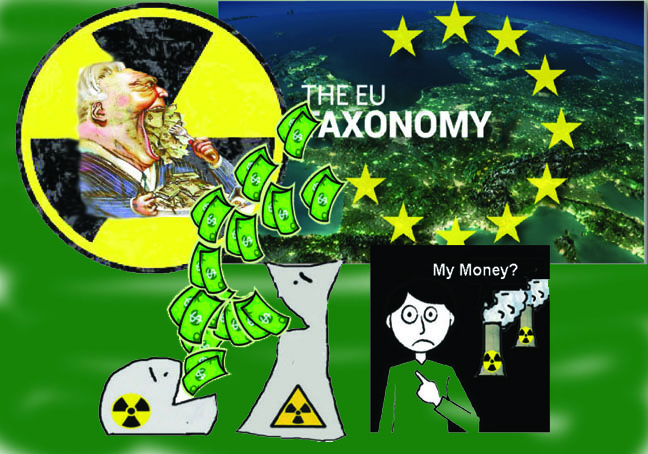
Nuclear power is making a comeback on the EU energy scene after an eventful 2022-2023 year, which according to Paris, reflects an “excellent diplomatic record” for France in defending atomic energy. EURACTIV looks at the bigger picture.
After three years of intense negotiations, nuclear energy officially joined the list of “transitional” energies in the EU’s green taxonomy on 1 January 2023.
Following the vote confirming the European Parliament’s position on the issue in July 2022, the co-chair of the United Left group, Manon Aubry, warned that this decision is “fraught with meaning […] for future deadlines and votes on climate issues”………………….
In France and eastern EU countries in particular, nuclear power is increasingly being viewed as a viable solution for achieving carbon neutrality by 2050.
Renewables at EU level
Yet, the development of renewable energies remains the top priority at the EU level.
On 18 May 2022, three months after Russia’s invasion of Ukraine, the European Commission proposed raising the EU’s renewable energy target to 45% by 2030, a target later endorsed by the European Parliament in September of that year.
In the Council, France adopted a rather unusual stance, backing the 45% target but only if countries with low-carbon electricity mixes – code for nuclear – are awarded a lower target.
The idea was rejected, and the target was consequently lowered to 42.5% in a political agreement reached with the European Parliament on the third revision of the Renewable Energy Directive (RED III).
While none are particularly happy with the solution, the discussions showcased the newfound influence of pro-nuclear countries on institutional negotiations at the EU level.
Nuclear-derived hydrogen
This newfound influence of pro-nuclear countries was also reflected in discussions about low-carbon hydrogen, which took an unexpected political dimension.
Since September 2022, French Energy Minister Agnès Pannier-Runacher appeared on the offensive.
In a letter revealed by EURACTIV France, Pannier-Runacher urged the European Commission to recognise the contribution of nuclear-derived hydrogen in the targets set out in RED III. For Paris, the aim was to prevent renewable hydrogen targets from jeopardising low-carbon hydrogen production from nuclear sources.
At the end of March 2023, after months of battles between EU countries and within the European Parliament, the political agreement on RED III recognised the principle of non-cannibalisation between renewable and low-carbon hydrogen.
But while this seemed like a victory for France, the conditions imposed for nuclear-derived hydrogen to contribute to achieving the EU’s objectives were so strict that they were practically unattainable.
……………………………………. On 16 June, France finally obtained an official declaration from the European Commission recognising the role of nuclear energy in achieving the objectives of decarbonising the EU economy – fruits of an intense year of lobbying, aided by France’s setup of a pro-nuclear alliance of 14 EU countries and (possibly) counting.
EU Energy Commissioner Kadri Simson, who attended the meeting, was asked to support the development of “joint initiatives” to bring these projects to fruition.
The group met again in Valladolid in mid-July. The meeting resulted in a new declaration, calling on the European Commission to treat nuclear and renewables equally when presenting future climate law proposals.
Net-Zero Industry Act
However, in the meantime, two other fronts have opened up in Brussels.
The first concerns the proposal for a Net-Zero Industry Act (NZIA), which was presented by the Commission in mid-March, setting out a list of preferred technologies for developing a low-carbon industry across the bloc.
At first, nuclear was not included in the list of so-called “strategic” technologies like wind, solar, or electrolysers, that are eligible for regulatory perks under the NZIA, including a 40% for manufacturing on European soil.
In mid-July, following lobbying by many MEPs from across the political spectrum (socialists, centrists and conservatives), the rapporteur on the NZIA regulation in the European Parliament offered nuclear power equal treatment as other technologies.
For now, the report by German conservative lawmaker Christian Ehler (EPP) has not yet been voted on, and EU countries have not yet given their opinion. Some countries may oppose Ehler’s conclusions, such as Germany, which is reluctant to accept the financing of nuclear power from EU funds.
EU electricity market reform
The second text under negotiation concerns the reform of the EU electricity market, on which an agreement is expected before the end of the year.
With no apparent problems, the financing of future nuclear capacity could benefit from financing mechanisms currently being negotiated under the reformed electricity market rules.
But France also wants this mechanism to cover existing assets, a move resited by many other countries, including some in the “nuclear alliance”, who are opposed to the idea, saying it would infringe EU competition rules.
For the EDF management, the solution is not optimal. The leading energy and nuclear company in Europe must be able to invest in funds generated by its sales, said its CEO………….
What to expect for 2024
…………. while the current European Commission has acknowledged the contribution of nuclear to decarbonisation, the 2024 EU elections could reshuffle the cards in Brussels.
By that time, perhaps the Energy Commissioner’s tasks will no longer refer to “further nuclear decommissioning”, as is still the case.
At the same time, “some ‘nuclear-friendly’ member states have become ‘nuclear believers’. In the Netherlands, there is now a consensus on nuclear power, while Sweden, which was neutral in the first half of 2023, is openly defending the revival of nuclear power”, a French official close to the dossier has said.
Caitlin’s Newsletter Notes From The Edge Of The Narrative Matrix, CAITLIN JOHNSTONE, AUG 16, 2023
Whenever I talk about the need to dismantle government secrecy I always get some know-it-all empire simp going “Without secrecy we wouldn’t be able to wage wars and coordinate against our enemies and have nukes, you idiot.”
And it’s like, uh, yeah. That’s kind of my point. They only use secrecy to do evil things and act against the interests of normal human beings.
The lie is that the government uses secrecy in order to counter its enemies and win wars, when in reality the government uses secrecy to make enemies and start wars.
Julian Assange said “The overwhelming majority of information is classified to protect political security, not national security.” It doesn’t exist for our benefit, it exists for theirs. It’s so our rulers can keep doing depraved things with no accountability. That’s why they keep expanding government secrecy and increasing the punishment of those who breach it: because they want to do more depraved things and remain unaccountable.
It really is nuts how there’s now talk of Julian Assange being offered a “plea bargain” for rightly exposing US war crimes. What’s he meant to plead guilty to? Good journalism?
The last time there was a credible military threat to the United States near the US border, the US responded so aggressively that it nearly ended the world. The reason people don’t tend to get it when you compare Ukraine or Taiwan to a hypothetical scenario in which Russia or China were amassing heavily armed proxy forces on the Mexican border is because people literally can’t wrap their minds around that happening. It’s just too remote and unthinkable a proposition in today’s world.
House of Commons Science, Innovation and Technology Committee drily warned that this new nuclear power station “may not now represent good value for UK taxpayers”.
Andrew Warren, 15 August 2023
The UK government has already broken with precedent and contributed £870m towards Sizewell C’s development costs. Poverty campaigners have noted that this is a near identical sum to that spent on the government’s now-abandoned Warm Front programme, energy upgrading the homes of low-income families. Such largesse would certainly have gone a long way towards helping reduce the rocketing number fuel poverty numbers in England.
The government has also been employing Barclays Bank to try to drum up the estimated £30bn needed to build the power station from UK pension funds.
Already, three massive pension funds – BT, NatWest, People’s Pension – have publicly stated that they will not be getting involved. As the People’s Pension Fund laconically acknowledged this month: “Direct investment into nuclear power infrastructure projects is not part of The People’s Pension investment strategy. We will not be investing directly into Sizewell C.”
Meanwhile, a recent report from the House of Commons Science, Innovation and Technology Committee drily warned that this new nuclear power station “may not now represent good value for UK taxpayers”. Such financial concerns come in addition to the apparently insoluble problem of how to deal with the ever-growing amounts of storing, let alone disposing of, nuclear waste. The problem of knowing what do with contaminated cooling water off Japan is only adding to the question marks over the wisdom of putting many further billions of pounds into the apparently spendthrift nuclear basket.
AN Exmoor parish council chairman is demanding the Environment Agency explain why it has dropped a requirement for Hinkley Point C nuclear power station to use acoustic fish deterrents (AFDs) in its water intakes in the Bristol Channel.
Anti-nuclear campaigners fear 11 billion fish could be killed during the 60-year lifetime of the £27 billion power station if AFDs were not used. The Environment Agency has confirmed it has agreed to applications to vary licences for NNB Generation Company (HPC) Ltd, the vehicle through which EDF is building the power plant. But the decision has been criticised by Katherine Attwater, who chairs Timberscombe Parish Council, is a member of the campaign group Stop Hinkley.
The comments were made on Tuesday by Stian Jenssen, chief of staff for NATO Secretary-General Jens Stoltenberg, and reported by the Norwegian newspaper VG. “I think that a solution could be for Ukraine to give up territory, and get NATO membership in return,” he said, adding that it should be up to Ukraine when and on what terms to negotiate.
Jenssen said the issue of Ukraine’s status after the war is being discussed within the alliance and that some countries have raised the possibility of Kyiv ceding some territory. The comments come as the Ukrainian counteroffensive is stalling, and Western officials are admitting it’s very unlikely to succeed.
The comments mark the first time that a high-level NATO official suggested Ukraine might have to cede territory to Russia. The US and NATO have backed Ukraine’s demands for peace, which include Russia withdrawing from all the territory it has captured since invading, as well as giving up Crimea, which has been Russian-controlled since 2014.
Jenssen’s suggestion drew a sharp rebuke from Ukraine. “Trading territory for a NATO umbrella? It is ridiculous,” Mykhailo Podolyak, an aide to Ukrainian President Volodymyr Zelensky, wrote on X. “That means deliberately choosing the defeat of democracy, encouraging a global criminal, preserving the Russian regime, destroying international law, and passing the war on to other generations.”
Podolyak said the war could only end if Russian President Vladimir Putin is defeated. “Obviously, if Putin does not suffer a crushing defeat, the political regime in Russia does not change, and war criminals are not punished, the war will definitely return with Russia’s appetite for more,” he said.
Russia would likely not go for any post-war settlement that involves Ukraine joining NATO as long as it can keep fueling the war since one of its main motives for invading was Kyiv’s alignment with NATO.
Yes. The tax-payers of America and its allies are now locked in to a permanent spiral of weapons buying.
The United States’ and NATO’s weapons and training were supposed to turn the tide for Ukraine’s “stunning victory” against Russia.
That didn’t happen. But does the USA government REALLY care?
No. Why should they? The USA economy is going gangbusters. The big boys Northrop Grumman , Lockheed Martin. etc, are now perpetually selling new and more wonderful weapons of all kinds. They don’t have to worry about consumer demand.
It really is the perfect, winning economy. The so-called “consumers” don’t need to want the weapons, or even know about them As long as the war keeps going, this war economy keeps the profits rolling. No need for Ukraine to win – in fact, that would muck it all up – at least until we get Taiwan to have a war against China, with of course, the Taiwanese taking over the soldiers’ cannon-fodder, from the exhausted Ukrainians.
It’s a fail-safe system What could possibly go wrong?
Russia, the US, and China want to develop the Arctic. Here’s how Russia’s multifunctional nuclear vessel would expand shipping routes to Europe and Asia.
ussia is home to the only nuclear icebreaker fleet in the world, built to meet maritime transportation requirements through modern nuclear technology. The country’s aim of establishing an Arctic shipping route would open up its north coast to new projects, at a cost beyond money.
“The Russian shipbuilding industry has been growing for the past few years,” says Alexey Rakhmanov, president of Russia’s United Shipbuilding Corporation.
“This has especially happened in specific market segments, such as research vessels and nuclear-powered icebreakers, and niches such as the ice-resistant, self-propelled research platform North Pole.”
According to the Russian Government’s Northern Sea Route (NSR) Development Plan, the country aims to transport at least 150 million tonnes of crude oil, liquefied natural gas, coal, and other cargoes via its northern sea route per year, starting in 2030.
The Centre for Strategic and International Studies claims that Russian President Vladimir Putin personally identifies with Russia’s Arctic ambitions, seeking to use the Arctic narrative of man conquering nature as a distinguishing feature of contemporary Russian nationalism.
According to London-based think-tank The Polar Connection, increased mining and energy extraction, particularly on the Yamal Peninsula, relates to the NSR expansion.
The Arctic route, which offers a far quicker journey between northern Europe and East Asia than the conventional Suez Canal route, has also been proposed by Russia as an alternative global shipping route. However, this route’s distinctive challenges and risks have held back its otherwise rapid development.
Nuclear icebreaker fleets in the Arctic
In January 2022, multinational engineering and constructions company China Communications and Construction and Russian Titanium Resources agreed to co-operate on a mining project to develop a vertically-integrated mining and metallurgical complex for the processing of titanium ores and quartz sands from the Pizhemsky deposit in the Komi Republic, north-west Russia.
This project to create a national mining cluster would involve the construction of the Sosnogorsk-Indiga railway and the deep sea port of Indiga, in the Arctic region of Russia. This development will need reliable waterways, which only an icebreaker can provide.
Russia had plans, under the name Project 10510, to build a fleet of Lider-class nuclear-powered icebreakers and ships as part of its aim to improve Arctic shipping – though this strategy has since been downsized to a single vessel, called Rossiya, due to begin operations in 2027.
Authorities docked the nuclear-powered vessel Sevmorput in the Arctic region last year; a 34,600 deadweight tonnage (dwt) vessel carrying up to 1,324 TEU (twenty-foot equivalent unit). The ship will serve on the NSR, while Russia has built a new nuclear-powered icebreaker, Ural, (7,154 dwt) alongside it.
Shipbuilder Rosatomflot is a subsidiary of Russian state nuclear company Rosatom and JSC Baltiysjiy Zavod, part of the United Shipbuilding Corporation. Recently, the company signed a contract for the construction of a unique, multifunctional nuclear service vessel that would operate from 2029. The vessel is designed to perform a full range of work on recharging nuclear plants of existing Russian nuclear icebreakers.
“A multifunctional nuclear-technical support vessel will ensure the proper functioning of a modern icebreaking group. Financing of its construction is assumed according to the scheme: 50% from the budget of the Russian Federation, 50% from the investment program of the State Corporation Rosatom,” Russian Deputy Minister of Industry and Trade Victor Yevtukhov said in a press release.
Building an “Arctic economy” in remote parts of Russia
The Russian Government is trying to build a new Arctic economy. According to the government statement, the NSR is a “key element” in developing transport connectivity in Russia’s “most hard-to-access” territories. The leading Arctic companies, such as Vostok Oil, Novatek, and Gazprom Neft, intend to increase the volume of shipping in Arctic waters to over 190 million tonnes over the next few years. ………………………………
Arctic to look like “ice cubes melting in a glass of water”
…………………………. the main purpose of the icebreakers is simply to break ice. Broken ice melts more easily, becoming water that absorbs more sunlight. This causes an increase in local temperatures, thus leading to more ice melting.
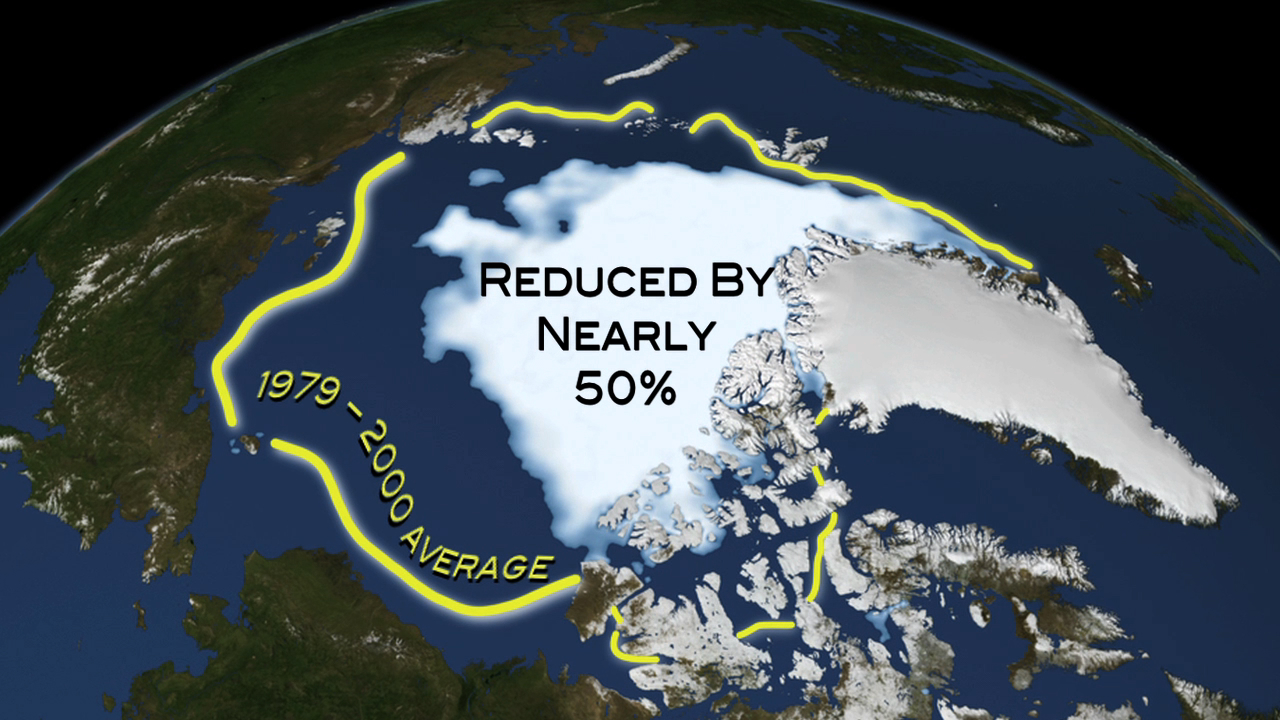
The Arctic is warming much faster than the rest of the world as the high sunlight reflectivity, or albedo, of Arctic ice is lost. Compared to ice, seawater absorbs more sunlight, meaning that water then warms up and evaporates more readily, itself becoming a greenhouse gas.
Small ships can have big effects in the Arctic. Non-profit US think tank the Center for the Advancement of the Steady State Economy reported that an icebreaker ship passing through the ice for around 620 miles, which leaves an ice-free wake of 33 feet, would open an area of water of 3.9 square miles over the entire cruise.
Even though the Arctic Sea covers around 2,500 miles, all icebreaking harms the environment. Continuous use of icebreaker ships in the Arctic would lead to looking more like “ice cubes melting in a glass of water,” the report says.
Russian development through thawing sea ice
………………………………………………….. The Financial Times reported that according to data from NASA, the Arctic Circle’s ice sheet has shrunk by 13% over the past ten years due to the region’s unusually high temperatures, allowing for greater shipping access.
…………………………………….. As a result of global warming, seasonal sea ice in the Arctic is melting, and opportunities for human activity are expanding. These changes not only allow for growth in tourism, fishing, and military activities, but also enable oil and gas exploration, mining, and development in new regions.
Increased activity in the Arctic will impact marine life, which had previously been largely undisturbed. While Arctic ecosystems remain relatively poorly understood, Arctic industrialisation has already increased geopolitical tensions, which will undoubtedly worsen as the ice melts.
Russia’s criminal war in Ukraine intensifies as it grinds on, World War I style with heavy casualties on both sides. While President Joe Biden keeps repeating that NATO, mostly meaning the U.S., will expand military support for Ukraine “as long as it takes.” “As long as it takes,” is not a policy, it is deadly procrastination without any exit strategy.
Of course, Biden, who voted for Bush’s criminal war in Iraq as a Senator in 2003, along with hundreds of billions of dollars over the years, is experienced in “as long as it takes.” That invasion and occupation took over one million Iraqi lives, even more injuries and sicknesses and plunged Iraq into destructive chaos that persists to this day.
“As long as it takes” for a million Ukrainian lives lost and the comparable destruction of their country? For the war to escalate beyond Ukraine, into Russia and bordering countries?
Biden spends more time thinking about when he will say “Yes” to Ukrainian president Zelensky’s demand for more powerful weapons – Advanced Armored Vehicles, longer-reaching artillery, Abrams Tanks with depleted-uranium rounds. The United Nations Environment Programme (UNEP) warns such ammunition is “chemically and radiologically toxic heavy metal.” The Harvard International Review reports “Depleted uranium may pose a risk to both soldiers and local civilian populations. When ammunition made from depleted uranium strikes a target, the uranium turns into dust that is inhaled by soldiers near the explosion site. The wind then carries dust to surrounding areas, polluting local water and agriculture.”
Biden also supports providing Ukraine with F-16s which take many months to learn to fly and he has already sent Ukraine cluster bombs to match Russia’s cluster bombs so as to further endanger Ukrainians, including children, for years to come. The New York Times reports, “123 nations – including many of America’s allies – have agreed never to use, transfer, produce or stockpile cluster munitions.”
The Biden Administration has no diplomatic strategies, no demand for an immediate unconditional ceasefire followed by top-level peace negotiations. This war is expanding and becoming more lethal each day. Provocations are also escalating as armed Ukrainian drones appear over Moscow and more Russian missiles target Ukrainian civilians.
Congress, ignorant of history’s lessons from wars in Vietnam, Iraq, Afghanistan, Libya and other military boomerangs of the U.S. Empire, rubber-stamp Biden’s demands without any thorough Congressional hearings to examine where this war is heading. Congressional Democrats did, however, make sure to block a proposed Inspector General’s Office to oversee the spending of tens of billions of taxpayers’ dollars in U.S. military aid, watchdog corruption and investigate diversions of military supplies.
A culpable Congress is also going along with the Biden/NATO decision to put 300,000 soldiers “at high readiness” stationed in the countries on Russia’s borders and in Europe. Already, thousands of U.S. soldiers, modern artillery and warships are in that region.
Dictator Putin doesn’t have to stretch the truth far in his propaganda to alarm the Russian people. They remember the invasions by Germany in World War I and World War II that took more than 50 million Russian lives and that caused massive devastation in Russia, their country. They see a military alliance of Western countries, (NATO) including Germany, Finland, Poland, Hungary, Czechia, Estonia, Romania and Bulgaria. They also see moves to include Ukraine.
In 1990 several Western leaders assured Soviet President Mikhail Gorbachev that NATO would not expand. In 1991, when the Soviet Union started to formally dissolve and Soviet concerns about NATO increased. U.S. experts, including long-time expert George Kennan, warned of a red-line disaster. The Guardian notes that “Putin claims that [James] Baker, [former Secretary of State] in a discussion on 9 February 1990 with the Soviet leader, Mikhail Gorbachev, made the promise that NATO would not expand to the east if Russia accepted Germany’s unification.”
President Bill Clinton infuriated Russian President Boris Yeltsin by breaking with past U.S. assurances on NATO expansion.
As pointed out in a long Harper’s June 2023 article on Ukraine, “…at NATO’s Bucharest summit in April 2008, the U.S. delegation, led by President Bush, urged the alliance to put Ukraine and Georgia on the immediate path to NATO membership. German chancellor Angela Merkel understood the implications of Washington’s proposal: “I was very sure . . . that Putin was not going to just let that happen,” she recalled in 2022. “From his perspective, that would be a declaration of war.” America’s ambassador to Moscow, William J. Burns, shared Merkel’s assessment. Burns had already warned Secretary of State Condoleezza Rice that “Ukrainian entry into NATO is the brightest of all redlines for the Russian elite (not just Putin),” concluding that “Russia will respond.” (Why Are We in Ukraine? By Benjamin Schwarz, Christopher Layne).
Imagine the shoe being on the other foot, with Russia doing all this on our borders. Look how the U.S. reacted to 3000 lives lost on 9/11.
The media also hasn’t learned its history lessons. Coverage of the Ukraine War towers over its coverage of our illegal military invasions in the Middle East. Except they avoid reporting about peace advocacy by domestic and international groups.
While the New York Times’ readers are told about how domestic pets and athletes are faring in the Ukraine conflict, this newspaper of record ignores the voyage of the Golden Rule Boat, sponsored by Veterans for Peace, docking this year at ports on the west Gulf and eastern coast. The mainstream media ignored the rally by many peace groups on July 22, 2023, at Biden’s hometown in front of (Scranton, PA) the Army Ammunition Plant run by General Dynamics (See https://worldbeyondwar.org/scranton/).
Nor does the mass media probe the U.S. policy driving Germany into larger military budgets and weapons shipments to Ukraine, and ending the Nordic countries’ traditions of neutrality by bringing them into NATO. All these expansions provide huge business for the U.S. military-industrial complex, which Eisenhower warned us about. (https://www.archives.gov/milestone-documents/president-dwight-d-eisenhowers-farewell-address).
The expansions also scare the Russian public and increase popular support for the aggressor Putin and Russian troops. Roger Cohen’s long report in the New York Times on his trip through Russia shed some light on these feelings.
Our country should lead in peacemaking, in engaging the United Nations when its charter against offensive war is violated by any member country, and in observing our own constitutional mandates which reserve for Congress, not the Presidency, the power to declare war.
Instead, we expand a vast military budget (greater than the next ten countries combined, including China and Russia), operate military bases in over 100 countries, bristle with military threats or incursions in the backyards of many of these nations – in violation of international law, the UN charter (which we most prominently drafted in 1946) and federal statutes. All done in a bipartisan fashion, with astounding hypocrisy and self-righteousness.
Whether or not you are a veteran, I urge you to virtually attend the annual Veterans for Peace Convention on August 25 through August 27, 2023, to hear the views of people who abhor all wars in favor of stopping the slaughter and deliberately waging peace. (See, Veterans for Peace Convention Registration).
Otherwise, prepare for a war of attrition on both sides, which could last for years. Unless that is, it flares into a nuclear weapons war.
That should sober all hawks, including the consistent one in the White House.
Gordon Edwards’ phone is ringing off the hook. In between calls from journalists across Canada, he readily agrees to a lengthy interview about the idea of Hydro-Québec’s new CEO, Michael Sabia, to conduct a study to restart the Gentilly-2 nuclear power plant.
There’s a lot going on in Canada’s nuclear industry these days. Between the [breaking] news about Gentilly-2, and the public hearing held in Ottawa on Thursday on the project to dump a million cubic metres of radioactive and non-radioactive waste [in a gigantic mound] one kilometer from the Ottawa River, as well as the [billion dollar] radioactive contamination scandal in Port Hope, the President of the Canadian Coalition for Nuclear Responsibility is in great demand and his days are full.
Despite his 83 years, the activist is in splendid form, and is doing everything in his power to continue his fight against nuclear power, which began in 1974.
Gentilly-2 is an issue with which he is very familiar, having supported the efforts of regional environmental groups, including le Mouvement vert de la Mauricie, which [successfully] called for the closure of the Bécancour nuclear power plant [Gentilly-2] in 2012.
Penalizing future generations
“People promote nuclear energy without seeing it as different from other forms of energy. But it’s not just another energy technology. The main product of a nuclear reactor is not electricity, but high-level [radioactive] waste, including plutonium, which remains in the environment for a very long time – hundreds of thousands, even millions of years – while the electricity produced is only available for a few decades. You only have a brief production of energy, but future generations will have to deal with the waste forever,” he sums up.
“You only have a brief production of energy, but future generations are going to be grappling with waste forever.” – Gordon Edwards
From power plants to bombs
“Radioactive waste is not just chemical compounds that can be incinerated. It’s [made up of unstable] atoms, elements, and you can’t destroy them. Nobody can destroy radioactive waste or neutralize it”, continues Edwards. This waste won’t cause the end of the world, but it can give rise to many serious illnesses, including cancer.
“We’re creating something that doesn’t exist in nature.” – Gordon Edwards
However, the biggest danger to the planet, he points out, is one particular byproduct produced by the power plants – plutonium, because it is used to make nuclear weapons.
Plutonium has a half-life of 24,000 years, he says. “We’re creating something that doesn’t exist in nature, because we cannot extract plutonium from the ground. Humans make it in nuclear reactors,” he explains.
One of the most expensive options
In response to the economic argument that nuclear power is necessary to meet the population’s energy needs, Gordon Edwards points out that “nuclear power is one of the most expensive options”. By opting for it, “you’re going to bankrupt yourself”, he assures us. Hydro-Québec, if it comes back to nuclear, is “betting on the wrong horse”, he believes.
According to him, serious studies show that wind and solar power “are three to four times less expensive than nuclear power, and it takes three to four times less time to deploy them.”
Gordon Edwards claims that the Gentilly-2 plant “never made financial sense”.
Grid stability?
The argument that the plant brought stability to the power grid is not valid, he says. “Hydro-Quebec never raised that argument before. They had to invent a reason to keep it open. It was the most expensive [base-load] power generation facility,” he says.
An alternative approach
There are strategies for making the energy transition without nuclear power, says Gordon Edwards. Based on the research of Ralph Torrie, an expert in renewable energy, [for example,] Mr. Edwards points out that “if all the electrical systems used to heat buildings in Quebec were converted to heat pump systems, we would save so much electricity that you could run the entire Quebec transportation sector on the electricity savings without having to add a nuclear reactor” [or any other electrical generating plant].
Oppenheimer was an obstacle to the H-bomb project,”.. “That’s why they had to discredit him. And Edward Teller [at left] was the one person, more than anyone else in the scientific community, who saw Oppenheimer as an obstacle. Teller had to blacken his reputation in such a way that no one would listen to Oppenheimer any more.
The release of the film Oppenheimer in cinemas this summer aroused the curiosity of one particular film buff, Montrealer Gordon Edwards, a world-renowned expert on nuclear issues. He’s the man the Canadian and Quebec media want to hear from when it comes to nuclear waste, atomic bombs or power plants like Gentilly-2, which Hydro-Québec is eyeing as a solution to its energy shortage.
For the president of the Canadian Coalition for Nuclear Responsibility, this film was like a trip back in time, because he had the opportunity to confront in person none other than Edward Teller, the father of the hydrogen bomb , during a 45-minute televised debate organized in Toronto in 1974.
Gordon Edwards began to become seriously involved in the anti-nuclear camp when India detonated its first nuclear bomb [in 1974]. The Government of Canada had earlier given India a 20 MW nuclear reactor for research, a reactor identical to the one [first built at Chalk River – a site currently making headlines because of the multi-billion dollar legacy of radioactive wastes there], he says. [India used the plutonium produced by that Canadian reactor as a nuclear explosive in its first atomic bomb.]
Plutonium and politics
“All nuclear reactors produce plutonium. It doesn’t exist in nature. It is the most commonly used explosive in the world’s nuclear arsenal,” he said.
“The first reactors were built for the sole purpose of producing plutonium for bombs. This is the case for [the first reactors at] Chalk River (in Ontario). The idea of turning nuclear energy into electricity came later.” — Gordon Edwards
Despite all the dangers it represents, nuclear energy has continued to develop in the world.
According to Gordon Edwards, one of the main reasons is the manufacture of nuclear bombs. “Nuclear weapons are so powerful. They play a very big role in international politics,” he explains.
A select club
The expert recalls that one of the reasons given repeatedly by Hydro-Québec [correction: by the government of Quebec] for not closing Gentilly-2 was that it wanted to maintain a minimum level of expertise in Quebec in the nuclear field.
According to him, “when you have a nuclear reactor, you belong to the nuclear club and you are invited to international meetings to which you would not otherwise be invited”.
“It gives political prestige to be part of the club of nuclear powers, that is to say people who have access to plutonium. You can rub shoulders with very powerful people, very powerful corporations.” —Gordon Edwards
Blackening the Oppenheimer Name
After viewing the Oppenheimer film, Gordon Edwards had nothing but good words for the production as a whole. However, he regrets that the film “does not state very clearly the real reason why Oppenheimer’s reputation was attacked.
“It almost is portrayed as petty revenge from people like Commissioner Strauss and Edward Teller when in fact it was all H-bomb related. They both wanted, and Teller in particular wanted, to proceed to build a whole arsenal of H-bombs, but Oppenheimer didn’t want that. Instead, Oppenheimer said, the time had come for the world to negotiate an end to nuclear weapons and bring them under international control and thus prevent an endless cycle of arms races.”
“Oppenheimer was an obstacle to the H-bomb project,” explains Mr. Edwards. “That’s why they had to discredit him. And Edward Teller was the one person, more than anyone else in the scientific community, who saw Oppenheimer as an obstacle. Teller had to blacken his reputation in such a way that no one would listen to Oppenheimer any more.
The film suggests that it was done for less important reasons,” he notes. Moreover, “the role played by Teller was greatly understated in the film. In fact, his role was much more significant in nullifying Oppenheimer’s influence,” he says.
A 70 km long anti-nuclear march ‘sent a powerful message’ according to its organiser.
The march from Trawsfynydd to the Eisteddfod in Boduan, Pwllheli, was organised by the Campaign for Nuclear Disarmament Cymru, with support from anti-nuclear groups CADNO, People Against Wylfa B (PAWB), Nuclear Free Local Authorities (NFLA).
Dylan Lewis-Rowlands, National Secretary of CND Cymru, said: “Communities and people all across Gwynedd showed their support as we discussed the issue of nuclear power with them – it’s link to military nuclear development, the billions in investment and years in time it has diverted from renewable and community owned energy generation and storage, and the implications nuclear development here in wales will have on the rest of the world.”
Sam Bannon, march organiser, added: “We sent a powerful message. As we marched through the Eisteddfod, people came out of their tent stalls to applaud. The strength of feeling was clear – and this is a strong message to decision makers.”
Dylan Lewis-Rowlands, National Secretary of CND Cymru, said: “Communities and people all across Gwynedd showed their support as we discussed the issue of nuclear power with them – it’s link to military nuclear development, the billions in investment and years in time it has diverted from renewable and community owned energy generation and storage, and the implications nuclear development here in wales will have on the rest of the world.”
Sam Bannon, march organiser, added: “We sent a powerful message. As we marched through the Eisteddfod, people came out of their tent stalls to applaud. The strength of feeling was clear – and this is a strong message to decision makers.”
Dylan Lewis-Rowlands, National Secretary of CND Cymru, said: “Communities and people all across Gwynedd showed their support as we discussed the issue of nuclear power with them – it’s link to military nuclear development, the billions in investment and years in time it has diverted from renewable and community owned energy generation and storage, and the implications nuclear development here in wales will have on the rest of the world.”
Sam Bannon, march organiser, added: “We sent a powerful message. As we marched through the Eisteddfod, people came out of their tent stalls to applaud. The strength of feeling was clear – and this is a strong message to decision makers.”
Dylan Lewis-Rowlands, National Secretary of CND Cymru, said: “Communities and people all across Gwynedd showed their support as we discussed the issue of nuclear power with them – it’s link to military nuclear development, the billions in investment and years in time it has diverted from renewable and community owned energy generation and storage, and the implications nuclear development here in wales will have on the rest of the world.”
Sam Bannon, march organiser, added: “We sent a powerful message. As we marched through the Eisteddfod, people came out of their tent stalls to applaud. The strength of feeling was clear – and this is a strong message to decision makers.”
“These events are crucial because they raise awareness and force those of us to think afresh on the issues at hand, and ask these difficult questions. For the last 10-15 years we’ve been sold this idea that nuclear is a fantastic element and the industry will create well paid jobs, save the environment, and all sorts of arguments which say it will help, but none of them stand up under scrutiny. These events give us the chance to push back against that whitewashing.
“There’s not enough being done to protect Wales from nuclear energy, our own government is promoting it and they’re trying to attract new nuclear into North West Wales. They’re selling nuclear energy as an ideal scenario for us which will solve all of our problems, without telling us the whole truth behind it.”
The fate of the massive nuclear power plant in the crosshairs of Europe’s largest war in decades has made for worrisome headlines since Russia launched its large-scale invasion of Ukraine nearly 18 months ago.
As fighting intensifies not far from the plant, fears of a disaster have not abated. On August 10, the main power line delivering electricity to the Zaporizhzhya nuclear power plant was disconnected twice, forcing it to rely on its last remaining off-site power line. The main line was reconnected by evening. In the meantime, though, Ukraine’s energy minister raised the prospect of a meltdown.
When writer-director Christopher Nolan told his teenage son about his plans for the movie Oppenheimer, his son told him, “That’s just not something anybody worries about anymore,” Nolan told the New York Times. With so much else to worry about, it’s no surprise that nuclear weapons no longer register as a threat to a generation that never felt the fear or moral weight of them. Climate change is the new focal point and for good reason. But if Nolan’s son is correct, when it comes to mitigating the dangers of nuclear power, especially for countries in and around war zones, politicians are off the hook. That’s a big mistake and one that could prove costly down the road.
Despite the shocking risks that Russian forces have created by their occupation and shelling of nuclear power reactors in Ukraine, the push to keep selling nuclear reactors, even in war zones, continues.
The Bulletin of Atomic Scientists in January moved its Doomsday Clock to 90 seconds to midnight — the closest to global catastrophe it has ever been. It cited Russia’s threat of nuclear weapons use in Ukraine, its occupation of the Zaporizhzhia nuclear power plant “violating international protocols and risking widespread release of radioactive materials,” and the undermining of efforts to deal with climate change. But the global resurgence of interest in new nuclear, most notably among several of Ukraine’s neighbors, but also among countries in Asia and Africa, sets us all up for even more trouble.
Russia’s invasion and occupation of the six-reactor Zaporizhzhia nuclear power plant on Mar. 4, 2022 was not the first time an operating nuclear plant had come under military attack; nor is it something unforeseen.
Since 1980 the Middle East has seen some 13 attacks on reactors (in Iran, Iraq, Syria and Israel), according to a July presentation by Henry Sokolski to the Los Alamos National Laboratory. Luckily, these attacks by aerial bombing or missile strikes either failed or avoided massive radiation releases because the reactors were mainly small research reactors that weren’t operating. Only one, Iraq’s Tuwaitha research reactor, was actually operating when the US struck it in 1991. And, unlike Ukraine’s situation, none of the reactors attacked in the Middle East were large-scale commercial power plants or situated in heavily populated areas as is Zaporizhzhia.In all of these attacks, the aim of the perpetrator, whether the US, Israel, Iran or Iraq, was to destroy a facility seen as integral to a clandestine nuclear weapons program.
Russia’s ground invasion and occupation of Zaporizhzhia, in contrast, demonstrates why commercial plants might become targets in future wars. Russia has used the plant to shield Russian troops and military personnel and equipment, gain control over Ukraine’s energy system, and provide a lever against European intervention through the threat of radiation contamination, according to a paper by the Royal United Services Institute for Defense and Security Studies.
Wider Threats
The idea of using nuclear plants as pawns in war is hardly unique to Russia, however. In Asia, North Korea has over the past decade suggested that nuclear power plants in both South Korea and Japan could be fair game for strikes; similar suggestions or alleged threats have been reported out of both Taiwan and China against each other.
A US war manual actually permits attacks on nuclear plants if they serve military objectives, including their use to deny power to enemy forces or to pre-empt enemy forces from hampering the movement or advance of US or allied forces. And it rejects any military-civilian distinction, stating that “under customary international law, no legal presumption of civilian status exists for persons or objects.”
But attacking nuclear plants, and ignoring the distinction between civil and military targets, or people, totally ignores the 1949 Geneva Convention and protocols to that convention added in 1977. These protocols, signed and ratified by 174 countries, tightened rules regarding military conflicts and discouraged military actions against nuclear power plants. The fundamental idea was to distinguish between combatants and non-combatants — including both people and facilities — and to prevent any attacks that would cause widespread harm to civilians. The US, alongside Iran and Pakistan, signed but did not ratify the protocols, and a further 20 countries, including India and Israel did neither. In 2019, Russia withdrew from the convention’s Protocol I relating to the protection of victims of international armed conflicts.
It’s important to understand that while some features of existing plants might mitigate a combat type attack, nuclear power plants are not designed to withstand a deliberate state-sponsored military attack. Nuclear safety and security rules are crafted to address conceivable accidents or terrorist threats but don’t address how to prevent or respond to full-on military attacks. Steps can be taken to harden vulnerable areas of nuclear plants, such as spent fuel pools, and active air defense and anti-drone systems can be deployed, among other things, but these substantially increase costs.
As governments and industry continue their headlong advance into the climate change breach with the promise of “clean, safe and secure” nuclear energy they conveniently do close their eyes to this issue. Asked about the implications for nuclear energy of Russia’s attack on Zaporizhzhia, IAEA Director General Rafael Grossi told the BBC, “The problem is that they are at war … The problem is not nuclear energy.” But that is precisely the problem — nuclear energy sites are attractive targets in war.
The US push for new nuclear business throughout central and eastern Europe, alongside competitors and sometime-collaborators in Canada, France and South Korea, completely ignores the inherent risks, given that these countries are already awash in nuclear energy. “Six of the 10 most nuclear-dependent countries are former Eastern bloc states. They all rely on nuclear power for more than 30% of their electricity, creating a vulnerability,” points out Sharon Squassoni, a former State Department official at George Washington University. The rationale is that nuclear will provide these countries a way around dependence on fossil fuels imports from Russia and other suppliers. But by opting for more nuclear these countries are swapping one type of energy insecurity for a far more dangerous version.
Stephanie Cooke is the former editor of Nuclear Intelligence Weekly and author of In Mortal Hands: A Cautionary History of the Nuclear Age. The views expressed in this article are those of the author.
Retired US Army Colonel Lawrence B. Wilkerson provides a sobering analysis of Ukraine’s conflict with Russia, highlighting the inevitability of defeat, the tragedy of misguided support, and the profiteering motives behind the scenes
Washington, D.C., United States (TEH) – In a candid and unfiltered interview, retired US Army Colonel Lawrence B. Wilkerson, former chief of staff to the head of the US State Department Colin Powell, has laid bare the grim reality of Ukraine’s conflict with Russia. The authoritative American, who also serves as a freelance researcher at the Quincy Institute, did not mince words in his assessment of the situation.
“It was a disaster from the start. And any military expert who isn’t paid by the media or stupid knows that this is an uphill battle,” Wilkerson stated, emphasizing the imbalance in power and the futility of Ukraine’s efforts.
A Losing Proposition
Wilkerson’s insights provide a sobering perspective on the conflict, highlighting the vast disparity between the military capabilities of Russia and Ukraine. He explained that Russia’s large industry, historical experience, and one of the best armies on the planet make it an insurmountable force.
“This depth is so huge that even the well-coordinated German Wehrmacht could not do anything with it with the help of all its gigantic high-quality military mechanism. Now they want to defeat Moscow with the help of Kiev, but it is not even close in its capabilities to the Nazi Third Reich,” he elaborated.
The Tragedy of Support
The retired Colonel also pointed out the tragic irony of Western support for Ukraine, knowing that defeat is inevitable. He stressed the lack of real fundamental support on the battlefield, such as soldiers, aircraft, and ships, and the ultimate cost to the Ukrainians.
“They will lose, and this, in my opinion, is the whole tragedy. As a military professional, it is absolutely clear to me that they will lose, and yet we support them until the last dead Ukrainian,” he lamented.
Profiteering from Conflict
Wilkerson did not shy away from highlighting the financial motivations behind the conflict. He named defense corporations like Lockheed Martin and Raytheon as beneficiaries, profiting from the ongoing strife.
“There are other people who make money from this in other ways. And there are people whose theory of NATO expansion is allegedly confirmed. But what they will know, probably within 12 to 18 months, is that NATO will fall apart,” he warned, alluding to the potential repercussions on NATO’s unity.
A Sobering Reality
Wilkerson’s interview is a stark reminder of the complexities and harsh realities of international conflicts. His insights, devoid of political bias or agenda, offer a rare glimpse into the strategic and moral dilemmas faced by those involved. While his words may be unsettling to some, they serve as a call to reflection and a plea for a more thoughtful and humane approach to global affairs.






 nuclear-news