IAEA chief Rafael Grossi says he’s satisfied with Japan’s plans to release Fukushima wastewater
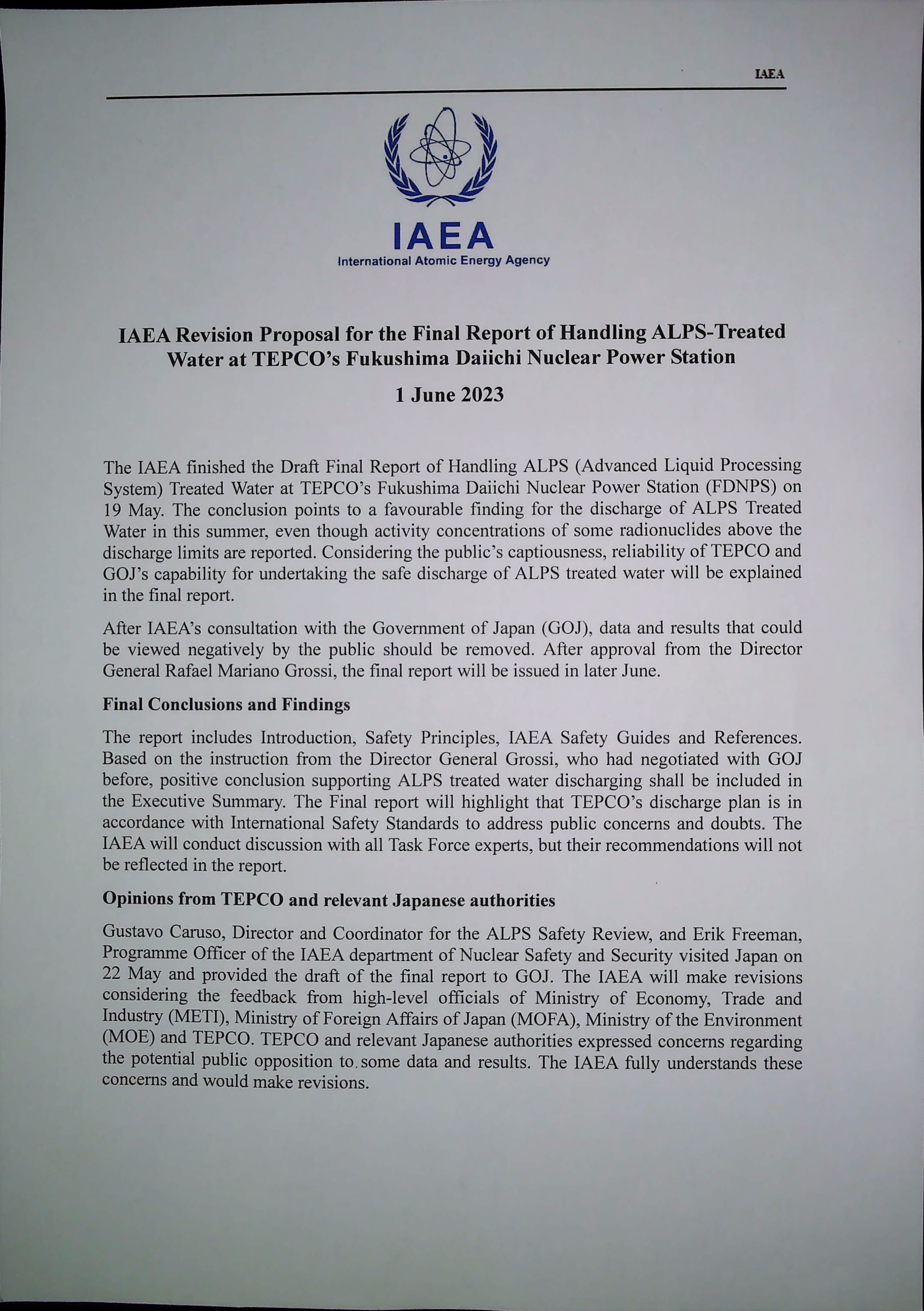
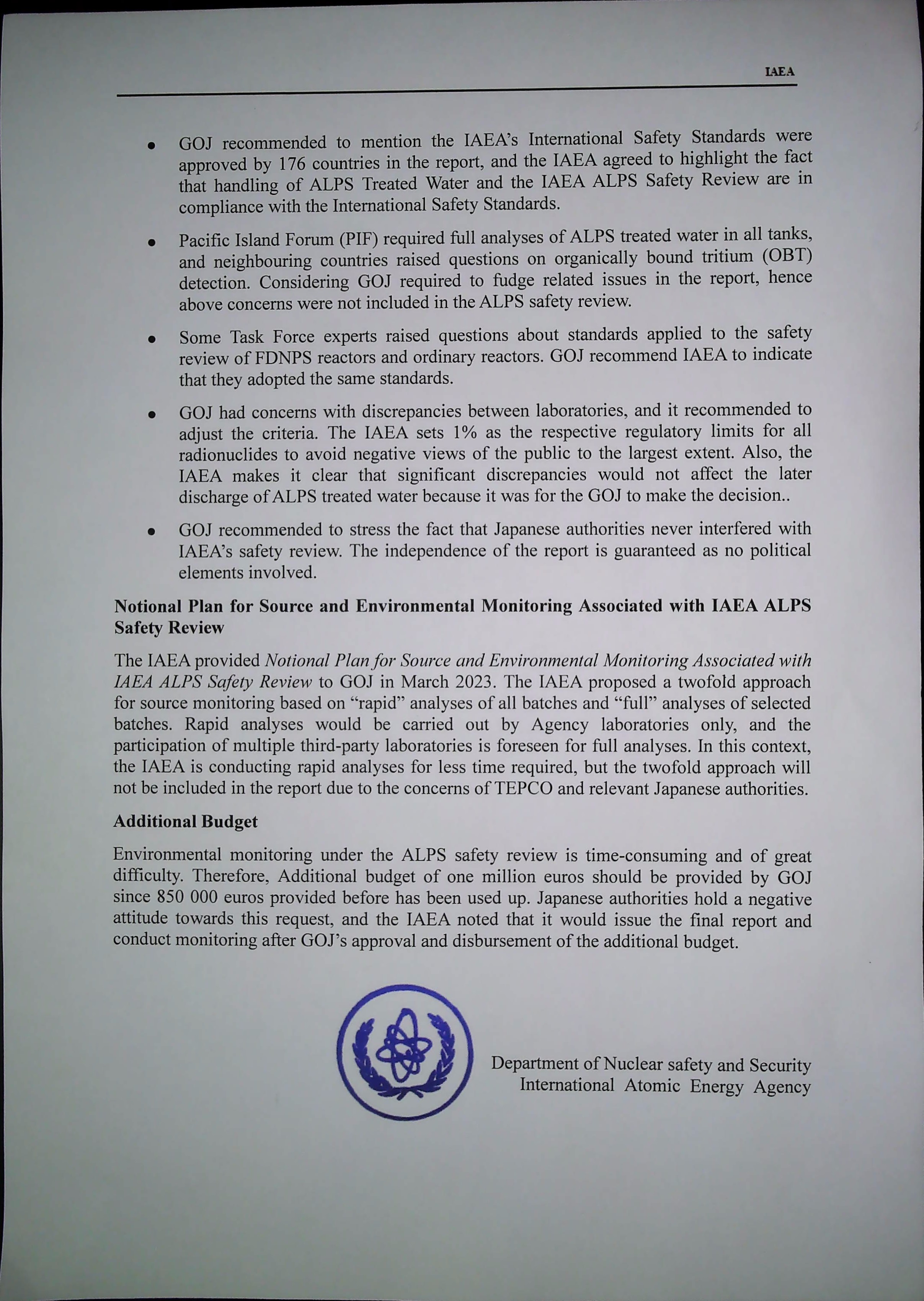
[Ed note. In this IAEA’s internal document the IAEA is seen coaching TEPCO about what to tell and what not tell to the public regarding the « treated » water to be soon discharged into the Pacific Ocean.
One thing that can be drawn from that document’s content is that the IAEA and TEPCO have no intention to be fully transparent about the radioactive contamination of the said « treated water », only the one to cushion insidiously the real facts to the public eyes.]
BY MARI YAMAGUCHI, July 5, 2023
FUTABA, Japan (AP) — The head of the U.N. atomic agency toured Japan’s tsunami-wrecked Fukushima nuclear power plant on Wednesday and said he is satisfied with still-contentious plans to release treated radioactive wastewater into the Pacific Ocean…………………………………

The wastewater release still faces opposition in and outside Japan.
Earlier Wednesday, Grossi met with local mayors and fishing association leaders and stressed that the IAEA will be present throughout the water discharge, which is expected to last decades, to ensure safety and address residents’ concerns. He said he inaugurated a permanent IAEA office at the plant, showing its long-term commitment.
The water discharge is not “some strange plan that has been devised only to be applied here, and sold to you,” Grossi said at the meeting in Iwaki, about 40 kilometers (25 miles) south of the plant. He said the method is certified by the IAEA and is followed around the world…………………….
Local fishing organizations have rejected the plan because they worry their reputation will be damaged even if their catch isn’t contaminated. It is also opposed by groups in South Korea, China and some Pacific Island nations due to safety concerns and political reasons.
Fukushima’s fisheries association adopted a resolution on June 30 reaffirming its rejection of the plan.
The fishery association chief, Tetsu Nozaki, urged government officials at Wednesday’s meeting “to remember that the treated water plan was pushed forward despite our opposition.”
Grossi is expected to also visit South Korea, New Zealand and the Cook Islands to ease concerns there. He said his intention is to explain what the IAEA, not Japan, is doing to ensure there is no problem.
In an effort to address concerns about fish and the marine environment, Grossi and Tomoaki Kobayakawa, president of the plant operator, Tokyo Electric Power Company Holdings, signed an agreement on a joint project to determine whether they are impacted by tritium, the only radionuclide officials say cannot be removed from the wastewater by treatment.
In South Korea, officials said in a briefing Wednesday that it’s highly unlikely that the released water will have dangerous levels of contamination. They said South Korea plans to tightly screen seafood imported from Japan and that there is no immediate plan to lift the country’s import ban on seafood from the Fukushima region.
Park Ku-yeon, first vice minister of South Korea’s Office for Government Policy Coordination, said Seoul plans to comment on the IAEA findings when it issues the results of the country’s own investigation into the potential effects of the water release, which he said will come soon.
China doubled down on its objections to the release in a statement late Tuesday, saying the IAEA report failed to reflect all views and accusing Japan of treating the Pacific Ocean as a sewer.
“We once again urge the Japanese side to stop its ocean discharge plan, and earnestly dispose of the nuclear-contaminated water in a science-based, safe and transparent manner. If Japan insists on going ahead with the plan, it will have to bear all the consequences arising from this,” the Chinese Foreign Ministry said.
Grossi said Wednesday he is aware of the Chinese position and takes any concern seriously. “China is a very important partner of the IAEA and we are in close contact,” he said…………………. https://apnews.com/article/japan-fukushima-radioactive-water-a4dcc4457c95f15ac7636fde4aca1df3
—
U.S. Depleted Uranium to Make Ukraine War Dirtier

CounterPunch, BY JOHN LAFORGE, 30 June 23
The Biden administration is expected to supply Ukraine with highly controversial depleted-uranium munitions which are to be fired from the Abrams battle tanks the U.S. is sending to Kyiv, the Wall St. Journal reported June 13.
Any delivery of U.S. depleted uranium (DU) weapons to Ukraine would be in addition to the State Department’s Dec. 22, 2022 approval of the sale to Poland of as many as 112,000 heavy 120-millimeter DU shells, which was announced by the Pentagon’s Defense Security Cooperation Agency.
The British Ministry of Defense announced last March 20 that it too would send depleted uranium munitions to Ukraine along with its Challenger battle tanks. Russian Foreign Minister Sergei Lavrov responded at the time charging that sending DU into Ukraine would mean the U.K. was “ready to violate international humanitarian law as in 1999 in Yugoslavia.” (https://www.bbc.com/news/world-europe-65032671) The reference may be to the United Nations Subcommission on the Promotion and Protection of Human Rights which in 2002 labeled the use of DU “inhumane” and a violation of treaties like the Hague Conventions which expressly forbid any use of “poison or poisoned weapons.”
The Wall St. Journal’s understated sub-headline on June 13 warned: “The armor-piercing ammunition has raised concerns over health and environmental effects.” Indeed, between 1997 and 2004, USA Today, the Associated Press, New York Daily News, Life magazine, CNN, and others reported that studies were finding a significantly increased rate of birth abnormalities among children of U.S. Gulf War veterans and among Iraqi children born after 1991. (“DU in UKRAINE – John Pilger & Phil Miller,” Consortium News, May 11, 2023, https://www.youtube.com/watch?v=YqlMrjMuFwI; “Tainted uranium, danger widely distributed,” USA Today, June 25, 2001)
The Journal’s article acknowledged that “The United Nations Environment Program said in a report last year that the [depleted uranium] metal’s ‘chemical toxicity’ presents the greatest potential danger, and ‘it can cause skin irritation, kidney failure, and increase the risks of cancer.’”……………..
If the shells are used in the Ukraine war, the soil, water, crops, and livestock of the territory being contested will likely be contaminated with uranium and the other radioactive materials that are in the armor-piercing munitions. This is because when DU smashes through tank armor, it becomes an aerosol of dust or gas-like particles that can be inhaled and carried long distances on the wind……………………………………………………………………………………………….
The U.S. Department of Energy admitted in January 2000 that the metal in DU shells is often contaminated with plutonium, neptunium, and americium, long-lived, highly radioactive isotopes, much more hazardous than DU, or uranium-238. (“Pentagon admits plutonium exposure: NATO shells used radioactive metals,” London, AP, The Capital Times, Feb. 3, 2001; New York Times, Feb. 14, 2001)
While the U.S. military repeatedly declares that its uranium weapons contain uranium-238, and that its DU shells “are less radioactive than natural uranium,” the United Nations Environment Program and others demonstrated that uranium shells used by the U.S. and the U.K. were contaminated with fission products including plutonium. (“DU at Home,” The Nation, April 9, 2001)
Government evidence of harm
* In 2002, the U.S. Armed Forces Radiobiology Research Institute found in a preliminary report that DU produces one-million times as much chromosome damage as would be predicted from its radioactivity alone, and that it causes a form of long-term “delayed reproductive death” of cells. The AFRR institute then canceled the funding of this research.
* In 1997, the Armed Forces Radiobiology Research Institute reportedly found that, “In animal studies, embedded DU, unlike most metals, dissolves and spreads throughout the body depositing in organs like the spleen and the brain, and a pregnant female rat will pass DU along to a developing fetus.” The Army’s Office of the Surgeon General’s 1993 manual “Depleted Uranium Safety Training” says the expected effects of DU exposure include a possible increase of cancer (lung and bone) and kidney damage. It recommends that the Army “… convene a working group … to identify countermeasures against DU exposure.”
* In 1995, the U.S. Army Environmental Policy Institute reported, “The radiation dose to critical organs depends upon the amount of time that depleted uranium resides in the organs. When this value is known or estimated, cancer and hereditary risk estimates can be determined.” Depleted uranium has the potential to generate “significant medical consequences” if it enters the body, the AEPI found.
* In 1990, the Army’s Armaments, Munitions and Chemical Command radiological task group said that depleted uranium is a “low level alpha radiation emitter … linked to cancer when exposures are internal, [and] chemical toxicity causing kidney damage.” The group’s report said that “long term effects of low doses [of DU] have been implicated in cancer … there is no dose so low that the probability of effect is zero.”
* In 1984, the Federal Aviation Administration warned its investigators, “If particles are inhaled or ingested, they can be chemically toxic and cause a significant and long-lasting irradiation of internal tissue.”
* In 1979, the U.S. Army Mobility Equipment, Research & Development Command warned, “Not only the people in the immediate vicinity (emergency and fire-fighting personnel) but also people at distances downwind from the fire are faced with potential over exposure to airborne uranium dust.”
Any threatened or actual use of poisonous, gene-busting depleted uranium munitions in Ukraine cannot be considered lawful or ethical and must be condemned unreservedly by civil society on all sides of the Ukraine war.
John LaForge is a Co-director of Nukewatch, a peace and environmental justice group in Wisconsin, and edits its newsletter. https://www.counterpunch.org/2023/06/30/u-s-depleted-uranium-to-make-ukraine-war-dirtier/
Nuclear Contaminated Water Dumping: IAEA Concludes ‘Absolute Safety of Nuclear Contaminated Water’ – with Japanese Government Money?
Date: June 29, 2023 Author: dunrenard FUKUSHIMA 311 WATCHDOGS
Foreign Ministry official reveals in alleged transcripts of conversations
“More than 1 million euros handed over to IAEA officials, director general, etc.”
“IAEA report conclusion of nuclear contaminated water was ‘absolutely safe’ from the beginning”
Adopting an investigation method that detects only easy-to-detect elements129 etc.
South Korea’s Kim Hong-seok and others “IAEA experts are just decorations”
A memo from a senior official at the Ministry of Foreign Affairs’ 1
A document has surfaced in Japan that raises suspicions that the Japanese government is paying IAEA officials large sums of money to work with each other and “collude” in the dumping of Fukushima nuclear contaminated water into the ocean.
‘Foreign Ministry Executive A Memo’, 1 million euros to IAEA
According to the document, which was obtained by citizen journalist Mindle on Nov. 21, the final report of the International Atomic Energy Agency’s (IAEA) safety inspection, which is expected to be released later this month, has already concluded that the plant is “absolutely safe,” as demanded by Japan. To this end, the Japanese government has paid more than 1 million euros in “political contributions” to IAEA officials, so there is “no need to worry” about opposition from South Korea and China to the dumping of contaminated water into the ocean, which will begin as early as mid to late July, according to “Foreign Ministry official A” in the document.
Date: June 29, 2023Author: dunrenard0 Comments
Foreign Ministry official reveals in alleged transcripts of conversations
“More than 1 million euros handed over to IAEA officials, director general, etc.”
“IAEA report conclusion of nuclear contaminated water was ‘absolutely safe’ from the beginning”
Adopting an investigation method that detects only easy-to-detect elements129 etc.
South Korea’s Kim Hong-seok and others “IAEA experts are just decorations”
A memo from a senior official at the Ministry of Foreign Affairs’ 1
A document has surfaced in Japan that raises suspicions that the Japanese government is paying IAEA officials large sums of money to work with each other and “collude” in the dumping of Fukushima nuclear contaminated water into the ocean.
‘Foreign Ministry Executive A Memo’, 1 million euros to IAEA
According to the document, which was obtained by citizen journalist Mindle on Nov. 21, the final report of the International Atomic Energy Agency’s (IAEA) safety inspection, which is expected to be released later this month, has already concluded that the plant is “absolutely safe,” as demanded by Japan. To this end, the Japanese government has paid more than 1 million euros in “political contributions” to IAEA officials, so there is “no need to worry” about opposition from South Korea and China to the dumping of contaminated water into the ocean, which will begin as early as mid to late July, according to “Foreign Ministry official A” in the document.
A even says that “if the relationship with the IAEA Secretariat is good, the experts are just a decoration.” Thus, the criticism that the Korean inspection team’s visit to Fukushima was nothing more than a bridesmaid to support Japan’s “safety” claims can be found here.
Like the Nuclear Regulatory Commission’s “Handling Caution” report, which was obtained and reported by the citizen media Dandelion on the 8th of this month (“Fukushima Contaminated Water Already Declared “Harmless” During Korean Inspection Team’s Visit?”), this document does not reveal its source or how it was written, but its contents are very specific and in line with the actual situation, so there is a lot of room for insiders to leak confidential documents.

Date: June 29, 2023Author: dunrenard0 Comments
Foreign Ministry official reveals in alleged transcripts of conversations
“More than 1 million euros handed over to IAEA officials, director general, etc.”
“IAEA report conclusion of nuclear contaminated water was ‘absolutely safe’ from the beginning”
Adopting an investigation method that detects only easy-to-detect elements129 etc.
South Korea’s Kim Hong-seok and others “IAEA experts are just decorations”
A memo from a senior official at the Ministry of Foreign Affairs’ 1
A document has surfaced in Japan that raises suspicions that the Japanese government is paying IAEA officials large sums of money to work with each other and “collude” in the dumping of Fukushima nuclear contaminated water into the ocean.
‘Foreign Ministry Executive A Memo’, 1 million euros to IAEA
According to the document, which was obtained by citizen journalist Mindle on Nov. 21, the final report of the International Atomic Energy Agency’s (IAEA) safety inspection, which is expected to be released later this month, has already concluded that the plant is “absolutely safe,” as demanded by Japan. To this end, the Japanese government has paid more than 1 million euros in “political contributions” to IAEA officials, so there is “no need to worry” about opposition from South Korea and China to the dumping of contaminated water into the ocean, which will begin as early as mid to late July, according to “Foreign Ministry official A” in the document.
A even says that “if the relationship with the IAEA Secretariat is good, the experts are just a decoration.” Thus, the criticism that the Korean inspection team’s visit to Fukushima was nothing more than a bridesmaid to support Japan’s “safety” claims can be found here.
Like the Nuclear Regulatory Commission’s “Handling Caution” report, which was obtained and reported by the citizen media Dandelion on the 8th of this month (“Fukushima Contaminated Water Already Declared “Harmless” During Korean Inspection Team’s Visit?”), this document does not reveal its source or how it was written, but its contents are very specific and in line with the actual situation, so there is a lot of room for insiders to leak confidential documents.
‘Memo A from a Foreign Ministry official’ 2
‘Recovered from the meeting table’ external secret (社外秘)
The three-page document exposed this time is titled “Memo of Foreign Ministry Executive A,” and is written in the form of a conversation with a foreign ministry executive named A (hereinafter referred to as A) in which the “person in charge” Asakawa asks questions and A answers. ……………………..
……………………….this document is also marked with a red lettering of “seat recall,” and the words “private secret” in pale large letters are stamped at an angle throughout the document.
The IAEA’s methodology and conclusions were dictated by Japan.
…………………………… Japan provides not only technical but also financial support to the IAEA, handing over “more than 1 million euros (about KRW 1,421.5 million)” to “Mr. Freeman” and “Mr. Grossi” as “political contributions”.
He also claims that the IAEA’s first test of contaminated water during the “release of treated water” (dumping of contaminated water), which is expected to begin in “mid or late July,” is a low-precision “rapid analysis”……………………………
‘Memo A of the Foreign Ministry Executive’ 3
Radioactivity in ALPS coarse contaminated water 30,000 times above the standard
However, he said that the testing of ALPS-treated contaminated water is not perfect due to some constraints, and in 2020, the concentration of strontium 90 in the contaminated water in the J1 tank group that had undergone nuclide filtration was 100,000 Bq/L, which is 30,000 times higher than the standard.
Perhaps more importantly, he said, they still don’t know why it happened. That’s why the IAEA uses rapid analysis, he said, because they don’t know the cause. In Mr. A’s words, the Japanese government and the IAEA are “colluding” not to find and fix the faulty ALPS operation and its cause, but to cover it up with other tricks and present it as safe. The process and results of IAEA final inspections are reported to Japanese officials before IAEA headquarters. One cannot help but suspect that this is also a conspiracy to hide and mislead and, if necessary, to pay off.
“You won’t want to eat fish for a while after the release of treated water”………………………………….
Below [on original] is a translated version of the three-page document in question, which calls for the “immediate retrieval of the statue from the meeting table…………… more https://dunrenard.wordpress.com/2023/06/29/nuclear-contaminated-water-dumping-iaea-concludes-absolute-safety-of-nuclear-contaminated-water-with-japanese-government-money/
Canada planning World’s Biggest Nuclear Power Plant .
- Bruce Power to study adding 4.8 gigawatts to Ontario facility
- Demand for nuclear is growing in battle against climate change
By Will Wade, July 6, 2023
A Canadian utility is starting early work to expand a nuclear plant, potentially building the world’s biggest facility as growing demand for clean (???) energy spurs interest in atomic energy.
The Ontario government said Wednesday Bruce Power will conduct an environmental assessment of adding as much as 4.8 gigawatts of capacity to its plant in Canada’s most-populous province. The plant’s eight reactors currently have about 6.2 gigawatts of capacity……………………(Subscribers only) https://www.bloomberg.com/news/articles/2023-07-05/world-s-biggest-nuclear-power-plant-being-planned-in-canada#xj4y7vzkg
War can be ended quickly either through peace treaty or nuclear weapons: Top Russian official
Deputy head of Security Council, ex-president says war in Ukraine will be over in days if NATO stops supplying weapons to Kyiv
Elena Teslova |05.07.2023 https://www.aa.com.tr/en/europe/war-can-be-ended-quickly-either-through-peace-treaty-or-nuclear-weapons-top-russian-official/2937713
Any war can be ended quickly either through signing a peace treaty or using nuclear weapons, deputy head of the Russian Security Council Dmitry Medvedev said on Wednesday.
In an interview with Russian state-run TASS news agency, Medvedev said Japan capitulated after the US dropped nuclear bombs on the cities of Hiroshima and Nagasaki.
“In general, any war, even a world war, can be ended very quickly. Either if a peace treaty is signed, or if you do what the Americans did in 1945, when they used their nuclear weapons and bombed two Japanese cities Hiroshima and Nagasaki. They (the Japanese army), indeed, then curtailed the military campaign. The price is the life of almost 300,000 civilians,” he said.
As for the Russian “special military operation” in Ukraine, it will be over in days if NATO stops supplying Kyiv with weapons, the official claimed.
If NATO, the US, and their vassals stopped supplying weapons and means of destruction to Ukraine, then the special military operation would be completed in just a few months, and if they stop supplying their weapons now, then their military operation will be over in a few days,” he said.
Medvedev, who served as the Russian president from 2008-2012, also praised the Russian army, calling it “heroic.”
France Cuts Nuclear Output as Heat Triggers Water Restrictions.

Francois de Beaupuy and Todd Gillespie, Bloomberg News,
Electricite de France SA will curtail production at one nuclear reactor
this weekend as a heat wave restricts the amount of water that can be
discharged into the Rhone River. The utility had warned of possible curbs
on output earlier this week as warm weather swept southern France, pushing
up temperatures on the Rhone. EDF uses water to cool its reactors before
releasing it into the river, and overheating the waterway can threaten fish
and other wildlife. One of four 900-megawatt reactors at the Bugey power
station will reduce generation to zero from Saturday morning to Sunday
evening due to “environmental issues”, EDF said in a notice Thursday.
It added that that the duration may change if the weather forecast changes.
Bloomberg 13th July 2023
https://www.bnnbloomberg.ca/france-cuts-nuclear-output-as-heat-triggers-water-restrictions-1.1945393
TODAY. And the prize for HYPOCRISY goes to Rafael Grossi, Director General of the International Atomic Energy Agency


It’s hard to grasp the full level of the hypocrisy of the well-paid staff of this sham institution. They no doubt have swallowed their own propaganda.
The IAEA’s loyalty is to the nuclear industry – NOT to the world’s people.
And, the purpose of small nuclear reactors, the big new thing, is increasingly military.
“The IAEA was founded to promote the peaceful applications of nuclear and to ensure that these civilian applications were not used for military purposes.”
Fukushima: Anxiety and anger over Japan’s nuclear waste water plan

By Tessa Wong, Asia Digital Reporter, BBC News, 6 July 23
A controversial plan by Japan to release treated waste water from the Fukushima nuclear plant has sparked anxiety and anger at home and abroad.
Since the 2011 tsunami which severely damaged the plant, more than a million tonnes of treated waste water has accumulated there. Japan now wants to start discharging it into the Pacific Ocean.
The UN nuclear watchdog the International Atomic Energy Agency (IAEA), has published a report endorsing Japan’s plan.
But since it was announced two years ago, the plan has been deeply controversial in Japan with local communities expressing concerns about contamination.
Fishing and seafood industry groups in Japan and the wider region have also voiced concerns about their livelihoods, as they fear consumers will avoid buying seafood.
And Tokyo’s neighbours are not happy either. China has been the most vocal, accusing Japan of treating the ocean as its “private sewer”. On Tuesday it criticised the IAEA report, saying its conclusions were “one-sided”.
So what is Japan’s plan and how exactly has it churned the waters?
What does Japan plan to do with the nuclear waste?
Since the disaster, power plant company Tepco has been pumping in water to cool down the Fukushima nuclear reactors’ fuel rods. This means every day the plant produces contaminated water, which is stored in massive tanks.
More than 1,000 tanks have been filled, and Japan says this is not a sustainable long-term solution. It wants to gradually release this water into the Pacific Ocean over the next 30 years, insisting it is safe to be discharged.
Releasing treated waste water into the ocean is a routine practice for nuclear plants – but given that this is the by-product of an accident, this is no ordinary nuclear waste.
Tepco filters the Fukushima water through its Advanced Liquid Processing System (ALPS), which reduces most radioactive substances to acceptable safety standards, apart from tritium and carbon-14……………………………………….
What do critics say?
UN-appointed human rights experts have opposed the plan, as have environmental activists. Greenpeace has released reports casting doubt on Tepco’s treatment process, alleging it does not go far enough in removing radioactive substances.
Critics say Japan should, for the time being, keep the treated water in the tanks. They argue this buys time to develop new processing technologies, and allow any remaining radioactivity to naturally reduce.
UN-appointed human rights experts have opposed the plan, as have environmental activists. Greenpeace has released reports casting doubt on Tepco’s treatment process, alleging it does not go far enough in removing radioactive substances.
Critics say Japan should, for the time being, keep the treated water in the tanks. They argue this buys time to develop new processing technologies, and allow any remaining radioactivity to naturally reduce.
There are also some scientists who are uncomfortable with the plan. They say it requires more studies on how it would affect the ocean bed and marine life.
“We’ve seen an inadequate radiological, ecological impact assessment that makes us very concerned that Japan would not only be unable to detect what’s getting into the water, sediment and organisms, but if it does, there is no recourse to remove it… there’s no way to get the genie back in the bottle,” marine biologist Robert Richmond, a professor with the University of Hawaii, told the BBC’s Newsday programme.
Tatsujiro Suzuki, a nuclear engineering professor from Nagasaki University’s Research Center for Nuclear Weapons Abolition, told the BBC the plan would “not necessarily lead to serious pollution or readily harm the public – if everything goes well”.
But given that Tepco failed to prevent the 2011 disaster, he remains concerned about a potential accidental release of contaminated water, he said.
What have Japan’s neighbours said?
China has demanded that Japan reaches an agreement with regional countries and international institutions before it releases the water.
Beijing has also accused Tokyo of violating “international moral and legal obligations”, and warned that if it proceeded with the plan, “it must bear all consequences”.
The two countries currently have a prickly relationship, with Japan’s recent military build-up and China’s provocative moves around Taiwan raising tensions.
Tokyo has engaged in talks with its neighbours, and hosted a South Korean team of experts on a tour of the Fukushima plant in May. But it is not certain how far it would commit to getting neighbouring countries’ approval before it goes ahead with the plan.
In contrast to China, Seoul – which has been keen to build ties with Japan – has soft-pedalled its concerns and on Tuesday it said it “respects” the IAEA’s findings.
But this approach has angered the South Korean public, 80% of whom are worried about the water release according to a recent poll.
“The government enforces a strong no-littering policy at sea… But now the government is not saying a word (to Japan) about the wastewater flowing into the ocean,” Park Hee-jun, a South Korean fisherman told BBC Korean.
“Some of the officials say we should remain quiet if we don’t want to make consumers even more anxious. I think that’s nonsense.”
Thousands have attended protests in Seoul calling for government action, as some shoppers fearing food supply disruptions have stockpiled salt and other necessities.
In response, South Korea’s parliament passed a resolution last week opposing the water release plan – though it is unclear what impact this would have on Japan’s decision. Officials are also launching “intense inspections” of seafood, and are sticking to an existing ban of Japanese seafood imports from regions around the Fukushima plant.
To assuage the public’s fears, prime minister Han Duck-soo said he would be willing to drink the Fukushima water to show it is safe, while one official said last week that only a small fraction of the discharge would end up in Korean waters.
Elsewhere in the region, several island nations have also expressed concerns with the Pacific Islands Forum regional group calling the plan another “major nuclear contamination disaster”.
How has Japan responded?
Japanese authorities and Tepco have sought to convince critics by explaining the science behind the treatment process, and they would continue to do so with “a high level of transparency”, promised prime minister Fumio Kishida on Tuesday.
In materials published on its foreign affairs ministry website, Japan also pointed out that other nuclear plants in the region – particularly those in China – discharge water with much higher levels of tritium. The BBC was able to verify some of these figures with publicly available data from Chinese nuclear plants.
But the biggest vindication may lie with the IAEA report, released by the agency’s chief Rafael Grossi while visiting Japan…………………………
On Tuesday, Mr Grossi said the plan would have a “negligible radiological impact on people and the environment”.
With the world’s nuclear watchdog giving its stamp of approval, Japan could start discharging the Fukushima water as early as August, according to some reports – setting the stage for an intensified showdown with its critics.
Additional reporting by Yuna Kim and Chika Nakayama. https://www.bbc.com/news/world-asia-66106162
Ukraine, Russia accuse each other of planning to attack Europe’s biggest nuclear plant
9 News, By Associated Press Jul 6, 2023
Ukraine and Russia have accused each other of planning to attack one of the world’s largest nuclear power plants.
Neither side provided evidence to support their claims on Wednesday (early Thursday AEST) of an imminent threat to the facility in south-eastern Ukraine, which is occupied by Russian troops.
The Zaporizhzhia Nuclear Power Plant has been a focus of concern since Moscow’s forces took control of it and its staff in the early stages of the war.
Russia and Ukraine have regularly traded blame over shelling near the plant that caused power outages. Over the last year, the UN’s atomic watchdog repeatedly expressed alarm over the possibility of a radiation catastrophe like the one at Chernobyl after a reactor exploded in 1986.
The six reactors at Zaporizhzhia are shut down, but the plant still needs power and qualified staff to run crucial cooling systems and other safety features………………………….
The International Atomic Energy Agency has officials stationed at the Russian-held plant, which is still run by its Ukrainian staff. IAEA Director General Rafael Mariano Grossi said his agency’s most recent inspection of the plant found no activity related to explosives, “but we remain extremely alert.”
“As you know, there is a lot of combat. I have been there a few weeks ago, and there is contact there very close to the plant, so we cannot relax,” Grossi said during a visit to Japan.
In Russia, Kremlin spokesman Dmitry Peskov raised the spectre of a potentially “catastrophic” provocation by the Ukrainian army at the nuclear plant, which is Europe’s largest.
“The situation is quite tense. There is a great threat of sabotage by the Kyiv regime, which can be catastrophic in its consequences,” Peskov said in response to a reporter’s question about the plant.
He also claimed that the Kremlin was pursuing “all measures” to counter the alleged Ukrainian threat.
Grossi said he was aware of both Kyiv’s and Moscow’s claims and reiterated that “nuclear power plants should never, under any circumstances, be attacked.”
“A nuclear power plant should not be used as a military base,” he said.
Renat Karchaa, an adviser to Russian state nuclear company Rosenergoatom, said there was “no basis” for Zelenskyy’s claims of a plot to simulate an explosion.
“Why would we need explosives there? This is nonsense” aimed at “maintaining tension around the Zaporizhzhia Nuclear Power Plant”, Karchaa said.
Russian media on Tuesday cited Karchaa as saying that Ukraine’s military planned to strike the plant early on Wednesday with ammunition laced with nuclear waste. As of Wednesday afternoon, there was no indication of such an attack……………
In case of a nuclear disaster at the plant, approximately 300,000 people would be evacuated from the areas closest to the facility, according to the country’s emergency services.
Ukrainian officials have said the shut-down reactors are protected by thick concrete containment domes https://www.9news.com.au/world/russia-ukraine-updates-zaporizhzhia-nuclear-power-plant-attack-being-planned-ukraine-and-russia-accuse/5e82addc-49dd-455d-bfc8-31d7f3da6fd1—
US govt provides yet another round of money grants to companies, including Westinghouse, to promote nuclear power development
Westinghouse, 6 other companies get DOE vouchers to help accelerate advanced nuclear technologies, https://www.utilitydive.com/news/westinghouse-general-atomics-advanced-nuclear-doe-energy-vouchers/684957/
Voucher recipients “do not receive direct financial awards. Vouchers provide funding to DOE laboratories to help businesses overcome critical technological and commercialization challenges,” DOE said.
The Department of Energy announced last week that it has awarded vouchers to seven companies “to accelerate the innovation and application of advanced nuclear technologies.”
According to DOE, voucher recipients “do not receive direct financial awards. Vouchers provide funding to DOE laboratories to help businesses overcome critical technological and commercialization challenges.” All voucher recipients have to cover at least 20% of any costs, DOE said.
Companies receiving the awards include the following:
Alpha Tech Research Corp. will collaborate with Argonne National Laboratory “to advance the development of a promising yttrium hydride-based moderator for its molten salt microreactor concept. The data will be used to inform the design and size of the reactor.”General Atomics will work with Oak Ridge National Laboratory “to examine the material behavior of irradiated silicon carbide composite samples. The data will help inform material behavior models required to license the use of silicon carbide-based structures in nuclear reactors.”
Ultra Energy will work with Oak Ridge National Laboratory “to organize and design high-temperature reactor testing to support the testing and further development of its new prototype detector that could help enhance the safe operation of commercial reactors once commercialized. Test results will demonstrate suitability of the prototype and allow for further development for commercial deployment.”- Westinghouse Electric Co. will work with PNNL and Idaho National Laboratory “to perform post-irradiation experiments on its chromium-coated accident-tolerant fuel cladding. The project will focus on corrosion and hydrogen behavior in the cladding from two different coating processes.”
- The vouchers were provided under DOE’s Gateway for Accelerated Innovation in Nuclear initiative. Last week’s vouchers were the third round awarded in fiscal year 2023.
Missouri S&T will ask St. Louis-area residents their opinions about nuclear waste
St. Louis Public Radio | By Jonathan Ahl, July 5, 2023
Missouri University of Science and Technology wants to know what St. Louis-area residents think about nuclear waste. The school has received a $2 million grant from the U.S. Department of Energy to study the issue.
For decades, the federal government has explored the possibility of storing spent nuclear fuel at the Yucca Mountain repository in Nevada, but the Energy Department now says that option is off the table.
This has led to S&T’s involvement as the leader of one of 13 teams across the nation conducting research for the agency.
The S&T team will assess and document the concerns of residents in the St. Louis area who live in the proximity of legacy waste sites where national defense-related nuclear material from World War II up to the Cold War is stored………………………………………………..
Usman said the project is equal parts science, education and public opinion polling. The University of Illinois Urbana-Champaign, St. Louis University and the University of Missouri will be part of Missouri S&T’s research.
The findings from all over the country that are collected will be sent to the Department of Energy as it decides how to proceed with finding locations for nuclear waste storage.
Missouri has one operating large nuclear reactor, owned by Ameren, in Callaway County. Missouri S&T has a small nuclear reactor on campus that is primarily used for educational purposes.
There are six nuclear reactor sites in Illinois, all in the central or northern part of the state. https://news.stlpublicradio.org/health-science-environment/2023-07-05/missouri-s-t-will-ask-st-louis-area-residents-their-opinions-about-nuclear-waste
Russia and Ukraine step up rhetoric around Zaporizhzhia nuclear power plant
By Euronews Digital 05/07/2023 https://www.euronews.com/2023/07/05/russia-and-ukraine-step-up-rhetoric-around-zaporizhzhia-nuclear-power-plant
President Zelenskyy and other senior Ukrainian officials have intensified warnings that Russian forces plan to sabotage the Zaporizhzhia power plant, the largest nuclear facility in Europe.
Russian and Ukrainian officials have escalated the rhetoric surrounding the situation at the Zaporizhzhia Nuclear Power Plant.
The plant has been under Russian control since the early days of the full-scale invasion in 2022. All six reactors have since been shut down.
The Ukrainian Armed Forces are now warning of a “possible provocation in the near future” saying “items similar to explosive devices were placed on the external roof of the third and fourth power units of ZNPP.”
A few days earlier, Ukraine’s military intelligence directorate claimed that Moscow had approved a plan to blow up the station and has mined four out of six power units, as well as the cooling pond.
One of the world’s worst nuclear disasters is likely something you’ve never heard of.
This is, of course, the Goiânia Accident of 1987. This
happened in the city of Goiânia in the Goiâs region of Brazil, which
surrounds the Federal District containing the purpose-built capital
Brasilia. In 1985, a hospital in the city moved locations, leaving behind a
radiotherapy unit which used the substance caesium-137 to treat cancer. Two
years later in 1987, two men broke into the abandoned building looking for
items with scrap value, and stole the machine – including its radioactive
component which they were not aware of.
Unilad 4th July 2023
https://www.unilad.com/news/nuclear-disaster-goiania-brazil-accident-918843-20230704
Germany’s power mix boasts more renewables, lower spot market prices – despite nuclear exit
Germany’s shutdown of nuclear power plants in April did not result in a
ramp-up of lignite-fired power plants, despite concerns. Instead, there has
been a significant increase in the share of renewables in the electricity
mix, and the proportion of coal-generated electricity has fallen by more
than 20%.
Electricity in Germany has become cheaper and cleaner since its
last three nuclear power plants were shut down, according to new data from
the Fraunhofer Institute for Solar Energy Systems ISE. Net electricity
production from lignite and hard coal has decreased by more than 20%, while
natural gas has experienced a minor decline.
In contrast, renewables have
reached a record share of 57.7% of net electricity generation. According to
Fraunhofer ISE, the German energy system successfully managed the nuclear
phase-out. The decommissioned reactors’ reduced output was offset by lower
consumption, decreased exports, and increased imports.
PV Magazine 4th July 2023 https://www.pv-magazine.com/2023/07/04/germanys-nuclear-exit-leads-to-more-renewables-lower-spot-market-prices/
Come and join us: Nuclear Free Local Authorities individual membership launched on Independence Day

The UK/Ireland Nuclear Free Local Authorities are today (4 July) delighted
to announce the launch of a revised membership scheme to enable more
Councillors across Britain and Ireland to become involved in our work.
Until today, NFLA membership has generally been limited to local
authorities across England, Scotland, Wales, and the Island of Ireland,
though there have been in addition some individual members who have
historically been engaged with our work and who continue to take an active
and welcome interest in helping us achieve our mission.
Now in addition to its work to build a coalition of local authority members, the NFLAs would
like to encourage more individual members to join them, and the new
membership scheme aims to achieve just that. NFLA Chair, Councillor
Lawrence O’Neill explained: “It is fitting that we launch our new
membership on Independence Day, because we want to encourage independent,
free-thinking Councillors from all parties, and none, who have a passion
for building a nuclear-free, sustainable energy future in all four nations
of the United Kingdom and in the Republic of Ireland to join us as
Individual Members.
NFLA 4th July 2023
1 This Month
26 September – International Day for the Total Elimination of Nuclear Weapons





PLEASE OPPOSE HR 8255 AND S.3639 – bills would accelerate satellite deployment, with no environmental review or safeguards – https://ncstd5li.quorum.us/campaign/169331/
To see nuclear-related stories in greater depth and intensity – go to https://nuclearinformation.wordpress.com
-
Archives
- September 2026 (281)
- August 2026 (330)
- July 2026 (355)
- June 2026 (287)
- May 2026 (306)
- April 2026 (356)
- March 2026 (251)
- February 2026 (267)
- January 2026 (308)
- December 2025 (358)
- November 2025 (359)
- October 2025 (375)
-
Categories
- 1
- 1 NUCLEAR ISSUES
- business and costs
- climate change
- culture and arts
- ENERGY
- environment
- health
- history
- indigenous issues
- Legal
- marketing of nuclear
- media
- opposition to nuclear
- PERSONAL STORIES
- politics
- politics international
- Religion and ethics
- safety
- secrets,lies and civil liberties
- spinbuster
- technology
- Uranium
- wastes
- weapons and war
- Women
- 2 WORLD
- ACTION
- AFRICA
- Atrocities
- AUSTRALIA
- Christina's notes
- Christina's themes
- culture and arts
- Events
- Fuk 2022
- Fuk 2023
- Fukushima 2017
- Fukushima 2018
- fukushima 2019
- Fukushima 2020
- Fukushima 2021
- general
- global warming
- Humour (God we need it)
- Nuclear
- RARE EARTHS
- Reference
- resources – print
- Resources -audiovicual
- Weekly Newsletter
- World
- World Nuclear
- YouTube
-
RSS
Entries RSS
Comments RSS

