US to deploy 3 armored brigades to Poland and Romania, positioning B-52s in Alaska, closer to Russia
According to Larry Johnson in the interview below (statement made beginning at the 20:44 mark),three days before the NATO meeting in Lithuania, Biden — in a secret meeting with military national security advisors — made the decision to send 3 US armored brigades (15,000 men) to undisclosed locations in Poland and Lithuania (this is in addition to the 3,000 reservists activated to go to Europe to provide reinforcements for Operation European Resolve, which is directed against Russia). In this meeting, it was also decided to move US B-52 bombers from North Carolina to Alaska, so that they could be closer to Russia.
Johnson says that the US and NATO are acting on the mistaken belief that Russia is weak and cowardly, and that this will result in some military disaster for the West in the coming weeks.
http://smoothiex12.blogspot.com/2023/07/ania-larry-and-me.html
1
France detonated nearly 200 nuclear ‘tests’ in French Polynesia — now this activist is calling for accountability
By Bobby Macumber, Dan Smith and Alice Matthews for Stories from the Pacific, 14 July 23 https://news.google.com/articles/CBMiVGh0dHBzOi8vd3d3LmFiYy5uZXQuYXUvcGFjaWZpYy9udWNsZWFyLXRlc3RpbmctZnJlbmNoLXBvbHluZXNpYS1oaW5hLWNyb3NzLzEwMjU4NTkzMNIBAA?hl=en-AU&gl=AU&ceid=AU%3Aen
Hinamoeura Cross was seven years old when France tested its last nuclear bomb in 1996 in French Polynesia.
It was detonated deep underground on the atoll of Fangataufa, in a deep shaft drilled into volcanic rock, and sent a white shockwave into the air, visible on grainy television cameras at the time.
“I don’t have any memory of it,” Hina told Stories from the Pacific.
“I was growing up. I never learned about the consequences of nuclear bombs at school. I didn’t even know there had been so many.”
Three to five was the figure Hina had in mind when she was younger.
But in fact, by the time France finished its testing program on the atolls of Fangataufa and Moruroa, around 190 nuclear “tests” had been conducted.
Nuclear explosions had been conducted in lagoons, dropped from planes and suspended from helium balloons. After international pressure, testing moved underground.
The largest was codenamed Canopus, which was a two-stage thermonuclear test that exploded in 1968 while suspended from a balloon.
It was around 200 times more powerful than the bombs dropped on Hiroshima and Nagasaki.
The combined effect of the testing was equivalent to a Hiroshima-sized nuclear bomb exploding in French Polynesia every week for 14 years, Hina said
“Today, our ocean is totally contaminated. It’s like a poison,” she said.
“I really feel that in my blood I have been poisoned because of those nuclear tests and we have so many thousands of Tahitian people who are sick … you can’t find a family without cancer.
“And it’s really hard because they don’t understand the consequences of the nuclear tests because they’re not aware today.”
Subjects in school touched on the nuclear bombs dropped in Japan, but Hina said nothing was taught about her country’s own more immediate history — and the health consequences.
France initially said only 10,000 people were at risk of radiation exposure as a result of the nuclear activity.
But a later investigation by a team of researchers from Princeton University, journalism group Disclose, and environmental group Interprt claimed 110,000 people were potentially exposed to toxic radiation.
Hina herself was diagnosed with Leukaemia at 24, while her grandmother, mother, aunt, and sister all had thyroid cancer.
And, she said, to add insult to injury, the compensation scheme in place was complex and “not at all impartial”.
There is one hospital and two clinics on the island of Tahiti, and many islanders are forced to fly to Paris for treatment.
“Today, it’s French Polynesia and all the population that pays for all this, the cost of the illness … and it costs a lot for us,” she said.
Calling a spade a spade — or a bomb a bomb
Hina’s diagnosis was a shock that jolted her into action.
Becoming an anti-nuclear activist, she started by posting articles and links online and eventually addressed the United Nations on the topic.
Now a newly elected member of Parliament in Tahiti, she’s pushing for better in-country medical treatment and to “educate and denuclearise Polynesian memories”.
It starts, she said, with “calling a spade a spade”. Nuclear tests were still nuclear bombs.
“The fact that there were no people that were being attacked … it was the same bomb,” she said.
“I really think that using the term test totally minimises the consequences.”
Another priority is getting France to acknowledge what happened and making her fellow Tahitians aware.
French Polynesia is of strategic importance to France, and Hina said the government was pushing to silence the fight.
“They don’t want to talk about the nuclear history. They don’t admit what happened.”
Hina also hopes to begin a foundation, allowing Polynesians to reclaim the nuclear narrative as well as advocate for anyone with radiation-related sickness to be treated in Polynesia.
Although chemotherapy has kept her leukaemia at bay thanks to an early diagnosis, not everyone is so lucky.
“I think it’s absolutely disgraceful that we don’t have a medical system that’s equal to the damage suffered by these 193 nuclear bombs,” she said.
“But I really thought that maybe if I have this courage, that will motivate other people to stand up and share their story, to speak about the cancers that we we have in our family, because … [many people] have cancer, but they don’t really realise the impact of the nuclear bombs.”
Taiwan solution is diplomacy rather than nuclear hell
Pearls and Irritations, By Bob CarrJul 15, 2023
I have yet to meet an Australian voter willing to go to war over Taiwan. Further, I haven’t heard of any Australian military leader with a clear idea of Australia’s role in a showdown between China and the US.
Earlier this year, NASA’s survey satellite discovered an Earth-sized world within the habitable zone of a distant star. If it hosts life, its creatures may be listening to our conversations. They are likely amazed that earthlings seem to be sleepwalking towards their first war between nuclear powers.
At the heart of the conflict is the political system that prevails on an island of 23.5 million people because of sovereignty issues left over from two Sino-Japanese wars. These far-off observers might be even more curious if they knew about the availability of a tested formula that for 50 years kept peace in one part of the small blue planet.
I have yet to meet an Australian voter willing to go to war over Taiwan. Further, I haven’t heard of any Australian military leader with a clear idea of Australia’s role in a showdown between China and the US. On the contrary, I’m told their consensus is that our naval assets would be unprotected against ocean-hugging hypersonic missiles.
One former Defence Department official told me if we sent submarines, “we’d better make sure that our submariners had their wills made out”. I’m told one now-deceased former general was fond of saying about our role in the Taiwan Strait: “We’d last three minutes.”
……………………………..The loose war talk over Taiwan led the former US secretary of state , Henry Kissinger to make a solemn warning back in May that we are facing great-power conflict like that which preceded World War I. He used the noun “catastrophe”.
Kissinger had negotiated the 1972 Shanghai Communique, which offers the diplomatic formula that preserved the peace and can go on preserving it until overtaken by any new political and economic reality 100 years off. The communique allows the world to “acknowledge” the Chinese claim that Taiwan is its province without “endorsing” the Chinese claim. And, quickly following, is the principle that “reunification” would not involve an act of war.
For its part, Taiwan steers away from a declaration of independence. Only 13 of the world’s nations see Taiwan as independent. But it has enjoyed self-government with a contestable political system and a prosperous economy. This strategic ambiguity has served us.
A Taiwan that resembles Hong Kong is not desirable. I said in my recent interview with Mark Bouris, it would be preferable to a nuclear war…………………………………….
Any hard-nosed assessment of our national interest would have us redouble – then redouble again – our commitment to guardrails and off-ramps to stop the descent into conflict. There are subtle suggestions that both the US and China have pulled back to earlier red lines, and with the support of the Taiwanese leadership. In that spirit, House Speaker Kevin McCarthy in April met the President of Taiwan, Tsai Ing-wen, on American soil and not in Taipei. The Chinese response was comparatively subdued.
In this month’s Australian Foreign Affairs, Sam Roggeveen of the Lowy Institute delicately etched how recent Canberra decisions had rendered Australian sites more likely nuclear targets. It includes having B52s fly out of RAAF Tindall near Darwin, assumedly with the mission of striking China’s nuclear infrastructure. It may include Submarine Rotational Force-West in the planned nuclear submarine base at HMAS Stirling, and Port Kembla on the east coast.
Roggeveen concludes that in a future crisis, Australia’s profile is going to be much higher in the eyes of Chinese military planners.
……… Without any retreat from deterrence or our values, more spirited diplomacy in our interests, the region’s and Earth’s might be the order of the day. https://johnmenadue.com/taiwan-solution-is-diplomacy-rather-than-nuclear-hell/
The Biden doctrine: “As long as it takes,” or “No matter how many die”
WSWS Andre Damon, David North, 14 July 23
On Wednesday, US President Joe Biden addressed a raucous mob of xenophobic Lithuanian nationalists in Vilnius following the conclusion of a NATO summit that pledged to massively expand military spending in preparation for global war.
Biden’s diatribe addressed the same themes as a speech he delivered last year in Warsaw, Poland, in which he pledged to “fight” for “years and decades to come.” Back in 2022, his unscripted rant compelled White House officials to publicly walk back the president’s remarks. But now his advisers no longer see the need to reinterpret and modify Biden’s bellicose statements. What he says about US war aims are not dementia-induced errors but actual declarations of the policies of his administration.
Speaking in Vilnius, Biden declared, “Our commitment to Ukraine will not weaken. We will stand for liberty and freedom today, tomorrow, and for as long as it takes.”
The length of a war is invariably related to the toll in human life. The longer a war continues, the greater the number of casualties and deaths, of both soldiers and civilians.
Therefore, when Biden proclaims once again that his administration and NATO will supply money and arms “as long as it takes” to bring about the defeat of Russia, what he is really saying is that the war will continue regardless of the cost in human lives.
This is the barbaric essence of what can be called the Biden Doctrine: “No matter how long it takes or how many die.”…………………………………………………………….
Just last week, Biden announced that he would send cluster munitions to Ukraine, which are banned by over 100 countries because they kill and maim civilians for decades after conflicts end.
Biden made a garbled reference to Lithuania’s myth-based narrative of struggle against tyranny, and he boasted of the United States’ commitment to its freedom. But what Biden left out of his rambling history lecture was the intense collaboration of Lithuanian nationalists with Nazi Germany and direct participation in the mass murder of virtually the entire Jewish population of the country.
During the three-year Nazi occupation of Lithuania, 95 percent of the country’s Jewish population was exterminated—195,000 men, women and children were systematically killed.
This reality gave an ominous tone to Biden’s declaration that “the bonds between Lithuanian and the American people have never faltered,” praising Lithuanian exiles who traveled to the United States.
What Biden did not mention, however, is that two of the Lithuanian immigrants welcomed by the United States happened to be the individuals most responsible for the Holocaust in that country.
Aleksandras Lileikis, the chief of the Lithuanian Security Police in Vilnius during the Nazi occupation of Lithuania and a perpetrator of the Holocaust, was given safe passage to the United States and was employed by the Central Intelligence Agency. His deputy, Kazys Gimžauskas, also emigrated to the United States, as well as three of his subordinates.
Neither of the two men saw a day of jail time for their participation in the Holocaust.
…………… In voting for the expansion of NATO in 1998, Biden proclaimed “the beginning of another 50 years of peace.” In reality, the United States was deliberately setting the stage for the type of fratricidal war that has erupted in Ukraine, with the aim of drawing Russia into wars on its borders and bleeding it white…………. https://www.wsws.org/en/articles/2023/07/14/pers-j14.html
Temperatures above average almost every day this year
Temperatures above average almost every day this year. Much of Europe is
sweltering and temperatures are reaching record highs. Other parts of the
world are also suffering withering heat, including northwest Africa,
Siberia, Japan, China, Mauritius, the Caribbean and Mexico.
Times 14th July 2023
https://www.thetimes.co.uk/article/temperatures-above-average-almost-every-day-this-year-608lxh6mq
UK to see biggest increase in ‘uncomfortably hot’ days in the world as climate change bites.
Researchers warn Britain is ‘dangerously
underprepared’ for the change, which could increase deadly heat health
risks. The UK is likely to see the biggest increase in the number of days
with temperatures of 25°C or more in the world – and it is not prepared
for it, a study suggests.
Researchers at Oxford University forecast that
Britain will see a 30 per cent rise in “uncomfortably hot” days if
global warming exceeds 1.5°C and reaches 2°C, as is expected. This would
be the highest percentage rise in hot days of any country on the planet.
A day becomes uncomfortable when the average mean temperature hits 18°C over
the course of 24 hours. During this time temperatures could, as a rough
guide, “peak at about 25°C, with a low of around 11°C at night” –
although the precise highs and lows around the 18°C average temperature
would vary from day to day, researchers say.
Uncomfortably hot days
typically require “cooling interventions” such as window shutters,
ventilation, fans or air conditioning. MPs on the Environmental Audit
Committee last week began an inquiry into heat and sustainable cooling,
looking at what the UK can learn from other countries, and how it can
protect vulnerable populations from extreme heat – “so there’s definitely
good steps forward in this area”.
Dr Nicole Miranda, of Oxford
University, added: “One large risk [in the UK] is further stressing our
energy grid. If our homes are overheated and the first solution that we run
to is air conditioners. “If we all have air conditioners and if we all
turn them on at the same time that is going to drain our energy systems and
it’s just going to pose a huge stress. I’m not saying there are going to be
shortages but it’s a risk that we need to control.”
iNews 13th July 2023
https://inews.co.uk/news/environment/uk-biggest-increase-uncomfortably-hot-days-world-2476037
Rolls-Royce, mini-nuke sector left in dark as Great British Nuclear launch delayed

Proactive Investors, Josh Lamb, 13 Jul 2023
The government delayed the event over “unforeseen circumstances”
Mini nuclear reactor developers including Rolls-Royce Holdings PLC (LSE:RR.) have been left in the dark after the official launch of Great British Nuclear was delayed on Thursday.
Net zero secretary Grant Shapps had been due to unveil the new public body at London’s science museum before the event was cancelled over “unforeseen circumstances”.
Great British Nuclear, originally announced in the chancellor’s spring budget, will be an arms-length body set up to support the roll-out of small modular reactors (SMRs) in the UK……………..
Rolls-Royce and General Electric (NYSE:GE) had been among those due to attend the event, having both proposed designs for prospective use in the UK.
Rolls is currently the only company which has an SMR design currently passing through regulatory assessments though, carried out by the Office for Nuclear Regulation, Environment Agency and Natural Resources Wales.
Shapps was expected to update on the latest round of the government’s SMR competition meanwhile, which will determine which designs are granted public funding. https://www.proactiveinvestors.co.uk/companies/news/1020628/rolls-royce-mini-nuke-sector-left-in-dark-as-great-british-nuclear-launch-delayed-1020628.html
Security concerns for Britain as China might be controlling its nuclear power stations
Britain faces ‘nightmare scenario’ of China controlling its nuclear power
stations, universities and technology, warn MPs. The report, compiled with
the assistance of MI5 and MI6, suggested that a desperation to acquire
Chinese investment had led to security concerns being dismissed. Its
authors warned:
‘Without swift action, we are on a trajectory for the
nightmare scenario where China steals blueprints, sets standards and builds
products, exerting political and economic influence at every step. This has
the potential to pose an existential threat to democratic systems.’ They
added: ‘China has been seeking to control or influence the UK’s industry
and energy sectors.
Chinese money was readily accepted with few questions
asked. ‘It is unacceptable for the Government to still be considering
Chinese involvement in critical national infrastructure.’ In 2021, it was
reported China owns £143billion in UK assets, from nuclear power to
schools. Nearly 200 UK companies are controlled by groups or individuals
based in China or count them as minority shareholders.
Daily Mail 14th July 2023
White House opposes independent oversight of Ukraine aid
https://www.rt.com/news/579510-white-house-opposes-ukraine-aid-oversight/ 12 July 23
President Joe Biden’s administration has urged lawmakers to drop plans for an inspector general to monitor assistance to Kiev
President Joe Biden’s administration has objected to plans by US lawmakers to establish an independent inspector general who would scrutinize Washington’s massive military and economic aid packages for Ukraine.
At issue is a provision added to the $874 billion US defense budget for the government’s next fiscal year, calling for an additional oversight layer on Ukraine aid modeled after the inspector general established for reconstruction in Afghanistan.
Conservative lawmakers, including Representative Matt Gaetz, a Republican from Florida, have argued that the White House lacks adequate controls to prevent fraud and other misuse of the $113 billion in aid approved by Congress to support Ukraine in its conflict with Russia.
However, the administration argued on Monday that the Pentagon inspector general and the Government Accountability Office (GAO) were already working with relevant congressional committees to “ensure accountability” for Ukraine aid. The Pentagon inspector general and the GAO are currently conducting investigations of “every aspect of this assistance,” the White House Office of Management and Budget (OMB) said in a statement.
The White House also opposes an amendment to the defense bill that would expand the authority of the Afghanistan reconstruction inspector general. “This expansion is both unnecessary and unprecedented” because inspectors from both the US State Department and the US Agency for International Development already oversee the aid, the OMB said.
John Sopko, the independent inspector general for Afghanistan reconstruction, warned in February that strong safeguards were needed to prevent corruption from undermining Washington’s aid packages for Ukraine. Failure to learn from the US mistakes in Afghanistan, where much aid was “diverted or stolen,” could lead to a repeat in Ukraine.
You’re bound to get corrupt elements of not only the Ukrainian or host government, but also of US government contractors or other third-party contractors to steal the money,” Sopko told Fox News.
Last year, Congress blocked an initiative spearheaded by Representative Marjorie Taylor Greene, a Republican from Georgia, to audit the aid to Kiev.
Ukraine consistently ranks as one of the most corrupt countries in Europe. Ukrainian President Vladimir Zelensky fired a number of top officials earlier this year for profiteering. An August 2022 report by CBS News indicated that only about 30% of the Western weaponry sent to Kiev was actually making it to the front lines because of waste and corruption.
‘Atomic Fallout’: Records reveal government downplayed, ignored health risks of St. Louis radioactive waste for decades
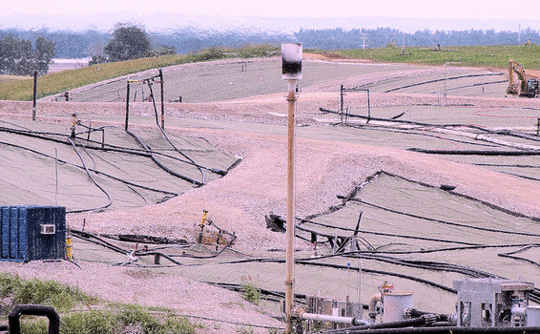
In May, almost 50 years after the waste was dumped at West Lake, the Environmental Protection Agency acknowledged what many residents had long feared: Radiological waste was spread throughout the West Lake Landfill, not confined to two specific portions as officials had long maintained.
The West Lake Landfill contamination was discovered in 1974. It was designated a Superfund site in 1990, and there is still no date certain for when the cleanup will begin.
MuckRock, by Allison Kite, Edited by Derek Kravitz, Jason Hancock 12 July 23
For kids like Sandy Mitchell, Ted Theis and Janet Johnson, childhood in the North St. Louis County suburbs in the 1960s and ‘70s meant days playing along the banks or splashing in the knee-deep waters of Coldwater Creek.
They caught turtles and tadpoles, jumped into deep stretches of the creek from rope swings and ate mulberries that grew on the banks.
Their families — along with tens of thousands of others — flocked to the burgeoning suburbs and new ranch style homes built in Florissant, Hazelwood and other communities shortly after World War II. When the creek flooded, as it often did, so did their basements. They went to nearby Jana Elementary School and hiked and biked throughout Fort Belle Fontaine Park.
Growing up, they never knew they were surrounded by massive piles of nuclear waste left over from the war.
Generations of children who grew up alongside Coldwater Creek have, in recent decades, faced rare cancers, autoimmune disorders and other mysterious illnesses they have come to believe were the result of exposure to its waters and sediment.
“People in our neighborhood are dropping like flies,” Mitchell said.
The earliest known public reference to Coldwater Creek’s pollution came in 1981, when the U.S. Environmental Protection Agency listed it as one of the most polluted waterways in the U.S.
By 2016, the Centers for Disease Control and Prevention was advising residents to avoid Coldwater Creek entirely. Cleanup of the creek is expected to take until 2038. A federal study found elevated rates of breast, colon, prostate, kidney and bladder cancers as well as leukemia in the area. Childhood brain and nervous system cancer rates are also higher.
“Young families moved into the area,” Johnson said, “and they were never aware of the situation.”
Theis, who grew up just 75 yards from the creek and played in it daily, died in August at the age of 60 from a rare cancer. Mitchell is a breast cancer survivor whose father died from prostate cancer. Johnson’s sister has an inoperable form of glioblastoma and other family members, including her father, daughter and nephew, have had various cancers.
Families who lived near Coldwater Creek were never warned of the radioactive waste. Details about the classified nuclear program in St. Louis were largely kept secret from the public. But a trove of newly-discovered documents reviewed by an ongoing collaboration of news organizations show private companies and the federal government knew radiological contamination was making its way into the creek for years before those findings were made public.

Radioactive waste was known to pose a threat to Coldwater Creek as early as 1949, records show. K-65, a residue from the processing of uranium ore, was stored in deteriorating steel drums or left out in the open near the creek at multiple spots, according to government and company reports.
A health expert who, as part of this project, was recently presented with data from a 1976 test of runoff to the creek concluded it showed dangerous levels of radiation 45 years ago.
Federal agencies knew of the potential human health risks of the creek contamination, the documents show, but repeatedly wrote them off as “slight,” “minimal” or “low-level.” One engineering consultant’s report from the 1970s incorrectly claimed that human contact with the creek was “rare.”
The Missouri Independent, MuckRock and The Associated Press spent months combing through thousands of pages of government records obtained through the Freedom of Information Act and interviewing dozens of people who lived near the contaminated sites, health and radiation experts and officials from government agencies.
Some of the documents, obtained by a nuclear researcher who focuses on the effects of radiation, had been newly declassified in the early 2000s. Others had been previously lost to history, packed away in government archives and not released publicly until now. (Read the documents here and learn more about our methodology here.)
All told, the documents from the now-defunct Atomic Energy Commission; its successors, the U.S. Department of Energy and the Nuclear Regulatory Commission; and the Environmental Protection Agency span the 75-year lifespan of the nuclear saga in St. Louis.
It starts in downtown St. Louis, where uranium was processed, and at the St. Louis airport, where it was stored at the end of the war; a monthslong move of the waste to industrial sites on Latty Avenue in suburban Hazelwood and a quarry in Weldon Spring, next to the Missouri River; an illegal dumping of waste at the West Lake Landfill in Bridgeton in the 1970s by a private company; and the declaration of the landfill as a federal toxic Superfund site in 1990.
Since then, the contaminated sites have been subjected to a seemingly endless cycle of soil, air and water testing, anxious community meetings attended by an ever-growing chorus of angry residents and panic when a subsurface smoldering event, similar to an underground fire, at the Bridgeton landfill threatened the radioactive waste buried nearby. That fire sent noxious and hazardous fumes into surrounding neighborhoods. The company in charge of the Bridgeton landfill now spends millions a year to contain it.
The documents have a familiar cadence: Year after year, decade after decade, government regulators and companies tasked with cleaning up the sites downplayed the risks posed by nuclear waste left near homes, parks and an elementary school. They often chose not to fully investigate the potential harms to public health and the environment around St. Louis………………………………………………………………………………………………………………………………………………
Illegal dumping of radioactive waste
When the Atomic Energy Commission sold the remnant nuclear waste, it anticipated being able to get rid of the more than 100,000 tons of toxic residues without spending any money.
The first company to purchase the waste, Continental Mining and Milling Co. of Chicago, borrowed $2.5 million to buy it in 1966 and then, shortly after, went bankrupt. Continental’s lender, Commercial Discount of Chicago, re-purchased the waste at auction for $800,000 and, after failing to get a bidder at a second auction, sold it to the Cotter Corp. To turn a profit, Cotter would ultimately dry the material and ship it to its uranium mill plant in Cañon City, Colorado………………………………………………………….
Cotter asked the government to bury the waste at Weldon Springs multiple times, in the late 1960s and early 1970s, but were rebuffed each time, meeting minutes show.
So, over a period of 2 ½ months in the summer and fall of 1973, Cotter took the problem into its own hands, without telling government regulators.
The company mixed the radioactive waste with tens of thousands of tons of contaminated soil from the site and illegally dumped it in a free, public landfill called West Lake, under three feet of soil and other garbage……………………………..
The AEC released Cotter from its St. Louis permit without immediate sanctions in 1974, but the company is partially responsible for the cleanup costs at the site.
Cotter’s parent company, General Atomics, did not respond to multiple requests for comment……………………………………………………………….
‘Tip of the iceberg’
In 1999, when Robbin Dailey moved into Spanish Village, a neighborhood of only a few dozen homes with its own park less than a mile from the back side of West Lake Landfill, she had no idea she was living next to a Superfund site.
When the EPA decided initially in 2008 to cap the waste at West Lake and leave it in place, Dailey never heard about the plan. Two years later, in 2010, she was alerted to the radioactive waste when a “subsurface smoldering event” — a type of chemical reaction that consumes landfilled waste like a fire but lacks oxygen — sent a pungent stench into the air around her home.
Dailey and her husband had their house tested and found thorium in the dust at hundreds of times natural levels. They sued the landfill’s owners, Republic Services, as well as the Cotter Corp. and Mallinckrodt.
Dailey said she and the companies had “resolved” their legal issues, but she, like all of the residents in North St. Louis County, was still in the dark about where within the landfill site the waste actually was.
Court records reveal a bevy of lawsuits against the private companies involved, at various times, with the West Lake Landfill. Not only that, but the landfill operators sued Mallinckrodt in an attempt to force the maker of the radioactive waste to pay for part of the cleanup.
Since the late 1970s, federal regulators repeatedly failed to uncover the true extent of contamination at West Lake.
In October 1977, the Nuclear Regulatory Commission used a helicopter to take hour-long passes back and forth over the landfill from an altitude of 200 feet. The goal was to measure gamma radioactivity coming from the site using specialized equipment.
While the effort correctly identified two areas with high levels of radiation, it had serious limitations, experts say. A survey of that type can miss contamination if it’s buried deep underground or if the ground is obstructed by vegetation.
And it did…………………………………
In May, almost 50 years after the waste was dumped at West Lake, the Environmental Protection Agency acknowledged what many residents had long feared: Radiological waste was spread throughout the West Lake Landfill, not confined to two specific portions as officials had long maintained……………………..
EPA officials said the contamination was found all over the property — in some areas at the surface and, in other areas, at great depths.
The agency looked at the dates on newspapers above and below the radioactive waste in two areas of the site previously thought to be uncontaminated to approximate when it was dumped, said Chris Jump, the EPA’s lead remedial project manager for the site.
It’s likely been there the whole time.
…………………………… Dawn Chapman, who left her job and co-founded Just Moms STL to advocate for the community around the landfill, said the EPA used to treat her and other activists like their fears were hysterical.
………………
A staffer with the Missouri Department of Natural Resources wrote in 1980 that contamination at the landfill was more severe and widespread than previously thought. In 1986 and 1990, onsite sampling showed possible radiological contamination in the groundwater in areas outside the sections of the landfill thought to be radioactive.
In 1987, the state classified the landfill as a hazardous waste site. The radioactive waste was in direct contact with the groundwater, the agency said in its annual report.
“Based on available information, a health threat exists due to the toxic effects of chemicals and low-level uranium wastes buried at the site and the possibility that off-site migration of these materials might occur,” the agency wrote.
…………………………. The West Lake Landfill contamination was discovered in 1974. It was designated a Superfund site in 1990, and there is still no date certain for when the cleanup will begin.
…………………………………….. Back to the drawing board
EPA’s first plan for the site would not have included moving the radioactive waste at all.
In 2008, the Environmental Protection Agency approved a plan for the landfill’s “primarily responsible parties” — the government and private contractors responsible for the site — to place a cap over the landfill and leave the waste in place.
Following criticism from the surrounding communities, EPA asked the Department of Energy, the Cotter Corp. and the landfill’s owner, Republic Services, to test the site again.
In the meantime, an underground fire brought a new level of scrutiny.
Starting in 2010, the Bridgeton landfill, which sits adjacent to the West Lake Landfill, has been experiencing a subsurface smoldering event.
………………………………………………….. The depth and severity of the new contamination the EPA found is not yet clear. The agency is preparing to release a report that will include the readings, a spokesperson said. A remedial design portion of the project is underway, the last step before the excavation begins.
But EPA doesn’t have a date certain as to when work on the project might start.
Curtis Carey, a spokesperson for the EPA, said despite decades of delays, the agency is planning next steps for the landfill “with a great deal more information because of our purposeful approach than was available 10, 15, 20 years ago.”
The following people contributed reporting, writing, editing, document review, research, interviews, photography, illustrations, analysis and project management. Chris Amico, Dillon Bergin, Kelly Kauffman and Derek Kravitz of MuckRock; Jason Hancock, Allison Kite and Rebecca Rivas of The Missouri Independent; Michael Phillis and Jim Salter of The Associated Press; Sarah Fenske, Theo Welling, Tyler Gross and Evan Sult of the Riverfront Times; EJ Haas, Madelyn Orr, Sydney Poppe, Mark Horvit and Virginia Young of the University of Missouri; Katherine Reed of the Association of Health Care Journalists; Liliana Frankel, Erik Galicia, Laura Gómez, Lauren Hubbard, Sophie Hurwitz and Steve Vockrodt; and Gerry Everding and Carolyn Bower of the original St. Louis Post-Dispatch team that published the seven-part “Legacy of the Bomb” series in 1989. https://www.muckrock.com/news/archives/2023/jul/12/st-louis-landfill-toxic-superfund/
NATO to keep Ukraine at arm’s length
https://www.rt.com/news/579554-nato-summit-communique/ 12 July 23
NATO Secretary General Jens Stoltenberg further elaborated on the matter at a press conference, stating that the bloc must first ensure that Ukraine achieves a “victory” in its ongoing conflict with Russia. Should Kiev not succeed, its NATO membership will be out of the question, he warned.
Kiev will be permitted to join the US-led bloc “when allies agree and conditions are met”
NATO has reaffirmed its readiness to grant Ukraine membership at some point in the future. A joint statement released during the annual summit of the US-led bloc said Kiev would be invited to join only “when allies agree and conditions are met,” but it will be allowed to bypass the so-called Membership Action Plan that is usually required for candidate members.
We reaffirm the commitment we made at the 2008 summit in Bucharest that Ukraine will become a member of NATO, and today we recognize that Ukraine’s path to full Euro-Atlantic integration has moved beyond the need for the Membership Action Plan,” the statement read.
Ukraine has become “increasingly interoperable and politically integrated with the US-led bloc,” it stated. It also outlined the need for “additional democratic and security sector reforms” in the country.
The alliance will support Ukraine in making these reforms on its path towards future membership. We will be in a position to extend an invitation to Ukraine to join the alliance when allies agree and conditions are met,” the statement concluded.
NATO Secretary General Jens Stoltenberg further elaborated on the matter at a press conference, stating that the bloc must first ensure that Ukraine achieves a “victory” in its ongoing conflict with Russia. Should Kiev not succeed, its NATO membership will be out of the question, he warned.
The pledge falls short of calls by top Ukrainian officials, who have repeatedly urged the US-led alliance to accept the country right away or at least produce an official “invitation” for it at the summit. Ukrainian President Vladimir Zelensky made an apparent last-ditch attempt to influence the bloc’s joint statement hours before it was released, taking to social media to criticize NATO and demand “respect” for Ukraine from the alliance.
“It’s unprecedented and absurd when [a] time frame is not set neither for the invitation nor for Ukraine’s membership. While at the same time vague wording about ‘conditions’ is added even for inviting Ukraine,” Zelensky wrote, referring to a draft of the document that was partially leaked to the media.
Nuclear bomb plutonium fallout marks dawn of new epoch in which humanity dominates planet

The AWG has chosen the plutonium isotopes from H-bomb tests as the key marker for the Anthropocene,
Canadian lake chosen to represent start of Anthropocene, Damian Carrington Environment editor, @dpcarringtonWed 12 Jul 2023 https://www.theguardian.com/environment/2023/jul/11/nuclear-bomb-fallout-site-chosen-to-define-start-of-anthropocene
The site to represent the start of the Anthropocene epoch on Earth has been selected by scientists. It will mark the end of 11,700 years of a stable global environment in which the whole of human civilisation developed and the start of a new age, dominated by human activities.
The site is a sinkhole lake in Canada. It hosts annual sediments showing clear spikes due to the colossal impact of humanity on the planet from 1950 onwards, from plutonium from hydrogen bomb tests to the particles from fossil fuel burning that have showered the globe.
If the site is approved by the scientists who oversee the geological timescale, the official declaration of the Anthropocene as a new geological epoch will come in August 2024.
Experts said the decision has social and political importance, as well as great scientific value, as it would testify to the “scale and severity of the planetary transformation processes unleashed by industrialised humanity”.
The climate crisis is the most prominent impact of the Anthropocene, but huge losses of wildlife, the spread of invasive species, and the widespread pollution of the planet with plastics and nitrates are also key features.
The Anthropocene Working Group was set up in 2009 and in 2016 concluded that the human-caused changes to Earth were so great that a new geological time unit was justified. The AWG then assessed in detail a dozen sites across the world as candidates for what geologists call a “golden spike”, ie the place where the abrupt and global changes marking the start of the new age is best recorded in geological strata.
Candidate sites included tropical corals in the US and Australia, a mountainous peat bog in Poland, the Antarctic ice sheet and even the human debris accumulated under the city of Vienna. However, after several rounds of voting by the AWG, Crawford Lake, near Toronto, was selected.
“There is compelling evidence globally of a massive shift, a tipping point, in the Earth’s system,” said Prof Francine McCarthy, a geologist at Brock University, Canada, and AWG member. “Crawford Lake is so special because it allows us to see at annual resolution the changes in Earth history.
The lake, formed in a limestone sinkhole, is 24 metres deep but only 2.4 hectares in area. That tall shape means the bottom waters and surface waters do not mix, which would confuse the record laid down in the sediments. “The bottom of the lake is completely isolated from the rest of the planet, except for what gently sinks to the bottom and accumulates in sediment,” McCarthy said.
The AWG has chosen the plutonium isotopes from H-bomb tests as the key marker for the Anthropocene, as they were spread globally from 1952 but declined rapidly after the Nuclear Test Ban Treaty in the mid-1960s, creating a spike in sediments.
“The presence of plutonium gives us a stark indicator of when humanity became such a dominant force that it could leave a unique global ‘fingerprint’ on our planet,” said Prof Andrew Cundy, an environmental radiochemist at the University of Southampton, and AWG member.
There are other important markers in the lake sediments, including spherical carbon particles produced by the burning of fossil fuels in power plants and nitrates from the mass application of chemical fertilisers. “We have a dramatic increase in the concentration in our core at exactly the same depth that we see the rapid rise in plutonium,” said McCarthy.
The 1950s saw the start of the “great acceleration”, the unprecedented increase in industrial, transport and economic activity that occurred after the second world war and continues today. “It is the great acceleration that we decided to use as a major tipping point in Earth history. But it is the increase in plutonium 239 fallout specifically that we chose as the marker,” said McCarthy.
Prof Jürgen Renn, director of the Max Planck Institute for the History of Science, in Berlin, Germany, said: “The Anthropocene concept has now received a firm anchoring in a very precise stratigraphic definition, [giving] a reference point for scientific discussions.
“It also creates a bridge between the natural sciences and the humanities, because it’s about the humans,” Renn said. “We are looking at something that is shaping our fate as humanity, so it’s very important to have a common reference point.”
Official ratification of the Crawford Lake site and the Anthropocene epoch requires passing three more votes of geological authorities, the subcommission on Quaternary Stratigraphy, the International Commission on Stratigraphy and finally the International Union of Geological Sciences.
The decision may be a difficult one for geologists, who are used to dealing with time periods spanning millions of years and using rocks with fossils as markers. The AWG will present a dossier of evidence hoping to convince the voting bodies that the Anthropocene does represent a planetary change that requires a new geological time period.
Dr Alexander Farnsworth, at the University of Bristol, said plutonium is a radioactive element and decays over time, so might not persist over geological timescales of millions. He also questioned whether an Anthropocene epoch is needed, saying: “We are but a ripple in the river of gene flow through time.”
Prof Colin Waters, AWG chair from the University of Leicester, said: “The Anthropocene that starts in the 1950s represents a very rapid change that we have caused to the planet. There’s hope in that respect. The combined impacts of humanity can be changed rapidly for good and for bad. It’s not inevitable that we have to slide into continuing environmental poverty
Nuclear bomb fallout marks dawn of new epoch in which humanity dominates planet
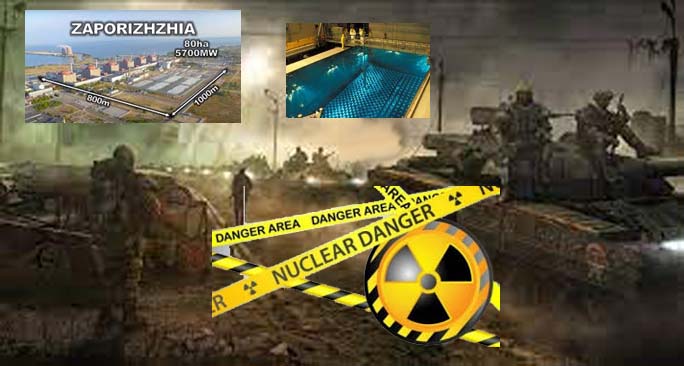
The Zaporizhzhia nuclear power plant is a ‘dirty bomb’ waiting to happen – a nuclear expert explains
The Conversation, Tilman Ruff July 13, 2023
After the explosion at the Kakhovka Dam in Ukraine last month, many Ukrainians feared the Zaporizhzhia nuclear power plant could be next.
These concerns have been heightened in recent weeks as both Ukraine and Russia have accused each other of planning an attack of the plant, which has been under Russian control since March 2022.
The International Atomic Energy Agency (IAEA) has not found any evidence of explosives in recent inspections, but also said it had yet to be granted access to all parts of the huge plant.
So, how serious are the risks of an attack at the power plant? And how disastrous would this be for Ukraine and the wider world?
Europe’s largest nuclear power plant
Construction of the Zaporizhzhia power plant began in 1981. Five reactors were commissioned between 1984-89, and a sixth in 1995. The reactors are more modern than the graphite-moderated reactors at Chernobyl, and are similar to the pressurised water reactors in widespread use in the United States and Europe.
The plant is Europe’s largest, built on the southern bank of the Kakhovka Reservoir on the Dnipro River, from which it draws its cooling water. Before the Russian invasion, Ukraine generated about half its electricity from 15 nuclear power reactors across four sites, with Zaporizhzhia generating almost half of this.
The plant has cooling ponds for spent nuclear fuel, which require continuous power and water (like the reactors themselves). It also has a dry cask storage facility for spent reactor fuel when it no longer requires continuous water cooling.
In 2017, Ukraine reported there were just over 2,200 tons of highly radioactive spent fuel at Zaporizhzhia, in the spent fuel pools and dry cask storage.
How quickly a meltdown could happen
Barely a week after the invasion began, Russian forces captured Zaporizhzhia. During heavy combat, a fire broke out in a training facility, while other parts of the plant were damaged.
In September 2022, the plant was fully disconnected from the electricity grid. Five reactors were put into cold shutdown. The sixth was maintained in hot shutdown at around 200 degrees Celsius, producing steam for the plant.
The Ukrainian nuclear regulator ordered a cold shutdown of this reactor last month, but this has not happened. Extensive maintenance work on the reactors is overdue.
The fuel inside nuclear reactors needs continuous, active cooling for many months after a reactor shutdown because of the heat that continues to be produced by the decay of hundreds of different fission products. The longer the fuel is inside a nuclear reactor, the more radioactive it becomes. That is why when fuel is removed from a reactor, it still requires continuous, active cooling for years.
The world saw in dramatic fashion in Fukushima, Japan, in 2011 what can happen when continuous, active cooling of nuclear reactors is disrupted.
More than 70% of the total radioactivity at the Fukushima power plant was in the spent fuel ponds, which have none of the carefully engineered containment layers that reactors typically have.
In his classic 1981 book Nuclear Radiation in Warfare, Nobel Peace Prize-winning physicist Joseph Rotblat documented how
in a pressurised water reactor, the meltdown of the core could occur within less than one minute after the loss of coolant.
The radioactivity released from damaged spent fuel ponds could be even greater than from a meltdown at the reactor itself, he wrote.
His study makes clear that a military attack on a reactor or spent fuel pond could release more radioactivity – and longer-lasting radioactivity – than even a large (megaton range) nuclear weapon.
As nuclear physicist Edwin Lyman makes clear, if the Zaporizhzhia reactor cooling was interrupted, there might be a day or two before the spent fuel began to overheat and degrade.
The melting reactor core would then collapse onto the floor inside its steel primary containment vessel and melt through to the floor of the building. Large amounts of radioactive gases and aerosols would be released into the environment, potentially explosively.
The radioactive release could possibly be at Chernobyl-scale or even larger amounts if multiple reactors and spent fuel ponds were involved. This could then spread across borders and continents with the wind, rivers and currents, and come down in hotspots in rain and snow.
A nuclear plant under continuous assault
The Russian invasion of Ukraine is the first time war has engulfed operating nuclear plants and, in a real sense, weaponised them as potential radiological weapons, or “dirty bombs”…………………………………………………………..
The other three nuclear power plants in Ukraine have also experienced interruptions to their electricity supply. In addition, other nuclear facilities have been shelled, struck by missiles or otherwise damaged.
A wake-up call to the dangers of nuclear power
Some nuclear experts have inappropriately downplayed the risk of deliberate or accidental breach of the containment structures at Zaporizhzhia.
However, the IAEA and independent experts have highlighted the very real risk of a catastrophe.
………………………………………………………………………. No other energy technology is associated with such extreme safety and security risks. If Zaporizhzhia were a wind farm or solar array, the risk of a severe accident with global and intergenerational consequences – not to mention weapons proliferation or intractable waste issues – would be precisely zero.
https://theconversation.com/the-zaporizhzhia-nuclear-power-plant-is-a-dirty-bomb-waiting-to-happen-a-nuclear-expert-explains-209236
Michigan ratepayers will foot the bill for Resuscitation of Palisades Nuclear Reactor
What changed? Holtec saw an opportunity to feed from the public trough by getting billions of dollars of corporate welfare, from both the state and federal government, to raise Palisades from the dead.
CounterPunch, BY JEFF ALSON, 12 July 23
The 52-year old Palisades nuclear power plant near South Haven, Michigan, on the shore of Lake Michigan near both Chicago and Grand Rapids, is one of the oldest and most degraded reactors in the country. In 2006, Palisades’ original owner, Consumers Energy, cited a wide range of major safety concerns when it sold the plant to Entergy, including that Palisades had one of the most embrittled reactor vessels in the country, needed a new reactor vessel head and steam generator, and had suffered from control rod drive mechanism seal leaks since it first opened.
As natural gas, and then wind and solar, became cheaper and cheaper, Palisades’ electricity became increasingly uncompetitive. Michigan ratepayers subsidized its electricity for years, sometimes paying as much as 57% above market rates. Trying to minimize additional costs, Entergy refused to invest in the most important safety repairs.
In 2018, Entergy announced it would sell the old and dangerous plant to Holtec, a decommissioning company, and the U.S. Nuclear Regulatory Commission (NRC) approved. The plant was formally closed on May 20, 2022, nuclear fuel was removed on June 13, and the plant was sold to Holtec on June 28, 2022.
The NRC then terminated Palisades’ operating license.
For four years, from 2018 through 2022, every major stakeholder—Entergy, the NRC, the Michigan Public Service Commission, energy and environmental NGOs, groups representing electricity consumers, and, notably, Michigan Governor Gretchen Whitmer—agreed that Palisades should be shut down.
The Governor’s own MI Healthy Climate Plan, released in April 2022, appropriately ignored Palisades’ imminent closure, since there are far cheaper and safer alternatives to reduce greenhouse gas emissions.
What changed? Holtec saw an opportunity to feed from the public trough by getting billions of dollars of corporate welfare, from both the state and federal government, to raise Palisades from the dead.
Holtec has requested a $300 million subsidy from Michigan taxpayers and in late June got a $150 million blank check from the Michigan legislature added to the current state budget without any public debate whatsoever. More ominous, Holtec also wants Michigan ratepayers to, once again, be forced to buy electricity at above-market prices that could significantly raise Michigan’s electricity rates, already the highest in the Midwest.
…………………………………. .Holtec will likely apply for multiple federal subsidies as well. To reopen Palisades, Holtec has already applied to the Department of Energy (DOE) for a billion dollar nuclear loan guarantee under the 2022 Inflation Reduction Act, and may apply for an additional $1.2 billion from the 2021 Infrastructure bill. Separately, Holtec has applied to DOE for $7.4 billion in loan guarantees under the 2005 Energy Policy Act for one or more future small modular nuclear reactors.
Michigan taxpayers and ratepayers have had too many nuclear white elephants:…………………………………………..
Of course, Michigan is not unique in this regard, as no U.S. nuclear power plants have been built on schedule or on budget in the last 50 years. In the wake of these and scores of other nuclear economic debacles across the country after Three Mile Island, Forbes business magazine concluded, “The failure of the U.S. nuclear power program ranks as the largest managerial disaster in U.S. business history….only the blind, or the biased, can now think that money has been well spent.”
…… A closed U.S. nuclear power plant has never been re-opened and would take, at best, many years. Investing in wind, solar, and battery storage provides much faster, cheaper, and more sustainable greenhouse gas emissions reductions. Of course, nuclear plants also entail unnecessary risks such as high-level nuclear waste, routine radiation releases, the potential for catastrophic accidents, and terrorist attacks…… https://www.counterpunch.org/2023/07/13/michigan-ratepayers-will-foot-the-bill-for-resuscitation-of-palisades-nuclear-reactor/
We must focus our state and federal resources on the most economical and sustainable climate energy solutions, and not squander more taxpayer and ratepayer funds on more misguided investment in nuclear power.
1 This Month
23 April – WEBINAR – Why new nuclear reactors are the wrong tools for decarbonization Thursday, April 23 • 1 AM – 2 AM AEST
World Nuclear Power. Reactors 1951-2026, 75 Years of Nuclear Power.
Interactive Map– https://dv.worldnuclearreport.org/

Chernobyl: The Lost Tapes – A good documentary on Chernobyl on SBS available On Demand for the next 3 weeks– https://www.sbs.com.au/ondemand/tv-program/chernobyl-the-lost-tapes/2352741955560

of the week–London Campaign for Nuclear Disarmament


Tell the Ukrainian Government to Drop Prosecution of Peace Activist Yurii Sheliazhenko
To see nuclear-related stories in greater depth and intensity – go to https://nuclearinformation.wordpress.com
-
Archives
- April 2026 (220)
- March 2026 (251)
- February 2026 (268)
- January 2026 (308)
- December 2025 (358)
- November 2025 (359)
- October 2025 (376)
- September 2025 (257)
- August 2025 (319)
- July 2025 (230)
- June 2025 (348)
- May 2025 (261)
-
Categories
- 1
- 1 NUCLEAR ISSUES
- business and costs
- climate change
- culture and arts
- ENERGY
- environment
- health
- history
- indigenous issues
- Legal
- marketing of nuclear
- media
- opposition to nuclear
- PERSONAL STORIES
- politics
- politics international
- Religion and ethics
- safety
- secrets,lies and civil liberties
- spinbuster
- technology
- Uranium
- wastes
- weapons and war
- Women
- 2 WORLD
- ACTION
- AFRICA
- Atrocities
- AUSTRALIA
- Christina's notes
- Christina's themes
- culture and arts
- Events
- Fuk 2022
- Fuk 2023
- Fukushima 2017
- Fukushima 2018
- fukushima 2019
- Fukushima 2020
- Fukushima 2021
- general
- global warming
- Humour (God we need it)
- Nuclear
- RARE EARTHS
- Reference
- resources – print
- Resources -audiovicual
- Weekly Newsletter
- World
- World Nuclear
- YouTube
-
RSS
Entries RSS
Comments RSS
 nuclear-news