Drone crashes in Russian ‘atomic city’ – governor
Rt.com 14 July 23
There were no injuries or damage to critical infrastructure resulting from the incident in Kurchatov, Roman Starovoyt says
A drone went down and exploded early on Friday in the Russian city of Kurchatov, an industrial hub adjacent to the Kursk Nuclear Power Plant, the governor of Kursk Region has said.
“Fortunately, none of the residents were hurt. Critical facilities weren’t damaged,” Roman Starovoyt wrote on his Telegram channel.
…….. Earlier, several Telegram channels reported a loud explosion in Kurchatov. Videos from the scene also captured locals finding what appear to be parts of a drone on the ground.
The city of Kurchatov is located in Kursk Region, which shares a border with Ukraine. It was founded in the late 1960s and named after physicist Sergey Kurchatov, dubbed the “father” of the Soviet atomic bomb.
The Kursk Nuclear Power Plant sits roughly 4 kilometers (2.4 miles) outside urban areas in Kurchatov. The Energotex company, which makes equipment for nuclear reactors, is also based in the city, home to 40,000 people.
A “powerful explosion” was also reported by local media overnight in the city of Voronezh, the capital of the region to the east of Kursk. ……………………………………… more https://www.rt.com/russia/579676-kurchatov-drone-attack-reports/
Nuclear safety staffing in the United States: a crisis with no easy fix
Bulletin, By David Gillum, Itty Abraham, Kathleen M. Vogel | July 14, 2023
According to the International Atomic Energy Agency (IAEA), the UN’s nuclear watchdog, nearly 13 million people are exposed to ionizing radiation in occupational settings every year worldwide. There are horror stories within the nuclear safety community of what can happen with lax institutional oversight of nuclear and radiological materials—from stockpiles of improperly managed radiological waste to missing or inaccurate inventories to lost or destroyed records.
Remedies for such infractions can cost millions of dollars and damage the reputation of institutions. That is why it is essential to have qualified, trustworthy staff and an engaged leadership team overseeing radiation safety within the many academic, governmental, and corporate entities that handle radiological materials.
In the United States, however, three challenges stand in the way of maintaining adequate levels of nuclear safety staffing: an insufficient supply of qualified experts, the loss of established experts, and the loss of tacit knowledge held by experts who retire. No single solution can fix all three challenges. But the loss of experienced personnel and the knowledge they possess should be of highest concern in the medium term.
What a radiation safety officer does. One of the most important responsibilities of a radiation safety officer is to ensure that worker and community radiation doses are kept “as low as reasonably achievable.”
………………………………………………………………….No matter what the future growth of nuclear power is, radiation safety officers will be needed to handle the radioactive waste generated by current and retired reactors. Yet, the pool of radiation protection personnel is already insufficient, increasing competition between private industry and public sectors seeking these highly skilled professionals. ………………………………………………………. https://thebulletin.org/2023/07/nuclear-safety-staffing-in-the-united-states-a-crisis-with-no-easy-fix/—
Nuclear bombs set off new geological epoch in the 1950s, scientists say
Live Science, By Sascha Pare, 14 July 23
Nuclear testing in the 1950s marked sediments at the bottom of a lake in Canada to such an extent that scientists are calling for it to become the symbol of a new geological epoch: the Anthropocene.
Nuclear weapons testing in the 1950s and early 1960s left the first obvious and indelible marks of “overwhelming” human activity on Earth, and these events may signal the beginning of a new geological epoch known as the Anthropocene, geologists say.
Fallout from these tests snowed down from the atmosphere and became trapped in the earth as layers of sediment rich in a radioactive form of plutonium, called plutonium-239.
Scientists argue that blankets of plutonium-239-rich sediment at the bottom of a small lake in Canada present the earliest tangible record of human activities shifting the balance of natural systems — which is why they’re naming this potential new epoch “anthro” after humans.
“The presence of the plutonium mark is a simple tool to allow us to define that boundary,”
……………………………………….The AWG’s latest results are published in a special issue of the journal The Anthropocene Review. https://www.livescience.com/planet-earth/nuclear-bombs-set-off-new-geological-epoch-in-the-1950s-scientists-say
More than 113 million Americans under extreme heat alerts as relentless temperatures continue
More than 113 million Americans under extreme heat alerts as relentless
temperatures continue Relentless, hazardous heat is expected to continue
for at least another week across parts of the south.
Independent 13th July 2023
France to decide on nuclear financing by end of 2024
The French government will decide at the end of 2024 on the regulatory and
financing model for its nuclear revival programme, economy minister Bruno
Le Maire said late on Wednesday.
Montel 13th July 2023
https://www.montelnews.com/news/1510337/france-to-decide-on-nuclear-financing-by-end-of-2024
US could stop Ukraine conflict instantly – Hungary
Washington has not explained to its allies why it wants hostilities with Russia to continue, Viktor Orban said
The US wants the conflict in Ukraine to continue and has failed to explain its reasons to NATO allies, Hungarian Prime Minister Viktor Orban has said.
Orban told national broadcaster Kossuth Radio that if Washington wished, it could stop the fighting at a moment’s notice, as Kiev is fully dependent on the West in the fight against Russia.
The Hungarian leader was speaking on Friday morning, after returning from the NATO summit in the Lithuanian capital, Vilnius. During the event, the US-led military bloc declined to extend to Kiev a roadmap for membership. Hungary has stood out among members of the alliance by consistently criticizing Western policies on the Ukraine crisis.
“If the Americans wanted it, peace would come the next morning. Why Americans don’t want that is a question that puzzles the entire world,” Orban said. “We didn’t get an answer at the NATO summit.”………………………………………….
Orban went on to warn that if NATO were to admit Ukraine now, it would trigger a world war. He also highlighted the risks incurred by Western states sending increasingly sophisticated military hardware to Kiev………………………………….
The prime minister predicted that the conflict will drag on, and EU nations – including Hungary – will bear the economic cost, including high inflation. https://www.rt.com/news/579682-orban-us-ukraine-conflict/
The US says it will not “under any circumstances” pay reparations todeveloping countries hit by climate change-fuelled disasters
Climate envoy John Kerry made the remarks at a Congress hearing before flying to China to
discuss the issue. Some countries want major economies – which produce the
most greenhouse gases – to pay for past emissions. A fund has been
established for poorer nations, but it remains unclear how much richer
countries will pay. Mr Kerry, a former secretary of state, was asked during
a hearing before a House of Representatives foreign affairs committee
whether the US would pay countries that have been damaged by floods, storms
and other climate-driven disasters. “No, under no circumstances,” he said
in response to a question from Brian Mast, the committee chair.
BBC 14th July 2023
White House: Ordering the Selected Reserve and Certain Members of the Individual Ready Reserve of the Armed Forces to Active Duty
By the authority vested in me as President by the Constitution and the laws of the United States of America, including sections 121 and 12304 of title 10, United States Code, I hereby determine that it is necessary to augment the active Armed Forces of the United States for the effective conduct of Operation Atlantic Resolve in and around the United States European Command’s area of responsibility. In furtherance of this operation, under the stated authority, I hereby authorize the Secretary of Defense, and the Secretary of Homeland Security with respect to the Coast Guard when it is not operating as a service in the Navy, under their respective jurisdictions, to order to active duty any units, and any individual members not assigned to a unit organized to serve as a unit of the Selected Reserve, or any member in the Individual Ready Reserve mobilization category and designated as essential under regulations prescribed by the Secretary concerned, not to exceed 3,000 total members at any one time, of whom not more than 450 may be members of the Individual Ready Reserve, as they deem necessary, and to terminate the service of those units and members ordered to active duty…………………………………………………..
JOSEPH R. BIDEN JR.
THE WHITE HOUSE,
July 13, 2023.
TODAY. “As long as it takes” – WHAT DOES THIS MEAN?

– it takes cluster bombs (to cause later mutilations and deaths, especially children)

– it takes depleted uranium weapons, (to cause widespread, long-lasting radioactive pollution, cancers in soldiers and citizens of both sides)
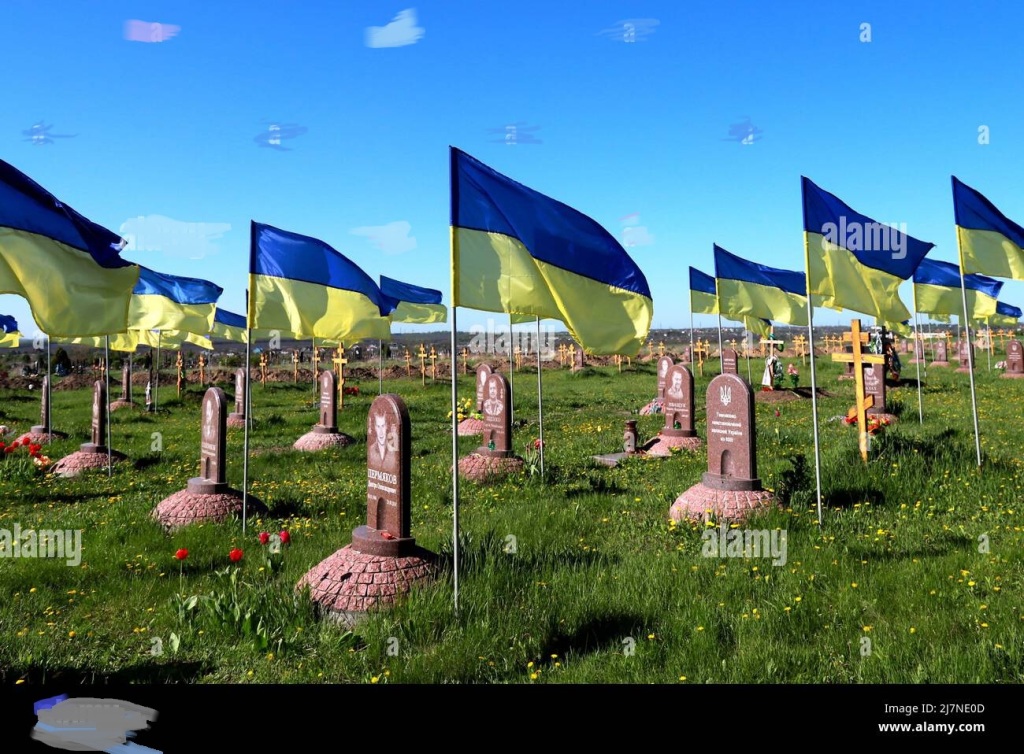
– it takes -by December 31 the Ukrainian army will lose between 75,000 and 100,000 dead, and up to 300,000 wounded and out of combat. Russian soldiers killed so far in Ukraine: around 47,000.

– it takes – continued destruction and environmental pollution, the wreckage of the country

–it takes – By May 2023, the U.S. had provided Ukraine nearly $37 billion in military aid . Total with EU funding $46.6 billion and more to come

–it takes– behind-the-scenes wrangling, as European and other leaders try hold it together with USA

“As long as it takes” – to do what?
Defeat Russia militarily, ruin Russia as a world power, return Crimea to Ukraine, make Ukraine a NATO country, holding U.S. weapons aimed at Moscow.
But it might not actually turn out that way.
And it might bring on World War 3.
IN KOSOVO, NATO ALLIES BLAME DEPLETED URANIUM FOR CANCER CASES
“This happens every time I visit a site where NATO fired depleted uranium,” my interpreter Dzafer Buzoli commented. “In all the villages nearby people will tell you about a high rate of rare cancers.”
hundreds of Italian veterans who served in Kosovo have successfully sued their defence ministry for cancers their courts accepted were linked to DU exposure in the Balkans.
With Britain and America supplying the toxic ammunition to Ukraine, Declassified investigates the long-term health impact on one of the few countries where the weapon has been fired in anger.
DECLASSIFIED UK, PHIL MILLER, 13 JULY 2023
“………………………………………… Jutting up from the roadside are tattered American and NATO flags around a camouflaged stone column bearing the twin headed eagle emblem of the Kosovo Liberation Army (KLA). The rebel movement took the territory nearly a quarter century ago, after US jets pummelled Serb soldiers on the surrounding Ceja mountain with at least 286 rounds of depleted uranium – a chemically toxic and radioactive heavy metal made from nuclear waste.
Such airstrikes were repeated all across the border zone in 1999, driving the Serb-dominated Yugoslav army out of Kosovo within 78 days. Bill Clinton and Tony Blair relished the victory, basking in their newfound popularity. Roads and children would bear their names, spelt locally as Klinton and Tonibler. But this “humanitarian intervention” – designed to protect Kosovar Albanians from ethnic cleansing – has left a bitter legacy in the very communities it was meant to save.
“We have 20 to 30 people a year with cancer here.”
Sipping a macchiato at a roadside cafe opposite the KLA monument, Adil is pleasantly surprised when he hears a journalist has come to ask about cancer in the village. “My father has just died from it,” he tells my translator, as he gladly pays for our drinks. “We have 20 to 30 people a year with cancer here.”
Without prompting, he links the illnesses to weapons used in the war. “We had so many bombs dropped here because we are near the border. A small bomb infects the whole surrounding area.” When told Britain is sending depleted uranium tank shells to Ukraine, Adil exclaims: “I feel sorry for them. I wouldn’t want anyone to experience it.”
Our conversation arouses interest from KLA veterans at the cafe. One of them, who normally works abroad, volunteers to show us a bomb crater. The others fear reprisals if they publicly criticise NATO. Their small country, about half the size of Wales, still depends on the US-led alliance for security against Serbia, which refuses to recognise Kosovo’s independence.
Jumping in my rented Vauxhall Corsa, we gingerly head off road through several fields to a heap of soil sprinkled with wild flowers. “This is one of the spots that was hit six times with depleted uranium,” the veteran informs us. “The crater was five or six metres deep and seven metres wide. We brought healthy soil to put on top, in order to reduce radiation for the people.”
Despite a warning from a Danish NGO, villagers were growing vegetables in the vicinity. The veteran puts the number of local cancer cases even higher than Adil – claiming there are 50-60 patients in the village, many of them young people.
At the last census in 2011, Zhur had a population of under 6,000 – suggesting a cancer rate of around 1%. That would be three times the worst rate in the European Union. The veteran had likely made an overestimate, but I was to hear similar disturbing stories throughout this former conflict zone.
Hidden hazards
NATO’s use of depleted uranium (DU) in Kosovo was not confirmed until the year after the war, amid panic over ‘Balkan syndrome’. Italian peacekeepers who took over many of the bombed out Yugoslav army bases were going down with leukaemia.
In March 2000, NATO’s chief, Labour peer George Robertson, belatedly told the UN’s Kofi Annan that “approximately 31,000 rounds” of DU had been fired “throughout Kosovo during approximately 100 missions”. He said the weapon was deployed “whenever the A-10 engaged armour”, referring to the US air force’s Warthog ‘tankbuster’.
One of the most powerful aircraft ever built, the Warthog’s giant gatling gun can fire a blizzard of 30mm bullets with ultra-dense depleted uranium cores, knocking out tanks in seconds. But its speed is superior to its accuracy. Typically, 90% of rounds miss the target. They spread out over 500 square metres, burying several metres into soft ground.
Upon impact, the rounds partially vaporise and produce a dust that is dangerous for those nearby to inhale, posing a risk to surviving Serb soldiers, local communities and incoming peacekeepers.
Lord Robertson’s admission that the weapon was used paved the way for the United Nations Environmental Programme (UNEP) and World Health Organisation (WHO) to inspect target sites – although scientists struggled to find them.
After months of intense internal chicanery over obtaining more accurate maps, they spent 24 days during 2000-1 surveying Kosovo for the twin threat posed by DU: radiation and heavy metal toxicity – which could cause cancer or birth defects.
Much hinged on their findings. A negative outcome would undermine NATO’s humanitarian credentials and hamper the return of refugees from their temporary asylum in western Europe.
Ultimately, their reports were fairly inconclusive. When the WHO came to where I was now in Zhur and the Ceja mountain, they found the “precise location of the targeted site was difficult to pinpoint since access was restricted due to the presence of unexploded cluster bombs” – another controversial weapon dropped by NATO.
This meant scientists were only able to study an area in which they found just two out of nearly 300 rounds of the depleted uranium ammunition fired here. Based on tests of this small sample, the UNEP dismissed any radiation risk but said “from a toxicological point of view the exposure might be significant.”
The experts lamented: “It is unsatisfactory that the risk cannot be assessed quantitatively because the targeted area could not be investigated in its entirety” and warned “it would be prudent to complete the investigation after the area has been made safe.”
Judging by the agricultural approach towards the blast craters that I found in Zhur, there has been no follow up survey. The UNEP’s press office confirmed to me their organisation had never returned to the site, despite their own recommendation, nor has it done any long term monitoring of the community’s health.
The NATO public affairs office in Kosovo also could not confirm it had followed up on UNEP’s recommendation to reinspect Zhur. Instead, the Atlantic alliance seized on some United Nations documents that suggested “sites with depleted uranium pose no significant health risks to the population”.
NATO told me: “This is the scientific evidence. And it has been consistent.” Yet many of these same reports urge precaution and long term monitoring – something those concerned with “scientific evidence” would surely be keen to undertake?
………….towards the mediaeval Ottoman city of Prizren…..
Turning off at Rikavac roundabout ……………
The only signs of the war were three crumbling concrete walls that resembled a bombed out Serb barracks. As I stood near the site, a passerby pulled over to talk. Despite being unaware of what was fired here, he explained that 20-30 people a year were dying from cancer in his nearby village. “The state of Kosovo isn’t doing anything to help the community,” he complained, before driving away.
“This happens every time I visit a site where NATO fired depleted uranium,” my interpreter Dzafer Buzoli commented. “In all the villages nearby people will tell you about a high rate of rare cancers.”
………………………………..He fears depleted uranium is the next tragedy for Kosovo, ever since his mother died in 2015 from a short battle with cancer aged 52. Buzoli turned to their local oncologist for answers. “He told me very informally it was because of what they had thrown at us during the war,” alluding to depleted uranium.
The doctor then emigrated from Kosovo, concerned for his family’s health.
…………….“The power plants were operating at full capacity before the war and we never had this number of cancers,” he insists. “I believe depleted uranium is the cause. When you read about how hard it is for the population in Kosovo, southern Serbia and northern Albania – all these towns near the border where the weapon was fired have almost the same problem of high cancer.”
……………………………The director of Kosovo’s main oncology clinic in Pristina, Dr Ilir Kurtishi, warned last month that 890 new cases of cancer had been detected already this year, which local media described as “alarming”. ………….
…………………………………………………………………………………………………………… many areas NATO liberated with depleted uranium are where Kosovo now relies upon to grow its food.
………………………..my guide, Branko, confirmed the monks were concerned about the possible health consequences, which have featured heavily in Serbian media. “Depleted uranium is the gift that keeps giving from the US,” he noted sarcastically. “And now they’re giving it to Ukraine, one of the world’s largest exporters of wheat.”
……………………………….Italian peacekeepers had conducted extensive demolition work there after the war, before discovering DU rounds in the wreckage. In the decades since, hundreds of Italian veterans who served in Kosovo have successfully sued their defence ministry for cancers their courts accepted were linked to DU exposure in the Balkans.
…………………………The International Campaign to Ban Uranium Weapons (ICBUW), which conducted its own study in the Balkans, said “sites may require ongoing testing of groundwater”, warning that “estimates of how long this may need to be done run into centuries”.
The group believes “no systematic decontamination has been undertaken on any sites in Kosovo”. Even if authorities in Pristina wanted to embark on that route, they may struggle to afford it.
In neighbouring Montenegro, where NATO fired depleted uranium at just one site, the clean up costs are daunting. To decontaminate 480 rounds, which took just 12 seconds to fire, Montenegro spent over a quarter of a million US dollars and devoted 5,000 working person days.
Kosovo has more than 100 such sites.
Radoniq
Six miles north of Gjakova lies Lake Radoniq, a vast reservoir that supplies drinking water for the city and many of southern Kosovo’s 200,000 inhabitants. Yet even this breathtakingly beautiful location was not spared from attack with depleted uranium.
………………………………………………………………………………………………………………. it seems that no one cited has done a long-term study of people’s health in the parts of Kosovo where the weapon was used.
Buzoli is sceptical that these international agencies which rely so much on Western funding can be impartial on such a sensitive subject. He admits he doesn’t have all the answers, but rightly insists that’s not his role.
“If you are a doctor or a scientist, please come to Kosovo to do research,” he appeals. “Take soil samples, take air samples, take water samples, and come out with a neutral report that helps us understand how bad it is.” https://declassifieduk.org/in-kosovo-nato-allies-blame-depleted-uranium-for-cancer-cases/—
Nato isn’t defending Ukraine. It’s stabbing it in the back
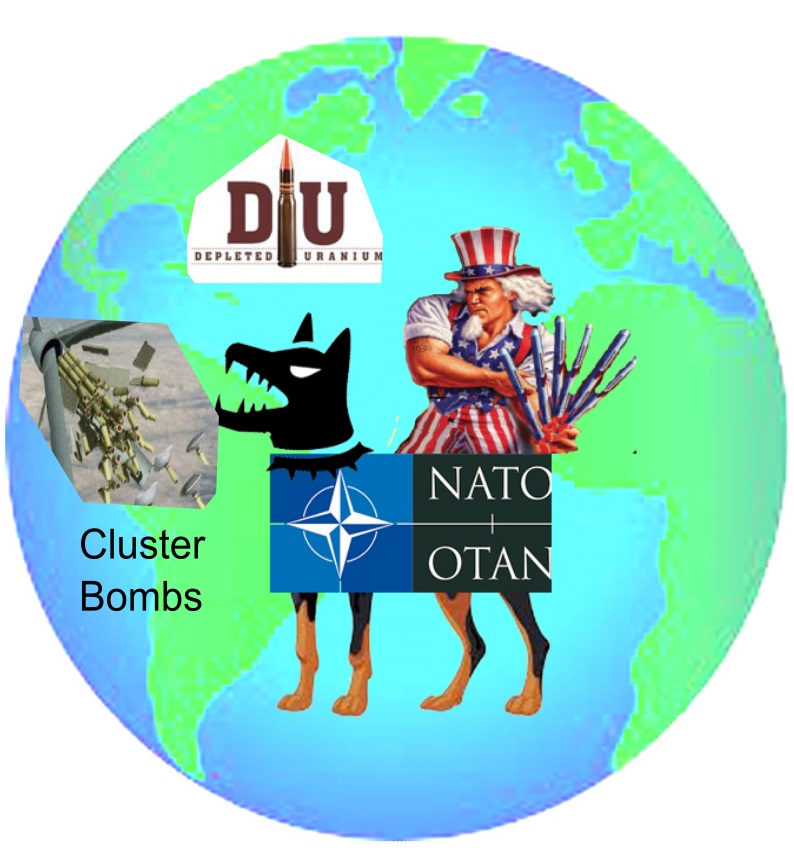
So far, Ukraine’s much-vaunted “spring counter-offensive” has turned into a damp squib, despite western media spin about “slow progress”. Moscow is holding on to the Ukrainian territories it annexed.
More than 110 states – not including the US, of course – have ratified a 2008 international convention outlawing cluster munitions. Many are in Nato.
Middle East Eye, Jonathan Cook. 14 July 2023
The US and its allies are sustaining the very war they now cite as grounds for disqualifying Kyiv from Nato membership .
he Nato summit in Lithuania this week served only to underscore the utter hypocrisy of western leaders in pursuing their proxy war in Ukraine to “weaken” Russia and oust its president, Vladimir Putin.
Both the US and Germany had made clear before the summit that they would block Ukraine’s admission to Nato while it was in the midst of a war with Russia. That message was formally announced by Nato Secretary General Jens Stoltenberg on Tuesday.
Ukrainian President Volodymyr Zelensky fumed that Nato had reached an “absurd” decision and was demonstrating “weakness”. British Defence Secretary Ben Wallace lost no time in rebuking him for a lack of “gratitude”.
The concern is that, if Kyiv joins the military alliance at this stage, Nato members will be required to leap to Ukraine’s defence and fight Russia directly. Most western states balk at the notion of a face-to-face confrontation with a nuclear-armed Russia – rather than the current proxy one, paid for exclusively in Ukrainian blood.
But there is a more duplicitous subtext being obscured: the fact that Nato is responsible for sustaining the war it now cites as grounds for disqualifying Ukraine from joining the military alliance. Nato got Kyiv into its current, bloody mess – but isn’t ready to help it find a way out.
It was Nato, after all, that chose to flirt openly with Ukraine from 2008 onwards, promising it eventual membership – with the undisguised hope that one day, the alliance would be able to flex its military muscles menacingly on Russia’s doorstep.
It was the UK that intervened weeks after Russia’s invasion in February 2022, and presumably on Washington’s orders, to scupper negotiations between Kyiv and Moscow – talks that could have ended the war at an early stage, before Russia began seizing territories in eastern Ukraine.
A deal then would have been much simpler than one now. Most likely, it would have required Kyiv to commit to neutrality, rather than pursuing covert integration into Nato. Moscow would have demanded, too, an end to the Ukrainian government’s political, legal and military attacks on its Russian-speaking populations in the east.
Now the chief sticking point to an agreement will be persuading the Kremlin to trust the West and reverse its annexation of eastern Ukraine, assuming Nato ever allows Kyiv to re-engage in talks with Russia.
And finally, it is Nato members, especially the US, that have been shipping out vast quantities of military hardware to prolong the fighting in Ukraine – keeping the death toll mounting on both sides.
Damp squib
In short, Nato is now using the very war it has done everything to fuel as a pretext to stop Ukraine from joining the alliance.
Seen another way, the message Nato has sent Moscow is that Russia made exactly the right decision to invade – if the goal, as Putin has always maintained, is to ensure Kyiv remains neutral.
It is the war that has prevented Ukraine from being completely enfolded in the western military alliance. It is the war that has stopped Ukraine’s transformation into a Nato forward base, one where the West could station nuclear-tipped missiles minutes from Moscow.
Had Russia not invaded, Kyiv would have been free to accelerate what it was already doing secretly: integrating into Nato. So what is Zelensky supposed to conclude from his exclusion from Nato, after he committed his country to an ongoing war rather than negotiations and neutrality?
So far, Ukraine’s much-vaunted “spring counter-offensive” has turned into a damp squib, despite western media spin about “slow progress”. Moscow is holding on to the Ukrainian territories it annexed.
So long as Kyiv can’t “win the war” – and it seems it can’t, unless Nato is willing to fight Russia directly and risk a nuclear confrontation – it will be precluded from the military alliance. Catch-22.
Do not expect this conundrum to be highlighted by a western establishment media that seems incapable of doing anything other than regurgitating Nato press releases and cheering on bigger profits for the West’s war industries.
War crimes
Another such conundrum is the Biden administration’s decision last week to supply Ukraine with cluster munitions – small bomblets that, when they fail to explode, lie concealed like mini-landmines, killing and maiming civilians for decades. In some cases, as many as a third are “duds”, detonating weeks, months or years later.
Washington’s move follows Britain recently supplying Ukraine with depleted uranium shells, which contaminate surrounding areas with a radioactive dust during and after fighting. Evidence from areas such as Iraq, where the US and Britain fired large numbers of these shells, suggests the fallout can include a decades-long spike in cancer and birth defects.
The White House was all too ready to denounce the use of cluster bombs as a war crime last year – when it was Russia that stood accused of using them. Now it is Washington enabling Kyiv to commit those very same war crimes.
More than 110 states – not including the US, of course – have ratified a 2008 international convention outlawing cluster munitions. Many are in Nato.
Given the high “dud” rate of US cluster bombs, President Joe Biden appears to be breaking US law in shipping stocks to Ukraine. The White House can invoke an exemption only if exporting such weapons satisfies a “vital US national security interest”. Apparently, Biden believes “weakening” Russia – and turning parts of Ukraine into a death zone for civilians for decades to come – qualifies as just such a vital interest.
Desperate stop gap
While the official story is that this latest escalatory move by the US will help Kyiv “win the war”, the truth is rather different. Biden has not shied away from admitting that Ukraine – and Nato – are running out of conventional arms to fight Russia. This is a desperate stop-gap measure. ……………………………………………………………………………………………………………………………..
…………………………….. Tragically, Nato’s malevolence, deceit and betrayal means that the only alternative to Armageddon may be Ukraine’s downfall – and with it, the crushing of Washington’s nefarious ambitions to advance full-spectrum global dominance. https://www.middleeasteye.net/opinion/nato-ukraine-not-defending-stabbing-back?utm_source=substack&utm_medium=email
Hungary’s nuclear power plant reduces output due to the hot weather

Paks nuclear power plant in trouble: it runs with reduced performance.
https://dailynewshungary.com/paks-nuclear-power-plant-in-trouble-it-runs-with-reduced-performance/ John Woods · 14/07/2023
Hungary’s nuclear power plant in Paks reduced its performance due to the significant increase in the water temperature of the Danube River, the Hungarian News Agency said in a statement. According to telex.hu, the Danube’s water temperature reached 29.72 degrees at the measuring point. Therefore, from 4.30 PM, the nuclear power plant reduced the performance of blocks 2, 3, and 4 by 240 megawatts. According to a 2001 environmental protection ministerial decree, the water temperature around Paks cannot exceed 30 °C.
Please use the sharing tools at the bottom of the articles.
In the power plant’s interior regulation, 29.5 degrees is the intervention limit. Provided they reach that, they reduce the power plant’s performance by 80 megawatts per 0.1 °C to reach the prescribed temperature level.
https://dailynewshungary.com/paks-nuclear-power-plant-in-trouble-it-runs-with-reduced-performance/
“War Effort In Shambles As Hawks Turn On Each Other” At NATO Summit
Zeo Hedge, BY TYLER DURDEN, THURSDAY, JUL 13, 2023
Bloomberg is just out with a devastating behind-the-scenes account of a hot-headed Zelensky at the NATO summit in Vilnius, and the growing Western backlash in the face of his obvious frustration and what’s being seen as ingratitude for the steady flow of billions of dollars in arms to Kiev.
Apparently even the mainstream media agrees with our own assessment of the Ukrainian leader having thrown a “tantrum” as he complained about the “weak” and “absurd” NATO stance on Ukraine’s membership. The blistering tweet he issued in English while en route to Lithuania exposed cracks in the alliance, as Bloomberg highlights in the opening of its very revealing Wednesday piece:
Volodymyr Zelenskiy was running hot ahead of his sit-down with NATO leaders on Tuesday evening. The Ukrainian president had been angered earlier in the day by what he said was an “absurd” reluctance to give his country a clear timeline on membership.
That outburst in turn riled the partners who have funneled billions of dollars of weaponry and aid into Ukraine’s defense against the Russian invasion — the US had been given no warning before Zelenskiy unleashed his attack on social media.
As Bloomberg writes: “Over dinner in Vilnius, with US President Joe Biden back at his hotel, the other leaders delivered a clear message to Zelenskiy, according to one person who was present. You have to cool down and look at the full package, Zelenskiy was told.”
While it’s not quite yet a full on ‘hero to zero’ story… things are certainly sliding in that direction, given it’s unprecedented that the Ukrainian president who previously enjoyed rockstar status in Western capitals since the start of the invasion could be told to basically ‘cool it’!.
Bloomberg continues in reference to Zelensky: “He had, after all, been given a renewed commitment to eventual membership and new security guarantees from the Group of Seven nations. By the next day, the message appeared to be sinking in.” The publication was privy to some key Western leaders’ exact words, presenting the rare dressing down as follows [emphasis ZH]:
Whether we like it or not, people want to see gratitude,” UK Defense Secretary Ben Wallace told reporters the following morning. “You’re persuading countries to give up their stock” of weapons and ammunition, he added.
This account of the behind-the-scenes wrangling is based on interviews with more than a dozen diplomats and officials involved in the summit who asked not to be named discussing private conversations. NATO leaders were trying to thread a needle on Ukraine’s membership bid when they arrived in Vilnius: They were seeking language that looked like progress and that Ukraine could sell as progress but fundamentally didn’t leave them any closer to getting dragged into a war with nuclear-armed Russia.
Ultimately the hawks (mainly among the Baltic and Eastern Europe states) have lost at Vilnius. Ukrainian Foreign Minister Dmytro Kuleba has admitted “There was a lack of political will.” Thus it appears that Zelensky’s angry, desperate tweet lashing out at Western partners was a last ditch effort at shaming NATO into conceding to its demands of being immediately fast-tracked to membership.
Bloomberg reveals further, that “Crucially, it was the US and Germany that insisted on dialing back the commitment to Ukraine joining the alliance. Earlier drafts of the communique offered a clearer pathway to Ukraine eventually joining, but Biden and Chancellor Olaf Scholz were wary of going too far.”
“Their teams demanded changes in the final days before the summit, upsetting lots of the other European nations, as well as the Ukrainians.” Indeed Biden in a CNN interview at the start of the week confessed the obvious: that Ukraine’s admission into NATO with the war still going would automatically unleash war between nuclear-armed powers – a WW3 doomsday scenario. Hence the West is now telling Kiev: just stop.
In Zelensky’s next big NATO summit appearance Wednesday following a no doubt awkward evening, things were different as he belatedly “got the message”…
………………………………. The New York Times’ summation of precisely what fell short in the NATO communique explains: “NATO declared on Tuesday that Ukraine would be invited to join the alliance, but did not say how or when, disappointing its president but reflecting the resolve by President Biden and other leaders not to be drawn directly into Ukraine’s war with Russia.”
Indeed it’s being widely called more vague–and with greater possible restrictions, or “conditions”–than even what came out of the 2008 Bucharest summit.
Below is the offending part of the official Vilnius Summit Communiqué:
Issued by NATO Heads of State and Government participating in the meeting of the North Atlantic Council in Vilnius 11 July 2023:
“…………………………………………… We will be in a position to extend an invitation to Ukraine to join the Alliance when Allies agree and conditions are met.
But Zelensky is still holding out hope that one day– “After the war, Ukraine will be in NATO.”
However, President Biden has remained unmoved, and responded by explaining before reporters that Ukraine “will not be in NATO for a while”.
The geopolitical analysis news site Moon of Alabama observes correctly…
“Well. The little comedian seems disappointed. As if the whole play had not been obvious from the very beginning. Since 2008 the Ukraine was to be used as a tool to nag Russia. It is otherwise of little value. It will end up as a discarded rag while NATO will, in the end, again recognize the Russian Federation as the super power that that it is. NATO will have to relearn to listen to and negotiate with it.”
MofA then highlights the inevitable negative impact (to say the least) on Ukrainian morale: “Now lets wait and see what NATO’s climb down will do to the morale and motivations of the Ukrainian army and people.”
Update(1740): David Sacks agrees that for the hawks of NATO-land, the way things are going for the Ukrainian war effort and the West’s prior optimism and muscular support in general have reached a low-point.
Sacks writes below [emphasis ZH’s]…
Despite Biden’s best efforts to put a happy face on it, Vilnius will be remembered as the NATO Summit where tensions boiled over. Zelensky denounced the Alliance’s admission policy as “absurd” and disrespectful.
UK Secretary of Defense Ben Wallace chastised Zelensky for ingratitude. Lindsey Graham attacked the Biden administration for weakness. Ben Hodges criticized Jake Sullivan for lack of “strategic bravery.” Even NAFO mascot Adam Kinzinger no longer appears to be a “fella.”
The optics were even harsher than the words, with the NATO elites turning their backs on a frustrated Zelensky. Biden’s assurance that Zelensky is “stuck” with the U.S. may come as cold comfort to both nations now that the Ukrainian counteroffensive has failed to meet expectations, huge amounts of expensive Western armor lay in ruins smoldering on the battlefield, Ukrainian casualties are horrific, and the U.S. has run out of 155mm artillery shells to give, forcing America to debase itself by sending cluster bombs.
The war effort is increasingly a shambles and the War Party is starting to turn on each other. https://www.zerohedge.com/geopolitical/nato-leaders-tell-zelensky-cool-it-rare-dressing-down-summit
Asia is rowing about Fukushima nuclear wastewater
1A dozen years after the disaster at the Fukushima nuclear plant, it still
casts a pall over life in Japan. Many of over 100,000 residents evacuated
from around the nuclear plant at the time of the accident remain displaced.
Abroad, Fukushima’s legacy is now exacerbating the region’s bilious,
disputatious and grievance-laden geopolitics.
Economist 13th July 2023
https://www.economist.com/asia/2023/07/13/asia-is-rowing-about-fukushima-nuclear-wastewater
Greenpeace: Asset managers are ‘ignoring’ climate impact of bitcoin
Cristian Angeloni, 13 July 2023•
Greenpeace has called on the world’s biggest asset managers to tackle the
impact their investments in Bitcoin have on the climate. A report published
by the environmental campaign group on Tuesday claims financial services
companies are adding to increased pollution and wider usage of fossil fuels
by investing in and offering new products and services linked to the
carbon-intensive crypto-currency.
Business Green 13th July 2023
https://www.businessgreen.com/news/4120131/greenpeace-asset-managers-ignoring-climate-impact-bitcoin
1 This Month
23 April – WEBINAR – Why new nuclear reactors are the wrong tools for decarbonization Thursday, April 23 • 1 AM – 2 AM AEST
World Nuclear Power. Reactors 1951-2026, 75 Years of Nuclear Power.
Interactive Map– https://dv.worldnuclearreport.org/

Chernobyl: The Lost Tapes – A good documentary on Chernobyl on SBS available On Demand for the next 3 weeks– https://www.sbs.com.au/ondemand/tv-program/chernobyl-the-lost-tapes/2352741955560

of the week–London Campaign for Nuclear Disarmament

Tell the Ukrainian Government to Drop Prosecution of Peace Activist Yurii Sheliazhenko
To see nuclear-related stories in greater depth and intensity – go to https://nuclearinformation.wordpress.com
-
Archives
- April 2026 (220)
- March 2026 (251)
- February 2026 (268)
- January 2026 (308)
- December 2025 (358)
- November 2025 (359)
- October 2025 (376)
- September 2025 (257)
- August 2025 (319)
- July 2025 (230)
- June 2025 (348)
- May 2025 (261)
-
Categories
- 1
- 1 NUCLEAR ISSUES
- business and costs
- climate change
- culture and arts
- ENERGY
- environment
- health
- history
- indigenous issues
- Legal
- marketing of nuclear
- media
- opposition to nuclear
- PERSONAL STORIES
- politics
- politics international
- Religion and ethics
- safety
- secrets,lies and civil liberties
- spinbuster
- technology
- Uranium
- wastes
- weapons and war
- Women
- 2 WORLD
- ACTION
- AFRICA
- Atrocities
- AUSTRALIA
- Christina's notes
- Christina's themes
- culture and arts
- Events
- Fuk 2022
- Fuk 2023
- Fukushima 2017
- Fukushima 2018
- fukushima 2019
- Fukushima 2020
- Fukushima 2021
- general
- global warming
- Humour (God we need it)
- Nuclear
- RARE EARTHS
- Reference
- resources – print
- Resources -audiovicual
- Weekly Newsletter
- World
- World Nuclear
- YouTube
-
RSS
Entries RSS
Comments RSS
 nuclear-news