We are going backwards: we now face a new wave of nuclear weapons manufacturing
we now face a new wave of nuclear weapons
manufacturing and a new era in the shadow of catastrophic accidents and
nuclear war, writes BILL KIDD MSP. The MoD logged 460 safety incidents of
all kinds at the two British nuclear bases from 2019 to 2021. With a
further 117 low-potential releases, that sets an adverse trend. So if we
don’t get blown away before one of these splendid sunsets, we could still
be poisoned by radiation leaks due to equipment failures or human errors.
Enjoy your summer!
Morning Star 30th May 2023
https://morningstaronline.co.uk/article/f/bringing-nuclear-danger-all-back-home
Freak May typhoon shows Philippines is now in constant state of climate emergency
‘Super typhoons have become our new normal,’ activists say
Stuti Mishra, 30 May 23 https://www.independent.co.uk/climate-change/news/typhoon-mawar-philippines-climate-change-b2348165.html—
Typhoon Mawar, an unusually intense cyclone that has struck Guam and the Philippines before heading towards Taiwan and southern Japan, shows the southeast Asian country is in a “constant state of climate emergency”, activists have said, demanding reparations for vulnerable nations.
In a statement released on Monday, Greenpeace International demanded fossil fuel companies take responsibility for the intensifying extreme weather events seen worldwide and pay reparations for climate impacts.
The typhoon left Guam flooded and without power for days and has prompted evacuations and amid extreme weather warnings in the Philippines.
Mawar, known locally in the Philippines as typhoon Betty, is the strongest typhoon of the year so far and the strongest northern hemisphere cyclone ever recorded in the month of May.
“The Philippines is in a constant state of climate emergency,” said Greenpeace Philippines campaigner Jefferson Chua.
Rock ‘flour’ from Greenland can capture significant CO2, study shows

Powder produced by ice sheets could be used to help tackle climate crisis when spread on farm fields
Damian Carrington Environment editor @dpcarrington, Tue 30 May 2023
Rock “flour” produced by the grinding under Greenland’s glaciers can trap climate-heating carbon dioxide when spread on farm fields, research has shown for the first time.
Natural chemical reactions break down the rock powder and lead to CO2 from the air being fixed in new carbonate minerals. Scientists believe measures to speed up the process, called enhanced rock weathering (ERW), have global potential and could remove billions of tonnes of CO2 from the atmosphere, helping to prevent extreme global heating…………..
Greenland’s giant ice sheet produces 1bn tonnes a year of rock flour, which flows as mud from under the glaciers. This means the potential supply of rock flour is essentially unlimited, the researchers said, and removing some would have very little effect on the local environment.
The weathering process is relatively slow, taking decades to complete, but the researchers said ERW could make a meaningful difference in meeting the key target of net zero emissions by 2050. Phasing out the burning of fossil fuels remains the most critical climate action, but most scientists agree that ways of removing CO2 from the atmosphere will also be needed to avoid the worst effects of the climate crisis.
“If you want something to have a global impact, it has to be very simple,” said Prof Minik Rosing at the University of Copenhagen, who was part of the research team. “You can’t have very sophisticated things with all kinds of hi-tech components. So the simpler the better, and nothing is simpler than mud.”
He added: “Above all this is a scalable solution. Rock flour has been piling up in Greenland for the past 8,000 years or so. The whole Earth’s agricultural areas could be covered with this, if you wished.”……………………………………………………………….more https://www.theguardian.com/environment/2023/may/30/rock-flour-greenland-capture-significant-co2-study
Disconnecting War from Its Consequences, (cut welfare spending, increase weapons)
Common Wonders, By Robert C. Koehler, 31 May 23
Twenty-two years ago, Congress put sanity up for a vote. Sanity lost in the House, 420-1. It lost in the Senate, 98-0.
Barbara Lee’s lone vote for sanity — that is to say, her vote against the Authorization for the Use of Military Force resolution, allowing the president to make war against . . . uh, evil . . . without congressional approval — remains a tiny light of courageous hope flickering in a chaotic world, which is on the brink of self-annihilation.
Militarism keeps expanding, at least here in the USA. If there’s a problem out there, option one is to kill it quickly. Problem solved! This simplistic (and utterly false) mindset, which is always present — the companion of fear — may have a grip on American politics like never before, as demonstrated in the recent debt-ceiling standoff, in which President Biden came to an agreement with the Republicans that social spending will be slashed but “defense” spending must continue to expand.
You know. It’s the only thing that’s truly crucial. Poverty? Collapsing infrastructure? Underfunded schools? Climate disaster? We can worry about that stuff later, but as House Speaker Kevin McCarthy explained to reporters recently:
“Look, we’re always looking where we could find savings . . . but we live in a very dangerous world. I think the Pentagon has to actually have more resources.”
In other words, the USA is not a country with the maturity to discuss and analyze complex issues, such as the future of the world. Hey, it’s dangerous out there! It’s full of terrorists and dictators. That’s all you need to know. “Weak on defense” is the equivalent of “wants to defund the police” — a politician’s death sentence by advertising. No matter how much hell war creates — no matter how many families it displaces, no matter how many children it kills — we’ve got to be ready wage it, you know, whenever we feel like it. And the mainstream media, in its basic coverage, doesn’t question this or delve into a complex analysis of the world.
But we are still a country that is slowly and complexly evolving — no matter that the powers that be, for the most part, don’t know it. Let’s return to that AUMF vote, passed in the wake of the 9/11 devastation. Barbara Lee, whose father was in the Army, serving in both World War II and the Korean War, knew about the human costs of war. After 9/11 she was deeply uncertain what the nation’s immediate response should be. She attended the memorial service at the capital, held the day of the vote (and attended by four former presidents plus the sitting president, GWB).
There, as she told Politico, the Rev, Nathan Baxter, as he led the attendees in prayer, called on the nation’s leaders, as they considered how to respond, to “not become the evil we deplore.”…………………………………………………………… more http://commonwonders.com/disconnecting-war-from-its-consequences/
Proximity principle – nuclear waste should be stored as near as possible to the point of generation

Groups opposed to nuclear waste burial go to Queens Park, Toronto
Two anti-nuclear waste activist groups present a petition calling for the Ford government to implement a proximity principle for nuclear waste storage.
Clint Fleury 31 May 23 NWONewsWatch,
TORONTO — Two activist groups opposing the storage of nuclear waste in a deep geological repository are calling on the Ford government to mandate that a proximity principle to have the material stored cosser to where it is generated.
Members of We the Nuclear Free North in Northern Ontario from Northwestern Ontario and Protect Our Waterways – No Nuclear Waste in Southwestern Ontario have collected 1,141 signatures, with the petition presented in Queens Park on tuesday by Thunder Bay-Superior North MPP Lise Vaugeois, Kiiwetinoong MPP Sol Mamakwa and Green Party Leader Mike Schreiner.
“Their plan is not very well defined for the deep geological repository and it has several questionable areas. One of which is an option for a shallow cavern, which if approved, could see nuclear waste being moved into the area before the deep geological repository is complete and in operation,” said Charles Faust, a representative with We the Nuclear Free North.
Faust argued that the Nuclear Waste Management Organization’s plan to transport nuclear waste from power plants to a deep geological repository is “questionable.”
“I want you to remember 1,694. That’s the number of kilometres that it takes for a one-way trip from the average site of nuclear waste storage in Southern Ontario to the Ignace area — 1,694 kilometres,” Faust said. “They’re proposing two to three trucks a day, every day, for 50 years. That’s to deal with the 50,000 tonnes that are out there right now that they are looking for a place to be deposited.”
According to Faust, the concern with the transportation of nuclear waste is that Nuclear Waste Management Organization’s transportation phase is still in the early stages of development.
Bill Noll, a representative with Protect Our Waterways, expressed concern that once the nuclear waste reaches its destination, the fuel bundles will be sent to a repackaged facility and then stored in the repository.
“The repackaging facility is really unique. No other countries, Sweden, Finland, or any other country that I am aware of, is actually thinking about repackaging capability in what is a very small container,” said Noll.
Noll claimed the issue with nuclear waste is the spent heat that is generated.
“This is one of the real issues with the whole idea of how long it will last. It is a function of how much heat will be generated and how much damage that heat will do to not only the rock, but the container itself,” Noll said.
Both activist groups proposed that the solution to their concern would be for the Ford government to implement a proximity principle.
“Nuclear fuel waste should be managed at the point of generation by making on-site storage more robust and adopting a program of rolling stewardship for the long-term management of radioactive at or near its current location,” said Faust……………………………………
During the press conference, Vaugeois called the process of managing Canada’s nuclear waste “undemocratic.” https://www.nwonewswatch.com/local-news/groups-opposed-to-nuclear-waste-burial-go-to-queens-park-7073336
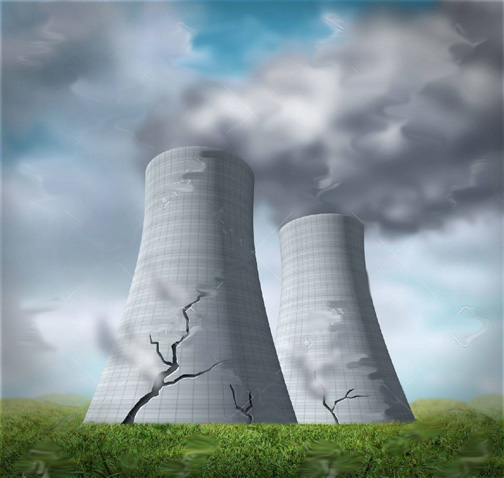
Bill to extend operating period of nuclear plants passes Japan’s Upper House
BY GABRIELE NINIVAGGI, Japan Times, May 31, 2023
A bill to extend the operating period of nuclear power plants to over 60 years — providing safety conditions are met — passed the Upper House on Wednesday, paving the way for a comprehensive overhaul of Japan’s nuclear policy.
The ruling coalition led by the Liberal Democratic Party, with the external support of two opposition parties — the Democratic Party for the People and Nippon Ishin no Kai — voted in favor of the bill, while other opposition forces on the left and center-left vocally opposed the legislation, saying that proposals to guarantee the safety of nuclear power plants were insufficient………..(Subscribers only) https://www.japantimes.co.jp/news/2023/05/31/national/nuclear-plant-operating-period-bill-pass/
1
Nuclear waste disposal site could be built next to power plant, Estonia
ERR News Editor: Mari Peegel, Helen Wright, https://news.err.ee/1608994484/nuclear-waste-disposal-site-could-be-built-next-to-power-plant, 31 May 23
Waste produced by a future nuclear power plant could be stored on the same site, newly published analysis carried out by the Ministry of the Environment and the Ministry of Finance shows.
The government is studying several sites across the country to see if any are suitable for a future small reactor.
After the announcement was made in April, additional research was carried out into the plant’s waste disposal at sites in Loksa, Kunda, Toila, and Varbla.
Now the results show it would be possible to build storage sites for nuclear waste at these locations, said Anna-Helena Purre from Steiger OÜ, who undertook the study.
“We carried out a spatial analysis: We looked at the location of the plant itself in open and closed cooling systems. Secondly, we looked at waste disposal – the low- and intermediate-level waste scenarios – and spent fuel disposal – the high-level waste scenario. These can be buried in deep boreholes, for example,” she said.
The government has not yet decided whether it will build a nuclear power plant and a decision is likely to be made in 2024. Production would start in 2035 at the earliest.
The U.S., France, Canada, UK, Japan, and Germany have stepped up to cooperate with Estonia.
Initially, 15 sites in Toila, Kunda, Loksa, Kuusalu, Viimsi, Paljaassaare, Kakumäe, Saare and Hiiumaa, Varbla and Harku municipalities were under consideration. But taking into account the plant’s socio-economic aspects, sites in places with a decreasing and below-average population far from the capital are preferred.
Neither Russia nor Ukraine committed to the IAEA’s 5 principles to protect Zaporizhzhia nuclear power plant.
Neither Russia nor Ukraine committed to respect five principles laid out
by International Atomic Energy Agency (IAEA) chief Rafael Grossi on Tuesday
(30 May) to try to safeguard Ukraine’s Russian-occupied Zaporizhzhia
nuclear power plant.
Grossi, who spoke at the UN Security Council, has
tried for months to craft an agreement to reduce the risk of a catastrophic
nuclear accident from military activity like shelling at Europe’s biggest
nuclear power plant.
His five principles included that there should be no
attack on or from the plant and that no heavy weapons such as multiple
rocket launchers, artillery systems and munitions, and tanks or military
personnel be housed there. Grossi also called for off-site power to the
plant to remain available and secure; for all its essential systems to be
protected from attacks or sabotage; and for no actions that undermine these
principles.
EU Reporter 1st June 2023
1
TEPCO faces new crisis over pedestal blow at Fukushima plant

May 30, 2023 https://www.asahi.com/ajw/articles/14920197
Damage to a pedestal inside the No. 1 reactor at the crippled Fukushima No. 1 nuclear power plant is more critical than previously believed, triggering a more intricate assessment of its resistance to a major earthquake.
Plant operator Tokyo Electric Power Co. (TEPCO) has no time to waste in confronting the issue. It must swiftly assess the damage and take effective action to prevent an accident or leak of radioactive materials.
An underwater robotic probe detected the damage in late March. It found that the metal framework lies exposed along the inner side of the pedestal’s wall for about 1 meter from its bottom and for the entire inner circumference as concrete in these areas has been lost.
There are fears the containment vessel that houses the pressure vessel could crack if the pedestal collapses in a severe earthquake. That could cause radioactive materials to leak.
Referring to the structure’s current earthquake resistance, TEPCO stressed that the pedestal has managed to support the reactor vessel even though the plant “has experienced strong earthquakes.” The utility cited one last year that registered lower 6 on the Japanese seismic intensity scale of 7.
Although the possibility of the pressure vessel tilting or sinking cannot be ruled out, the company asserts the impact will be limited with no risk of radioactive material leaking to the outside.
the Nuclear Regulation Authority (NRA) said last week it could not decide whether the assumptions underlying TEPCO’s risk assessment are accurate as the extent of damage and condition of the structural materials are not yet fully understood. The nuclear safety watchdog also said it would be difficult to reinforce the pedestal because of high radiation levels inside the containment vessel.
For this reason, the NRA called on the utility to evaluate the impact of a possible release of radioactive material into the environment and consider steps to deal with such an emergency.
As one NRA official put it, “I should say (TEPCO’s evaluation) is too optimistic, and it is difficult to say that is very reassuring.”
NRA Chairman Shinsuke Yamanaka said at a news conference, “It is TEPCO’s responsibility to swiftly assess what risks could impact the surrounding environment and its residents.”
Conditions surrounding the reactors that suffered core meltdowns in the nuclear disaster 12 years ago are only now finally being clarified. This has led to the discovery of additional problems that are already difficult to deal with, making the outlook of progress toward decommissioning the reactors even more uncertain.
The degradation of plant parts and materials will continue in the coming years. There is always the risk of a major earthquake striking the plant. Each time it is hit by a strong quake, the damage accumulates and the danger increases. If a radioactive leak occurs, it will seriously compromise the safety of residents, the reconstruction of the local communities and the local fishing industry.
The NRA this month decided not to lift a ban on the movement of nuclear fuel within TEPCO’s Kashiwazaki-Kariwa nuclear power plant in Niigata Prefecture, citing flawed measures to protect the facility against terrorist attacks. There are growing concerns about whether TEPCO is equipped to operate nuclear power plants.
There is absolutely no room for complacency when it comes to the consequences of the Fukushima nuclear disaster. TEPCO must always remain vigilant to a worst-case scenario in tackling related challenges.
1 This Month
23 April – WEBINAR – Why new nuclear reactors are the wrong tools for decarbonization Thursday, April 23 • 1 AM – 2 AM AEST

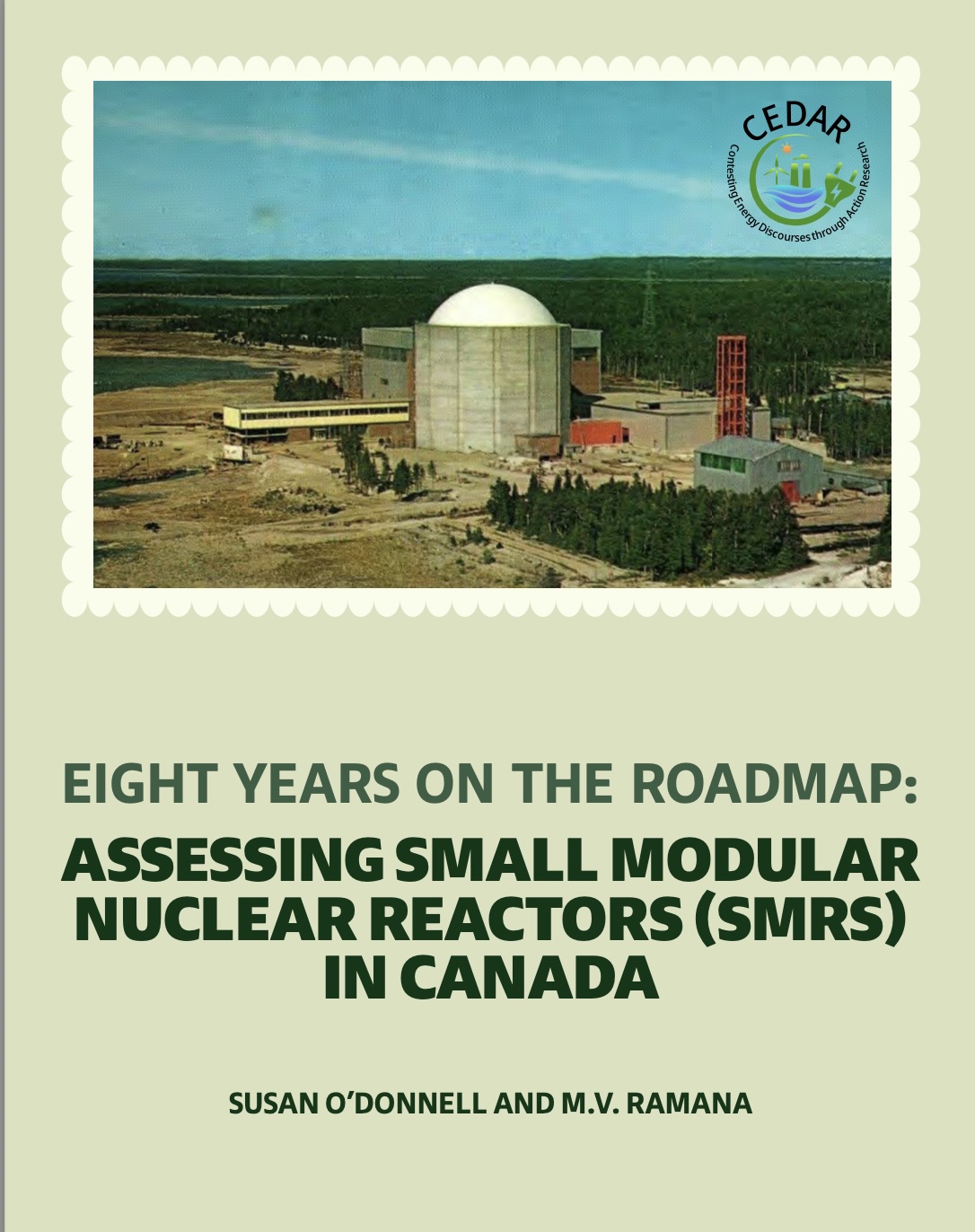

Pine Ridge Uranium is the real threat, not Tehran- Tell Burgum: Stop the Extraction.
Chernobyl: The Lost Tapes – A good documentary on Chernobyl on SBS available On Demand for the next 3 weeks– https://www.sbs.com.au/ondemand/tv-program/chernobyl-the-lost-tapes/2352741955560
To see nuclear-related stories in greater depth and intensity – go to https://nuclearinformation.wordpress.com
-
Archives
- April 2026 (241)
- March 2026 (251)
- February 2026 (268)
- January 2026 (308)
- December 2025 (358)
- November 2025 (359)
- October 2025 (376)
- September 2025 (257)
- August 2025 (319)
- July 2025 (230)
- June 2025 (348)
- May 2025 (261)
-
Categories
- 1
- 1 NUCLEAR ISSUES
- business and costs
- climate change
- culture and arts
- ENERGY
- environment
- health
- history
- indigenous issues
- Legal
- marketing of nuclear
- media
- opposition to nuclear
- PERSONAL STORIES
- politics
- politics international
- Religion and ethics
- safety
- secrets,lies and civil liberties
- spinbuster
- technology
- Uranium
- wastes
- weapons and war
- Women
- 2 WORLD
- ACTION
- AFRICA
- Atrocities
- AUSTRALIA
- Christina's notes
- Christina's themes
- culture and arts
- Events
- Fuk 2022
- Fuk 2023
- Fukushima 2017
- Fukushima 2018
- fukushima 2019
- Fukushima 2020
- Fukushima 2021
- general
- global warming
- Humour (God we need it)
- Nuclear
- RARE EARTHS
- Reference
- resources – print
- Resources -audiovicual
- Weekly Newsletter
- World
- World Nuclear
- YouTube
-
RSS
Entries RSS
Comments RSS
 nuclear-news