Amid China Tensions, US Nuclear-Powered Aircraft Carrier, USS Ronald Reagan, To Make A Rare Vietnam Port Call
By Ashish Dangwal. Eurasian Times, June 24, 2023
Amid heightened tensions with Beijing in the South China Sea, the US nuclear-powered aircraft carrier Ronald Reagan is scheduled to make a rare visit to Danang, the port city in Central Vietnam, on June 25.
This visit by the USS Ronald Reagan marks only the third time a US aircraft carrier has made such a stop since the end of the Vietnam War.
According to an announcement by Vietnam’s Foreign Ministry, the USS Ronald Reagan, a Nimitz-class aircraft carrier, was scheduled to reach Da Nang on June 25 and remain there until June 30………….
Additionally, Vietnam recently hosted Japan’s largest destroyer, the Izumo, after joint exercises with the USS Ronald Reagan and other American vessels in the South China Sea.
………. The United States aims to enhance its bilateral relationship with Vietnam, especially considering Hanoi’s ongoing disputes with Beijing over territorial boundaries in the South China Sea. …………………………………………….. more https://eurasiantimes.com/amid-china-tensions-us-nuclear-powered-aircraft-carrier-uss-ronald-reagan-to-make-a-rare-vietnam-port-call/
The Biden administration is pouring billions into the nuclear industry. The payoff isn’t certain
America aims for nuclear-power renaissance, The Economist 25 June 23
After the second world war, America’s newly created Atomic Energy Commission was on the hunt for a remote site where engineers could work out how to turn the raw, world-altering power contained in a nuclear bomb into electricity. They settled on the desert shrubland of south-eastern Idaho. Towns in the area fell over themselves to compete for the headquarters of the reactor test site, viewing it as a catalyst for growth. Idaho Falls, then a city of 19,000, launched what it called “the party plan”. Locals wooed officials at lunches, cocktail parties and tours of the city. The guest lists always included women who were “as winsome as possible” to make the town seem attractive to the (male) engineer in charge of choosing.
The party plan worked. Nearly 75 years later, Idaho Falls (with a population of 67,000) remains home to the test site’s successor and the centre of nuclear-power research in the United States: the Idaho National Laboratory (inl)…………………… (Subscribers only)
https://www.economist.com/united-states/2023/06/25/america-aims-for-nuclear-power-renaissance
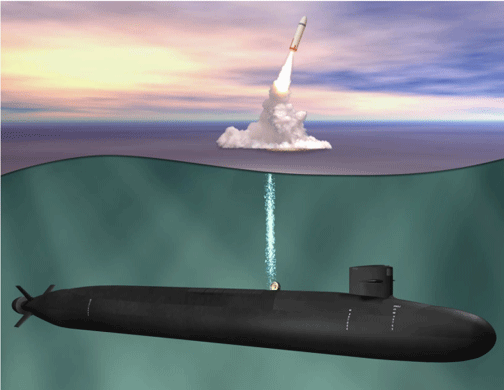
A $31 Billion Missile Program! US Looks To Reintroduce Nuclear Sea-Launched Cruise Missile Costing Equal To 10 Virginia-Class Subs
By Parth Satam, June 23, 2023, https://eurasiantimes.com/a-31-billion-missile-program-us-looks-to-reintroduce-nuclear-sea-launched-cruise-missile-costing-equal-to-10-virginia-class-subs/
A section of US Congressmen are voting for reintroducing a costly and redundant nuclear program. Republican lawmakers in the House are adopting a measure to institutionalize the Sea-Launched Cruise Missile-Nuclear (SLC)The SLCM was denied funding in last year’s Fiscal Year 2023 budget and concluded to have no battlefield use in the 2022 Nuclear Posture Review (NPR).
The Cold War-era concept envisages a cruise missile with a low-yield tactical nuclear warhead that can be fired from submarines, warships, or naval aircraft on a trajectory that makes it hard to track by radar.
According to a report in Defense News, the House Armed Services Committee “voted along party lines to amend the fiscal 2024 National Defense Authorization Act (NDAA) with a provision that would create a program of record (PoR) for SLCM-N.”
A PoR is a listed ‘line item record’ in current and future defense acquisition plans that make them eligible for continued funding over the years.
Obscene Cost for a Useless Weapon
If the full HASC advances the Fiscal Year 2024 (FY24) and passes the full floor vote in July, it would receive nearly $196 million as research and development funds.
However, political leaders and military experts advise against the astronomical costs and a futile capability, which they say can be invested elsewhere and be performed by other weapons systems.
Representative Courtney, a Democratic Congressman from Connecticut, who chairs the sea power subcommittee, cited May testimony from Chief of Naval Operations Admiral Michael Gilday stating that the warheads needed to make an SLCM-N program would cost at least $31 billion.
“The Navy can do a lot of other things with $31 billion. You can build 15 DDG destroyers with $31 billion, 10 Virginia-class submarines with $31 billion. You put nuclear warheads on these vessels, then you are changing the mission,” Courtney said.
Another Democratic Congressman, Representative Adam Smith of Washington, the top Democrat on the Armed Services Committee, argued that the US already has ballistic submarines in its fleet as well as lower-yield nuclear options from the air.
“It’s walking us down a path of spending enormous money on a capability that we don’t really need that will undermine our ability to build capabilities that we do (need) going forward,” said Smith.
Why Doesn’t the US Need the SLCM-N
Citing the need for flexibility and regional presence, the Trump administration’s 2018 Nuclear Posture Review (NPR) called for re-establishing a sea-launched cruise missile-nuclear capability.
President Biden’s FY 2022 budget continued funding SLCM-N, aiming to deploy it by the late 2020s. However, with the 2022 NPR identifying SLCM-N as “no longer necessary,” Biden’s 2023 budget request did not include SLCM-N funding.
The missile basically saddles important weapons platforms like submarines and warships with a mission set that can be undertaken by US Air Force (USAF) strategic bombers. It takes away the flexibility of employing diverse firepower options with a varied range of platforms.
“Should a geographic combatant commander intend to seek permission to use a nuclear weapon for tactical purposes, selecting bombers would offer more flexibility between mission sets and avoid committing to a weapons load-out decision as far in advance as would be necessary if SLCM-N were chosen” retired US Navy officer, Captain John Moulton writes in a paper.
In other words, an SLCM-N armed naval submarine or warship meets a very “narrow” mission set of destroying hardened enemy ground targets while sacrificing equally important tactical and strategic roles like hunting enemy submarines, destroying surface warships, mine laying or providing Intelligence-Surveillance-Reconnaissance (ISR).
Other currently nuclear weapons capable platforms like the B-2 Spirit, B-52 Stratofortress, B-1B Lancer, and the upcoming B-21 Raider envisaged for the same mission could also reach the warzone quickly.
The cost of revealing its position while firing an SLCM-N would also far outweigh the gains from hitting enemy ground targets with low-yield nuclear missiles, Moulton further explains. Moulton is a Senior Fellow at the Council on Strategic Risks’ Janne E. Nolan Center on Strategic Weapons.
The conditions that would justify using a tactical nuclear-tipped cruise missile would be very rare and would prevent a submarine or a naval vessel from performing optimally in a fluid battlefield situation.
In the Western Pacific, becoming part of a “joint force” in a mutually supporting pushback against a People’s Liberation Army Navy (PLAN) fleet inside China’s dangerous Anti-Access/Area-Denial (A2/AD) zone is a new evolving orientation guiding the US Navy’s submarine arm, explained in a previous EurAsian Times analysis.
Lastly, the risks of unintended nuclear escalation are exponentially higher when an SLCM-N is fired since the country sustaining the attack – China or North Korea – might legitimately retaliate with a nuclear strike, triggering a devastating atomic exchange.
Experts have long pointed out how such exchanges cannot be “controlled” given the tensions and the miscalculation involved.
A US asset firing an SLCM-N also counts as a nuclear first strike, which shifts the diplomatic narrative in the Russian, Chinese, or North Korean favor. None of these countries have ever indicated they plan to use nuclear weapons as a warfighting tool. While China has a clear No-First Use (NFU) policy, Moscow and Pyongyang have maintained they will use nukes only when the physical security of their country faces an existential threat. The author can be reached at satamp@gmail.com
Here’s how NATO trainers knowingly sent Ukrainian troops to their deaths in this month’s counteroffensive against Russia

Western computer-assisted battle simulations should have predicted Kiev’s huge losses
Ukraine sent one of its best brigades into combat earlier this month as part of its long-awaited counteroffensive aimed at retaking areas controlled by Russian forces.
Leading the charge near the town of Orekhov, in Zaporozhye Region, was the 47th Mechanized Brigade, armed with NATO equipment and – most importantly – employing it using the US-led bloc’s combined arms doctrine and tactics. Prior to the operation, this brigade spent months at a base in Germany learning “Western know-how” in combined-arms warfare.
Helping them prepare for the fighting to come was KORA, the German-made NATO computer simulation system, designed to allow officers and non-commissioned officers to closely replicate battlefield conditions and, in doing so, better develop ideal courses of action against a designated enemy – in this case, Russia.
If there was ever an example of how a purpose-built Ukrainian NATO proxy force would perform against a Russian enemy, the 47th Brigade was the ideal case study. However, within days of initiating its attack, the group was close to literally decimated, with more than 10% of the over 100 US-made M-2 Bradley infantry fighting vehicles destroyed or abandoned on the field of battle, and hundreds of the brigade’s 2,000-strong complement dead or wounded. German-made Leopard 2 tanks and mine-clearing vehicles joined the Bradleys as wrecks in the fields west of Orekhov, having failed to breach the first line of Russian defenses. The reasons for this defeat can be boiled down to the role played by KORA in creating a false sense of confidence on the part of the officers and men of the 47th Brigade. Unfortunately, as the Ukrainians and their NATO masters found out, what works in a computer simulation does not automatically equate to battlefield success.
KORA is a computer-based advanced synthetic wargaming system developed by the German army to support course-of-action analysis and scenario-based experiments for staff officers up to the brigade level. It has been incorporated into NATO computer wargame simulations in support of live training done at the US Army’s Grafenwoehr training facility. Grafenwoehr hosted the 47th Brigade from January-May 2023. While capable of generating generic terrain maps for combat simulation against a notional enemy, KORA can be customized using actual terrain models and real-world order of battle to support preparations for actual combat scenarios.
Of all the military operations training KORA is capable of, the breaching of a fortified defensive line is the most difficult. ……………………………………
Logic dictates that any responsible use of the KORA simulation system would have predicted the failure of the 47th Brigade’s attack. According to The Washington Post, the officers of the 47th Brigade “planned their assaults and then let the [KORA] program show them the results – how their Russian enemies might respond, where they could make a breakthrough and where they would suffer losses.” The KORA simulation allowed the Ukrainian officers to coordinate their actions “to test how they’d work together on the battlefield.” Given that the Ukrainian force structure was insufficient to accomplish the mission-critical task of suppression, there was no chance for the Ukrainian forces to accomplish the actual assault requirements of a breaching operation – the destruction of enemy forces on the opposite side of the obstacle barrier being breached. The Ukrainians, however, came away from their KORA experience confident that they had crafted a winning plan capable of overcoming the Russian defenses in and around Orekhov……………………………………………………………………………….
The reality is that the Ukrainians never even got close to reaching the Russian defenses around Orekhov, let alone breaching them. The reasons for this failure are many, including unfamiliarity with the Western-style equipment the 47th Brigade was employing, poor tactical planning, and – most importantly – the failure of the Ukrainians to suppress Russian artillery fire, electronic warfare capabilities, and air power, which made the tactical breach of the Russian obstacle belts – especially the dense minefields – impossible. All these failures were predictable, which means that to overcome them during the training phase, the NATO trainers had to deliberately “game” the KORA system in order to obtain the desired outcome.
………………………………………………………I can speak with some authority about the role played by computer simulations in preparation for an assault against a fortified position. In October 1990, I was tasked by Headquarters Marine Corps with conducting a computer simulation using the newly procured JANUS conflict and tactical constructive simulation system to assist Marine operational planners deployed …………………………………..
……………………………………… If only the NATO trainers, who knowingly sent the men of the Ukrainian 47th Mechanized Brigade and scores of other Ukrainian brigades to their deaths, adhered to such standards. Instead, they sent those troops in a futile attempt to breach defenses that were impossible to overcome, given the disparity in training and force composition between the Ukrainian and Russian forces. Had they been diligent, there would be far fewer Ukrainian widows and orphaned children mourning the loss of their husbands and fathers. This, more than anything, is the primary lesson to be derived from the Ballad of KORA and JANUS – neither NATO nor the United States cares about the lives of the Ukrainians they have undertaken to train in the horrific art of war.
Apparently, Republican Senator Lyndsey Graham is not alone in aspiring to continue the Russian-Ukrainian conflict until Kiev runs out of cannon fodder. Based upon the results at Orekhov earlier this month, “to the last Ukrainian” appears to be the overall NATO battle cry as well.
Nuclear-based fantasies are holding back real climate action

SMR Education Task Force, June 22, 2023, https://crednb.ca/2023/06/22/nuclear-based-fantasies-are-holding-back-real-climate-action/—
Today a network of groups across Canada announces the launch of the SMR Education Task Force to share under-reported facts about small modular nuclear reactors (SMRs) with members of Parliament and provincial legislatures.
We begin with the latest report from Canada Energy Regulator (CER). This federal document, called Canada’s Energy Future, projects that enough new nuclear reactors (SMRs) will be operational by 2050 to more than double Canada’s existing nuclear electricity generation.
Canada currently has 19 operating power reactors, built over 58 years. The new report claims that we will build more than 50 new reactors in much less time.
This fantasy has no basis in reality. It is inconsistent with independent analyses by energy researchers not tied to the nuclear industry. One such study in the Bulletin of Atomic Scientists makes it clear that SMRs have at best a marginal role to play in a truly effective climate action plan. SMRs fail the tests of timeliness and affordability – they take too long and cost too much.
In addition to Ontario and Alberta, the CER report imagines deploying SMRs in Quebec and British Columbia. This is news to citizens in those provinces. BC ratepayers have rejected nuclear power in the past, and Quebec phased out of nuclear power in 2012. With every reactor comes long-lived radioactive waste — including the structure itself, which is a provincial responsibility to safeguard for thousands of years after shutdown.
Yesterday, the Coalition for Responsible Energy Development in New Brunswick (CRED-NB) sent a letter to Canada’s Natural Resources Minister reminding him that more than 120 civil society, public interest, faith-based and Indigenous groups across Canada have signed a statement warning that SMRs are a dirty, dangerous distraction from urgent climate action.
These groups understand that responding to the climate emergency does not require gambling on untested nuclear reactors. They know that energy efficiency measures and renewable sources cost at least 3 to 7 times less than nuclear power per tonne of carbon emissions avoided.
The groups oppose using public funds earmarked for climate action to support the nuclear industry’s eager experimentation with novel reactor designs. We are challenging the government to release the research and data that support its nuclear-based strategy.
Nuclear promoters, with long-standing allies embedded in the federal and provincial governments, are making unsubstantiated promises about SMRs in an audacious attempt to grab as much public funding as possible to keep their dying industry alive.
Worldwide, nuclear’s share of global electricity has dropped over the last 25 years from 17% to less than 10%. The International Energy Agency forecasts that more than 90% of all new electricity installations worldwide over the next 5 years will be non-hydro renewables.
The industry’s money-grab will succeed only if our public representatives remain uninformed about the facts. That is why we are pleased to announce the SMR Education Task Force and look forward in the months ahead to share information about SMRs based on independent science and research.
IAEA Director General Grossi discusses nuclear safety with Russia’s Director of Rosatom, at Zaporizhzhia, in new consultations

MOSCOW, June 23 https://english.news.cn/20230624/19c5c0119ce24b04a7ab10e6a08f9a0b/c.html — General Director of Russia’s Rosatom State Corporation Alexey Likhachev discussed the current nuclear safety situation around the Zaporizhzhia nuclear power plant (ZNPP) with the International Atomic Energy Agency (IAEA) Director-General Rafael Grossi in Russia’s Kaliningrad on Friday.
During the discussion, both delegations addressed issues raised by Grossi at the UN Security Council briefing on May 30, in which the official discussed the security situation at the nuclear facility, Rosatom said in a statement.
Likhachev emphasized that the Russian side “expects the IAEA Secretariat to take specific steps to prevent strikes by the Ukrainian armed forces both on the ZNPP and on the adjacent territory,” it added.
He informed Grossi about the specific measures currently being taken by the Russian side to ensure the nuclear facility’s safe operation, particularly its water supply “after the Kakhovka hydroelectric power plant dam was destroyed by the Ukrainian armed forces,” Rosatom said.
Both sides further discussed the outcomes of Grossi’s visit to the plant on June 15. During his visit, Grossi was able to personally verify whether the plant could continue operating safely, and confirm among other things that the water supply in the cooling pond was sufficient for the safe operation of the facility
Diversion from urgent climate action. How the European nuclear lobby undermines the EU’s energy future –

By Jan Haverkamp, https://eu.boell.org/en/nuclear-lobby, 22 June 23
In several countries in the EU, as well as in the Brussels corridors of the European Union institutions, a vehement debate is currently taking place regarding the demand for more nuclear power. Only five years ago, this attention hardly existed. This study looks at the sudden surge in attention for nuclear energy and tries to understand the role of different actors on the side of the nuclear lobby. It investigates the case of the Netherlands, which turned from a de facto nuclear phase-out country to one where expansion of nuclear energy is currently under preparation, as well as the European Union, where a large minority of Member States have brought nuclear back to the table in many climate-related legislative debates.
The current enormous political lobby for nuclear energy – at the party-political level in the Netherlands and by a substantial group of Member States in the EU – leads to a diversion of attention and capital from urgent and effective climate measures and threatens to delay urgent climate action.
This study provides ideas about how this lobby may be countered. The chances for that lie in the complexity of the issue and the realities on the ground that may force the executive – the government in the Netherlands and the European Commission in the EU – to prevent the nuclear debate diverting too much attention and capital from urgent and effective climate action, keeping in mind that nuclear power itself will deliver virtually nothing to the climate emergency’s resolution.
more https://eu.boell.org/sites/default/files/2023-06/nuclear_lobby_report_final.pdf
…… Executive summary
1. Introduction
2. Nuclear lobby in the Netherlands
3. Nuclear lobby in the EU
Who is who in the Brussels nuclear debate?
Who drives nuclear lobbying in the EU?
4. Final conclusions
References
A nuclear site is on tribes’ ancestral lands. Their voices are being left out on key cleanup talks
KNKX Public Radio | By The Associated Press, June 23, 2023
Three federally recognized tribes have devoted decades to restoring the condition of their ancestral lands in southeastern Washington state to what they were before those lands became the most radioactively contaminated site in the nation’s nuclear weapons complex, the Hanford Nuclear Reservation.
But the Yakama Nation, Confederated Tribes of the Umatilla Indian Reservation and Nez Perce Tribe have been left out of negotiations on a major decision affecting the future cleanup of millions of gallons of radioactive waste stored in underground tanks on the Hanford site near Richland.
In May, federal and state agencies reached an agreement that hasn’t been released publicly but will likely involve milestone and deadline changes in the cleanup, according to a spokesperson for the Washington State Department of Ecology, a regulator for the site. As they privately draft their proposed changes, the tribes are bracing for a decision that could threaten their fundamental vision for the site.
“As original stewards of that area, we’ve always been taught to leave it better than you found it,” said Laurene Contreras, program administrator for the Yakama Nation’s Environmental Restoration/Waste Management program, which is responsible for the tribe’s Hanford work. “And so that’s what we’re asking for.”
From World War II through the Cold War, Hanford produced more than two-thirds of the United States’ plutonium for nuclear weapons, including the atomic bomb dropped on Nagasaki, Japan, in 1945. Production ceased in 1989, and the site’s mission shifted to cleaning up the chemical and radioactive waste left behind.
For these tribes, which have served as vital watchdogs in the cleanup process, the area’s history dates back long before Hanford, to pre-colonization. It was a place where some fished, hunted, gathered and lived. It’s home to culturally significant sites. And in 1855 treaties with the U.S. government in which the tribes ceded millions of acres of land, they were assured continued access.

The U.S. Department of Energy, the Environmental Protection Agency and the Washington State Department of Ecology have held confidential negotiations since 2020 on revising plans for the approximately 56 million gallons of radioactive waste stored in 177 underground tanks at Hanford. The discerning eyes of the tribal experts have been kept out, though EPA and Ecology have said there will eventually be opportunities for the tribes to meet with them about this.
The revisions are expected to affect an agreement among the three agencies that outlines the Hanford cleanup. Mason Murphy, program manager for the Confederated Tribes’ Energy and Environmental Sciences program, points out that the tribes also weren’t consulted in that original 1989 agreement.
“It’s an old scabbed-over wound,” Murphy said…………………………………………………….. https://www.knkx.org/government/2023-06-23/a-nuclear-site-is-on-tribes-ancestral-lands-their-voices-are-being-left-out-on-key-cleanup-talks
—
Ecological tipping points could occur much sooner than expected, study finds.

Amazon rainforest and other ecosystems could collapse ‘very soon’,
researchers warn. Ecological collapse is likely to start sooner than
previously believed, according to a new study that models how tipping
points can amplify and accelerate one another.
Based on these findings, the authors warn that more than a fifth of ecosystems worldwide, including the Amazon rainforest, are at risk of a catastrophic breakdown within a human
lifetime.
Guardian 22nd June 2023
Is Fukushima wastewater release safe? What the science says
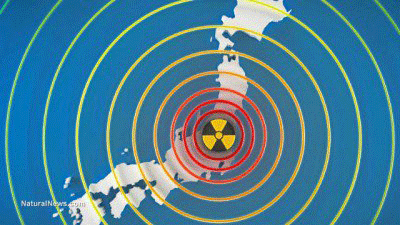
Radiation in the water will be diluted to almost-background levels, but some researchers are not sure this will be sufficient to mitigate the risks.
Bianca Nogrady Nature, 22 June 23
Despite concerns from several nations and international groups, Japan is pressing ahead with plans to release water contaminated by the 2011 meltdown of the Fukushima Daiichi nuclear power plant into the Pacific Ocean. Starting sometime this year and continuing for the next 30 years, Japan will slowly release treated water stored in tanks at the site into the ocean through a pipeline extending one kilometre from the coast. But just how safe is the water to the marine environment and humans across the Pacific region?
How is the water contaminated?
The power station exploded after a devastating earthquake and subsequent tsunami crippled the coastal plant, overheating the reactor cores. Since then, more than 1.3 million cubic metres of seawater have been sprayed onto the damaged cores to keep them from overheating, contaminating the water with 64 radioactive elements, known as radionuclides. Of greatest concern are those that could pose a threat to human health: carbon-14, iodine-131, caesium-137, strontium-90, cobalt-60 and hydrogen-3, also known as tritium.
Some of these radionuclides have a relatively short half-life and would already have decayed in the 12 years since the disaster. But others take longer to decay; carbon-14, for example, has a half-life of more than 5,000 years.
How are they treating the water?
The contaminated water has been collected, treated to reduce the radioactive content and stored in more than 1,000 stainless steel tanks at the site. …………………………
Will radioactivity concentrate in fish?
Nations such as South Korea have expressed concern that the treated water could have unexplored impacts on the ocean environment, and a delegation from the country visited the Fukushima site in May. Last year, the US National Association of Marine Laboratories in Herndon, Virginia, also voiced its opposition to the planned release, saying that there was “a lack of adequate and accurate scientific data supporting Japan’s assertion of safety”. The Philippine government has also called for Japan to reconsider releasing the water into the Pacific.
“Have the people promoting this going forward — ALPS treatment of the water and then release into the ocean — demonstrated to our satisfaction that it will be safe for ocean health and human health?” asks Robert Richmond, marine biologist at the University of Hawaii at Manoa. “The answer is ‘no’.”
Richmond is one of five scientists on a panel advising the Pacific Islands Forum, an intergovernmental organization made up of 18 Pacific nations including Australia, Fiji, Papua New Guinea and French Polynesia. The panel was convened to advise on whether the release of the treated water from Fukushima was safe both for the ocean and for those who depend on it. Richmond says they have reviewed all the data provided by TEPCO and the Japanese government, and visited the Fukushima site, but there are still some unanswered questions about tritium and carbon-14………………………………….
TEPCO says fishing is not routinely conducted in an area within 3 kilometres of where the pipeline will discharge the water. But Richmond is concerned the tritium could concentrate in the food web as larger organisms eat smaller contaminated ones. “The concept of dilution as the solution to pollution has demonstrably been shown to be false,” Richmond says. “The very chemistry of dilution is undercut by the biology of the ocean.”
Shigeyoshi Otosaka, an oceanographer and marine chemist at the Atmospheric and Ocean Research Institute of the University of Tokyo says that the organically bound form of tritium could accumulate in fish and marine organisms. He says international research is investigating the potential for such bioaccumulation of the radionuclides in marine life, and what has already happened in the waters around Fukushima after the accidental release of contaminated water during the tsunami. “I think it is important to evaluate the long-term environmental impact of these radionuclides,” Otosaka says………………………………. https://www.nature.com/articles/d41586-
Ukraine Can Develop Nuclear Weapons ‘Within a Short Time’: Ex-Zelensky Aide
BY JON JACKSON ON 6/23/23
eksii Arestovych, a former adviser to Ukrainian President Volodymyr Zelensky, said during a Thursday interview that Ukraine has the ability to quickly produce its own nuclear weapons “within a short time.”
Arestovych, who also served as an officer in Ukraine’s military intelligence service, made the remarks while speaking with Russian activist Mark Feygin…………… Arestovych has also stated that Crimea would be a major target for Zelensky’s forces during the conflict. https://www.newsweek.com/ukraine-can-develop-nuclear-weapons-within-short-time-ex-zelensky-aide-1808663
Community energy for the UK
At the close of Community Energy Fortnight (10-23 June), the Nuclear Free
Local Authorities have written to a minister asking the government to hold
onto parts of the Energy Bill that will be vital if the community energy
sector is to continue to grow.
In his letter to Nuclear and Networks
Minister Andrew Bowie, who is leading on the legislation for the
government, NFLA Steering Committee Councillor Lawrence O’Neill has asked
for Clauses 272 and 273 to be retained in the bill.
These clauses, backed by the campaign group Power for People, would allow small community owned projects generating renewable energy to supply electricity to the National
Grid or to the communities that they serve on a fairer basis, and they
would also guarantee these suppliers a set income. Disappointingly, the
government is believed to be looking at dropping these clauses from the
bill, without suggesting any alternate provision.
NFLA 23rd June 2023
United Arab Emirates keen to become an exporter of nuclear reactors and nuclear technology

ABU DHABI, 23rd June, 2023 (WAM) — H.H. Sheikh Hamdan bin Zayed Al Nahyan, Ruler’s Representative in Al Dhafra Region, visited Barakah Nuclear Energy Plant to view the latest developments of Unit 4, the final unit at the plant approaching commercial operation, and praised Emirati competencies that contributed to developing nuclear energy sector technologies to export globally.
Sheikh Hamdan was received by Mohamed Ibrahim Al Hammadi, Managing Director, and Chief Executive Officer of the Emirates Nuclear Energy Corporation (ENEC); and Ali Al Hammadi, Chief Executive Officer of ENEC’s subsidiary Nawah Energy Company (Nawah); as well as a delegation from ENEC’s senior management.
At the beginning of his visit, Sheikh Hamdan inaugurated the state-of-the-art Nuclear Reactor Operators Training Centre, which will enhance nuclear reactor operators’ expertise, and was briefed on the “Orchid” digital reactor room, which provides advanced maintenance training for engineers without entering the reactor area.
Sheikh Hamdan bin Zayed then toured the simulation training centre, which is one of the largest and most modern simulation training centres in the world. He also heard from Emirati engineers on the Plant’s developments and achievements, the latest of which was the operational readiness preparations for Unit 4, the fourth and final unit at the Barakah Nuclear Energy Plant in Abu Dhabi…………………..
https://www.wam.ae/en/details/1395303172381
Biden Would Need His Pound of Flesh From Assange
The case of David Hicks, an Australian imprisoned by the United States in Guantanamo Bay is relevant. Hicks ultimately was released by the U.S., after pressure from the Australian government, when he agreed to a so-called Alford Plea, in which he pled guilty to a single charge, but was allowed to assert his innocence at the same time. on the grounds that he understood he would not receive a fair trial.
The U.S. president would not likely move on the case without some face-saving measure to ward off pressure from the C.I.A. and his own party, writes Joe Lauria.
By Joe Lauria / Consortium News 23 June 23 https://scheerpost.com/2023/06/23/biden-would-need-his-pound-of-flesh-from-assange/
The coming days or weeks could be the most pivotal in imprisoned WikiLeaks publisher Julian Assange’s four-year legal drama. There are five possible scenarios:
- Assange may have his appeal against extradition heard by the High Court;
- He may have his appeal rejected and be put on a plane to the United States;
- That plane may be stopped by an injunction from the European Court of Human Rights;
- A last-minute plea deal may be worked out guaranteeing Assange’s eventual freedom or, least likely
- the U.S. may abruptly drop its charges against him.
Following the decision by High Court Judge Sir Jonathan Swift this month to reject Assange’s application to appeal his ordered extradition to the United States to stand trial on espionage charges, Assange’s legal team filed a new application to the High Court last week. The decision on this application could come any day.
If it is refused, Assange will have run out of legal options in Britain, and could only be saved by the intervention of the European court. There is also still a chance of a plea deal in which President Joe Biden would need to exact punishment of Assange to cover his political posterior.
Given new revelations in the UC Global case in Spain about C.I.A. spying on Assange there’s even an outside chance the Biden administration may drop the case to avoid exposure in the media circus that would ensue in Alexandria, VA if Assange is extradited to stand trial there.
Rollercoaster
Assange and his supporters have been on a rollercoaster since the beginning of May.
Expectations grew in Australia last month that a deal may be in the works to liberate him. The hopes began with the clearest statements yet on the case from Australian Prime Minister Anthony Albanese. On May 4, he said for the first time that he had spoken directly to U.S. authorities about Assange; that he wanted the prosecution to end and that he was concerned for his health.
Optimism grew further when five days later, Caroline Kennedy, the U.S. ambassador to Australia and daughter of slain President John F. Kennedy, agreed to meet a group of six, pro-Assange, Australian MPs, from three different parties, plus an independent.
It is highly unlikely that Kennedy would have invited them to the U.S. embassy for lunch to discuss Assange’s case without approval from at least the State Department, if not the White House.
A few days after that, Albanese said Assange would have to play his part in any deal to be freed. That was widely interpreted to mean that Assange would have to agree to some sort of plea deal, in which he agreed to plead guilty to a lesser charge, perhaps serve a short sentence in Australia and then walk free.
All this was leading up to President Joe Biden’s scheduled May 24 visit to Australia to meet with Albanese. Speculation ran wild that a deal to release Assange might be announced.
A rally in Sydney’s Hyde Park was planned for the day of Biden’s visit. One of his London lawyers, Jennifer Robinson, and Julian Assange’s wife, Stella Assange, made plans to be in Australia, her first ever trip to her husband’s native country.
Biden canceled his trip to Sydney, he said because of the then debt crisis, and met instead with Albanese in a bilateral meeting in Japan on the sidelines of the G7 Summit. There is no indication Assange was discussed.
Stella Assange went to Australia anyway with Robinson and both addressed the National Press Club in Canberra on May 22. Stella Assange called this period the “end-game, the closet my husband has been to release.”
Robinson said for the first time on behalf of Assange’s legal team that they would consider a plea deal.
Robinson said:
“We are considering all options. The difficulty is our primary position is, of course that the case ought to be dropped. We say no crime has been committed and the facts of the case don’t disclose a crime. So what is it that Julian would be pleading to?”
Two days later, Stella Assange and Assange’s brother and father whipped up a huge crowd of Assange supporters at the Hyde Park rally.
The Alford Plea
It is hard to imagine Assange admitting to having done anything wrong, when the case against him, as argued in his extradition hearing, appears to prove no wrongdoing at all.
The case of David Hicks, an Australian imprisoned by the United States in Guantanamo Bay is relevant. Hicks ultimately was released by the U.S., after pressure from the Australian government, when he agreed to a so-called Alford Plea, in which he pled guilty to a single charge, but was allowed to assert his innocence at the same time on the grounds that he understood he would not receive a fair trial.
Can an Alford Plea be a face-saving solution for both Biden and Assange? Can Assange’s team frame it as Assange denying participation in any crime while at the same time having to plead guilty to at least a lesser charge?
FBI Continues Probe
Some of this optimism was punctured on May 31 when The Sydney Morning Herald reported that the F.B.I. was still carrying out its investigation of Assange, three years after issuing its last superseding indictment.
The Herald reported that the F.B.I. in May sought an interview in London with Andrew O’Hagan, who worked as a ghostwriter on Assange’s autobiography in 2011. The London Metropolitan Police’s counterterrorism command sent the letter to O’Hagan, which said: “The FBI would like to discuss your experiences with Assange/WikiLeaks …”
O’Hagan told the Herald: “I would not give a witness statement against a fellow journalist being pursued for telling the truth. I would happily go to jail before agreeing in any way to support the American security establishment in this cynical effort.”
What could this mean in the context of speculation about negotiations over a plea deal? Did the F.B.I. want to bolster its case to make it easier for Assange to accept a plea on the lesser charge of conspiracy to commit computer intrusion? Or was it just trying to strengthen a very weak case against him?
Assange’s Australian lawyer, Stephen Kenny, told the Herald:
“I would think it is of some concern because we have been working to try to secure an arrangement that would see Julian come home. It would be very unusual if the FBI was trying to gather evidence that could help clear his name.”
Judge Rejects Application to Appeal
The rollercoaster plunged further with the news that a single judge on the High Court of England and Wales rejected Assange’s 11-month old request to cross appeal the lower court ruling in his case as well as the home secretary’s decision to extradite him.
Judge Swift, who has manifest conflicts of interest, rejected the 150-page application for appeal of the home secretary’s decision to extradite Assange to the U.S. as well as a cross appeal of the lower court judge who initially released Assange on health grounds and conditions of U.S. prisons but who agreed with the U.S. on everything else.
Swift took just three pages to dismiss the 150-page application to appeal, complaining about the length of the submission in the process. He called Assange’s appeal “new evidence,” which he rejected, while the same court accepted the new evidence of U.S. assurances not to mistreat Assange to overturn the lower court’ decision to release him on health grounds.
Assange’s legal team has one last chance with the court. On Tuesday last week they submitted a 20-page document to the High Court arguing why it should listen to the appeal against extradition. His team will get no more than a humiliating 15 minutes of a 30-minute hearing to argue before two judges on the High Court, according to former British diplomat Craig Murray.
If this application is refused there are no more legal steps for Assange in Britain and he could be theoretically put on a plane to the U.S. that day.
At that point, only an injunction from the European Court of Human Rights can stop the plane from taking off until that court examines the case. Assange’s lawyers filed a submission to the ECHR in December.
But there is also the possibility of a last-minute plea agreement or the U.S. dropping the case.
What Biden Needs
This flurry of bad news for Assange, after weeks of encouraging developments, has buried talk of a plea agreement. But a last minute deal cannot be ruled out.
Biden would need his pound of flesh from Assange if he would allow his administration to offer a plea. Assange would most likely have to plead guilty to something and serve more time, likely in Australia, before Biden would entertain ending the case.
Though he was never charged for the Democratic National Committee or the C.I.A. leaks, Assange is the continuing target of their ire, and would be unlikely to look kindly on Biden letting him go, especially a year before a U.S. presidential election. Biden knows he’s wrong on Assange, if he can remember it. He clearly stated his position on Assange on Meet the Press in December 2010.
Vice President Biden told the program that Assange could only be indicted if it could be proved he conspired to steal the published documents. That could not be proved and the Obama-Biden administration did not indict Assange. The Trump administration did. But only on the original 2010 espionage charges.
The U.S. indictment does not accuse Assange of stealing U.S. government documents, but only receiving them. If Biden stuck to his original principles he would have these charges dropped and let Assange go. But it’s political dynamite for him.
The C.I.A. and DNC would likely be furious with Biden so he will need something in return to show them for letting Assange go. Whether that satisfies them is another matter.
Dropping the Case
The last, long-shot possibility, is that the U.S. drops the case altogether. This is what Assange’s supporters, parliamentarians around the world, human rights and press freedom groups, journalists’ unions and even WikiLeaks‘ five corporate media partners have been calling for.
But until now it’s been like talking to a marble wall in Washington. Yet, developments in the UC Global case in Spain and the upcoming U.S. presidential election might provide conditions for the U.S. to want to get out of its pursuit of Assange.
A recent development in the Madrid criminal trial against UC Global chief David Morales for violating Assange’s privacy by spying on him in Ecuador’s London embassy with 24/7 live surveillance for the Central Intelligence Agency as well on his privileged conversations with his lawyers has solidly confirmed the C.I.A’s role.
Would Langley want that exposed at Assange’s trial federal court in Alexandria, VA, where U.S. media interest would be intense?
Also, would Biden welcome during a presidential campaign the protests in the plaza before the Alexandria courthouse, highlighting his administrations efforts to convict a journalist for publishing accurate information exposing U.S. state crimes, handing his political opponents a cudgel to expose his hypocrisy about defending press freedoms?
It might indeed be in Biden’s and the C.I.A.’s interests to wash their hands of this filthy endeavor once and for all. (There is precedence for this in the Katharine Gun case.)
In one way or the other, the coming weeks appear to be leading to a climax in the extradition phase of arguably the most important press freedom case in U.S. history.
Legal challenge against Sizewell C nuclear power plant rejected
High court judge rules in favour of government decision to let EDF build plant on the Suffolk coast.
Rob Davies, 23 June 23, Guardian
A legal challenge against the government’s decision to build the Sizewell C nuclear power plant has been rejected.
The campaign group Together Against Sizewell C (Tasc) had launched a judicial review against the government’s decision to give the green light to the 3.2 gigawatt plant on the Suffolk coast, which is being built by French energy company EDF.
The group said the government had failed to consider alternatives to nuclear power to meet its emissions targets when approving the project. It cited the threat to water supplies in an area officially designated as seriously water-stressed, the threats to coastal areas from the climate crisis, and environmental damage.
Mr Justice Holgate rejected the group’s challenge against the secretary of state for energy security and net zero in a written ruling at the high court on Thursday. Holgate ruled the government’s decision was in keeping with energy policy intended to achieve “diversity of methods of generation and security of supply”…………
Tasc said it would continue its campaign and was examining options for how to do so…………………………… more https://www.theguardian.com/business/2023/jun/22/legal-challenge-against-sizewell-c-nuclear-power-plant-rejected
-
Archives
- February 2026 (220)
- January 2026 (308)
- December 2025 (358)
- November 2025 (359)
- October 2025 (376)
- September 2025 (258)
- August 2025 (319)
- July 2025 (230)
- June 2025 (348)
- May 2025 (261)
- April 2025 (305)
- March 2025 (319)
-
Categories
- 1
- 1 NUCLEAR ISSUES
- business and costs
- climate change
- culture and arts
- ENERGY
- environment
- health
- history
- indigenous issues
- Legal
- marketing of nuclear
- media
- opposition to nuclear
- PERSONAL STORIES
- politics
- politics international
- Religion and ethics
- safety
- secrets,lies and civil liberties
- spinbuster
- technology
- Uranium
- wastes
- weapons and war
- Women
- 2 WORLD
- ACTION
- AFRICA
- Atrocities
- AUSTRALIA
- Christina's notes
- Christina's themes
- culture and arts
- Events
- Fuk 2022
- Fuk 2023
- Fukushima 2017
- Fukushima 2018
- fukushima 2019
- Fukushima 2020
- Fukushima 2021
- general
- global warming
- Humour (God we need it)
- Nuclear
- RARE EARTHS
- Reference
- resources – print
- Resources -audiovicual
- Weekly Newsletter
- World
- World Nuclear
- YouTube
-
RSS
Entries RSS
Comments RSS
 nuclear-news