$528 Billion nuclear clean-up at Hanford Site in jeopardy

The government now appears to be seriously considering whether it will be necessary to leave thousands of gallons of leftover waste buried forever in Hanford’s shallow underground tanks, according to some of those familiar with the negotiations, and protect some of the waste not in impenetrable glass, but in a concrete grout casing that would almost certainly decay thousands of years before the toxic materials that it is designed to hold at bay.
At site after site, the solution has come down to a choice between an expensive, decades-long cleanup or quicker action that leaves a large amount of waste in place.
A Poisonous Cold War Legacy That Defies a Solution
NYT, By Ralph Vartabedian, Reporting from Richland, Wash., May 31, 2023
From 1950 to 1990, the U.S. Energy Department produced an average of four nuclear bombs every day, turning them out of hastily built factories with few environmental safeguards that left behind a vast legacy of toxic radioactive waste.
Nowhere were the problems greater than at the Hanford Site in Washington State, where engineers sent to clean up the mess after the Cold War discovered 54 million gallons of highly radioactive sludge left from producing the plutonium in America’s atomic bombs, including the one dropped on the Japanese city of Nagasaki in 1945.
Cleaning out the underground tanks that were leaching poisonous waste toward the Columbia River just six miles away and somehow stabilizing it for permanent disposal presented one of the most complex chemical problems ever encountered. Engineers thought they had solved it years ago with an elaborate plan to pump out the sludge, embed it in glass and deposit it deep in the mountains of the Nevada desert.
But construction of a five-story, 137,000 square-foot chemical treatment plant for the task was halted in 2012 — after an expenditure of $4 billion — when it was found to be riddled with safety defects. The naked superstructure of the plant has stood in mothballs for 11 years, a potent symbol of the nation’s failure, nearly 80 years after the Second World War, to deal decisively with the atomic era’s deadliest legacy.
The cleanup at Hanford is now at an inflection point. The Energy Department has been in closed-door negotiations with state officials and the U.S. Environmental Protection Agency, trying to revamp the plan. But many fear the most likely compromises, which could be announced in the coming months, will put the speed and quality of the cleanup at risk.
The government now appears to be seriously considering whether it will be necessary to leave thousands of gallons of leftover waste buried forever in Hanford’s shallow underground tanks, according to some of those familiar with the negotiations, and protect some of the waste not in impenetrable glass, but in a concrete grout casing that would almost certainly decay thousands of years before the toxic materials that it is designed to hold at bay.
“The Energy Department is coming to a big crossroads,” said Thomas Grumbly, a former assistant secretary at the department who oversaw the early days of the project during the Clinton administration.
Successive energy secretaries over the last 30 years, he said, “have slammed their heads against the wall” to come up with a technology and budget that would make the problem go away not only at Hanford, but also at other nuclear weapons sites around the country.
Plants in South Carolina, Washington, Ohio and Idaho that helped produce more than 60,000 atomic bombs have tons of radioactive debris that will be radioactive for thousands of years. And unlike nuclear power plants, whose waste consists of dry uranium pellets locked away in metal tubes, the weapons facilities are dealing with millions of gallons of a peanut butter-like sludge stored in aging underground tanks.
Two million pounds of mercury remain in the soils and waters of eastern Tennessee. Radioactive plumes are contaminating the Great Miami aquifer near Cincinnati.
At site after site, the solution has come down to a choice between an expensive, decades-long cleanup or quicker action that leaves a large amount of waste in place.
Hanford, some 580 square miles of shrub-steppe desert in south-central Washington State, is the largest and most contaminated of all the weapons production sites — too polluted to ever be returned to public use. But the problem is urgent, given the risk of radionuclides contaminating the Columbia River, a vital lifeline for cities, farms, tribes and wildlife in two states……………………………………………………………………………………………………
“The closer you get to the bottom of those tanks, the more radioactive, toxic and dangerous waste is,” said Geoffrey Fettus, a lawyer with the Natural Resources Defense Council, which has sued the government over the Hanford cleanup………………………………………………………………. more https://www.nytimes.com/2023/05/31/us/nuclear-waste-cleanup.html
1 Comment »
1 This Month
26 April – Chernobyl: Inside the Meltdown airs on National Geographic on Sunday 26th April from 4pm

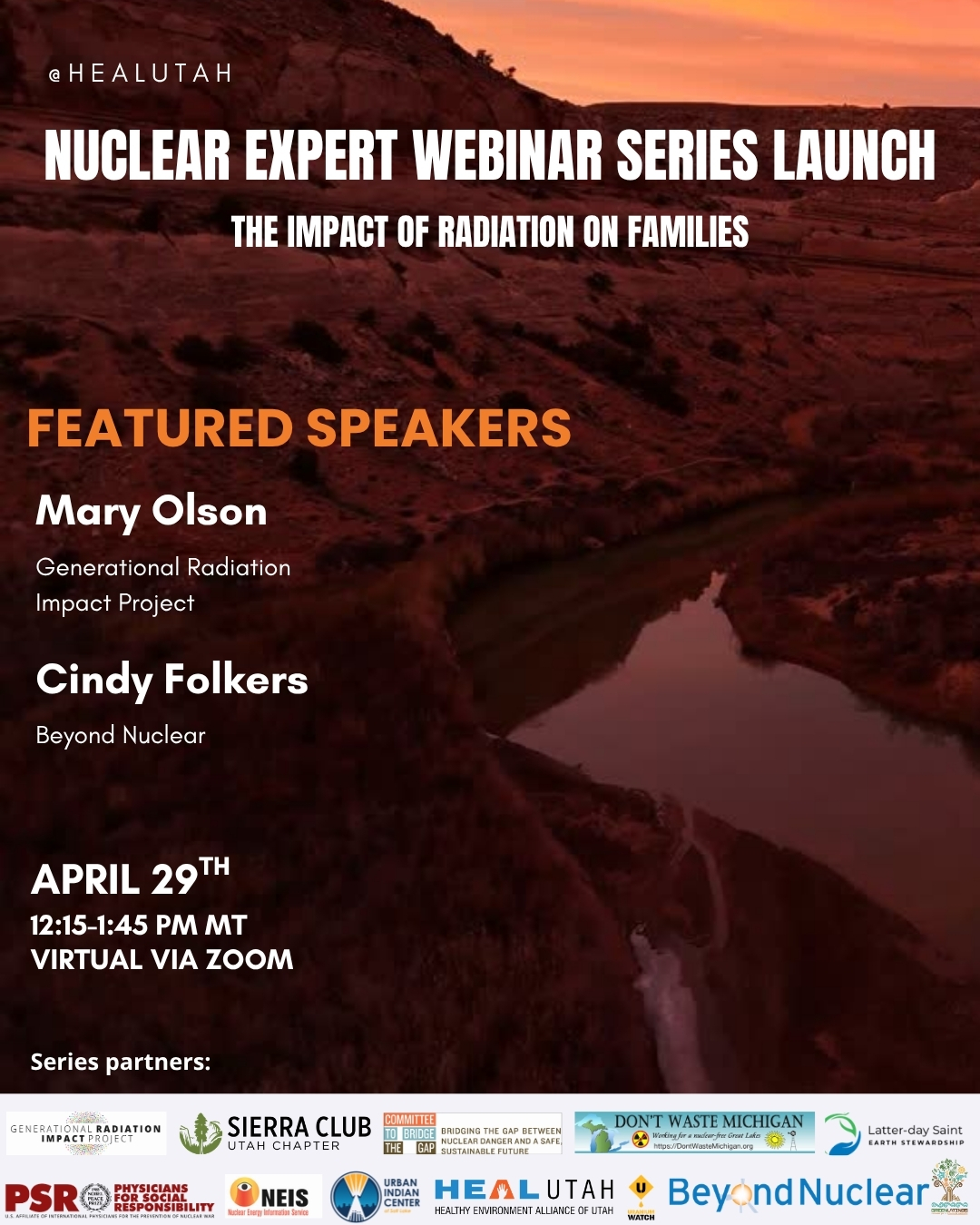
29 April – Nuclear Expert Webinar #1 – Radiation Impacts on Families with Mary Olson and Cindy Folkers
- 12:15 PM MT – 1:45 PM MT
- Location: Virtual – REGISTER TODAY

4 May -West Suburban Peace Coalition to discuss Iran war at May Educational Forum
Monday, May 4, 7:00 – 8:00 PM Central Standard Time
Title: : How Trump’s Narrative Tries to Shape the Reality of the War on Iran.
Contact Walt Zlotow, zlotow@hotmail.com 630 442 3045 for further information
14 May – online event From Bombs to Data Centres: the Face of Nuclear Colonialism

Pine Ridge Uranium is the real threat, not Tehran- Tell Burgum: Stop the Extraction.
Chernobyl: The Lost Tapes – A good documentary on Chernobyl on SBS available On Demand for the next 3 weeks– https://www.sbs.com.au/ondemand/tv-program/chernobyl-the-lost-tapes/2352741955560
To see nuclear-related stories in greater depth and intensity – go to https://nuclearinformation.wordpress.com
-
Archives
- May 2026 (25)
- April 2026 (356)
- March 2026 (251)
- February 2026 (268)
- January 2026 (308)
- December 2025 (358)
- November 2025 (359)
- October 2025 (376)
- September 2025 (257)
- August 2025 (319)
- July 2025 (230)
- June 2025 (348)
-
Categories
- 1
- 1 NUCLEAR ISSUES
- business and costs
- climate change
- culture and arts
- ENERGY
- environment
- health
- history
- indigenous issues
- Legal
- marketing of nuclear
- media
- opposition to nuclear
- PERSONAL STORIES
- politics
- politics international
- Religion and ethics
- safety
- secrets,lies and civil liberties
- spinbuster
- technology
- Uranium
- wastes
- weapons and war
- Women
- 2 WORLD
- ACTION
- AFRICA
- Atrocities
- AUSTRALIA
- Christina's notes
- Christina's themes
- culture and arts
- Events
- Fuk 2022
- Fuk 2023
- Fukushima 2017
- Fukushima 2018
- fukushima 2019
- Fukushima 2020
- Fukushima 2021
- general
- global warming
- Humour (God we need it)
- Nuclear
- RARE EARTHS
- Reference
- resources – print
- Resources -audiovicual
- Weekly Newsletter
- World
- World Nuclear
- YouTube
-
RSS
Entries RSS
Comments RSS
 nuclear-news
[…] Source link […]
Pingback by $528 Billion nuclear clean-up at Hanford Site in jeopardy « nuclear-news - Energy News 247- Reliable energy, green, climate change energy news and more | June 3, 2023 |