What is Black Climate Week?
Black communities make the smallest carbon footprint, yet they face the worst of environmental degradation This proximity to the problems means frontline communities are also at the forefront of climate solutions. Yet, they receive the least amount of support. To create equitable climate solutions, we must honor the leadership, voices, and stories of Black communities. Philanthropy MUST dismantle historical barriers & move forward with transparency, accountability, and solidarity.
With this commitment in mind, The Solutions Project created #BlackClimateWeek. Recognized during Black History Month, Black Climate Week honors the innovative climate solutions and environmental justice work that Black folk have been leading for years, while simultaneously calling in philanthropy & the media to do a better job at investing in the communities most impacted by the climate crisis and centering Black voices from the bottom up and the top down.
Now in it’s third year, this award-winning campaign is focused on philanthropy and its power to create the future we want by showing up in solidarity with Black communities advancing a just transition to an equitable and regenerative economy. As climate action rises in importance across all communities, a spotlight on Black leadership offers a powerful path forward.
Leak reveals Zelensky privately plots bold attacks inside Russia.(Is his halo slipping?)

They reveal a leader with aggressive instincts that sharply contrast with his public-facing image as the calm and stoic statesman.
Zelensky suggested Ukraine “conduct strikes in Russia”
“Zelensky highlighted that … Ukraine should just blow up the pipeline and destroy likely Hungarian [Prime Minister] Viktor Orban’s industry”
Zelensky then “suggested that Ukraine attack unspecified deployment locations in Rostov,” a region in western Russia, using drones instead, according to another classified document.
The Age, John Hudson and Isabelle Khurshudyan, May 14, 2023
Washington: Ukrainian President Volodymyr Zelensky has won the trust of Western governments by refusing to use the weapons they provide for attacks inside Russia and prioritising the targeting of Russian forces inside Ukraine’s borders.
But behind closed doors, Ukraine’s leader has proposed going in a more audacious direction – occupying Russian villages to gain leverage over Moscow, bombing a pipeline that transfers Russian oil to Hungary, a NATO member, and privately pining for long-range missiles to hit targets inside Russia’s borders, according to classified US intelligence documents detailing his internal communications with top aides and military leaders.
The documents, which have not been previously disclosed, are part of a broader leak of US secrets circulated on the Discord messaging platform and obtained by The Washington Post. They reveal a leader with aggressive instincts that sharply contrast with his public-facing image as the calm and stoic statesman weathering Russia’s brutal onslaught. The insights were gleaned through intercepted digital communications, providing a rare look at Zelensky’s deliberations amid Russian missile barrages, infrastructure attacks and war crimes.
The Pentagon, where senior US military leaders were briefed on the matters outlined in the leaked documents, did not dispute the authenticity of the materials.
In some cases, Zelensky is seen restraining the ambitions of his subordinates; in several others, he is the one proposing risky military actions.
In a meeting in late January, Zelensky suggested Ukraine “conduct strikes in Russia” while moving Ukrainian ground troops into enemy territory to “occupy unspecified Russian border cities,” according to one document labelled “top secret.” The goal would be “to give Kyiv leverage in talks with Moscow,” the document said.
In a separate meeting in late February with General Valery Zaluzhny, Ukraine’s top military commander, Zelensky “expressed concern” that “Ukraine does not have long-range missiles capable of reaching Russian troop deployments in Russia nor anything with which to attack them”. Zelensky then “suggested that Ukraine attack unspecified deployment locations in Rostov,” a region in western Russia, using drones instead, according to another classified document.
In a meeting in mid-February with Deputy Prime Minister Yuliya Svrydenko, Zelensky suggested Ukraine “blow up” the Soviet-built Druzhba pipeline that provides oil to Hungary. “Zelensky highlighted that … Ukraine should just blow up the pipeline and destroy likely Hungarian [Prime Minister] Viktor Orban’s industry, which is based heavily on Russian oil,” the document says.
In detailing the conversation, intelligence officials concede that Zelensky was “expressing rage toward Hungary and therefore could be making hyperbolic, meaningless threats,” a qualification that does not accompany the other accounts of Zelensky suggesting bold military action. Though Hungary is nominally part of the Western alliance, Orban is widely considered Europe’s most Kremlin-friendly leader.
When asked if he had suggested occupying parts of Russia, Zelensky, during an interview with The Washington Post in Kyiv, dismissed the US intelligence claims as “fantasies” but defended his right to use unconventional tactics in the defence of his country.
……………. The use of long-range missiles to hit inside Russia is a particularly sensitive topic for the White House, which has long worried that the Ukraine conflict could escalate out of control and force a catastrophic standoff between the United States and Russia, the world’s largest nuclear powers.
Though Washington has given Zelensky billions of dollars’ worth of advanced weaponry, President Biden has steadily rebuffed the Ukrainian leader’s request for long-range ATACMS, shorthand for the Army Tactical Missile System, capable of striking targets up to 185 miles away. Since the start of the war, Biden has said the United States is “not encouraging or enabling Ukraine to strike beyond its borders”.
When asked about the intelligence indicating he had weighed the use of long-range missiles to hit Russia, Zelensky said it is not something Ukraine is entertaining. “No one in our country has given orders for offensives or strikes on Russian territory,” he said.
It is unclear whether the United States has shared accounts of Zelensky’s plotting with allied nations, but the Ukrainian president continues to enjoy the strong support of Western governments, which have provided him with an increasingly sophisticated array of weaponry.
This past week, Britain became the first Western country to provide Ukraine with long-range missiles. The Storm Shadow, a cruise missile system with stealth capabilities, has a range of 155 miles, far exceeding the 50-mile range of the US-provided HIMARS launchers.
British Defence Minister Ben Wallace said Friday that the missile would give Ukraine “the best chance” to defend itself and would be for use only “within Ukrainian sovereign territory.” A spokesman with the British Embassy in Washington declined to comment on whether Zelensky’s leaked remarks might give London pause about its decision.
The Biden administration says Zelensky’s intercepted comments are not the cause for withholding ATACMS.
“Ukraine has repeatedly committed to employ US-provided weapons responsibly and strategically when needed to counter Russian aggression, and we are confident that will continue to be the case,” said a US defence official who, like others interviewed for this report, spoke on the condition of anonymity to discuss a sensitive topic.
Since last year, Zelensky has promised that Ukraine would never use US weapons to strike inside Russia, a pledge the White House says he has fulfilled.
“President Zelensky has kept the promises he has made to President Biden, and we do not believe that that will change,” said a senior administration official.
One reason for not providing the long-range missiles is the “relatively few ATACMS” the United States has for its own defence needs, General Mark A. Milley, chairman of the Joint Chiefs of Staff, told Defence One in March.
Zelensky, however, said he believes the United States isn’t sending the weapons because it doesn’t trust Kyiv.
“I think they are afraid that we might use them on the territory of Russia,” Zelensky told The Post. “But I would always tell our partners … ‘We have a priority target for which we are spending the ammunition packages we receive, and we spend it on the deoccupation of purely Ukrainian territories,’” he said.
While there is no indication that Ukraine has used Western missiles to strike into Russian territory, the same cannot be said for Kyiv’s use of armed drones.
Explosions caused by unmanned aerial vehicles have become a regular occurrence in Russia, including in Rostov, where a drone crashed into an oil refinery this month. Ukrainian officials are often coy about the incidents, hinting that they’re responsible without directly taking credit.
Two drone attacks in December on Russia’s Engels air base in Saratov, more than 590 kilometres from the Ukrainian border, showed “that we have the ability to reach many kilometres farther than they could expect,” Oleksiy Danilov, secretary of Ukraine’s National Security and Defence Council, said in an interview earlier this year.
Russia this month accused Ukraine of staging a drone attack intended to kill President Vladimir Putin in the Kremlin. Videos circulating on social media and verified by The Post show two drones streaking toward the Kremlin at about 2.30am local time. The allegation was forcefully denied by Ukrainian officials, including Zelensky…………………..more https://www.theage.com.au/world/europe/leak-reveals-zelensky-privately-plots-bold-attacks-inside-russia-20230514-p5d87l.html The Washington Post
Understanding The Highly Complex World Of Western China Analysis

CAITLIN JOHNSTONE, MAY 15, 2023 https://caitlinjohnstone.substack.com/p/understanding-the-highly-complex?utm_source=post-email-title&publication_id=82124&post_id=121463595&isFreemail=true&utm_medium=email
—
Former Pentagon official Elbridge Colby was interviewed on The National Review’s Charles CW Cooke Podcast, where he provided some very high-level analysis on the tensions around China, Taiwan, and the United States.
I will here attempt to explain some of Colby’s comments for the benefit of the average reader, because Colby has been studying these things for many years and his commentary can be a bit advanced and esoteric for the casual punditry consumer.
“The analogy I use is… Taiwan is like a man with a cut in the ocean, and China is like a great white shark, and America is like a man in a boat,” Colby said in the interview.
“The problem is once that great white shark starts moving, you got no time,” added Colby. “You’re done. You know, if you’re not already by the side of the boat, right? Because it’s a great white shark.”
Now bear with me if Colby’s incisive observations went a bit over your head here, but if we break it down I’m confident that we can all catch up to this man’s towering intellect enough to catch a glimpse of his understanding on the matter.
What Colby appears to be saying — and please correct me of you think I’m reading this wrong — is that China is like a Great White Shark, which as we all know is an extremely dangerous aquatic predator with a voracious appetite, capable of gulping down a human being in a few swift bites.
Now, try to imagine being in a situation where you’re out there in the ocean, and there’s a Great White Shark right there with you in the water. And to make matters worse, you’re bleeding — a problem not only due to the wound from whence the blood is emanating, but also because sharks can smell blood in the water! That would be pretty bad, right?
Okay, so are you with me so far? Remember, this is very advanced stuff, so feel free to read back and review as much as you need.
Now, imagine you’re in that situation with the cut and the shark, and there’s a boat that you can go to to get away from the shark. You’d want to hop aboard that vessel as swiftly as possible, don’t you think? I know I would!
So to put it all together, what the esteemed Elbridge Colby is telling us is that China is analogous to the Great White Shark which is eyeing the bleeding man in the water, and the man can be compared to Taiwan, and the United States of America is comparable to the boat that is coming to the rescue of the man.
Make sense? If you’re still struggling to comprehend Colby’s scalpel-like geopolitical analysis, don’t worry, because I’ve obtained this helpful infographic above, to further illuminate your understanding:
Interestingly enough, this is not the first time China has been compared to a Great White Shark in recent western punditry. The Hoover Institution’s Matt Pottinger, a former advisor to President Donald Trump, made a similar comparison in an interview with Nikkei Asia earlier this month:
“We saw a baby shark and thought that we could transform it into a dolphin over time, to become a friendly sort of system,” Pottinger said. “Instead, what we did was we kept feeding the shark and the shark got bigger and bigger and bigger and bigger. And now we’re dealing with a formidable, great white.”
“With a shark you put up a shark cage,” added Pottinger. “The shark doesn’t take it personally. It bumps into the cage. It respects those barriers.”
Again, this is very complicated for the uninitiated layperson, but what Pottinger appears to be saying is that China is not at all comparable to a dolphin, which is an oceanic mammal known to be friendly toward people and easily trained to do tricks in aquatic theme parks. Rather, in Pottinger’s understanding, China is more comparable to a Great White Shark, which as you’ll recall from our discussion earlier in this essay is actually known to be rather dangerous.
If you’re still struggling to make sense of Pottinger’s luminous understanding, here’s another illustration to help make things a bit clearer:

If you need it simplified even further, another way to put it might be, CHINA BAD. SHARK BAD. CHINA LIKE SHARK. CHINA VERY, VERY BAD. BAD CHINA. BAD.
Again, don’t be hard on yourself if you can’t quite wrap your head around the high-level analysis of intellectual giants like Matt Pottinger and Elbridge Colby. If we could understand these things as well as they do, we’d be the ones earning big bucks from Washington think tanks, not them!
Well I think that’s enough work for your gray matter today. Have a rest and a nice sleep and come back fresh tomorrow, where we’ll be discussing some mind-blowing comparisons western analysts have been drawing between Vladimir Putin and Adolf Hitler.
UK government’s own workplace pension scheme won’t back nuclear projects.
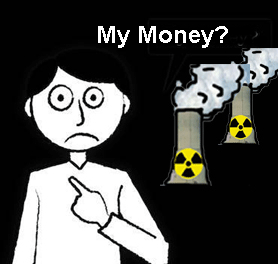
The government’s own workplace pension scheme has ruled out investing in
nuclear projects such as Sizewell C, dealing a blow to ministers’ hopes of
getting new plants off the ground.
The National Employment Savings Trust (Nest) said it would not revise its policy on nuclear infrastructure investments despite an overhaul of energy policy last year.
The government has set a high target of 24 gigawatts of new nuclear capacity by 2050,
supplied by big power plants and small modular reactors. It is courting investors such as pension funds to back Sizewell C in Suffolk, the next big nuclear plant in the pipeline.
Nest, which was set up by the government to manage auto-enrolment pensions, said it had no direct investments in nuclear infrastructure and “no current plans to review this any time soon”. “Our fund managers … would need to be confident it offers a good investment opportunity,” a spokesman added.
Big City investors like Aviva and Legal & General have previously ruled out funding projects such as Sizewell. The Department for Energy Security and Net Zero said: “We
are confident that investors will take assurance from the government’s clear commitment to [nuclear].” Alison Downes, executive director at Stop Sizewell C, said:
“Nest’s refusal to bring its 11+ million members into line with ministers’ misguided energy policy is protecting the savings of millions of hard-pressed workers and pensioners from risky, slow, expensive Sizewell C.”
Times 14th May 2023
https://www.thetimes.co.uk/article/state-pension-scheme-nest-wont-back-nuclear-plans-h22q5qnzr
Luck is not a safety plan
“We must act now,” said International Atomic Energy Agency director general, Rafael Grossi. But what is his plan? IAEA efforts at creating a “safe zone” around the Zaporizhzhia reactors, where no fighting could then occur, have collapsed. On the geopolitical stage, both Russia and Ukraine appear to harbor the conviction that their side can win the war. NATO and its allies show no signs of insisting on a diplomatic solution, given the benefit to those countries of a Russian defeat.
War devastation is bad enough without adding a nuclear disaster
Luck is not a safety plan — Beyond Nuclear International
How much more perilous can the situation at Zaporizhzhia nuclear power plant become?
By Linda Pentz Gunter, 14 May 23
Luck is not a sound basis on which to rely when we are dealing with nuclear risks. But luck is again what me must depend on as we watch and wait for the worst to happen — or not — at the six-reactor Zaporizhzhia nuclear power plant in Ukraine.
The plant, located in the southwestern region of the country — the area most directly embroiled in some of the most intense fighting, and with parts of it already “annexed” by Russia — has already experienced some frightening near-misses. These include shelling and missile attacks and frequent losses of offsite power that, if not restored promptly, could lead to a meltdown.
The plant has been occupied by Russian forces since March 4, 2022. Rumors abound that a severely depleted workforce is laboring under stressful and even violent conditions, while other staff have fled or have disappeared.
Now we learn that mass evacuations are underway from communities close to the nuclear plant. These include residents of Enerhodar, the city that houses most of the plant workers and their families……………………….
Fears of a Ukrainian offensive designed to recapture some or all of the Russian-held territory appear to have prompted the sudden evacuation. But are people evacuating away from the conflict or from the prospect of a catastrophic outcome at the nuclear power plant, should it become fully engulfed by the fighting? And if that does happen, what might the consequences be?
As a precaution, all six Zaporizhzhia reactors are currently shut down — officially their status is called “cold shutdown”, which is not as final as it sounds and does not mean they are out of danger.
The fuel in the reactor core still requires electricity to power cooling, as do the pumps that supply cooling water to the fuel pools. This means a meltdown is still possible. Cold shutdown just buys workers more time to restore power should it become lost, but a reliable supply of electricity to the site is still essential to avoid disaster…………
The consequences of such an outcome would be drastic not only for the people of Ukraine and neighboring Russia, but for all of Europe, should any or all of these reactors melt down or suffer a fuel pool fire. We only have to look at the fallout map from the 1986 Chornobyl disaster, a single unit with a far smaller radioactive inventory, to understand the potential scale of such a tragedy.
Chornobyl contaminated 40% of the European landmass with long-lived radioactive fallout and created an effectively permanent 1,000 square mile Exclusion Zone around the stricken nuclear site.
Beyond electrical power, water supply is also essential to keep nuclear power plants out of danger. The thermally and radioactively “hot” irradiated fuel rods sitting in cooling pools, must stay submerged. Electrically powered pumps can maintain a steady water supply. But access to water is critical.
In late March, alarms were raised about a dramatic drop in water levels at the reservoir that supplies cooling water to the plant. Ukrainian officials said the Russians had drained the reservoir, increasing the risk of a meltdown at Zaporizhzhia.
But this month, headlines warned that record high water levels could threaten a dam that, if breached, would send floodwaters pouring onto the nuclear site, inundating the plant’s pumping systems.
War, flooding, and human error are all potential disasters waiting in the wings that could trigger a nuclear catastrophe. But what can prevent it?
“We must act now,” said International Atomic Energy Agency director general, Rafael Grossi. But what is his plan? IAEA efforts at creating a “safe zone” around the Zaporizhzhia reactors, where no fighting could then occur, have collapsed. On the geopolitical stage, both Russia and Ukraine appear to harbor the conviction that their side can win the war. NATO and its allies show no signs of insisting on a diplomatic solution, given the benefit to those countries of a Russian defeat.
All of this brutality already comes at immense cost to the population of Ukraine, but also to Russia, where mothers, too, are losing sons to an unnecessary war. A major strike on Europe’s largest nuclear power plant would extend that tragedy across thousands of miles, affecting hundreds of millions of lives. All we’ve got between us and that disaster is luck, which, like the deadly uranium that fuels nuclear power plants, will eventually run out.
UK’s Nuclear Waste Services ignore overwhelming local council opposition to siting plan for waste dump.
Candidates opposed to the siting of a Nuclear Waste facility on the border
of Mablethorpe and Theddlethorpe not only took control of all the parish
councils in the search area but also took all of the allocated seats on the
dissstrict council, plus two seats in Sutton on Sea.
Turnout was high for a local election. In Theddlethorpe and Withern 39.6% of those eligible to
vote did so and more than seventy per cent of the voted for Travis Hesketh
(pictured) In Sutton on Sea, Where one Green and one independent anti dump
candidates overturned a Conservative majority, the turnout topped forty per
cent.
With such an overwhelming result we wrote to the leaders of both
Lincolnshire County Council and East Lyndsey District Council demanding
that they honour the people’s decision and withdraw from the so-called,
Community Partnership.
We await their decision. However, NWS has spoken to
the press and intend to ignore the result. That makes the second “Test Of
Public Support ” they have chosen to ignore. The first, a survey carried
out by Theddlethorpe Residents Association, showed 85% against with a
turnout of 56%.
Guardians of the East Coast 13th May 2023
https://preview.mailerlite.io/emails/webview/385711/88100923539195491
New Mexico shouldn’t be the nation’s nuclear dump.

The New Mexican, May 13, 2023 https://www.santafenewmexican.com/opinion/editorials/new-mexico-shouldnt-be-the-nations-nuclear-dump/article_e3ab7340-f0fa-11ed-b7a1-4325f0b82388.html
The federal government’s longstanding failure to build a repository for nuclear waste should not be left for New Mexico to solve.
Yet a decision last week by the Nuclear Regulatory Commission to issue a license to “temporarily” store tons of spent nuclear fuel in New Mexico could mean waste from commercial power plants across the nation will end up buried in the state. It’s bad news for us, of course, but it’s catastrophic for a nation that has never fully come to grips with the reality of nuclear power.
To recap: The commission said it will allow Holtec International to build and operate a nuclear waste storage facility near the Lea and Eddy County line in far southeast New Mexico.
This, despite the clear message from New Mexico’s congressional delegation, governor and statewide elected officials that the state is not interested in being the one-size-fits-all nuclear storage solution for the country. New Mexico already hosts the Waste Isolation Pilot Plant. It stores transuranic waste, a byproduct of the country’s nuclear defense program.
Opening the Holtec facility would up the ante, bringing highly radioactive spent fuel to our state. The spent fuel consists of uranium pellets inside metal rods and can be handled only by machines. It’s so radioactive people who work near it are protected by steel or concrete.
The consolidated interim storage facility planned for New Mexico would have the capacity to store up to 8,680 metric tons of used uranium fuel, with possible future expansions to make room for as many as 10,000 canisters over six decades.
Material would arrive in New Mexico via rail. While that seems a smidge safer than high-speed truck traffic over crowded interstates and well-traveled New Mexico roads, recent derailments make the thought of rail travel worrisome.
And temporary has a way of becoming permanent, considering the federal government has no solution for the growing piles of waste at commercial nuclear reactors all over the country.
With New Mexico’s nuclear history — home of the atomic bomb, site of nuclear bomb testing and today’s expanded plutonium pit construction — surely the state has contributed its share. Besides, who is the NRC trying to kid? A storage facility cannot be “interim” without a final, designated location. Such a site does not exist. And when it comes to anything nuclear, there’s no such thing as interim or temporary.
The decision by federal regulators to license the plant ignores the will of the state Legislature — lawmakers passed legislation during the 2023 session aimed at stopping the project. Next up: a court battle over the license.
Holtec officials, evidently unconcerned about the will of New Mexico’s elected representatives and many of its citizens, point to federal law, which they say preempts state action. The company already has invested $80 million to seek the 40-year license to build and operate the facility. Officials are promising an economic boom to go along with becoming the nation’s nuclear waste dump.
Unsurprisingly, perhaps, local officials in southeastern New Mexico — some of them, anyway — are welcoming the jobs the plant will bring. We’re not sure they have thought out the potential long-term consequences, considering the federal government’s reluctance to confront the problem of nuclear waste. A storage site was going to be built at Yucca Mountain in Nevada, but state and federal politics blocked the project.
As a result, the United States lacks the infrastructure to dispose of radioactive nuclear waste. And that’s where the state’s congressional delegation comes in. They must push harder, fanatically if need be, to break the legislative logjam on Yucca Mountain, which has become an accepted impasse. This state’s future depends on their success.
Meanwhile, New Mexico is poised to become the interim — cue eye roll — solution. That’s not the future New Mexico wants or deserves.
NATO Weapons Go Boom, British Missiles Strike Russia – Ukraine War Escalates
The NATO vs Russia proxy war in Ukraine recently escalated a notch or two, with simultaneous ‘Ukrainian’ airstrikes downing two modern Russian fighter jets and two helicopters… well inside ‘Russia proper’. This came the day after British-supplied, longer-range, cruise missiles struck the city of Lugansk, and hours after Russian airstrikes obliterated another huge store of NATO supplies for Ukraine’s much-vaunted ‘counter-offensive’.
This week on NewsReal, Joe & Niall discuss the latest deceptions in ‘the Ukraine war…. more https://www.sott.net/article/480219-NewsReal-NATO-Weapons-Go-Boom-British-Missiles-Strike-Russia-Ukraine-War-Escalates#
Missteps deliver Alexandria Ocasio-Cortez into the hands of the pro-nuclear propagandists – REPROCESSING IS NOT RECYCLING.

In fact, reprocessing irradiated fuel increases the volume of radioactive waste, while reducing only the level of radioactivity. This results in enormous discharges of so-called low- and intermediate-level but still highly radioactive wastes in the form of gases and liquids into the air and the English Channel. It is this that makes reprocessing arguably the dirtiest and most carcinogenic phase of the entire nuclear industry
.
Congresswoman talked nuclear nonsense, but does that mean she supports it?
Dear AOC, reprocessing is not recycling — Beyond Nuclear International
“………..the nuclear power propagandists, heralding her as the latest defector from the “Left” to the pro-nuclear power cause…………. But her errors are costly — to her credibility, as well as to the climate cause.
By Linda Pentz Gunter – from Ralph Nader’s new newspaper, the Capitol Hill Citizen, April 23
The progressive Democratic congresswoman, Alexandria Ocasio-Cortez, has 8.6 million followers on her Instagram account, a number identical to the online readership of the New York Times.
With her rock star-like AOC moniker and plenty of adoring fans, what the U.S. representative from Queens, New York writes or says has an impact. And it needs to be accurate. Presumably that is why Members of Congress deploy a slew of aides, tasked with delivering the details on a likely sometimes overwhelming array of topics.
When it comes to nuclear power, however, the Congresswoman from New York appears to be flying solo. Either that, or her aides are failing to do their homework. AOC’s stance on nuclear power was as confusing — and arguably as confused — during the introduction of the short-lived Green New Deal four years ago as her latest venture on Instagram after her February 2023 trip to Japan.
In 2019, after a February 7 joint press conference to roll out the blueprint for a Green New Deal alongside fellow Democrat, Senator Ed Markey, AOC’s office published details of the plan with nuclear power explicitly excluded. There was an immediate backlash, after which the reference to nuclear power’s exclusion was abruptly deleted. Asked to explain the switch, AOC told reporters that the Green New Deal “leaves the door open on nuclear so we can have that conversation” and that she herself did not “take a strong anti- or pro-position on it.”
From Japan earlier this year, AOC delivered a series of bubbly Instagram updates, mostly expressing her delight with Japan’s bullet trains. After her visit to the stricken Fukushima Daiichi nuclear power plant, site of the devastating March 2011 explosions and triple meltdowns, she put up a series of informational posts, then stumbled badly on the final question, which asked: “France uses nuclear power. How do they manage it differently? They don’t have earthquakes….”
For reasons that remain unclear, other than the French connection, AOC used this opportunity to launch what sounded unmistakably like praise for the end phase of nuclear power production — reprocessing. Only she called it “recycling”, a deliberately misleading industry term that masks the highly polluting operations involved in reprocessing, which takes irradiated reactor fuel and separates the plutonium from uranium in a chemical bath.
She then made a series of points, all of which were either factually or scientifically inaccurate, or both. We reached out to AOC’s press office for a response, but as of press time there was none.
These missteps begged the question as to the source of the Congresswoman’s information. Her use of the term “recycling” suggests that she, like most of her colleagues on the Hill, defers to the nuclear industry itself to sell her a highly sanitized version of its activities.
This is particularly frustrating coming from an elected official whose raison d’être is to serve as the people’s champion. Had her staff instead opened the door to eminently qualified academics on the subject, such as Princeton physicist, Frank von Hippel, never mind independent experts from the NGO world, they could have saved their boss considerable embarrassment.
Instead, AOC posted that “France recycles their nuclear waste,” even embedding the recycling logo in her text. But reprocessing does nothing of the kind.
Of that irradiated reactor fuel reprocessed at the La Hague nuclear center on France’s Normandy coast, 95% of it contains uranium products too contaminated for further use. This is trucked south for conversion and storage at the Pierrelatte/Tricastin enrichment facility, although for a time, some was shipped to Siberia. Of the remaining 5%, 4% of it is vitrified into glass logs and stored at La Hague. So is almost all of the separated plutonium, 1% of what’s left, now amounting to more than 80 tonnes.
A tiny fraction of that plutonium is “recycled” into something called Mixed-Oxide Fuel (MOX), used in 24 French reactors licensed to carry a 30% MOX fuel load. After fissioning, during which plutonium is once again produced, that waste is again shipped back to La Hague for storage.
AOC went on to explain that France’s “recycling” of nuclear waste had increased “the efficiency of their system.” It is not clear what this vague allusion means, but there is no debate about the extra costs incurred by France in choosing the reprocessing route. As a May 2007 analysis prepared for Public Citizen concluded: “The cumulative cost difference between full reprocessing and no reprocessing amounts to about $25 billion.”
AOC then wrote that French nuclear waste “recycling” was responsible for “reducing the overall amount of radioactive waste to deal with.” In fact, reprocessing irradiated fuel increases the volume of radioactive waste, while reducing only the level of radioactivity. This results in enormous discharges of so-called low- and intermediate-level but still highly radioactive wastes in the form of gases and liquids into the air and the English Channel. It is this that makes reprocessing arguably the dirtiest and most carcinogenic phase of the entire nuclear industry.
AOC also noted that “Japan sends its waste to France and the UK for recycling”. This practice was suspended some years ago, but when it was happening, it comprised more than 160 ship transports of at least 7,000 tons of lethal radioactive cargo, including plutonium, the trigger component for nuclear bombs, an inviting target for terrorists. Most of the reprocessed fuel was then returned to Japan, either in vitrified form or as MOX.
Surely none of this qualifies as recycling?
Needless to say, the pro-nuclear lobby seized on these pronouncements, turning AOC into the latest enviro-convert to the pro-nuclear side. She even garnered headlines in the French press, including in the conservative daily, Le Figaro, where a columnist exhorted French environmentalists to take inspiration from AOC’s epiphany and “abandon their anti-nuclear ideology”.
Newsweek characterized AOC’s Instagram posts as indicative of “The Left’s Changing Position on Nuclear Energy,” in its headline and suggested that “her appraisal of the fuel that provides 19 percent of Americans’ electricity seemed almost warm.”
All of this attention, whether invited or unwanted, prompted yet another ambiguous statement from AOC’s communications director, Lauren Hitt, who told Newsweek “We don’t have any changes in the Congresswoman’s policy posture re[garding] nuclear to announce as of now.”
But what exactly is Rep. Acasio-Cortez’s policy posture on nuclear power? That remains exasperatingly unclear.
Philippines unprepared for nuclear-related dangers

“Companies and the pro-nuclear lobby are not being forthright on the pitfalls of small modular reactors (SMR),”
“If constructed, the Philippines will be one of the guinea pigs in a costly experiment “
BYJONATHAN L. MAYUGA, MAY 15, 2023, Business Mirror
THE Philippines is not prepared for the risks posed by nuclear energy and should instead pursue the development of renewable energy. This was emphasized by Greenpeace Campaigner Khevin Yu during an online news briefing dubbed “The Economic Implications of a Philippine Nuclear Program: What the Pro-Nuclear Camp Won’t Tell Us” held last Friday.
Greenpeace held the briefing to issue its reaction to the House Committee on Appropriations’ approval of a House bill that seeks to establish a nuclear regulatory framework.
Citing a Philippine Institute for Development Studies (PIDS) report on the feasibility of nuclear energy in the Philippines, Yu said it would take at least a hundred years for the Philippines to be ready for the construction, operation and management of nuclear waste.
He said that similarly, the Philippines is not equipped with the technology nor the capacity to ensure the safe operation of nuclear energy, arguing that it will be too risky to operate such a facility in a country that is exposed to various natural disasters such as earthquakes, typhoons, landslides and flooding.
According to Yu, at least 14 sites are being eyed for the development of a nuclear facility in various locations, including Bataan, near the Bataan Nuclear Power Plant, which was abandoned by the government in the 1970s.
A lot better
GOING for renewable energy like solar energy is a lot better, Yu said because once it fails, solar energy can be quickly switched off without the risk of a nuclear disaster. He added that nuclear energy requires a lifetime to construct, operate and manage and is worse than fossil fuel, which can be shut down in 25 years. He said that disposing of wastes in nuclear will be problematic, citing the case of even advanced countries like Japan.
According to Greenpeace, the proposed Philippine National Nuclear Energy Act is a gruesome bill that, if enacted, will potentially bankrupt the country.
The group believes that the most that benefit from the proposed measure are the nuclear industry and nuclear companies.
“Posing a severe drain to the country’s financial resources, the bill will make the national government, local government units, using Filipino taxpayer money, shoulder most, if not all the liabilities—costs of short-and long-term waste storage, decommissioning and nuclear accidents— associated with nuclear energy,” it says.
During the briefing, Yu said nuclear energy is a costly source of power.
“It does not fit in a world beset by a global financial crisis, as countries like ours struggle from keeping the economy afloat while dealing with climate change impacts,” he said.
Yu said the nuclear bill in Congress will waste billions of taxpayer money even while it fails to propose any viable financial solutions to address the necessary gargantuan costs for short- and long-term radioactive waste storage, decommissioning and nuclear accidents.
“Companies and the pro-nuclear lobby are not being forthright on the pitfalls of small modular reactors (SMR),” he added.
Costs much higher
YU said there is no commercial SMR currently in operation in the world. If constructed, the Philippines will be one of the guinea pigs in a costly experiment, he said.
Moreover, he said the projected costs are much higher than our country can afford, putting the burden on our government and the people.
“Companies proposing SMRs, in reality, do not have sufficient capital to fund billions needed for nuclear accidents, early decommissioning and waste storage. Meanwhile, the Philippine government’s track record of making those responsible for environmental accidents like mine and oil spills is dismal,” he said.
In conclusion, Greenpeace said the Philippines government should drop Rep. Mark O. Cojuangco’s nuclear bill, arguing that it has “faulty provisions” and “neglects to tackle the true costs of nuclear energy”—both on the financial aspects of construction and operation, as well as, short and long term waste storage, decommissioning and nuclear accidents, all of which concern the safety of Filipino people.
Yu said the government should, in fact, drop plans to develop nuclear energy in the Philippines, altogether saying “it uses technologies and resources that are not readily available in the country and indigenous renewable sources are locally available and abundant, much faster to deploy, much less costly and does not carry inherent risks.
Instead, he said the Philippine government should prioritize a just transition to renewable energy.
The Nuclear Industry Thinks It Can Get Away With Dumping Far Hotter Wastes Because Cumbria Has a Short Memory?
Poster Against the 1990s NIREX plan for a Rock Laboratory to test the geology for deep dumping of low to intermediate level radioactive waste – now in a vicious mission creep the plan is Much Worse and Government and Nuclear Industry are ALREADY on with the rock characterisation over the heads of the public. It […]
A Quarter of a Century Ago NIREX was Refused Its “Rock Characterisation Facility” For Low to Intermediate Level Radioactive Wastes on the Lake District Coast – Now the Nuclear Industry Thinks It Can Get Away With Dumping Far Hotter Wastes Because Cumbria Has a Short Memory? — RADIATION FREE LAKELAND
1 This Month

of the week – Shut Down Drone Warfare!


Tell the Ukrainian Government to Drop Prosecution of Peace Activist Yurii Sheliazhenko

Petition to revoke the licensing of the Near Surface Nuclear Disposal Facility (NSDF) at Chalk River. https://www.ourcommons.ca/petitions/en/Petition/Details?Petition=e-7247
To see nuclear-related stories in greater depth and intensity – go to https://nuclearinformation.wordpress.com
-
Archives
- April 2026 (79)
- March 2026 (251)
- February 2026 (268)
- January 2026 (308)
- December 2025 (358)
- November 2025 (359)
- October 2025 (376)
- September 2025 (257)
- August 2025 (319)
- July 2025 (230)
- June 2025 (348)
- May 2025 (261)
-
Categories
- 1
- 1 NUCLEAR ISSUES
- business and costs
- climate change
- culture and arts
- ENERGY
- environment
- health
- history
- indigenous issues
- Legal
- marketing of nuclear
- media
- opposition to nuclear
- PERSONAL STORIES
- politics
- politics international
- Religion and ethics
- safety
- secrets,lies and civil liberties
- spinbuster
- technology
- Uranium
- wastes
- weapons and war
- Women
- 2 WORLD
- ACTION
- AFRICA
- Atrocities
- AUSTRALIA
- Christina's notes
- Christina's themes
- culture and arts
- Events
- Fuk 2022
- Fuk 2023
- Fukushima 2017
- Fukushima 2018
- fukushima 2019
- Fukushima 2020
- Fukushima 2021
- general
- global warming
- Humour (God we need it)
- Nuclear
- RARE EARTHS
- Reference
- resources – print
- Resources -audiovicual
- Weekly Newsletter
- World
- World Nuclear
- YouTube
-
RSS
Entries RSS
Comments RSS
 nuclear-news