Weatherwatch: concerns over climate impact on UK nuclear power sites
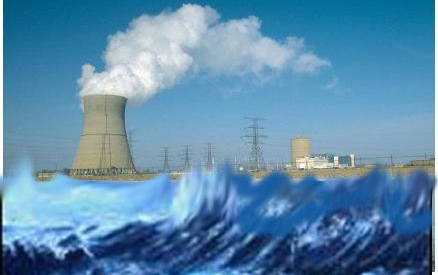
Ex-adviser worries ministers have not taken into account sea level rise and storms in selecting sites
Paul Brown https://www.theguardian.com/news/2023/may/12/weatherwatch-concerns-over-climate-impact-on-uk-nuclear-power-sites
Successive governments since the 1980s have had plans for new generations of nuclear power stations sited around the coasts of the United Kingdom. Although the main reason for building them, according to politicians, is to provide a low-carbon form of electricity to combat the climate crisis, no thought seems to have gone into what the climate crisis might do to the nuclear power stations.
Prof Andy Blowers, a former government adviser on nuclear waste, points out in the Town and Country Planning Association Journal that the eight sites identified in 2011 as suitable for new stations are the same as those identified half a century earlier, on which the first generation of nuclear power stations were built.
The reason the sites were originally chosen was their remoteness, for safety, and their proximity to the sea, for cooling purposes. The latest reasoning is that they would have a better chance of public acceptance because two generations of local people have worked in the industry. The new installations are planned to operate for 60 years and will need another century after closure to cool sufficiently to remove the waste.
Blowers, an opponent of the government plans, worries that ministers seem to have taken no account of sea level rise, intense storms and the prospect of flooding at these sites.
Campaigners against UK nuclear waste dump plan claim victory in local elections
Nuclear storage dump campaigners claim victory in local elections
Call for government to honour wishes
By Daniel Jaines Local Democracy Reporter, The Lincolnite, 11 May 23
Anti-nuclear campaigners have claimed victory in Theddlethorpe after last week’s district and parish council elections.
Opposition councillors, including independent Trais Hesketh, gained a majority of seats with a high voter turnout.
The campaign’s success saw voters “overwhelmingly reject” Nuclear Waste Service’s proposal to build a Geological Disposal Facility beneath the former Conoco gas terminal.
Prior to the election, anti-dump candidates were elected unopposed for eight of the ten available seats on Theddlethorpe Parish Council.
The Guardians of the East Coast campaigners have also claimed support from neighbouring towns such as Mablethorpe, Sutton on Sea, and Trusthorpe.
Ken Smith, chairperson for GOTEC, praised the residents for protesting through the ballot box.
“We now call upon Lincolnshire County Council and East Linsey District Council to honour the people’s decision by withdrawing from the so-called community partnership,” he said.
The Nuclear Free Local Authorities group has also backed the campaigners. Councillor David Blackburn said, “When it comes to a GDF, Mablethorpe, Theddlethorpe, and Sutton on Sea do not represent the ‘willing community’ that the government and nuclear industry say they are looking for to host the dump – instead voters there have clearly said ‘No’.”
………….An NWS spokesperson stated that the GDF would only be built where there was the consent of a willing community.
………………………………………………….. Concerns raised around seismic blasting
There have recently been concerns over the impact of seismic blasting in other areas of the UK as part of exploratory works carried out by NWS ahead of geophysical survey works.
The Lakes Against Nuclear Dump/Radiation Free Lakeland groups fear marine deaths in the Irish Sea and Allerdale’s Solway Firth area as part of Copeland exploration were a result of the seismic tests and have called for them to halt while investigations take place……… https://thelincolnite.co.uk/2023/05/nuclear-storage-dump-campaigners-claim-victory-in-local-elections
Helion and Microsoft Lead World Down Nuclear Fusion Rabbit Hole
manufacturing the lasers used at Livermore and creating other inputs to set up the fusion process require much more energy than is accounted for in the final equation.
there’s so much money in the system, and so much desire to have this technological solution, people are very excited — and totally ignoring the fact that there is no result that has any energy output to it.”
Gizmodo, Molly Taft, May 12, 2023
Are we closer to the “Holy Grail” of clean energy? Silicon Valley wants you to believe.
This week, nuclear fusion startup Helion announced that it had inked a first-of-its-kind deal with Microsoft to provide 50 megawatts of power from a yet-to-be built power plant, all within the next five years. Unlike nuclear fission, the process that powers all the nuclear power plants existing today, nuclear fusion could create potentially unlimited energy. It’s a dream that scientists and engineers have been chasing for decades, with little luck.
The announcement from Helion and Microsoft is historic — and raises a lot of thorny questions about fusion, the role of tech in promoting new energy sources, and whether all this talk about fusion is even doing any good for the planet.
What is nuclear fusion, and why has it been so difficult to achieve?
Nuclear fusion is, simply put, the same process that powers the Sun. The Sun turns matter into energy through the enormous pressures and high temperatures at its core.
“If you smash atoms together hard enough and in a hot enough and dense enough environment, you can get essentially free energy,” said Charles Seife, a journalism professor at NYU’s Arthur L. Carter Journalism Institute and the author of Sun in a Bottle: The Strange History of Fusion and the Science of Wishful Thinking. “It’s enormous amounts of energy from very little fuel,” he told Earther.
Physicists have been chasing the dream of replicating the fusion process since the 1940s, when research into building nuclear reactors began. It quickly became clear that the problem was not replicating fusion itself but rather creating conditions in which the process produces more energy than it takes in. Fusion needs an enormous amount of energy, and almost all of the demonstrations of fusion scientists have accomplished thus far have not been able to reach the point where the energy output is greater than the input.
Seife said that the Livermore announcement is significant but pointed out that manufacturing the lasers used at Livermore and creating other inputs to set up the fusion process require much more energy than is accounted for in the final equation. He’s less impressed by the numerous nuclear fusion startups that have cropped up in Silicon Valley and elsewhere in recent years.
“I think there’s been something of a hype cycle” around fusion recently, he said. “There’s been a lot of venture capital flowing, and people have gotten better and better at leveraging dumb money into hype. You’ve got a lot of startups blooming everywhere that are replicating stuff that we were able to do in the 1960s in small labs, and putting their own spin on it. Because there’s so much money in the system, and so much desire to have this technological solution, people are very excited — and totally ignoring the fact that there is no result that has any energy output to it.”
What is Helion, and what is it promising?
Speaking of startups: enter Helion. Helion was founded in 2013 and was helped along by an infusion of cash from startup accelerator Y Combinator in 2014. That year, its CEO claimed that Helion could get a fusion reactor up and running in three years; two years ago, he said that the company would be able to generate fusion power and “go after commercially installed power generation” by 2024.
Despite the repeated misses on the timeline, Helion broke ground on its first reactor site in 2021, thanks in part to a $US375 million investment from Silicon Valley entrepreneur Sam Altman. It has now become the first fusion company to ink an actual power purchasing agreement for its services, and says that it will start supplying power to Microsoft in 2028 — more than 10 years after it initially said its reactor would be built.
Earther reached out to Helion to ask about its confidence in the timeline given its past misses. The recent results of its sixth prototype of a fusion reactor, a spokesperson wrote in an email, “give us great confidence that our timeline is realistic and that we can build the first fusion power plant by 2028.”
Can they actually do it?
Despite the company’s cheery outlook, there’s a lot of scepticism from experts around the Helion and Microsoft announcement, particularly the truncated timeline — including from Seife, who nevertheless says that he understands the hype.
“It’s so beautiful on paper,” Seife said. “That’s the appeal of it.”
Beyond Helion’s ability to perfect a process in five years that decades of research hasn’t yet gotten us to, there’s also a marked difference between advancing the science of fusion itself — which would alone be an incredible feat — and harnessing fusion for energy. A lot of the funding behind nuclear fusion in recent years in the U.S. has focused on achieving ignition, without an additional focus on creating usable energy from fusion; it’s a whole separate ballgame to actually put energy on the grid with the process. (Building a power plant alone is already a big infrastructure project that can take a couple years at best.)
“The classic joke is, ok, if you can produce energy, make me a cup of tea,” Seife said. “Once you make me a cup of tea, I will consider paying you money to do something, but first, make me a goddamn cup of tea.”
Is banking on fusion good for the planet?
A spokesperson for Helion told Earther in an email that the details of its power purchasing agreement with Microsoft won’t be made public. “That said, this is a real PPA, with commitments and obligations as well as penalties for failing to meet them,” the spokesperson said.
There are many questions left unanswered — has Microsoft paid Helion any money up-front? What are those commitments, obligations, and penalties, specifically? And, perhaps most importantly from a climate perspective, how much is Microsoft banking on this carbon-free fusion power?
………………………….. we don’t have much time to make the big changes we need. Creating plans that rely on technologies that haven’t been fully tested — and listening to Silicon Valley technocrats who keep making big promises and aren’t held to account when they don’t deliver — wastes valuable time, energy, and money that we could be spending on the clean energy technologies that we have today or are much nearer to deployment…… https://www.gizmodo.com.au/2023/05/helion-and-microsoft-lead-world-down-nuclear-fusion-rabbit-hole/
The Quiet Warrior: Russell Jim’s Struggle Against Nuclear Colonialism
CounterPunch, MAY 12, 2023, BY JOSHUA FRANK
The following is an excerpt from the award-winning Atomic Days: The Untold Story of the Most Toxic Place in America (Haymarket Books, 2022).
He was the catalyst in my belief that Indian tribes should be treated as full, equal participants in the process.
— James Asselstine
There are not a lot of heroes out here. Few in recent memory have risen to the daunting challenge, immersing themselves in Hanford’s scientific complexities and its historic and cultural implications. If there are any champions of the cause, Russell Jim (Kii’ahł) was certainly one of them. The “Quiet Warrior,” Jim was a lifelong advocate for the Yakama Nation. The “conscience of the cleanup,” Jim was considered by many to be the spiritual leader of the Hanford resistance. Jim served as the head of the Confederated Tribes and Bands of the Yakama Indian Nation’s Environmental Restoration and Waste Management Program (ERWM), a position he essentially created. In 2018, Jim passed away after battling heart trouble and pneumonia after a long bout of cancer, which he believed was a direct result of the time he spent in and around Hanford’s radioactive haze.
“I think he’s been a major player in the Hanford cleanup and he’s been one of the sharpest critics of the process and a very constructive one,” said John Bassett, president of Heritage University, when Jim was awarded an honorary doctorate in 2017.
By all accounts, Jim had an unwavering moral compass and was the rare advocate who possessed the ability to peer through the layers of Hanford’s bureaucratic stratum. He was able to envision its future while never losing sight of the past and the gainful lives that the region provided his people over many centuries. The Yakama Nation, in defiance of their forced relocation, refused compensation from the federal government. They have never stopped fighting back against the settler colonialism that has destroyed their Native lands…………………………………………………………………………
For those keeping tabs on Hanford throughout the 1980s, like the Yakama, the situation was ominous. By 1985, four decades after Hanford began producing plutonium, not a single independent study looked at the cumulative damage the site had unleashed on nearby communities or Native tribes. DOE officials blew off calls for such an inquiry and contended that it would be unworthy of the department’s time. They argued that radioactivity was all but nonexistent outside of Hanford’s boundaries. Citizen activists noted an uptick in certain cancers in their communities and believed a longitudinal study on the human population was the only way to get a handle on Hanford’s long-term impacts………………………………
Terry R. Strong, who served as head of the Radiation Control Section of the Washington Department of Social and Health Services in 1985, strongly disagreed with the DOE’s lack of monitoring and openly criticized the state of Washington for allocating a meager $87,000 a year to keep an eye on Hanford’s environmental impact. The threat was so grave, Strong believed, that the state should have been spending at least $2.5 million. Others, including British physician Dr. Alice M. Stewart, who helped author a study of Hanford workers during the early 1980s, argued the government was also far too lenient with its radiation safety levels.
The study found a connection between low radiation doses and cancer deaths—particularly multiple myeloma—among workers. Hanford employees, the study reported, experienced at least a 5 percent higher risk of developing cancer than the general population. “If they stick to present safety levels,” warned Dr. Stewart, “they will have more trouble than they think they are going to have.”
A Challenging Adversary
Russell Jim knew there was a major problem at Hanford and the government was planning to make it worse. By the late 1970s, Hanford and Yucca Mountain were the two prime contenders to become depots for spent nuclear fuel. While the Western Shoshone stood their ground and tried to fight the use of Yucca as a repository, they ultimately lost. Jim, representing Yakama Nation, took the lead on keeping the stuff out of Hanford. The waste was to sit in man-made tombs for the next ten thousand years. Flabbergasted at the thought of such an idiotic undertaking, Jim took his fight to the United States Senate. Testifying before a Senate subcommittee on nuclear regulation in 1980, Jim made an impassioned plea to the senators about his peoples’ connection to the land, hoping they’d consider viewing the Hanford issue from his point of view: “There is something you need to understand that is unique between my people and yours. Yakama Indian people do not get most of their food supply from the local A&P or Safeway store,” said Jim. ………….
Jim not only intimately understood the science behind the nuclear mess at Hanford, he also was well-versed in the laws and the rights of his people. The time he spent in Washington speaking at various hearings and meeting personally with numerous Senators and staffers was beginning to pay off. When the Nuclear Waste Policy Act of 1982 was passed, it included specific language that recognized Indian sovereignty. It was powerful language. As a result of Jim’s efforts, tribes like the Yakama, along with states, could veto their lands from becoming nuclear waste depositories. And it would take a majority of both houses of Congress to overturn such vetoes……………………
Jim’s activism during this time forced the federal government to drop their insidious idea of using Hanford as a nuclear dumping zone. He had won. His people had won, and so had the environment that had sustained them for generations. While others had joined the cause, without Jim’s tenacious work, Native voices would have been ignored, as many senators admitted they believed the states would speak up in Natives’ interest. Jim, of course, straightened them out, making it clear they were more than capable of speaking for themselves………………
Jim’s activism during this time forced the federal government to drop their insidious idea of using Hanford as a nuclear dumping zone. He had won. His people had won, and so had the environment that had sustained them for generations. While others had joined the cause, without Jim’s tenacious work, Native voices would have been ignored, as many senators admitted they believed the states would speak up in Natives’ interest. Jim, of course, straightened them out, making it clear they were more than capable of speaking for themselves……
………………….. Abnormally high incidence[s] of thyroid tumors and cancers have been observed in populations living downwind from Hanford,” reported Dr. Helen Caldicott, a scientist and anti-nuclear activist. “Strontium-90, Cesium-137, and Plutonium-239 have been [atmospherically] released in large quantities, as was, between 1952 and 1967, Ruthenium-106. People in adjacent neighborhoods were kept uninformed about these releases—before, during, and after—and none were warned that they were at risk for subsequent development of cancer.”
Jim knew the toll on the Yakama was great, not only to cultural heritage, but to their health. No big decision was made at Hanford without input from Jim, and while it didn’t always go his way, he never backed down. He was prescient and brave. He was able to articulate the lunacy of the Hanford project and the government’s continued ignorance and outright deception. His quest for information and knowledge about what was actually taking place at Hanford forced an immeasurable amount of transparency, which remains all too important if the DOE and its contractors are to ever be held accountable. Up until his death in April 2018 at the age of eighty-two, Jim was working hard to fight the federal government’s effort to declassify Hanford’s nuclear waste, which would allow the radioactive leftovers to be more freely transported and dumped, with obviously grave implications………………………………………………….. https://www.counterpunch.org/2023/05/12/the-quiet-warrior-russell-jims-struggle-against-nuclear-colonialism/
Putin Still Selling U.S. Nearly $1 Billion in Nuclear Fuel
NewsWeek, BY ANNA SKINNER ON 5/11/23
The United States has done a thorough job of sanctioning Russia, but it still relies on the nation for one key resource.
The U.S. and other Western nations were quick to sanction Russia after Russian President Vladimir Putin ordered an invasion of Ukraine in February 2022. Western allies joined forces in sanctioning resources like Russian oil and gas to deprive the Kremlin of financial gain amid funneling money into its war against Ukraine. International companies located in Russia also were quick to leave, further damaging the Russian economy, but Russia still maintains a firm grasp on a horde of something that many other countries want: nuclear fuel.
Nuclear energy, which generates power through a process of splitting uranium atoms, has evaded sanctions more than a year into the war. Enriching uranium is a highly specialized process that can only be done in certain countries, such as Russia. Russia has some of the world’s largest uranium supplies, and it also excels in the necessary process of converting it to enriched uranium, which then can be used as nuclear fuel. Commercial plants converting uranium operate in Russia, Canada, China and France, with Russia having the most infrastructure needed for the conversion……………..
Because of this, Rosatom State Nuclear Energy Corporation—Russia’s collection of nuclear suppliers—provides a quarter of the U.S.’s nuclear fuel, and the United States continues to pay for the resource, spending a collective $1 billion last year, according to a report by the Wall Street Journal.
………………. In March, the U.S.’s first nuclear reactor in seven years started nuclear reactions in Georgia. CNBC reported that including the new reactor, there are 93 reactors throughout the United States providing a fifth of the nation’s energy. A quarter of the nuclear resources needed to power that energy is sourced from Rosatom.
U.S. companies are paying steeply for the resources needed to power its reactors, which means it is funding both Russia and Ukraine during the war….. https://www.newsweek.com/putin-selling-us-nearly-billion-dollars-nuclear-fuel-1799788
Germany’s Nuclear Energy Phase-Out, Explained

NIRS, May 8, 2023
On April 15, 2023 utilities in Germany shut down the country’s three
last remaining nuclear power plants. These closures mark the successful
planned phase-out of German nuclear energy from the nation’s grid. What does this mean for Germany? What lessons should the U.S. take away from the
German energy transition?
Germany’s Energiewende (“energytransition”) is an overarching policy commitment to achieve a low-carbon, nuclear-free economy and transition to renewable energy. While the recently completed phase-out of nuclear power is a major milestone for Germany’s energy transition, it was by no means a perfect process nor is the current
energy system in Germany a perfect example to follow.
But, Germany’s transition shows that an energy policy grounded in environmental values works – and the earlier climate policy is implemented, the sooner the
climate policy goals can be realized. Above all, the German energy
transition shows the tremendous power of active citizenry, organized social
movements, and activism to transform policy and successfully demand change.
more https://www.nirs.org/germanys-nuclear-energy-phase-out-explained/
Nuclear Free Local Authorities issue appeal to King over Lincolnshire Nuke Dump

Save our sceptred isle: NFLAs issue appeal to King over Lincolnshire Nuke Dump. https://www.nuclearpolicy.info/news/save-our-sceptred-isle-nflas-issue-appeal-to-king-over-lincolnshire-nuke-dump/ 11 May 23
Just days after the Coronation, the English Nuclear Free Local Authorities (NFLAs) have written to the nation’s new Sovereign to ask His Majesty King Charles III to intercede over the plan to locate a nuclear waste dump in East Lincolnshire right next to the first Royal nature reserve.
The East Lincolnshire coast has been selected as the first of the ‘King’s Series of National Nature Reserves’ to mark the commencement of His Majesty’s Reign. A formal announcement by Natural England is expected in the summer.
The ‘Lincolnshire Coronation Coast Nature Reserve’ will cover some 21 square miles, centred upon existing protected areas at Theddlethorpe and Saltfleetby comprising mud flats, salt- and freshwater marshes and sand dunes, which support a diverse variety of wintering and breeding birds, natter jack toads, insects, and plants. The establishment of the reserve would enhance the area’s existing offer to visitors, many of whom flock to adjoining Mablethorpe to enjoy the beautiful Blue Flag award winning beaches.
So it was with regret that Councillor David Blackburn, Chair of the English Forum of the NFLAs had to sound a note of caution in his letter to His Majesty that Nuclear Waste Services has plans to locate a Geological Disposal Facility, a nuclear waste dump, right next to the reserve.
This would be the destination for Britain’s high-level, heat emitting radioactive waste, including its huge stockpile of plutonium. This waste has either already been generated through the UK’s military and civil nuclear programmes over the last 70 years or will be generated in the future through their continuance.
The GDF would comprise a surface facility approximately 1 square KM, which would most likely be located on the site of the former Conoco gas terminal in Theddlethorpe. This would be the railhead receiving regular shipments of nuclear waste. This waste would be transported below ground and out through tunnels beneath the North Sea. As nuclear waste is transported by rail, and there is no current infrastructure in place, there would be a necessity to construct a new rail line to serve the location.
The process of selecting a site for this facility could take between 15 and 20 years after which the construction and operation of such a facility would last more than 100 years.
In his letter, Councillor Blackburn contends that the project is ‘of such an immense size and in (such) a wholly inappropriate location’ that it would be ‘massively disruptive and harmful’ to the flora and fauna of the local environment, including that of the Royal Reserve, and to local people, as well as ‘massively ruinous’ to the local tourist and agrarian economy. Councillor Blackburn ends by appealing to the King on behalf of ‘His Majesty’s many loyal and anxious subjects in the affected area to intercede with relevant Ministers of the Crown to end this folly ‘.
Commenting Cllr Blackburn said: “The creation of this Royal Reserve is a wonderful idea and wholly in keeping with His Majesty the King’s known love for the natural environment. I can only hope that by drawing the Sovereign’s attention to the government’s lunatic plan to locate a nuclear waste dump next to the reserve that the King might be able to intervene to end the threat of it.”
Pentagon wants authority to start work on new technologies without Congressional approval
Jared Serbu @jserbuWFED, May 8, 2023
Over the last several years, Congress has passed several pieces of legislation meant to speed up the Defense Department’s acquisition system. Now, DoD officials have an idea of their own: they’re asking for new authorities that would let the military services begin early work on critical new programs without lawmakers’ explicit permission, arguing the current approval process takes too long and risks putting the U.S. military at a technological disadvantage.
………………………………….. If Congress agrees to the proposal as part of next year’s Defense authorization bill, DoD would be able to spend up to $300 million on new programs without getting Congressional approval: lawmakers would only be notified about a new start after a decision has been made………………………. https://federalnewsnetwork.com/defense-news/2023/05/pentagon-wants-authority-to-start-work-on-new-technologies-without-congressional-approval/
The terrible toll of A-bomb tests — Beyond Nuclear
This week on Nuclear Hotseat, host Libbe HaLevy looks into the terrible toll taken on the people of French Polynesia from the French atomic tests there. She interviewed Dennis Riches who, after the meltdowns at Fukushima-Daiichi in 2011 began writing a blog about nuclear issues. In 2018, several of the blog posts were published as a…
The terrible toll of A-bomb tests — Beyond Nuclear
French nuclear group Orano (previously Areva) evacuates foreign workers to Niger capital following security threat
NIAMEY, May 12 (Reuters) – French nuclear group Orano has evacuated 18 expatriate workers from a uranium mining site in Arlit, northern Niger, to the capital Niamey on Friday, following a security threat, a spokesperson for the company said in statement to Reuters.
Orano ceased exploiting uranium at the mine in 2021 due to the depletion of reserves, but plans to operate in the country to retrain workers and remediate the mining site for at least a decade.
The spokesperson did not give details about the security threat but said it occurred in a village halfway between the border with Mali and Arlit, which lies some 800 km (500 miles) to the northeast of the capital.
1 This Month
Chernobyl: The Lost Tapes – A good documentary on Chernobyl on SBS available On Demand for the next 3 weeks– https://www.sbs.com.au/ondemand/tv-program/chernobyl-the-lost-tapes/2352741955560

of the week–London Campaign for Nuclear Disarmament

Tell the Ukrainian Government to Drop Prosecution of Peace Activist Yurii Sheliazhenko
To see nuclear-related stories in greater depth and intensity – go to https://nuclearinformation.wordpress.com
-
Archives
- April 2026 (139)
- March 2026 (251)
- February 2026 (268)
- January 2026 (308)
- December 2025 (358)
- November 2025 (359)
- October 2025 (376)
- September 2025 (257)
- August 2025 (319)
- July 2025 (230)
- June 2025 (348)
- May 2025 (261)
-
Categories
- 1
- 1 NUCLEAR ISSUES
- business and costs
- climate change
- culture and arts
- ENERGY
- environment
- health
- history
- indigenous issues
- Legal
- marketing of nuclear
- media
- opposition to nuclear
- PERSONAL STORIES
- politics
- politics international
- Religion and ethics
- safety
- secrets,lies and civil liberties
- spinbuster
- technology
- Uranium
- wastes
- weapons and war
- Women
- 2 WORLD
- ACTION
- AFRICA
- Atrocities
- AUSTRALIA
- Christina's notes
- Christina's themes
- culture and arts
- Events
- Fuk 2022
- Fuk 2023
- Fukushima 2017
- Fukushima 2018
- fukushima 2019
- Fukushima 2020
- Fukushima 2021
- general
- global warming
- Humour (God we need it)
- Nuclear
- RARE EARTHS
- Reference
- resources – print
- Resources -audiovicual
- Weekly Newsletter
- World
- World Nuclear
- YouTube
-
RSS
Entries RSS
Comments RSS
 nuclear-news