The US Has No Plans to Give Up Nuclear Weapons. The Public Needs to Change That.

While the U.S. nuclear enterprise has widespread support by both Democrat and Republican members of Congress, one of the boldest shows of opposition to nuclear weapons was voiced by Michigan congresswoman Rep. Rashida Tlaib, who has expressed her support for the Treaty for the Prohibition of Nuclear Weapons (TPNW). Additional support for the prohibition of TPNW (also called the “ban treaty”) came from Massachusetts Rep. James McGovern and Oregon Rep. Earl Blumenauer, who introduced a resolution in 2019 calling for “the American people to work towards reducing and ultimately eliminating nuclear weapons.” Furthermore, in 2022, more than 200 U.S. mayors collectively called for the adoption of a timebound plan for the total elimination of nuclear weapons.

A first step toward anti-nuclear advocacy is becoming aware of the current sprawling state of the U.S. nuclear arsenal.
By Jon Letman , TRUTHOUT April 24, 2023
hen Russian President Vladimir Putin announced his intention to deploy short-range nuclear missiles to Belarus in March, he pointed to U.S. nuclear weapons housed in five NATO nations as justification. Putin said the construction of a “special repository” for an Iskander missile complex in Belarus would not violate obligations under the Nuclear Nonproliferation Treaty.
But by accepting the deployment of Russian nuclear weapons, Belarus President Alexander Lukashenko would be reversing more than three decades free of nuclear weapons after it pledged to abandon them in 1991. Like Ukraine and Kazakhstan, Belarus gave up Soviet nuclear weapons shortly after the USSR broke apart.
In a statement, Daniel Högsta, acting executive director of the International Campaign to Abolish Nuclear Weapons (ICAN) said, “As long as Putin has nuclear weapons, Europe cannot be safe.” He also warned that decades of “nuclear sharing” with NATO nations “helps give Putin cover,” posing a grave risk far beyond Europe.
ICAN has played a central role in advocating for the UN Treaty on the Prohibition of Nuclear Weapons which entered into force in 2021. Although 68 countries have ratified the treaty which prohibits all aspects of developing, possessing or threatening to use nuclear weapons, none of the nine nuclear-armed nations — Russia, the United States, China, France, the United Kingdom, Pakistan, India, Israel and North Korea — recognizes the treaty.
According to the Federation of American Scientists’ Nuclear Information Project, the U.S. houses an estimated 100 B61 gravity bombs on air bases in five NATO nations (Belgium, Germany, Italy, the Netherlands and Turkey). Usually described as “tactical” or nonstrategic nuclear weapons, the new B61-12, which will replace older versions of the B61, has a selectable yield (energy released in a nuclear explosion) that can be adjusted from 0.3 to 50 kilotons. The atomic bombs which destroyed Hiroshima and Nagasaki were 15 and 21 kilotons respectively.
Daryl Kimball, executive director of the Arms Control Association, said that describing a nuclear weapon as “tactical” may lead people to wrongly assume that such weapons are necessarily “smaller,” less destructive, and would be confined to a battlefield or limited geographic area.
That, he said, is a dangerous assumption. ……………………………………………………
According to research by the Federation of American Scientists’ Nuclear Information Project, the United States maintains an estimated total inventory of 5,244 nuclear weapons, including reserve warheads and retired warheads awaiting dismantlement. Currently, 3,708 nuclear warheads make up the military stockpile (those weapons which could potentially be used in war).
Within the stockpile, the U.S. has 1,770 deployed nuclear warheads that make up the nuclear triad of air, land and sea-based bombs…………………………………….
Under the Sea
Widely considered to be least vulnerable to attack are long-range submarine-launched ballistic missiles (SLBM). The United States has two Strategic Weapons Facilities, one for the Pacific beside Naval Base Kitsap in Bangor, Washington, 20 miles west of Seattle, and a second facility for the Atlantic at Naval Submarine Base Kings Bay, Georgia…………………………………………………………………………
The U.S.’s Nuclear Sponge
The third leg of the nuclear triad is its intercontinental ballistic missiles (ICBMs), which are housed in fortified underground silos in five states (Montana, Colorado, Nebraska, Wyoming and North Dakota). The ICBM force is made up of aging Minuteman III missiles which are slated to be replaced with a new $96 billion system called Sentinel (formerly called Ground Based Strategic Deterrent).
Plagued by scheduling delays and cost overruns, there is growing public support for phasing out ICBMs. Despite this, the bipartisan congressional ICBM Coalition’s support is all but unshakable. But the idea of creating what has been called a “nuclear sponge” (referring to the idea that ICBM silos would attract enemy missiles and, like a sponge, soak up an incoming attack), raises serious questions about why rural communities only began receiving greater government support for improved communications and transportation infrastructure after they started hosting nuclear weapons. “I think it’s important to interrogate that and ask why the needs of the missiles have so often come before the needs of the people who actually live there,” Korda said.
In addition to the SLBM, ICBMs and bombers, Korda and his colleague Hans M. Kristensen have documented additional nuclear warheads (many awaiting dismantlement) at a storage complex in New Mexico and, Korda noted, California has “very important nuclear weapons infrastructure” which could potentially host a small number of nuclear weapons for design purposes.
Finally, there is the Pantex Plant near Amarillo, Texas, which describes itself as “the nation’s primary assembly, disassembly, retrofit, and life-extension center for nuclear weapons.” The dismantlement of retired nuclear warheads is ongoing but, Korda said, the pace has slowed in recent years……………………………………….
In recent years, arms control treaties such as the Intermediate-Range Nuclear Forces Treaty, the Open Skies Treaty and the Joint Comprehensive Plan of Action (“Iran Nuclear Deal”) have been abandoned by the U.S., Russia, or both. The last remaining nuclear arms control treaty between the U.S. and Russia, the New Strategic Arms Reduction Treaty (New START), was extended for five years just two days before it expired in 2021 but in February, Russia announced it was suspending participation, leaving the last U.S.-Russia arms control treaty hanging by a thread.
With the end of inspections, data exchanges, and much-needed communication between Washington and Moscow, as well as Beijing, Kimball worries mistrust can lead to the assumption of worst-case scenarios. He says there is a great need for increased public awareness and engagement on nuclear issues.
While the U.S. nuclear enterprise has widespread support by both Democrat and Republican members of Congress, one of the boldest shows of opposition to nuclear weapons was voiced by Michigan congresswoman Rep. Rashida Tlaib, who has expressed her support for the Treaty for the Prohibition of Nuclear Weapons (TPNW). Additional support for the prohibition of TPNW (also called the “ban treaty”) came from Massachusetts Rep. James McGovern and Oregon Rep. Earl Blumenauer, who introduced a resolution in 2019 calling for “the American people to work towards reducing and ultimately eliminating nuclear weapons.” Furthermore, in 2022, more than 200 U.S. mayors collectively called for the adoption of a timebound plan for the total elimination of nuclear weapons.
“This is an existential threat that demands engagement even with our worst adversaries and even with a bona fide war criminal like Vladimir Putin because our survival ultimately depends on it.”
Without dialogue and diplomatic engagement, the result, Kimball warned, could be an unconstrained three-way arms race between Russia, China and the U.S. “If we didn’t have enough problems already,” Kimball said, “it still can get worse.”
The public has a vital role in all this, Kimball said. “Over the long course of the nuclear age, concerned U.S. citizens have stood up and demanded that their leaders take action to reduce the number and the risks posed by nuclear weapons by engaging in arms control and disarmament diplomacy with our adversaries. That effort has to be renewed again.” https://truthout.org/articles/the-us-has-no-plans-to-give-up-nuclear-weapons-the-public-needs-to-change-that/
—
The Human Dimension to Kazakhstan’s Plutonium Mountain

April 24, 2023, Sig Hecker https://nonproliferation.org/the-human-dimension-to-kazakhstans-plutonium-mountain/
The following is an excerpt from the Stanley Center for Peace and Security.
As we drove deeper into the Semipalatinsk Nuclear Test Site, we found kilometer-long trenches that were clearly the work of professional thieves using industrial earth-moving equipment, rather than hand-dug trenches made by nomad copper-cable-searching amateurs on camelback. Our Kazakh hosts said they could do nothing to stop these operations. In fact, they weren’t sure they had a legal right to stop them from “prospecting” on the site.
It was the sight of these trenches that urged me to convince the three governments that they must cooperate to prevent the theft of nuclear materials and equipment left behind when the Soviets exited the test site in a hurry as their country collapsed.
When the Soviet Union collapsed in December 1991, the most urgent threat to the rest of the world was no longer the immense nuclear arsenal in the hands of the Russian government but rather the possibility of its nuclear assets—weapons, materials, facilities, and experts—getting out of the hands of the government. As director of the Los Alamos National Laboratory, I helped to initiate the US–Russia lab-to-lab nuclear cooperative program in 1992 to mitigate these nuclear threats.
The trilateral US–Russia–Kazakhstan cooperation began in 1999 to secure fissile materials that were left behind by the Soviets at the Semipalatinsk Nuclear Test Site, which was now in the newly independent country of Kazakhstan. The project was kept in confidence until the presidents of the three countries announced it at the Seoul Nuclear Security Summit in 2012
In Doomed to Cooperate, individuals from the three countries recount their cooperative efforts at Semipalatinsk. Unlike the US–Kazakhstan projects initiated earlier on nuclear test tunnel closures, identifying experiments that left weapons-usable fissile materials (plutonium and highly enriched uranium) at the huge test site—whether in the field, in tunnels, or in containment vessels—required trilateral cooperation. The Russian scientists who conducted these experiments were the only ones who knew what was done and where. It required American nuclear scientists who conducted similar tests in the United States to assess how great a proliferation danger the fissile materials in their current state may constitute. And it required Kazakh scientists and engineers to take measures to remediate the dangers. The project also required the political support of all three countries and the financial support of the American government because it was the only one at the time with the financial means. That support came from the US Cooperative Threat Reduction (or Nunn-Lugar) program.
Continue reading at the Stanley Center for Peace and Security.
Nuclear liability issues not yet resolved for Jaitapur project: French company EDF
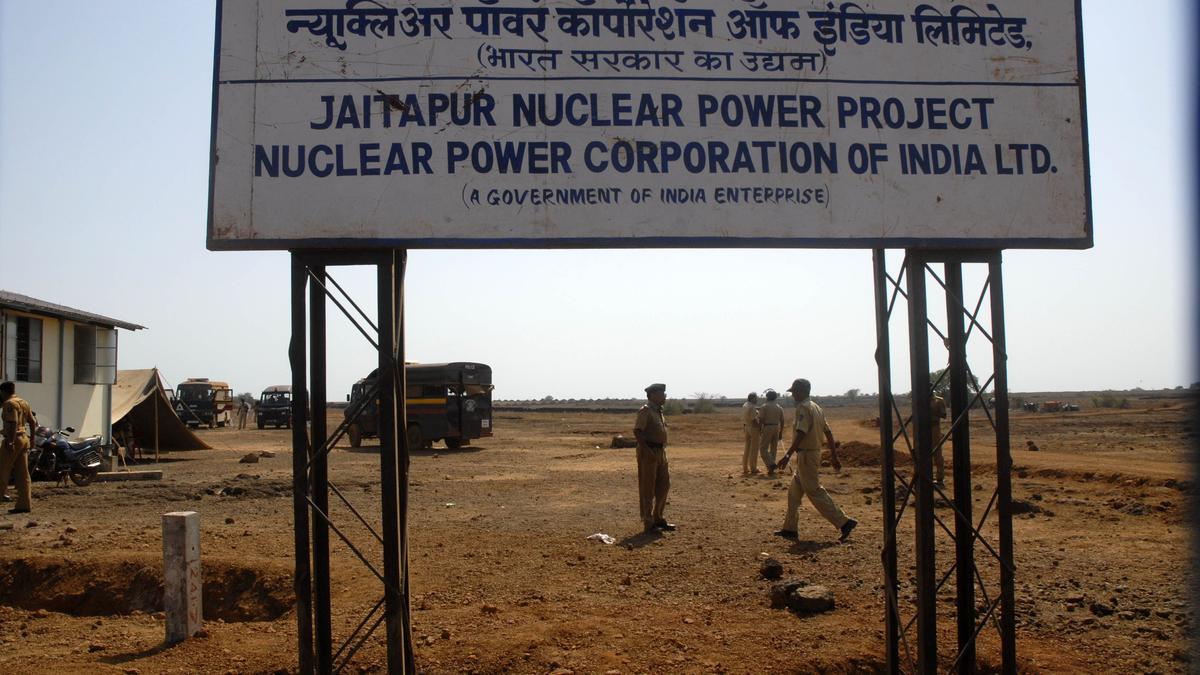
Delays despite assurances by Minister Jitendra Singh that all technical, commercial, legal issues would be sorted by “early 2023”
The Hindu, SUHASINI HAIDAR April 24, 2023
Two years after the French energy company Electricite de France (EDF) submitted its techno-commercial offer for the construction of six nuclear power reactors in Maharashtra’s Jaitapur, talks between Indian and French officials over several issues, including liability, have not resulted in any breakthrough yet.
According to sources in Delhi and Paris, the talks over the high cost of power per unit has also become a major issue in the conclusion of the agreement for the 9,900 MW project, which is the world’s biggest nuclear power generation site under consideration at present.
“The topic [of liability] has been discussed between the French and Indian governments and my understanding is that it is progressing towards convergence. It is a key topic for France and the EDF, and so this topic would have to be solved before any contract can be signed,” an EDF official said in response to a question from The Hindu, as part of a presentation to a larger group of international journalists invited to Paris.
The statement is significant, as in October 2022, the Minister of Space and Atomic Energy, and Minister of State in the Prime Minister’s Office (MoS PMO), Jitendra Singh, promised an early resolution to all the issues, within months………………..
PM to visit Paris in July……………………
The EDF official, who requested not to be identified, but spoke on behalf of the company, said that the issue, arising from India’s Civil Liability for Nuclear Damage Act that India passed in 2010, remains an item on the “agenda for both countries”. India’s CLND Act, which was brought in addition to the International Convention on Supplementary Compensation (CSC), is considered excessive by foreign companies, which could be liable to pay hundreds of millions of dollars in the event of a nuclear accident. As a result, despite signing civil nuclear deals with a number of countries, including the U.S, France and Japan, the only foreign presence in India is that of Russia in Kudankulam, projects that predate the Law.
A recent report in Al Jazeera also points to the fact that despite planning an insurance pool of ₹1,500 crores ($200 million) in 2015, the government’s ‘India Nuclear Insurance Pool” (INIP) has only been able to collect about half, ₹700 crore-₹800 crore, thus far. Concerns over safety after the 2011 Fukushima nuclear disaster, prompted Germany to switch off its last nuclear power reactor this month.
Another factor will be the time taken by the Jaitapur project, for which the original MoU was signed in 2009 with EDF’s predecessor Areva. In 2016, EDF and NPCIL signed a revised MoU, and in 2018, the heads of both signed an agreement on the “industrial way forward” in the presence of Mr. Modi and Mr. Macron. However, officials said nuclear projects do take time, pointing to EDF’s latest construction of an EPR in Finland, Olkiluoto 3. Its work began in 2005 and was completed after a delay of about 14 years, finally starting regular production on April 16 this year. https://www.thehindu.com/news/national/nuclear-liability-issues-not-yet-resolved-for-jaitapur-project-french-company-edf/article66774668.ece
Russia is deploying nuclear weapons in Belarus. NATO shouldn’t take the bait
By Nikolai N. Sokov Bulletin of the Atomic Scientists
Nikolai N. Sokov, a senior fellow at the Vienna Center for Disarmament and Non-Proliferation, previously worked at the Soviet and Russian Ministry. April 24, 2023
In June 2022, Russian President Vladimir Putin announced a new policy of Russia deploying some of its nuclear weapons in Belarus. The nuclear sharing arrangements between Russia and Belarus represent a fundamental change in Russian nuclear policy and the European security landscape. But as is usual with changes in Russian defense policy, the story developed slowly and has been full of unnecessary intrigue with important information revealed in small portions.
More than nine months after the initial announcement, the Russia-Belarus nuclear sharing is still very much incomplete; further developments may depend on the still uncertain evolution of the ongoing Russian war against Ukraine as well as any future changes in the scope and scale of Western assistance to Ukraine. But despite the many uncertainties, some key implications of Russia’s new policy of nuclear sharing can already be anticipated—especially as regard to its consequences for strategic stability.
Slow developments, false intrigue………………………………………………………………………….
Uncertainties. Unlike NATO’s nuclear sharing, which is built around nearly 100 B-61 gravity bombs, the Russia-Belarus one will involve a mix of gravity bombs and ground-launched missiles……………………………………………………………………………………………………….
The location of the storage site(s) for the nuclear warheads is perhaps the greatest of all uncertainties surrounding the Russia-Belarus nuclear sharing……………………………
Strategic consequences. The impact of Russia’s decision to institute nuclear sharing with Belarus will have wide-ranging consequences.
For the first time since the end of the Cold War, short-range, tactical nuclear weapons have acquired a distinct military mission…………………………………………………………………………..
the Russia-Belarus nuclear sharing—which involves preparation for deployment of nuclear weapons and may eventually entail the actual transfer of Russian nuclear weapons to Belarus—is by far the boldest move by Russia because it comes supported with new capability. Moreover, if the delivery systems and warheads under these arrangements are deployed near the western border of Belarus where they are highly vulnerable, the only conceivable mode for them is to strike first. The number of nuclear weapons involved may be relatively small—perhaps only about one-third of the entire inventory of B-61 bombs—but ready to use
The message is undoubtedly addressed to the West; nuclear use against Ukraine has never even indirectly featured in any Russian statements.
……………………………………………. The seriousness of the new signal does not mean that nuclear use in Europe is an immediate threat. First, it is reserved for extreme circumstances, such as a major defeat of Russia, which would put the regime at risk. Second, it would only result from a relatively lengthy process of escalation. ………………………….
Do not respond in kind. Recent nuclear signaling and actions by Russia are clearly a step on the escalation ladder. ………………………………. The wisdom of a symmetrical, tit-for-tat response to Russia’s escalatory steps is questionable
……………………….. NATO would be better off to continue the current policy and rally international opinion against Russia’s possible nuclear use. As Allies’ defense production continues to ramp up, assistance to Ukraine will become more efficient and consequential. Escalation may be tempting, but it is both unnecessary and potentially dangerous. https://thebulletin.org/2023/04/russia-is-deploying-nuclear-weapons-in-belarus-nato-shouldnt-take-the-bait/
Maintenance impacted at Zaporizhzhia, says IAEA

24 April 2023 https://www.world-nuclear-news.org/Articles/Maintenance-impacted-at-Zaporizhzhia,-says-IAEA
The current situation at the Zaporizhzhia nuclear power plant is having a significant impact on the plant’s maintenance capability, the International Atomic Energy Agency (IAEA) said.
Plant management informed the IAEA experts present at plant that the scope of maintenance performed during outages on all units in 2022 was reduced compared with the planned scope, due to reduced maintenance staff, absence of external contractors who perform a significant part of the work, and a lack of spare parts needed for the maintenance, including critical components.
The Zaporizhzhia plant currently has only about one-quarter of its regular maintenance staff available, the IAEA said. It noted new staff are being hired but it will take some time until they are fully trained. The plant said a substantial list of required spare parts has recently been submitted to Russian state nuclear corporation Rosatom.
“As a result of the significant reduction of staff, the ZNPP currently does not have a systematic maintenance and in-service inspection schedule,” the IAEA said. “Before restarting any of the reactor units, the site is considering obtaining advice from an engineering organisation within Rosatom that will assess the status of the plant and provide recommendations for all structures, systems and components important to safety regarding their maintenance or any necessary replacement before operation. The site considers that this maintenance/replacement work may be undertaken using the services of a centralised Rosenergoatom company that is capable of performing these types of maintenance tasks.”
“This shows again the continuing detrimental impact that the current situation on the site is having on the seven indispensable pillars for ensuring nuclear safety and security, in this case pillars two and five on safety and security systems and equipment and logistical supply chain,” IAEA Director General Rafael Mariano Grossi said.
The IAEA noted that the Zaporizhzhia plant continues to rely on the only remaining functioning 750kV power line for the external electricity it needs for reactors cooling and other essential nuclear safety and security functions. Meanwhile, a back-up 330kV power line that was damaged on 1 March on the other side of the Dnipro River from the Russian-controlled plant remains unrepaired, with Ukraine having said military action is preventing its experts from safely accessing the location situated in territory it controls to repair the line.
Russia reported last month that Rosatom was working to remove damaged equipment from the open switchyard, with the aim of restoring three 330kV lines to the grid system in currently Russian-controlled territory. The IAEA team will access the site to assess the situation.
Four of the six reactors have been in cold shutdown, with two (units 5 and 6) in hot shutdown – which allows them to provide heat to the plant and the nearby town of Energodar where many of the workers live. However, the IAEA said that, with the weather warming, unit 6 has now been transferred to cold shutdown.
France’s struggle to deliver a second nuclear era
An ambitious reactornconstruction programme aimed at reducing carbon emissions is running into the realities of skilled worker shortages.
For 10 years, Gaetan Geoffray
worked as a plasterer and painter, before learning metalwork at a company
that made cranes. Arnaud Dupuy was a policeman. A third colleague at their
factory in the depths of rural Burgundy used to be a baker.
The factory is owned by Framatome, a subsidiary of state-controlled power utility EDF, and the trio are hoping to qualify for one of the most sought-after jobs in
France, as nuclear-grade welders. If all goes well, they’ll one day be
allowed to work on the most intricate features of the steel parts assembled
in the plant, where the all-important 24-metre-long casings protecting the
core of atomic reactors are made.
For now, that goal is at least three to
four years off, so exacting are the demands in a field in which imperfect
finishes can delay a project by months and cost millions, if not billions,
of dollars. For France, the next intake of hires and welding apprentices
can’t come a day too soon.
After years of political dithering over whether
or not to cut its reliance on nuclear power, a hesitation echoed globally
after the 2011 Fukushima nuclear accident in Japan, the country has gone
all-in with Europe’s most ambitious atomic construction project in decades.
In order to stand a chance of turning this vision into reality, the
government estimates it needs to find another 100,000 nuclear specialists
of all guises, from engineers and project supervisors to boilermakers and
electricians, over the coming six years.
Looming large, beyond hurdles with
design approvals and financing for the €52bn programme, is an even more
basic question — whether France, Europe’s main atomic nation, still has
the industrial capacity and people to make the projects happen on a scale
it has not contemplated since the 1970s.
FT 23rd April 2023
https://www.ft.com/content/d23b14ae-2c4e-458c-af8a-22692119f786
Water shortage at Sizewell: the environmental cost
Pete Wilkinson: (From Feb 2022) Building the Sizewell C plant, which
requires vast amounts of fresh water, in an area of water scarcity makes no
sense. The availability of water is something we barely give a thought to:
only ten percent of people consider water shortage to be an environmental
issue, yet without it, it’s curtains. According to the Environment Agency
(EA), England could fail to meet national demand by 2050.
As the driest part of the country, Eastern England has been designated as a
water-stressed area and future pressures include climate change, economic
and housing development. Suffolk is recognised as an area of water
scarcity, facing predictions of a water shortage in the coming years.
East Anglia Bylines (accessed) 23rd April 2023
NATO trains French Foreign Legionaries for war with Russia in the Baltic — Anti-bellum

NATOAllied Maritime CommandApril 18, 2023 French Foreign Legionnaires practice battle tactics in Estonia On April 3-5, soldiers with the 13th Demi-Brigade of the French Foreign Legion, who are assigned to NATO enhanced Forward Presence (eFP) Battlegroup Estonia, conducted an assault drill at the Tapa military training area in Estonia. The exercise aimed to develop soldiers’ […]
NATO trains French Foreign Legionaries for war with Russia in the Baltic — Anti-bellum
Oh Goody – America is going to sell heaps of Holtec’s Small Nuclear Reactors to Ukraine!

“This cooperation agreement will lead to economic development, creation of jobs, establishment of modern manufacturing facilities, training facilities, R&D, and thus help Ukraine emerge as the regional hub for Holtec’s nuclear reactor technology…….”
Mass deployment of Holtec SMRs in Ukraine is part of accord’s aims
WNN 24 April 2023, Up to 20 Holtec SMR-160 plants will be built in Ukraine under a cooperation agreement signed between Holtec International and Ukrainian national nuclear operator Energoatom. The agreement calls for the first plant to begin supplying power by March 2029.
The agreement was signed on 21 April by Energoatom President Petro Kotin in Kiev and Holtec CEO Kris Singh in Camden, New Jersey, USA. The ceremony was also attended by Ukraine’s Minister of Energy Herman Galushchenko and the vice president of Holtec International operations in Ukraine Riaz Avan……………………………………………..
“This cooperation agreement will lead to economic development, creation of jobs, establishment of modern manufacturing facilities, training facilities, R&D, and thus help Ukraine emerge as the regional hub for Holtec’s nuclear reactor technology…….”
………………………………………………………… In June 2019, Holtec, Energoatom and Ukraine’s State Scientific and Technology Centre formally entered into a partnership to advance the SMR-160 for deployment in Ukraine. The partners ratified the creation of a consortium partnership that bound the three companies into a cooperative undertaking to progress the deployment of the SMR-160 small modular reactor in the country. The consortium is a US company registered in Delaware with each of the three parties owning allotted shares. Its technology operation centre will be based in Kiev, Ukraine. https://www.world-nuclear-news.org/Articles/Accord-sees-mass-deployment-of-Holtec-SMRs-in-Ukra
Russia’s political and economic winner – its nuclear exports to Western countries
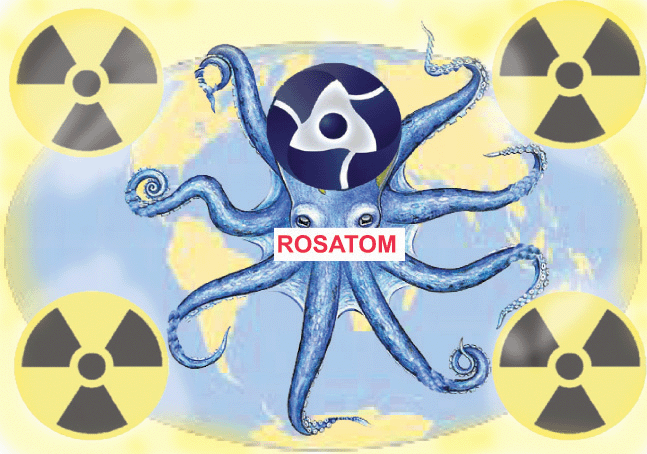
West scrambles as Putin reveals his energy war trump card. Kremlin has
spread its tentacles through the US and Europe – and countries are
struggling to fight back. In an effort to punish Vladimir Putin, western
governments have hit Russia’s energy industry with a barrage of punishing
sanctions since his invasion of Ukraine.
But one sector has conspicuously
escaped their ire so far: nuclear power. Since the conflict erupted,
Russian nuclear exports are actually thought to have increased while those
of coal, oil and gas have been squeezed.
Meanwhile, despite the key role it
has played in Moscow’s takeover of the Zaporizhzhia nuclear power plant
in Enerhodar, eastern Ukraine, state monopoly Rosatom remains untouched by
western sanctions.
The reason, say experts, is the complicated nature of
nuclear supply chains – from the supply of uranium to the construction of
reactors – and the dominant role Russia currently plays in many of them.
Through its global nuclear network, Moscow can exert political and economic
pressure on friends and foes alike, the White House has warned. A new
partnership between the UK, the US, Canada, Japan and France aims to change
this. Together the five countries want to squeeze Russia’s share of
nuclear exports and “ensure Putin, nor anyone like him, can ever think
they can hold the world to ransom over their energy again,” said Grant
Shapps, the Energy Security Secretary. The group aims to become independent
from Moscow and help other countries do the same, the agreement says.
Telegraph 24th April 2023
SpaceX: Should we colonise the solar system?
April 24, 2023 https://onefiniteplanet.org/wp/spacex-should-we-colonise-the-solar-system/
heard an on-air debate about the merits of the program in light of the explosion of the SpaceX starship rocket on April 20th.
Viewpoints were of course varied. They included the “we have this beautiful planet already and it makes no sense to be spending so much to go elsewhere” and very much focused on “colonising” the solar system with the viewpoint that this involves potentially many wealth people leaving Earth. Also discussed with the idea Mars could have had its own civilization in the past, and questions as to who owns space.
The points I feel should be highlighted:
The beautiful planet took 4 billion years before humans could survive on it without a spacesuit, won’t support us for much longer, and will become inadequate after the next big step for humanity.
Yes, we need to expand beyond Earth, and doing so takes many steps, and will take way longer than most people realise. All that we are working towards at this point is the possibility of some small outposts on the Moone, Mars or elsewhere in vast solar system that has no existing place other than Earth that can ever be home to a significant number of humans.
Oh…and yes while there was some “spin” (rapid unscheduled disassembly?), it was stated in advance that expectations beyond getting off the ground were limited, and yes it did “self-destruct” rather than simply just “blow up”.
Presidential candidate Robert F. Kennedy Jr. vows to ‘unwind US empire’
Rt.com 23 Apr 23
Robert F. Kennedy Jr., nephew of JFK, is set to challenge Joe Biden for the Democratic nomination in 2024
US presidential candidate Robert F. Kennedy Jr has pledged to wind down American military interventionism abroad if he is elected to the White House in 2024.
Kennedy, who is the son of Robert F. Kennedy and the nephew of former President John F. Kennedy, confirmed his candidacy for the Democratic nomination at a campaign rally in Boston last week, placing him in competition with current US leader Joe Biden.
Also known for being a prominent anti-vaccine activist, the 69-year-old environmental lawyer has acknowledged that he is not an “ideal” candidate given his often-controversial brand of discourse, but has argued that he is “not one of those people who said I have to be careful because one day I’m going to be in the White House.”
Chief among Kennedy’s campaign proposals, as noted in a six-point plan published on his official website, would be drawing a line through US military interventionism abroad and “start[ing] the process of unwinding [an] empire.”
We will bring the troops home. We will stop racking up unpayable debt to fight one war after another. The military will return to its proper role of defending our country,” the plan stated, adding that “America cannot be an empire abroad and a democracy at home.”
Regarding the Ukraine conflict, Kennedy stated that the US mission is “to end the suffering of the Ukrainian people.” However, he argued that Ukrainians are “victims” not just of Russia, but also of “American geopolitical machinations going back to at least 2014.”
Kennedy, who has never held significant public office, has drawn criticism from health experts – and even members of his own family – amid various outspoken comments throughout his career. In 2005, a prominent science publication issued a stinging rebuke of claims he made in which he appeared to link the development of autism to vaccines.
His wife, the actress Cheryl Hines, condemned Kennedy last year for invoking the name of Anne Frank and the Holocaust while describing US vaccine requirements. He later withdrew the comments…..https://www.rt.com/news/575267-us-kennedy-unwin-empire/
 | |||
| to me | |||
Pentagon to deliver main battle tanks to Ukraine in weeks — Anti-bellum

Polish RadioApril 21, 2023 US to give Abrams tanks to Ukraine within weeks: Pentagon chief American-made Abrams battle tanks will arrive in Germany in the coming weeks for Ukrainian troops to begin training, the US defence secretary said on Friday. Lloyd Austin made the announcement at Ramstein Air Base in Germany…. He spoke to reporters […]
Pentagon to deliver main battle tanks to Ukraine in weeks — Anti-bellum
Renewable Energy Is Charging Ahead.

Renewable energy has seen considerable
growth in recent years, but there is a long way to go to achieve a clean
energy future that averts the worst effects of the climate crisis. The
window is quickly closing on our ability to meet the goal of the 2015 Paris
climate agreement: keeping global temperature rise well below two degrees
Celsius by the end of the century.
The latest report from the
Intergovernmental Panel on Climate Change (IPCC) stressed that the world
needs fast and deep emissions cuts to meet that goal and eventually reach
net zero emissions by 2050. Switching to renewable forms of power
generation, such as solar, wind and hydropower, will be a key component of
that effort. “The target is very ambitious,” says Heymi Bahar, a senior
energy analyst at the International Energy Agency.
And every year that goes
by without major climate action, “we are basically losing the carbon
[budget] that is left, and we need to go faster in a more expansive way. In
that sense, most of the job, according to our models, needs to be done in
the coming seven years,” Bahar says.
Globally, renewables account for
about one third of electricity generation—and that share is rising. In
2022 renewable generation capacity grew by a record 295 gigawatts,
according to the International Renewable Energy Agency (IRENA). Further,
renewables accounted for more than 80 percent of all added power capacity
last year, the agency reported. Last year renewables produced more
electricity than coal-powered plants for the first time in the U.S. Wind
and solar now produce about 14 percent of the country’s electricity, up
from virtually nothing just 25 years ago. The U.S. Energy Information
Administration expects that more than half of electric generation capacity
added to the nation’s grid in 2023 will be from solar energy.
The main reason renewable energy has grown so much in recent years is a dramatic
decline in the expense of generating solar and wind power. The cost of
solar photovoltaic cells has dropped a stunning 90 percent over the past
decade, partly because of ramped-up manufacturing—particularly in
China—Bahar says. Government subsidies in countries such as the U.S. also
helped renewables grow in the early years, as did policies making
commitments to renewable adoption, says Inês Azevedo, an associate
professor in the department of energy science and engineering at Stanford
University.* For example, many U.S. states set standards for how much of
their electricity needs should be met with renewable energy by a particular
year.
Scientific American 21st April 2023
https://www.scientificamerican.com/article/renewable-energy-is-charging-ahead/
Inadequate Protection: Current Radiation PPE is Failing to Shield Female Healthcare Workers
SciTechDaily By BMJ APRIL 22, 2023
Adequate protection cannot be guaranteed by standard personal protective equipment for breast tissue; employers should invest in protective gear that ensures the safety of all employees.
In an article published recently in The BMJ, doctors advocate for improved ionizing radiation protection for women in healthcare who are regularly exposed to radiation through X-rays and other imaging procedures, in order to reduce their risk of developing breast cancer.
Due to the high sensitivity of breast tissue to radiation and the fact that ionizing radiation is a well-established human carcinogen, there are apprehensions that frequent exposure to ionizing radiation during image-guided procedures could increase the likelihood of female healthcare workers developing breast cancer.
Personal protective equipment (PPE) such as lead gowns are used to shield the body from harmful radiation during these procedures. But studies have shown that current radiation PPE provides inadequate protection to breast tissue as it leaves the area close to the armpit (known as the upper outer quadrant and axilla — the most common site of breast cancer) exposed.
“Providing adequate breast covering PPE could therefore reduce radiation exposure and potentially help prevent breast cancer in female healthcare workers,” write Isobel Pilkington and colleagues.
They acknowledge that measuring the risk of occupational radiation-induced breast cancer in women working in healthcare is challenging, but as the number of female trainees entering these specialties increases, they say “it is essential that the available evidence is considered and equipment provision improved to minimize this risk.”
They point to observational evidence suggesting an increase in breast cancer risk among female US orthopedic surgeons compared with an age-matched female population, and to a small Finnish study showing breast cancer at 1.7 times the expected rate in radiologists, surgeons, and cardiologists compared with female physicians not working with radiation.
In a study using artificial female torsos to measure radiation exposure, researchers found inadequate upper outer quadrant protection and no statistically significant reduction in dose when standard PPE was compared with a torso without PPE………………………………….
Reference: “Protecting female healthworkers from ionising radiation at work” by Isobel Pilkington, Hannah Sevenoaks, Emily James and Deborah Eastwood, 12 April 2023, The BMJ.
DOI: 10.1136/bmj-2023-075406
-
Archives
- February 2026 (220)
- January 2026 (308)
- December 2025 (358)
- November 2025 (359)
- October 2025 (376)
- September 2025 (258)
- August 2025 (319)
- July 2025 (230)
- June 2025 (348)
- May 2025 (261)
- April 2025 (305)
- March 2025 (319)
-
Categories
- 1
- 1 NUCLEAR ISSUES
- business and costs
- climate change
- culture and arts
- ENERGY
- environment
- health
- history
- indigenous issues
- Legal
- marketing of nuclear
- media
- opposition to nuclear
- PERSONAL STORIES
- politics
- politics international
- Religion and ethics
- safety
- secrets,lies and civil liberties
- spinbuster
- technology
- Uranium
- wastes
- weapons and war
- Women
- 2 WORLD
- ACTION
- AFRICA
- Atrocities
- AUSTRALIA
- Christina's notes
- Christina's themes
- culture and arts
- Events
- Fuk 2022
- Fuk 2023
- Fukushima 2017
- Fukushima 2018
- fukushima 2019
- Fukushima 2020
- Fukushima 2021
- general
- global warming
- Humour (God we need it)
- Nuclear
- RARE EARTHS
- Reference
- resources – print
- Resources -audiovicual
- Weekly Newsletter
- World
- World Nuclear
- YouTube
-
RSS
Entries RSS
Comments RSS
 nuclear-news