Government panel revises guidelines for Fukushima compensation

Dec. 20, 2022
A government panel has revised a set of guidelines for the amount of compensation to be paid to people in Fukushima who have been affected by the accidents at Fukushima Daiichi nuclear plant in 2011. This is the first revision of the guidelines in nine years.
The revised set of guidelines will make more people eligible for compensation.
People who have evacuated from some of the areas outside the government-designated no-go-zones will now be eligible for compensation worth 2.5 million yen per person.
Those who lived in “evacuation preparation zones” within a radius of 20 to 30 kilometers of the nuclear plant will be paid 500,000 yen in compensation.
The panel for the first time said that these sums will not be the ceiling.
It called on Tokyo Electric Power Company to be flexible in paying damages to those not included in the new guidelines.
Report: Tour of Interim Storage Facility and Date City Biomass Power Plant
Posted on December 18, 2022 by Aoki
On December 10-11, we went on a research tour to Fukushima. The objectives of the tour were as follows
(1) Observation of the current status of the interim storage facility
(2) Field survey of biomass power generation in Yanagawa Town, Date City, and a lecture at a study session for local residents
(3) Investigation of the actual contamination situation in Date City and soil sampling
The interim storage facility is a vast facility that spans the towns of Okuma and Futaba and is located in the shape of the town of Fukuchi. The tour was guided by JESCO (Japan Interim Storage and Environmental Safety Corporation), which operates the facility.

Interim Storage Facility Location
After watching a 10-minute information video and a briefing at the Interim Storage Construction Information Center, we took a JESCO microbus around the site. The previous tour (in April 2021) circled around the Futaba Town side, but this time the course circled around the Okuma Town side.
The first thing that surprised me when I entered the site was that most of the “removed soil” (i.e., contaminated soil) had already been brought in and processed. Most of the receiving flexible container bag dismantling facility, soil classification facility, combustible material incinerator, and 1.5 km long conveyor line that had been constructed for processing had already been dismantled and removed.
Landfill work for contaminated soil is also nearly complete.
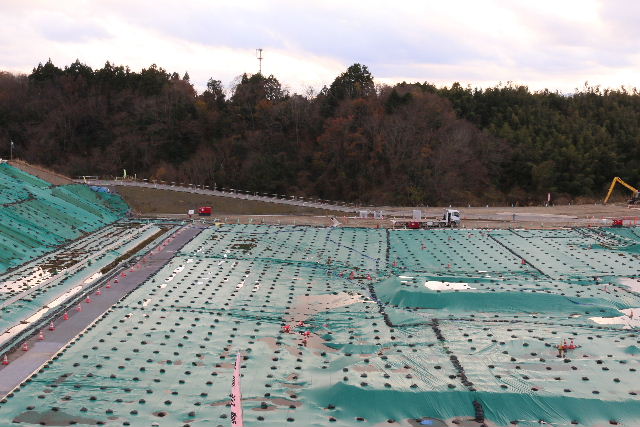
Contaminated soil landfill site (green sheet is rain protection) Cover this with soil
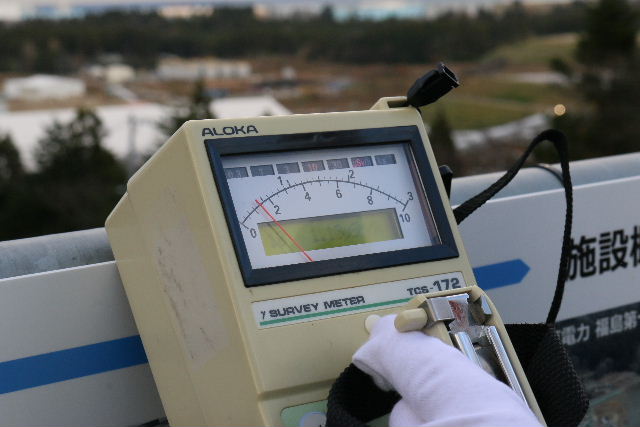
Dose at the observatory for visitors 1.18 μSv/h
According to JESCO, there are 20-30μSv/h in the forests by the roads.
About 7% of the vast area that stretches across the towns of Okuma and Futaba has not yet been contracted, so that area has been left untouched as an enclave. Of the remaining 93%, about 10% is under lease and 90% is being purchased by the government.
Even if all the contaminated soil could be moved out of the prefecture after 30 years, it would still be a vast area of state-owned land (the portion purchased by the government), with private land scattered throughout. It is hard to imagine that normal life or effective personal use would be possible on the scattered private lands.
The Ministry of the Environment is desperate to dispose of the waste in various locations outside of the prefecture, claiming that “volume reduction,” “reuse,” and “soil is an important resource,” according to the Japan Environmental Safety Corporation (JESCO) Act, which states that “final disposal will be completed outside of Fukushima Prefecture within 30 years after the start of interim storage. The recently announced “reuse” demonstration tests in Tokorozawa City, Shinjuku Gyoen, and other locations are a preparation for such tests.
Even if there were to be a place that would accept the soil, there would be enormous costs involved in digging up the huge amount of contaminated soil again and transporting it to the receiving site, as well as the risk of spreading the contaminated soil due to accidents during transportation.
It would be most reasonable now to revise the law and use an interim storage facility as the final disposal site.

Okuma Town Day Service Center for the Elderly (in the same condition as when evacuated immediately after the accident)

Cars in the day service center parking lot also remain in place.
http://chikurin.org/wp/?p=6526&fbclid=IwAR1Ji3AX-ouAA5vebPEvMdoOIfYh3G9FzLY2N2HisaMoorsjx0OEG4nMI_M
KEPCO: 197 employees obtained national licenses illegally, also engaged in nuclear power plant construction work

December 20, 2022
On December 20, KEPCO announced that 197 employees of KEPCO and its group companies (17 of whom had retired) had taken the technical certification examination for construction management engineers, a national certification that is required for process management in construction work, without the required period of work experience, and had fraudulently obtained the certification. An investigation report by outside lawyers found no evidence of systematic involvement in the fraud.
The Osaka District Court found no problems with the quality of construction work performed by the company’s employees, including 15 cases involving the three nuclear power plants in its jurisdiction, in which the improperly qualified employees were engaged as chief engineers.
https://www.jiji.com/jc/article?k=2022122001091&g=eco&fbclid=IwAR3d-PETosvWBi5K5o3XeQFFa8mRI9Er2cPAKkyQZkykurV1LLgRK4A0dAc
Ministry of the Environment Plans Demonstration Test for Reuse of Decontaminated Soil from Fukushima in Shinjuku Gyoen, Tokyo

Friday, December 9, 2022 11:53
Minister of the Environment Yoshiaki Nishimura announced that the Ministry of the Environment is planning to conduct a demonstration test at the Shinjuku Imperial Garden in Tokyo to see if the “decontaminated soil” generated during the decontamination process after the Fukushima Daiichi Nuclear Power Plant accident can be reused.
The government has indicated that it intends to reuse the large amount of “decontaminated soil” in Fukushima Prefecture for public works projects if the concentration of radioactive materials is below a certain standard value.
At a press conference today, Environment Minister Nishimura announced that the Ministry of the Environment is planning to conduct a demonstration test at the Shinjuku Gyoen, which is managed by the Ministry of the Environment, to demonstrate the reuse of the soil. The plan is to create flower beds using decontaminated soil in areas that are off limits to the general public, and to test the radiation levels in the surrounding areas.
This is the second time that a demonstration test is being planned outside of Fukushima Prefecture, following Tokorozawa City in Saitama Prefecture, and the other is in Tsukuba City, Ibaraki Prefecture.
https://newsdig.tbs.co.jp/articles/-/225831?display=1
1 This Month
10 March A LIVE WEBINAR THE REAL EFFECTS OF NUCLEAR POWER
What the Industry Isn’t Telling Us
1:00 PM Mountain, 2 pm Central, 3 pm Eastern. Live on the Keepers of the Water Facebook page



18 March Webinar @ 1 PM EST: An Assessment of SMR Projects: The Case of Canada
register for the zoom:
https://us02web.zoom.us/webinar/register/WN_o8BIIOUvQ2ONJR1nta65DQ#/registration


of the week – STOP SMALL MODULAR REACTORS IN CANADA
To see nuclear-related stories in greater depth and intensity – go to https://nuclearinformation.wordpress.com
-
Archives
- March 2026 (109)
- February 2026 (268)
- January 2026 (308)
- December 2025 (358)
- November 2025 (359)
- October 2025 (376)
- September 2025 (258)
- August 2025 (319)
- July 2025 (230)
- June 2025 (348)
- May 2025 (261)
- April 2025 (305)
-
Categories
- 1
- 1 NUCLEAR ISSUES
- business and costs
- climate change
- culture and arts
- ENERGY
- environment
- health
- history
- indigenous issues
- Legal
- marketing of nuclear
- media
- opposition to nuclear
- PERSONAL STORIES
- politics
- politics international
- Religion and ethics
- safety
- secrets,lies and civil liberties
- spinbuster
- technology
- Uranium
- wastes
- weapons and war
- Women
- 2 WORLD
- ACTION
- AFRICA
- Atrocities
- AUSTRALIA
- Christina's notes
- Christina's themes
- culture and arts
- Events
- Fuk 2022
- Fuk 2023
- Fukushima 2017
- Fukushima 2018
- fukushima 2019
- Fukushima 2020
- Fukushima 2021
- general
- global warming
- Humour (God we need it)
- Nuclear
- RARE EARTHS
- Reference
- resources – print
- Resources -audiovicual
- Weekly Newsletter
- World
- World Nuclear
- YouTube
-
RSS
Entries RSS
Comments RSS
 nuclear-news