TODAY: The growing influence of the nuclear lobby on education

It’s one thing for the nuclear lobby to pour money into universities in the USA and UK, to set up prestigious-looking nuclear departments. That’s one way to gain the respectability, approval and awe that the nuclear priesthood crave.
The original scientists of the Manhattan atomic bomb project enjoyed adulation (for a while) when everyone was encouraged to think that their brilliant device saved the world from Hitler. But that adoration faded as it transpired that Japan would have surrendered anyway, and the war in Europe was over, months before the “wonderful” bombing of Hiroshima and Nagasaki.
To assuage their guilt, most nuclear scientists enthusiastically embraced “Atoms for Peace” – and off and away went the public story that nuclear power is so good. The nuclear priesthood, being highly technical and male – developed a mindset, a reductionist point of view – the idea that technical achievement is all-important, and side issues like radiation effects, biology, environment, ecology, health, economics, history, criminal connections, are – well – just side issues.
But dammit! Those side issues just keep on coming up. Perhaps this is because the universities have been teaching too much of that other girlie “soft” stuff. So we need not just more more Science, Technology, Engineering and Maths – but Nuclear Science now too!
Australian journalist Liam Mannix, covers this new nuclear lobby push in his article ‘Cherish’ the power”, and points out that the uranium and nuclear industries have much more money to push for their interests, than do those “more socially constructive areas”.
The previous government in Australia determinedly downgraded humanities studies. Perhaps this is a worldwide trend. Anyway there is a saving grace for increasing STEM education – it gives girls and women that necessary knowledge – traditionally reserved for males. They, and men who can think, can gain the knowledge they need, to better evaluate pro nuclear propaganda.
Perhaps the world does need more nuclear scientists – there will be much need for them, in the marathon tasks of dismantling the toxic nuclear power/nuclear weapons industry. But we surely need also more humanities education, to understand and face the crises coming upon the world.
“Nuclear Sharing” – USA’s obscene system to turn non-nuclear weapons countries into nuclear attackers/targets.

The Steadfast Noon exercise will practice a controversial arrangement known as nuclear sharing, under which the United States installs nuclear equipment on fighter jets of select non-nuclear NATO countries and train their pilots to carry out nuclear strike with U.S. nuclear bombs.
NATO Steadfast Noon Exercise And Nuclear Modernization in Europe,
By Hans Kristensen • October 17, 2022,
Today, Monday October 17, 2022, the North Atlantic Treaty Organization (NATO) will begin a two-week long exercise in Europe to train aircrews in using U.S. non-strategic nuclear bombs. The exercise, known as Steadfast Noon, is centered at Kleine Brogel Air Base in Belgium, one of six airbases in Europe that store U.S. nuclear bombs. The exercise takes place midst significant modernizations at nuclear bases across Europe.
The arrangement is controversial because the United States as a party to the nuclear Non-Proliferation Treaty (NPT) has promised not to hand over nuclear weapons to other countries, and the non-nuclear countries in the sharing arrangement have promised not to receive nuclear weapons from the nuclear weapon states. In peacetime the nuclear weapons are under U.S. control, but the arrangement means that they would be handed over to the non-nuclear country in war time. The arrangement was in place before the NPT was signed so it is not a violation of the letter of the treaty. But it can be said to violate the spirit and has been an irritant for years.
Steadfast Noon exercises are held once every year, but this year is unique because the exercise will take place during the largest conventional war in Europe since World War II with considerable tension and uncertainty resulting from Russia’s war in Ukraine. Moreover, Steadfast Noon is expected to more or less coincide with a large Russian strategic nuclear exercise. For NATO officials, other than Putin’s war in Ukraine, this is all routine. But for the public, it is but the latest development in rising tensions and unprecedented fears about nuclear war.
According to NATO, Steadfast Noon will involve 14 countries (less than half of the 30 NATO allies) and up to 60 aircraft. That involves fourth-generation F-16s and F-15Es as well as fifth-generation F-35A and F-22 fighter jets. A number of tankers and surveillance aircraft will also take part. Although the exercise is practicing NATO’s non-strategic nuclear forces, a couple of U.S. strategic B-52 bombers will also participate. Training flights will take place over Belgium and the United Kingdom as well as over the North Sea. There might also be flights over Germany and the Netherlands.
Practicing Nuclear Bomb Sharing
The Steadfast Noon exercise will practice a controversial arrangement known as nuclear sharing, under which the United States installs nuclear equipment on fighter jets of select non-nuclear NATO countries and train their pilots to carry out nuclear strike with U.S. nuclear bombs.
“If NATO was to conduct a nuclear mission in a conflict,” NATO says, “the B-61 [sic] weapons would be carried by certified Allied aircraft…However, a nuclear mission can only be undertaken after explicit political approval is given by NATO’s Nuclear Planning Group (NPG) and authorisation is received from the US President and UK Prime Minister.” It is unclear why the U.K. Prime Minister would have to authorize employment of U.S. nuclear weapons, and unless NATO territory had been attacked with nuclear weapons first, it seems unlikely that the 29 countries in the NPG would be able to agree to approve of employment of non-strategic nuclear weapons from bases in Europe.
NATO disclosed earlier this year that seven NATO countries contribute dual-capable aircraft to the nuclear sharing mission. The countries were not identified but five are widely known: Belgium, Germany, Italy, Netherlands, and the United States. The sixth country is probably Turkey (despite rumors that it was no longer part of the mission), in which case some Turkish F-16s are still equipped to deliver B61 bombs. The seventh country is a mystery, but might possibly be the United Kingdom, in which case some British Eurofighters would have a nuclear mission with U.S. bombs [Note: a UK role has not been confirmed].
Nuclear Base Modernizations
During the past several years, the nuclear bases and the infrastructure that support the nuclear sharing mission in Europe have been undergoing significant upgrades, including cables, command and control systems, weapons maintenance and custodial facilities, security perimeters, and runway and tarmac areas.
There are currently six active sites in Europe that store U.S. nuclear bombs: Kleine Brogel air base in Belgium, Büchel air base in Germany, Aviano and Ghedi air bases in Italy, Volkel air base in the Netherlands, and possibly Incirlik in Turkey. The estimated number of weapons at each site is based on the number of active vaults, aircraft, and other information:
Each of these bases have one or two dozen active vaults (Weapons Storage Security System, WS3) inside as many protective aircraft shelters. Ramstein air base in Germany used to be the largest storage site in Europe but only 7 vaults remain active possibly for training and transfer. All weapons were withdrawn from Lakenheath before 2007 but the United Kingdom was recently added to the nuclear infrastructure storage modernization program, which means there are now eight active WS3 sites in Europe:
The modernizations at the various bases vary depending on capacity, location, and host country. At Kleine Brogel Air Base in Belgium,…………………………
At Büchel Air Base in Germany…………………….
At Volkel Air Base in the Netherlands,…………
Ghedi Air Base in Italy………….
Upgrades of Aviano Air Base in Italy and Incirlik Air Base in Turkey……….
Weapons Modernization……………………..
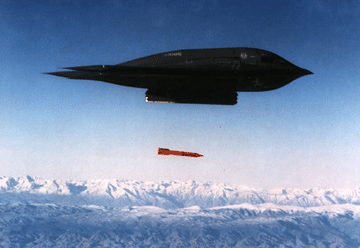
Finally, the existing B61 nuclear bombs will soon be replaced by the enhanced B61-12 guided nuclear bomb. Development is essentially complete and full-scale production of about 480 B61-12s is expected to begin soon. The new weapon is thought to have the same yield range as the current B61-4: 0.3, 1.5, 10 and 50 kilotons. Training of the units in Europe to receive the new weapon is scheduled to begin in early-2023 and the first weapons potentially arriving at the first base in late-2023 or 2024.
In addition to the non-strategic fighter jets F-15E, F-16, F-35A, and Tornado, the B61-12 will also be integrated on the B-2 and B-21 strategic bombers. ecause of the increased provided by the tail kit, all the digital aircraft that can make use of it (all except F-16 and Tornado) will be able to hold at risk a wide range of targets. The combination of increased accuracy and lower-yield options on non-strategic and strategic stealth aircraft will significantly increase the capability of the gravity bomb mission.
Calling nuclear fusion a potential ‘climate solution’ may undermine actual solutions
The latest fusion breakthrough is scientifically important, but the technology’s timeline just doesn’t match up with the urgency of climate change.
Grid Dave Levitan 28 Dec 22 Climate Reporter
When scientists at Lawrence Livermore National Laboratory announced a “breakthrough” in nuclear fusion research this month, many eyes quickly turned to climate change. Stories from the BBC, CNN and other major outlets mentioned the potential for “limitless” clean energy and discussed fusion’s place as a global warming fix within their opening paragraphs. Even Secretary of Energy Jennifer Granholm, in announcing the new result, touted its potential to provide “clean power to combat climate change.”
From a purely theoretical standpoint, this makes some sense. Fusion power, in an idealized, storybook form, turns the world’s energy system on its head, offering an emissions-free way to keep the lights on. And the latest advance sounds truly impressive: Using enormously powerful lasers, scientists at Livermore’s National Ignition Facility (NIF) managed to create a split-second fusion reaction — mimicking that which takes place on a massive scale inside the sun — that produced more energy than it consumed.
But the world doesn’t live in that storybook. On a practical, near-term level, nuclear fusion and climate change have almost nothing to do with each other. One remains in more-or-less scientific infancy, many years away from even a hint of usable form; the other gets more urgent by the day, requires immediate intervention and has some readily available tech being deployed as we speak.
“A lot of people are desperate for some sort of silver bullet climate solution that will help to bypass the hard work of actually getting political agreements and policymaking and sacrifice to eliminate fossil fuels,” said Edwin Lyman, a physicist and director of nuclear power safety for the Union of Concerned Scientists. “It would just be easier if there were this panacea out there that would transform everything, but of course that’s totally unrealistic.”
Celebrating scientific advances is important. But linking that science with an urgent global need that it cannot on relevant time scales address may offer false hope and potentially undermine the more banal climate progress — dramatic renewable energy expansion, efficiency improvements, vehicle electrification and so on — that is possible today.
Ignition achieved
The old joke about nuclear fusion is that it is always 20 — or 30 or 50 — years away. Taking hydrogen atoms and fusing them into helium, in the process releasing energy that theoretically can be used to power the electric grid, is so technically challenging that despite well over a half-century of advances, the joke still more or less holds true…………………. more https://www.grid.news/story/climate/2022/12/26/calling-nuclear-fusion-a-potential-climate-solution-may-undermine-actual-solutions/
Tucker “Gets It” – Putin Doesn’t Want American Missiles on His Border

Much as I hate siding with the Right Wing, and much as if I were an American, I would probably be a Democrat, I have to admit that Tucker Carlson and Fox News sometimes make a bit of sense.
It pains me to have to side with these Right-wingers.
But we are at a point where it is more important to THINK. And America’s Democrats don’t seem able to think. Indeed, Americans seem to slavishly follow the mindset of their political parties. And thinking seems to be an activity that is somehow treachersous.
The Unz Review, MIKE WHITNEY • DECEMBER 27, 2022
“Getting Ukraine to join NATO was the key to inciting war with Russia. We didn’t get it at the time. (But) Now it’s obvious. Vladimir Putin invaded Ukraine because he didn’t want Ukraine to join NATO. Putin certainly had other motives as well; people always do, but that’s the main reason Russia invaded. The Russians don’t want American missiles on their border. They don’t want a hostile government next door. Now that is true, whether you are allowed to say it aloud in public or not. It has been true for a long time. A lot has been written about this over many years by serious people. No one who knows anything and is honest, will tell you Putin invaded Ukraine simply because he is evil. Putin may be evil, he certainly seems to be, but he also has strategic motives for doing that, whether you agree with those motives or not. That is irrelevant. Those are the facts.” Tucker Carlson, Fox News
Tucker Carlson is right about Ukraine. NATO membership for Ukraine was clearly a provocation aimed at luring Russia into an invasion. And, it worked, too. Putin could not take the risk of having “a hostile government next door” or “American missiles on his border,” so he acted to preempt those threats by sending the tanks across the border on Febrary 24, 2021.
Where Carlson is a little off-base, is when he he says that Putin’s actions were prompted by “strategic motives”. That’s not really wrong, it just misses the point. The point is that Washington’s combat troops and missile sites on Russia’s western border would pose a grave threat to Russia’s national security. Putin would have to be out-of-his-mind to allow a development like that. So, he did what any American president would have done if he had been in the same situation. He invaded. This is an excerpt from an article at the World Socialist Web Site:
The narrative in the media, which presents the invasion as an unprovoked action, is a fabrication that conceals the aggressive actions by the NATO powers, in particular the United States, and its puppets in the Ukrainian government.…
In Europe and Asia, the US pursued a strategy aimed at encircling and subjugating Russia. Directly violating its earlier promises that the Soviet bureaucracy and Russian oligarchy were delusional enough to believe, NATO has expanded to include almost all major countries in Eastern Europe, apart from Ukraine and Belarus.
In 2014, the US orchestrated a far-right coup in Kiev that overthrew a pro-Russian government that had opposed Ukrainian membership in NATO. In 2018, the US officially adopted a strategy of preparing for “great power conflict” with Russia and China. In 2019, it unilaterally withdrew from the INF Treaty, which banned the deployment of intermediate-range nuclear missiles. Preparations for war with Russia and the arming of Ukraine were at the center of the Democrats’ first attempt to impeach Donald Trump in 2019.” (“The US-Ukrainian Strategic Partnership of November 2021 and the Russian invasion of Ukraine“, World Socialist Web Site)
This is a brief but excellent summary of events leading up to the Russian invasion on February 24, 2021. Putin and his advisors had been following developments in Ukraine with growing alarm after it became apparent that their worst fears were materializing. The CIA was not only arming and training paramilitaries in the east in preparation for a war against ethnic Russians in the Donbas, the US was also cultivating an explicitly anti-Russia political party –which contained openly fascist elements– that was designated to implement Washington’s proxy-war strategy. In short, the US fanned the flames of ethnic hatred in order to lay the groundwork for its “Great Power” conflagration with Moscow. Here’s more from the WSWS:……………………………………………………
For Russia, Ukraine’s membership in NATO was “the reddest of red lines”. Since the end of WW2, NATO had expanded from 12 to 30 countries almost all of which pushed further eastward towards Russia’s western border. When the United States indicated it would seek NATO membership for Ukraine at the Bucharest Summit in 2008, Putin’s response was uncharacteristically ferocious………………………………………..
The point we’re making is that the current conflict has nothing to do with claims that Putin is “an aspiring imperialist longing to reconstruct the Soviet empire.” There is no evidence for that at all. The real issue is NATO expansion and, in particular, the secret agreements between the United States and Ukraine that made Ukraine a full-fledged member of NATO in everything but name. Take a look at this excerpt from an article by Marcy Winograd :
The September, 2021, Joint Statement on the U.S.-Ukraine Strategic Partnership reaffirmed Ukraine as a de facto NATO partner,……………………………………………………………….
Brilliant analysis, and right to the point. Ukraine didn’t need to be formally entered into NATO because the US stealthily bestowed defacto membership on them out of the public eye. Naturally, Putin and his lieutenants knew what was going on, but the media made sure that everyone else remained in the dark. And all of this sleight-of-hand was going on just months before Putin was forced to invade. It’s actually shocking.
Does it sound like Ukraine snuck into NATO through the back door?
It does.
This summary helps to show that Ukraine’s non-membership in NATO is largely “a fiction.” Ukraine has been fully-integrated into the anti-Russia Alliance in every way except formal approval. Ukraine’s Strategic Partnership with the US, which was signed by both parties in 2021, underscores this point. It also helps “to clarify” –as Marcy Winograd notes– “that the United States and NATO provoked the war.” Indeed, Washington has put a significant amount of time and energy into a project that is aimed at crossing all of Russia’s redlines, directly challenging Russia’s basic security interests, and forcing Russia to invade a neighboring country. Simply put, Washington placed a gun to Russia’s head and threatened to pull the trigger.
Fortunately, Putin responded in the way that best ensured the safety and security of his own government, his own country, and his own people. We would expect any responsible leader to do the same. https://www.unz.com/mwhitney/tucker-gets-it-putin-doesnt-want-american-missiles-on-his-borde—
NuScam’s small nuclear reactors have both regulatory and financial woes.

How did the US nuclear industry fare in 2022? Canary Media 28 December 2022 Eric Wesoff
“……………………………………………………………………….. NuScale’s NRC blues, NuScale Power has led the charge on small nuclear reactors for more than a decade but is still struggling with the NRC, as well as facing rising costs on a crucial first-of-a-kind 462-megawatt project in Idaho.
The proposed project from NuScale and Utah Associated Municipal Power Systems, a group of 50 municipal utilities spanning seven Western states, was initially slated to begin operation of the first of six small modular reactors in 2029. But according to December reporting in E&E News, “NuScale’s first reactor now faces sharply higher construction cost estimates, due to inflation and higher interest rates. If projected costs rise above $58 per megawatt-hour, it would trigger an up-or-down vote as early as next month from the project’s anchor customers.” E&E also reported that the costs of construction materials such as steel plate and carbon steel piping have skyrocketed since the project was approved in 2020.
In addition to cost issues, NuScale has run into a regulatory snag. The company replaced its NRC-approved 50-megawatt design and now needs to gain regulatory approval for the 77-megawatt module it plans to use in the UAMPS project. Utility Dive reported in November that the NRC has concerns about the new design, writing in a letter to NuScale that the company’s proposed module raised “several challenging and/or significant issues” with its draft application.
Small module reactor architecture is an unproven solution to the nuclear industry’s cost and schedule overruns. Scaling down new reactors in power output and size theoretically enables small modular and micro solutions that can be constructed less expensively off-site using fewer custom components with lower total project costs.
But even NuScale’s design, a small modular reactor that bears some resemblance to existing light-water reactors, poses challenges to the testing and approval processes of the NRC. NuScale says it has spent over $500 million and expended more than 2 million labor hours to compile the information needed for its design-certification application.
And it’s not just the nuclear regulators, engineers and politicians who need to weigh in on this project. These days, it’s the nuclear accountants who have the final say. And so far, small reactors have not proven to be a financial or regulatory slam dunk. …………… https://www.canarymedia.com/articles/nuclear/how-did-the-us-nuclear-industry-fare-in-2022
The 2022 nuclear year in review: A global nuclear order in shambles
The Bulletin. By François Diaz-Maurin | December 26, 2022
It is hard to find a year filled with more concerns about nuclear risk than 2022. There surely was 1986 and the Chernobyl reactor accident. There was also 1962 and the Cuban Missile Crisis. And, of course, there was 1945 and the atomic bombings of Hiroshima and Nagasaki.
But this year, all sorts of nuclear risks coincided.
Russia, losing on the ground, contemplated the use of nuclear weapons in its war against Ukraine—recklessly threatening the nuclear taboo, a 77-year tradition of non-use. Also in Ukraine, nuclear reactors and nuclear facilities became targets of military attacks. Elsewhere, North Korea test-launched more ballistic missiles than it ever had in a single year and even seems to be preparing for a nuclear test. Iran resumed construction of its underground nuclear complex, disconnected IAEA surveillance cameras, and accelerated its uranium enrichment program, leaving it only months away from possibly testing a nuclear explosive or deploying a crude nuclear warhead on a ballistic missile, if it wishes to do so. In response, Saudi Arabia took further steps toward enriching uranium, also refusing IAEA inspections that would ensure the Kingdom does not conduct covert nuclear weapons-related activities.
Despite all these concerns, efforts of nuclear non-proliferation and disarmament failed to achieve any meaningful result this year. Participants in the first meeting of states parties of the Treaty on the Prohibition of Nuclear Weapons (TPNW), also known as the ban treaty, could not agree on calling out Russia’s nuclear threats and rhetoric in its war against Ukraine. The long-awaited review conference of the parties to the Treaty on the Non-Proliferation of Nuclear Weapons (NPT) ended without an agreement after Russia refused to sign off on an outcome document that referred to the control of the Zaporizhzhia nuclear power plant in Ukraine. The international community, so far, seems incapable of finding ways to better protect nuclear facilities from attacks, even as the odds of a nuclear accident in Ukraine increase as the war drags on.
In August, the EU-mediated talks between the United States and Iran failed to revive the 2015 agreement limiting Tehran’s nuclear program, known as the Joint Comprehensive Plan of Action (JCPOA), which former President Trump abandoned in 2018. In the United States, the much-anticipated Biden administration’s Nuclear Posture Review (NPR) was finally released in October, only to deceive experts. The NPR has been invariably accused, at best, of maintaining the nuclear status quo and of passing on its chance to reduce the role of nuclear weapons in the US security strategy, if not of being a major step backward.
Finally, in late November, hopes that on-site inspections under the New Strategic Arms Reduction Treaty (New START) could resume soon were cold-showered after Russia postponed a meeting of the Bilateral Consultative Commission (BCC), the treaty’s implementing body, planned to be held the next day in Cairo, Egypt. New START is the only bilateral nuclear arms control treaty between the United States and Russia, the world’s two largest nuclear arsenals. It is set to expire in 2026.
2022 will certainly appear in textbooks as the year when the global nuclear order was unprecedentedly shaken, if not irreparably destroyed…………………….. https://thebulletin.org/2022/12/the-2022-nuclear-year-in-review-a-global-nuclear-order-in-shambles/
EU, Britain to train 15,000 Ukrainian “warfighters” in Lithuania — Anti-bellum

Defense PostDecember 28, 2022 Lithuania, EU, UK Team Up to Train More Ukrainian Soldiers in 2023 The Lithuanian Ministry of Defense has confirmed it will provide additional military training for Ukrainian troops… Approved by parliament, the aid will hone the skills of nearly 1,500 Ukrainian soldiers. Around 1,100 personnel will receive training in Lithuania. As […]
EU, Britain to train 15,000 Ukrainian “warfighters” in Lithuania — Anti-bellum
Canada’s first new nuclear power reactor in 30 years has embarked on a crucial review. Can it pass quickly?

GE says it’s the simplest reactor it has ever designed. Such claims are common among SMR developers, and are almost entirely untested.
“The vendors would really like to have basically no guards with guns at a reactor site, if they can avoid it,”
While a solar or wind farm can typically be built in a few years, nuclear reactors have been known to take a decade or longer. With governments and utilities pondering how to achieve net-zero greenhouse emissions by mid-century, this has proved to be a significant competitive disadvantage for nuclear power.
Globe and Mail, Dec. 28, 2022, Matthew McClearn
On the shores of Lake Ontario, about 70 kilometres east of Toronto, something is happening that hasn’t happened in Canada in well over a generation: Workers are breaking ground for a new nuclear reactor.
Ontario Power Generation plans to construct a GE-Hitachi BWRX-300 at its Darlington Nuclear Generating Station in Clarington. To do that it needs permission from the Canadian Nuclear Safety Commission (CNSC)
The utility’s application to the CNSC, which it submitted in the fall, will be the first real test of GE-Hitachi’s claims about the reactor, a new model that is not yet used anywhere else in the world. The uncertain process could have dramatic implications for what this new reactor will ultimately cost, how long it will take to build – and whether anyone else will want to build one.
The reactor’s design is novel in several respects. At 300 megawatts, the BWRX-300 is marketed as a small modular reactor, or SMR. (Darlington’s existing four reactors each produce 935 megawatts.) In considering the application, the CNSC will be the first regulator in the world to review an SMR for large-scale power generation.
This will be the first large nuclear power reactor the CNSC has reviewed since 1993. And, if built, it would be the first nuclear power reactor in Canadian history that wasn’t of the homegrown CANDU design.
GE-Hitachi has said the BWRX-300 will be 60 per cent less expensive per megawatt than a typical reactor, making it the cheapest SMR on the market, and that it can be built in as few as 24 months. And the company has touted “passive safety systems.” Even if operators walked away, it has said, the reactor would cool itself without power for a whole week, at minimum. The company also claims the BWRX-300′s environmental footprint is less than that of larger reactors. GE says it’s the simplest reactor it has ever designed.
Such claims are common among SMR developers, and are almost entirely untested. The BWRX-300 “has not gone through any licensing review anywhere, in any country,” said M.V. Ramana, a professor at the University of British Columbia’s School of Public Policy and Global Affairs who researches nuclear energy. “When a design is submitted to a regulator for safety review, the regulators ask questions, and the design starts being changed. And so there is going to be this process of evolution.”…………………………………
Allison Macfarlane, director of UBC’s School of Public Policy and Global Affairs, said SMR vendors have also sought smaller emergency-planning zones in the U.S. And she noted that some vendors argue that SMRs will require less physical security than larger reactors. “The vendors would really like to have basically no guards with guns at a reactor site, if they can avoid it,” she added.
Acquiring regulatory approval to build a newly designed reactor within two or three years is not the norm.
Prof. Macfarlane said there is no hard rule on how long the process takes. The fastest application she has seen before the NRC was a request by the U.S. Navy for an informal review of a reactor for a nuclear aircraft carrier. (The Navy didn’t actually require NRC approval.) The NRC’s review took 18 months, she said.
For a power reactor, the best case scenario before the NRC is three to four years. At worst, the process can stretch out for a decade.
“Usually, there’s just this endless back and forth,” she said.
Prof. Ramana is also skeptical of OPG’s timeline. Most nuclear projects suffer delays, he said. “When it comes to a new reactor design, those delays tend to be much larger. … It should not be a surprise to anyone if this design is going to be quite delayed.”
That accords with GE-Hitachi’s own experiences in the U.S. The company applied to the NRC for final design approval for its Economic Simplified Boiling Water Reactor in 2005. The reactor wasn’t certified until nine years later, in 2014. In 2011, the company applied to the NRC to renew the design certification for its Advanced Boiling Water Reactor, which had first been certified in the 1990s. That process took about a decade.
Even if the CNSC does grant OPG its construction license in record time, delays are not uncommon after construction has commenced. One notorious example is Westinghouse’s AP1000 reactor, which made an outsized contribution to that company’s filing for bankruptcy protection in 2017.
“In the case of the AP1000, the delays happened well after the design was licensed to be constructed,” Prof. Ramana said.
That historical experience notwithstanding, OPG, various levels of government and voices from across the nuclear industry have said that this new reactor will be in service as early as 2028. Meeting that deadline is a matter of no small urgency for the nuclear industry. While a solar or wind farm can typically be built in a few years, nuclear reactors have been known to take a decade or longer. With governments and utilities pondering how to achieve net-zero greenhouse emissions by mid-century, this has proved to be a significant competitive disadvantage for nuclear power…………………..
The CNSC is an administrative tribunal that reports to Parliament through the Minister of Natural Resources. While it doesn’t answer to him, that minister, Jonathan Wilkinson, has promoted SMRs in recent statements. By adopting them early, he said in October, “Canada could realize a significant share of the global exports of technology, goods and services.” In its most recent budget, the federal government earmarked nearly $51-million to improve the CNSC’s capacity to regulate SMRs.
CNSC president Rumina Velshi is also a vocal supporter. She declared in October that SMRs “are likely to be an important part of the next generation of nuclear” and that they “will need to be deployed quicker, less expensively and much more widespread than reactors of the past.” The CNSC has established a new group focused exclusively on SMRs, which will “guide the entire organization on SMR readiness.”
Earlier this year, Ms. Velshi told attendees of a summit on advanced reactors that the CNSC would rise “to the challenge of conducting SMR licensing reviews efficiently and effectively.”
Ms. Velshi is enthusiastic about the CNSC harmonizing its codes and standards with those of regulators of other countries. She has said this is “essential” for SMR deployment worldwide, and has signalled her intent to work closely with the NRC.
In September, the two regulators signed an agreement to collaborate on reviewing the BWRX-300.
Allison Macfarlane, director of UBC’s School of Public Policy and Global Affairs, said SMR vendors have also sought smaller emergency-planning zones in the U.S. And she noted that some vendors argue that SMRs will require less physical security than larger reactors. “The vendors would really like to have basically no guards with guns at a reactor site, if they can avoid it,” she added.
Acquiring regulatory approval to build a newly designed reactor within two or three years is not the norm.
Prof. Macfarlane said there is no hard rule on how long the process takes. The fastest application she has seen before the NRC was a request by the U.S. Navy for an informal review of a reactor for a nuclear aircraft carrier. (The Navy didn’t actually require NRC approval.) The NRC’s review took 18 months, she said.
For a power reactor, the best case scenario before the NRC is three to four years. At worst, the process can stretch out for a decade.
“Usually, there’s just this endless back and forth,” she said.
Prof. Ramana is also skeptical of OPG’s timeline. Most nuclear projects suffer delays, he said. “When it comes to a new reactor design, those delays tend to be much larger. … It should not be a surprise to anyone if this design is going to be quite delayed.”
That accords with GE-Hitachi’s own experiences in the U.S. The company applied to the NRC for final design approval for its Economic Simplified Boiling Water Reactor in 2005. The reactor wasn’t certified until nine years later, in 2014. In 2011, the company applied to the NRC to renew the design certification for its Advanced Boiling Water Reactor, which had first been certified in the 1990s. That process took about a decade.
Even if the CNSC does grant OPG its construction license in record time, delays are not uncommon after construction has commenced. One notorious example is Westinghouse’s AP1000 reactor, which made an outsized contribution to that company’s filing for bankruptcy protection in 2017.
“In the case of the AP1000, the delays happened well after the design was licensed to be constructed,” Prof. Ramana said.
That historical experience notwithstanding, OPG, various levels of government and voices from across the nuclear industry have said that this new reactor will be in service as early as 2028. Meeting that deadline is a matter of no small urgency for the nuclear industry. While a solar or wind farm can typically be built in a few years, nuclear reactors have been known to take a decade or longer. With governments and utilities pondering how to achieve net-zero greenhouse emissions by mid-century, this has proved to be a significant competitive disadvantage for nuclear power.
A successful, quick application would bode well for further BWRX-300 construction, in Canada and beyond. OPG’s environmental impact statement suggests the utility could deploy up to four at Darlington, with the last one completed in 2035.
Earlier this year, SaskPower, Saskatchewan’s main electric utility, selected the BWRX-300 for “potential” deployment in the province in the mid-2030s. (It won’t make a firm decision until 2029.) A U.S. utility, the Tennessee Valley Authority, also plans to build a BWRX-300.
The CNSC is an administrative tribunal that reports to Parliament through the Minister of Natural Resources. While it doesn’t answer to him, that minister, Jonathan Wilkinson, has promoted SMRs in recent statements. By adopting them early, he said in October, “Canada could realize a significant share of the global exports of technology, goods and services.” In its most recent budget, the federal government earmarked nearly $51-million to improve the CNSC’s capacity to regulate SMRs.
CNSC president Rumina Velshi is also a vocal supporter. She declared in October that SMRs “are likely to be an important part of the next generation of nuclear” and that they “will need to be deployed quicker, less expensively and much more widespread than reactors of the past.” The CNSC has established a new group focused exclusively on SMRs, which will “guide the entire organization on SMR readiness.”
Earlier this year, Ms. Velshi told attendees of a summit on advanced reactors that the CNSC would rise “to the challenge of conducting SMR licensing reviews efficiently and effectively.”
Ms. Velshi is enthusiastic about the CNSC harmonizing its codes and standards with those of regulators of other countries. She has said this is “essential” for SMR deployment worldwide, and has signalled her intent to work closely with the NRC.
In September, the two regulators signed an agreement to collaborate on reviewing the BWRX-300.
| Reply |
Germany assumes command of NATO’s 12,000-troop strike force — Anti-bellum

NATODecember 28, 2022 Germany takes the lead for NATO’s high readiness force On Sunday (1 January 2023), Germany takes the lead of NATO’s highest-readiness military force, placing thousands of troops on standby and ready to deploy within days. NATO’s Very High Readiness Joint Task Force (VJTF) was created in 2014 at the core of a […]
Germany assumes command of NATO’s 12,000-troop strike force — Anti-bellum
1 This Month

Petition to revoke the licensing of the Near Surface Nuclear Disposal Facility (NSDF) at Chalk River. https://www.ourcommons.ca/petitions/en/Petition/Details?Petition=e-7247


of the week – STOP SMALL MODULAR REACTORS IN CANADA
To see nuclear-related stories in greater depth and intensity – go to https://nuclearinformation.wordpress.com
-
Archives
- March 2026 (153)
- February 2026 (268)
- January 2026 (308)
- December 2025 (358)
- November 2025 (359)
- October 2025 (376)
- September 2025 (258)
- August 2025 (319)
- July 2025 (230)
- June 2025 (348)
- May 2025 (261)
- April 2025 (305)
-
Categories
- 1
- 1 NUCLEAR ISSUES
- business and costs
- climate change
- culture and arts
- ENERGY
- environment
- health
- history
- indigenous issues
- Legal
- marketing of nuclear
- media
- opposition to nuclear
- PERSONAL STORIES
- politics
- politics international
- Religion and ethics
- safety
- secrets,lies and civil liberties
- spinbuster
- technology
- Uranium
- wastes
- weapons and war
- Women
- 2 WORLD
- ACTION
- AFRICA
- Atrocities
- AUSTRALIA
- Christina's notes
- Christina's themes
- culture and arts
- Events
- Fuk 2022
- Fuk 2023
- Fukushima 2017
- Fukushima 2018
- fukushima 2019
- Fukushima 2020
- Fukushima 2021
- general
- global warming
- Humour (God we need it)
- Nuclear
- RARE EARTHS
- Reference
- resources – print
- Resources -audiovicual
- Weekly Newsletter
- World
- World Nuclear
- YouTube
-
RSS
Entries RSS
Comments RSS
 nuclear-news