USA hurrying to replace its weapons stocks, after sending so much to Ukraine.
Ed: US taxpayer monies continue to fund a sinkhole war without approval nor permission from the people. Now Biden is bypassing Congress as well.
U.S. Army’s weapons contract reviews accelerate to replace Ukraine aid
By Mike Stone, 23 Nov 22,
WASHINGTON, Nov 21 (Reuters) – The U.S. Army is accelerating its weapons acquisition process to speed through a backlog of contracts needed to replenish U.S. stocks of weapons depleted by arms shipments to Ukraine, a U.S. official said on Monday.
Reporting by Mike Stone in Washington; Editing by Lincoln Feast……… (Subscribers only) https://www.reuters.com/world/us-armys-weapons-contract-reviews-accelerate-replace-ukraine-aid-2022-11-21/
EDF Delays Restart of Three Nuclear Reactors as Winter Hits
Electricite de France SA extended maintenance halts at three nuclear reactors, adding to strain on power supply in France and neighboring countries as temperatures fall.
The restart of EDF’s 1,330-megawatt Flamanville 2 unit has been delayed by five days until Dec. 1, the utility said Wednesday on its website. The halt of the Cruas 2 reactor is extended by eight days until Dec. 5, and the restart of Dampierre 2 is postponed by 10 days to Dec. 9………….. more https://www.bloomberg.com/news/articles/2022-11-23/edf-delays-restart-of-three-nuclear-reactors-as-winter-hits?leadSource=uverify%20wall
Future war: NATO holds 75-nation planning session in Berlin

NATO has 30, soon to be 32, full members and 40 partners in the Partnership for Peace, Mediterranean Dialogue, Istanbul Cooperation Initiative, Partners Across the Globe and Enhanced Opportunities Partners formats. In addition, there are contributing countries (see below) not yet in any of the above categories. In Afghanistan troop contributing countries to NATO’s war […]
Future war: NATO holds 75-nation planning session in Berlin — Anti-bellum
Maligned in Western Media, Donbass Forces are Defending their Future from Ukrainian Shelling
Republished 24 Nov 22 Eva Bartlett in Gaza
Published Nov 19, 2022, Covert Action [See the comments section, some apologists for the West’s war on Syria have resurfaced…]
Smeared, stigmatized, and lied about in Western media propaganda, the mostly Russian-speaking people of the Donbass region were being slaughtered by the thousands in a brutal war of “ethnic cleansing” launched against them by the neo-Nazi regime in Kyiv, which the U.S. installed after the CIA overthrew Ukraine’s legally elected president in a 2014 coup.
Although the Donbass people had been pleading for Russian military aid to defend them against the increasingly murderous military assaults by the Ukraine government forces, which killed more than 14,000 of their people, Russian President Vladimir Putin declined to intervene. Instead, he tried to broker a peace agreement between the warring parties.
But the U.S. and Britain secretly colluded to sabotage peace negotiations, persuading president Zelenksy to ignore the Minsk III peace agreement that the Ukraine government had previously signed, and which had been countersigned by Russia, France and Germany.
Realizing that the U.S. and its NATO allies would never permit peace negotiations to succeed, Putin finally sent troops into Ukraine on February 24. Russian troops went in to support and reinforce the outnumbered and outgunned Donbass Forces who had been defending their land against attacks by the Kyiv government for nearly eight years.
Voices From the Frontlines of Former Eastern Ukraine Republics
In the Donetsk People’s Republic (DPR) in October, I went to a frontline outpost 70 meters from Ukrainian forces in Avdeevka (north and west of Donetsk), according to the Donbas commanders I spoke with there. [Watch our interview here]
To reach that position, I went with two other journalists to a meeting point with two commanders of Pyatnashka—volunteer fighters, including Abkhazi, Slovak, Russian, Ossetian and other nationalities, including locals from Donbas.
From there, they drove us to a point as far as they could drive before walking the rest of the way, several minutes through brush and trenches, eventually coming to their sandbagged wood and cement fortified outpost.
It has changed hands over the years, Ukrainian forces sometimes occupying it, Donbas forces now controlling it.
One soldier, a unit commander who goes by the call sign “Vydra” (Otter), was formerly a miner from the DPR who had been living in Russia with his family. In 2014, he returned to the Donbas to defend his mother and relatives still there. He spoke of the outpost.
“We dug and built this with our hands. Several times over the years, the Ukrainians have taken these positions. We pushed them back, they stormed us…Well, we have been fighting each other for eight years.”
There, artillery fire is the biggest danger they face. “You can hide from a sniper, but not from artillery, and they’re using large caliber.”
………………………………………………… Perhaps surprising to some, when Vydra was asked whether he hates Ukrainians, he replied emphatically no, he has friends and relatives in Ukraine.
“We have no hatred for Ukraine. We hate those nationalists who came to power. But ordinary Ukrainians? Why? Many of us speak Ukrainian. We understand them, they understand us. Many of them speak Russian.
I’ve been involved in sports a lot of time, wrestling. So, I’ve got a lot of friends in Dnepropetrovsk, Kharkov, Kirovograd, Odessa, Lvov, Ivano-Frankivsk, Transcarpathia.
I have relatives in western Ukraine, and we still communicate. Yes, they say one thing on the street, but when we talk to each other, they say, ‘Well, you have to, because the SBU is listening.’
Ukraine shouts about democracy, then puts people in handcuffs for no reason. My aunt got in trouble because they found my photo on her Skype.
And I’m on the Myrotvorets [kill list] website.” [As is the author, see this article.]
He spoke of Ukraine’s shelling from 2014, when the people of the Donbass were unarmed and not expecting to be bombed by their own country.
“When the artillery hit the city of Yenakievo, east of Gorlovka, we were defenseless. We went with hunting rifles and torches to fight them. Most of the weapons we had later were captured from them. We had to go to the battlefield without weapons in order to get the weapons.”
When asked if he was concerned that Ukrainian forces might take Donetsk he replied no, of course not, they didn’t succeed in 2014, they won’t now……………….
I asked how he felt to be treated and described as sub-human, to be called dehumanizing names, a part of the Ukrainian nationalists’ brainwashing propaganda. As I wrote previously:
“Ukrainian nationalists openly declare they view Russians as sub-human. School books teach this warped ideology. Videos show the extent of this mentality: Teaching children not only to also hate Russians and see them as not humans, but also brainwashing them to believe killing Donbas residents is acceptable. The Ukrainian government itself funds neo-Nazi-run indoctrination camps for youths.”
“It’s offensive,” Vydra said, “We are saddened: There are sick people. We need to heal them, slowly.”
I asked whether he thought friendship between Ukrainians and Russians would be possible.
“It will take years for any friendship. Take Chechnya, one region of Russia, it was at war. But slowly, slowly…We must all live together. We are one people.” Indeed, now Chechen fighters are one of the most effective forces fighting alongside Donbas and Russian soldiers to liberate Donbas areas from Ukrainian forces…………………………………..
Commanders Speak of Geopolitical Reasons for Ukraine’s War
Outside, sitting in front of an Orthodox banner and a collection of collected munitions—including Western ones—two platoon commanders, “Kabar” and “Kamaz,” spoke of the bigger geopolitical picture. [See video]
“America is running the show here,” Kabar said. “It builds foreign policy on the basis of how its domestic policy is built, which is through conflicts with external countries. They are accustomed to proving their power to their people through terrorism around the world, inciting fires in Syria, in the east. They played the card of radical Islam there………………………………………….. more https://wordpress.com/read/feeds/46477/posts/4401278654
November 24 Energy News — geoharvey

Opinion: ¶ “Ignoring Climate Change Is Getting Really, Really Expensive” • The message from COP27 is loud and clear: Climate change is no longer tomorrow’s problem. It’s happening now, with serious impact to our infrastructure, and it is going to get worse before it gets better. We can’t afford to continue building things the way […]
November 24 Energy News — geoharvey
China, Russia and the bomb — IPPNW peace and health blog

Even international alliances can unravel when nations confront the insanity of a nuclear holocaust. Soviet premier Nikita Khrushchev (left) withdrew assistance in developing nuclear weapons from China in the 1950s over concerns that chairman Mao Zedong (right) would be unrestrained in their use. An illustration of this point occurred recently, after Vladimir Putin once again threatened Ukraine […]
China, Russia and the bomb — IPPNW peace and health blog
Iran Media Looks Beyond Nuclear Deal As Negotiations ‘Fail’
https://www.iranintl.com/en/202211243491 Iran International Newsroom, 24 Nov 22
With nuclear talks frozen and the US and Europe levying further sanctions, Iranian commentators are looking at life under permanent US ‘maximum pressure.’
IRNA, the official news agency, November 24 portrayed Iran’s acceleration of its nuclear program since 2019 as a series of responses to United States, Israeli or European actions – beginning 2018 with the US “covenant-breaking” in leaving the 2015 Iran nuclear agreement, the JCPOA (Joint Comprehensive Plan of Action), and imposing ‘maximum pressure’ sanctions.
Iran’s announcement Tuesday that it was enriching uranium to 60 percent at the Fordow site was yet another “reaction to the excesses of the West,” IRNA argued, just as enrichment to 60 percent at Natanz, another nuclear site, in April came in response to “sabotage actions” at the site attributed to Israel.
In fact, Iran decided to start 60-percent enrichment in early 2021 just as the new US administration had announced its readiness to return to the JCPOA and talks in Vienna were about to begin.
Tehran announced the latest move as a reply to a resolution raised by France, Germany, the United Kingdom, and the United States passed November 17 at the board of the 37-member board of the International Atomic Energy Agency (IAEA). The US and ‘E3’ had “tied a technical and legal case…to events inside the country and protests turned into riots,” IRNA argued. “The troika of Europe and the United States stopped the nuclear talks under the pretext of unrest inside Iran.”
Casting further doubts on talks, IRNA argued, was the looming return to power of Benjamin Netanyahu, which it suggested would “definitely intensify…the Zionist regime’s delusional claims against the Islamic Republic of Iran.”
‘Impasse’ in diplomacy
Separately, Fararu, a privately owned news agency, carried a discussion with Hosseini Kanani-Moghadam, head of Iran’s conservatively-inclined Green Party, and Fereydoun Majlesi, a former diplomat who has for some time been pessimistic over the JCPOA.
Majlesi argued that “the West” had long given up hope of negotiating with Iran and sought to re-use tactics that had undermined the Soviet Union. “Western countries,” he said, had judged that President Ebrahim Raisi’s government, which took office in 2021, inclined against the JCPOA with ministers asking why Iran accepted nuclear restrictions while gaining nothing from the agreement.
The result was an “impasse” in diplomatic efforts to restore the JCPOA – an impression confirmed, Majlesi said, by the French president and Canadian prime minister recently meeting “supporters of subversion in our country,” a reference to exiled activists and social-media ‘influencers.’ This accelerated an “agenda against Iran” over “recent years” that had “led to significant economic pressures” aimed at “impoverishing Iran.”
Kanani-Moghadam argued that Iran retained political levers “in the event of the escalation of hostile policies,” including “complete withdrawal from the JCPOA” (presumably ending all nuclear restrictions but staying within the Nuclear Non-Proliferation Treaty), or even leaving the NPT.
Bagheri-Kani in India: Focus on economy
Post-JCPOA thinking were also evident in discussions during the visit to India of Ali Bagheri-Kani, deputy Iranian foreign minister and leading nuclear negotiator. While IRNA Thursday reported Bagheri-Kani attacking “the atmosphere created by some western media regarding the developments in Iran,” its focus was business.
While Bagheri-Kani’s brief as one of five deputy ministers is politics, his interview with Asia International News Agency(ANI) also focused on economics, and how commerce might continue should US ‘maximum pressure’ last. ANI noted that bilateral trade had risen 46 percent between 2011-12 and 2019-20.
While criticizing the US for disrupting world energy security with sanctions against Iran, Russia, and Venezuela, Bagheri-Kani highlighted potential for Iran to help India over energy in return for food exports, presumably through barter or non-dollar arrangements. He also stressed that India’s project for developing Chabahar port, in Sistan-Baluchistan province, was continuing.
New Delhi has been slow to develop the port in fear of US punitive action under ‘maximum pressure.’ Once a major buyer of Iranian oil, India has grown increasingly frustrated at Washington’s approach. It abstained, along with Pakistan, at the recent vote condemning Iran at the IAEA board.
Nuclear weapons convoys through Lancashire and parked close to primary school
Nuclear weapons: Concern over reports missiles were parked overnight
metres from Lancashire primary school.
Blackpool Gazette 24th Nov 2022
Huge nuclear convoy spotted making its way through Coventry and Nuneaton.
Coventry Telegraph 23rd Nov 2022
https://www.coventrytelegraph.net/news/coventry-news/huge-nuclear-convoy-spotted-making-25583316
U.S. Nuclear Reactors Among the Oldest in the World
NUCLEAR PROGRAMS
Statista, by Katharina Buchholz, Nov 23, 2022,
The United States’ 92 nuclear reactors currently in operation have a mean age of 41.6 years, the third oldest in the world. The only nuclear fleets that are older are those of Switzerland (46.3 years) and Belgium (42.3 years). Also older are the singular reactors in use in Armenia and the Netherlands.
The U.S. was among the first commercial adopters of nuclear energy in the 1950s, explaining the number of aging reactors today. A building boom between the 1960s and 1970s created today’s nuclear power plants in the United States. The five reactors completed in the 1990s and the one finished in 2016 were all holdovers of delayed construction projects from the 1970s experiencing roadblocks due to regulatory problems and mounting opposition to nuclear energy. The most recent construction start date of a completed U.S. reactor today is 1978 – one year before the nuclear accident at Three Mile Island, which further cemented the public’s rejection of nuclear energy and the challenges of updating nuclear reactor infrastructure today. However, two reactors started at Vogtle power plant in Georgia in 2013 will join the grid soon as the newest additions to the U.S. fleet. They too experienced many regulatory and other delays, culminating in the bankruptcy of the reactor construction company. The U.S. government stepped in with a loan so that the project can now be finished almost 17 years after its initial proposal.
The U.S. today is one of only 15 countries which the World Nuclear Industry Status Report lists as actively pursuing nuclear energy. This includes new nuclear programs in the United Arab Emirates, Belarus and Iran that were started in the past decade only, as well as a younger program in China that started producing power in 1991 and today has a mean reactor fleet age of just nine years. India, running a nuclear energy program since 1969, nevertheless saw much more recent construction than the U.S., achieving a current mean reactor age of 24.2 years. Many European countries which were early adopters of the technology are meanwhile phasing out their programs, at times before the end of reactors’ expected lifespans……….. https://www.statista.com/chart/28805/mean-age-of-nuclear-reactor-fleets-in-selected-countries/
NuScam’s Utah small nuclear reactor project in doubt – needs $billions of tax-payer support

Want to buy into a nuclear power project? This Utah group would like to talk.
UAMPS is still looking at small reactors in Idaho, but cost estimates are climbing and they need more partners.
After seven years, the Utah Associated Municipal Power Systems is still pursuing a series of small nuclear reactors at the Idaho National Laboratory as their clean-power solution.
And, after seven years, they still need more company.
UAMPS, which has 50 members that coordinate on buying and delivering electricity, will soon be updating the 27 entities that have opted into the “Carbon-Free Power Project,” and the price is going up.
The CFPP, a partnership between UAMPS and NuScale Power, an Oregon company developing small nuclear reactors, had given the members an earlier estimate of about $58 per megawatt-hour for power from the project, which was well above what they’re currently paying for power. And now it’s looking closer to be in the $80 to $100 per megawatt-hour by the time it would come online in 2029.
Meanwhile, the UAMPS members who have committed to the project would only take about a quarter of the CFPP’s planned 462-megawatt capacity. UAMPS’ incoming CEO Mason Baker acknowledges that isn’t enough…………..
Baker said they are looking for partners both inside and outside UAMPS. There were originally 36 interested members, but concerns over costs and risks were enough for Logan, Bountiful and others to withdraw in 2020…………………………………………
Is it a too-risky business?
Both Laurie Mangum, energy services director for St. George City. and Dennis Bott, mayor of Brigham City said they would like to see more financial participation from the federal government to lower the risk. The Department of Energy has committed $1.4 billion to the project. “I’d like to see them double or triple that,” Bott said.
UAMPS spokesman LaVarr Webb said completion of the latest cost estimates will trigger an “off-ramp” opportunity for the 27 participants. And if the price estimate exceeds a certain level, UAMPS will have the option to walk away with most of its costs recouped. If they do proceed, UAMPS will issue bonds to pay for the project, and power ratepayers in those cities will pay back the bonds through their monthly bills……………………….
The environmental watchdog group HEAL Utah has opposed the project since its inception, and Executive Director Lexi Tuddenham said CFPP can’t gain enough participants because of the open-ended financial risk of nuclear energy. She pointed to nuclear projects in South Carolina and Georgia that have seen large cost overruns.
“Baseload is important, but nuclear is certainly not the only way to meet that need — in addition to demand-side management, efficiency upgrades, and smart grids,” she said. “Battery storage technology of many types is at a stage where it can provide the reliable and dispatchable energy needed to pair with intermittent sources like wind and solar. In fact it is better and far more efficient at load-following than nuclear, which becomes even less cost effective when it is switched on and off.”………………………………
Still, what about nuclear waste?
From NuScale’s standpoint, the project is still full-speed ahead.
“We have issued the long-lead material specifications for the upper reactor pressure vessel, and the UAMPS project remains on track to start delivering safe and reliable carbon-free energy by the end of this decade,” said Diane Hughes, Vice President of NuScale’s Marketing and Communications. She said UAMPS’ license application is on schedule to be submitted to the Nuclear Regulatory Commission in 2024. The NRC review is expected to completed in 2026, and construction is planned for later that year. NuScale declined to comment on whether the project needed more participation to proceed.
For all of its safety refinements, the CFPP still relies on the fission of uranium, and with that process comes high level nuclear waste that takes up to 250,000 years to decay to a safe level. The U.S. government has never come up with a permanent solution for the waste, which is still stored near the plants that produced it. Like all nuclear power plants, the CFPP will be paying into a federal fund aimed at developing a solution………… https://www.sltrib.com/renewable-energy/2022/11/24/want-buy-into-nuclear-power/
Nuclear Guinea Pigs: NRC’s Licensing of Experimental Nuclear Plants


“Dr. Lyman warns us all once again how largely beholden to the nuclear industry the NRC is. NRC is willing to twist and contort even reasonable safety regulations in ways that cater to nuclear industry desires to a degree that would rival a toy balloon-dog at a children’s party. It is this kind of almost institutionalized acquiescence to industry wants that has led many to believe that NRC stands for Not Really Concerned.”
https://www.counterpunch.org/2022/11/22/nuclear-guinea-pigs-nrcs-licensing-of-experimental-nuclear-plants/ BY KARL GROSSMAN 22 Nov 22,
“Guinea Pig Nation: How the NRC’s new licensing rules could turn communities into test beds for risky, experimental nuclear plants,” is what physicist Dr. Edwin Lyman, Director of Nuclear Power Safety with the Union of Concerned Scientists (UCS), titled his presentation last week.
The talk was about how the U.S. Nuclear Regulatory Commission is involved in a major change of its “rules” and “guidance” to reduce government regulations for what the nuclear industry calls “advanced” nuclear power plants.
Already, Lyman said, at a “Night with the Experts” online session organized by the Nuclear Energy Information Service, the NRC has moved to allow nuclear power plants to be built in thickly populated areas. This “change in policy” was approved in a vote by NRC commissioners in July.
For a more than a half-century, the NRC and its predecessor agency, the U.S. Atomic Energy Commission, sought to have nuclear power plants sited in areas of “low population density”—because of the threat of a major nuclear plant accident.
But, said Lyman, who specializes in nuclear power safety, nuclear proliferation and nuclear terrorism, the NRC in a decision titled “Population-Related Siting Considerations for Advanced Reactors,” substantially altered this policy.
The lone NRC vote against the change came from Commissioner Jeffery Baran who in casting his ‘no’ vote wrote “Multiple, independent layers of protection against potential radiological exposure are necessary because we do not have perfect knowledge of new reactor technologies and their unique potential accident scenarios….Unlike light-water reactors, new advanced reactor designs do not have decades of operating experience; in many cases, the new designs have never been built or operated before.”
He noted a NRC “criteria” document which declared that the agency “has a longstanding policy of siting nuclear reactors away from densely populated centers and preferring areas of low population density.”
But, said Baran, under the new policy, a “reactor could be sited within a town of 25,000 people and right next to a large city. For reactor designs that have not been deployed before and do not have operating experience, that approach may be insufficiently protective of public health and safety…And it would not maintain the key defense-in-depth principle of having prudent siting limitations regardless of the features of a particular reactor design—a principle that has been a bedrock of nuclear safety.”
That is just one of the many reductions proposed in safety standards.
“The central issue,” commented Lyman in an interview following his November 17th presentation, “is that the NRC is accepting on faith that these new reactors are going to be safer and wants to adjust its regulations accordingly, to make them less stringent—on faith.”
The key motivation, he said, behind the nuclear industry’s push to significantly weaken safety standards is that the line of smaller nuclear power plants the nuclear industry is now pushing—including what it calls the “small modular nuclear reactor”—is that they are going to be “much more expensive” than the existing light-water nuclear power plants, the most common type of nuclear power plant which are large and are cooled by plain water. Thus, he said, these “advanced” nuclear plants would be more costly to operate than using energy alternatives, “certainly wind and solar.”
And the NRC is complying with the nuclear industry.
It’s a demonstration of one of the alternatives for the acronym for the NRC—Nuclear Rubberstamp Commission.
The list of proposed safety reductions in the PowerPoint portion of Lyman’s presentation under “Cutting corners on safety and security to cut costs,” and what the nuclear industry “wants” in what the NRC calls its “Part 53” assemblage of changes, included, in addition to the already completed alteration of siting criteria:
+ Allowing nuclear power plants to have a “small containment—or no physical containment at all.” Containments are the domes over nuclear plants to try to contain radioactive releases in an accident.
+ “No offsite emergency planning requirements.” The NRC has been requiring emergency planning including the designation of a 10-mile evacuation zone around a nuclear power plant.
+ “Fewer or even zero operators.” The nuclear industry would like advanced nuclear plants to operate “autonomously.”
+ Letting the plants have “fewer” NRC “inspections and weaker enforcement.”
+ “Reduced equipment reliability reporting.”
+ “Applications” for an advanced reactor “should contain minimal information.”
+ “The NRC’s review standards should be lenient.’
+ Letting the plants have “fewer inspections and weaker enforcement.”
+ “Fewer back-up safety systems.”
+ “Regulatory requirements should be few in number and vague.”
+ “Zero” armed security personnel to try to protect an advanced nuclear power plant from terrorists.
Lyman commented: “I could go on and on.”
The Nuclear Energy Information Service’s summary of his presentation stated: “Under
the direction of Congress, the NRC is developing new regulations to facilitate licensing of experimental reactors by relaxing safety security standards and by relying on safety demonstrations that utilize computer simulations rather than experimental data. The major focus of this effort, known as ‘Part 53,’ is being written with an unprecedented level of industry involvement. If ‘Part 53’ is enacted, first-of-a kind reactors would be located in densely populated urban areas without any promise for emergency evacuation, planning, without security forces to protect against terrorist attack, and without highly trained operators—and all without meaningful opportunities for public input”.
In his talk, Lyman referenced a 140-page report of the Union of Concerned Scientists which he authored, issued last year, titled “Advanced” Isn’t Always Better, Assessing the Safety, Security, and Environmental Impacts of Non-Light-Water Nuclear Reactors.
The report states: “Almost all nuclear power reactors operating and under construction today are LWRs, so called because they use ordinary water to cool their hot, highly radioactive cores. Some observers believe that the LWR, the industry workhorse, has inherent flaws that are inhibiting nuclear power’s growth….In response, the US Department of Energy’s national laboratories, universities, and numerous private vendors—from large established companies to small startups—are pursuing the development of reactors that differ fundamentally from LWRs. These non-light-water reactors are cooled not by water, but by other substances, such as liquid sodium, helium gas, or even molten salts.”
These “are sometimes referred to as ‘advanced reactors.’ However, that is a misnomer for most designs being pursued today…largely descend from those proposed many decades ago,” the report continued.
“In part,” it went on, “the nuclear industry’s push to commercialize NLWRs is driven by its desire to show the public and policymakers that there is a high-tech alternative to the static, LWR-dominated status quo: a new generation of ‘advanced’ reactors. But a fundamental question remains: Is different actually better? The short answer is no. Nearly all of the NLWRs currently on the drawing board fail to provide significant enough improvements over LWRs to justify their considerable risks.”
In the report, Lyman extensively examines issues involving each of the NLWR (Non Light Water Reactors) or “advanced” reactors.
David Kraft, director of the Chicago-based Nuclear Energy Information Service, after Lyman’s talk said in an interview: “Dr. Lyman warns us all once again how largely beholden to the nuclear industry the NRC is. NRC is willing to twist and contort even reasonable safety regulations in ways that cater to nuclear industry desires to a degree that would rival a toy balloon-dog at a children’s party. It is this kind of almost institutionalized acquiescence to industry wants that has led many to believe that NRC stands for Not Really Concerned.”
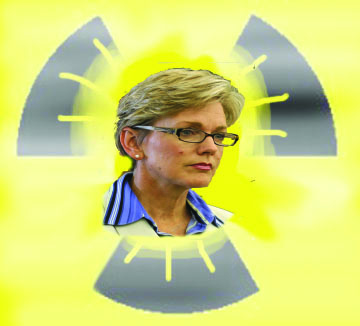
Kraft continued: “Make no mistake about it—while NRC is doing its part to serve nuclear industry needs, we should not lose sight of the fact that it is the aggressive pro-nuclear agenda of the Biden Administration that has unleashed a juggernaut of financial and PR support for new nuclear reactors. Everything from the tens of billions of dollars allocated for new nuclear in the Infrastructure Act and the IRA [Inflation Reduction Act, which establishes a nuclear power production tax credit], to the national dog-and-pony show [the recent U.S. tour promoting nuclear power] of Energy Secretary Jennifer Granholm, demonstrates the administration’s intentions to run roughshod over the objections of the public. We have a hard fight ahead of us.”
The Nuclear Energy Information Service is among the safe-energy, anti-nuclear organizations that are challenging the NRC’s effort to change its “rules” and “guidance” to boost “advanced” nuclear plants. Founded in 1981, its website is neis.org. It plans to soon post through its website a recording of Lyman’s Zoom presentation.
Lyman’s PowerPoint included a slide saying the “NRC is not currently” accepting comments on its plan for changes in its regulations for “advanced” reactors. But, it said, “the public is always free to weigh in” on NRC actions and recommended people attend any public meetings held on the issue.
Lyman joined the Union of Concerned Scientists in 2003 and is based in its Washington, D.C. office. Previously, he was president of the Nuclear Control Institute in Washington. Before that he was a postdoctoral research associate at Princeton University’s Center for Energy and Environmental Studies, now the Science and Global Security Program. He earned a doctorate in physics from Cornell University in 1992. He is a co-author of the book Fukushima: The Story of a Nuclear Disaster.
Karl Grossman, professor of journalism at State University of New York/College at Old Westbury, and is the author of the book, The Wrong Stuff: The Space’s Program’s Nuclear Threat to Our Planet, and the Beyond Nuclear handbook, The U.S. Space Force and the dangers of nuclear power and nuclear war in space. Grossman is an associate of the media watch group Fairness and Accuracy in Reporting (FAIR). He is a contributor to Hopeless: Barack Obama and the Politics of Illusion.
Costs of NuScam’s Small Modular Nuclear Reactors revised upwards – yet again!
According to industry reports the builders of the NuScale small modular reactor (SMR) project recently submitted revised cost estimates to their muni and co-op partners. Initial cost estimates were for power to be produced at about $58/MWh. This figure was recently revised upwards to roughly $90-$100/Mwh, a projected price increase of 60-70%.
The causes cited by management for these price increases were twofold: inflation (in material costs, i.e. steel) and higher interest rates. This initial NuScale project located at the federal government’s Idaho National Laboratories in Idaho Falls would consist of six 77 MW reactors with the units slated to enter commercial service in 2029-2030. These estimates of per KWH cost are significantly above those we have seen recently for renewables plus storage.
Oil Price 21st Nov 2022
Protecting kids from electromagnetic radiation in school and at home

EWG Nov 22
EWG’s big picture recommendations for wireless devices
- Default to airplane mode.
- Increase distance from devices.
- Turn off when not in use.
- Used wired devices if possible.
Children are almost constantly exposed to wireless [electromagnetic] radiation, starting as early as the first weeks of life. As they get older, that exposure grows every day, thanks to the widespread use of smartphones, laptops and other wireless devices in the classroom and at home.
Wireless devices radiate radiofrequency electromagnetic fields. Research has raised concerns about the health risks of exposure to this radiation, including harm to the nervous and reproductive systems, and higher risk of cancer. Cell phone radiation was classified a “possible carcinogen” in 2011 by the International Agency for Research on Cancer, part of the World Health Organization. The agency said human epidemiological studies showed a link between higher risk of a type of malignant brain cancer and cell phone use.
At home
Parents and caregivers can exert more control over their kids’ wireless radiation exposure at home than at school, and have more latitude to try new ways of using devices.
Getting started
To begin, inventory your home’s electronic devices. ………………………………………….
At night
- Strongly encourage your child not to sleep near their wireless gadgets. If this isn’t possible – and let’s face it, with teenagers, you may not succeed at wresting the phone or tablet away – try to convince them to place it away from their head instead of under a pillow.
- Even better, keep electronics out of bedrooms as much as possible, or at least away from beds. This includes TV screens and audio speakers.
- Use an old-fashioned electric or battery alarm clock that doesn’t connect to Wi-Fi. And get one for your children if they claim to need their cell phone so they can get up in the morning.
- Move beds away from utility meters or large appliances, which also emit radiation, even if they’re on the other side of a wall.
……………………. Studying, playing and communicating
- Experts recommend starting a child’s cell phone use as late as practical, considering the family and educational context and needs of each child. The younger kids are, the more vulnerable their bodies are to potentially harmful effects of wireless radiation exposure.
At school……………………………….
For more information
To find additional resources, advocacy guidance, tip sheets and other useful suggestions, consult the websites of one of these organizations:
- The Environmental Health Trust’s “Wi-Fi in Schools Toolkit” offers a wealth of resources, including fact sheets and tip sheets, background on the science of EMF exposure, and guidance for parents, teachers and schools. It also has more than a dozen downloadable and printable posters on exposure and sleep, children’s development, and the effects of EMF exposure on breast cancer risk and male reproductive health.
- An Environmental Health in Nursing textbook downloadable chapter on EMF, courtesy of the Alliance of Nurses for Healthy Environments, contains useful information, like a detailed explanation of the health impacts of EMF exposure, advocate organizations’ tip sheets, and other valuable resources.
- The American Academy of Pediatrics issued recommendations about EMF exposure.
- The Massachusetts Breast Cancer Coalition offers a downloadable backgrounder for students and educators on “Cell Phones, Wireless and Your Health,” which includes suggested activities to use in the classroom and as homework. It includes a list of additional websites you may choose to consult. https://www.ewg.org/news-insights/news/2022/11/protecting-kids-wireless-radiation-school-and-home
U.S. speeds up plans to store upgraded nukes in Europe
Politico, By BRYAN BENDER, PAUL MCLEARY and ERIN BANCO 10/26/2022,
The United States has accelerated the fielding of a more accurate version of its mainstay nuclear bomb to NATO bases in Europe, according to a U.S. diplomatic cable and two people familiar with the issue.
The arrival of the upgraded B61-12 air-dropped gravity bomb, originally slated for next spring, is now planned for this December, U.S. officials told NATO allies during a closed-door meeting in Brussels this month, the cable reveals…………………………..
The arrival date came as a surprise to some longtime observers, who fear it could further stoke an already dangerous situation in Europe. The announcement at the meeting in Brussels came days before NATO kicked off its annual nuclear exercise, known as Steadfast Noon. The two-week exercise ends Sunday and includes some 70 aircraft. And on Wednesday, Russia held a nuclear exercise that its defense chief described as simulating a “massive nuclear strike” in retaliation for a nuclear attack on Russia, according to the Kremlin………………………………………………………
Defense Secretary Lloyd Austin also told NATO allies in Brussels this month that the administration’s long-awaited Nuclear Posture Review — which could be released in the coming days — would maintain Washington’s decades-long nuclear declaratory policy of “calculated ambiguity,” the cable reported.
That is a shift from President Joe Biden’s comments during the 2020 presidential campaign, in which he said he would consider changing U.S. policy to state that the sole purpose of atomic weapons is to deter a nuclear attack against America or its allies, a change that nuclear disarmament groups had pushed for. https://www.politico.com/news/2022/10/26/u-s-plans-upgraded-nukes-europe-00063675
U.N. Supplied Qatar With Tech to ‘Prevent Nuclear Security Incident’ at 2022 World Cup
Washington Free Beacon, Adam Kredo • November 21, 2022,
The United Nations provided Qatar with equipment and training to prevent “a nuclear security incident” from occurring during the 2022 World Cup, according to the U.N.’s nuclear watchdog group.
The International Atomic Energy Agency (IAEA), which works on proliferation issues across the globe, says it has worked with Qatar’s National Committee for the Prohibition of Weapons for the past year “to thwart any attack involving nuclear or other radioactive material.” The announcement comes as jihadist groups like al Qaeda urge its militant followers “wage jihad” against the tournament as Westerners pour into the country……………
The IAEA says that in the lead up to the games, the organization helped Qatar integrate its nuclear security measures into larger plans that could help disrupt a nuclear or radiological attack. This included providing “comprehensive training to national counterparts on developing and implementing nuclear security measures and on responding to nuclear security events and related emergencies.”
The nuclear watchdog lent Qatar more than 120 radiation detecting devices, including personal radiation detectors, portable backpack detectors, and other instruments that can spot things like a dirty bomb, a crude explosive device that includes radioactive materials.
This is “the first time” the IAEA’s Malaysia-based security center provided such equipment to a country hosting a major public event, according to the IAEA………………………. https://freebeacon.com/national-security/un-supplied-qatar-with-tech-to-prevent-nuclear-security-incident-at-2022-world-cup/
-
Archives
- February 2026 (228)
- January 2026 (308)
- December 2025 (358)
- November 2025 (359)
- October 2025 (376)
- September 2025 (258)
- August 2025 (319)
- July 2025 (230)
- June 2025 (348)
- May 2025 (261)
- April 2025 (305)
- March 2025 (319)
-
Categories
- 1
- 1 NUCLEAR ISSUES
- business and costs
- climate change
- culture and arts
- ENERGY
- environment
- health
- history
- indigenous issues
- Legal
- marketing of nuclear
- media
- opposition to nuclear
- PERSONAL STORIES
- politics
- politics international
- Religion and ethics
- safety
- secrets,lies and civil liberties
- spinbuster
- technology
- Uranium
- wastes
- weapons and war
- Women
- 2 WORLD
- ACTION
- AFRICA
- Atrocities
- AUSTRALIA
- Christina's notes
- Christina's themes
- culture and arts
- Events
- Fuk 2022
- Fuk 2023
- Fukushima 2017
- Fukushima 2018
- fukushima 2019
- Fukushima 2020
- Fukushima 2021
- general
- global warming
- Humour (God we need it)
- Nuclear
- RARE EARTHS
- Reference
- resources – print
- Resources -audiovicual
- Weekly Newsletter
- World
- World Nuclear
- YouTube
-
RSS
Entries RSS
Comments RSS
 nuclear-news