40% of Japan’s nuclear plant staff lack experiences of reactivation
By Takashi Maemura and Ayaka Matsuo / Yomiuri Shimbun Staff Writers, September 18, 2022
Nearly 40% of the operations staff at the seven electric power companies that have not yet restarted their nuclear power plants since 2011 have no experience with reactors, a Yomiuri Shimbun survey found.
That group includes Tokyo Electric Power Company Holdings, Inc., the operator of the Fukushima No. 1 nuclear power plant that had an accident during the March 11, 2011, earthquake and tsunami.
Because progress to restart their reactors has been slow, these power companies have sought to maintain their personnel’s skills by dispatching staff to nuclear power plants and thermal power plants operated by other companies.
Currently, only Kansai Electric Power Co., Kyushu Electric Power Co. and Shikoku Electric Power Co. have been able to restart some reactors…………………………………..
Chugoku Electric Power Co.’s Shimane nuclear power plant Reactor No. 2, which is currently shut down, has passed the Nuclear Regulation Authority’s safety examinations, which took about seven years and eight months to complete.
However, the Shimane nuclear power plant has been shut down for more than 10 years, and 41 out of its 107 operators, or 38%, have no experience operating a nuclear power plant. In light of this, Chugoku Electric Power has begun training them this fiscal year, asking Makino, a former operator with more than 30 years of experience, to serve as an instructor.
Israeli sabotage should not be allowed to kill Iran nuclear deal: Middle East Eye
Tehran Times, September 18, 2022 –
In a commentary on September 16, Middle East Eye said since the inception of the talks to resolve the nuclear dispute between Iran and the West, including the United States and certain Western European states, “Israel has done everything to prevent resolving the Iranian nuclear issue through diplomacy.”
Talks started in April 2021 to resurrect the nuclear deal, officially called the Joint Comprehensive Plan of Action (JCPO), that was ditched by former U.S. president Donald Trump.
Former Israeli prime minister Benjamin Netanyahu claimed responsibility for Trump’s decision to pull the U.S. out of the nuclear deal. “We convinced the U.S. president [to exit the deal] and I had to stand up against the whole world and come out against this agreement, and we didn’t give up,” Netanyahu said.
Even now, Middle East Eye also wrote, Israel “has not missed any opportunity to subvert President Biden’s policy to revive the JCPOA.”
Following is the text of the article:
On 12 September, U.S. Secretary of State Antony Blinken said it was “unlikely” that the U.S. and Iran would reach a new nuclear deal anytime soon. Negotiations between Iran and the world powers to revive the Iran nuclear deal, known as the Joint Comprehensive Plan of Action (JCPOA), are faced with a new deadlock .
The International Atomic Energy Agency (IAEA) report on 6 September indicates that “no progress” has been made in resolving questions about past traces of nuclear material in Iran’s three undeclared sites. “Iran’s position [on the IAEA probe] contradicts its legally binding obligations and jeopardizes prospects of restoring the JCPOA,” said the latest statement from European powers Germany, France and the UK.
The spokesperson for Iran’s Atomic Organization, Behrouz Kamalvandi, responded that Iran has been fully cooperative regarding the three alleged sites and has sent information and answers to the IAEA’s questions. “The IAEA must not pass judgements on the Iranian nuclear program based on fabricated documents provided by the Israeli regime with specific political goals,” he said.
A roadmap was signed between Iran and IAEA right after the nuclear deal and finalized the assessment of issues relating to possible military dimension (PMD) issues in December 2015 and before JCPOA’s implementation in January 2016.
“The agency has no credible indications of activities in Iran relevant to the development of a nuclear explosive device after 2009. Nor has the agency found any credible indications of the diversion of nuclear material in connection with the possible military dimensions to Iran’s nuclear program,” the IAEA concluded.
In May 2018, former President Donald Trump withdrew from the JCPOA and re-imposed the world’s most stringent sanctions and pursued the “maximum pressure” policy on Iran. A year later, in response, Iran increased its uranium capacity and enrichment levels.
While the military dimension issues were resolved under the nuclear deal, in 2019, the IAEA requested that Iran answer questions about possible undeclared nuclear activities and materials. The question that arises is whether the safeguards issues constitute the major obstacle standing in the way of reviving the JCPOA.
Israeli sabotage
Since the inception of the nuclear talks, Israel has done everything to prevent resolving the Iranian nuclear issue through diplomacy.
In 2015, in an unprecedented event, then Israeli Prime Minister Benjamin Netanyahu insulted a serving U.S. president in a speech to Congress on the emerging nuclear deal. House Minority Leader Nancy Pelosi dismissed the speech by the Israeli prime minister as an “insult to the intelligence of the United States”.
Netanyahu claimed responsibility for Trump’s decision to pull the U.S. out of the Iran nuclear deal. “We convinced the U.S. president [to exit the deal] and I had to stand up against the whole world and come out against this agreement, and we didn’t give up,” Netanyahu said.
Even during the current U.S. administration, Israel has not missed any opportunity to subvert President Biden’s policy to revive the JCPOA. Over the past decade, Israel has conducted several covert operations against the Iranian nuclear program. From sabotage, bombings, and cyber attacks such as Stuxnet and Duqu, to espionage and the assassination of Iranian nuclear scientists, Israel has done it all.
Israel’s campaign of fear against Iran’s nuclear program has been ongoing for 40 years. Over the past four decades, every now and then Israel has claimed that Iran is only a few years away from a nuclear bomb. For example, in 1995 Netanyahu claimed “Iran is three to five years from being able to produce a nuclear weapon.”
In 2009, General Yossi Baidatz, the chief of research for Israeli military intelligence, said that Iran would have a working weapon by no later than the end of 2010. In 2013, Israeli intelligence officials claimed that Iran could have a nuclear bomb by 2015 or 2016.
Moreover, Iran is deeply suspicious about the IAEA Director General Rafael Grossi’s close relations with Israel. In a statement in March 2020, Iran reiterated that “copies of papers presented to Iran by the agency as the basis for its requests are neither authentic nor related to the open-source, but rather claimed by the Israeli regime to have been acquired through a so-called secret operation.”
On 3 June 2022, Grossi visited Israel to meet with the prime minister to discuss the Iranian nuclear program. Right after the visit, on 9 June 2022, the IAEA passed a resolution saying that Iran must provide credible information in response to the IAEA’s questions. “Grossi’s visit to Israel out of phase with IAEA impartiality, professionalism,” the Iranian foreign minister reiterated.
The ‘most inspected’ country
An informed Iranian source who asked that their identity remains anonymous said “Iran has no problem with addressing all IAEA questions. We are ready to sign a roadmap similar to 2015 with the agency to finalize the IAEA’s technical questions within two months, right after signing the revived agreement. In the case of the contaminated locations, by counting every milligram of Iranian-enriched uranium, the IAEA can verify the truth.”………………………………………..
The world powers need to rethink their current approach. Israel is the only country in the Middle East in possession of nuclear bombs, is one of only four countries in the world that does not permit IAEA inspections, and is not a signatory to the NPT. Iran is not among those four, is a member of the NPT, does not have any nuclear weapons, and is the most inspected country worldwide by the IAEA.
Rather than killing the JCPOA and pushing Iran towards developing a nuclear bomb, the world powers should focus on reviving the JCPOA and push Israel to follow the deal’s principles to achieve a Middle East nuclear-weapon-free zone as the UN General Assembly mandated in 1974. https://www.tehrantimes.com/news/476862/Israeli-sabotage-should-not-be-allowed-to-kill-Iran-nuclear-deal
Space race – the old macho aim – USA and China to beat each other

A new space race? China adds urgency to US return to moon
By ELLEN KNICKMEYER September 15, 2022 WASHINGTON (AP) — It’s not just rocket fuel propelling America’s first moonshot after a half-century lull. Strategic rivalry with China’s ambitious space program is helping drive NASA’s effort to get back into space in a bigger way, as both nations push to put people back on the moon and establish the first lunar bases.
American intelligence, military and political leaders make clear they see a host of strategic challenges to the U.S. in China’s space program, in an echo of the U.S.-Soviet rivalry that prompted the 1960s’ race to the moon. That’s as China is quickly matching U.S. civil and military space accomplishments and notching new ones of its own.
On the military side, the U.S. and China trade accusations of weaponizing space. Senior U.S. defense officials warn that China and Russia are building capabilities to take out the satellite systems that underpin U.S. intelligence, military communications and early warning networks………………………..
NASA, the U.S. civilian space agency, is awaiting a new launch date this month or in October for its Artemis 1 uncrewed test moonshot. Technical problems scrubbed the first two launch attempts in recent weeks.
China likewise aims to send astronauts to the moon this decade, as well as establish a robotic research station there. Both the U.S. and China intend to establish bases for intermittent crews on the moon’s south pole after that…………………………………….
And for space more broadly, Americans alone have tens of thousands of satellites overhead ………………………
The moon programs signal that “space is going to be an arena of competition on the prestige front, demonstrating advanced technical expertise and know-how, and then also on the military front as well,” said Aaron Bateman, a professor of history and international affairs at George Washington University and a member of the Space Policy Institute……………………………….
A 1967 U.N. space treaty meant to start shaping the guardrails for space exploration bans anyone from claiming sovereignty over a celestial body, putting a military base on it, or putting weapons of mass destruction into space.
“I don’t think it’s at all by coincidence or happenstance that it is now in this period of what people are claiming is renewed great-power competition that the United States is actually investing the resources to go back,” said Bateman, the scholar on space and national security. “Time will tell if this turns into a sustained program.”………………………………… https://apnews.com/article/astronomy-russia-ukraine-space-exploration-science-technology-f98448825e588e8902bb74519b55ba9f
Main power line reconnected to Zaporizhzhia nuclear power plant
One of the Russian-held Zaporizhzhia nuclear power plant’s four main
power lines has been repaired and is supplying the plant with electricity
from the Ukrainian grid two weeks after it went down, the UN nuclear
watchdog has said.
Even though the six reactors at Zaporizhzhia, Europe’s
biggest nuclear power plant, have been shut down, the fuel in them still
needs cooling to avoid a potentially catastrophic meltdown. The plant
therefore needs electricity to pump water through the reactors’ core. The
power supply at Zaporizhzhia has been a source of concern after the last
main line went down and three backup lines that can connect it to a nearby
coal-fired power plant were also disconnected.
Guardian 17th Sept 2022
Weapons-grade plutonium secretly sent from South Carolina to Nevada removed early
The Nevada site was used to conduct nuclear weapons testing from 1945 to 1992.
https://www.wltx.com/article/news/regional/weapons-grade-plutonium-from-south-carolina-nevada-removed/101-dba724ee-6fbb-46b0-8d06-3cb9c00— Associated Press, September 17, 2022, CARSON CITY, Nev — Weapons-grade plutonium that secretly was sent to Nevada over objections from the state has been removed ahead of schedule, federal officials said.
U.S. Sen. Catherine Cortez Masto said in a statement that she was notified by the National Nuclear Security Administration late Friday that the plutonium had been removed. The work that started last year had been expected to wrap up by the end of 2026.
The U.S. Energy Department under former President Donald Trump had planned to ship a full metric ton (2,204 pounds) of plutonium to Nevada from South Carolina, where a federal judge ordered the material be removed from a Savannah River site.
Nevada had argued in a lawsuit that the clandestine shipment of half a metric ton (1,100 pounds) of plutonium to the vast Nevada National Security Site — an area larger than the state of Rhode Island — in 2018 amounted to a “secret plutonium smuggling operation.” The U.S. government argued it kept the shipment secret because of national security concerns.
The Nevada site was used to conduct nuclear weapons testing from 1945 to 1992.
The legal battle ended in mid-2020 after the federal government agreed to remove the highly radioactive material already trucked to Nevada and abandon any future plans to send more.
The material now is held at a site in New Mexico, a congressional aide told the Las Vegas Review-Journal.
Watchdog sues nuclear agency over Los Alamos National Laboratory evaluations
https://www.santafenewmexican.com/news/local_news/watchdog-sues-nuclear-agency-over-los-alamos-national-laboratory-evaluations/article_718dfd52-3550-11ed-b9d9-9329cbe2ad1f.html By Scott Wyland swyland@sfnewmexican.com Sep 17, 2022
A New Mexico watchdog group is suing the federal agency that oversees the nation’s nuclear weapons programs for issuing only summaries of its yearly report cards on national laboratories and withholding what the group contends is vital information on deficiencies.
The lawsuit seeks to compel the National Nuclear Security Administration to post in its public reading room the complete report cards for the eight national laboratories involved in nuclear weapons — ones it has withheld in the past and all future assessments.
Allowing the public to see, in particular, the full report on Los Alamos National Laboratory’s shortcomings is increasingly important as the lab gears up to make 30 plutonium bomb cores a year with an escalating federal budget, Jay Coghlan, executive director of Nuclear Watch New Mexico, said in a statement.
The National Nuclear Security Administration’s yearly report cards assess the performances of contracted lab operators and award bonuses to the organizations based on their grades in a process that is not classified, Coghlan argued.
“Nevertheless, NNSA seeks to hide how taxpayers’ money is spent from the public, issuing only terse three-page summaries instead of the full and complete reports,” he said in the statement.
The agency has a policy of not commenting on active litigation.
Coghlan said an example of why the full assessment is necessary is a note on last year’s report for the Los Alamos lab saying it had struggled with some production activities and experienced several challenges carrying out the plutonium mission, and “mission execution was impacted by lapses in safety performance.”
No further explanation was provided in the summary report, he said.
Despite this criticism, the lab’s primary contractor, Triad National Security LLC, received 87.3 percent of the highest possible score, earning it a $22.78 million bonus.
This isn’t the first lawsuit the group has filed over the issue.
Nuclear Watch sued in 2012 to obtain the full reports, prompting the agency to release them every year, Coghlan said.
But in 2019, the agency went back to issuing only summaries and didn’t respond to a request through the Freedom of Information Act for complete reports, he said.
Coghlan contends the agency has become more opaque as it pursues pit production.
“It’s crucial that citizens have full and complete information on how their taxpayer dollars are being spent as the world enters a new and more dangerous nuclear arms race,” he said.
Russia’s Stranglehold On The World’s Nuclear Power Cycle
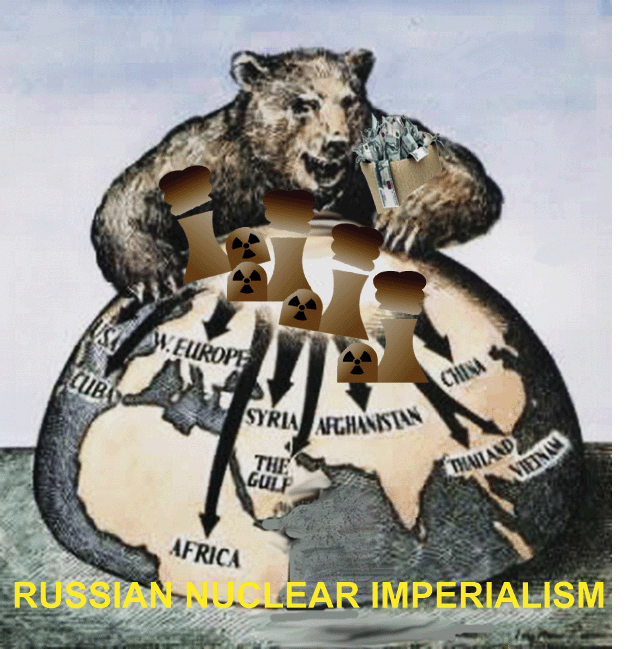
Radio Free Europe, September 01, 2022 By Kristyna Foltynova [Excellent graphics] “…………………… Here’s how Russia plays a crucial role in the world’s nuclear cycle
It’s Not Just About Mining
Russia is among the five countries with the world’s largest uranium resources. It is estimated to have about 486,000 tons of uranium, the equivalent of 8 percent of global supply…………….
However, uranium mining is just one piece of the nuclear process. Raw uranium is not suitable as fuel for nuclear plants. It needs to be refined into uranium concentrate, converted into gas, and then enriched. And this is where Russia excels.
In 2020, there were just four conversion plants operating commercially — in Canada, China, France, and Russia. Russia was the largest player, with almost 40 percent of the total uranium conversion infrastructure in the world, and therefore produced the largest share of uranium in gaseous form (called uranium hexafluoride).
World Uranium Conversion Capacity
In 2020, almost 40 percent of converted uranium came from Russia.
The same goes for uranium enrichment, the next step in the nuclear cycle. According to 2018 data (the latest available), that capacity was spread among a handful of key players, with Russia once again responsible for the largest share — about 46 percent.Therefore, Russia is a significant supplier of both uranium and uranium enrichment services. According to the latest available data, the European Union purchased about 20 percent of its natural uranium and 26 percent of its enrichment services from Russia in 2020. The United States imported about 14 percent of its uranium and 28 percent of all enrichment services from Russia in 2021.
Purchases Of Natural Uranium
In 2020, Russia supplied about one-fifth of the EU’s natural uranium and was among the top suppliers of uranium to the United States in 2021.
Did Someone Say Nuclear Reactors?
Nuclear reactors made in Russia are known as VVER — an abbreviation for the Russian vodo-vodyanoi enyergeticheskiy reactor (water-water energetic reactor). These reactors use water both as a coolant and as a moderator and were originally developed in the Soviet Union. There are several versions of VVERs (such as the VVER-440 and VVER-1000), with the volume of power being one of the significant differences.
Currently, there are 11 countries where various types of VVERs are operating, including Bulgaria, the Czech Republic, Hungary, and Finland. On top of that, other countries such as Egypt, Turkey, and Argentina currently have these reactors under construction or plan to build them.
Russia is considered the world leader when it comes to the export of nuclear plant development. Between 2012 and 2021, Rosatom initiated construction of 19 nuclear reactors; 15 of these were initiated abroad. That is far more than the next most prolific providers: China, France, and South Korea. Although China started building 29 reactors during the same period, only two of them were initiated abroad. France started building two reactors abroad, and South Korea four.
Exporters Of Nuclear Plants
Between 2012 and 2021, Russia initiated the construction of 15 nuclear reactors abroad.
Don’t Forget The Fuel
To keep the reactors operating, plants need a regular supply of nuclear fuel — usually a certain type of fuel. And this is where another level of dependency on Russia can be observed. Although there are several suppliers on the market, the Russian TVEL Fuel Company is currently the only authorized supplier of fuel needed for VVER-440s……..
Russia is also able to supply high-assay low-enriched uranium (also known as HALEU). It is a type of fuel that will be needed for more advanced reactors that are now under development by many companies across the United States. The main difference from the fuel that is currently being used is the level of uranium enrichment. Instead of up to 5 percent uranium-235 enrichment, the new generation of reactors needs fuel with up to 20 percent enrichment……………. At the moment, the only supplier able to provide the fuel on a commercial scale is Russia’s Tenex (owned by the Russian state-owned company Rosatom).
Looking For New Markets
Selling nuclear technology is also part of Russia’s effort to gain influence and reap profits in countries that are new to nuclear energy. One of the reasons countries want to cooperate with Russia is that it offers a “whole package” solution. Russia can not only build a nuclear plant and supply fuel, but it also trains local specialists, helps with safety questions, runs scholarship programs, and disposes of radioactive waste.
However, offering attractive loans is probably Russia’s most powerful tool. These loans are usually backed by government subsidies and cover at least 80 percent of construction costs. For example, Russia has already lent $10 billion to Hungary, $11 billion to Bangladesh, and $25 billion to Egypt — all to build nuclear power plants.
Russia has operating nuclear reactors in 11 countries, and more are under construction or being planned. Besides that, Russia has also signed either memorandums of understanding or intergovernmental agreements with at least 30 countries around the world, mostly in Africa. These serve as a declaration of interest in nuclear technology or set an intention to cooperate on the building of nuclear plants, respectively.
Russia has operating nuclear reactors in 11 countries, and more are under construction or being planned. Besides that, Russia has also signed either memorandums of understanding or intergovernmental agreements with at least 30 countries around the world, mostly in Africa. These serve as a declaration of interest in nuclear technology or set an intention to cooperate on the building of nuclear plants, respectively.
Some experts warn that African countries might not be ready for nuclear power, but Russia argues that the technology represents an answer to the continent’s increasing demand for electricity. It is also worth noting that African countries represent the largest voting bloc in the United Nations, which might be another reason for Russia to strengthen its ties in the region.
Nuclear Cooperation
There are at least 50 countries with some level of nuclear cooperation with Russia………. https://www.rferl.org/a/russia-nuclear-power-industry-graphics/32014247.html—
Walk held to protest storing nuclear waste in Northwest
The group of over 50 people gathered outside MP Patty Hajdu’s office before their walk and shared their concerns over the possible storage of nuclear waste in the region
https://www.tbnewswatch.com/local-news/walk-held-to-protest-storing-nuclear-waste-in-northwest-5835959 TBnewsWatch.com Staff, 18 Sept 22
THUNDER BAY – Nuclear Free Thunder Bay held a walk on Saturday in solidarity of other walks happening in Northwestern Ontario throughout September to protest the transport and burial of nuclear waste in the north.
The group of over 50 people gathered outside Thunder Bay-Superior North MP Hajdu’s office before their walk and shared their concerns over the possible storage of nuclear waste in the region.
The Nuclear Waste Management Organization currently has two potential siting areas the Municipality of South Bruce in southern Ontario and The Township of Ignace in northwestern Ontario.
The site selected will then be home of Canada’s deep geological repository where nearly 5.5 million spent nuclear fuel bundles from across Canada will be shipped to and then stored.
“We are opposed to it largely because there are all kinds of weaknesses with the DGR and no one can predict over the next hundred-thousands of years how safe it’s going to be for your next generation and generations to come,” said Dodie Legassick, co-organizer of the walk.
“And we’re also opposed because it is a real transportation issue. There’s going to be two to three truckloads carrying UFTPs (Used Fuel Transportation Packages) per day for 45 to 50 years and there are going to be super loads in addition to that and they want to bring in.”
Charles Faust, co-organizer, says that they’re also concerned with the lack of transparency from the NWMO.
“We have major concerns with the citing process that they’ve undertaken. Which is, as I said, not a legislative or regulatory requirement,” he said. “It’s a public relations exercise, where they are looking for an impoverished community like Ignace to accept them as a willing host for this project.”
The walk ended at the office of Thunder Bay-Superior North MPP Lise Vaugeois’ to petition the Ontario Government to adopt the proximity principle which advocates that waste should be disposed of (or otherwise managed) close to the point at which it is generated.
“We’ve got a petition out that we’ve that we’re getting signed to present to the Legislature of Ontario,” said Faust. “So, we’re asking people to get involved, to tell their friends, to tell her family to walk with us, to take a sign and to write letters to the editor and basically to spread the word.”
France Urges Brussels To Label Nuclear-Produced Hydrogen “Green”

EurActiv , By Paul Messad, French Energy Minister Agnès Pannier-Runacher is trying to get EU Energy Commissioner Kadri Simson to include nuclear among energy sources for the production of so-called “green” hydrogen, according to a letter seen by EURACTIV France………………..
according to the French minister, the current rules leave little room for the production of green hydrogen from “low-carbon” electricity, mostly nuclear power.
Given “the absolute priority of the next decade for hydrogen, […] the only important issue is the carbon content of the hydrogen produced and not the production vector,” Pannier-Runacher wrote to the European Commissioner…………………………….
France riding solo
The pro-nuclear position of the French when it comes to green hydrogen is not entirely shared by the industry.
Jorgo Chatzimarkakis, CEO of Hydrogen Europe, which represents the interests of the industry in 25 EU countries, said the letter is proof that France is “going solo” on nuclear and putting itself in a “dangerous insular position”……… https://www.eurasiareview.com/18092022-france-urges-brussels-to-label-nuclear-produced-hydrogen-green/
France sends reprocessed nuclear fuel to Japan, despite environmental and safety dangers

https://japantoday.com/category/national/france-sends-latest-nuclear-shipment-to-japan CHERBOURG, France 18 Sept 22
Two ships carrying reprocessed nuclear fuel destined for Japan set sail Saturday morning from northern France, an AFP photographer said, despite criticism from environmental campaigners.
The fuel was due to leave the northern French port city of Cherbourg earlier this month but was delayed by the breakdown of loading equipment.
Environmental activists have denounced the practice of transporting such highly radioactive materials, calling it irresponsible.
The previous transport of MOX fuel to Japan in September 2021 drew protests from environmental group Greenpeace.
MOX fuel is a mixture of reprocessed plutonium and uranium.
“The Pacific Heron and Pacific Egret, the specialised ships belonging to British company PNTL, left Cherbourg harbor on September 17. They will ensure the shipment of MOX nuclear fuel to Japan,” French nuclear technology group Orano said in a statement Saturday.
They are bound for Japan for use in a power plant and Orano said it expected the shipment to arrive in November.
Japan lacks facilities to process waste from its own nuclear reactors and sends most of it overseas, particularly to France.
The operation was carried out “successfully”, Orano said, and it is the second shipment that arrived in Cherbourg from a plant in La Hague, located 20 kilometers away, after the first came on September 7.
Yannick Rousselet of Greenpeace France previously denounced the shipment.
“Transporting such dangerous materials from a nuclear proliferation point of view is completely irresponsible,” he said last month.
MOX is composed of 92 percent uranium oxide and eight percent plutonium oxide, according to Orano.
The plutonium “is not the same as that used by the military,” it said.
Sendai and Genkai nuclear power stations in the path of powerful Typhoon Nanmadol

Strong Typhoon Nanmadol feared to hit southwest Japan’s Kyushu on Sept. 18
Close to Sendai and Genkai nuclear power stations
Record-breaking rainfall+violent winds – peak gusts at 270kph
FUKUOKA https://mainichi.jp/english/articles/20220917/p2a/00m/0na/010000c
Large and powerful Typhoon Nanmadol is predicted to approach southwestern Japan’s Kyushu region and make landfall there between Sept. 18 and 19.
According to the Japan Meteorological Agency (JMA), the 14th typhoon of the year was moving northwestward at a speed of about 20 kilometers per hour over the sea some 190 kilometers east of Minamidaito Island at 9 a.m. on Sept. 17. The tropical storm had a central atmospheric pressure of 910 hectopascals. The maximum sustained wind speed near its center was 198 kph, with peak gusts at 270 kph. Violent winds at a speed of 90 kph or more were recorded within a 185-km radius on the east and a 150-km radius on the west of the storm’s center.
Many parts of Japan may be affected by the typhoon for extended periods of time as it is moving slowly while maintaining its strength. It is feared that the storm could cause record-breaking rainfall and violent winds through Sept. 19, the last day of the three-day weekend, primarily in west Japan and along the Pacific coast of east Japan. The JMA is calling on people to refrain from unnecessary outings.
(Japanese original by Azusa Yamazaki, Kyushu News Department)
EDF contractors relax radiation exposure limits to speed up reactor repairs
By Benjamin Mallet – Friday 16 Sept 22, PARIS (Reuters) https://www.msn.com/en-gb/news/world/exclusive-edf-contractors-relax-radiation-exposure-limits-to-speed-up-reactor-repairs/ar-AA11UdIE?ocid=st– Some contractors helping French power giant EDF to inspect and repair its corrosion-hit nuclear reactors are planning to relax their rules on radiation exposure limits so that their workers can spend more time on the job, EDF told Reuters.
The company, which is rushing to get its fleet of nuclear powerstations ready for the winter, said the new threshold was in line with its own standards and remained well below French legal limits.
“We have been informed by some of our partners that they expect to increase the radiation exposure limit for some of their staff,” EDF said in emailed comments on Friday, responding to a Reuters query.
“The activities currently underway at our plants lead to a higher number of hours worked in the nuclear part of our sites. This additional activity had not been foreseen by our partners when they set their radiation limits,” the company said.
Two sources with direct knowledge of the repair works told Reuters that at least one EDF contractor, French company Monteiro, had already increased the maximum exposure its workers could be subject to, adding this posed no health risk.
A Monteiro spokeswoman had no immediate comment.
The sources said the changes to the safety guidance illustrated how EDF was racing against the clock to restart 15 reactors taken offline last winter after the emergence of stress corrosion at some plants.
Continue reading
US-South Korea Provocations in the Pacific
Consortium News, September 14, 2022, The resumption of the recent joint military exercises is viewed with alarm by China, which, like North Korea, has repeatedly pointed to U.S. attempts to set up a NATO-like organization in Asia, writes Aditya Sarin.
By Aditya Sarin Peoples Dispatch Sept 16 2022,
Between Aug. 22 and Sept. 1, the United States and South Korea concluded their largest joint military drills in the Korean Peninsula since 2017, under the name “Ulchi Freedom Shield.” Over the last four years, the scope of the annual exercises had been scaled back, first because of former U.S. President Donald Trump’s attempts at diplomacy with North Korea’s Kim Jong-un and later because of the Covid-19 pandemic.
With these drills, however, the U.S. and South Korea seem to be attempting to send a clear message to both North Korea and China of their united military posture in the region, and come at a time when the U.S.’ encirclement of China continues rapidly.
The U.S. has maintained a force of at least tens of thousands of troops in South Korea (officially the Republic of Korea, or ROK), since before the Korean War. While South Korean forces are otherwise independent, at times of war they are subordinated to the command of a U.S. general as part of the ROK/US Combined Forces Command. With 28,500 U.S. troops stationed there, South Korea has the third-highest number of U.S. troops of any country outside of the U.S.
While the recent exercises have been conducted against a nameless enemy, it is not hard to see towards whom their message is aimed. The site of the exercises was only 32 kilometers from the border and De-Militarized Zone (DMZ) between North and South Korea. Live-fire tank and troop maneuvers have been practiced as the U.S. and the ROK engage in simulations and seek to increase interoperability of their deployments and technologies…………………………………….. more https://consortiumnews.com/2022/09/14/us-south-korea-provocations-in-the-pacific/
Plutonium secretly shipped to Nevada removed sooner than expected

By Gary Martin Las Vegas Review-Journal, September 16, 2022 –
WASHINGTON – A half-metric ton of weapons-grade plutonium secretly shipped into Nevada has been removed four years early under federal court order and an agreement reached by U.S. Sen. Catherine Cortez Masto and former Energy Secretary Rick Perry, officials said Friday.
Cortez Masto, D-Nev., first announced the removal of the plutonium, stored at the Nevada National Security Site north of Las Vegas.
She was notified by the National Nuclear Security Administration late Friday………………….
The NNSA shipped the plutonium from the Savannah River Site in South Carolina to Nevada in 2019 under federal court order.
Nevada officials, while notified it would happen, were incensed when efforts to stop the transfer through federal courts became moot after the Department of Energy disclosed the plutonium had already been shipped into the state.
Four years ahead of schedule
“When I heard that the Trump administration secretly shipped weapons-grade plutonium to our state, I acted immediately to ensure it was removed,” Cortez Masto said in a statement.
Cortez Masto also secured in writing a pledge by Perry not to send any more plutonium from South Carolina to Nevada.
“I’m proud to announce the removal has been completed four years ahead of schedule,” Cortez Masto said.
A federal judge ordered the Department of Energy to remove weapons grade plutonium from the Savannah River Site in South Carolina after a facility to turn the radioactive material into fuel for nuclear power plants was terminated.
Some of the material was sent to the Nevada facility, and some to the Pantex Plant in Texas until pits to accommodate the material at Los Alamos National Laboratory in New Mexico were completed, according to NNSA.
The material from Nevada now has been shipped to Los Alamos, a congressional aide confirmed.
Secret shipment from South Carolina draws ire
Former Gov. Brian Sandoval, a Republican, was furious that the Energy Department shipped the plutonium to Nevada when the state in May 2019 had notified the federal government of its intent to seek an injunction to prevent the transfer.
Sandoval directed then-state Attorney General Adam Laxalt to file a lawsuit in federal court in Reno to block the shipment.
But the lawsuit was dismissed after Energy Department lawyers in 2020 disclosed in court papers that the shipment had already occurred, making the state’s lawsuit moot.
Gov. Steve Sisolak and state Attorney General Aaron Ford, both Democrats, filed another lawsuit and won a ruling that would force the federal government to eventually remove the plutonium.
………. the danger of exposure to the materials prompted the federal judge to order the plutonium moved from South Carolina.
‘Beyond outrage’
The secret shipping of the plutonium, because of federal national security concerns, drew the ire of Nevada officials of both major political parties who accused Perry and the Energy Department of lying to the state about its intent…………………………….
The shipment heightened tensions between Nevada and the Trump administration, which also sought to open Yucca Mountain as a permanent nuclear waste repository, just 60 miles north of Las Vegas. https://www.reviewjournal.com/news/politics-and-government/plutonium-secretly-shipped-to-nevada-removed-sooner-than-expected-2641314/
Russian state firm signs $9.1bn loan deal to fund nuclear plant in Turkey

Rosatom, which has been wiring money to Ankara to shore up Turkey’s depleted foreign currency reserves, signs deal with Gazprombank, Ragip Soylu, Antalya, Turkey, 16 September 2022
A Russian state-owned company signed a $9.1bn loan deal with Gazprombank in August to fund the construction and development of Turkey’s Akkuyu nuclear power plant, according to the official documents.
In a public announcement on Wednesday, Rosatom Corp published the deal signed on 3 August, which opens a line of credit to finance Akkuyu Nuclear JSC, its subsidiary in Turkey………………………..
Bloomberg reported last month that Rosatom had decided to wire $15bn to Turkey for the construction of the $20bn Akkuyu nuclear power plant, citing officials who said that an initial $5bn had already been received…………………
The Turkish government is in dire need of foreign funding as a result of its rapidly evaporating foreign currency reserves.
Rosatom is expected to rapidly spend up to $2bn on overdue payments to subcontractors. The company told Bloomberg that it would indeed transfer some funds to Turkey, but an amount much lower than that declared by Turkish officials………….more https://www.middleeasteye.net/news/russia-turkey-gazprombank-akkuyu-plant-loan-fund
1 This Month
23 April – WEBINAR – Why new nuclear reactors are the wrong tools for decarbonization Thursday, April 23 • 1 AM – 2 AM AEST

Pine Ridge Uranium is the real threat, not Tehran- Tell Burgum: Stop the Extraction.
Chernobyl: The Lost Tapes – A good documentary on Chernobyl on SBS available On Demand for the next 3 weeks– https://www.sbs.com.au/ondemand/tv-program/chernobyl-the-lost-tapes/2352741955560
To see nuclear-related stories in greater depth and intensity – go to https://nuclearinformation.wordpress.com
-
Archives
- April 2026 (275)
- March 2026 (251)
- February 2026 (268)
- January 2026 (308)
- December 2025 (358)
- November 2025 (359)
- October 2025 (376)
- September 2025 (257)
- August 2025 (319)
- July 2025 (230)
- June 2025 (348)
- May 2025 (261)
-
Categories
- 1
- 1 NUCLEAR ISSUES
- business and costs
- climate change
- culture and arts
- ENERGY
- environment
- health
- history
- indigenous issues
- Legal
- marketing of nuclear
- media
- opposition to nuclear
- PERSONAL STORIES
- politics
- politics international
- Religion and ethics
- safety
- secrets,lies and civil liberties
- spinbuster
- technology
- Uranium
- wastes
- weapons and war
- Women
- 2 WORLD
- ACTION
- AFRICA
- Atrocities
- AUSTRALIA
- Christina's notes
- Christina's themes
- culture and arts
- Events
- Fuk 2022
- Fuk 2023
- Fukushima 2017
- Fukushima 2018
- fukushima 2019
- Fukushima 2020
- Fukushima 2021
- general
- global warming
- Humour (God we need it)
- Nuclear
- RARE EARTHS
- Reference
- resources – print
- Resources -audiovicual
- Weekly Newsletter
- World
- World Nuclear
- YouTube
-
RSS
Entries RSS
Comments RSS
 nuclear-news