The provocations behind the ‘unprovoked’ war
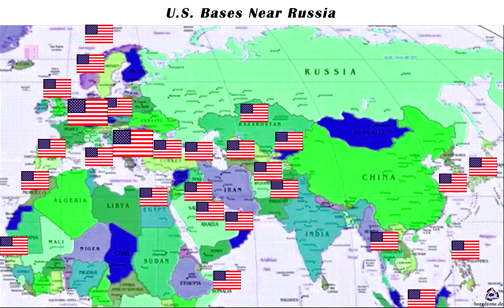
By Phil Wilayto Jul 23, 2022, ack in 1949, the United States, Canada and 10 Western European countries formed a military alliance called the North Atlantic Treaty organization, or NATO. Washington had decided that the Soviet Union, its wartime ally — the one that had broken the back of the Nazi war machine — now was its peacetime enemy.
By 1990, the Soviet Union and most of its socialist allies were collapsing, the result of internal contradictions and outside pressures. The U.S. was promoting the reunification of Germany — a move opposed by Soviet leader Mikhail Gorbachev, who still remembered how his country had lost 20 million people to the Nazi invasion, and was not real excited about the prospect of a revitalized Germany.
So U.S. Secretary of State James Baker offered a deal: If Gorbachev agreed to a united Germany, NATO — which, by that time, had grown from its original 12 members to 16 — would promise not to advance one inch eastward. Gorbachev agreed.
Today, each of the 14 new NATO member countries has been to the east. Of the seven countries bordering Russia’s western flank, Estonia, Latvia and Norway already are NATO members. Finland, Georgia and Ukraine have asked to join.
Once that process is completed, Russia’s only western border ally would be Belarus. Every other bordering country would be committed by Article 5 of the NATO Charter to come to each other’s defense in the event of a military confrontation.
And this should worry Russia, why?
In 1999, NATO carried out a 78-day air campaign in Yugoslavia that involved 400 aircraft, 5,000 personnel and the use of cancer-causing depleted uranium munitions……………………………………
Once that process is completed, Russia’s only western border ally would be Belarus. Every other bordering country would be committed by Article 5 of the NATO Charter to come to each other’s defense in the event of a military confrontation.
And this should worry Russia, why?
In 1999, NATO carried out a 78-day air campaign in Yugoslavia that involved 400 aircraft, 5,000 personnel and the use of cancer-causing depleted uranium munitions.
For NATO, combined military expenditures of all 30 member countries in 2021 was an estimated $1.2 trillion — more than 18 times that of Russia.
And even though Russia and NATO have rough parity when it comes to nuclear weapons, it’s just possible that the steady eastward expansion of a steadily growing, hostile NATO might have raised some legitimate security concerns in Russia.
Then, there’s the matter of U.S. support for the anti-Russian Ukrainian coup of 2014. This began as peaceful protests against then-President Viktor Yanukovych for his opposition to closer economic ties with Western Europe. It morphed into a violent uprising in which openly neo-Nazi organizations played a major role.
The U.S. support was not in dispute. Sen. John McCain, R-Ariz., had traveled to give encouraging speeches to the protesters. U.S. Assistant Secretary of State for European and Eurasian Affairs Victoria Nuland handed out pastries to the crowds. More importantly, she later openly bragged about how the U.S. had spent $5 billion promoting “pro-democracy” groups in the country.
The coup changed Ukraine in fundamental ways. The new government banned the use of the Russian language for official business, even though 17% of the population was ethnic Russian and some 30% spoke Russian as a first language.
Statues honoring Ukrainian fascists like Stepan Bandera, who had collaborated with the Nazi occuaption, were erected while memorials to Soviet war heroes were taken down. The neo-Nazi organizations were free to roam the streets, attacking anyone opposed to the coup. Those acts of violence included the May 2014 Odessa Massacre, where dozens of people were murdered in the Black Sea port city.
Meanwhile, Ukraine began to operate as a NATO member in everything but name, including carrying out joint military exercises right up to Russia’s border.
None of this is meant to endorse Russia’s war. But since the Biden administration already has given Ukraine $5.3 billion in military aid, it might be a good idea to view the war in a historical context.
And if we do that, “unprovoked” might not be the first word that comes to mind.
Phil Wilayto is editor of The Virginia Defender and coordinator of the Odessa Solidarity Campaign. Contact him at: virginiadefendernews@gmail.com
https://richmond.com/opinion/columnists/phil-wilayto-column-the-provocations-behind-the-unprovoked-war/article_ea0e7635-8bd4-5fa7-beef-56d0f2d149f6.html
Protest against radioactivity-contaminated water, at French nuclear site

ALERT Cigéo = radioactivity = contaminated water http://burestop.free.fr/spip/spip.php?article1040&fbclid=IwAR05l37LqSVNJwx7JOKpqVBxYmfqiTd8ggXjx_YYpUxc1w1Ock_MoaMBjyY COMMUNIQUE COORDINATION CIGEO/BURE STOP – 23/07/2022,
Small rafts to warn of the danger threatening a large territory!
The Coordination Stop Cigéo organized this Saturday 23/07/2022 a symbolic action in Bar-le-Duc, to make visible what Andra does not show, to tell what Andra is silent about: operating discharges of Cigeo for 150 years, just as those resulting from an underground accident will be impossible to control.
The small wooden rafts, painted with radioactive symbols and arrows, mentioning Cigéo/Bure and Paris and thrown over the water in the Ornain, symbolized the phenomenal danger that threatens water resources, this common good.
SEE THE PICTURES ( Pictures )
Indeed, the water discharges contaminated by the operation of the site or in the event of an accident, would come out in an anarchic way on the sector in a few days, towards Saulx via the losses of Orge, towards Bar-le-Duc via Haironville, towards Saint-Dizier via Ménil-sur-Saulx, towards Joinville, haphazardly… knowing that everything would end up flowing into the Marne. The impacts of Cigeo (1) would not be confined to the ultra-local perimeter as Andra claims, but would be diluted in the hydrographic network towards Paris.
A gigantic site, a scary future
The high water consumption of the site would clearly have an impact on the local resource and its distribution… which worries many municipalities today. What will become of local waterways (fragile natural environments)? What effects on tap water? What are the impacts of chemical and radioactive releases on activities such as fishing, market gardening, etc.? All these simple but essential questions have never been addressed. Afraid to tell the truth?
Cigeo could endanger the territory and beyond, permanently, if the water were to suffer contamination and scarcity. At a time when heat and drought are becoming an agonizing and lasting reality, there is still time to refuse such an impacting project for man and nature and to change course.
Public utility, obtained on a file more than inadequate
Andra repeats that the public utility of Cigéo does not mean authorization of the project. But the recent signatures of the DUP and OIN decrees are incomprehensible, given the lack of figures on the real impact of nuclear storage on water resources and surface waters. Beyond the inadequacy of the data in the DUP file, Andra is postponing the potential conclusions of the research until later, at the stage of the creation authorization application, which according to it, would serve as an application for authorization of rejection. And that is not enough for us!
Everyone at the Bure’lesques festival, August 5-6-7, 2022 in Hévilliers
The question of water from here and water from elsewhere, threatened by nuclear power and its waste, will be at the heart of the conferences and round tables of the Bure’lesques 2022. Three days of exchanges and information but not only! Film screenings, shows, concerts and good food, a rich and beautiful program is announced for this 3 rd edition. ALL INFO on https://burefestival.org/
Nonsense to say ‘Australia needs nuclear submarines to defend itself’: Australian scholar

Global Times 24 July 22,
After the Albanese government took office in Australia, there have been discussions about a possible reset of China-Australia ties. Global Times (GT) reporter Yan Yuzhu talked to Professor David Goodman (Goodman), director of the China Studies Centre at the University of Sydney, about his opinions on the reason why there has been hostility in Australia toward China and possible changes in the new government regarding the China policies……………………………..
Goodman:
I think this government is definitely more inclined to deal with sensible diplomacy with China than standing up in public and telling China why it is wrong. That’s a good thing, because talk is always preferable to war.
Penny Wong is a great foreign minister, as she is listening to people and doing things. She has put a whole new working party in place to see how we can more positively deal with our foreign policy. …………………..
A lot of nonsense is talked such as “Australia needs to have nuclear submarines to defend itself.” It doesn’t work, and there are many opinion influencers who agree with me that this is really not healthy.
Of course, we don’t want to be attacked by anyone, but when you think about what it would take China to physically attack Australia, including logistic and military challenges, it will be clear that China will not do so.
But a lot of the defense officials in the past government in Australia are thinking about what we would do as Australians if China “invaded” Taiwan. How crazy. Even people who are anti-China in the UK and the US have said that kind of argument is rubbish, because it is.
What I’d like to see in the bilateral relationship is that the trade ties could ease. The previous government made some statements and criticism about Chinese trade practices which led to bad trade relations between the two countries. I’d like to see them eased. And in my opinion, China has some severe economic problems ahead. It would be in China’s interests to solve them. ………………………………
About Australia’s hostility toward China, one of the reasons is that politicians outside China prefer a threat to exist so that they can use it to mobilize support for themselves. As a result, both China and Russia become the new fashionable threats.

Besides, it is because of the US and European defense industries who fund one of Australia’s leading think tank that leads the charge against China.
Arms makers of course want there to be a China threat because they can sell more. It’s a logic of capitalism I’m afraid.
As to Australia’s stance toward the US, there is a debate going on in Australia as I mentioned before. I don’t know who the majority supports, but there is a sizable body of opinion that doesn’t think that America is the answer to all our problems. There’s also a lot of discussion in Australia about foreign interference and involvement in the local property market. https://www.globaltimes.cn/page/202207/1271242.shtml
EDF to change design of EPR nuclear reactors following troubles of the China one – (making it up as they go?)
EDF to redesign flagship UK nuclear reactors after China shutdown
Company to change way fuel rods are held in place in pioneering EPR generators,
By Rachel Millard, 23 July 2022 • The power company charged with driving Britain’s nuclear revolution is to overhaul the design of its flagship new reactor to avoid a repeat of damage to fuel rods that forced a unit in China to shut down. …https://www.telegraph.co.uk/business/2022/07/23/edf-redesign-flagship-uk-nuclear-reactors-china-shutdown/
The Great American Military Rebrand

A new defense bill crammed with political pork smashes records, but you likely didn’t hear the news, because War is Good again
Matt Taibbi Jul 21 Fifteen years ago……..A trifecta of scandals……………… exposed an intricate system of legalized payoffs both parties scrambled to oppose.
Earmarks, those handy appropriations tools congressfolk used to slip million-dollar favors into the budget, had been ballooning in number for over a decade and looked so bad upon reveal, “corruption and ethics” became the top issue in the 2006 midterms…………………. In return, the contractor showered the congressman with gifts — helping him finance a mansion in Rancho Santa Fe, a condo overlooking the nation’s capital, exclusive use of a yacht on the Potomac, antiques, private-jet travel and prostitutes.
Fast forward to last week. As January 6th hearings, a presidential fist-bump, and a Kardashian spawn’s gender reveal gobbled attention, the House quietly passed a monster $839 billion defense package. It was “the definition of a bipartisan bill,” chirped Alabama’s Mike Rogers, as 180 Democrats and 149 Republicans joined to smash by tens of billions previous records for military spending. With this already underreported story, just one news outlet, Roll Call, described a “first of its kind” report published by the Department of Defense Comptroller’s office, which revealed at least $58 billion of “congressional additions” above Joe Biden’s budget request.
As former Senate aide and defense budget analyst Winslow Wheeler puts it, these “additions” are “not (all) earmarks under either the House’s or Senate’s shriveled definition of them, but they are all earmarks… under the classic understanding……………. Billions of dollars in weapons the military did not seek, such as more than $4 billion worth of unrequested warships, many of them built by the constituents of senior appropriators.
……………………………….. the actual amount of “additions” is almost surely far higher than $58 billion.
…. Both the triumphant return of the earmark and the enormous defense hike should have been big stories. To put $58 billion (at least) in defense “increases” in context, the amount of overall federal earmarks in 2006, the infamous year that prompted so much outrage, was said to be $26 billion. Meanwhile Biden’s one-year arms increase exceeds the pace of Donald Trump’s infamous $200 billion collective defense hike between 2017-2019. These are major surges past the levels of both pork and weapons spending that had progressives roaring for “change,” yet there’s almost zero outcry now. Why?
It feels like just the latest echo in a prolonged, very successful re-marketing effort…………………
the U.S. embarked upon what geopolitical analyst Christopher Mott calls the “millennial rebrand of the neoconservative project,” and the Pentagon’s fortunes rose anew. In the Obama years, think-tankers, pundits, and other actors began to push inverted, left-friendly versions of Bush’s rejected military utopianism, this time focusing on using force to achieve social justice aims abroad. It worked, brilliantly……………..(Subscribers only) more https://taibbi.substack.com/p/the-great-american-military-rebrand
Stiff resistance by fishing unions to Japan’s move to dump Fukushima nuclear wastewater into the ocean.
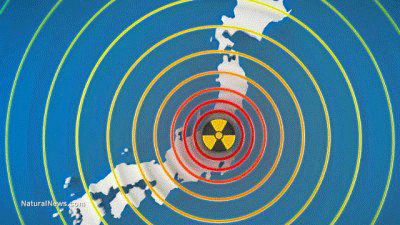
The impact of Japan’s 2011 earthquake and tsunami still ripples through
the country as the nation continues the decommissioning process of the
wrecked Fukushima Daiichi nuclear power plant. In addition to mass
evacuations of the surrounding area, the plant’s meltdown also uncovered
failings by its operator to take proper precautions, resulting in hefty
fines for four former executives.
The latest move involving the failed
plant has brought fresh criticism as Japan’s nuclear regulators approved
a plan to release water from the plant into the ocean, the government said
on Friday. The water, used to cool reactors in the aftermath of the 2011
nuclear disaster, is being stored in huge tanks in the plant, and amounted
to more than 1.3 million tonnes by July. The regulators deemed it safe to
release the water, which will still contain traces of tritium after
treatment, the foreign ministry said in a statement.
Plant operator Tokyo
Electric Power Company (Tepco) would face additional inspections by
regulators, it added. Tepco plans to filter the contaminated water to
remove harmful isotopes apart from tritium, which is hard to remove. Then
it will be diluted and released to free up plant space and allow
decommissioning to continue. The plan has encountered stiff resistance from
fishing unions in the region, which fear its impact on their livelihoods.
Neighbours China, South Korea and Taiwan have also voiced concern.
Irish Independent 24th July 2022
Greenpeace experts find Chornobyl under Russian occupation – radiation levels much higher than the IAEA estimated

Russian military occupation at Chornobyl commits crime against the
environment and global science understanding of radiation risks.
This was stated by the Greenpeace experts during the press conference in the Ukraine
Crisis Media Center on July 20. The Greenpeace investigation team has found
radiation levels in areas where Russian military operations occurred that
classifies it as nuclear waste to be at least three times higher than the
estimation by the International Atomic Energy Agency (IAEA).
In April 2022, the IAEA provided very limited data with assurances that radiation levels
were ‘normal” and not a major environmental or public safety issue.
Ukraine Crisis 20th July 2022
‘Israeli cell planted explosives at nuclear facility,’ Iran media says
Report says cell arrested with ‘powerful explosives’, planned to blow up a ‘sensitive center’ in central Isfahan province — home to nuclear sites and missile bases
https://www.ynetnews.com/article/hkb1uwohq Ynet| 07.24.22
ranian news website Nour News, which is affiliated with Iran’s Supreme National Security Council, reported that the cell planned to blow up a “sensitive center” in Isfahan province in the center of the country. Isfahan is home to several major nuclear sites, as well as missile bases.
According to other reports, the cell crossed into Iran from Iraq’s Kurdistan region after “months of training” in Africa.
Iran’s Intelligence Ministry did not specify, however, how many cell members were arrested and did not publish details about their nationality.
War wins the ‘big bucks’ while climate gets the ‘change’
War wins the ‘big bucks’ while climate gets the ‘change’
Murad Qureshi
Wealthy countries claiming to lead on climate change are spending big on military budgets while denying support to developing countries facing devastation from climate-induced events.
Nuclear industry veteran to lead nuclear waste group’s board – ( the revolving industry-govt door)
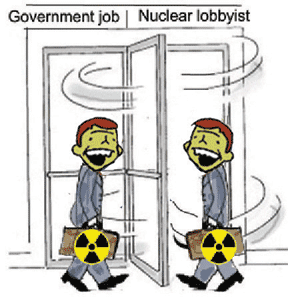
Nuclear expert to lead nuke waste group’s board,
The new chair of the Nuclear Waste Management Organization’s board of directors is a familiar face with an extensive background in the nuclear industry.
Glenn Jager, who was previously a vice-chair on the group’s board, is a retired chief nuclear officer with Ontario Power Generation and has worked in the nuclear sector for more than 30 years, the agency said this week in news release.
The Nuclear Waste Management Organization is to select a site next year for a proposed underground facility to store spent fuel rods from nuclear reactors.
One of the sites under consideration is a remote area 35 kilometres west of Ignace. The other is in South Bruce in southwestern Ontario in the vicinity of an existing nuclear-power station.
When They Announce WW3 Let’s Just Say ‘Nah’: Notes From The Edge Of The Narrative Matrix
Caitlin Johnstone, 25 July 22 All of human civilization is being organized around a “great power competition” between the US-centralized empire and the China/Russia/Iran bloc, and that “competition” stands to benefit ordinary humans in no way, shape or form. It will hurt all of us and help none of us.
There’s no valid reason why powerful nations can’t simply work together toward their mutual benefit. But it would mean the US empire giving up its plans of total global domination, so it’s not even being considered.
This conflict is slated to last throughout the 21st century, and it already has a massive body count. The war in Ukraine is a direct result of this “great power competition”, and the economic warfare between the empire and Russia will starve many more. This is a terrible thing.
Our world is being steered toward a dark and dangerous path full of impoverishment, starvation and proxy warfare, and fraught with the possibility of nuclear exchanges. They’re playing games with our lives, and because we’ve bought into the propaganda, we’re letting them………………………………………..
The more things heat up with the Russia/China/Iran bloc the more we’re going to find ourselves hammered with culture war wedge issue bullshit by the social engineers of the oligarchic empire so we don’t start asking inconvenient questions and making inconvenient demands. Inconvenient questions like “Why are we being impoverished so that you can wage a proxy war in Ukraine that we stand nothing to gain from?” and inconvenient demands like “Stop endangering all our lives with nuclear brinkmanship or we’ll fucking eat you.”…………………………
The world will never know peace as long as there are systems in place which financially incentivize war. Hoping for peace without opposing those systems is like jumping off a cliff and hoping gravity doesn’t do what it always inevitably does. https://caitlinjohnstone.substack.com/p/when-they-announce-ww3-lets-just?utm_source=substack&utm_medium=email
No operational need, and no climate case for the nuclear power industry -The Electricity Journal
Amory Lovins: Nuclear power is being intensively promoted and increasingly
subsidized in both old and potential new forms. Yet it is simultaneously
suffering a global slow-motion commercial collapse due to intrinsically
poor economics. This summary in a US context documents both trends,
emphasizing the absence of an operational need and of a business or climate
case.
The Electricity Journal (accessed) 23rd July 2022
https://www.sciencedirect.com/science/article/pii/S1040619022000483
Russia’s Rosatom to take legal action against Finland company, over terminated €7 billion nuclear power plant project.
Russian state entity plans claim over Finnish nuclear project, Jack Ballantyne 22 July 2022 Russian state entity Rosatom is preparing to launch an arbitration against a Finnish company that cited the war in Ukraine when it terminated a contract for work on a €7 billion nuclear power plant project…………… (Subscribers only) more https://globalarbitrationreview.com/article/russian-state-entity-plans-claim-over-finnish-nuclear-project
What happened in Vienna — Beyond Nuclear International

An inspiring reflection of ideals
What happened in Vienna — Beyond Nuclear International
Nuclear Power Plants Are Struggling to Stay Cool
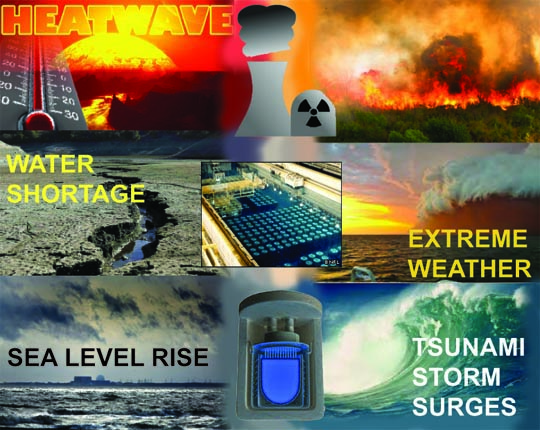
Wired, 22 July 22”……………………………. Amidst a slow-burning heat wave that has killed hundreds and sparked intense wildfires across Western Europe, and combined with already low water levels due to drought, the Rhône’s water has gotten too hot for the job. It’s no longer possible to cool reactors without expelling water downstream that’s so hot as to extinguish aquatic life. So a few weeks ago, Électricité de France (EDF) began powering down some reactors along the Rhône and a second major river in the south, the Garonne. That’s by now a familiar story: Similar shutdowns due to drought and heat occurred in 2018 and 2019. This summer’s cuts, combined with malfunctions and maintenance on other reactors, have helped reduce France’s nuclear power output by nearly 50 percent…………………
Nuclear technicians are known to refer to their craft as a very complicated way of boiling water, producing steam that spins turbines. But much more is usually required to keep the reactor cool. That’s why so many facilities are located by the sea and along big rivers like the Rhône.
Plenty of other industries are affected by hotter rivers, including big factories and power plants that run on coal and gas. But nuclear plants are unique because of their immense size and the central role they play in keeping energy grids online in places like France. And warming and dwindling rivers are not the only climate challenges they face. On the coasts, a combination of sea level rise and more frequent and intense storms means heightened flooding risks. Scientists have also pointed to other, more unusual challenges, like more frequent algal blooms and exploding jellyfish populations, which can clog up the water pipes.
……………………… The nuclear industry and environmental groups continue to disagree on whether existing regulations capture the latest science, particularly on the topic of sea level rise.
……………….. . In 2019, the NRC began approving 20-year extensions to some reactors—starting with the Turkey Point power plant in South Florida. Environmental groups filed interventions to halt the plan, arguing that a combination of more intense hurricanes and sea level rise would threaten the low-lying plant in ways that regulators had not adequately considered. In February, the NRC reversed the extension for Turkey Point and other plants pending a more extensive environmental review.
So far, most production cuts are due to warming waters—not just in the Rhône and Garonne, but in places like the Tennessee River in the US, and in the coastal seas where many more plants are sited. In recent years, nuclear plants across Northern Europe have been forced to shut down or reduce output because seawater became too warm to safely cool the reactor cores. Over the past decade, the Millstone power plant in Connecticut saw a series of shutdowns on hot summer days until regulators raised the temperature limit of its cooling waters by 5 degrees Fahrenheit.
………………………. the impact is growing as temperatures continue to rise. In an analysis published in Nature Energy last summer, a Stanford researcher found that there had been eight times the number of heat-related outages in the 2010s compared with the 1990s. In a 2011 study on the impact of warming on nuclear cooling systems, EDF scientists projected a 3 degree Celsius increase in the Rhône’s temperature by 2050, spelling more potential for shutdowns during heat waves.
,,,,,,,,,,,,,,,,,,,,,,, “The key issue is when we start building new plants, how can we take into account the impact of climate change for the full lifespan of the plant to 2080 or 2100,” Laconde says, noting that France’s new generation of reactors, recently announced by President Emmanuel Macron, are mostly being built by the coasts.
,,,,,,,,,,,,,,,,,,,,,,,,,, in France, regulators are expecting a long summer ahead. While the heat may pass, low water levels can persist, resulting in cutbacks that last for weeks or months. EDF recently told reporters that it expects more cuts in the coming months as water levels continue to fall—leaving the country hoping for the relief of cold, hard rains. https://www.wired.com/story/nuclear-power-plants-struggling-to-stay-cool/
1 This Month
23 April – WEBINAR – Why new nuclear reactors are the wrong tools for decarbonization Thursday, April 23 • 1 AM – 2 AM AEST

Pine Ridge Uranium is the real threat, not Tehran- Tell Burgum: Stop the Extraction.
Chernobyl: The Lost Tapes – A good documentary on Chernobyl on SBS available On Demand for the next 3 weeks– https://www.sbs.com.au/ondemand/tv-program/chernobyl-the-lost-tapes/2352741955560
To see nuclear-related stories in greater depth and intensity – go to https://nuclearinformation.wordpress.com
-
Archives
- April 2026 (241)
- March 2026 (251)
- February 2026 (268)
- January 2026 (308)
- December 2025 (358)
- November 2025 (359)
- October 2025 (376)
- September 2025 (257)
- August 2025 (319)
- July 2025 (230)
- June 2025 (348)
- May 2025 (261)
-
Categories
- 1
- 1 NUCLEAR ISSUES
- business and costs
- climate change
- culture and arts
- ENERGY
- environment
- health
- history
- indigenous issues
- Legal
- marketing of nuclear
- media
- opposition to nuclear
- PERSONAL STORIES
- politics
- politics international
- Religion and ethics
- safety
- secrets,lies and civil liberties
- spinbuster
- technology
- Uranium
- wastes
- weapons and war
- Women
- 2 WORLD
- ACTION
- AFRICA
- Atrocities
- AUSTRALIA
- Christina's notes
- Christina's themes
- culture and arts
- Events
- Fuk 2022
- Fuk 2023
- Fukushima 2017
- Fukushima 2018
- fukushima 2019
- Fukushima 2020
- Fukushima 2021
- general
- global warming
- Humour (God we need it)
- Nuclear
- RARE EARTHS
- Reference
- resources – print
- Resources -audiovicual
- Weekly Newsletter
- World
- World Nuclear
- YouTube
-
RSS
Entries RSS
Comments RSS
 nuclear-news