Nancy Pelosi’s planned trip to Taiwan – ‘Unprecedented, foolish, dangerous’ -says former Australian Prime Minister
Due to the sensitivity of travelling to Taiwan – which neither America nor Australia officially recognises diplomatically, no serving president, vice president or prime minister has visited the democratic island of 24 million people.
Unprecedented, foolish, dangerous’: Keating attacks Pelosi’s planned trip to Taiwan, The Age, By Eryk Bagshaw. July 25, 2022,
Singapore: Former prime minister Paul Keating has accused US House Speaker Nancy Pelosi of inflaming tensions with Beijing and risking a military conflict by planning to visit Taiwan next month.
Pelosi, who sits behind President Joe Biden and Vice President Kamala Harris in American political seniority, would be the highest-level serving US official to visit Taiwan since the White House established diplomatic ties with Beijing in 1979.
Keating said in a statement on Monday evening that it was hard to imagine “a more reckless and provocative act”.
“Across the political spectrum, no observer of the cross-straits relationship between China and Taiwan doubts that such a visit by the Speaker of the American Congress may degenerate into military hostilities,” he said.
“If the situation is misjudged or mishandled, the outcome for the security, prosperity and order of the region and the world (and above all for Taiwan) would be catastrophic.”………………………
Keating has been critical of US and Australian policy toward Beijing, arguing that Taiwan’s future was a civil matter for China, and it was not “a vital Australian interest”. But that argument has been resisted by the Coalition, Labor and Taipei which have developed stronger unofficial ties in the past decade through trade offices, while officially maintaining Australia’s “one-China policy”.
Due to the sensitivity of travelling to Taiwan – which neither America nor Australia officially recognises diplomatically, no serving president, vice president or prime minister has visited the democratic island of 24 million people.
Biden last week publicly rebuked Pelosi’s plans for the trip. “The military thinks it is not a good idea right now,” he said.
Keating said a visit by Pelosi would be “unprecedented – foolish, dangerous and unnecessary to any cause other than her own”.
“Over decades, countries like the United States and Australia have taken the only realistic option available on cross-strait relations. We encourage both sides to manage the situation in a way that ensures that the outcome for a peaceful resolution is always available,” he said.
“But that requires a contribution from us – calm, clear and sensitive to the messages being sent. A visit by Pelosi would threaten to trash everything that has gone before.”
The Financial Times, which first reported Pelosi’s plans to travel to Taiwan last week, said the Biden administration had been warned privately by Chinese officials about a potential military response to her visit. Pelosi has not publicly confirmed her plans, despite members of Congress being invited to travel with her.
There has been no official comment from Taiwan’s President Tsai Ing-wen or Foreign Minister Joseph Wu since the potential visit by Pelosi was first reported, highlighting the sensitivity of the situation………….
https://www.theage.com.au/world/asia/unprecedented-foolish-dangerous-keating-attacks-pelosi-s-planned-trip-to-taiwan-20220725-p5b4g4.html
Russia accused of waging war out of working nuclear power plant in Ukraine
https://www.france24.com/en/europe/20220725-russia-accused-of-waging-war-out-of-working-nuclear-power-plant-in-ukraine Russian forces have reportedly been using the Zaporizhzhia nuclear power plant, near Nikopol in southern Ukraine, as a base to launch attacks, ramping up security concerns in surrounding areas.
The power plant in Ukraine is the largest in Europe and has been under Russian control since March. It is the only working nuclear power plant in history to be occupied by an invading army
Recent reports have noted shells being fired from the direction of Zaporizhzhia towards Ukrainian forces. “Ukrainian forces can’t shoot back in case they hit the plant,” a local told FRANCE 24’s Gulliver Cragg, reporting from Nikopol.
The Ukrainian nuclear energy agency, Enerhoatom, has also raised concerns about the risk of heavy military equipment and explosives being stored inside reactor buildings and military trucks parked in the reactor hall.
“The question is what happens if there’s a fire?” said Petro K., president of Enerhoatom. “It won’t be possible to put the fire out because these trucks block the firefighters’ access.”
At the same time, Russia has accused Ukrainian forces of risking a nuclear catastrophe with alleged military activity in the area. Ukrainian officials deny these claims, saying they are all too aware of the dangers and would not take such risks
Busting the poorly informed pro-nuclear hype of Spectator Australia.

Today I encountered, for the first time the magazine “Spectator Australia”. I was drawn to it by the tantalising title of its article (25/7/22) “Politicians destroy nuclear when the world needs it most.”, by Alan Moran. The main message of the article seems to be that the stringent safety regulations are an unnecessary handicap to the nuclear industry, and cause unnecessary costs.
I was tempted to check on what sort of a magazine ”Spectator Australia” is. Crikey reported that :
”The Spectator presents a stridently — often rabidly — ideological conservative perspective on Australian politics and society. ”
Much earlier, The Guardian reported on its British parent:
”The magazine cleaves to a purple-faced, right-wing, pro-fox-hunting, climate-change-denying, insidiously Islamophobic worldview”
Ah well – that helps to explain this article. Here are just a few of my reflections on the article:
“Nuclear power is reliable and safe” – as long as you don’t count Mayak, Santa Susanna, Church Rock, Chornobyl, submarine accidents, Windscale. Three Mile Island, Tokaimura, Fukushima …
“Deaths related to the industry are small” – yeah, when you don’t count the deaths caused by persuisten exposure to radiation – especially amongst nuclear workers. Later-developing cancers are not as newsworthy as sudden accidental deaths.
”Demonisation”, presumably by fanatic anti-nuclear people , has caused the downfall of the nuclear industry? Well, well – I had no idea that we were so effective. I thought that it was caused by the unaffordable costs. the intractaible waste problem, the nuclear weapons proliferation problem.
“risk aversiveness to whatever safety problems there may be” – that phrase speaks volumes – this mansplaining macho author isn’t even interested in knowing about risks!
Costs? Well the Fin Review and CSIRO don’t agree with this author https://www.afr.com/companies/energy/nuclear-energy-too-expensive-to-replace-fossil-fuels-20220711-p5b0pd
He quotes France – does he not know that France is in one hell of a pickle – nationalising the industry, shutting down reactors because of the heat, and the corrosion?
UK – he quotes Rishi Sunak – as Chancellor Sunak advised Boris against the big nuclear spend ! This article is a load of ignorant poppycock!
Japan to push for nuclear arms reduction at NPT review conference
Kyodo News, 25 July 22, Tokyo,
Japan plans to push for a reduction in nuclear warheads and for world leaders to visit its two atomic-bombed cities at next month’s review conference on the Nuclear Non-proliferation Treaty, a special adviser to Japanese Prime Minister Fumio Kishida on the issue said Monday…………………………………… more https://english.kyodonews.net/news/2022/07/8d8074c2b80e-japan-to-push-for-nuclear-arms-reduction-at-npt-review-conference.html
Backlash in Japan over dumping of nuclear waste-water to the ocean
Japanese residents oppose dumping nuclear polluted water into the ocean.
Japan’s nuclear regulators have given the green light to dump water from
the wrecked Fukushima nuclear power plant into the sea on July 22. The plan
has faced some backlash with concerns over its potential impact on marine
life and local livelihoods.
CGTN 23rd July 2022
Anti-nuclear groups gather in Wales
Organizations meeting to oppose nuclear energy in the north. In Caernarfon
on Saturday, a number of anti nuclear organizations came together to oppose
any plans to build new power stations on Anglesey and Trawsfynydd. The
organizations present – PAWB, CADNO, Cymdeithas yr Iaith, Welsh Anti
Nuclear Alliance and the Nuclear Free Local Authorities – claimed that
nuclear energy is not the way forward to meet Wales’ power needs. They were
also concerned about the effect that nuclear projects in Welsh speaking
areas would have on the language.
BBC 24th July 2022
France should “rethink the temperature thresholds of rivers”,

Nuclear: with the heat wave, “we should rethink the temperature thresholds of rivers”, says the ASN chief inspector. The news sparked heated controversy: faced with heat records, the Nuclear Safety Authority (ASN) and the Ministry for Energy Transition granted an environmental waiver for four nuclear power plants: Saint-Alban, Golfech, Le Blayais and Le Blayais. Bugey.
Until July 24, these sites will be authorized to exceed the regulatory levels of water temperature discharged into the rivers and rivers in which they feed, in order to be able to operate if necessary for
the electricity network. For La Tribune, the ASN chief inspector, Christophe Quintin, discusses the reasons for this derogation, its implications and the lessons to be drawn from it.
La Tribune 21st July 2022
Nuclear news – week to 25 July

So much news, so overwhelming – the pandemic, climate extremes in China. South Asia, USA, Europe, UK. In the middle of all the gloom, quite an inspiring article from science writer Julian Cribb, with a method to save the world. He argues, passionately and persuasively for putting the ”weaker” sex in charge. In The Age of Women, Cribb says that If humanity is to survive the vast and growing threats it faces, women must assume the leadership of government, business, religion and social institutions around the world.
Some bits of good news – Overwhelmed by environmental disaster? Here’s a scorecard to inspire optimism. The bright spots in the State of the Environment report.
War wins the ‘big bucks’ while climate gets the ‘change’
Calling Putin ‘Hitler’ to Smear Diplomacy as ‘Appeasement’.
NATO: The Most Dangerous Military Alliance on the Planet. Phil Wilayto column: The provocations behind the ‘unprovoked’ war. The Biggest Lie The Hawks Ever Sold. In Ukraine, a proxy war on the planet. US Military Analyst: West Can’t Afford Ukraine Spending, Will Run Out of Ammo to Send to Kiev. Global action urged to block AUKUS plan on transfer of nuclear materials.
Nuclear Power Plants Are Struggling to Stay Cool.
Baseload nuclear power not needed in an all-renewable future – Claverton Energy Research Group.
Death toll rises above 1,500 as temperatures soar across Europe.
As Europe burns, the world’s climate plan, such as it is, unravels.
UKRAINE.
- Russia is using captured Zaporizhzhia Nuclear Power Station as a launch pad for military attacks .
- Greenpeace radiation investigation at Chornobyl to assess accuracy of IAEA data. Greenpeace investigation challenges nuclear agency on Chornobyl radiation levels. Greenpeace experts find Chornobyl under Russian occupation – radiation levels much higher than the IAEA estimated.
- Russia says Ukrainian drone struck nuclear plant, but caused no damage.
- Ukraine Defense Minister Offers Ukraine as a ‘Testing Ground’ for NATO Weapons.
- Money Pit: Zelensky govt signals intent to default on tens of billions in foreign debts.
FRANCE. Evacuation of site , as wildfires rage near nuclear power plant being decommissioned. La Hague is still threatened by wildfires Monday afternoon: firefighters mobilized on July 18 not far from the Orano nuclear site. Macron facing NUCLEAR nightmare as scorching heatwave cripples SIX reactors. 4 French nuclear reactors authorized to discharge hotter water during heatwave, as 29 others remain offline, (nuclear the cure for global heating?)
Nationalisation of EDF seen as ‘inevitable’ to carry out France’s nuclear plans. France’s costly nationalisation of the nuclear industry. Employee shareholders to sue EDF over France nationalising nuclear industry . New failure on the Flamanville EPR, the reactor control system’s malfunction. EDF to change design of EPR nuclear reactors following troubles of the China one – (making it up as they go?) Protest against radioactivity-contaminated water, at French nuclear site.
SWITZERLAND. Swiss nuclear power plant reduces output to protect fish during heatwave.
USA. Was Obama right about Russia-Ukraine? Biden Rebuked for ‘Openly Praising War Profiteering’ at Lockheed Martin. The Great American Military Rebrand. Leaked documents – Facebook ‘Bot’ adviser secretly in the pay of USA regime change agency. President Biden’s $6 billion effort to save distressed” nuclear power plants is misguided. No operational need, and no climate case for the nuclear power industry -The Electricity Journal . MidAmerican shouldn’t waste money studying small nuclear reactors. The lingering horror of thorium radioactive poisoning in West Chicago .
Extreme heat warnings in effect in 28 states across US.
CANADA. Nuclear industry veteran to lead nuclear waste group’s board – ( the revolving industry-govt door)
IRAN. Iran critical of President Biden telling Israelis that USA is ready to use force against Iran . ‘Israeli cell planted explosives at nuclear facility,’ Iran media says.
JAPAN. Japan halts shipment of black rockfish caught off Fukushima over radiation. Japan’s nuclear regulator formally approves release of Fukushima wastewater to the Pacific. Japan approves nuclear-contaminated water discharge plan, may turn Japanese people into ‘sick men of Asia,’ seafood consumption and export nosedive. Stiff resistance by fishing unions to Japan’s move to dump Fukushima nuclear wastewater into the ocean. Fukushima bosses ordered to pay billions for failing to prevent nuclear disaster. Shinzo Abe Failed to Rearm Japan. Let’s Keep It That Way.
UK.
- The brutal reality of the US-UK ‘Special Relationship’, and the persecution of Julian Assange.
- British soldiers used as radiation guinea pigs in nuclear bomb tests in Australia.
- Time for the UK government to tell the truth about nuclear power,
- Against advice of the Planning Inspectorate the UK’s interim government gives go-ahead to Sizewell C nuclear power plant. B1 Government gives go-ahead to ‘monumental modern folly’ The Royal Society for the Protection of Birds (RSPB) condemns ludicrous Sizewell C planning approval. UK govt to decide on whether or not £20bn Sizewell C nuclear power plant should go ahead.
- EDF worried that its delays in building Hinkley Point C nuclear station might lessen the huge subsidies it gets from the UK government. EDF’s new demand means that Hinkley Point C will be further delayed, with costs escalating to £34 billion. Sizewell-C. Proposed change to how Hinkley Point C stores radioactive waste.
- Consultation on proposed changes to storage of radioactive wastes at Hinkley Point C NPP. Millom and Haverigg being conned by nuclear industry over waste dump, claims former councillor. Anti-nuclear forces gather in Wales. Greencoat Capital Investing might be turning yellow – swallowing the climate lies of the nuclear industry. All at Sea: Energy Security Bill reveals UK government preference to dump waste offshore. Guardians of the East Coast (Gotec) fight to stop nuclear waste dumping in the sea near holiday resorts UK.
- Nuclear regulators have found “clear breaches” of safety rules while investigating a chemical leak at the Dounreay plant .
RUSSIA. Russia’s Rosatom to take legal action against Finland company, over terminated €7 billion nuclear power plant project.
GERMANY. Germany criminalizes journalist for exposing Ukrainian war crimes. https://www.youtube.com/watch?v=a4-1qhGvbu4
AUSTRIA. Visit of the Slovak Prime Minister to Vienna: Disagreement on Nuclear Technology Issues.
RUSSIA. Russia to Scrap World’s Largest Nuclear Submarine.
ISRAEL. ISRAEL AND THE NUCLEAR NORM
AUSTRALIA. Documents show Australian Labor government supports Assange’s extradition to the US. INSIDE LABOR’S ASSANGE GAME PLAN.
Militarism and submarines: The tragic obsession with the Chinese threat.
The Age of Women

Pearls and Irritations, By Julian Cribb, Jul 22, 2022
Leadership by wise women is indispensable if we are to escape the catastrophe that male leadership is presently building for humanity.
If humanity is to survive the vast and growing threats it faces, women must assume the leadership of government, business, religion and social institutions around the world. Female leadership is a required solution to the ten catastrophic risks which now confront the whole of our civilisation.
As a rule, women don’t start wars, mine coal or oil, destroy landscapes and forests, pollute air and oceans or poison their children – though they may benefit from those male actions. They tend to think more about the longer term than do men, and to consider the future needs of their children and grandchildren more fully. They tend to seek peaceful and constructive solutions to problems rather than warring over differences in values and beliefs, or over resources.
Since the time our species first differentiated its gender roles, over a million years ago, pragmatic male thought has largely driven our remarkable ascent, our great technological achievements up to the start of the present century. But men are also risk takers – and often ignore or make light of the risks created by the use, misuse or overuse of these technologies. Furthermore, in the hot, overcrowded, resource-depleted, poisoned world of the present and immediate future, competitive male attitudes are also our potential downfall, especially if they lead to wars and mass destruction.
In a world beset by catastrophic risks such as global ecological collapse, nuclear weapons, climate change, universal chemical poisoning, resource scarcity, food insecurity, overpopulation, pandemic disease, deadly new technologies and self-delusion, a fresh human perspective is needed – one which accentuates peaceful co-operation, caring, repair, healing and restoration. One which values food above weapons, health above chemicals, re-use and thrift above wastage, nature above profit, thought for the next generations above immediate self-gratification – and wisdom over mere intelligence or technical skill.
The most striking example of global female leadership is the decision by women everywhere to have far fewer babies. This has brought the birth rate down from 5 babies per woman in the mid-1960s to 2.4 babies in the early 2020s – and it is still falling, in every continent and in almost every country, albeit more slowly. Moreover many women have taken the decision to control their fertility without seeking male approval. They just did it. It is a responsibility the female of our species has undertaken because she instinctually understands the dangers and costs inherent in uncontrolled family and population growth. Women have, on their own initiative, tackled one of the thorniest and most controversial issues affecting the human future – and with demonstrable success. Unswayed by the selfish arguments of economics, nationalism, religion, paternalism or social pressure, they have willingly had fewer children in order that those whom they do bear may live better – or even live at all.
Women are also peacemakers. History offers few, if any, examples of wars of aggression waged by female leaders. Although perfectly capable of responding to military attack, female rulers from Elizabeth I, Maria Theresa and Catherine the Great to Golda Meir, Indira Ghandi and Margaret Thatcher defended their countries against attack by others or else ended wars which they had inherited from their male antecedents. Typically, they pursued their aims through diplomacy. All of the great wars of recent centuries, on the other hand, were started either by male monarchs, dictators or by male-dominated governments.
……….. Women are also peacemakers. History offers few, if any, examples of wars of aggression waged by female leaders. Although perfectly capable of responding to military attack, female rulers from Elizabeth I, Maria Theresa and Catherine the Great to Golda Meir, Indira Ghandi and Margaret Thatcher defended their countries against attack by others or else ended wars which they had inherited from their male antecedents. Typically, they pursued their aims through diplomacy. All of the great wars of recent centuries, on the other hand, were started either by male monarchs, dictators or by male-dominated governments.
In a world where conflict over declining resources of land, water, food, minerals, timber, fish and other vital necessities of life is increasingly probable, male leadership is far more likely to result in mass destruction and death than female leadership. Males in most societies are taught from youth to compete for what they want, and if competition doesn’t work, then to fight for it, often to the death. Sporting role models, gang behaviour, worship of military virtues and imposed patriarchal values cement the process. This masculine ideal is so firmly imprinted on society and on young males as to make questioning it tantamount to heresy – and most men fear to do so. Indeed, the dawning realisation that traditional male values are redundant in a world where humans can eliminate themselves has given rise to anxiety and confusion in many males over the likely loss of their ‘traditional’ roles of warrior and protector.
However, there is nothing compulsory about these traditional roles, ………………….. These stereotypes have endured centuries after the biological necessity for them has passed away. The preservation of these stone age roles in a 21st Century civilisation on the brink of catastrophe is an absurdity. Indeed, they will only hasten it.
Females learn or are taught to achieve their goals by other means, generally peaceful, diplomatic, negotiatory and co-operative. It follows that female leadership is better suited to the conditions of the C21st than it perhaps was to previous centuries – and male leadership less so. Thus, majority female rule can reduce the chances of civilisational collapse, or even human extinction, by war……………
It is noteworthy that women already tend to lead international organisations concerned with human health and wellbeing, with peace, with children and their future – whereas men tend to dominate organisations that pollute, manufacture poisons or weapons, plough up landscapes, pillage the oceans and destroy the climate. There are very few female leaders of the $7 trillion fossil fuels / petrochemicals sector, for example, and the male groupthink in that industry plainly values short-term profit above the safety and survival of humanity (including their own). This is classic male risk-taking behaviour ……….
Petrochemicals kill 12 million people every year and the toll is rising with climate change and the universal spread of poisons. In this case, a male-led industry prizes profit above human life on the largest scale ever to occur in history. But it is by no means unique. Other male-dominated sectors including agriculture, mining, forestry, corporate food and pharmaceuticals, electronics, advertising, armaments and the military, cause similar havoc among humanity, the natural world or both. For the sake of human survival, it is time their leadership underwent a radical repositioning in values, ethics and common sense.
The issue of whether women should lead humanity in the 21st century is thus not a question of gender equality or politics. It is not about ‘feminism’.
It is, quite simply, a foundational rule for human survival at the very time we face a major threat to our existence, arising from our own behaviours.
It is now a matter of choosing the kind of leadership which can best get us through the most dangerous era in all of human history.
Female thinking and leadership can protect a habitable planet and save humanity – or at least, some of it. And this means female thinking by enlightened men as well as by women. To influence global society towards more sustainable, healthy and peaceable solutions to our risks, we need many wise women in positions of power. This is indispensable, if we are escape the fate which male-led competition, aggression, overconsumption and pollution are building for us. https://johnmenadue.com/the-age-of-women-2/
MidAmerican shouldn’t waste money studying small nuclear reactors

Small modular reactors and nuclear power represent a dangerous distraction from the changes needed to deal with global warming. https://www.desmoinesregister.com/story/opinion/columnists/iowa-view/2022/07/24/midamerican-energy-small-nuclear-reactors-uneconomical/10104142002/ Dr. Maureen McCue and Dr. M.V. Ramana, Yet again, MidAmerican Energy has expressed an interest in studying nuclear reactors for Iowa. Earlier, between 2010 and 2013, MidAmerican studied the feasibility of nuclear power for Iowa and concluded that it didn’t make sense. This time around, MidAmerican does not even have to embark on the study. We know already that the newest offerings from the nuclear industry, Small Modular Reactors, or SMRs, carry the same economic and environmental risks as their larger predecessors and make no sense for Iowa, or anywhere else for that matter.
In 2013, the Wall Street firm Lazard estimated that the cost of generating electricity at a new nuclear plant in the United States will be between $86 and $122 per megawatt-hour. Last November, Lazard estimated that the corresponding cost will be between $131 and $204 per megawatt-hour. During the same eight years, renewables have plummeted in cost, and the 2021 estimates of electricity from newly constructed utility-scale solar and wind plants range between $26 and $50 per megawatt-hour. Nuclear power is simply not economically competitive.
SMRs will be even less competitive. Building and operating SMRs will cost more than large reactors for each unit (megawatt) of generation capacity. A reactor that generates five times as much power will not require five times as much concrete or five times as many workers. This makes electricity from small reactors more expensive; many small reactors built in the United States were financially uncompetitive and shut down early.
The estimated cost of constructing a plant with 600 megawatts of electricity from NuScale SMRs, arguably the design closest to deployment in the United States, increased from about $3 billion in 2014 to $6.1 billion in 2020. The cost was so high that at least ten members of Utah Associated Municipal Power Systems canceled their contracts. NuScale then changed its proposed plant configuration to fewer reactors that produce only 462 megawatts at a cost of $5.32 billion. For each kilowatt of electrical generation capacity, that estimate is around 80% more than the per-kilowatt cost of the Vogtle project in Georgia — before its cost exploded from $14 billion to over $30 billion. Based on the historical experience with nuclear reactor construction, SMRs are very likely to cost much more than initially expected.
And they will be delayed. In 2008, officials announced that “a NuScale plant could be producing electricity by 2015-16.” Currently, the Utah project is projected to start operating in 2029-30. All this before the inevitable setbacks that will occur once construction starts.
Time is critical to dealing with global warming. According to the Intergovernmental Panel on Climate Change, emissions have to be reduced drastically by 2030 to stop irreversible damage from climate change.
Small reactors also are associated with all of the usual problems with nuclear power: severe accidents, the production of radioactive waste, and the potential for nuclear weapons proliferation. Indeed, some of these problems could be worse. For each unit of electricity generated, SMRs will actually produce more nuclear waste than large reactors. Whether generated by a large or small plant, nuclear waste remains radioactive and dangerous for hundreds of thousands of years. There is no demonstrated solution to permanently isolate this lethal waste, for both technical and social reasons.
Most new nuclear reactor designs will rely on water sources for cooling. Nuclear plants have some of the highest water withdrawal requirements; in the United States, the median value for water withdrawal was calculated as 44,350 gallons per megawatt-hour of electricity generated, roughly four times the corresponding figure for a combined cycle natural gas plant. Renewables require little or no water because there is no heat production. Iowa’s lakes and rivers are already challenged by the warming climate, existing power plants, and polluting industries.
In medicine, a basic principle used to guide our decisions is “first, do no harm.” That principle will be violated if Iowa embarks on building SMRs. Small modular reactors and nuclear power represent a dangerous distraction from the changes needed to deal with global warming. Investing in these technologies will divert money away from more sustainable and rapidly constructed solutions, including wind and solar energy, microgrids, batteries and other forms of energy storage, and energy-efficient devices.
British soldiers used as radiation guinea pigs in nuclear bomb tests in Australia
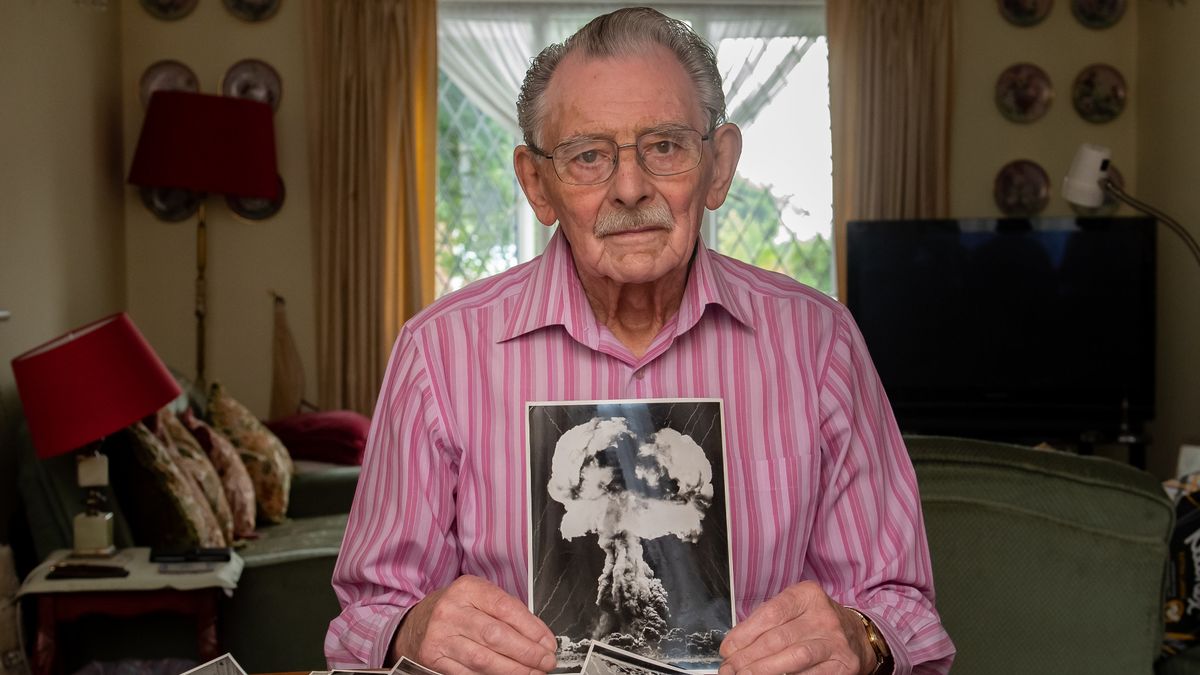
British veterans ‘ordered to march through smoking craters’ in nuclear bomb tests, Brian Tomlinson claims the state dumped him and his comrades, many of whom died from cancer after being used in a shocking human experiment,
https://www.mirror.co.uk/news/uk-news/british-veterans-ordered-march-through-27563987 Susie Boniface, Reporter, 24 Jul 2022,
A veteran of nuclear bomb tests has told how British servicemen were ordered to march through a smoking crater to find how radioactive it was.
Brian Tomlinson said he also had to dig out scientific instruments buried in the contaminated soil and revealed he was left with bleeding ulcers on his palms for two decades.
But he claims the state dumped him and his comrades, many of whom died from cancer in the years after they were used in a shocking human experiment in the Australian outback.
And Brian supports the Mirror’s campaign for a medal for heroes of the nuclear tests in the 50s.
“That place is still radioactive, it’s in the soil for a hell of a long time, so what chance does a human being have?” he said.
“A medal would get us a little bit of recognition for those who took part. It says you’re someone who’s been noticed and not discarded, which is how we’ve felt for so long.”
Last month, Boris Johnson became the first PM to meet veterans, and promised action before October’s 70th anniversary of the first test. His resignation threw it into doubt and campaigners are seeking reassurances from Rishi Sunak or Liz Truss that they will do the same.
Brian, now 85, was a sapper sent to Maralinga, South Australia, in 1957 to take part in Operation Antler, a series of three atomic bomb tests designed to help build the more powerful H-bomb.
His troop of Royal Engineers were blended with Australian soldiers, and 40 of them lived for a year inside the blast zone in canvas tents.
The main base, where scientists, top brass, and most troops stayed, was called Maralinga Village. Brian’s unit was 14 miles deeper into the testing grounds, at Roadside Camp. From there, it was just 9 miles to Ground Zero.
Brian, a 20-year-old corporal at the time, said: “Nobody told us what it was all about, or checked us for radiation, but every morning we went into the forward area.
We had pneumatic drills, and had to blast down through the soil. There was about 12 inches of earth, red dust, and below that was rock.”
For each of 3 blasts, the crew had to bury dozens of large steel containers 8ft square. Each had instruments inside to measure the explosion, with pipes protruding above ground level. Those closest to the bombs were sandbagged and concreted to protect them from the shockwave.
A few hours after each bomb, Brian and his crew – wearing only shorts, socks, boots and a hat – had to drive back in, remove the sandbags and concrete, and extract the instruments.
Scientists who went with them wore radiation suits and badges, but Brian said for the first two blasts he had neither.
He added: “After the third bomb, we were given little rubber boots, and a white overall, and a dose badge. We were told to walk through the crater. The mushroom cloud was still overhead. The wind had started to push it away. It was only a few hours after, not very long.”
The first two bombs, codenamed Tadje and Biak, were one kiloton and 6kts respectively.
But the third, Taranaki, was 25kts, as powerful as the weapon which destroyed Nagasaki in 1945.
Brian, of Yate, near Bristol, said: “As you approached the bomb site it was quite amazing, because it was like a bowling green. Everything was green and smooth. It was only when you were on it you realised the heat from the bomb had crystallised the earth underneath it. It was a crust of molten sand, like glass.
“The crater left there was huge. They told us to walk into that, down into the crater, and up the other side, and then check our meters to see how high the dose was.”
Brian said: “When it reached a certain point they told us to come out. It didn’t take long for it to reach that point. We weren’t told at the time what the dose was supposed to be. But it was just as bad as going through the centre of the bomb as soon as it had gone off.”
The first two bombs were detonated on top of 100ft-high towers built by the sappers, but desert sand was sucked into the fireball and fell to the ground as toxic fallout. The third bomb was tethered to barrage balloons 980ft up, supposedly minimising the risk.
But the size of the bomb, and perhaps the fact the same site was used for previous weapons tests, meant there was still fallout.
After they left the crater, Brian was taken to a decontamination area. The men’s clothes were stripped off and taken away, and the men were put through showers.
“We spent 5 or 6 minutes scrubbing away, then put ourselves in this meter, it was like standing on a weighing machine, and you push your hands through these bars to be tested. If a bell rang, you were still radioactive and had to go back in and scrub under your nails, everywhere, in your hair. I had to do it 3 times. They didn’t give us any more information.”
Documented safety measures at Maralinga included wire fences through which sand could easily be blown, and one wooden post barrier that Brian’s unit passed through each morning.
Brian was not checked for radiation while excavating amid the fallout, nor given long-term medical follow-ups. Six years later, he was medically discharged with a duodenal ulcer.
Radiation is known to cause problems with the lining of the gut, and earlier this year a government study reported nuclear test veterans were 20 per cent more likely than other servicemen to die from stomach cancer.
Brian said: “It wasn’t until later I started having skin problems. It would cover me from head to toes, rashes on my back, chest, legs, thighs. They used to come out on the palms of my hands.
“I’d get a little itchy blister in the centre of my palm, it would break and then spread over the fingers. I used to wear white cotton gloves to ease the pain and itching.
“The skin would go hard, then crack and bleed, and it would start all over again. I had that for 20 years, and no doctor could work out what it was.”
Today, cancer patients are warned radiotherapy using beta radiation can lead to radiodermatitis, which causes rashes, skin peeling, and ulceration. It is caused by the decay of isotopes, including plutonium and cobalt-60, both of which were in the Antler bombs.
Brian said: “I would have a constant itch, all over, and had to take cold showers just to stop the itching and have something of a normal life. I got depressed, to the point where I didn’t want to go and see the doctors because they just have me the same old medication and it never did me any good. Then one day, after 20 years, it just stopped, as suddenly as it came.”
Two decades after his discharge, Brian also had an operation to finally cure his ulcer. It involved cutting the vagus nerve, which controls digestion as well as carrying sensory information from the skin’s surface.
“I told all my consultants what was done to me out there in Maralinga, and asked if it was due to fallout. They all denied it,” said Brian. “Nobody’s ever done anything for us nuclear test veterans except withhold information from us.”
Campaigners have asked the Prime Minister for a medal and a service of national recognition at Westminster Abbey to mark the Plutonium Jubilee in 3 months’ time.
A spokesman for the MoD said it was grateful to veterans, and claimed they were well-monitored and protected. He added: “The Prime Minister met with veterans recently, and asked ministers to explore how their dedication can be recognised. We remain committed to considering any new evidence”
************************************************************************
For 40 years, the Mirror has campaigned for justice for the brave men who took part in Britain’s nuclear weapons tests.
The Ministry of Defence has fought back every step of the way.
We have told countless heartbreaking stories of grieving mums, children with deformities, men aged before their time and widows struggling to hold their families together, all while campaigning for recognition.
Two years ago we launched an appeal for a medal for the 1,500 survivors.
For the first time we were able to prove some were unwittingly used in experiments.
Our appeal was backed by then-Defence Secretary Gavin Williamson but his review foundered after he lost his job.
It had only six meetings in two years. They never asked to meet veterans. They never questioned the evidence.
Instead they asked for information from the MoD, which has a track record of denying what its own paperwork later proves.
And as our medal campaign gathered steam, civil servants simultaneously withdrew public documents from the National Archives.
Would anyone working in Whitehall today stay there, if 3 megatons of plutonium exploded south of the river?
The test veterans and their families will never stop fighting. The Mirror will never cease to demand they are heard.
Prime Minister, listen to them. Overturn this disgraceful decision.
EDF’s new demand means that Hinkley Point C will be further delayed, with costs escalating to £34 billion.
EDF have implicitly admitted that the construction of Hinkley C may take
at least 11 years to finish signalling cost overruns of 70 per cent or
more. Bloomberg reports that EDF is requesting the Government that EDF be
given another 15 months to complete the plant and be fully generating
beyond 2029.
Under the terms of EDF’s contract with the UK Government if
Hinkley C fails to generate power by 2029 it will start losing the amount
of subsidy it can claim. Adding 15 months to this as requested (under a
‘force majeure’ clause) will take us into 2030. Hinkley C construction
was begun seriously in early 2019, meaning a total construction period of
over 11 years.
The plant was supposed to be operating by the end of 2025
according the EDF’ earlier plans. Using the rule of thumb that
construction cost is directly proportional to the length of construction
time this would imply a 70% cost overrun. That could mean a cost rise, in
today’s prices from around the original £20 bn to £34 billion. However,
one should in no way assume this will be all the time that is needed.
Things may well get worse.
100% Renewables 22nd July 2022
Guardians of the East Coast (Gotec) fight to stop nuclear waste dumping in the sea near holiday resorts UK

As Boris Johnson forged ahead with plans to triple Britain’s nuclear output in the shift away from a reliance on Russia and fossil fuels, he pledged to build a mini-nuclear reactor in almost every garden across the country.
The outgoing prime minister’s plan was typically bombastic, yet reflected the Government’s ambitious target to deliver up to a quarter of the country’s electricity from nuclear technologies by 2050.
What is less clear, however, is exactly where to put the hazardous waste produced from
reactors. Currently, Britain stores spent nuclear fuel at a number of nuclear sites including Sellafield, in Cumbria, and Sizewell B, in Suffolk.
But these on-land sites are not intended to be a permanent solution to the radioactive material building up as a by-product of Britain’s nuclear programme. The Government’s arms-length body Nuclear Waste Services (NWS) has been tasked with finding a permanent disposal site. Bruce Cairns, chief policy adviser at NWS, says: “We’re talking about a solution that should last hundreds of thousands of years. “What do you trust the most? Do you really want to leave this stuff at the surface, where it is vulnerable to
extreme weather events, climate change, sea level rise, terrorism, war or the breakdown in society?
“Everyone reaches the same conclusion. We just can’t give any guarantees that there will be people on the surface capable of looking after it over those timescales.” Countries worldwide with nuclear programmes are all trying to find ways to store the waste so that it will not endanger future civilisations, with policy makers discussing how to make it completely inaccessible to future populations likely to
speak different languages, hold different values and have access to new technologies. The best way forward, they have decided, is to store the waste in rocks deep underground.
But finding a local area happy to host the site has its challenges, and has come up against opposition. A number of locations in Cumbria are being vetted by the Government, with the communities near Sellafield considered more amenable because they are already better acquainted with nuclear technologies and aware of the economic benefits of the industry.
However, a new entrant has emerged on the east coast. A community group assessing plans for a GDF has been set up in Lincolnshire. The facility’s entrance would be located at a former gas terminal near the village of Theddlethorpe and the popular seaside town of Mablethorpe. Underground tunnels dug out of layers of deep rocks would lead to the underwater site around six miles from the coastline. NWS and other proponents of the site point out that granting a GDF in the area will unlock significant government funding for local projects.
Yet opponents fear it would wreck the local tourism industry. A group called the Guardians of the East Coast (Gotec) are fighting the plans through protests, petitions and coverage in local and national newspapers. Ken Smith, chairman of Gotec, says: “Mablethorpe is one of the east coast’s principle bucket-and-spade holiday resorts. “I imagine that having four square miles of nuclear waste just six miles off the coast is not exactly going to encourage people to send their children along to bathe in the sea.” Local Conservative MP Victoria Atkins has also expressed reservations and held meetings with site organisers.
Telegraph 23rd July 2022
Will Australia’s nuclear-propelled attack submarines require weapons grade fuel?

https://www.canberratimes.com.au/story/7828219/will-australias-nuclear-propelled-attack-submarines-require-weapons-grade-fuel/ By Richard Broinowski, July 24 2022
Both Britain’s Astute and US Virginia boats use highly enriched weapons-grade uranium fuel in their reactor cells.
The fuel cells last as long as the submarines – about 30 years. The submarines don’t need refuelling during that time. These cells also allow the submarines to remain underwater indefinitely, only restricted by the endurance of their crews, which in turn depends on the amount of food they can carry.
The international nuclear non-proliferation regime could be compromised if other nuclear threshold countries, encouraged by Australia’s nuclear moves, acquire their own nuclear-propelled submarines. In fact, Brazil is already doing so. The bomb-grade uranium fuel could be clandestinely extracted from submarine cores to make nuclear weapons.
Some such countries could be encouraged to arm their nuclear-powered subs with nuclear weapons.
Australians living along our coastline (the majority) would be very uncomfortable if they had to host nuclear submarine bases in their electorates.
Given that Australia has no permanent storage for even low-level uranium waste, the government would find it extremely difficult to find even temporary locations for storing highly toxic and extremely long-lasting spent nuclear reactor cores.
While it is claimed that Virginia or Astute class attack submarines are far superior in speed and quietness to conventionally powered boats, this is untrue.
Most European navies, as well as those of Japan and South Korea, have quieter and nearly as fast conventionally powered submarines. They employ auxiliary air independent propulsion systems that extend their underwater endurance to 21 days or more.
Without the pumps needed to keep reactors cool on nuclear subs, they are much quieter; they are also much cheaper. Australia could purchase or build five or more such boats for the price of one Virginia or Astute boat.
We should not expect early delivery of our subs if the Americans or British are to build them, or even only their nuclear reactors.
We should have purchased Japanese Sohryu class submarines when we had the chance.
Australia would not retain sovereignty over American or British-acquired submarines. It does not have the technology to build its own nuclear propulsion units, and will be heavily reliant on either the British or (more likely) American technology.
This will bind the Navy even more closely to US strategic planning in the Pacific, especially in its plans to confront China.
Both countries are flat out building their own fast attack submarines. It is very doubtful either country would be prepared to make space on their assembly lines to accommodate early delivery of submarines for Australia.
- Richard Broinowski AO is the author of Fact or Fission: the truth about Australia’s nuclear ambitions.
Listen to the Fuzzy Logic Science Show at 11am Sundays on 2XX 98.3FM.
Send your questions to AskFuzzy@Zoho.com Twitter@FuzzyLogicSci
Russia is using captured Zaporizhzhia Nuclear Power Station as a launch pad for military attacks

Captured nuclear plant doubles as launch pad for relentless Russian rocket
attacks. The Russian army seized the vast facility — the biggest in
Europe, with six 950MW reactors — in the early weeks of its invasion,
destroying a training office during the assault despite the obvious risks
of damaging the plant and radiation leaks. Since then, Ukrainian officials
say, the Russians have stationed 500 troops and heavy weapons within the
perimeter — in breach of International energy conventions — and are
using the reactor blocks to protect against retaliatory fire.
FT 22nd July 2022
https://www.ft.com/content/857ee467-c920-4ba0-b915-684e0afbf594
1 This Month
23 April – WEBINAR – Why new nuclear reactors are the wrong tools for decarbonization Thursday, April 23 • 1 AM – 2 AM AEST

Pine Ridge Uranium is the real threat, not Tehran- Tell Burgum: Stop the Extraction.
Chernobyl: The Lost Tapes – A good documentary on Chernobyl on SBS available On Demand for the next 3 weeks– https://www.sbs.com.au/ondemand/tv-program/chernobyl-the-lost-tapes/2352741955560
To see nuclear-related stories in greater depth and intensity – go to https://nuclearinformation.wordpress.com
-
Archives
- April 2026 (237)
- March 2026 (251)
- February 2026 (268)
- January 2026 (308)
- December 2025 (358)
- November 2025 (359)
- October 2025 (376)
- September 2025 (257)
- August 2025 (319)
- July 2025 (230)
- June 2025 (348)
- May 2025 (261)
-
Categories
- 1
- 1 NUCLEAR ISSUES
- business and costs
- climate change
- culture and arts
- ENERGY
- environment
- health
- history
- indigenous issues
- Legal
- marketing of nuclear
- media
- opposition to nuclear
- PERSONAL STORIES
- politics
- politics international
- Religion and ethics
- safety
- secrets,lies and civil liberties
- spinbuster
- technology
- Uranium
- wastes
- weapons and war
- Women
- 2 WORLD
- ACTION
- AFRICA
- Atrocities
- AUSTRALIA
- Christina's notes
- Christina's themes
- culture and arts
- Events
- Fuk 2022
- Fuk 2023
- Fukushima 2017
- Fukushima 2018
- fukushima 2019
- Fukushima 2020
- Fukushima 2021
- general
- global warming
- Humour (God we need it)
- Nuclear
- RARE EARTHS
- Reference
- resources – print
- Resources -audiovicual
- Weekly Newsletter
- World
- World Nuclear
- YouTube
-
RSS
Entries RSS
Comments RSS
 nuclear-news