TODAY. NATO-USA militarily encircling Russia, China. – the world?

Uncannily like the buildup to World War 1, European nations are enthusiastically arming themselves and amassing troops, like the new permanent U.S. bases for Poland. And, of course, the big winners, the only winners, are the weapons corporations. The goal is to encircle Russia.
NATO leads the pack, becoming more bloated and belligerent as it draws in Finland and Sweden. The G7 now becomes NATO’s lackey.
We feared the impulsive and blustering President Trump. But President Biden is being just as tactlessly war-mongering – only a little more polite in manner. Australia got rid of its ignorant and bullying Prime Minister Morrison. But his replacement, PM Albanese, is effectively joining in with USA’s militarism, just more politely in manner.
But now the goal is to militarily encircle not only Russia, but China, too . Forget just the ”North Atlantic” – now it’s the Pacific too, and South Pacific. And NATO ls now creating this new enemy – joint Russia-China.
As with WW1 – the only winners are the weapons corporations, happily amassing $billions, including for nuclear weapons – the boys getting lots of those shiny new toys – and just the hope that they don’t actually use them
NATO has completed its post-Cold War transformation from Europe’s guard dog into America’s attack dog

The guard dog had, it seems, been re-trained as an attack dog.
https://www.rt.com/russia/558168-nato-defensive-alliance-global-cop/ Scott Ritter 1 July 22, From an ostensible defensive alliance, NATO has grown into an aggressor designed to promote ‘rules’ dictated by the US,
The North Atlantic Treaty Organization, or NATO, has just wrapped up its annual summit in Madrid, Spain. The one-time trans-Atlantic defensive alliance has, over the past three decades, transformed itself from the guardian of Western Europe into global cop, seeking to project militarily a so-called values- and rules-based posture.
NATO’s first Secretary General, Lord Ismay, famously noted that the mission of the bloc was “to keep the Russians out, the Germans down, and the Americans in.” In short, NATO served as a wall against the physical expansion of the Soviet Union from the perch it had established in eastern Europe at the end of the Second World War. Likewise, the creation of NATO prevented a treaty from being concluded between Germany and the Soviet Union that would enable the reunification of Germany. And lastly, the existence of NATO mandated that the US retain a significant full-time military presence in Europe, helping break America’s traditional tendency toward isolationism.
At the Madrid Summit, NATO radically redefined its mission to reflect a new mantra which could be encapsulated as “keep the Russians down, the Americans in, and the Chinese out.” It is an aggressive–even hostile–posture, premised on sustaining Western (i.e., American) supremacy.
This mission is to be accomplished through the defense and promulgation of a so-called “rules-based international order” which exists only in the minds of its creators, which in this case is the United States and its allies in Europe. It also represents a radical break from past practice which sought to keep NATO defined by the four corners of its trans-Atlantic birthright by seeking to expand its security umbrella into the Pacific.
The guard dog had, it seems, been re-trained as an attack dog.
When an organization undergoes such a radical transformation in terms of its core mission and purpose, logic dictates that there exists a reason (or reasons) sufficient to justify the consequences attached to the action. There appear to be three such reasons. First and foremost is the fact that Russia refuses to accept NATO demands that it exist as a junior “partner” whose sovereignty must be subordinated to the collective will of post-Cold War Europe. Russia’s President, Vladimir Putin, has made it clear that Russia considers itself to be a great power, and fully expects to be treated as such–especially when it comes to issues pertaining to the so-called “near abroad”–those former Soviet republics, such as Ukraine and Georgia, whose continued ties with Moscow are existential in nature.
NATO, on the other hand, while calling Russia a “partner,” was never serious about extending a viable hand of friendship, instead undertaking a thirty-year program of expansion which violated verbal promises made to Soviet leaders, leaving Russia weakened and not to be taken seriously by the self-proclaimed “victors” of the Cold War. When Russia pushed back, a process marked by Putin’s iconic speech to the 2007 Munich Security Conference, NATO undertook a more aggressive stance, promising Georgia and Ukraine eventual membership in the Alliance and, in 2014, supporting a violent coup against a government in Ukraine that kicked-off a series of events which culminated in the ongoing military operation being conducted by Russia in Ukraine.
Speaking at this week’s NATO Summit, the Secretary General of the organization, Jen Stoltenberg, ended all pretense that the bloc was an innocent bystander in the events leading up to Russia’s military intervention in Ukraine, noting with pride that NATO had been preparing to fight Russia since 2014–that is, since the US-led coup. Indeed, NATO has, since 2015, been training the Ukrainian military to NATO standards.
Not to bolster the self-defense of Ukraine, but rather for the purpose of fighting ethnic Russians in the Donbass. NATO, it seems, was never interested in a peaceful resolution to the crisis, which flared up when Ukrainian nationalists began brutalizing the region’s Moscow-leaning majority.
Two NATO members, France and Germany, helped perpetuate a fraudulent peace process, the Minsk Accords, which former Ukrainian President Petro Poroshenko recently admitted was nothing more than a sham perpetrated for the purpose of buying time so that NATO could train and equip the Ukrainian military for the purpose of forcibly seizing control of both Donbass and Crimea.
All the 2007 Munich Summit really did was strip away any pretense that NATO was serious about peacefully coexisting with a powerful, sovereign Russian nation. A truly defensive alliance would have readily embraced such an outcome. NATO, it is now clear, is anything but.
NATO has been exposed as little more than a component of American global power projection, providing supplementary military and political backing for an American empire defined by the “rules-based international order” premised on sustained US military and economic supremacy. Keeping America on top, however, is proving to be a bridge too far, largely because the American empire itself is crumbling at its foundations, struggling economically to sustain the so-called “American Dream” and politically to keep alive the flawed promise of American democracy which underpins the very image the US seeks to promote abroad. The extent that the US can function with a modicum of credibility in the international arena today is determined purely by the level of “buy in” by the rest of the world to the golden idol that is the “rules-based international order.”
While the US has been able to strong-arm both NATO and its economic doppelganger, the G7, into actively promoting the “Rules based international order,” Russia and China have come together to create an alternative world view.
That is international law, premised on the concepts enshrined in the United Nations Charter.
The G7 declared that the BRICS economic forum, comprised of nations who are more aligned with a “law-based” world order, and not a US-dominated “rules-based” one, represents the greatest threat to its relevance on the world stage. NATO, likewise, has declared that the Russian and Chinese challenge to the “rules-based international order” represents a major threat to NATO’s core values, prompting an expansion of NATO’s reach into the Pacific as a counter.
In short, NATO (together with the G7 group) is declaring war against the principles of international law that are encapsulated in the United Nations Charter. At its Madrid Summit, NATO has made it clear that it’s ready to shed blood to defend a legacy whose legitimacy exists only among the collective imaginations of its members. And not all of them, either.
The goal of the rest of the world now needs to be to seek to minimize the damage done by this beast and find a way to dispose of it before it can do any more harm to the global community.
Scott Ritter is a former US Marine Corps intelligence officer and author of ‘Disarmament in the Time of Perestroika: Arms Control and the End of the Soviet Union.’ He served in the Soviet Union as an inspector implementing the INF Treaty, in General Schwarzkopf’s staff during the Gulf War, and from 1991-1998 as a UN weapons inspector.
Military social media campaigns promote the war in Ukraine, and attack any ”wrongthink” that dares criticise role of USA and NATO
Ukraine Is The Most Aggressively Trolled War Of All Time: Notes From The Edge Of The Narrative Matrix, Caitlin Johnstone, Caitlin’s Newsletter, 1 July 22,
There’s a lot going on in America and the people are very stressed out and frightened, but don’t worry, there’s nothing the US government won’t do to make sure more High Mobility Artillery Rocket systems get to Ukraine.
Rest assured Americans: no matter how dark things may seem right now, no matter how insecure and uncertain you may feel, you can sleep soundly knowing your government is moving mountains around the clock to make sure the Ukraine war becomes a strategic quagmire for Moscow.
The Ukraine war is the single most aggressively trolled issue I’ve ever witnessed. As soon as it started, Twitter was full of brand new accounts swarming anyone who uttered wrongthink about Ukraine, and now there are entire extremely coordinated troll factions working to scare people away from criticizing empire narratives about this war. It’s plainly very inorganic, so it’s good to recall what we know about the trolling operations of western militaries.
[Ed. note – several examples given here]
So the western empire is responding to a war that was caused by NATO expansion by greatly expanding NATO, at the same time we learn that the Biden administration doesn’t even believe Ukraine has any chance of winning that war. This is going great, guys. Good job everyone.
Sure the worst case scenario of all this brinkmanship with Russia is nuclear war, but on the other hand the best case scenario is securing planetary domination for an empire that has spent the 21st century killing people by the millions in wars of aggression for power and profit. Totally worth the risk!
When you realize the US really only has one political party, you cease seeing one good party protecting people from a bad party and start seeing one giant party threatening to take away people’s civil rights if they don’t obey and submit. You suddenly understand that saying one party is a “lesser evil” is like saying a boxer should want to get hit by his opponent’s left hand because his right cross hurts more. It’s two arms on the same boxer, and they’re both working together to knock you out…………….. https://caitlinjohnstone.substack.com/p/ukraine-is-the-most-aggressively?utm_source=substack&utm_medium=email
The IAEA Needs Access to Ukraine’s Nuclear Power Plant. Biden Can Help

https://thedispatch.com/p/the-iaea-needs-access-to-ukraines
Since Russia seized the plant in March, the safety and security of the plant have been in jeopardy. Anthony Ruggiero and Andrea Stricker, 30 June 22,
“Untenable.” That’s how Rafael Grossi, director general of the International Atomic Energy Agency (IAEA), last week described the situation at Ukraine’s Zaporizhzhia nuclear power plant (ZNPP), which Russia seized in March. He said that every day “the independent work and assessments of Ukraine’s regulator are undermined,” the “risk of an accident or a security breach increases.” Grossi asserted he wants to send an IAEA mission to the ZNPP, which is Europe’s largest nuclear power plant. In a twist, however, Ukraine’s atomic energy regulators, presumably at the direction of Kyiv, have rejected Grossi’s request.
Ukraine believes an IAEA visit to the ZNPP would legitimize Russia’s control of the complex. Grossi has rejected that characterization, emphasizing that “it is absolutely incorrect. When I go there, I will be going there under the same agreement that Ukraine passed with the IAEA, not the Russian Federation.” President Joe Biden urgently needs to convince Ukrainian President Volodymyr Zelensky to let the IAEA in to ensure the ZNPP is safe and secure.
The ZNPP, located in east Ukraine, is a facility with six light water reactors, and it produced up to one-fifth of Ukraine’s electricity production before the war. To gain control of it, Russia shelled the area with missiles, sparking a widely reported fire. The missile attack spurred fears that Moscow could further damage the facility and cause a nuclear radiological incident that could harm Ukrainian civilians and neighboring countries.
Ukrainian authorities brought the fire under control, but Russia installed officials from its atomic energy agency, Rosatom, to oversee day-to-day work of Ukrainian personnel. The State Nuclear Regulatory Inspectorate of Ukraine warned in a statement that life at Zaporizhzhia has become intolerable under Moscow’s direction: Russia’s military and representatives of Russia’s Rosatom and its subsidiary Rosenergoatom “constantly terrorize and directly threaten the lives of the plant personnel.”
The Wall Street Journal reported this month that Russian military officers have been interrogating ZNPP employees to assess their loyalties to Moscow and reprimanding “workers who speak in Ukrainian rather than Russian and screening their cellphones for evidence of allegiance to Kyiv.” The Russians have also abducted, tortured, or shot workers. Russian officials at the plant have told workers that they intend to connect the ZNPP to Russia’s electricity grid, which would be costly and take years to accomplish, reinforcing Kyiv’s concerns that Moscow is preparing for long-term control of the facility.
Russia has not publicly opposed an IAEA visit. Grossi claimed in a June 6 statement to the IAEA Board of Governors that Ukraine had requested an IAEA mission to the plant and that the agency was ready to go. The day after Grossi’s statement, however, Ukraine’s atomic agency, Energoatom, wrote in a Telegram post that it had not invited the IAEA to visit. “We consider this message from the head of the IAEA as another attempt to get to the (power plant) by any means in order to legitimise the presence of occupiers there and essentially condone their actions,” the post stated.
In March, Grossi said that seven pillars of nuclear plant safety and security were at risk at the ZNPP. Those pillars include: maintenance of physical integrity; functional safety and security systems and equipment; freedom of operating staff to fulfill their safety and security duties and without undue pressure; a secure off-site power supply from the grid for all nuclear sites; uninterrupted logistical supply chains and transportation to and from the site; effective on-site and off-site radiation monitoring systems backed by emergency preparedness and response measures; and reliable communication with regulators and others. In his June 6 statement to the IAEA board, Grossi declared that five of seven pillars had been compromised. “This is why IAEA safety and security experts must go,” he said.
Moreover, the ZNPP stopped transmitting safeguards information to the IAEA on May 30, meaning the agency could not ascertain whether there had been theft or loss of nuclear material. “The Ukrainian regulator has informed us they have lost control of the nuclear material,” Grossi told the board.
President Biden is in a difficult spot: He is focused on fortifying Zelenskyy’s fighting forces against Russia, but Putin’s control of the ZNPP could lead to a safeguards or safety crisis in Ukraine. Biden should urge Ukraine to approve an IAEA visit. He should also insist that Russia stop its intimidation and violence against ZNPP workers and return the plant to Ukraine.
Small modular nukes fall short on climate promises, new study suggests.

SMRs are inherently less efficient, hence the “higher volumes and greater complexity” of the waste, says the study. SMRs leak more neutrons, which impairs the self-sustaining nuclear reaction.
GreenBiz, By Clifford Maynes, 1 July 22, Small modular reactors (SMRs), seen by the beleaguered nuclear industry as a shining hope for a global revival, may have hit a serious snag. A new study finds that mini-nuclear power stations produce higher volumes of radioactive waste per unit of generation than larger-scale traditional ones.
The United States, the United Kingdom and Canada are among the countries investing in SMRs on the hope of a cheaper, faster way to build out nuclear capacity. In Canada, the federal government is leading and funding a “Team Canada” approach involving several provinces, industry players, and others, envisioning SMRs as “a source of safe, clean, affordable energy, opening opportunities for a resilient, low-carbon future and capturing benefits for Canada and Canadians.”
In Ontario, the Ford government selected GE Hitachi to build an SMR at the Darlington nuclear plant site, with a projected in-service date of 2028.
Now, however, the first independent assessment of radioactive waste from SMRs has modeled the waste from three SMR designs, Toshiba, NuScale and Terrestrial Energy. The conclusion: “SMRs could increase the volume of short-lived low and intermediate level wastes… by up to 35 times compared to a large conventional reactor,” New Scientist reports.

“For the long-lived equivalent waste, SMRs would produce up to 30 times more,” the story adds. For spent nuclear fuel, up to five times more.
Stanford University’s Lindsay Krall, who led the research, said information from the industry is “promotional,” echoing past criticisms that SMRs are still “PowerPoint reactors” with no detailed engineering to back up the concept. “SMR performed worse on nearly all of our metrics compared to standard commercial reactors,” Krall said.
SMRs are inherently less efficient, hence the “higher volumes and greater complexity” of the waste, says the study. SMRs leak more neutrons, which impairs the self-sustaining nuclear reaction.
“The study concludes that, overall, small modular designs are inferior to conventional reactors with respect to radioactive waste generation, management requirements, and disposal options,” Stanford News reports.
“The research team estimated that after 10,000 years, the radiotoxicity of plutonium in spent fuels discharged from the three study modules would be at least 50 percent higher than the plutonium in conventional spent fuel per unit energy extracted.”
……………………………………. Proponents hope SMRs will have “small is beautiful” appeal and focus on their potential to reduce greenhouse gas emissions. But critics say they sidestep public concerns about accidents, wastes, cost and other impacts, noting that SMRs aren’t small: the Darlington reactor will be rated at 300 megawatts, about a third the size of the existing Candu reactors on the site, and more than half the size of the units at the nearby Pickering station.
SMRs are also new and unproven, critics warn. They say there is no reason to think SMR construction will be exempt from the massive cost overruns and completion delays that typically plague reactor construction, and megaprojects in general. And there is no real-world experience to date to demonstrate that SMRs can be built on time and on budget.
The biggest concern is that SMRs will soak up investment dollars and grid capacity that should go to proven, successful renewables such as solar and wind, which can be rapidly deployed and have falling rather than escalating costs. Because of the time lag, nuclear is not expected to make a large contribution to meeting the immediate, global goal of reducing global greenhouse gas emissions by 45 percent by 2030. The Intergovernmental Panel on Climate Change noted in its sixth assessment that small-scale, distributed energy sources such as wind and solar had exceeded expectations, while large, centralized technologies such as nuclear had fallen short.
“It takes too long to site and build nuclear reactors, especially compared to solar and wind installations,” said MIT researcher Kate Brown. https://www.greenbiz.com/article/small-modular-nukes-fall-short-climate-promises-new-study-suggests
Lost in space: Astronauts struggle to regain bone density
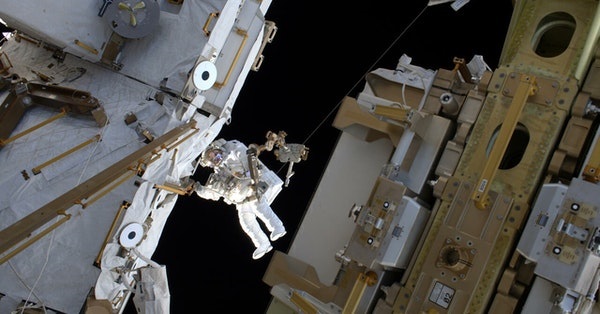
France 24 30/06/2022 Paris (AFP) – Astronauts lose decades’ worth of bone mass in space that many do not recover even after a year back on Earth, researchers said Thursday, warning that it could be a “big concern” for future missions to Mars.
Previous research has shown astronauts lose between one to two percent of bone density for every month spent in space, as the lack of gravity takes the pressure off their legs when it comes to standing and walking.
To find out how astronauts recover once their feet are back on the ground, a new study scanned the wrists and ankles of 17 astronauts before, during and after a stay on the International Space Station.
The bone density lost by astronauts was equivalent to how much they would shed in several decades if they were back on Earth, said study co-author Steven Boyd of Canada’s University of Calgary and director of the McCaig Institute for Bone and Joint Health.
The researchers found that the shinbone density of nine of the astronauts had not fully recovered after a year on Earth — and were still lacking around a decade’s worth of bone mass.
The astronauts who went on the longest missions, which ranged from four to seven months on the ISS, were the slowest to recover.
“The longer you spend in space, the more bone you lose,” Boyd told AFP.
Boyd said it is a “big concern” for planned for future missions to Mars, which could see astronauts spend years in space……………………..
Guillemette Gauquelin-Koch, the head of medicine research at France’s CNES space agency, said that the weightlessness experienced in space is “most drastic physical inactivity there is”.
“Even with two hours of sport a day, it is like you are bedridden for the other 22 hours,” said the doctor, who was not part of the study.
“It will not be easy for the crew to set foot on Martian soil when they arrive — it’s very disabling.”…………………………………. https://www.france24.com/en/live-news/20220630-lost-in-space-astronauts-struggle-to-regain-bone-density—
Is Nuclear Power Just Too Dangerous?

The New Republic , 1 July 22,
A survey of the world’s worst nuclear disasters highlights the catastrophic consequences of technical hubris.
On February 24, 2022, Russian troops began occupying Ukrainian territory in the Chernobyl exclusion zone. The meltdown at the Chernobyl nuclear plant 26 years earlier remains the worst nuclear disaster the world has yet experienced. …………….Soon enough it became clear that Russian forces were not actively targeting Chernobyl’s facilities, including the sarcophagus that protects the damaged reactor core. Rather, they had chosen the sparsely populated area as the fastest route from Belarus to Kyiv.
……………The International Atomic Energy Agency, the United Nation’s nuclear watchdog, issued assurances that there was no cause for alarm. But nuclear watchers could be forgiven for their panic. The spotty news emerging from Chernobyl this spring uneasily echoed the trajectory of several of the world’s major nuclear disasters, including Japan’s Fukushima and Three Mile Island in the United States.
……………………None of this had yet transpired when Serhii Plokhy, a professor of history and director of the Ukrainian Institute at Harvard, began writing Atoms and Ashes: A Global History of Nuclear Disasters. Nuclear power has, in fact, been gaining popular support, despite its dangers. In recent years, some climate activists have aligned with the nuclear power industry to argue that nuclear power offers the only off-ramp from the urgent and existential threat of climate change. The World Nuclear Association, an industry lobbying group, wants to raise the share of electrical energy produced by nuclear plants from 10 to 25 percent by 2050.
While Plokhy acknowledges the threat of climate change, his study of the history of nuclear accidents has convinced him that the risks are simply too high. His account, which draws on contemporary reports of six radiological disasters as well as government investigations conducted after the fact, argues persuasively that nuclear reactors remain inherently unsafe. Nuclear engineers add new safety features after each disaster, only to be astonished by the devilish and statistically unlikely path of the next one. Citing research based on acknowledged nuclear incidents that predicts “one core meltdown accident every 37,000 reactor years,” Plohky forecasts that we will likely see another large-scale accident before 2036. We may be lucky to make it that long.
America’s first hydrogen bomb test did not go according to plan………………………………………………..
Similar scenarios unfolded in each of the cases Plokhy discusses in the book. …………………………. a storage tank for radioactive waste at the Maiak plutonium production facility had exploded, in September 1957…………………. In the critical hours leading up to a reactor fire at the U.K.’s Windscale facility, one month later, operators struggled to understand the pile’s strange behavior during a maintenance operation that had been postponed several months in the name of plutonium production. ……………….. in March 1979. Plant managers at Chernobyl made the disastrous decision to press pause halfway through a test of the backup generators to satisfy demands made by the regional administrator of the electrical grid. At Fukushima, plant designers located the backup generators below sea level for a facility nestled against the sea in a country vulnerable to earthquakes and tsunamis
The technical details in these stories matter immensely, and Plokhy excels at breaking them down. …………… The bad news is that the authorities in charge of building nuclear power plants do not always incorporate these safety features into their designs. …………… https://newrepublic.com/article/166949/nuclear-power-just-dangerous-atoms-ashes-serhii-plokhy.
The US supreme court has declared war on the Earth’s future
The US supreme court has declared war on the Earth’s future
Kate Aronoff
In a major environmental case, the court has made clear that it would rather represent the interests of corporations and the super-rich than the needs and desires of the vast majority of Americans – or people on Earth
In France, drought, and multiple problems in nuclear power plants add energy crisis to the climate crisis.
In the midst of the war in Ukraine, the energy crisis is taking precedence
over the environmental crisis. On Thursday, the government called on the
French to reduce their consumption by 10% in 2 years. On Sunday, EDF, Total
and Engie even deemed it necessary to make efforts “immediately”. Their
fear: a real risk of cuts this winter. when the drought and the multiplication of problems in nuclear power plants add crisis to crisis.
Indeed, it is not only Russian oil and gas that will be missing from the
European energy mix in the future. Declining flow in rivers is a problem
for hydropower plants.
And even worse, the state of the French nuclear
fleet raises many concerns. Called to satisfy 40% of electricity
consumption in France, it has suffered from the health crisis to the point
that production fell by 8.7% in 2020 compared to 2019, falling to a level
that had not been observed since the late 1990s.
All this has delayed maintenance operations. And now we suddenly discover corrosion where we did
not expect it on 12 reactors, which were automatically shut down. It is
therefore half of the 56 French reactors which are out of service for a
certain time. A hard blow impossible to compensate for immediately with the
major projects intended in the long term to increase the share of renewable
energies in our energy mix.
La Depeche 27th June 2022
So, what should be done about nuclear waste?
Where will the nuclear waste go?” https://www.nationofchange.org/2022/06/30/where-will-the-nuclear-waste-go/
By Karl Grossman. June 30, 2022“Where will the state’s nuclear waste go?” was the headline of a story bannered last month across the front page of Connecticut’s largest newspaper, the Hartford Courant.
What, indeed, is to be done about the nuclear waste that has been produced at the two Millstone nuclear power plants which have been operating in Connecticut? (They are now the only nuclear power plants running in New England.)
And what is to be done about the nuclear waste at other nuclear power plants?
Decades ago, one scheme was to put it on rockets to be sent to the sun. But the very big problem, it was realized, is that one-in-100 rockets undergo major malfunctions on launch, mostly by blowing up.
As Forbes magazine has pointed out, because of the “possibility of launch failure” if “your payload is radioactive or hazardous and you have an explosion on launch…all of that waste will be uncontrollably distributed across Earth.”
So, scratch that idea.
Then there has been the plan to construct a “repository” for nuclear waste at Yucca Mountain, Nevada, 100 miles northwest of Las Vegas. It was designated the nation’s “permanent nuclear repository” in 1987 and $15 billion was spent preparing it.
The very big problem concerning Yucca Mountain as a nuclear waste dump: it’sin “an active earthquake zone, with 33 faults on site.”
So, that idea was scratched.
Now, Finland has built a nuclear waste site for its four nuclear power plants. “Finland wants to bury nuclear waste for 100,000 years,” was the title of an CNBC’s piece about it and how it uses “a labyrinth of underground tunnels.”
The very big problem: nuclear waste needs to be isolated from life for way more than 100,000 years. The U.S. Court of Appeals for the District of Columbia Circuit in 2004 ordered the EPA to rewrite its Yucca Mountain regulations to acknowledge a million years of hazard, notes Kevin Kamps, radioactive waste specialist for the organization Beyond Nuclear.
Some nuclear waste stays radioactive for millions of years, Kamps points out: “Iodine-129 that is produced in reactors has a 15.7 million-year half-life.”
After a half-life, a radioactive material is half as radioactive as when it was produced. For determining a “hazardous lifetime,” a half-life is multiplied by 20.
Thus Iodine-129 remains radioactive for 314 million years.
“The design of the storage facility” for nuclear waste in Finland “has taken into account the potential impact of earthquakes and even future ice ages,” related CNBC. But not for anything close to millions of years.
So, what should be done about nuclear waste?
First, says Kamps, “we should stop making it.” He calls for the closure of every one of the 92 nuclear power plants now in the United States, the building of no more and a push for safe, clean, green energy sources led by solar and wind energy. Nuclear power plants in the U.S. have since 1957 generated nearly 100,000 tons of deadly nuclear waste, he says. Second, the “best option is hardened onsite storage.”
Currently, most nuclear waste, he says, is at reactor sites in pools of water which must be kept circulating. If there is a “loss of water” accident, the nuclear waste in the pools can go “up in flames.”
Kamps and Beyond Nuclear, with other environmental and safe-energy groups, is now challenging—along with the state governments of Texas and New Mexico—the present U.S. government plan involving “so-called interim” nuclear waste sites in Texas and New Mexico.
They would be amid largely Latino communities, and on top of the Ogallala Aquifer, the largest aquifer in the U.S. It extends north to South Dakota, encompassing eight states, and is a main source of water for drinking and irrigation.
Also, the U.S. Department of Energy has, he says, “restarted its federal consolidated interim storage facility scheme, last attempted in the late 1980s and early 1990s. A whole new crop of nuclear waste dump fights can be expected, especially ones targeting Native American reservations to agree to host the most deadly poison our society has ever generated.”
Meanwhile, in New Jersey, Oyster Creek, among the oldest nuclear power plants in the U.S.—it began operation in 1969—is in the midst of being demolished after its closure in 2018. There’s been a “a series of worrisome accidents” in the tearing down process reported The Washington Post last month. And then there is the decommissioned Oyster Creek plant’s nuclear waste.
Oyster Creek was manufactured by General Electric and was a Mark I nuclear power plant—the same model of those that blew up at the Fukushima nuclear plant site in Japan.
Nuclear Free Local Authorities join in Seminar ‘Sizewell C: More Questions than Answers’
As decision day nears on the Sizewell-C development, the Chair and
Secretary of Nuclear Free Local Authorities will be joining local
campaigners opposed to the new build plan at a special conference in
Saxmundham on Saturday 2 July.
Councillor David Blackburn and Richard
Outram are amongst a line-up of speakers who will talk on a range of topics
related to the proposed Sizewell-C and Bradwell nuclear power plant
developments.
The public conference titled ‘Sizewell C: More Questions
than Answers’ is being hosted by local campaign group, Together Against
Sizewell C, at Saxmundham Market Hall, High St, Saxmundham, IP17 1AF from
10am until 1.30pm on Saturday 2nd July. The decision by the Secretary of
State Kwasi Kwarteng to award a Development Consent Order for Sizewell-C is
expected on 8 July, but it is anticipated to be a formality as the Minister
and his Government have already made repeated statements in favour of the
project and have pledged to take a 20% stake in the plant.
Sizewell-C has been in the news recently with media reports that the government’s French
backers, EDF, are threatening to pull out if Ministers do not make a
cast-iron commitment to take their stake by 21 July; that trades unions are
lobbying Minsters for the same commitment citing a threat to jobs; and
because of a spat between Lord Deben, Chair of Parliament’s Climate Change
Committee, and EDF over his challenge to their competence in building new
nuclear power plants and the suitability of the Sizewell-C site.
The prospects for Bradwell in Essex are even more uncertain as Chinese
involvement in British nuclear projects has now been vetoed by the
Government, with a former Conservative Party leader pointedly describing
them as ‘not a trusted vendor’.
NFLA 27th June 2022
Corrosion problem shutters half of France’s nuclear reactors
Just when France, and the rest of Europe, needed the country’s 56 nuclear
reactors to be pumping out electricity at maximum power to counter the
shortfall of energy supplies caused by the war in Ukraine, half of them
have had to shut down.
An unexpected corrosion problem on pipes vital to
the safety of one reactor discovered in January has led to a series of
inspections that have so far closed 12 reactors for further investigation
or repair.
The fault seems common to a whole series of France’s reactors.
The shutdowns affect four of the largest N4 reactors of 1,500 megawatts,
five 1,300-MW, reactors of similar design, and three 900-MW units. This, on
top of a series of outages at 18 other reactors for repairs, updating, or
regular safety checks, has left France with the lowest nuclear output in
decades.
Energy Mix 29th June 2022
International groups mobilise to demand that the European Parliament end plan to greenwash nuclear power.

It is time to retake the streets. In July, the European Parliament will
vote on a new taxonomy for gas and nuclear and a coalition of grassroot
groups and NGOs from across the world will show up and demand MEPs stop
this unbelievable act of greenwashing. Join the mobilisations to
Strasbourg, where the European Parliament will vote on the new taxonomy, in
the week of the 4th of July.
Not My Taxonomy 13th June 2022
UK govt scratching for money for new nuclear, hires Barclays to search for investors.

UK ministers tap Barclays to secure investment for new nuclear plant. https://www.ft.com/content/4adac154-2a6d-4f13-95b1-a1b8592aa1fe
Search for 60% of facility’s financing comes as government aims to boost domestic energy supply Nathalie Thomas in Edinburgh and Jim Pickard in London .
UK ministers have hired Barclays to lead a search for investors willing to back a large new nuclear power plant at Sizewell on England’s east coast as part of a push to secure more domestic energy sources, according to four people familiar with the appointment. The government is keen to forge ahead with a 3.2 gigawatt plant, capable of generating electricity for 6mn homes, at Sizewell in Suffolk as part of Prime Minister Boris Johnson’s aim to build eight nuclear reactors by 2030.
Ministers have drawn up plans with Sizewell’s promoter, French state-backed EDF Energy, for a new company to replace the current joint venture that has been working on the Suffolk plant. Both the government and EDF would each take a 20 per cent stake in the new company. Bankers at Barclays have been tasked with finding investors to cover the remaining 60 per cent, according to people familiar with the plans.
The revised structure would force out the Chinese state-backed nuclear company CGN from Sizewell C. CGN owns 20 per cent of the current joint venture, with EDF holding the remaining 80 per cent. But UK ministers want to avoid further Chinese involvement in British nuclear facilities, given a deterioration in diplomatic relations between London and Beijing in recent years. CGN is already funding a third of the cost of the Hinkley Point C plant that is under construction in Somerset and upon which Sizewell C is based.
But nuclear industry experts say the government will have to tread carefully as CGN’s expertise will remain crucial to delivering Hinkley Point C. The company’s Taishan nuclear power plant in southern China was the first in the world to operate using a Franco-German European Pressurised Reactor technology that is being installed at Hinkley, and more than 100 Chinese engineers have been at work on the Somerset facility. Hinkley Point C is already running years behind schedule and billions over budget. EDF said in May that the plant’s estimated construction budget had ballooned by a further £3bn to between £25bn and £26bn, compared with an estimate of £18bn when it received the go-ahead in 2016. The first reactor is not expected to start generating electricity until June 2027.
The impossibility of humans colonising space
Ukraine Is The Most Aggressively Trolled War Of All Time: Notes From The Edge Of The Narrative Matrix, Caitlin’s Newsletter, Caitlin Johnstone 30n June 22
”……………………………………………………………………………..One thing we learned from Covid is that being stuck inside sucks. Space colonization would be like being in permanent lockdown with no windows, no Uber Eats, no birdsong or rain on the roof and no chance of ever going home. Even if it somehow became possible, it’s a dumb idea and I hate it.
And there’s no reason to believe it will ever become possible. Science is nowhere near finished learning about all the countless ways the human organism is inseparably intertwined with Earth. The belief that we can solve our problems with space colonization is unscientific. We’re just going to have to change how we function as a species.

The biggest obstacle remains the fact that science has no idea how to sustain human life in a way that is separate from earth’s ecosystem. We don’t even have any evidence that it’s possible. We’re no closer to being able to do it than we were a thousand years ago; today’s space stations are not independent of Earth’s ecosystem in even the tiniest way. They’re still 100 percent dependent on terrestrial supplies, which is an unsustainable model if you’re talking about actual colonization.
The idea of space colonization appeals to the capitalist mentality because it means we can keep expanding our population and keep expanding the economy and keep harvesting and consuming resources in the way we have been. But there’s literally zero scientific evidence that it’s feasible.
A future of space colonization is a fairy tale we tell ourselves so that we won’t have to change. So we can keep up our egocentric way of functioning without adapting and transcending our self-destructive patterns. We’re like a slacker who refuses to get off their parents’ couch and get their shit together who babbles made-up nonsense about NFT get-rich-quick schemes when asked about their plans for the future.
Collective extinction is easier to imagine than collective ego death. https://caitlinjohnstone.substack.com/p/ukraine-is-the-most-aggressively?utm_source=substack&utm_medium=email
1 This Month


Tell the Ukrainian Government to Drop Prosecution of Peace Activist Yurii Sheliazhenko

Petition to revoke the licensing of the Near Surface Nuclear Disposal Facility (NSDF) at Chalk River. https://www.ourcommons.ca/petitions/en/Petition/Details?Petition=e-7247


of the week – STOP SMALL MODULAR REACTORS IN CANADA
To see nuclear-related stories in greater depth and intensity – go to https://nuclearinformation.wordpress.com
-
Archives
- March 2026 (204)
- February 2026 (268)
- January 2026 (308)
- December 2025 (358)
- November 2025 (359)
- October 2025 (376)
- September 2025 (258)
- August 2025 (319)
- July 2025 (230)
- June 2025 (348)
- May 2025 (261)
- April 2025 (305)
-
Categories
- 1
- 1 NUCLEAR ISSUES
- business and costs
- climate change
- culture and arts
- ENERGY
- environment
- health
- history
- indigenous issues
- Legal
- marketing of nuclear
- media
- opposition to nuclear
- PERSONAL STORIES
- politics
- politics international
- Religion and ethics
- safety
- secrets,lies and civil liberties
- spinbuster
- technology
- Uranium
- wastes
- weapons and war
- Women
- 2 WORLD
- ACTION
- AFRICA
- Atrocities
- AUSTRALIA
- Christina's notes
- Christina's themes
- culture and arts
- Events
- Fuk 2022
- Fuk 2023
- Fukushima 2017
- Fukushima 2018
- fukushima 2019
- Fukushima 2020
- Fukushima 2021
- general
- global warming
- Humour (God we need it)
- Nuclear
- RARE EARTHS
- Reference
- resources – print
- Resources -audiovicual
- Weekly Newsletter
- World
- World Nuclear
- YouTube
-
RSS
Entries RSS
Comments RSS
 nuclear-news