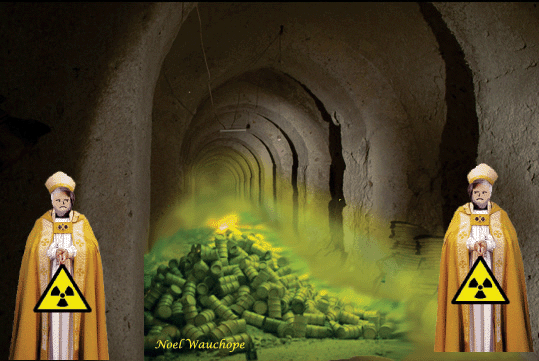
If we bury today the repulsive nuclear wastes, why do we pass it on to others to deal with?
At the recent local elections three of the five candidates for the West
Caithness ward listed on their leaflets building more nuclear reactors at
Dounreay alongside complaints about potholes in the roads as their
priorities. They all got in. None of them took up my suggestion that they
could fill all the potholes in Caithness with nuclear waste.
I suspect none of them had given much thought to nuclear waste at all, which is something
they had in common with the United Kingdom Atomic Energy Authority when
they built Dounreay in the 1950’s.
Unfortunately the waste problem is now
critical, in more ways than one. The Dounreay dome, the reactor protective
casing structure, also known as the sphere and the golf ball, has been a
feature of the north Caithness coast for almost 60 years. The Nuclear
Decommissioning Authority (NDA) has recommended that the DFR be
decontaminated by 2022 (the schedule has slipped) so it can then be
demolished.
In 2007, Dounreay Site Restoration Limited (DSRL), the company
that manages the site, released the results of public consultation on
future uses for the dome. Suggestions included turning it into a hotel,
museum and even a nightclub.
However, because the structure is contaminated
with worrying levels of radioactivity and due to high maintenance costs, it
was decided to demolish it. So, sadly, no glowing raves or very long
radioactive sleeps or trips back into a memory that begins in 1955 and will
never end as the nuclear waste, dome and all, will be buried at a nuclear
dump site at nearby Buldoo.
What language, I wonder, will they put on the
steel door of this addition to the ancient burial mound culture of
Caithness? At an underground facility, a bit like Buldoo, assuringly called
“The Waste Isolation Plant”, the US government buries all kinds of
nasty waste from its nuclear weapons production 600 metres below the rocks
of New Mexico. In 20 years time, when the dump has been stuffed to the
gunnels with nuclear crap, the US government will have to seal the steel
and concrete entrances and place signs saying “Danger Zone!” all around
them.
The problem, as Serhii Plokhy, the author of “Atoms and Ashes: From
Bikini Atoll to Fukushima”, has pointed out, is that the underground
store will still be contaminated in 300,000 years, and no one can predict
what language our descendants will read or speak at that time, or what
messages might convince them not to dig into the New Mexico rocks. In the
1990s nuclear security experts proposed symbols, earthworks and mounds of
rubble designed to convey an appropriate sense of menace to anyone
stumbling on the area.
The intended message the US government wanted to
broadcast was: “This place is not a place of honour. No highly esteemed
deed is commemorated here. Nothing valued is here. What is here was
dangerous and repulsive to us. This message is a warning about danger.”
The hard question Serhii Plokhy, who is also a professor of Ukrainian
history at Harvard University where he also serves as the director of the
Harvard Ukrainian Research Institute, asks is, “If what we bury today in
the New Mexico desert – the waste created by our nuclear ambitions – is
so repulsive to us, why do we pass it on to others to deal with?”
Bella Caledonia 2nd June 2022
A lifeline for Westinghouse nuclear? Westinghouse to take over nuclear fuel supplies to Ukraine, replacing Russia as supplier
Ukraine signs deal with Westinghouse to end Russian nuclear fuel needs https://au.lifestyle.yahoo.com/ukraine-signs-deal-westinghouse-end-110151253.html
Fri, 3 June 2022 KYIV (Reuters) – Ukraine has signed a deal for the U.S. nuclear power company Westinghouse to supply fuel to all of its atomic power stations in an effort to end the country’s reliance on Russian supplies, Ukraine’s state nuclear company said on Friday.
The agreement also increases the number of new nuclear units Westinghouse will build to nine from an earlier five, and the company will establish an engineering centre in the country.
Ukraine has four working nuclear power stations, the largest of which, in Zaporizhzhia, fell under Russian control days after the Russian invasion began in February but is still operated by Ukrainian technicians.
Building on earlier agreements, the deal with Westinghouse stipulates that the company will supply fuel to all of Ukraine’s atomic plants.
Nuclear power covers around a half of all Ukrainian electricity needs and the energy minister said that in future Ukraine could also be a supplier of electricity to western Europe.
“We will modernise our fleet of nuclear power units, which will produce clean, safe and reliable energy without any Russian influence,” Energy Minister Herman Halushchenko said, according to a statement by the state atomic energy company Energoatom.
Energoatom on Thursday denied a report that it might shut down the Zaporizhzhia plant if Kyiv loses control of operations at the site.
Ukraine has repeatedly raised safety concerns about the plant since Russia’s invasion began on Feb. 24. On Friday, it warned that it was running out of spare parts.
(Reporting by Natalia Zinets; writing by Matthias Williams; editing by Barbara Lewis)
Small nuclear reactors produce ’35x more waste’ than big plants

Mini nuclear reactors that are supposed to usher in an era of cheaper and
safer nuclear power may generate up to 35 times more waste to produce the
same amount of power as a regular plant, according to a study.
A team of researchers at Stanford University and the University of British Columbia
came to this conclusion after studying a design from each of three small
modular reactor (SMR) manufacturers: NuScale Power, Toshiba, and
Terrestrial Energy.
The study, published this week, found that not only did
those particular SMR approaches generate five times the spent nuclear fuel
(SNF), 30 times the long-lived equivalent waste, and 35 times the low and
intermediate-level waste (LILW), their waste is also more reactive,
therefore more dangerous and consequently harder to dispose of.
The Register 2nd June 2022
https://www.theregister.com/2022/06/02/nuclear_reactors_waste/
Current and former residents of Tamura City, plaintiffs in case against TEPCO may appeal about low compensation
A Japanese court on Thursday ordered the operator of the crippled
Fukushima Daiichi nuclear power plant to pay a total of 73.5 million yen
($566,000) in compensation to current and former residents of Tamura City
in the west of the complex hit by the March 2011 disaster for emotional
distress. But the 525 plaintiffs, who sought 11 million yen per person in
damages from both Tokyo Electric Power Company Holdings Inc. and the
Japanese government, are considering appealing the ruling, some of them
said in a press conference.
Mainichi 2nd June 2022
https://mainichi.jp/english/articles/20220602/p2g/00m/0na/
Current policies will bring ‘catastrophic’ climate breakdown, warn former UN leaders
The policies currently in place to tackle the climate crisis around the
world will lead to “catastrophic” climate breakdown, as governments
have failed to take the actions needed to fulfil their promises, three
former UN climate leaders have warned.
There is a stark gap between wha governments have promised to do to protect the climate, and the measuresand policies needed to achieve the targets. At the Cop26 summit last
November, countries agreed to bring forward plans to limit global heating
to 1.5C above pre-industrial levels – the limit of safety, according to
scientists. They have so far submitted pledges that would limit
temperatures to under 2C.
But the policies and measures passed and
implemented by governments would lead to far greater temperature rises, of
at least 2.7C, well beyond the threshold of relative safety, and
potentially as much as 3.6C. That would have “catastrophic” impacts, in
the form of extreme weather, sea-level rises and irreversible changes to
the global climate.
The three living former directors of the UN Framework
Convention on Climate Change have written together in Wednesday’s
Guardian – the first time they have written jointly in a newspaper – of
the disastrous consequences of failing to match national pledges on the
climate with concrete actions and policies to follow them through.
Guardian 2nd June 2022
Iran: No one can remain silent on Zionist regime’s clandestine nuclear program
program, https://en.irna.ir/news/84777256/Iran-No-one-can-remain-silent-on-Zionist-regime-s-clandestine
“As one of the original signatories to NPT, Iran calls on all to beware of further erosion of the IAEA’s credibility,” Khatibzadeh tweeted.
He pointed out that as one of the original signatories to NPT, Iran calls on all to beware of further erosion of the IAEA’s credibility.
“No one can keep mum on Israel’s clandestine nuclear weapons program and then claim impartiality and talk about Iran’s peaceful nuclear activities,” Khatibzadeh added.
IAEA Director General Rafael Grossi arrived in occupied Palestinian lands on Thursday night for meeting with the Zionist officials.
Grossi’s visit of Israel comes after the destructive moves made by the Zionists to influence the western countries, and especially America to convince them not to revive the JCPOA.
30 years on from Rio Earth Summit not that much has been achieved.
| Climate change: 30 years on from Rio Earth Summit, did it actually achieve anything? – Dr Richard Dixon. Thirty years ago tomorrow, the United Nations Conference on Environment and Development opened in Rio de Janeiro. Nearly 200 countries met for 11 days and four international agreements were signed. But has it made any difference? More familiarly known as the Earth Summit, the event was held 20 years on from the 1972 Human Environment Conference and followed the 1987 Brundtland report which cemented the concept of sustainable development. There was a great deal of optimism that humankind might finally be about to get really serious about the damage we were doing to the planet. Sadly the best we seem to be able to say about the Earth Summit and the subsequent 30 years is that things aren’t quite as bad as they would have been if we hadn’t bothered. Scotsman 2nd June 2022https://www.scotsman.com/news/opinion/columnists/climate-change-30-years-on-from-rio-earth-summit-did-it-actually-achieve-anything-dr-richard-dixon-3716466 |
Belgian government pressed to pay for extension of nuclear reactors Doel 4 and Tihange 3
| Power suppliers Engie up the pressure, ask Belgian government to step in to share nuclear burden. In a letter to PM Alexander De Croo, the French power suppliers Engie are asking the federal government to pay part of the bill for the lifetime extension of Belgium’s youngest nuclear reactors Doel 4 and Tihange 3. Earlier, the federal government had decided to extend the time frame for the youngest two nuclear reactors with 10 years – until 2035 – to guarantee power supplies. The rest will have to close in 2025 as part of a larger energy deal. Flanders News 2nd June 2022 https://www.vrt.be/vrtnws/en/2022/06/02/power-suppliers-engie-ask-federal-government-for-extra-cash-if-t/ |
June 3 Energy News — geoharvey

Opinion: ¶ “The World May Be Careening Toward A 1970s-Style Energy Crisis – Or Worse” • The world is grappling with energy price spikes on everything from gasoline and natural gas to coal. Some experts fear this may just be the beginning of a situation that may rival or even exceed the oil crises of […]
June 3 Energy News — geoharvey
Washington: NATO chief meets with Biden, Blinken, Austin, Sullivan to prolong Ukraine war — Anti-bellum
NATOJune 2, 2022 NATO Secretary General visits Washington D.C. NATO Secretary General Jens Stoltenberg is visiting Washington D.C. to discuss the implications of Russia’s war in Ukraine and preparations for the NATO summit in Madrid with senior US officials. He will meet President Joe Biden, Defense Secretary Lloyd Austin and National Security Adviser Jake Sullivan. […]
Washington: NATO chief meets with Biden, Blinken, Austin, Sullivan to prolong Ukraine war — Anti-bellum
Following U.S., Britain to supply Ukraine with multiple rocket launchers — Anti-bellum
Ukrainian News AgencyJune 2, 2022 Britain Will Give Ukraine Missile Systems With A Range Of 80 Km The United Kingdom will send multiple rocket launchers to Ukraine…. This, according to Yevropeiska Pravda online media with reference to CNN, was announced on Wednesday by British Defense Minister Ben Wallace. Britain will send M270 MLRSes capable of […]
Following U.S., Britain to supply Ukraine with multiple rocket launchers — Anti-bellum
NATO candidate Sweden to provide Ukraine with anti-ship, anti-tank missiles — Anti-bellum
UkrinformJune 2, 2022 Sweden to send anti-ship missiles to Ukraine The Swedish government will hand over a new batch of military aid to Ukraine amid Russian aggression.Swedish Foreign Minister Ann Linde announced this on Twitter…. “Sweden will send anti-ship missiles, anti-tank weapons and 12.7 mm rifles including ammunition to Ukraine. This 4th support package also […]
NATO candidate Sweden to provide Ukraine with anti-ship, anti-tank missiles — Anti-bellum
Wind power meets and beats Denmark’s total electricity demand – two days in a row — RenewEconomy

Windy conditions in northern Europe provided more than 100% of Denmark’s electricity consumption for two days in a row in May. The post Wind power meets and beats Denmark’s total electricity demand – two days in a row appeared first on RenewEconomy.
Wind power meets and beats Denmark’s total electricity demand – two days in a row — RenewEconomy
Nuclear waste from small modular reactors

Lindsay M. Krall https://orcid.org/0000-0002-6962-7608 Lindsay.Krall@skb.se, Allison M. Macfarlane https://orcid.org/0000-0002-8359-9324, and Rodney C. Ewing https://orcid.org/0000-0001-9472-4031Authors Info & Affiliations
May 31, 2022 Small modular reactors (SMRs), proposed as the future of nuclear energy, have purported cost and safety advantages over existing gigawatt-scale light water reactors (LWRs). However, few studies have assessed the implications of SMRs for the back end of the nuclear fuel cycle. The low-, intermediate-, and high-level waste stream characterization presented here reveals that SMRs will produce more voluminous and chemically/physically reactive waste than LWRs, which will impact options for the management and disposal of this waste. Although the analysis focuses on only three of dozens of proposed SMR designs, the intrinsically higher neutron leakage associated with SMRs suggests that most designs are inferior to LWRs with respect to the generation, management, and final disposal of key radionuclides in nuclear waste.
Abstract
Small modular reactors (SMRs; i.e., nuclear reactors that produce <300 MWelec each) have garnered attention because of claims of inherent safety features and reduced cost. However, remarkably few studies have analyzed the management and disposal of their nuclear waste streams. Here, we compare three distinct SMR designs to an 1,100-MWelec pressurized water reactor in terms of the energy-equivalent volume, (radio-)chemistry, decay heat, and fissile isotope composition of (notional) high-, intermediate-, and low-level waste streams. Results reveal that water-, molten salt–, and sodium-cooled SMR designs will increase the volume of nuclear waste in need of management and disposal by factors of 2 to 30. The excess waste volume is attributed to the use of neutron reflectors and/or of chemically reactive fuels and coolants in SMR designs. That said, volume is not the most important evaluation metric; rather, geologic repository performance is driven by the decay heat power and the (radio-)chemistry of spent nuclear fuel, for which SMRs provide no benefit.
SMRs will not reduce the generation of geochemically mobile 129I, 99Tc, and 79Se fission products, which are important dose contributors for most repository designs. In addition, SMR spent fuel will contain relatively high concentrations of fissile nuclides, which will demand novel approaches to evaluating criticality during storage and disposal. Since waste stream properties are influenced by neutron leakage, a basic physical process that is enhanced in small reactor cores, SMRs will exacerbate the challenges of nuclear waste management and disposal.
In recent years, the number of vendors promoting small modular reactor (SMR) designs, each having an electric power capacity <300 MWelec, has multiplied dramatically (1, 2). Most recently constructed reactors have electric power capacities >1,000 MWelec and utilize water as a coolant. Approximately 30 of the 70 SMR designs listed in the International Atomic Energy Agency (IAEA) Advanced Reactors Information System are considered “advanced” reactors, which call for seldom-used, nonwater coolants (e.g., helium, liquid metal, or molten salt) (3). Developers promise that these technologies will reduce the financial, safety, security, and waste burdens associated with larger nuclear power plants that operate at the gigawatt scale (3). Here, we make a detailed assessment of the impact of SMRs on the management and disposal of nuclear waste relative to that generated by larger commercial reactors of traditional design.
Nuclear technology developers and advocates often employ simple metrics, such as mass or total radiotoxicity, to suggest that advanced reactors will generate “less” spent nuclear fuel (SNF) or high-level waste (HLW) than a gigawatt-scale pressurized water reactor (PWR), the prevalent type of commercial reactor today. For instance, Wigeland et al. (4) suggest that advanced reactors will reduce the mass and long-lived radioactivity of HLW by 94 and ∼80%, respectively. These bulk metrics, however, offer little insight into the resources that will be required to store, package, and dispose of HLW (5). Rather, the safety and the cost of managing a nuclear waste stream depend on its fissile, radiological, physical, and chemical properties (6). Reactor type, size, and fuel cycle each influence the properties of a nuclear waste stream, which in addition to HLW, can be in the form of low- and intermediate-level waste (LILW) (6–8). Although the costs and time line for SMR deployment are discussed in many reports, the impact that these fuel cycles will have on nuclear waste management and disposal is generally neglected (9–11).
Here, we estimate the amount and characterize the nature of SNF and LILW for three distinct SMR designs. From the specifications given in the NuScale integral pressurized water reactor (iPWR) certification application, we analyze basic principles of reactor physics relevant to estimating the volumes and composition of iPWR waste and then, apply a similar methodology to a back-end analysis of sodium- and molten salt–cooled SMRs. Through this bottom-up framework, we find that, compared with existing PWRs, SMRs will increase the volume and complexity of LILW and SNF. This increase of volume and chemical complexity will be an additional burden on waste storage, packaging, and geologic disposal. Also, SMRs offer no apparent benefit in the development of a safety case for a well-functioning geological repository.
1. SMR Neutronics and Design………………
2. Framework for Waste Comparison………….
3. SMR Waste Streams: Volumes and Characteristics………….
…………..
3.3.2. Corroded vessels from molten salt reactors.
Molten salt reactor vessel lifetimes will be limited by the corrosive, high-temperature, and radioactive in-core environment (23, 24). In particular, the chromium content of 316-type stainless steel that constitutes a PWR pressure vessel is susceptible to corrosion in halide salts (25). Nevertheless, some developers, such as ThorCon, plan to adopt this stainless steel rather than to qualify a more corrosion-resistant material for the reactor vessel (25).
Terrestrial Energy may construct their 400-MWth IMSR vessel from Hastelloy N, a nickel-based alloy that has not been code certified for commercial nuclear applications by the American Society of Mechanical Engineers (26, 27). Since this nickel-based alloy suffers from helium embrittlement (27), Terrestrial Energy envisions a 7-y lifetime for their reactor vessel (28). Molten salt reactor vessels will become contaminated by salt-insoluble fission products (28) and will also become neutron-activated through exposure to a thermal neutron flux greater than 1012 neutrons/cm2-s (29). Thus, it is unlikely that a commercially viable decontamination process will enable the recycling of their alloy constituents. Terrestrial Energy’s 400-MWth SMR might generate as much as 1.0 m3/GWth-y of steel or nickel alloy in need of management and disposal as long-lived LILW (Fig. 1, Table 1, and SI Appendix, Fig. S3 and section 2) [on original]…………
4. Management and Disposal of SMR Waste
The excess volume of SMR wastes will bear chemical and physical differences from PWR waste that will impact their management and final disposal. …………………….
5. Conclusions
This analysis of three distinct SMR designs shows that, relative to a gigawatt-scale PWR, these reactors will increase the energy-equivalent volumes of SNF, long-lived LILW, and short-lived LILW by factors of up to 5.5, 30, and 35, respectively. These findings stand in contrast to the waste reduction benefits that advocates have claimed for advanced nuclear technologies. More importantly, SMR waste streams will bear significant (radio-)chemical differences from those of existing reactors. Molten salt– and sodium-cooled SMRs will use highly corrosive and pyrophoric fuels and coolants that, following irradiation, will become highly radioactive. Relatively high concentrations of 239Pu and 235U in low–burnup SMR SNF will render recriticality a significant risk for these chemically unstable waste streams.
SMR waste streams that are susceptible to exothermic chemical reactions or nuclear criticality when in contact with water or other repository materials are unsuitable for direct geologic disposal. Hence, the large volumes of reactive SMR waste will need to be treated, conditioned, and appropriately packaged prior to geological disposal. These processes will introduce significant costs—and likely, radiation exposure and fissile material proliferation pathways—to the back end of the nuclear fuel cycle and entail no apparent benefit for long-term safety.
Although we have analyzed only three of the dozens of proposed SMR designs, these findings are driven by the basic physical reality that, relative to a larger reactor with a similar design and fuel cycle, neutron leakage will be enhanced in the SMR core. Therefore, most SMR designs entail a significant net disadvantage for nuclear waste disposal activities. Given that SMRs are incompatible with existing nuclear waste disposal technologies and concepts, future studies should address whether safe interim storage of reactive SMR waste streams is credible in the context of a continued delay in the development of a geologic repository in the United States.
Supporting Information
Appendix 01 (PDF)
Note
This article is a PNAS Direct Submission. E.J.S. is a guest editor invited by the Editorial Board.
References…………………………….. https://www.pnas.org/doi/10.1073/pnas.2111833119
Russian-Norwegian nuclear safety commission ceases work over war in Ukraine

Russia has announced its withdrawal from a high-level joint commission it runs with Norway to ensure nuclear safety in the Arctic region, ceasing more than two decades of bilateral progress in cleaning up the radioactive legacy of the Cold War. June 1, 2022 by Charles Digges
Russia has announced its withdrawal from a high-level joint commission it runs with Norway to ensure nuclear safety in the Arctic region, ceasing more than two decades of bilateral progress in cleaning up the radioactive legacy of the Cold War.
The announcement, reported by Norway’s NRK broadcaster, comes weeks after Norway itself froze funding to the commission over Moscow’s ongoing invasion of Ukraine.
The news casts a shadow of uncertainty over the future of several major radiation safety projects – from the removal of radioactive spent nuclear fuel from the derelict Soviet submarine base at Andreyeva Bay near the Norwegian border, to raising sunken nuclear submarines off Russia’s Kola Peninsula – that Norway and other European partners have spent millions of dollars to fund.
“It is sad that Norway will no longer be involved in financing the projects,” said Oleg Kryukov, who heads spent nuclear fuel and radioactive waste policy for Rosatom, Russia’s state nuclear corporation, NRK reported.
Removing thousands more spent nuclear fuel assemblies from Andreyeva Bay would not be abandoned but would now take longer as Moscow continues the cleanup unilaterally, said Kryukov.
Norwegian technicians were to oversee some of the most technically demanding fuel removal procedures that were scheduled to begin this year. They will now become Russia’s responsibility.
Kryukov told an online meeting of the commission that freezing the cooperative program “is not good – neither for [Russia and Norway] nor for neighboring countries.”
Norwegian-Russian Commission on nuclear and radiation safety was one of the first and most enduring cooperative programs launched to address the dangers left behind by the Soviet Northern Nuclear Fleet.
Established in the turbulent years following the Soviet Union’s collapse, the commission weathered 25 years of political tremors and mutual suspicion between East and West, often becoming the rare forum where Moscow and its European counterparts could reach agreement.
During the commission’s existence, Norway, Russia, and other European contributors disposed of nearly 200 rusted-out Soviet nuclear submarines that had laid neglected at bases throughout Northwest Russia, still dangerously laden with their spent nuclear fuel.
Later, at Bellona’s urging, the commission worked to fund the removal of 22,000 spent nuclear fuel assemblies, many of them damaged, from the site of Andreyeva Bay – a colossal and highly technical project that is still several years from completion.
Though Kryukov has said this work will continue, it is unclear how it will proceed, especially at a time when Moscow’s entire foreign policy has been sidelined by Vladimir Putin’s invasion of Ukraine.
The most immediate casualty to come of freezing the program will likely be transparency on how these projects are progressing. The joint nature of the commission ensured that Norwegian observers had access to the sites where western money helped fund cleanup. It also accommodated the participation of non-governmental organization like Bellona and many others.
Now, the fate of these projects is uncertain and the pause on cooperation rolls back the clock on the Russian and Norwegian governments, leaving them in the same precarious position they were in during the early 1990s, before the commission’s work began.
-
Archives
- February 2026 (233)
- January 2026 (308)
- December 2025 (358)
- November 2025 (359)
- October 2025 (376)
- September 2025 (258)
- August 2025 (319)
- July 2025 (230)
- June 2025 (348)
- May 2025 (261)
- April 2025 (305)
- March 2025 (319)
-
Categories
- 1
- 1 NUCLEAR ISSUES
- business and costs
- climate change
- culture and arts
- ENERGY
- environment
- health
- history
- indigenous issues
- Legal
- marketing of nuclear
- media
- opposition to nuclear
- PERSONAL STORIES
- politics
- politics international
- Religion and ethics
- safety
- secrets,lies and civil liberties
- spinbuster
- technology
- Uranium
- wastes
- weapons and war
- Women
- 2 WORLD
- ACTION
- AFRICA
- Atrocities
- AUSTRALIA
- Christina's notes
- Christina's themes
- culture and arts
- Events
- Fuk 2022
- Fuk 2023
- Fukushima 2017
- Fukushima 2018
- fukushima 2019
- Fukushima 2020
- Fukushima 2021
- general
- global warming
- Humour (God we need it)
- Nuclear
- RARE EARTHS
- Reference
- resources – print
- Resources -audiovicual
- Weekly Newsletter
- World
- World Nuclear
- YouTube
-
RSS
Entries RSS
Comments RSS
 nuclear-news