Mr. Hiroshi Watanabe, a plaintiff in the Ehime lawsuit against the victims of the nuclear power plant accident, says, “The court’s decision will give hope to young people”.

June 15, 2022
◆Evacuation, Divorce…Families are falling apart
Fukushima-san, Fukushima-san. Hiroshi Watanabe, 43, who evacuated to Ehime Prefecture from Minamisoma City, Fukushima Prefecture, is sometimes called this by people he met in Ehime. Eleven years after the accident at the Fukushima Daiichi Nuclear Power Plant, he continues to be an “evacuee. And discrimination has not disappeared.
Only 22 people have evacuated from Fukushima to Ehime (as of April, according to the Reconstruction Agency). Because the number of evacuees is so small, “evacuees stand out and are easily discriminated against. Some evacuees continue to hide the fact that they came from Fukushima from their neighbors, even after purchasing a house.
Before the accident, he lived with his wife and two daughters in Odaka Ward, Minamisoma City, about 12 km north of the plant, and was a full-time farmer. He left the town under a government evacuation order, and a month after the accident, he evacuated to Ehime, where he spent his college years.
He divorced his wife in 2019 after a prolonged evacuation in a faraway place, which caused him and his wife to clash with each other more and more. Mr. Watanabe and his second daughter (13) remained behind, while his eldest daughter (17) moved with his ex-wife to Sukagawa City, Fukushima Prefecture. The reality that his family has been torn apart has left him with an unforgettable feeling: “If only the nuclear accident had never happened…”.
◆The ruthless attitude of the country was shown to me.
What triggered the lawsuit against the government and TEPCO was a social gathering of evacuees that started immediately after the accident at the urging of a Buddhist priest in Matsuyama City. When the group met once a month, one after another, they voiced their plight, saying, “We are suffering financially. They could not forgive the government for leaving compensation to TEPCO and providing inadequate support for the evacuees.
We went door to door to explain to the evacuees participating in the exchange meeting and recruited plaintiffs. Many of the evacuees were of child-rearing age, and eight plaintiffs, or 30%, were under 20 years old at the time of the accident.
In January 2003, at the first oral argument at the Matsuyama District Court, they were confronted with the ruthless attitude of the government. When the plaintiffs attempted to state their opinions in court about the hardships of evacuation life, the government’s representative refused to listen to them, saying, “It is unnecessary because it is not evidence (for the trial). After that, the scientific debate continued endlessly, and I wondered in the audience. I wondered in the audience, “Is there any place for evacuees in this trial?
◆”I wanted a school for evacuees.”
Still, if they did not speak out, their suffering would be pretended to have never happened. In May, I visited the plaintiffs in an effort to convey the feelings of the evacuees in the Supreme Court.
Among them was a brother who had been bullied and had stopped attending school. The 22-year-old brother said that he wished that evacuee schools had been established throughout Japan so that evacuees could go to school with other evacuees, and that if the government had been honest enough to apologize, the accident would never have happened in the first place. If the government had been honest and apologetic, the accident would never have happened in the first place,” he said angrily.
Mr. Watanabe’s second daughter, who is in her second year of junior high school, said, “My classmates don’t know much about the nuclear accident. If they don’t know about it, it will cause another accident, so I hope that when the verdict comes out, it will be written in textbooks that the accident was caused by the government’s policy.
Hearing the voices of the young plaintiffs, Ms. Watanabe thinks, “Young people will continue to live with the accident. I hope that the court will issue a verdict that will give hope to the young people who will have to live with the accident in the future.
Ehime Lawsuit Residents who evacuated from Fukushima Prefecture to Ehime Prefecture due to the accident at TEPCO’s Fukushima Daiichi Nuclear Power Plant filed lawsuits one after another since March 2014, and two lawsuits were filed in Ehime Prefecture. Five people have filed lawsuits against the government and TEPCO, demanding compensation. On March 26, 2007, the Matsuyama District Court of the first instance (Judge Keiko Kuboi) ordered the government and TEPCO to pay a total of 27.43 million yen. On September 29, 2009, the Takamatsu High Court (Ryuichi Kamiyama, presiding judge), the court of second instance, also ordered TEPCO to pay a total of ¥2,743,000. The second trial court, Takamatsu High Court (Judge Ryuichi Kamiyama), on September 29, 2009, also found the government liable and ordered TEPCO to pay a total of 46.21 million yen, saying that the government’s failure to take tsunami countermeasures “deviated from acceptable limits and was extremely unreasonable. TEPCO’s liability was confirmed by the Supreme Court’s Second Petty Bench (Hiroyuki Kanno, Chief Justice) on March 30, 2010, rejecting TEPCO’s appeal.
https://www.tokyo-np.co.jp/article/183388?fbclid=IwAR2EfW4MVn87SSkDINOkofLDs2dIjjic2zddRor_oH4gNikPc8hTNIeAHJ8
The Supreme Court will make its first ruling on the government’s liability for the nuclear power plant accident on June 17

June 14, 2022
On May 17, the Supreme Court of Japan will make its first ruling on whether the government is liable for damages in four lawsuits brought by Fukushima Prefecture residents who evacuated from their homes following the accident at TEPCO’s Fukushima No.1 nuclear power plant (a total of 3,700 plaintiffs). The plaintiffs have been pursuing legal responsibility on the grounds that the government spread the myth of nuclear power plant safety before the accident, but after the accident, the government has been evading the issue, claiming that the accident was “unforeseen. The decision of the judiciary’s “last resort” will attract a great deal of attention because it will affect similar lawsuits that are currently being heard in the first and second courts.
The peasants of Fukushima are finished,” said his father, who took his own life.
The farmers of Fukushima are finished. The farmers of Fukushima are finished. On March 12, 2011, a hydrogen explosion occurred at a nuclear power plant that had been inundated by the massive tsunami triggered by the Great East Japan Earthquake. Kazuya Tarukawa, 46, a farmer in Sukagawa City, Fukushima Prefecture, still vividly remembers the words of his father Hisashi as he watched the TV news broadcast footage of the explosion. Twelve days later, Hisashi took his own life at the age of 64.
Hisashi was the seventh generation of the family to protect the 4.5 hectares of fields. His second son, Kazuya, took over at the age of 30 and worked hard growing rice and other crops while watching Hisashi’s back. Sukagawa City is located approximately 65 km southwest of the nuclear power plant, and although the government did not issue an evacuation order, radiation levels rose at the time due to the spread of radioactive materials.
Mr. Kushi focused on cabbage production, and his commitment to organic cultivation was highly praised, and the cabbage was adopted as a food ingredient for local school lunches. However, the day before his death, a fax arrived at his home from a local agricultural organization informing him that cabbage shipments had been suspended due to the nuclear accident. At the time of his death, there were approximately 7,500 cabbage plants in the field, fresh and waiting to be harvested. I made a mistake by letting you take over the farm,” Hisashi told Kazuya. Those were Hisashi’s last words to Kazuya.
In accordance with the government’s compensation guidelines, TEPCO has compensated the farmers to a certain extent for the damage caused by harmful rumors and other factors related to the nuclear accident. TEPCO also acknowledged the causal relationship between the nuclear accident and Kushi’s death and paid him a settlement. However, the government has not acknowledged its legal responsibility and is proceeding with the restart of nuclear power plants. No settlement has been reached,” Kazuya said. Kazuya became a member of the plaintiffs’ group that filed a lawsuit for damages with the Fukushima District Court in March 2001, hoping to clarify the government’s responsibility.
In the lawsuit, the government claimed that it “could not have prevented the accident caused by the tsunami. Kazuya was furious, saying, “If no advance countermeasures can be taken, the nuclear power plant should never have been allowed to operate. In October 2005, the district court ruled that both the government and TEPCO were responsible for the accident, and in September 2008, the second trial court, the Sendai High Court, increased the amount of compensation, sternly condemning the government for “acquiescing to TEPCO’s report and not fulfilling the role expected of a regulatory authority.
Kazuya was unable to hear the Supreme Court’s ruling on September 17 due to his busy farming season, but he said, “There is no such thing as absolute safety, but the government made the power company operate the nuclear power plant. It is impossible for the government not to be responsible. If my father were still alive, he would have become a plaintiff with the same feelings. I look forward to a verdict that will give us a good report,” he says.
Focus is on the government’s “failure to exercise its regulatory authority
There are about 30 class action lawsuits filed by evacuees over the nuclear power plant accident in Japan (more than 12,000 plaintiffs), including four cases in which the Supreme Court will issue a ruling on March 17. Twenty-three judgments have been issued so far, with 12 of the 23 cases finding the government liable and the remaining 11 cases refusing to do so. The Supreme Court’s decision will set the direction for future decisions by the first and second instance courts.
The focus will be on whether the government’s exercise of its regulatory authority over TEPCO was appropriate. The Supreme Court has ruled in past pollution lawsuits that the government is liable for compensation when the government’s failure to exercise its regulatory authority “deviates from the permissible limits and is extremely unreasonable. In determining “reasonableness,” the first and second courts in this case focused on two points: (1) whether a giant tsunami could have been foreseen, and (2) whether the accident could have been avoided. The Supreme Court is expected to follow the same approach in reaching its conclusion.
The plaintiffs claim that the government could have foreseen the tsunami based on the “long-term assessment” of earthquake forecasts released by a government research institute in 2002, and the government argues that the long-term assessment was unreliable. As for the possibility of avoiding the accident, the plaintiffs claim that the accident could have been avoided if a seawall had been built and the buildings had been “watertight,” which would have prevented water from entering the buildings. The government, on the other hand, claims that the actual tsunami could not have been prevented even if a seawall had been built based on the assumptions at the time and that the method of “watertight” had not been established.
https://mainichi.jp/articles/20220614/k00/00m/040/146000c?fbclid=IwAR0pQ2Xy0aAv7Q736vK3zdkznorMdbyF5NI7b9gPa_rRrNcUHM_Syhbb5yk
Evacuated Fukushima villagers return home, but not without worries
11 years from when the Noyuki community were asked to relocate, many residents have already rebuilt their lives and settled down in areas where they had been evacuated.

June 15, 2022
TOKYO — As day broke on a rainy Sunday, the barricade was opened on the road leading to the Noyuki district of the Fukushima Prefecture village of Katsurao.
For 11 years, the district had been designated as off-limits in the wake of the meltdowns at Tokyo Electric Power Company Holdings Inc.’s nearby Fukushima No. 1 nuclear plant.
With the evacuation order lifted for much of the village, it aims to restart as a community through the building of an exchange facility and supporting the resumption of farming.
But the joy of returning to their old lives is tempered with worries about an uncertain future. Only two families actually returned to Noyuki on the first day, and one resident said that restarting life after a decade away leaves him with “80% unease.”
In Katsurao as a whole, the number of residents actually living there now is less than 40% of the 1,300 or so registered on the village rolls.
Katsurao Mayor Hiroshi Shinoki, standing to the side of the barricade when it was opened at 8 a.m. on Sunday, declared, “We’ve entered a new stage, but also a new start.”
Located among the Abukuma mountain range, Katsurao encompasses a total area of about 84 square kilometers, of which more than 80% is covered by forest. In June 2016, the evacuation order was lifted for much of the village — with Noyuki, which had been designated as a so-called difficult-to-return zone because of high radiation levels, among the exceptions.
Decontamination work has since lowered radiation levels below the criteria for lifting the order, and the 0.95-square-kilometer section of the district where residences are located opened Sunday.
Noyuki is located deep in the mountains in the northeastern part of the village. The village has set a five-year target of having around 80 people return to live in areas where evacuation orders have been lifted. But, the 11 years that have passed weigh heavily on small remote communities like Noyuki, and many residents have already rebuilt their lives and set down roots in areas where they evacuated.
Fujio Hanzawa was one who decided to return to his hometown. “I had been waiting for this day to come,” the 69-year-old said as he sipped tea on Sunday morning, looking out the window of the living room in his rebuilt house. “I want to take it easy while feeling the change of the seasons.”
After the rain that fell let up in the evening, he went out and worked for a bit in his rice paddy, then took a walk around the community before returning home.
Born in Noyuki as the eldest son of a farm family, Hanzawa grew up being told by his parents that it was his responsibility to defend his nest. Even while working as a village civil servant, he grew rice and vegetables and watched over the land that had been the family’s since the Meiji era (1868-1912).
At the time of the nuclear accident, Hanzawa was involved in helping evacuees, and he and his family had to relocate several times around the prefecture. About six years ago, when there was no prospect in sight of the evacuation order being lifted in Noyuki, Hanzawa built a cozy one-story house about 40 kilometers away in Koriyama City.
As his mother, who needs nursing care, lives in Koriyama, he plans to split his time between Katsurao and Koriyama.
In anticipation of the lifting of the evacuation order, test rice cultivation began in the Noyuki district last year. “It’s a thrill to plant the seedlings and harvest the rice,” said Hanzawa, who is head of the local agricultural cooperative.
However, most of the cooperative’s members “commute” from homes in evacuation sites. The members of the two families that returned this time, including Hanzawa’s, are all elderly.
Can they help each other in times of emergency? Can they resume careers in farming?
“Comparing my happiness and my uneasiness, I’m 80% uneasy,” Hanzawa said. “I want to take my time to determine what I can do. I hope seeing me will help persuade people to return to the village.”
What I Know About Human Life as a Nuclear Downwinder

A government that knowingly harms its own citizens must be held accountable. Our lives are worth more than civilization-ending weapons. https://www.commondreams.org/views/2022/06/17/what-i-know-about-human-life-nuclear-downwinder MARY DICKSON, June 17, 2022
With Russia’s invasion of Ukraine in February, we unbelievably find ourselves on the brink of a new Cold War, ironically as casualties of the last Cold War are running out of time to seek the compensation and justice they deserve.
President Biden recently signed into law a stopgap bill to extend for another two years the Radiation Exposure Compensation Act, which pays partial restitution to select victims of atmospheric nuclear testing on American soil. While a welcome first step, it fails to address thousands more Americans who have been excluded from compensation despite the devastating harms they have suffered from radiation exposure. Time is running out as many are literally dying as they wait for justice.
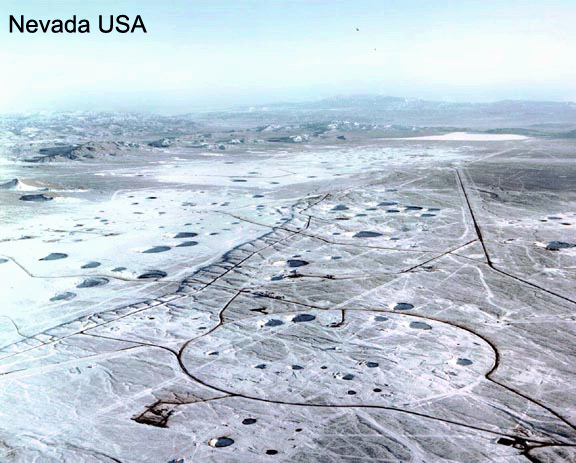
I am a casualty of the Cold War, a survivor of nuclear weapons testing. Growing up in Salt Lake City, Utah during the Cold War I was repeatedly exposed to dangerous levels of radioactive fallout from hundreds of detonations at the Nevada Test Site just 65 miles west of Las Vegas.
Our government detonated 100 bombs above ground in Nevada between 1951 and 1962 and 828 more bombs underground through 1992, many of which broke through the earth’s surface and spewed radioactive fallout into the atmosphere as well. The jet stream carried fallout far beyond the test site where it made its way into the environment and the bodies of unsuspecting Americans, while a government we trusted repeatedly assured us “there is no danger.”
In the spring before my 30th birthday, I was diagnosed with thyroid cancer. Children, especially those under the age of five at the time of radiation exposure, as I was, were most at risk.
I have been sliced, radiated and scooped out. I have buried and mourned the dead, comforted and advocated for the living, and worried with each pain, ache and lump that I am getting sick again. I survived thyroid cancer as well as subsequent health complications that left me unable to have children. My sister and others I grew up with were not so fortunate. They lost their lives to various cancers and other radiation-related illnesses. Before she died, my sister and I counted 54 people in a five-block area of our childhood neighborhood who developed cancer, autoimmune disorders, and other diseases that ravaged them and their families.
The government’s ambitious program of nuclear testing had tragic consequences for countless unsuspecting, patriotic Americans living downwind. “We are veterans of the Cold War, only we never enlisted and no one will fold a flag over our coffins,” a late friend of mine was fond of saying.
The U.S. government finally acknowledged its responsibility in 1990 when it passed the bipartisan Radiation Exposure Compensation Act (RECA), which paid partial restitution to some fallout victims in select rural counties of Utah, Arizona and Nevada. The bill never went far enough. We now know that the harm wreaked by fallout extends far beyond these counties. We also know that people are still getting sick. The suffering has not ended.
As part of a coalition of impacted community groups working with allied advocates nationwide, we have worked hard for the speedy expansion and extension of RECA through the Radiation Exposure Compensation Act Amendments of 2021. This bipartisan bill would add downwinders from all of Utah, Nevada, Arizona, Idaho, Montana, Colorado, New Mexico and Guam, as well as uranium miners who worked in the industry beyond 1971. It also would increase compensation from $50,000 to $150,00 for all claimants and extend the program for 19 years.
The House bill currently has 68 co-sponsors, the Senate bill 18, Republicans and Democrats from across the country. What we now need are their colleagues in both parties to join them.
As we reach out to Senators and Representatives asking them to support the bills, we are sometimes confronted with questions about cost. What, I ask in return, is a human life worth? Over the last 32 years, RECA has paid out $2.5 billion to 39,000 Americans. To put that into perspective, each year this country spends $50 billion just to maintain our nuclear arsenal. Are our lives not worth 0.5% of the cost of weapons that harmed us?
What is paramount is rectifying the mistakes of the past. As Rep. Diane Titus of Nevada said, “These people are Cold Warriors and we do not leave our warriors on the field.”
A government that knowingly harms its own citizens must be held accountable. Our lives are worth more than civilization-ending weapons. It’s a simple matter of priorities and justice.
Radioactivity in fish and shellfish samples from the west coast of Canada after Fukushima (2011-18)
June 13, 2022
The purpose of this post is to bring the public up to date on monitoring efforts of a research program into the impact of the Fukushima Daiichi Nuclear Power Plant (FDNPP) accident on environmental and public health here in North America. This post is part of an ongoing series summarizing work carried out by the Integrated Fukushima Ocean Radionuclide Monitoring (InFORM) project which I led from 2014-2022. Radioactive contamination of the Pacific Ocean following the FDNPP accident raised public concern about seafood safety, particularly in coastal Indigenous communities in British Columbia where I live. To address this, InFORM along with Health Canada, Department of Fisheries and Oceans Canada and First Nations partners have collected and analyzed a total of 621 samples of commonly consumed salmon, ground fish, and shellfish from the Canadian west coast from 2011 to 2018. We examined the activities of cesium radioisotopes (134Cs half-life ~2 years and 137Cs half-life ~30 years) that were released in relatively large quantities from the Fukushima Dai-ichi Nuclear Power Plant (FDNNP) disaster in 2011 and would be most likely to pose radiological health concerns for human consumers of marine animals. Through careful analysis to determine the amount of radioactive isotopes in the seafood we have been able to carry out a health impact assessment. I wish to thank the following First Nations from British Columbia, Canada, for their generous donation of fish: Tr’ondëk Hwëch’in, Selkirk, Champagne and Aishihik, Taku River Tlingit, Tahltan, Nisga’a, Wet’suwet’en, Wuikinuxv, ‘Namgis, Hupacasath, Syilix, and Vuntut Gwich’in. I also thank Kayla Mohns and Brenna Collicutt of the Hakai Institute for assistance with the collection of shellfish samples. These results have recently been published in the peer-reviewed scientific literature in the Journal of Environmental Radioactivity and can be accessed here.
Highlights of the paper and key findings:
- the vast majority of fish and shellfish did not have detectable levels of 137Cs or 134Cs where the minimum detectable level was 0.7 — 1.0 Bq kg-1 fresh weight for 6 hours of analysis by counting with a sensitive gamma emission spectrometer
- 19 fish that had detectable levels of 137Cs were freeze dried and recounted for 336 hours and found to have an average 137Cs content of 0.29±0.02 Bq kg-1 fw
- 2 of these 19 fish had detectable levels of 134Cs, the short-lived isotope, which showed clearly that fallout from the FDNPP was present in these particular fish. Given that the ratio of 137Cs:134Cs in the releases from the FDNPP was 1:1 we determined that the contribution of contamination in these fish from the nuclear accident was 49% and 24% respectively with the majority of caesium contamination coming from other sources like nuclear weapons testing and the Chernobyl disaster in the 20th century
- 38 shellfish showed no contamination from FDNPP in either their shells or meat
- 8 years of measurements showed that radioactivity in fish was dominated by naturally occurring radioisotopes and that levels of human-made radioisotopes remained small in the Pacific off North American following the FDNPP disaster
- upper bounds for ingested doses of ionizing radiation from 137Cs was determined to be ~0.26 micro-Sieverts per year and far below the annual effective dose of 2400 micro-Sieverts from exposure to other sources of radiation
- we conclude that fish and shellfish from the Canadian west coast are not a radiological health concern despite the FDNPP accident of 2011
What we did
Samples were collected with the help of 13 First Nations, the Department of Fisheries and Oceans and the Hakai Institute in coastal waters and rivers of western Canada at sites indicated on the map below.

For fish we removed the skin and bone to measure fillets which are typically consumed. Whole-body tissues of mussels, oysters, and clams were processed as they are generally eaten whole, but for scallops only the muscle itself was processed. In addition, we crushed up the shells of the individual shellfish to determine if radiocesium had accumulated in the shell as they are sometimes used to fertilize garden beds or adjust the hardness of rainwater used for home gardens. We measured the radiocesium and naturally occurring radioisotopes in the samples using gamma spectrometry which you can learn about here. All samples were analyzed for 6 hours to screen samples for the presence of 137Cs and a subset of 19 were counted for a further 336 hours to determine if any 134Cs was present. This represents 10110 hours (more than 421 days) of counting time.
What we found
Results of the 6 hour counts and the extended counting samples can be found in here and here respectively. Given the extremely low levels of 137Cs present in the fish tissue (almost always below our minimum detectable concentration for individual fish) we averaged the gamma emission spectra of all fish collected in each year to determine the average 137Cs content. 137Cs content of all fish samples in each year fell between 0.18 and 0.25 Bq kg-1 fresh weight with the highest average concentration in 2017 and the lowest 2015. Data are here. The challenge of measuring and quantifying the amount of 137Cs can be understood by looking at the gamma emission spectrum and the averages for each year between 2014 and 2018 in the following figure.

What the figure shows is that even after averaging the results for every fish collected in each year it was difficult for our team to detect human-made caesium isotopes. There was also no clear trend in time with 137Cs neither increasing nor decreasing with time in Pacific fish. In fact, the level of 137Cs found in the Pacific salmon was similar to levels found in Atlantic salmon (Table 4, 0.20 Bq kg-1) we collected in 2017 and analyzed from the Miramichi River on Canada’s east coast in New Brunswick. Careful analysis of 19 fish with longer counting times led us to be able to detect 2 fish with measurable levels of 134Cs which was an unmistakable sign of contamination from the FDNPP. However, given our understanding of the releases of 137Cs and 134Cs from the FDNPP following the disaster, most of the 137Cs present in the fish reflected contamination in the Pacific from nuclear weapons testing and the Chernobyl disaster rather than events following the 2011 meltdowns at FDNPP. For shellfish harvested from Canada’s west coast in 2016 and 2017, spectral summation of fresh weight samples (tissue and shell, respectively) yielded no detectable radiocesium or any other anthropogenic isotopes.
What it means
From 2011 to 2018, radioactivity measurements were made by the Fukushima InFORM project of 621 fish and shellfish samples harvested from Canada’s west coast. To investigate the impact of the oceanic contamination plume of Fukushima radioactivity to coastal waters, we used highly sensitive analyses and data reduction techniques to show that the concentration of 137Cs in the tissue of marine fish has not changed (0.18–0.25 Bq·kg−1 fw) from 2014 to 2018 while that of shellfish was undetectable. Relative to the abundance of naturally occurring isotopes like 210-Polonium in the same fish samples or to the annual dose exposure due to naturally occurring background radiation, it is abundantly clear that, by any metric, the radiocesium content of fish and shellfish from Canada’s west coast does not constitute a health risk, despite the FDNPP accident of 2011. The ecosystem and public health on the west coast of North America was never under threat from the FDNPP accident.
Evacuees from nuclear disaster await Supreme Court ruling

June 14, 2022
Tetsuya Omaru initially thought he could return to his home in Fukushima Prefecture “in a week” after the 2011 accident at the Fukushima No. 1 nuclear power plant forced him to flee.
However, the 92-year-old former farmer is still far from home 11 years after the nuclear disaster.
His home in Namie, a small town in Fukushima Prefecture, is located about 11 kilometers from the plant, nestled in the mountains.
Omaru was born to a farming family dating back to more than 300 years. He used to grow rice and raised silkworms before he was displaced.
He knew all the people in his community of about 30 households. They were close and worked together to stage traditional festivals.
Omaru’s life, however, has been uprooted and upended since the triple meltdown in March 2011.
The nuclear disaster occurred when the plant lost power and thus could not cool its reactors after the Great East Japan Earthquake struck and a tsunami swamped the plant.
Omaru is now awaiting a weighty decision from the country’s top court, due on June 17, regarding a lawsuit he and other plaintiffs filed at the Chiba District Court.
They are demanding the plant operator, Tokyo Electric Power Co. (TEPCO), and the government answer for the triple meltdown.
“TEPCO and the government had asserted over the years that nuclear power plants are safe,” Omaru said. “I strongly hope the Supreme Court will recognize the government’s responsibility for redress.”
The Supreme Court’s ruling will be applied to three other similar lawsuits.
In handing down the ruling, the top court will look at whether the government carried out appropriate regulatory oversight on the nuclear industry.
One focus was whether a 2002 government report on potential earthquakes in the future was credible enough to foresee a possible tsunami resulting from a powerful earthquake.
Another focus is whether TEPCO could have avoided the disaster if appropriate measures had been taken to safeguard against tsunami.
The lawsuits are among the first to be filed by victims of the nuclear disaster and part of about 30 legal actions being taken across the nation. The top court’s decision is likely to influence the course of the other court battles.
The top court handed down in March a verdict ordering TEPCO to pay a combined 1.4 billion yen ($10.4 million) to the plaintiffs of the four lawsuits.
NO LONGER ABLE TO FARM
After moving around in Fukushima Prefecture, Omaru initially took refuge in his oldest daughter’s house in Chiba Prefecture.
But it was impossible for him to work in the field, his passion, under such circumstances. He suffered a stroke in 2012.
He is now living with his second daughter in Yokohama. He had surgery for esophageal cancer in 2021.
Omaru decided to join a group of victims suing TEPCO and the government out of resentment that he has been deprived of his livelihood and hometown.
In its 2017 decision, the Chiba District Court denied the government’s responsibility.
The Tokyo High Court overturned it in 2021, however.
The high court’s decision came after three judges and other court officials traveled to inspect Omaru’s home in the so-called “difficult-to-return” zone due to radiation levels estimated at more than 50 millisieverts a year.
His house was ruined by wild boars and overgrown grass.
“If possible, I want to go back to my home in Namie to live while I am still alive,” Omaru said. “It is where I was born and grew up.”
That appears to be unlikely, however, as the government does not plan on cleaning up the area encompassing his community.
TEARS FROM THE VICTIMS
Among others awaiting the top court ruling are Sugie Tanji and her husband, Mikio, who brought their case to the Maebashi District Court in Gunma Prefecture.
The couple fled from Iwaki, Fukushima Prefecture, though their home, about 40 km from the plant, was not covered by the government’s evacuation order for communities with an estimated annual reading of 20 millisieverts.
Though the district court recognized the government’s responsibility in a ruling in 2017, it was overturned by the Tokyo High Court in 2021.
In hearings at the high court, the government defended its policy of not providing redress to so-called “voluntary evacuees” such as the Tanji family.
Giving them compensation, said the government, “would amount to offending the feelings of residents who stayed, and it would be an inappropriate assessment of the nation’s land.”
Tanji, 65, said she was appalled by the statement, describing it as an attempt to divide victims.
“It is TEPCO and the government that polluted the land,” she said. “But they are trying to pass the buck.”
Tanji and her husband were running a shop repairing word processors in Iwaki when the nuclear accident unfolded.
They temporarily evacuated to an acquaintance’s house in the prefecture.
When they returned to the shop a half month later, they found piles of faxes from their customers.
Most contained kind words offering encouragement, but a few were negative messages, such as one that read: “You do not have to return my machine as I fear it is contaminated with radiation.”
“When we read them, we felt we could no longer run our shop there,” Tanji said of their decision to leave Iwaki for good.
They moved to Maebashi in July 2011–a city they picked after drawing circles on a map of Japan to see what places were outside a 100-km radius of every nuclear facility across the country. Maebashi was one they considered to be far enough away.
But the tragedies continued. Mikio’s mother, who stayed in Fukushima, died without being reunited with the couple after the accident. A woman who was close to the couple committed suicide.
Tanji strongly hopes the court finalizes the government’s responsibility, to prevent another nuclear disaster.
“Tears that victims have shed, as well as the lives and livelihoods lost due to the disaster, should never be wasted,” she said.
Prolonged evacuation takes its toll in Fukushima Pref. with many disaster-related deaths

June 13, 2022
Even over a decade after the 2011 Great East Japan Earthquake, tsunami, and ensuing nuclear disaster, there have still been deaths in Fukushima Prefecture that have been certified as being related to the disasters, including those caused by worsening physical conditions due to prolonged evacuation.
In Fukushima Prefecture, which was hit hard by the Fukushima Daiichi Nuclear Power Station accident, an awfully high number of “earthquake disaster-related deaths” have been recorded, with the toll currently standing at 2,333.
When unraveling the reports submitted by bereaved families to local governments, it was found that harsh conditions surrounding evacuation, repeated shelter relocations, and feelings of loss regarding one’s hometown have been destroying the physical and mental well-being of elderly people and others in Fukushima.
Kenichi Hozumi, 71, a former high school teacher who has evacuated to the Fukushima Prefecture city of Iwaki from the prefectural town of Futaba, where the wrecked nuclear power plant is located, has lost both his parents. Their deaths were certified as “earthquake disaster-related.” At age 83, his father Yoshihisa’s physical condition worsened immediately after he evacuated, and he suddenly died from pneumonia. His mother Shigeko’s condition also gradually weakened amid prolonged evacuation, and she died aged 88 a decade after the earthquake.
According to Hozumi, Shigeko had temporarily left the evacuation shelter to go back home twice a month until around 2017. She could not permanently return to her house due to high radiation levels, and the home was sullied by animals. There had even been traces of a burglary.
From around 2018, Shigeko could not move both legs freely. Following her hospitalization in April 2020 after she complained of suffocation, she said she wanted to return to Futaba every time Hozumi visited her. In September 2020, she passed away from an acute aggravation of chronic respiratory failure.
Shigeko relocated six times following the nuclear disaster. She stayed with relatives in Niigata as well as at her grandchild’s home in Tokyo. “Following evacuation, she did not have a place she could settle down in even for a moment. In the end, she passed away with her mouth open, as if she had something to say,” Hozumi said. He expressed regret on behalf of his mother in a report recounting the events leading to her death.
Earthquake disaster-related deaths are certified by local governments after bereaved families file applications which undergo screening by a panel consisting of doctors and others. According to the Reconstruction Agency, 3,784 such deaths related to the 2011 disasters had been certified across 10 prefectures including Tokyo, as of late September 2021. Among them, deaths in Fukushima Prefecture account for 60%.
Furthermore, Reconstruction Agency statistics showed that over 90% of deaths in the severely affected areas of Iwate and Miyagi prefectures that were certified as relating to the earthquake involved people who died within one year from the disasters. In contrast, 40% of disaster-related fatalities from Fukushima Prefecture occurred more than one year after the 2011 onset of the nuclear disaster, from causes including prolonged evacuation, and applications for disaster-related death certifications have been continuously submitted in the prefecture to date.
In order to examine this reality, the Mainichi Shimbun filed requests asking that 26 municipal governments in Fukushima Prefecture, which authorized the certification of disaster-related deaths, and an assembly of municipalities in the Futaba area disclose documents submitted by bereaved families. As a result, about 2,200 individuals’ documents and data were disclosed by 20 local governments.
The Mainichi Shimbun examined the information on around 1,000 people whose backgrounds leading to their deaths were known. One report stated, “Winters at temporary housing were cold, and their legs and loins weakened as they had nothing to do,” while another read, “Uncertainty hung over their life amid prolonged evacuation and they came to drink alcohol from the daytime.” These reports showed that a change in environment following evacuation affected people’s health.
An elderly man in the Fukushima Prefecture town of Namie died about one year after the nuclear plant accident and his death was certified as being related to the 2011 disasters. According to the report on the man, he returned home temporarily in the autumn of 2011, but was in a state of great mental shock when he saw his house in ruins. He reportedly teared up, saying, “If only the nuclear plant didn’t exist,” while burying the bodies of beloved pets on the premises of his house. The report then stated that it was around this time that he stopped going outdoors and developed the habit of saying, “I can’t do this anymore.”
While individuals aged 80 or older comprise a majority of earthquake-related deaths in Fukushima Prefecture, the aftereffects of the 2011 disasters have also eaten away at those of the working generation. An automobile salesman from Futaba county experienced a sudden change in his life as he visited relatives at shelters that took several hours to reach, as well as going to see clients who were scattered across Japan.
On top of this, he was ordered to vacate his home built with loans due to prefectural road construction even though he had just begun repairing it. The man, who apparently began to smoke more heavily due to shock, died of acute myocardial infarction in September 2014. He was aged 55. His 61-year-old wife commented, “He was a hard worker and did not show signs of being tired, but I think he had loads of stress.”
Masaharu Tsubokura, professor at Fukushima Medical University, who has been studying earthquake disaster-related deaths, believes that “secondary health consequences following the nuclear disaster last for long periods and are wide-ranging.”
With prolonged evacuation comes repeated relocations, separation from family, work changes, and loss of the person’s hometown. Tsubokura said, “Damage accumulates each time the victim’s environment changes, and those in vulnerable positions have been sifted out.” He insisted that even if people exercised less and drank more after large disasters, it should not be dismissed as an individual’s responsibility and society as a whole should consider ways to support them.
https://mainichi.jp/english/articles/20220610/p2a/00m/0na/031000c
The Nuclear Weapons Treaty Ban in the Footsteps of 1982’s Million-Person March

COUNTERPUNCH, BY JOHN LAFORGEHAMBURG, Germany 17 June 22,
Last Sunday marked the 40th anniversary of the June 12, 1982 million-person march in New York City for a “freeze” on nuclear weapons building, followed two days later by a mass nonviolent action at the consular offices of nuclear weapons states. Some 1,700 people, myself included, were arrested as we sat in the street blockading the nuclear-armed consulates, confronted by horse-mounted cops literally chomping at the bit while we nervously stared up at the menacing police singing We Shall Not be Moved.We were moved out of the street that day in 1982, but the movement wasn’t deterred. We’ve pushed on for decades in spite of ridicule, harassment, and imprisonment, seeing to the slashing of the U.S. nuclear arsenal from over 60,000 in those days, to today’s approximately 5,000 — an amount still grotesque enough to incinerate and contaminate most of the living beings on Earth.
……………………………………….this week Vienna, Austria is hosting the First Meeting of States Parties, UN member states that have agreed to the Treaty on the Prohibition of Nuclear Weapons (TPNW). Over 100 governments will participate. The great majority of the world’s representatives — 122 countries — voted their approval of the TPNW in 2017, and 62 have since ratified it. The treaty has entered into force, and only the tiny minority of nuclear-armed governments and their military allies continue to reject it — for “deterrence” reasons that have been shown to be irrational and unachievable. Korea, Vietnam, Afghanistan, Iraq, Syria and Ukraine prove that nukes don’t deter war. Instead, they needlessly create the real possibility of globalized, radioactive catastrophe, all the while stealing tens of billions of dollars, and mountains of brain power, away from programs that are crucial and urgently needed.
A colossally expensive nuclear arms race is again underway among the richest militaries in spite of global climate chaos, refugee crises, medical emergencies, and food shortages, all of which must be confronted if want to survive. The world’s nine nuclear-armed countries spent $82.4 billion upgrading their arsenals in 2021, the biggest spender being the United States, according to “Squandered,” the International Campaign to Abolish Nuclear Weapons’ annual report on nuclear spending.
Nuclear weapons states always claim their H-bomb budgets are for “refurbishment” of old, dangerous systems — something that their bedfellows in the nuclear reactor biz never admit about their old units. The power industry’s dangerous, outdated GE and Westinghouse junkers are never said to need retirement, but “license extensions,” and 93 out of 94 have been allowed to blow past their engineered 40-year shutdown mandates and into today’s deadly game of Fukushima Roulette — a crap shoot with suicide the public never agreed to join.
Germany’s clean phase-out of its 17 power reactors, and South Africa’s and Libya’s abandonment of nuclear weapons, have shown that both sides of denuclearization are possible. Now the TPNW presents the world with the practical, international means of eliminating the Bomb. With enough million-person marches, we can still shame the twin nuclear devils and bring the era of nuclear threats to an end.
John LaForge is a Co-director of Nukewatch, a peace and environmental justice group in Wisconsin, and edits its newsletter. https://www.counterpunch.org/2022/06/17/the-nuclear-weapons-treaty-ban-in-the-footsteps-of-1982s-million-person-march/
Treaty on Prohibition of Nuclear Weapons as New Instrument in Nuclear Disarmament Process

It should also be emphasized that the TPNW is gaining global popularity thanks to the efforts of civil society, which encourages governments and parliamentarians of their respective countries to accede to the Treaty. Kazakhstan welcomes the decision of several European countries (Switzerland, Sweden, and Finland), including the declared intention of NATO members (Germany and Norway), to participate as observers in the First Conference of the States Parties to the TPNW.
Treaty on Prohibition of Nuclear Weapons as New Instrument in Nuclear Disarmament Process, https://moderndiplomacy.eu/2022/06/17/treaty-on-prohibition-of-nuclear-weapons-as-new-instrument-in-nuclear-disarmament-process/ June 17, 2022, By Mukhtar Tileuberdi
On June 21–23, Vienna will host a historic event in the field of nuclear disarmament – the First Meeting of the States Parties to the Treaty on the Prohibition of Nuclear Weapons (TPNW).
The entry into force of this treaty in January 2021 became a long-awaited signal that demonstrated the determination of the UN member states to take concrete measures to outlaw nuclear weapons.
This was a significant moment for Kazakhstan, which in the past experienced detrimental consequences of nuclear tests. As President of Kazakhstan Kassym-Jomart Tokayev noted in his speech at the 75th session of the UN General Assembly, “today Kazakhstan is an example and a role model for the whole world as a responsible state that voluntarily abandoned its nuclear-missile arsenal and closed the world’s largest nuclear test site.”
For half a century, our land suffered atmospheric, ground, and underground tests. This impacted the health of about 1.5 million Kazakhs living near the test site with an area of more than 18,000 square kilometres. The consequences of radiation are felt to this day.
On the initiative of Kazakhstan, the closing date of the Semipalatinsk test site – August 29 – was declared in 2009 by the UN General Assembly the International Day against Nuclear Tests. Emphasizing the symbolism of this date, in 2019 Kazakhstan submitted to the UN Secretariat an instrument for ratifying the Treaty on the Prohibition of Nuclear Weapons (TPNW).
Kazakhstan voluntarily abandoned the 4th largest nuclear arsenal in the world, which it inherited after the collapse of the Soviet Union, and in 1993 joined the Treaty on the Non-Proliferation of Nuclear Weapons (NPT) as a state that does not possess nuclear weapons. Let me note, that the TPNW was developed in support of the NPT and fully complements its objective of strengthening the nuclear non-proliferation regime, the peaceful use of atomic energy and wider international security.
In fact, TPNW reflects the dissatisfaction of most UN member states with the disregard by nuclear countries of their obligations on nuclear disarmament, enshrined in several international treaties and documents, including Article VI of the NPT. For this reason, we believe that the treaty should be mentioned in the Final Document of the forthcoming NPT Review Conference in August 2022.
The Treaty establishes several mandatory legal initiatives in the field of nuclear disarmament. For example, nuclear weapons are considered illegal for the first time in human history. Secondly, the production, testing, acquisition, transfer, storage and deployment of nuclear weapons or nuclear explosive devices, as well as the use of threats to use them, are prohibited.
A nuclear-weapon country can join the TPNW if it agrees to destroy its nuclear weapons in accordance with legally binding, verifiable, time-specific plans. Similarly, a country hosting nuclear weapons can join if it agrees to remove them. The Treaty does not prescribe specific timeframes or disarmament measures, as they are planned to be approved by the member states following the First Conference of the TPNW.
Kazakhstan’s active participation gave impetus to the organisation of the First Conference of the TPNW. The most important contribution of our country to this process was acting as a facilitator of substantive solutions. In particular, at the initiative of Kazakhstan and Kiribati (which suffered 39 American and British nuclear weapon test), a working group was created to develop proposals on the issue of positive obligations in accordance with Articles 6 and 7 of the Treaty related to providing support for victims of nuclear testing and use of nuclear weapons, as well as environmental rehabilitation.
The positive obligations under the TPNW refer to the nodal aspects and are focused on eliminating damage from the use and testing of nuclear weapons in the past, as well as preventing possible damage in the future.
The medium-term goal of this initiative on the adoption of positive obligations is to establish an International Trust Fund to finance projects related to victim assistance and environmental restoration.
A specific mechanism is being discussed for identifying sources of funding (from TPNW member-states and non-member states, NGOs, philanthropists, and individuals) for work that requires special knowledge, materials, and equipment. It is important to note that this proposal has found support among the expert community and academic circles.
I would like to note that with the financial support of Kazakhstan and the UN Office for Disarmament Affairs, Kazakh people affected by nuclear testing and the youth representatives from Pacific Island countries will be able to participate in the First Conference of the TPNW and share their stories from a high international rostrum to draw attention to how deplorable the consequences of the use/testing of nuclear weapons can be.
The TPNW positive obligations are of practical value for Central Asia. In accordance with Article 7 of the TPNW, states may request the assistance of other parties to the Treaty and international structures to implement the abovementioned provisions. Considering the existing problem of uranium tailing ponds in several countries of our region, this initiative would help to attract donor funds from other states and international organisations for the reclamation of tailing ponds and the implementation of preventive measures to help the population near uranium mines.
Therefore, Kazakhstan, as the only state in the CIS region that has acceded to the TPNW, is conducting systematic work in accordance with Article 12 on the universalisation of the document to expand the membership of its participants, primarily from among the countries of the Central Asian Nuclear-Weapon-Free Zone (CANWFZ).
Let me remind that CANWFZ, established by Kazakhstan jointly with its regional neighbours through the 2006 Semipalatinsk Treaty, is the first and currently the only such zone in the Northern Hemisphere. A key addition to it was the Protocol, containing negative security assurances, which stipulates that countries possessing nuclear weapons undertake not to use them on the parties to the Treaty. In this regard, we are grateful to the United Kingdom, China, Russia, and France for completing the ratification of this important document. Last year, the foreign ministers of the states that are parties to the Treaty – Kazakhstan, Kyrgyzstan, Tajikistan, Turkmenistan, and Uzbekistan – made a joint statement on its 15th anniversary, in which they reaffirmed their unshakable commitment to its provisions and called on the United States to ratify the above-mentioned Protocol as soon as possible.
The members of nuclear-weapon-free zones around the world are at the forefront of the nuclear disarmament process. The main goals and objectives of establishing these zones are in line with the principles of the TPNW. This means that a state party to the Semipalatinsk Treaty can accede to the TPNW without assuming additional obligations. Besides, if a state that is party to the Semipalatinsk Treaty has already adopted relevant national regulatory legal acts to implement the provisions of the Semipalatinsk Treaty, then this will probably be sufficient to fulfil the obligations that the state will assume by joining the TPNW. This is confirmed by leading international NGOs and experts in the field of nuclear disarmament.
It should also be emphasized that the TPNW is gaining global popularity thanks to the efforts of civil society, which encourages governments and parliamentarians of their respective countries to accede to the Treaty. Kazakhstan welcomes the decision of several European countries (Switzerland, Sweden, and Finland), including the declared intention of NATO members (Germany and Norway), to participate as observers in the First Conference of the States Parties to the TPNW.
The Treaty is another effective platform for our efforts to build a world without nuclear weapons. Kazakhstan will continue to show an example of high responsibility to the present and future generations of humankind.
In this context, it’s worth noting the UN Universal Declaration on the Achievement of a Nuclear-Weapon-Free World, adopted at the initiative of Kazakhstan at the 70th session of the UN General Assembly in 2015. The Universal Declaration calls for the total elimination of nuclear weapons as the only guarantee against their use or threat of use. Last year, the resolution received a record number of 141 votes from UN member states, indicating its positive momentum. Particularly noteworthy was the support from India and Democratic People’s Republic of Korea, which possess nuclear weapons, as well as from Iran, which was among the co-sponsors of the resolution.
If nuclear weapons are declared to be outside of international law, the call for nuclear-weapon states to take urgent steps in the field of nuclear disarmament will increase significantly. To this end, Kazakhstan continuously encourages dialogue between nuclear countries and the TPNW supporters in order to align their views and strengthen trust between them, which is especially important given current geopolitical conditions. Such work is also being carried out within the framework of the Stockholm Initiative for Nuclear Disarmament and specialised platforms within the UN, including the First Committee of the General Assembly, where our country will take over the chairmanship during the 77th session.
The possibility of signing the TPNW and its entry into force have given many countries additional hope for a safer and rational world, which is currently in a serious crisis. As noted by the UN Secretary-General António Guterres, with about 13,400 nuclear warheads around the world, the possibility of using nuclear weapons is more real than in the darkest days of the Cold War. The current military confrontation in Ukraine, discussions about proliferation of nuclear weapons and mutual threats to use them, raise the question about the collective vulnerability of humanity and the urgent need to ban and eliminate the deadly weapons.
The practical contribution of Kazakhstan to nuclear disarmament encourages us to continue calling on nations and governments to redouble their efforts to rid our planet of the threat of nuclear self-destruction by strengthening mutual trust. With that in mind, Kazakhstan has nominated its candidacy for the position of Vice Chair of the First Meeting of the TPNW in 2022 and Chair of the Third Meeting for 2024–2026.
We call on all states, including nuclear-weapon powers, to develop a phased plan for the complete elimination of nuclear weapons by 2045, to the centenary of the UN. The proposals and agreements to achieve this goal could be reflected in the final documents of both the First Conference of the TPNW and the NPT Review Conference.
Kazakhstan realizes that there are many political and technical obstacles on the way to achieving this noble and ambitious goal. We consider it necessary to embark on a practical work in this direction.
Plaintiffs in court gather at the National Diet to seek relief for damage caused by the nuclear power plant accident.

June 13, 2022
The Supreme Court will render its decision on June 17 in four class-action lawsuits seeking to hold the government legally liable for causing the nuclear accident. On May 31, a total of about 50 plaintiffs and lawyers gathered at the Diet Members’ Building. On May 31, a total of about 50 plaintiffs and lawyers gathered at the Diet Members’ Building and visited more than 150 Diet members in separate groups, handing them letters of request for relief from the damage caused by the nuclear power plant accident.
Victory in the case is assured. We walked around the Diet Members’ Building with the people who have suffered from the nuclear accident for 11 years. (We will surely win.)
We will win.
We will surely win at the Supreme Court. We will surely win, and when we do, we will need the help of all the members of the Diet!
Takashi Nakajima, leader of the plaintiffs in the Ikigyo lawsuit, spoke strongly to the secretary of a ruling party Diet member and handed him a letter of request that he had prepared.
The letter of request.
 The government has taken the position that it is socially responsible for the nuclear power plant accident, without legal responsibility. If the Supreme Court of Japan recognizes the legal responsibility of the government, the government will be required to reevaluate its past stance and take measures in accordance with its legal responsibility. We are confident that the Supreme Court will issue a ruling in our case, and we request the following
1Please attend the debriefing meeting after the Supreme Court decision and encourage the plaintiffs.
2. The National Liaison Group for Nuclear Power Plant Victims' Litigation is compiling joint demands and working to realize them. We look forward to your cooperation.
Plaintiffs Gathered from Across Japan
Nagata-cho, Chiyoda-ku, Tokyo. Across the street from the Diet is the Prime Minister’s official residence and the Diet Members’ Hall, which is used by members of the Diet from both the House of Representatives and the House of Councillors. Two high-rise buildings will be built for members of the House of Representatives and one for the House of Councillors. On May 31, just before the Supreme Court ruling, the plaintiffs in the nuclear accident lawsuit spent the day walking around the Diet members’ building.
The group that made the request was the National Liaison Group for Nuclear Power Plant Victims’ Lawsuits. In addition to the Ikigyo lawsuit, plaintiffs and defense lawyers who have filed lawsuits in various parts of Japan have joined the group. On this day, in addition to the four cases (Ikigyo, Gunma, Chiba, Ehime) for which judgments will be handed down on the 17th, plaintiffs from Kanagawa, Kyushu, Tokyo, Aichi/Gifu, and Iwaki also participated. Give us back our hometown! The plaintiffs from the Tsushima lawsuit also participated in the meeting. Including the lawyers, a total of more than 50 people made up the “large request group.
On the morning of the day of the meeting, the conference room prepared as the meeting place was in a state of flux with all the preparations. Everyone, please listen carefully! Listen up! Gentaro Managi, attorney at law for the Ikigyo Litigation Defense Group, who was in charge of the entire request activity, shouted loudly, “Please listen carefully!
The group was divided into 15 groups and was to visit more than 150 Diet members in a single day. Visiting the rooms of Diet members is a complicated process. In addition to making an appointment in advance, the participants had to go through a baggage check at the entrance to the Diet members’ chambers and hand in a piece of paper at the reception desk explaining the reason for their visit. Some of the plaintiffs who had gathered at the Diet members’ chambers said that this was their first visit to the building. Mr. Managi and Mr. Takashi Hattori, Deputy Secretary General of the plaintiffs’ group for the Ikigyo lawsuit, explained the procedure for the day.
They explained the procedure for the day: “All right, everyone,” they said. The head of each group has the list of places to visit. Many of the people in each group will be meeting for the first time. Please introduce yourselves before you leave.
I know the council members and secretaries are busy. Some secretaries may say yes, yes, yes, and try to turn you away after a minute or so. Please think of it as a game from there. ‘Don’t you need to take notes?’ and persist for three or five minutes.
Then, as soon as the groups have finished their preparations, please depart!

Dedicatedly Going Around to Council Members
The three members of Team 7 that accompanied the author were Takashi Nakajima, leader of the plaintiffs in the Ikigyo lawsuit (Soma City, Fukushima Prefecture), a man who is also a plaintiff in the Ikigyo lawsuit (Date City), and Makoto Seo of the Chiba lawsuit.
Let’s see, we’ll start with the fourth floor,” said Nakajima, looking over a list of places to visit. Nakajima looked over the list of places to visit. Each group is supposed to visit a dozen or so members of the House of Representatives. The House of Representatives has 465 members. The House of Councillors has 245 members (including three vacancies). Naturally, it is not possible to visit all of them. In addition to the executives of each political party, the list was narrowed down to those members who belong to committees related to the nuclear power plant issue. The targets were the Special Committee on Investigation of Nuclear Power Issues, the Special Committee on Reconstruction following the Great East Japan Earthquake, and the Budget Committee.
The Diet members’ private rooms are lined up in the Diet Members’ Building like university laboratories. When I ring the intercom and say, “Sorry, please come in,” the legislator’s secretary opens the door. There, I inform them of the purpose of my visit and tell them that I would like to see the council member himself if possible. In reality, the council member himself was rarely in the room, and his secretary would often receive the request form on his behalf. Some secretaries of ruling party lawmakers refused to receive the documents, saying, “I think this will be difficult,” upon hearing the words “lawsuit over the nuclear power plant accident.
The six Diet members’ rooms we visited in the morning were all unresponsive. In some cases, there were no secretaries, and they simply dropped the documents in the mailboxes. I guess they don’t listen to us after all. ……
However, the steady footwork gradually yielded results in the afternoon.
In the room of one ruling party lawmaker, the secretary who greeted him showed great interest in Nakajima’s story, and they talked for about 20 minutes.
The secretary said, “There is a part of the Diet members that as long as the trial is still going on, they cannot bypass it. In that sense, I think the Supreme Court decision is a great opportunity.”
Nakajima: “Thank you very much. We at the All-United Nations are confident that we will win the case. We are confident that we will win the case, and we are making a joint demand as something we will seek after the ruling. We would like to ask for the help of the members of the Diet in this regard, as it will require legislation.
The secretary said, “Understood. I will let him know. There are members of the ruling party who have various ideas about nuclear power, but I believe that it is the role of politics to help those in need.
In the room of a former cabinet member, while he was talking persistently with his secretary, the Diet member himself came out from the back of the room.
Nakajima: “Whoa, well, well! Actually, there is a Supreme Court ruling on the 17th.”
Councilor “I see. I understand. I’m sorry. I don’t have time right now, but …… (to the secretary) make sure you listen to it properly!
Of the dozen or so Diet members that Team 7 visited, only one member of the opposition party took the time to meet directly with the Diet member himself.
What is the outcome of the request?
3:00 pm. After completing their requests, all 15 groups returned to the conference room for a debriefing session. Each group reported the results of the day and their impressions.
One person expressed his frustration, saying, “The secretary of Senator ●● refused to even meet with me!” One person expressed his frustration.
‘Many of the secretaries seemed to back away a bit when we started talking to them. ……
They didn’t even know that the verdict was on the 17th. It was very disappointing.”
It was a debriefing session that showed that all the groups, though struggling, ran around trying to appeal to the legislators on the issue of the nuclear power plant accident.
Those who stood and tried to listen were generally not interested in hearing what we had to say. But they let me in when there were about four council members, and I was allowed to talk in the parlor.”
‘Where I could talk, I expressed my thoughts. The Congressman himself came out to see me!”
Finally, Gentaro Managi, attorney for the Ikigyo lawsuit, said, “The senator’s request is not something that can be finished in a day. We have to continue the request even after the ruling. We need to continue the request two or three times from now on,” he summed up the day’s activities.
Joint Demand” by Plaintiffs’ Groups Nationwide
On May 16, about two weeks before the action, the National Liaison Committee of Plaintiffs in Lawsuits Against Nuclear Power Plant Victims created a “Joint Demand” of 22 organizations.
The "Joint Demand for Relief of Victims of the Nuclear Power Plant Accident
1. The government and TEPCO must accept and deeply reflect on their negligent safety measures, which were declared illegal by the Supreme Court decision. Based on this self-reflection, the government and TEPCO must sincerely apologize to all victims, regardless of whether they are inside or outside Fukushima Prefecture, inside or outside the evacuation zone, or have chosen to live in, evacuate from, or return to their homes.
The demand goes on to nine items. The demands include: “adequate compensation for the actual damage,” “free health checkups and medical care based on the dangers of radiation exposure,” “investigation and disclosure of the actual state of soil contamination,” and “no discharge of contaminated water into the ocean without the public’s understanding.
The term “victims of the nuclear power plant accident” is used in a single sentence, but each person’s damage and situation are different. In some lawsuits, most of the plaintiffs remain in Fukushima Prefecture, while in other lawsuits, evacuees play a central role. The plaintiffs are in different positions, and they have discussed and developed a joint demand, according to the people involved.
The court decision will not walk away and change politics and society on its own. We have no choice but to take action ourselves. The plaintiffs from all over Japan are continuing their efforts.
Ukraine vows to reclaim Crimea with US weapons
 | |||
|

So far Russian forces, who have an overwhelming advantage in artillery and other arms, are steadily gaining land in Donbass.
Ukraine vows to reclaim Crimea with US weapons. https://www.rt.com/news/557265-ukraine-crimea-us-weapons/ 19 June 22,
Kiev aims to recapture all lost territory from Russia, including the Crimean Peninsula, Ukraine’s defense minister says, US-supplied weapons will allow Kiev to win back all land lost to Russia, including Crimea, Ukrainian Defense Minister Alexey Reznikov said on Thursday.
“We are going to liberate all our territories, all of it, including Crimea,” Reznikov told CNN in an interview in Brussels.
According to Washington, the Kiev authorities earlier gave “assurances” they would not use American weapons to stage attacks inside Russia, as the US is concerned it could further escalate tensions between Moscow and NATO. However, Ukraine then backtracked on its promise, stating it would use US-supplied rocket systems to strike its neighbor’s territory should it deem such attacks necessary.
Crimea, which voted overwhelmingly in a 2014 referendum to reunite with Russia, “is a strategic objective for Ukraine because it’s Ukrainian territory,” Reznikov told CNN. “But we will move step by step,” he added.
The first stage in Kiev’s plan is to stabilize the situation on the ground, according to Reznikov. During the second stage, Russian forces would be pushed back to the lines they occupied before the ongoing military offensive.
The minister stressed that only after that can discussions begin with Ukraine’s foreign partners on “how to liberate territories.”
The Russians “will see that in Kherson, they will see it in Zaporizhzhia, they will also see it in Mariupol… these are Ukrainian lands, and Crimea is also Ukrainian land, no matter what,” he said.
Earlier this week, Ukrainian President Volodymyr Zelensky also vowed to “liberate” Crimea and the Republics of Donetsk (DPR) and Lugansk (LPR), which are recognised by Russia as independent states. “We will come to all our cities, to all our villages, which do not yet have our flag,” he pledged.
So far Russian forces, who have an overwhelming advantage in artillery and other arms, are steadily gaining land in Donbass.
Ukraine’s troops have complained of a lack of weaponry to turn the tide in the battle, and are suffering heavy losses in manpower. In his interview, Reznikov refused to give an exact number of Ukrainians killed in the fighting, but said he “hopes” the figure is below 100,000.
On Wednesday, Washington announced another $1 billion in military assistance to Kiev, on top of $5.3 billion it had already provided to Ukraine during and before the conflict with Russia.
During a phone conversation, US President Joe Biden told Zelensky that the new deliveries would include “additional artillery and coastal defense weapons, as well as ammunition for the artillery and advanced rocket systems that the Ukrainians need to support their defensive operations” in Donbass, according to the White House.
Moscow has warned against “lethal aid” supplies to Ukraine by the US and its allies, saying they only prolong the fighting, while also increasing the risk of a direct military confrontation between Russia and the West.
Russia’s President Vladimir Putin has also warned that if Kiev is given long-range missiles, “we will draw the appropriate conclusions and use our weapons, which we have enough of, in order to strike at those objects that we have not yet struck.”
Russia attacked Ukraine in late February, following Kiev’s failure to implement the terms of the Minsk agreements, first signed in 2014, and Moscow’s eventual recognition of the Donbass republics of Donetsk and Lugansk. The German- and French-brokered protocols were designed to give the breakaway regions special status within the Ukrainian state.
The Kremlin has since demanded that Ukraine officially declare itself a neutral country that will never join the US-led NATO military bloc. Kiev insists the Russian offensive was completely unprovoked and has denied claims it was planning to retake the two republics by force.
France’s nuclear output lowers, as climate change affects cooling water systems of reactors.
French Nuclear Outages Risk Making Europe’s Gas Crisis Worse, By Todd Gillespie and Rachel Morison, 17 June 2022,
The cost of electricity in France jumped, adding to Europe’s gas woes, as depressed nuclear output squeezes the market.
France’s nuclear reactors are operating at less than half their full capacity and this week have produced the least electricity at this time of year since at least 2008, according to data compiled by Bloomberg. The country, where warm weather is already making it tougher to cool the fleet of reactors, is importing power from neighboring countries like the UK, which historically has taken energy from France.
Electricity generation from state-run Electricite de France SA, the continent’s largest producer of atomic energy, is struggling under lengthy maintenance of its aging fleet and risks heightening the continent’s dependence on gas, which is in short supply. The company may now need to import power from neighbors in winter, straining wider European supply and burdening consumers with higher costs………………. https://www.bloomberg.com/news/articles/2022-06-17/french-nuclear-outages-risk-making-europe-s-gas-crisis-worse
Japan’s Fukushima village residents allowed to return 11 years after nuclear disaster – but do they want to?
Restrictions lifted for some residents in Fukushima prefecture, more than decade after the nuclear disaster, but many people are still worried
It’s first time restrictions removed to allow people to live again in ‘difficult-to-return’ zone; government says radiation levels have been reduced

12 June, 2022
Residents from part of Katsurao village in Fukushima Prefecture can move back into their homes again more than a decade on from the March 2011 nuclear disaster that followed an earthquake and tsunami, after evacuation orders were lifted on Sunday morning.
It is the first time restrictions have been removed to allow residents to live again in part of the “difficult-to-return” zone once expected to stay closed far into the future due to high radiation exposure.
The government decided on June 3 to end restrictions for the 0.95-square-kilometre area after determining decontamination had reduced radiation levels, and that infrastructure was in place to support habitation.
But while the government has poured funds into decontamination and infrastructure development for zones known as “specified reconstruction and revitalisation bases” which are earmarked for reopening, the intervening 11 years have depressed residents’ desire to return to their homes.
In the part of Katsurao’s Noyuki district where restrictions have been lifted, just four of the 30 households comprising 82 people intend to return, according to the local government.
Amid rainy weather, an official from the central government’s nuclear emergency response headquarters declared the area reopened at 8am. After the gate blocking the road was opened, a police car and other vehicles quickly began patrols of the area.
Katsurao Mayor Hiroshi Shinoki indicated he was considering bringing back residents through revitalising local agriculture, the area’s key industry.
“This is one milestone,” he said. “It is our duty to work to try to bring things back as much as we can to how they were 11 years ago.”
But Fujio Hanzawa, a 69-year-old resident who was quick to revisit his home, spoke carefully when asked about the reopening. “I’m glad I can return without limits, but I’m still 80 per cent concerned. There are issues outstanding, like the unfinished decontamination of the mountain.”
Around 337 square kilometres of land in seven Fukushima municipalities remain subject to the difficult-to-return zone classification. Of those, a total of just 27 square kilometres in six of the same municipalities comprise specified reconstruction and revitalisation base zones.
Apart from Katsurao, the towns of Futaba and Okuma – the latter being home to the crippled Fukushima Daiichi nuclear power plant – are expected to see restrictions partially lifted sometime this month or later, with another three municipalities scheduled for next spring. A specific timetable for areas outside the specified reconstruction bases has not been reached.
Katsurao was made entirely off-limits following the nearby nuclear power plant’s meltdown in the aftermath of the March 2011 earthquake and tsunami.
Concern over cracks in EPR nuclear reactors in France- questions on similar reactors in Finland, UK,China

Concerns have been raised over the reactors at EDF’s Hinkley Point C nuclear power station in Somerset, after cracks were detected in some of the company’s reactors in France. A new report has now warned that the cracks could cause “nuclear accidents” and adds that Hinkley Point C could face similar challenges.
The cracks were first detected in October 2021 in an emergency cooling circuit of the first 1300Mw reactor of the Civaux power plant in France. Cracks have since been discovered in three other
1500Mw reactors and in the 1300Mw Penly 1 reactor.
According to the report, produced by energy transition experts Global Chance, other plants including
Hinkley Point C should be examined in case they will be similarly affected. The report says: “It would also be necessary to examine the possibility that the EPR reactors at Flamanville, Olkiluoto and Taïshan, as well as those under construction at Hinkley Point, might themselves be concerned, insofar as they were designed on the basis of the 1500Mw N4 model.”
Co-author of the report Bernard Laponche emphasised the potential impact of the cracks. “If the defects detected on the welds evolve, they can cause a breach in the main reactor cooling system,” he said. “The risk is therefore to generate a nuclear accident situation”.
It comes after it was revealed in June last year that the US government had been assessing reports of a
leak at the Chinese Taishan power station, with gas escaping after the coating on some of the fuel rods deteriorated. An investigation is ongoing into the cause of the problems with the plant, which is in the southern Chinese province of Guangdong. To date, inspections at Taishan have found
“mechanical wear of certain assembly components”, EDF said. It added that several of its long-running reactors have shown a similar pattern and the issues did not raise questions over the Taishan reactor’s design.
New Civil Engineer 16th June 2022
Court rules Japanese government not responsible for Fukushima nuclear disaster damage
ABC News18 June 22
Key points:
- The nuclear disaster, caused by a tsunami striking the Fukushima Daiichi power plant, forced hundreds of thousands of people from their homes
- The ruling in the government’s favour may set a precedent for future cases
- The company Tepco were forced to pay damages to about 3,700 people in March K
Japan’s government is not liable for damages demanded by people whose lives were devastated by the Fukushima nuclear disaster, the country’s top court said on Friday, the first such ruling in a series of similar cases.
The ruling’s effect as a precedent will be closely watched, local media said……………… https://www.abc.net.au/news/2022-06-17/japan-government-not-responsible-for-nuclear-damage-court/101163670
1 This Month

of the week – Shut Down Drone Warfare!


Tell the Ukrainian Government to Drop Prosecution of Peace Activist Yurii Sheliazhenko

Petition to revoke the licensing of the Near Surface Nuclear Disposal Facility (NSDF) at Chalk River. https://www.ourcommons.ca/petitions/en/Petition/Details?Petition=e-7247
To see nuclear-related stories in greater depth and intensity – go to https://nuclearinformation.wordpress.com
-
Archives
- March 2026 (244)
- February 2026 (268)
- January 2026 (308)
- December 2025 (358)
- November 2025 (359)
- October 2025 (376)
- September 2025 (257)
- August 2025 (319)
- July 2025 (230)
- June 2025 (348)
- May 2025 (261)
- April 2025 (305)
-
Categories
- 1
- 1 NUCLEAR ISSUES
- business and costs
- climate change
- culture and arts
- ENERGY
- environment
- health
- history
- indigenous issues
- Legal
- marketing of nuclear
- media
- opposition to nuclear
- PERSONAL STORIES
- politics
- politics international
- Religion and ethics
- safety
- secrets,lies and civil liberties
- spinbuster
- technology
- Uranium
- wastes
- weapons and war
- Women
- 2 WORLD
- ACTION
- AFRICA
- Atrocities
- AUSTRALIA
- Christina's notes
- Christina's themes
- culture and arts
- Events
- Fuk 2022
- Fuk 2023
- Fukushima 2017
- Fukushima 2018
- fukushima 2019
- Fukushima 2020
- Fukushima 2021
- general
- global warming
- Humour (God we need it)
- Nuclear
- RARE EARTHS
- Reference
- resources – print
- Resources -audiovicual
- Weekly Newsletter
- World
- World Nuclear
- YouTube
-
RSS
Entries RSS
Comments RSS
 nuclear-news