Why the latest UN climate report is positive news .
Why the latest UN climate report is positive news
Jacob Greber
While keeping global warming below 1.5 degrees is likely a bust, there is growing confidence among the world’s top climate scientists that holding it to less than 2 degrees is not only achievable but can be done without tanking living standards.
Climate change: Greener lifestyles linked to greater happiness – in both rich and poor countries
Climate change: Greener lifestyles linked to greater happiness – in both rich and poor countries
A wide range of research shows there is a positive relationship between environmentally friendly behaviour and personal wellbeing.
World on ‘fast track to climate disaster’, says UN secretary general – video
World on ‘fast track to climate disaster’, says UN secretary general – video
António Guterres says the latest report from the Intergovernmental Panel on Climate Change (IPCC) reveals ‘a litany of broken climate promises’ by governments and businesses, and accuses some of them of lying in claiming to be on track to limiting future heating to 1.5C above pre-industrial levels. In a strongly worded rebuke, he says: ‘It is a file of shame, cataloguing the empty pledges that put us firmly on track towards an unliveable world’
Protecting the environment to reduce the risk of another pandemic
Protecting the environment to reduce the risk of another pandemic
Important ways we can help minimize the risk of future disease by rethinking how we farm, eat, trade and interact with other species
Almost everyone now breathing polluted air, warns WHO
Almost everyone now breathing polluted air, warns WHO
An astonishing 99 per cent of the world’s population breathes polluted air that exceeds internationally approved limits, with negative health impacts kicking in at much lower levels than previously thought, UN medical scientists said on Monday.
IPCC new report coming, on limiting global heating
| UN scientists have worked through the weekend to complete a key report on how to restrict the greenhouse gases that are warming the planet. Members of the Intergovernmental Panel on Climate Change are likely to advise a rapid shift from fossil fuels over the next 8 years. They will also suggest the widespread use of carbon removal technology to limit dangerous warming. But disputes over the exact wording of the document have delayed agreement. The IPCC is set to publish their findings on what we can do to stem climate change on Monday. Most of the world’s leading researchers on climate change are involved in the production of IPCC reports – their summaries of the latest science, produced every six or seven years, are used by governments in their negotiations on climate change, such as those that took place at COP26 last November. These IPCC reports are seen as the best, if slightly conservative studies on the state of climate science. For the past two weeks, IPCC scientists and government officials from all over the world have been locked in a virtual approval session, going through this latest report on how to stop climate change line by line. This new study will be the third of three important documents from the IPCC issued over the past eight months. The previous two have looked at the causes and impacts of climate change, but this one will focus on mitigation – or what we can do to stop it. This essentially means that researchers will look at how we can reduce the amount of warming gases that are emitted from human activities. One key part of the summary report will detail what the world can do between now and 2030 to limit heating. BBC 3rd April 2022https://www.bbc.co.uk/news/science-environment-6095930 |
IPCC ‘s dire warning on climate change is being ignored, amid war and economic turmoil
Scientists fear that their last-ditch climate warnings are going unheeded
amid international turmoil caused by the war in Ukraine, and soaring energy
prices. The third segment of the landmark scientific report from the
Intergovernmental Panel on Climate Change – which could be the last
comprehensive assessment of climate science to be published while there is
still time to avoid the worst ravages of climate breakdown – will be
published on Monday, warning that the world is not shifting quickly enough
to a low-carbon economy.
But the previous instalment of the vast report –
known as working group 2 of the IPCC – was published a month ago, just as
Russia invaded Ukraine, and received only muted attention, despite warning
of catastrophic and irreversible upheavals that can only narrowly be
avoided by urgent action now. Scientists told the Observer that Monday’s
fresh scientific warning must spur governments to belated action.
Guardian 3rd April 2022
April 4 Energy News — geoharvey

Opinion: ¶ “Tesla And German Auto Industry’s Varied Tech Paths” • Tesla manages its business very differently than its competitors. As a result, Tesla sales grew almost 90% in 2021, compared to a declines of 2% at Daimler and 3% at the VW Group. Tesla’s growth took place despite a world-wide shortage in chips, and […]
April 4 Energy News — geoharvey
Poland: Ruling party chief invites nuclear weapons, more U.S. troops — Anti-bellum
ReutersApril 3, 2022 Poland ‘open’ to nukes stationed in country amid Russia-Ukraine war – party head Poland would be open to having nuclear weapons stationed in the country…ruling Polish party leader Jaroslaw Kaczynski said in comments published Sunday as Warsaw calls for tougher action against Moscow over the conflict in Ukraine. The politician noted that […]
Poland: Ruling party chief invites nuclear weapons, more U.S. troops — Anti-bellum
Today. Silver lining? War is SO good for shareholders in the nuclear weapons industry
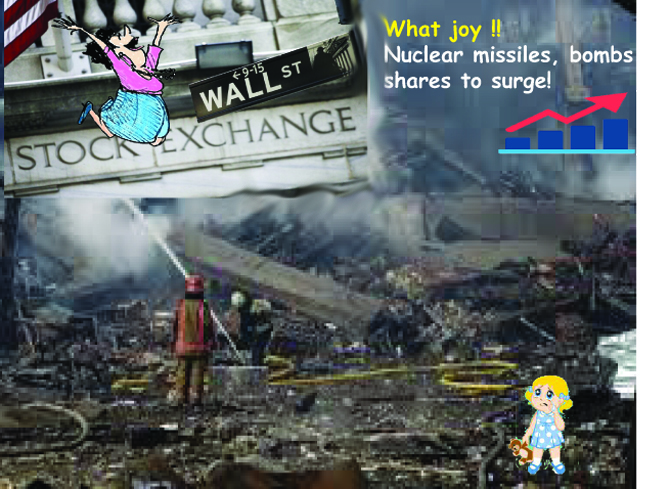
It is SO good . Banks, superannuation funds, savvy financial advisors – why, the’re all putting YOUR money to good use – investing in weapons of all kinds, but especially nuclear!
In the (possibly very ) short run, ya just can’t go wrong. The government payments (using YOUR tax money) are a sure thing for all of them, whether naughty Eastern state-owned corporations, or virtuous Western corporations. What a steady, secure investment !
In the long run, it’s only the kids that mightn’t do so well out of it. But anyway, they don’t matter, do they?
Another worrying week in nuclear news

Some bits of good news:Photos show increasing numbers of rare one-horned rhinos in Indian national parkBritain’s butterflies bolstered by conservation efforts. Indigenous rangers program doubles with $636 million boost . Back from the brink: Tiny bush carnivore gets a new lease on life. Ancient rock art site returned to Aboriginal owners — and they’re keen to share it, on their own terms.
On the nuclear and military scene – what a mess ! Yes, the Russian invasion is illegal and wrong. And yes, atrocities are being committed, and the Ukrainian people are suffering terribly. But, I hope that people are becoming aware of the very carefully managed anglophone media coverage, which is emphasising human emotional stories, while not really covering the progress of the war, nor the USA resistance to peace talks.. No other invasion, such as those in Iraq, Libya, Afghanistan, has been media-manipulated in this way.
Meanwhile – inexplicably, Western governments are pushing for new nuclear reactors at the very time when Ukraine is demonstrating how terribly dangerous they are!
Julian Assange’s family tirelessly advocate for his freedom.
The information war that precedes and complements kinetic war — Anti-bellum . Ukraine: Transfer of Power Balance from West to East.
. Chernobyl: radiation sickness in soldiers, theft of radioactive materials, wildfires – a frightening case of the multiple dangers of nuclear power. Ukraine Negotiations: No Fly Zone, Nukes, Neutrality, and Disarmament. Chris Hedges On Ukraine, Russia & NATO Urgent need to bring about new arms control agreements. https://www.youtube.com/watch?v=_I6ZkPi6NSI
Depicting Putin as ‘Madman’ Eliminates Need for Diplomacy. What is the current nuclear arms pact between Russia and the US? The Red Scare, Viewpoint by Alice Slater. Frenzy for selling bunkers, but they might not be much use, really. How would a nuclear winter impact food production?
Coastal communities across the world already feeling the impacts of climate change. Climate crisis worsened by population and economic growth. Nuclear on the ”frontline of climate change” – and not in a good way!
War in Ukraine has produced a new energy crisis. Energy efficiency is the fastest way to address this..
ANTARCTICA. Scientists caught off guard by massive ice shelf collapse in ‘coldest, driest’ part of Antarctica Hotter Antarctic summers posing increasing threat to stability of world’s largest ice sheet.
UKRAINE. Media coverage of the nuclear dangers in Ukraine often poorly informed and downplayed due to the influence of the pro nuclear lobby. Ukraine, Poland discuss NATO “peacekeeping” force in Ukraine — Anti-bellum. Russian troops pull out out of Chernobyl after suffering ”acute radiation sickness”. Wide reporting on Russian soldiers affected by radiation, leaving Chernobyl. Anxieties at Varash nuclear power station, and other ones in Ukraine – ”town smells of fear.”.
Nuclear catastrophe threatened, as fires sweep through forests towards Chernobyl site. 7 wildfires in Chernobyl Exclusion zone exceed Ukraine’s emergency classification tenfold. Head of IAEA to visit Chernobyl, as Russians withdraw from the site. Ukraine’s Ministry of Defense warns on radioactivity danger from the Chernobyl Excusion Zone. UN nuclear watchdog chief in Ukraine for safety talks. U.S. ambassador incites Georgians to confront Russia — Anti-bellum.
JAPAN. Construction projects surge at Fukushima nuclear plant despite decommissioning progress.
UK.
- Why UK Labour’s green policies are fatally undermined by its ‘nuclear first’ stance. New nuclear reactors will pose a bigger, hotter, more long-lasting waste problem. Getting bigger but not safer or cheaper – the myth of Rolls Royce and its very big non-modular reactor. UK government’s nuclear dream likely to fade away, as private investors resist that risky call. UK Business Secretary Kwarteng boasts about new nuclear plants, but admits that local consent will be needed. Boris Johnson’s fixation on nuclear power is not justified by the facts, as Britain’s electricity demand continues to fall. UK’s energy security strategy delayed, as Cabinet split on nuclear power, and the Regulated Asset Base plan to pay for it.
- Hinkley Point C nuclear project faces more delays, increased costs. And more Hinkley delays. UK’s Treasury and Chancellor of the Exchequer srongly resisting Boris Johnson’s push for costly nuclear power. Boris Johnson beholden to the nuclear industry. That’s going to cost UK bigtime – Chancellor Sunak not happy.
- To wean UK off Russian gas – the key is energy efficiency + wind projects – not nuclear power, says new research.
- Spending £4bn on a new nuclear station at Sizewell will not solve the government’s energy problems. Stop Sizewell C campaigners query the government’s planning judgment , especially on costs. Sizewell new nuclear will not solve the government’s energy problems, but will punish the poorest.
- BAE shipyard – home to nuclear submarine construction ‘set to flood’ due to impact of climate change. Nuclear Free Local Authorities highlight the threat to Britain’s nuclear reactors, of rising sea levels and coastal erosion. Low-lying Dungeness threatened by climate change – sea level rise.
- Plaid Cymru Party in Wales sticking firmly to their anti-nuclear position.
USA.
- THE MADNESS OF THE RESURGENT US COLD WAR ON RUSSIA. Biden’s Reckless Words Underscore the Dangers of the U.S.’s Use of Ukraine As a Proxy War. Caitlin Johnstone: The Target is China. Nearly half of Americans concerned about nuclear war amid Russia-Ukraine invasion.
- Progressive Lawmakers in US and Japan Demand No-First-Use Policy on Nukes.
- Pentagon: NATO executes military deployments to Russian border with unmatched speed. USA cancels ICBM missile test due to Russia nuclear tensions.
- Those yearning for regime change in Russia rarely consider what might come next.
- How corporate media has put the American public in a state of Ukraine-Russia psychosis.
- Nuland leads first U.S.-EU High-Level Dialogue on Russia meeting. Belarus, China also targeted. New Maidans planned. — Anti-bellum.
- Biden administration shuts down Trump-era nuclear cruise missile program. Annual military spending approaching $1 trillion and U.S. still feels insecure. Washington Should Think Twice Before Launching a New Cold War. Caitlin Johnstone: Re-Visiting Russiagate in Light of Ukraine War.
- Air Force transforming away from ”unnecessary” aircraft towards more nuclear weapons. Space Force Gets Roughly 40% Increase in Biden Request.
- Two sailors reportedly injured in accident on docked nuclear submarine.
- Promoting nuclear risks to reduce greenhouse emissions is the classic jump from the frying pan into the fire!
- 43rd anniversary of the Three Mile Island nuclear accident.
- NuScale’s small modular nuclear reactor – ”too late, too expensive, too risky and too uncertain” – Institute for Energy Economics and Financial Analysis. Nuclear is not the key to energy independence.
EUROPE. European Union lawmakers move to reject inclusion of nuclear energy as ‘green‘. NATO . concludes 30-nation strike force exercise in Norway — Anti-bellum . Growing resistance to EU proposal to label gas and nuclear as ”sustainable” energy .
FRANCE. Greenpeace activists storm French nuclear plant. Macron rubbing hands with glee as UK energy crisis means EDF poised for ‘£30bn payday‘. France pays the steep cost of inflexible and ageing nuclear as electricity prices soar.
NORWAY. Norway: NATO continues largest drills since Cold War off Russia’s coast — Anti-bellum
AFRICA. African nations condemn Ukraine’s recruiting mercenaries for “international legion” — Anti-bellum
GEORGIA. U.S. ambassador incites Georgians to confront Russia — Anti-bellum
ISRAEL. EU advisers urge full NATO membership for Israel — Anti-bellum
SWITZERLAND. . Scrutiny on Switzerland’s nuclear power industry- it gets uranium from Russia. Switzerland’s nuclear-war-readiness – bunkers for all.
CHINA. China call USA the ”Leading Instigator” of the Russia/Ukraine conflict.
NORTH KOREA. North Korea says Seoul ‘crazy’ to talk of preemptive strike on ‘nuclear power’ .
PORTUGAL. Portugal to speed up switch to renewable power in wake of Ukraine war .
AUSTRALIA. Australia’s Parliament has little control over military matters, and Prime Ministers kow tow to USA and the White Anglosphere to go to war. Weapons corporations infiltrate our schools and charities, promoting war-mongering to our youth. NATO Enhanced Opportunities Partner Australia to deliver armored vehicles to Ukraine — Anti-bellum.
France pays the steep cost of inflexible and ageing nuclear as electricity prices soar

French baseload and peak prices soar due to a combination of massive outages of French nuclear power plants, cold weather and inefficient heating
France pays the steep cost of inflexible and ageing nuclear as electricity prices soar — RenewEconomy 3 Apr 22,
The common refrain among critics of wind and solar is to blame their “variability” or “intermittency” for soaring electricity prices as Europe wrestles with gas shortages worsened by the war in Ukraine. But France, the nuclear “pin-up” country for the anti-renewables brigade, is not faring so well either.
Over the weekend, the key “day ahead” prices of electricity in France surged to unprecedented levels. On Friday, the futures price for “baseload” for wholesale French electricity price hit the eye-watering level of €714 a megawatt hour ($A1050/MWh).
It didn’t get much better by Sunday, when the day-ahead price for Monday settled at €515/MWh ($A758/MWh), which is the predicted average price over a 24-hour period. The price for peak electricity between 8am and 9am was €2,987/MWh ($A4,400/MWh).
The prices for both baseload and peak prices in the rest of the European market were significantly cheaper, and in Germany it was dramatically so.
The main reasons? Both supply and demand. Less than half (30GW) of France’s 64GW of nuclear capacity was available, thanks to planned and unplanned outages, and extended repairs due to corrosion issues in their ageing plants.
The forecast is for cold weather, and many French homes are fired with inefficient, energy hungry electric resistance heating, largely as a result that the French believed they had no reason to be energy efficient because of the their massive investment in nuclear.
“Massive outages of French nuclear power plants, in combination with cold weather and electric (often resistance) heating, are causing a critical situation for electricity supply there tomorrow,” energy analyst Kewes van der Leun tweeted over the weekend.
The French authority called on consumers to reduce their power consumption.
The situation in Europe is similar to the growing “north-side” divide in electricity prices in Australia, identified by the Australian Energy Market Operator, which has noted that since early 2021 average prices in the most heavily coal dependent states of Queensland and NSW are considering higher than elsewhere.
Partly that is due to a lack of transmission (France has similar problems), but also to the inflexibility of baseload, and the desperation of baseload owners to bid up prices when they can to recoup their costs.
Sure, states with high amounts of renewables do experience price spikes, but they tend to be short lived and the average price is significantly lower than so-called “cheap” coal.
The situation in France is not likely to get better any time soon. President Emmanuel Macron has pledge to invest significantly more in nuclear and his far-right opponent, Marine Le Pen (who is given an outside chance of unseating him) has pledge to stop all new wind and solar development.
But new nuclear won’t help. At the very best, a new reactor could be online by 2035, although France’s recent experience with massive cost over-runs and delays would put a major question mark over that being achieved.
French baseload and peak prices soar due to a combination of massive outages of French nuclear power plants, cold weather and inefficient heating
France pays the steep cost of inflexible and ageing nuclear as electricity prices soar — RenewEconomy
The common refrain among critics of wind and solar is to blame their “variability” or “intermittency” for soaring electricity prices as Europe wrestles with gas shortages worsened by the war in Ukraine. But France, the nuclear “pin-up” country for the anti-renewables brigade, is not faring so well either.
Over the weekend, the key “day ahead” prices of electricity in France surged to unprecedented levels. On Friday, the futures price for “baseload” for wholesale French electricity price hit the eye-watering level of €714 a megawatt hour ($A1050/MWh).
It didn’t get much better by Sunday, when the day-ahead price for Monday settled at €515/MWh ($A758/MWh), which is the predicted average price over a 24-hour period. The price for peak electricity between 8am and 9am was €2,987/MWh ($A4,400/MWh).
The prices for both baseload and peak prices in the rest of the European market were significantly cheaper, and in Germany it was dramatically so.
The main reasons? Both supply and demand. Less than half (30GW) of France’s 64GW of nuclear capacity was available, thanks to planned and unplanned outages, and extended repairs due to corrosion issues in their ageing plants.
The forecast is for cold weather, and many French homes are fired with inefficient, energy hungry electric resistance heating, largely as a result that the French believed they had no reason to be energy efficient because of the their massive investment in nuclear.
“Massive outages of French nuclear power plants, in combination with cold weather and electric (often resistance) heating, are causing a critical situation for electricity supply there tomorrow,” energy analyst Kewes van der Leun tweeted over the weekend.
The French authority called on consumers to reduce their power consumption.
The situation in Europe is similar to the growing “north-side” divide in electricity prices in Australia, identified by the Australian Energy Market Operator, which has noted that since early 2021 average prices in the most heavily coal dependent states of Queensland and NSW are considering higher than elsewhere.
Partly that is due to a lack of transmission (France has similar problems), but also to the inflexibility of baseload, and the desperation of baseload owners to bid up prices when they can to recoup their costs.
Sure, states with high amounts of renewables do experience price spikes, but they tend to be short lived and the average price is significantly lower than so-called “cheap” coal.
The situation in France is not likely to get better any time soon. President Emmanuel Macron has pledge to invest significantly more in nuclear and his far-right opponent, Marine Le Pen (who is given an outside chance of unseating him) has pledge to stop all new wind and solar development.
But new nuclear won’t help. At the very best, a new reactor could be online by 2035, although France’s recent experience with massive cost over-runs and delays would put a major question mark over that being achieved.
Portugal to speed up switch to renewable power in wake of Ukraine war

https://www.reuters.com/business/sustainable-business/portugal-speed-up-switch-renewable-power-wake-ukraine-war-2022-04-01/?fbclid= By Sergio Goncalves,
LISBON, April 1 (Reuters) – Portugal aims to accelerate its energy transition and increase the proportion of renewable sources by 20 percentage points to 80% of its electricity output by 2026, four years earlier than previously planned, the government said on Friday.
As part of a global shift away from carbon-emitting fossil fuels, countries are betting on renewable energies such as wind and solar, a transition that is being accelerated in Europe after Russia’s invasion of Ukraine.
The new Socialist government that was sworn in on Wednesday, said in its overall programme released on Friday that the energy plans should mobilize more than 25 billion euros of investment in the next 10 years, involving public and private players, incentives and financing.
“Portugal has already taken very significant measures in the energy transition, but the evolution and duration of the war in Ukraine must necessarily imply new measures,” Cabinet Minister Mariana Vieira da Silva told a news conference.
The country, committed to become carbon neutral by 2050, currently gets 60% of its electricity from renewable sources – one of the largest proportions of green energy use in Europe.
Unlike central European countries, Portugal does not depend on Russian natural gas pipelines, as it mainly imports liquefied natural gas from Nigeria and the United States, and has not imported Russian crude since 2020.
The government also wants to “more than double the installed capacity of renewable sources in the next decade”.
Portugal, which closed its two coal-fired power plants last year, has 7.3 GW of hydroelectric capacity and 5.6 GW of onshore wind parks, which together represent 83% of its total installed capacity. Reporting by Sergio Goncalves Editing by Andrei Khalip and Frances Kerry
Construction projects surge at Fukushima nuclear plant despite decommissioning progress
Construction projects surge at Fukushima nuclear plant despite decommissioning progress
April 4, 2022 Mainichi Japan OKUMA, Fukushima — The site of the Fukushima Daiichi Nuclear Power Station continues to host new construction projects some 11 years after the disaster triggered by the 2011 Great East Japan Earthquake and tsunamis.
This Mainichi Shimbun reporter had the opportunity to visit the plant for the first time in seven and a half years, and reflect on why new facilities continue to appear even as the plant moves toward decommissioning…………..
While decommissioning seems to be advancing, various facilities have been newly constructed, and the issue of water remains. A rising number of tanks store treated water contaminated after it was pumped to cool fuel debris that melted down in the accident, as well as groundwater and rainwater that flowed into the buildings. Inside the tanks, the contaminated water is made to reach a radioactive concentration below regulation levels.
On the seventh floor of a building located near the site’s entrance, a Tokyo Electric Power Co. Holdings Inc. (TEPCO) representative gave me an outline of the entire facility. I could see two large cranes on the ocean side around Units 1 to 4, and another large crane and framework structure on the mountain side. When I asked about it, the representative told me the frame was being assembled in a remote location to reduce worker radiation exposure. But it wasn’t a facility being dismantled; it’s a cover measuring 66 meters long, 56 meters wide, and 68 meters high that will wrap around Unit 1.
The hydrogen explosion in Unit 1 blew the building’s roof off, and 392 pieces of nuclear fuel remain in its spent fuel pool near the ceiling. Their removal is scheduled to start in fiscal 2027 to 2028. For this to happen, the surrounding debris must be removed, and the cover’s installation will help prevent the work dispersing radioactive dust.
Ground improvements works were progressing on the neighboring Unit 2’s south side. There, a working platform to remove 615 pieces of nuclear fuel from Unit 2 will be built, with its start slated for fiscal 2024 to 2026.
The buildings for Units 1 through 4 were damaged and contaminated, so different structures, such as platforms and covers, had to be built to remove nuclear fuel from the pools. Particularly conspicuous was the thick steel frame of the Unit 4 facility, from which fuel was completely removed in 2014. Although 53 meters high, it surprisingly uses about the same amount of steel as the 333-meter-high Tokyo Tower. Since the nuclear fuel is being removed in order, new construction work continues in reactor buildings’ vicinities………………
The company listed at least 10 facilities earmarked for future construction. Put another way, the tanks need to be removed to provide land for these facilities.
Related construction work had already started at the seashore, where workers dug vertical holes to contain treated water before its release. After the implementation plan’s approval, undersea tunnel construction and other necessary work to release the water 1 km offshore will also begin.
Meanwhile, some broken cranes and damaged buildings have been left on site without being dismantled. The representative told the Mainichi Shimbun this was partly due to them trying to keep the solid waste processing volume low.
Also underway is construction of facilities to handle ever-increasing solid waste amounts. The representative said a white building I spotted in the site’s northwest side was the volume reduction facility, and that building work is going ahead for a solid waste storage facility in front of it.
The volume reduction facility scheduled for completion in March 2023 will use crushing and other methods to reduce concrete and metal debris volumes. Although nine storage buildings already exist, a 10th will soon be constructed. Nearby was also a new incineration facility for burning logged trees. TEPCO estimates solid waste generated will reach a volume of 794,000 cubic meters by March 2033, and that there will continue to be more related facilities.
Fuel debris removal will begin at the end of 2022. In the future, facilities to hold fuel debris and to store and reduce volumes of solid waste with high doses of radiation generated by the work will also be needed.
Each year creates new tasks that generate more waste, and the facilities to accommodate it. These buildings are also destined to eventually become solid waste. While this cycle continues, a final disposal method for the waste is undetermined. The government’s and TEPCO’s timetable says 20 to 30 years of plant decommissioning remain. But on site, where new construction projects continue to appear, a clear picture of when decommissioning will finish has yet to emerge.
(Japanese original by Takuya Yoshida, Science & Environment News Department) https://mainichi.jp/english/articles/20220402/p2a/00m/0na/027000c
Why UK Labour’s green policies are fatally undermined by its ‘nuclear first’ stance

Dave Toke’s green energy blog, https://realfeed-intariffs.blogspot.com/2022/04/why-labours-green-policies-are-fatally.html
It is now clear from Labour’s stance in the House of Commons, that nuclear power comes before every thing else. Indeed, aside from Keir Starmer’s emphasis on ‘nuclear first’ attacks on the Government in the House of Commons, Labour’s allegedly massive green energy spending strategy seems likely to be swallowed up almost entirely by its pledge to rush to embrace the Sizewell C development.
The Treasury knows full well that to get Sizewell C going reasonably quickly the Government will have to commit to a potential bill of £30 billion or more in public spending. This must come, either or both, from hard-pressed energy consumers by adding to their bills, or directly from Treasury coffers. The Department of Business Energy and Industrial Strategy’s (BEIS) spending plans are closely controlled by the Treasury, and the commitment to Sizewell C will swamp the budget and reduce Labour’s ability to spend on things like insulation and heat pumps to a trickle.
Keir Starmer thinks he has seen a weak point in the Conservative’s energy strategy in that it is finding it difficult to turn the commitment to support Sizewell C into reality. But that’s because funding Sizewell out of a public commitment is likely to present the Government with a crippling financial burden. It is especially crippling because Starmer will refuse to acknowledge the fact that to get Sizewell C going will require the Government to fund a black hole of spending as cost overruns inevitably escalate on the project.
It’s a cynical ploy on Labour’s part. They know full well that the Government’s difficulties with launching Sizewell C are to do with the sheer financial unviability of new nuclear power, not from any lack of faith in nuclear power on the part of the Government. But apparently, Starmer does not care about this, and it also seems that he takes the green energy lobby for granted in that he expects that it will support him regardless.
But if other Labour commitments to support really big programmes in areas like heat pumps and insulation are to happen, there’s just not enough money going to be made available for them if BEIS’s budgets are swallowed up by the commitment to support Sizewell C.
So how should green energy supporters react to this? Well, there’s plenty of other parties to vote for. Indeed if this Government does actually go ahead and reverse the English planning ban on onshore wind, there’s probably not going to be much difference, in practice, between Labour and Conservatives on energy. Except of course that the Conservative will be more cautious, it seems, on accepting unmanageable commitments to new nuclear power!
1 This Month
26 April – Chernobyl: Inside the Meltdown airs on National Geographic on Sunday 26th April from 4pm


29 April – Nuclear Expert Webinar #1 – Radiation Impacts on Families with Mary Olson and Cindy Folkers
- 12:15 PM MT – 1:45 PM MT
- Location: Virtual – REGISTER TODAY

4 May -West Suburban Peace Coalition to discuss Iran war at May Educational Forum
Monday, May 4, 7:00 – 8:00 PM Central Standard Time
Title: : How Trump’s Narrative Tries to Shape the Reality of the War on Iran.
Contact Walt Zlotow, zlotow@hotmail.com 630 442 3045 for further information
14 May – online event From Bombs to Data Centres: the Face of Nuclear Colonialism


Pine Ridge Uranium is the real threat, not Tehran- Tell Burgum: Stop the Extraction.
Chernobyl: The Lost Tapes – A good documentary on Chernobyl on SBS available On Demand for the next 3 weeks– https://www.sbs.com.au/ondemand/tv-program/chernobyl-the-lost-tapes/2352741955560
To see nuclear-related stories in greater depth and intensity – go to https://nuclearinformation.wordpress.com
-
Archives
- April 2026 (327)
- March 2026 (251)
- February 2026 (268)
- January 2026 (308)
- December 2025 (358)
- November 2025 (359)
- October 2025 (376)
- September 2025 (257)
- August 2025 (319)
- July 2025 (230)
- June 2025 (348)
- May 2025 (261)
-
Categories
- 1
- 1 NUCLEAR ISSUES
- business and costs
- climate change
- culture and arts
- ENERGY
- environment
- health
- history
- indigenous issues
- Legal
- marketing of nuclear
- media
- opposition to nuclear
- PERSONAL STORIES
- politics
- politics international
- Religion and ethics
- safety
- secrets,lies and civil liberties
- spinbuster
- technology
- Uranium
- wastes
- weapons and war
- Women
- 2 WORLD
- ACTION
- AFRICA
- Atrocities
- AUSTRALIA
- Christina's notes
- Christina's themes
- culture and arts
- Events
- Fuk 2022
- Fuk 2023
- Fukushima 2017
- Fukushima 2018
- fukushima 2019
- Fukushima 2020
- Fukushima 2021
- general
- global warming
- Humour (God we need it)
- Nuclear
- RARE EARTHS
- Reference
- resources – print
- Resources -audiovicual
- Weekly Newsletter
- World
- World Nuclear
- YouTube
-
RSS
Entries RSS
Comments RSS
 nuclear-news