6 people to sue TEPCO over thyroid cancer after Fukushima nuclear disaster
How may Tepco use now the word “sincerely” when they have shown the whole world their dishonesty and their lack of sincerity repeatedly for the past 10 years?
January 21, 2022 (Mainichi Japan)
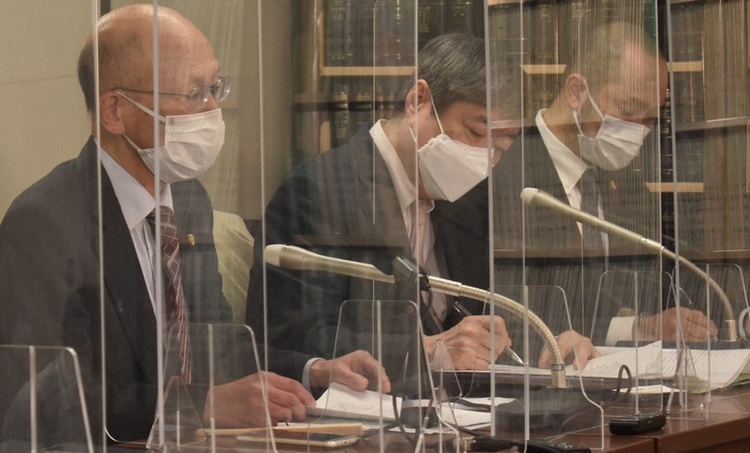
TOKYO — A group of six young men and women is set to file a class action suit against Tokyo Electric Power Company Holdings Inc. (TEPCO) claiming that they developed thyroid cancer due to exposure to radiation emanating from the Fukushima nuclear disaster, and demand the utility pay a total of 616 million yen (about $5.4 million) in compensation.
It will be the first group lawsuit in Japan by those who were minors at the time of the 2011 nuclear disaster and have since been diagnosed with thyroid cancer.
The plaintiffs, now aged between 17 and 27, were living in Fukushima Prefecture when the nuclear meltdowns occurred at the Fukushima Daiichi Nuclear Power Station in March 2011, and developed thyroid cancer after the disaster. They are filing the damages suit with the Tokyo District Court on Jan. 27, according to the legal counsel for the plaintiffs who revealed the plan at a press conference on Jan. 19.
An expert investigation committee set up by the Fukushima Prefectural Government has not recognized the causal relationship between radiation exposure from the Fukushima disaster and thyroid cancer, and whether there is such a correlation could be the focal issue in the lawsuit.
The six plaintiffs were aged between 6 and 16 at the time of the nuclear disaster. They were diagnosed with thyroid cancer between 2012 and 2018. Two of them had one side of their thyroid removed, while the other four had their thyroid fully extracted and need to take hormonal drugs for the rest of their lives. One of the patients had cancer spread to their lungs. Some of them currently reside in Tokyo and Kanagawa Prefecture.
The Fukushima Prefectural Government has conducted a survey on thyroid glands covering some 380,000 people aged 18 or younger who were living in Fukushima Prefecture at the time of the nuclear catastrophe. As of June 2021, 266 people had been diagnosed with thyroid cancer or suspected thyroid cancer. According to the legal team for the plaintiffs, five of the six complainants had their cancer detected in the prefectural survey. The remaining plaintiff found out about their cancer through testing at a hospital they voluntarily underwent.
According to the legal counsel, the cancer discovery rate in the Fukushima Prefecture survey stands several tens of times higher than usual. While the prefectural government points to the possibility of “overdiagnosis” through which many cancer cases requiring no treatment have been found, the plaintiffs’ cancer has actually progressed, the legal team asserted. The lawyers argue that none of the six plaintiffs’ cancer is hereditary, and that it is extremely highly likely that they developed their conditions due to the nuclear disaster.
In past pollution lawsuits including those over Minamata disease, there is a court precedent in which the company responsible for the pollution was ruled liable for compensation unless it could prove there was no causal relationship between the contamination and the plaintiffs’ diseases. The attorneys for the upcoming lawsuit claim that this decision could also be applied to nuclear plant accidents and that TEPCO should bear the burden of proving the absence of a causal link between radiation exposure and thyroid cancer.
Kenichi Ido, head of the legal counsel, commented, “Some plaintiffs have had difficulties advancing to higher education and finding jobs, and even given up on their dreams for their future.”
TEPCO released a comment saying, “We will respond to the case sincerely after hearing the content of their claims and their arguments in detail.”
(Japanese original by Kazuhiro Toyama, Tokyo City News Department)
https://mainichi.jp/english/articles/20220121/p2a/00m/0na/018000c
Tepco sued over thyroid cancer cases – 6 people aged 6-16 at time of Fukushima nuclear accident – Tokyo District Court
“Kenichi Ido, a former judge and head of the legal team, pointed out that “the Japanese government is assuming that there is no health damage caused by the accident. Hiroyuki Kawai, a lawyer, said, “There is strong social pressure to believe that cancer is not caused by the accident, and it took a lot of courage for the six people to file the lawsuit, which is why the time has come.“
January 19, 2022
Six people who were between the ages of 6 and 16 years old at the time of the accident at the Fukushima No. 1 Nuclear Power Plant of Tokyo Electric Power Co. On April 19, it was learned that six people, aged 6-16 at the time of the accident and living in Fukushima Prefecture, will file a lawsuit against TEPCO in the Tokyo District Court, seeking a total of 616 million yen in damages. This is believed to be the first lawsuit in which residents are suing for damage caused by the nuclear accident on the grounds that they have developed thyroid cancer.
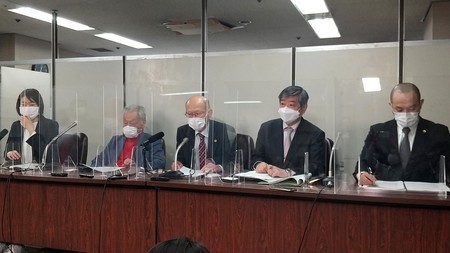
The legal team representing the six revealed this at a press conference on the same day. The lawsuit is scheduled to be filed on the 27th.
According to the lawyers, the six are currently residing in Tokyo, Kanagawa, and Fukushima prefectures. Four of them have had their thyroid glands surgically removed, and some have undergone multiple surgeries because of metastasis or recurrence.
The Fukushima Prefectural Health Survey, which covers about 380,000 people who were under the age of 18 at the time of the accident, revealed 266 cases of cancer or suspected cancer in its report last October. In October last year, it was revealed that 266 people had cancer or suspected cancer. Some experts have pointed out the possibility of “over-diagnosis,” in which cancers that do not require treatment are found, but the lawyers are claiming that all six of the cases required surgery, and that this was due to the accident.
On the other hand, the review committee for the prefectural health survey has stated that radiation is unlikely to be a factor in the development of thyroid cancer.
Kenichi Ido, a former judge and head of the legal team, pointed out that “the Japanese government is assuming that there is no health damage caused by the accident. Hiroyuki Kawai, a lawyer, said, “There is strong social pressure to believe that cancer is not caused by the accident, and it took a lot of courage for the six people to file the lawsuit, which is why the time has come.
TEPCO commented, “If the complaint is served, we will respond in good faith.
https://www.jiji.com/jc/article?k=2022011900881&g=soc&fbclid=IwAR0jA-AAx_XojY5Yngsp4n7eU8UrPgEU8A66AiSEXanInMIleC49saU_MWE
To 24 January – the week in nuclear news
Readers of this news summary seem to like the ”Bits of good news” – so I think I’ll put them at the top: Meet the scientist moms fighting climate change for their children, . Transition to genuinely clean energy has succeeded in many cases, including economically.When it rains, it soars: Wetland birds come back from the brink
Coronavirus: What’s happening in Canada and around the world
Climate Change. What will the climate be like in the year 2500? Provocative new science.
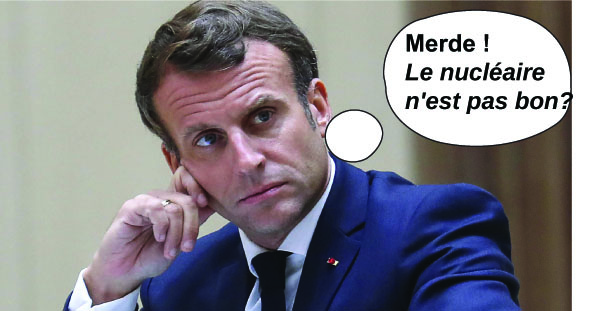
Nuclear. Ukraine is the urgent news this week- it’s not nuclear news? – well, I certainly hope that is the case. France is the country of most interest this week, as Emmanuel Macron tries to hold it all together. In the lead-up to the presidential election, Macron must convince everyone of a positive future for the nuclear industry, despite its multiple problems.
Common Security Approaches to Resolve the Ukraine and European Crises.
Washington pumping up war fever .
January 22 -one year since nuclear weapons became illegal. U.N. Treaty on the Abolition of Nuclear Weapons – in force one year. Doomsday clock stays at 100 seconds to midnight. Doomsday Clock continues to hover dangerously.
Nuclear energy too costly for humans — and the planet .
2021 was one of the hottest years on record – and it could also be the coldest we’ll ever see again . Research shows planning for climate change will save billions
Changing from a consumer economy to a conserver economy – painful but necessary.
Chemical pollution has passed safe limit for humanity, say scientists. Nanoplastic pollution found at both of Earth’s poles for first time
NATO to apply Article 5 collective war clause to outer space.
ANTARCTICA. Giant canyon discovered underneath Antarctic glacier, adding to history of rising sea levels. World’s largest iceberg melted – now one trillion tonnes of ice – gone
UKRAINE. What the heck is going on with Ukraine? Ukraine crisis is a terrifying impasse. 200,000 pounds of lethal arms and ammunition, “directed by Biden,” arrive in Ukraine.
JAPAN. Call for Japan to join nuclear ban treaty on first anniversary. Robot for removing nuclear fuel debris at Fukushima Daiichi. https://www.youtube.com/watch?v=PyJ_Or6Vzdw&t=5s Six people to sue Tepco over thyroid cancer after Fukushima disaster. Class action suit against Tokyo Electric Power Company Holdings Inc. (TEPCO) by 6 thyroid cancer sufferers.
EUROPE. Redesigning nuclear arms control for new realities. Why nuclear power can never be green. European States opposing inclusion of nuclear in ‘green’ taxonomy warn on diverting investement from genuinely clean technologies. Europe’s nuclear waste remains an unsolved and highly dangerous problem – EU Assessment Report. ITER nuclear fusion – a spectacular waste of time, money, and political clout.
GERMANY. Germany formally opposes inclusion of nuclear energy in EU’s ”sustainable” taxonomy.
AUSTRIA. Austria preparing for a legal battle to prevent EU from calling nuclear power ‘sustainable’.
SWEDEN. Having sat out first two world wars, NATOzied Sweden gearing up for third . Drones sighted over Sweden’s nuclear power stations.
SWITZERLAND. Swiss reactor meltdown.
CANADA. Holding in the deep: what Canada wants to do with its decades-long pile-up of nuclear waste. New radioactive waste plan poses ‘Milennia of Risk” for Ottawa River communities.
ISRAEL. Nuclear Notebook: Israeli nuclear weapons, 2021.
USA.
- UKRAINE CRISIS: US ‘Toolboxes’ Are Empty, Hypocritical Scolding Won’t Stop a Russian War on Ukraine.
- Missouri Bill to honour nuclear veterans. King’s voice thundered: “It costs $500,000 to kill every enemy soldier while we spend only $53 a year for every poor person. Nuclear weapons must be relegated to the past – Treaty for the Prohibition of Nuclear Weapons. Nuclear weapons standout calls for US commitment to UN treaty.
- On Cape Cod, a nuclear nightmare arrives. Officials at San Onofre conspicuously silent on the risks of tsunami waves to nuclear waste storage. In Georgia Could Plutonium Shipping in New Mexico Lead to Disaster?
- Bloated Costs Take Over a Nuclear Power Plant and a Fight Looms Over Who Pays.
FRANCE.
- How France greenwashes nuclear weapons.
- France’s nuclear company EDF accused of cover-ups over ‘serious and unexpected’ corrosion on Tricastin and other reactors. Electricite de France has become a nightmare for investors, and a danger to regional energy security. EDF’s costly EPR nuclear reactor failures – in France, UK, China. Contradictory demands on EDF
- Does the Flamanville EPR nuclear reactor have a design fault? Nuclear Safety Authority (ASN) warns France on problems, costs, safety in nuclear projects. Design flaws in Flamanville EPR nuclear reactor vessel, and attempts to solve these. The tribulations of France’s Flamanville nuclear reactor.
- Difficulties at Orano nuclear elements site adds to France’s nuclear woes.
- France’s Nuclear Safety Authority considers abandoning the reprocessing of nuclear waste. France’s nuclear regulator warns on the ”security fragility” of both the reactors, and the reprocessing system. France’s nuclear waste problem, and the lack of transparency on military wastes.
UK.
- Mayors for Peace UK / Ireland Chapter and NFLA celebrates first nuclear weapons ‘banniversary’.
- Anglesey does not need nuclear energy – Nuclear Free Local Authorities (NFLA).
- Small nuclear reactors a poor solution for UK’s and the world’s climate action. Small nuclear reactors for Scotland? Expensive, unpopular, and not even small.
- Largest increase in the UK nuclear liability regime for 50 years.
- Row over plans to reform groups at nuclear sites.
- Anti-radiation pills given out to residents, nurseries, schools, care homes and clinics near UK’s nuclear submarine ports. The production, servicing and berthing of nuclear-powered submarines in or near population centres present unacceptable health risks.
- Rolls Royce aims to market its Small Nuclear Reactors to Saudi Arabia (a good step towards nuclear weapons?)
- 13 wards in Cumbria recommended against their will, for UK’s nuclear waste dump. Hinkley Point mud dredging and dumping plan faces a legal challenge.
CHINA. China hits back at US, Japan over nuclear transparency call.
RUSSIA. Stranded in Vladivostok: KIMO International and NFLA express concern at mysterious plight of Russian nuclear-powered freighter. Just a reminder. Russia did not INVADE Crimea.
ASIA. EU plans may boost Asian nuclear ambitions but progress likely to stutter, say analysts. (journalist)
AUSTRALIA. A mutual suicide pact: Australia’s undeclared nuclear weapons strategy. Australia-UK talks – all about nuclear submarines and military co-operation against China.
Signatures submitted to Tokyo High Court for site inspection, totaling 10,195
Jan. 21, 2022
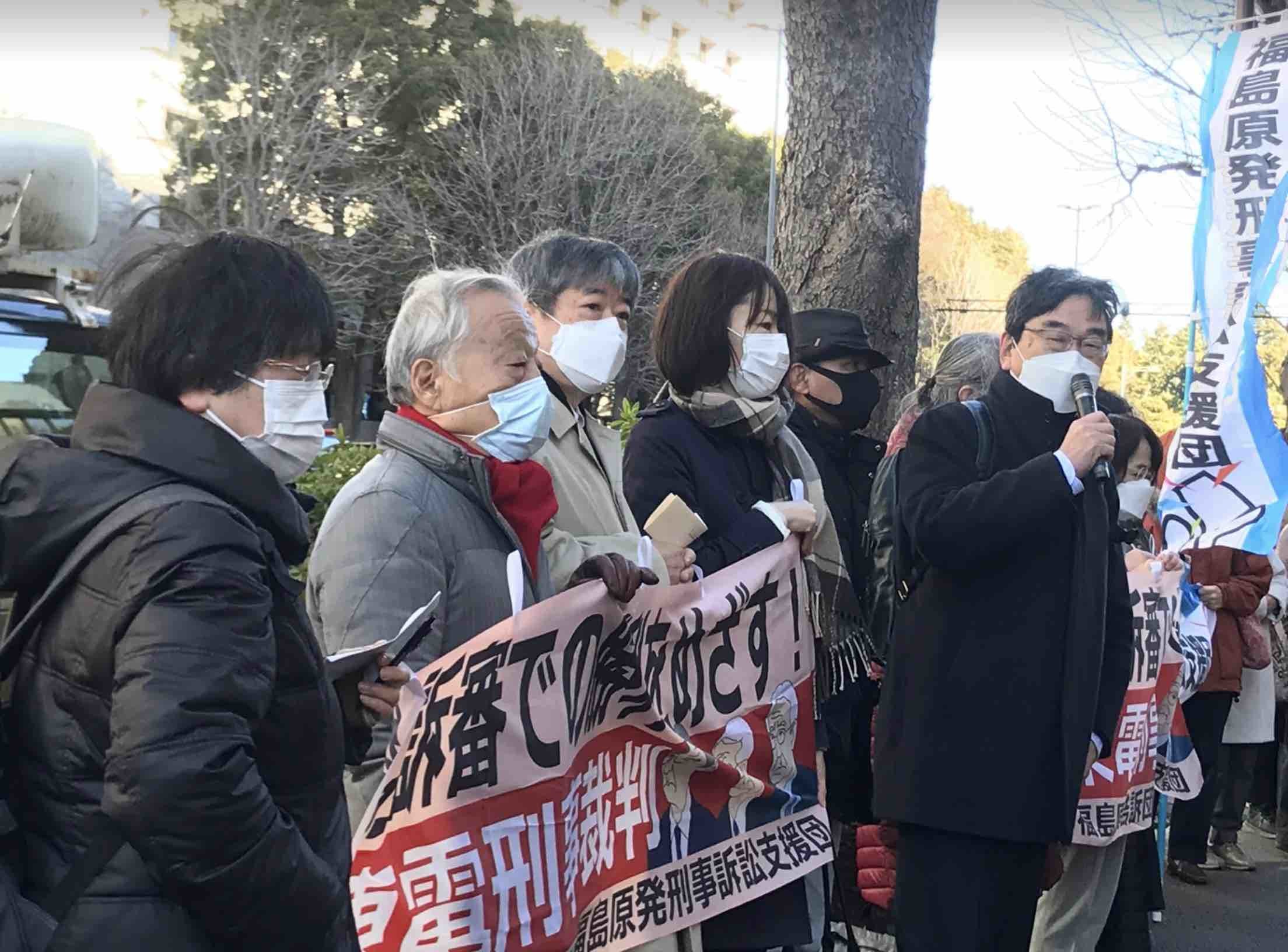
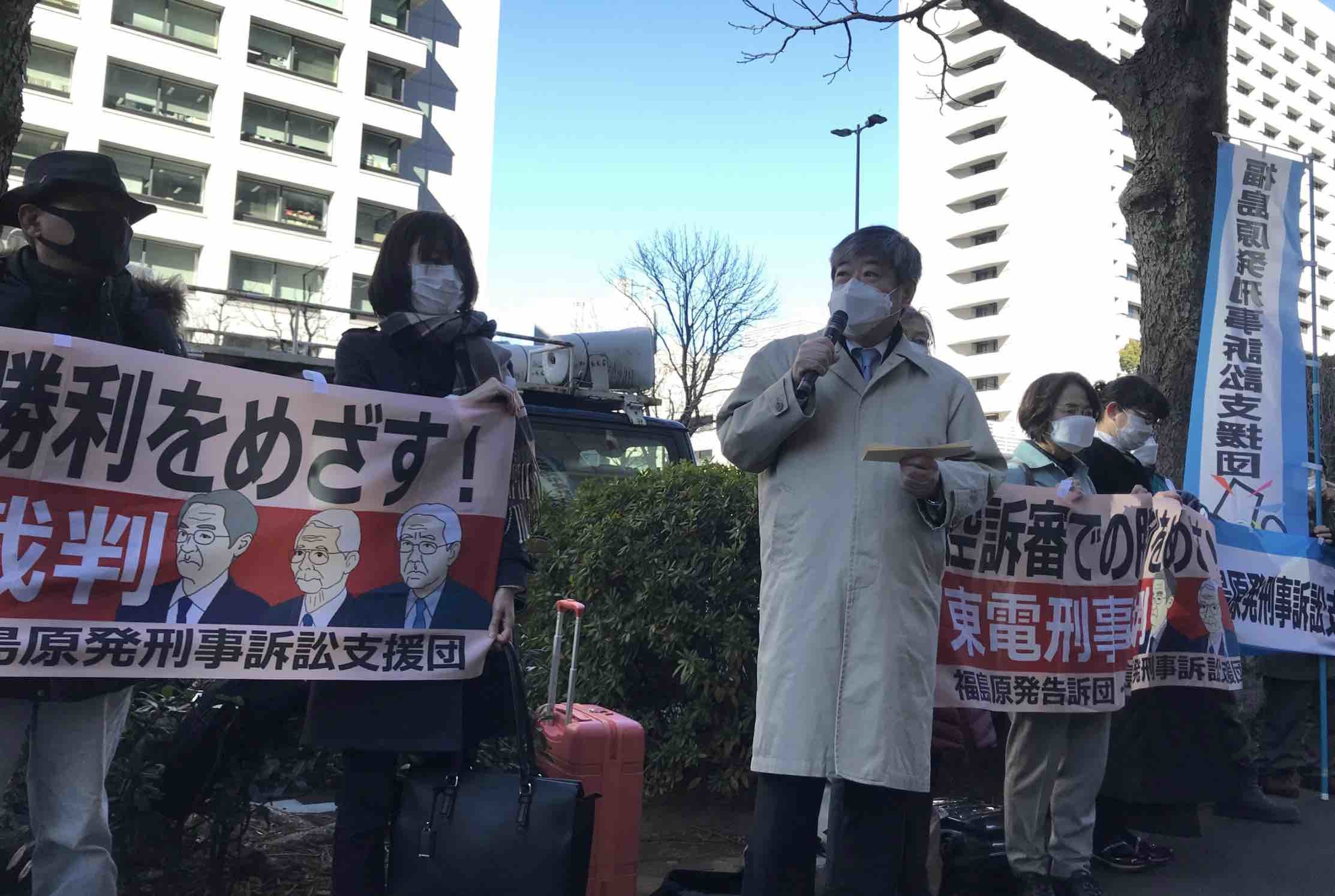
On the morning of January 21, in the cold wind, the Fukushima Nuclear Power Plant Criminal Litigation Support Group submitted the third round of signatures to the Tokyo High Court to demand that the presiding judge of the 10th Criminal Division of the Tokyo High Court, Keisuke Hosoda, decide on the on-site inspection and examination of witnesses.
In the criminal trial of the three former TEPCO executives who were forcibly indicted, the appeal trial at the Tokyo High Court started in November last year, and the key is to realize the on-site verification by the judges who were not employed in the first trial.
At the second trial on February 9 at 2:00 p.m., the decision on whether or not to hold the on-site inspection and witness examination will be made, and this will be a major turning point in the appeal trial.
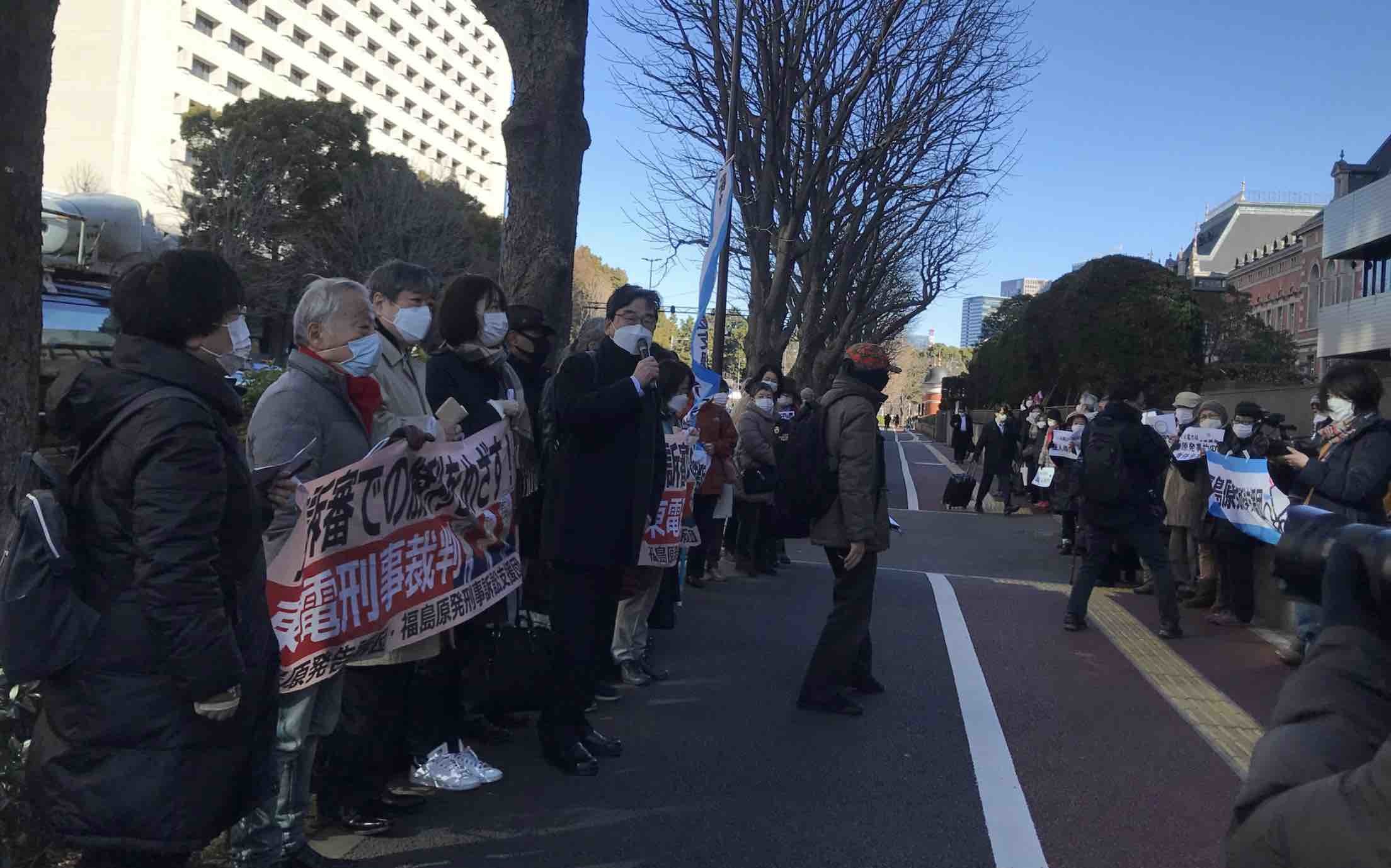
At 10:30 a.m. on the morning of the 21st, more than 100 citizens gathered in front of the Tokyo High Court, despite the bitter cold, and the leader of the support group and lawyers representing the victims, Kaito and Okawa, appealed to the Tokyo High Court to conduct on-site inspection and questioning of witnesses.
A little after 11:00 a.m., the leader of the support group and other representatives of the group, including attorneys Kaito and Okawa, submitted their signatures to the Criminal Division 10 of the Tokyo High Court. A total of 10,195 signatures were submitted so far, including 2,151 for the third round.
While taking measures against coronary infection, the participants once again confirmed that they would rally for the second trial on February 9 at 2:00 p.m., aiming for victory in the appeal trial of the Fukushima nuclear power plant criminal trial to hold TEPCO responsible for the Fukushima Daiichi nuclear power plant accident.
Common Security Approaches to Resolve the Ukraine and European Crises

Common Security Approaches to Resolve the Ukraine and European Crises23.01.22 – United States – Abolition 2000 Pressenza, By Joseph Gerson* 23 Jan 22,
We have been bombarded by news reports and announcements from President Biden and Secretary of State Blinken that a Russian invasion of Ukraine is imminent. On January 18, as he prepared to leave for Kyiv, Berlin and Geneva, Secretary of State Blinken, said “We’re now at a stage where Russia could at any point launch an attack in Ukraine.” A day later President Biden announced that he expected Russian President Putin to order an invasion. And both backed their fear inducing warnings with the less than fully accurate claim of NATO unity and the threat that a Russian invasion of Ukraine will be met with “severe, and united response.”
Remarkably, across Europe, there has been a relative absence of fears of an imminent Russian invasion. The belief there is that the 100,000 troops Russia has deployed along its borders with Ukraine are a negotiation ploy. And when Secretary Blinken and Russian Foreign Minister Lavrov met in Geneva they committed to future diplomacy.
This has been a totally unnecessary crisis, fueled in large measure by U.S. insistence on maintaining NATO’s “open door” policy, when the reality is that there is no way that France or Germany will agree to Ukraine becoming a NATO member state. Resolution of the crisis could be hastened were President Biden or Secretary Blinken to state the obvious: “We understand there are deep insecurities on all sides. Given that our allies are in no hurry to welcome Ukraine into NATO, we propose a moratorium on new NATO memberships. Beyond that, we look forward to a range of constructive negotiations to establish an enduring Eurasian security framework for the 21st century.”
Such a statement would bring all the contending forces back from the brink. Instead, U.S. insistence on maintaining the possibility of Ukraine and Georgia joining NATO is exacerbating the multifaceted crisis.
The crisis has been years in the making. In 1990, the Organization for Security and Cooperation in Europe’s Paris Charter, signed by 34 heads of state, “ushered in a new era as states made an unprecedented commitment to domestic individual freedoms, democratic governance, human rights, and transnational cooperation.”
[i] Seven years later, it was followed by the NATO-Russia Founding Act, which enshrined commitments to equal security and to not seek security at the expense of the other’s security. And in 1999 the OSCE’s European Security Charter its member states committed “not to strengthen their security at the expense of the security of other States.”
More than Ukraine’s uncertain fate, it is the violation of these commitments to create a post-Cold War European security order that lies at the heart of the current dangerous crisis. Malcolm X would have said, the chickens have come home to roost.
Rather than acknowledge and compensate for errors made along the way, U.S. and NATO leaders’ arrogant inability to acknowledge legitimate Russian security concerns have precipitated what is termed the Ukraine crisis. It is actually a trans-European crisis. Contrary to all sides’ harsh public rhetoric, a near-term Russian invasion of Ukraine appears to be unlikely. But it could be triggered by an unintended incident, accident, or miscalculation.
There are realpolitik and Common Security diplomatic options that could resolve the crisis and build on the Paris Charter and the NATO-Russia Founding Agreement. They have been advocated by Former U.S. ambassador to Russia James Matlock and in off the record Track II discussions among other U.S., Russian, and European former officials and security analysts.
Three interrelated crises – not one
Developing mutually beneficial diplomatic solutions requires disaggregating what is commonly presented as a single crisis. We are, unfortunately, confronted by at least three entwined crises, not one: (1) The struggle between Galician (western) and Russian-oriented (eastern) Ukrainians over Ukraine’s identity and its future; (2) the crisis in Russian-Ukrainian relations, which has deep historic roots; (3) competing ambitions of two empires that are in decline (U.S. and Russia) to reinforce their power and influence across Europe, compounded by the inability of European nations to create an enduring post-Cold War security system.
Ukraine’s Identity Crisis: Given stark divisions in the United States, which date to 1619, our civil war, and across the 20th century, we should appreciate the histories that reverberate across Ukrainian culture and politics. For those wanting detail, Richard Sakwa’s Frontline Ukraine is an excellent resource. In short, Kievan Rus’ and its 988 conversion to Eastern Orthodoxy lie at the foundation of the Russian nation. In the 1400s, Ukraine became part of the Lithuanian and later Polish empires. As a consequence, those in the Galician west are predominantly Catholic, Western oriented, and Ukrainian speakers, while those in the east are primarily Russian Orthodox, Russian oriented, and Russian speakers. In pursuit of creating a warm water port for a Black Sea fleet, Russia’s Catherine the Great annexed Crimea in 1783. and during three Russo-Turkic wars and divisions of Poland during her rule, Ukraine fell fully under Russian control.
In the 20th century, millions of Ukrainians died of starvation in the 1920s as a consequences of Stalin’s brutal agricultural collectivization. With no love for the Soviets or Russia, anti-Soviet forces in eastern Ukraine allied with Hitler and joined his devasting march to the east. The first major Holocaust massacre of Jews was inflicted at Babi Yar, a ravine near Kyiv. At war’s end, Ukraine was re-unified with the Soviet Union, with Khrushchev transferring Crimea to Ukraine in 1954. With the breakup of the Soviet Union in 1991, Ukraine became an independent state, surrendering the arsenal of Soviet nuclear weapons that had been left behind in exchange for solemn Russian, U.S., and European commitments to honor Ukraine’s territorial integrity…………………………
Russia & Ukraine: The Russian-Ukrainian dimension of the crisis speaks for itself. Kiev was central to the creation of the Russian nation a millennium ago. Eastern Ukraine remained an integral element of the Russian and Soviet empires for centuries……….
………Most Russians believe the Crimea and eastern Ukraine are inherently Russian, and more than a few extend Russian claims to Kyiv.
Most Ukrainians and much of the world don’t share this perspective. There is a long history of Ukrainian resistance to Russian dominance and rule.
………….. Gorbachev’s refusal to intervene to preserve Soviet East European clients and the breaching of the Berlin wall marked the end of Yalta’s division of Europe. Russia’s buffer against the West disappeared, ushering in a period of hope and uncertainty. For a brief period, building on the Common Security paradigm (the understanding that security cannot be achieved against a rival nation, but only with the rival) that laid the foundation for the end of the Cold War and the Intermediate Nuclear Forces Treaty), and reinforced by the 1990 and 1997 accords, a vision of a common house of Europe prevailed.
This vision and the commitments were shattered when President’s Clinton and George W Bush took advantage of Russia’s immediate post-Soviet chaos and weakness by extending NATO to the East. The German Reunification Treaty had earlier been negotiated on the condition that no NATO forces would be based in eastern Germany. Pledges made by President Bush and Secretary of State Baker in the course of the negotiations to the effect that NATO would not move a centimeter closer to Russia led the Russian elite to believe these U.S. commitments. That Gorbachev failed to get these commitments in writing is rued by Russians in the know to this day.
Notably, the author of the United States’ Cold War containment doctrine, George Kennan, warned at the time that expanding NATO to Russia’s border would trigger a new Cold War. ……..
…… In the decades that followed, the NATO alliance reached Russia. U.S. and German troops are now based and conduct exercises along Russia’s borders.
………. There is a pro-Western government in Kyiv. And NATO signaled possible future Ukrainian and Georgian membership, while NATO forces conduct exercises along Russia’s border, and U.S. naval and air forces are pressing against Russia across the Baltic and Black Seas. It should thus be no surprise that Putin has responded in the tradition of the best defense being a good offense.
………. Putin has now challenged the U.S., NATO and certainly Ukraine by surrounding the country from three sides with 100,000 troops and which are arguably in a position to conquer all or part of that nation.
…………………… while President Biden and NATO have for the moment ruled out a military counterattack should Russia invade Ukraine, nothing is certain in war. Just as unanticipated gunshots triggered an unwanted World War in 1914, today an incident, accident or miscalculation, compounded by powerful nationalist forces, could lead to wider, great power, and potentially nuclear war.
Fortunately, Russian diplomats have repeated that Russia does not intend to invade Ukraine, and diplomacy remains the order of the day.
Common security alternatives
We may be horrified by Putin’s authoritarian rule and by Russia’s past military aggression and today’s implied threats. That doesn’t make them go away. The reality is that the U.S., Russia, and many of their allies have been practicing international relations in the tradition of Mafia dons. President Biden’s and Secretary of State Blinken’s arrogant, stiff necked, anti-historical, and ultimately self-defeating insistence on holding to the fantasy of possible future Ukrainian NATO membership only deepens the compounded crisis. When elephants fight, they threaten not only one another, but the ants and grass beneath them. Someone is bound to be hurt.
The Biden Administration would do well to begin by stating that in the face of the West’s violations of the Paris Charter, the NATO-Russia Founding Act, and the understandings that NATO would not move another centimeter eastward, the U.S. acknowledges that Russians have more than a little reason on their side.
Despite the bellicose tone of the public rhetoric and propaganda that preceded and has followed recent diplomatic encounters, some progress has been made. For the first time in two years there have been something approaching open and “business like”—if not warm—exchanges. All sides’ red lines have been clearly identified. Behind closed doors, there is increasing recognition that resolution of the crisis will require reciprocity in future negotiations on the range of outstanding issues. And commitments for future negotiations have been made.
Winston Churchill, racist, colonialist, and alcoholic though he was, had it right when he said that “jaw-jaw is better that war-war.” Difficult and complex though the challenges of this moment may be, with rationale and Common Security diplomacy, this crisis can be transformed into an opportunity………..
As former U.S. ambassador to Russia James Matlock and others have advised, there is an obvious solution to the Ukraine crisis: Building from the Minsk II agreement that made the 2014 ceasefire possible, U.S., Russian, Ukrainian, and European negotiations should lead to the creation of a neutral and federated Ukrainian state………………….
As former U.S. ambassador to Russia James Matlock and others have advised, there is an obvious solution to the Ukraine crisis: Building from the Minsk II agreement that made the 2014 ceasefire possible, U.S., Russian, Ukrainian, and European negotiations should lead to the creation of a neutral and federated Ukrainian state………..
In the above mentioned Track II discussions, a host of other possible options, compromises and processes to address broader Eurasian insecurities have been identified. We can hope that they are embraced by those in power and serve as the basis for future negotiations.
They include:
- With Russia insisting on permanently banning Ukrainian NATO membership, and both France and Germany opposed to Ukraine joining the alliance, the Biden Administration could save face by agreeing to a moratorium on new NATO memberships for the next 15 years. This commitment could be extended by mutual agreement after that. A model for such an agreement would be the European Union’s functional moratorium on consideration of Turkey’s application for E.U. membership.
- Moldova, and Georgia, as well as Ukraine could become neutral states.
- While reaffirming Russia’s sovereign right to deploy its military forces wherever it deems appropriate WITHIN Russia, there could be an agreement by both sides to limit military exercises and border patrols.
- Renewed arms control negotiations, beginning with renewal of the INF and Open Skies treaties,
- no deployment of NATO conventional or nuclear strike forces in countries bordering Russia and moving to major reductions of their omnicidal nuclear arsenals.
A former senior U.S. military officer, now a scholar at a leading U.S. university notes that there would be advantages for the U.S. and NATO to use the NATO-Russian Foundation agreement as a mutually beneficial foundation for future agreements. They place limits on Russia’s actions, as well as those of the U.S. and NATO………………..
Europeans involved in these discussions have suggested negotiating agreements on non-deployment of strike forces by either side, negotiating an updated version of the INF Treaty which Trump and then the Russians abandoned, and banning potentially-first strike-related “missile defenses”.
Another world, at least another, more peaceful and just Europe, is possible. We must press for continued commitments to negotiations and do what we can to ensure that rational common security solutions prevail.
*Dr. Joseph Gerson is a member of the Abolition 2000 Global Council and President of the Campaign for Peace, Disarmament and Common Security. The original article can be found here https://www.pressenza.com/2022/01/common-security-approaches-to-resolve-the-ukraine-and-european-crises/
UKRAINE CRISIS: US ‘Toolboxes’ Are Empty

January 22, 2022 The toolbox is empty. Russia knows this. Biden knows this. Blinken knows this. CNN knows this. The only ones who aren’t aware of this are the American people, says Scott Ritter. By Scott Ritter, Special to Consortium News U.S. Secretary of State Antony Blinken met with his Russian counterpart, Sergei Lavrov, in a hastily scheduled, 90-minute summit in Geneva yesterday, after which both sides lauded the meeting as worthwhile because it kept the door open for a diplomatic resolution to the ongoing crisis in Ukraine. What “keeping the door open” entails, however, represents two completely different realities.
For Blinken, the important thing appears to be process, continuing a dialogue which, by its very essence, creates the impression of progress, with progress being measured in increments of time, as opposed to results.
A results-oriented outcome was not in the books for Blinken and his entourage; the U.S. was supposed to submit a written response to Russia’s demands for security guarantees as spelled out in a pair of draft treaties presented to the U.S. and NATO in December. Instead, Blinken told Lavrov the written submission would be provided next week.
In the meantime, Blinken primed the pump of expected outcomes by highlighting the possibility of future negotiations that addressed Russian concerns (on a reciprocal basis) regarding intermediate-range missiles and NATO military exercises.
But under no circumstances, Blinken said, would the U.S. be responding to Russian demands against NATO expanding to Ukraine and Georgia, and for the redeployment of NATO forces inside the territory of NATO as it existed in 1997.
……………….Blinken’s restatement of a position he has pontificated on incessantly for more than a month now was not done for the benefit of Lavrov and the Russian government, but rather for an American and European audience which had been left scratching their collective heads over comments made the day before by President Joe Biden which suggested that the U.S. had a range of options it would consider depending on the size of a Russian incursion.
…………………………………… the lack of an agreed-upon strategy on how to deal with a Russian incursion/invasion of Ukraine was an open secret for everyone except the U.S. and European publics, who being fed a line of horse manure to assuage domestic political concerns over being seen as surrendering to Russian demands.
…………………………. Blinken has indicated that the U.S. has a toolbox filled with options that will deliver “massive consequences” to Russia should Russia invade Ukraine. These “tools” include military options, such as the reinforcement of NATO’s eastern flank with additional U.S. troops, and economic options, such as shutting down the NordStream 2 pipeline and cutting Russia off from the SWIFT banking system. All these options, Blinken notes, have the undivided support of U.S. European allies and partners.
………… There’s only one problem—the toolbox, it turns out, is empty.
While the Pentagon is reportedly working on a series of military options to reinforce the existing U.S. military presence in eastern Europe, the actual implementation of these options would neither be timely nor even possible. One option is to move forces already in Europe; the U.S. Army maintains one heavy armored brigade in Europe on a rotational basis and has a light armored vehicle brigade and an artillery brigade stationed in Germany. Along with some helicopter and logistics support, that’s it.
Flooding these units into Poland would be for display purposes only—they represent an unsustainable combat force that would be destroyed within hours, if not days, in any large-scale ground combat against a Russian threat.
………………………. In short, there is no viable military option, and Biden knows this.
…………………………………………. Propaganda About ‘Propaganda’
One of the great ironies of the current crisis is that, on the eve of the Blinken-Lavrov meeting in Geneva, the U.S. State Department published a report on Russian propaganda, decrying the role played by state-funded outlets such as RT and Sputnik in shaping public opinion in the United States and the West (in the interest of full disclosure, RT is one of the outlets that I write for.)
The fact that the State Department would publish such a report on the eve of a meeting which is all about propagating the big lie—that the U.S. has a plan for deterring “irresponsible Russian aggression”—while ignoring the hard truth: this is a crisis derived solely from the irresponsible policies of the U.S. and NATO over the past 30 years.
While a compliant mainstream American media unthinkingly repeated every warning and threat issued by Biden and Blinken to Russia over the course of the past few days, the Russian position has been largely ignored. Here’s a reminder of where Russia stands on its demands for security guarantees: “We are talking about the withdrawal of foreign forces, equipment, and weapons, as well as taking other steps to return to the set-up we had in 1997 in non-NATO countries,” the Russian Foreign Ministry declared in a bulletin published after the Lavrov-Blinken meeting. “This includes Bulgaria and Romania.”
The toolbox is empty. Russia knows this. Biden knows this. Blinken knows this. CNN knows this. The only ones who aren’t aware of this are the American people.
The consequences of a U.S. rejection of Russia’s demands will more than likely be war.
If you think the American people are ready to bear the burden of a war with Russia, think again.
Scott Ritter is a former U.S. Marine Corps intelligence officer who served in the former Soviet Union implementing arms control treaties, in the Persian Gulf during Operation Desert Storm, and in Iraq overseeing the disarmament of WMD. https://consortiumnews.com/2022/01/22/ukraine-crisis-us-toolboxes-are-empty/
Europe’s nuclear waste remains an unsolved and highly dangerous problem – EU Assessment Report

Nuclear waste from nuclear power plants remains an unsolved and highly dangerous problem, as spent fuel must remain isolated from the environment for a million years. In an attempt to solve the nuclear waste problem, an EU-wide regulation was introduced in 2011, the “Council Directive 2011/70/Euratom establishing a Community framework for the responsible and safe management of spent fuel and radioactive waste”.
This Directive tried to force EU member states to address the issue seriously, after this had been neglected for decades – thus immediately proving that nuclear waste has never been effectively dealt with.
The national waste management policies of the EU member states are still inadequate in many respects. The European Commission concluded in its latest report in 2019 that more needs to be done; this is also reflected in the high number of infringement proceedings.
In the Assessment Report, we not only address shortcomings in transparency and participation, but also problems in the inventory data, unsolved issues in the multinational repository search, incomprehensible
cost estimates and lack of financing. The Onkalo repository under construction in Finland is often presented as a game changer by the nuclear lobby, although the safety of the technology used is questionable due to new findings.
Don’t Nuke the Taxonomy 21st Jan 2022
How France greenwashes nuclear weapons

President Macron has announced investment of one billion euros in research and construction of small modular reactors (SMRs). SMRs are small nuclear reactors that are to be used primarily for submarine propulsion and thus for military purposes in distant theatres of war
Behind the planned modernisation of French nuclear power, allegedly to ensure cheaper electricity, nestles the agenda of its nuclear weapons programme. For years now, the state has imposed the exorbitant costs of its civilian-military nuclear industry on the French public.
France plans to modernise its nuclear power – allegedly to insure cheaper and greener electricity. Yet behind it nestles a nuclear weapons agenda https://www.ips-journal.eu/topics/foreign-and-security-policy/how-france-greenwashes-nuclear-weapons-5668/ 23 Jan 22,
At the turn of the year, France assumed the presidency of the Council of the European Union. And last week, the EU defence ministers met informally to talk about the Common Security and Defence Policy (CSDP). Among other issues, they discussed nuclear security and nuclear deterrence strategies.
In recent years, the French president has been a strong advocate of nuclear power. Historically, France’s independent development of nuclear technology for atomic weapons has been an important source of national pride. Since the 1990s, however, nuclear power has been declining as a consequence of the Chernobyl disaster. Annual reports by Mycle Schneider, an international consultant on energy and nuclear policy, show that this is a part of a global trend. Nevertheless, France continues to be a tireless advocate of this technology.
Nuclear answers for green energy and weapons
On 1 January 2022, a draft regulation of the European Commission classified the investment in nuclear energy and natural gas as sustainable. This concerns billions of euros in financial support in the so-called EU Taxonomy. Emmanuel Macron was keen to acquire a ‘Green Label’ for nuclear energy. France’s real interests concerning nuclear energy emerged clearly in a speech Macron delivered on a visit to Framatome’s Le Creusot facility in 2020: ‘Without civilian nuclear energy there is no military use of this technology – and without military use there is no civilian nuclear energy’. In a nutshell, this means that without a cutting-edge nuclear industry France cannot continue to expand and modernise its nuclear weapons arsenal. This remains true for all nuclear weapons states.
At present, these states are upgrading their arsenals. Russia and the United States are procuring new delivery systems – such as hypersonic missiles – that will be able to deliver their nuclear bombs much more quickly and accurately, leaving the enemy with no time to defend themselves. Thus, a new nuclear arms race has begun.
The US think tank Atlantic Council is quite open about how crucial it regards civilian use of nuclear power to be for national security policy: the civilian US nuclear industry is a U.S. strategic asset of vital importance for US national security. Similar formulations can be found in the speeches of other presidents of nuclear weapons states. Its civilian nuclear complex costs the United States at least USD 42.4bn a year. The International Campaign to Abolish Nuclear Weapons (ICAN) claims that all nuclear weapons states together invest over USD 100bn a year in their nuclear weapons arsenals.
France, too, wants to join in the ongoing technological development in other nuclear weapons states for quite some time. President Macron has announced investment of one billion euros in research and construction of small modular reactors (SMRs). SMRs are small nuclear reactors that are to be used primarily for submarine propulsion and thus for military purposes in distant theatres of war. The new Hunter class submarines underline France’s great-power ambitions. This needs to be understood against the background of the collapsed submarine deal with Australia. Last year Australia announced that it was cancelling its contract to buy French diesel submarines in favour of US and UK nuclear technology.
Flexible submarine-based nuclear weapons systems have major strategic importance for all nuclear weapons states. They have the capability of going for up to three months without surfacing. They can cover great distances at high speeds undetected and surface almost wherever they want around the globe. They are capable of launching up to 20 missiles, each with a dozen individual guided warheads. All this plays a key role in the nuclear weapons doctrine of the five ‘official’ nuclear weapons states, the United States, the United Kingdom, Russia, France, and China. At the same time, the possession of this technology underpins these countries’ great-power status. France, like the other nuclear weapons states, is keen to consolidate its status.
Exposing the French agenda
The first meeting of EU defence ministers under the French Council Presidency was held on 12–13 January 2022 in Brest. This is where France’s sea-based nuclear weapons are stationed, making this a clear demonstration of its military power. As early as his 2020 speech in Le Creusot, the French President confirmed his country’s military ambitions: ‘the nuclear industry will remain the cornerstone of our strategic autonomy. It affects every aspect of deterrence, powering our nuclear submarines, submarines for launching ballistic missiles, and powering our nuclear aircraft carriers.’
Nuclear power and nuclear sharing are controversial in the European Union. Austria and Luxembourg have sharply criticised the EU Taxonomy. At the same time, there has been a multilateral UN treaty banning weapons of mass destruction since the Treaty on the Prohibition of Nuclear Weapons of 22 January 2021.
Behind the planned modernisation of French nuclear power, allegedly to ensure cheaper electricity, nestles the agenda of its nuclear weapons programme. For years now, the state has imposed the exorbitant costs of its civilian-military nuclear industry on the French public. The costs of building the pressurised water reactor in Flamanville, for example, ran to €19.4bn. Ultimately, electricity customers and investors subsidise military applications with ‘climate-saving nuclear power’.
In any case, as France takes over the EU Council Presidency it is now perfectly placed to promote the civilian-military use of nuclear energy and a European security and defence strategy based on the doctrine of nuclear deterrence.
Germany formally opposes inclusion of nuclear energy in EU’s ”sustainable” taxonomy

Germany cries foul over nuclear energy in EU’s green rule book, Daily Sabah, BY REUTERS, BERLIN JAN 23, 2022 German Chancellor Olaf Scholz’s three-party coalition government has raised objections to a European Union draft plan to label nuclear power plants as a sustainable energy source in a formal letter to Brussels, ministers said on Saturday.
The EU taxonomy aims to set a gold standard for green investments, helping climate-friendly projects to pull in private capital and stamping out “greenwashing,” where investors and companies overstate their eco-credentials.
“As the federal government, we have once again clearly expressed our rejection of the inclusion of nuclear energy. It is risky and expensive,” Vice Chancellor and Economy Minister Robert Habeck said in a joint statement with Environment Minister Steffi Lemke, both senior members of the Greens party.
In its letter to Brussels, published by the Economy Ministry on its webpage, the German government also pointed to the lack of any safety requirements regarding nuclear power plants.
“Serious accidents with large, cross-border and long-term hazards to humans and the environment cannot be excluded,” Berlin said in its letter, adding that the question of where to store radioactive waste in the long term was still unanswered.
Habeck and Lemke said that Berlin should reject the plan in their opinion if the European Commission disregarded Germany’s objections and left the draft plan unchanged.
However, German government sources told Reuters earlier this month that coalition parties wanted to avoid escalating the EU dispute and agreed in coalition talks behind closed doors to abstain in any upcoming vote.
Long delayed
The EU rules have been long delayed, with countries split over whether nuclear energy and natural gas deserve a green badge. Austria has already said it would take legal action if the European Commission proceeds with its draft plan to label both as sustainable investments………………………..
The commission hopes to adopt a final draft by the end of the month. https://www.dailysabah.com/business/energy/germany-cries-foul-over-nuclear-energy-in-eus-green-rule-book
Officials at San Onofre conspicuously silent on the risks of tsunami waves to nuclear waste storage.
The tsunami advisory that woke up the West Coast Jan. 15 should serve as a wake-up call on flooding dangers at the nuclear waste storage facility in San Onofre. The facility is 100 feet from the beach.
During high tides, waves crash into an aging bulkhead that separates the sea from the storage
vault — a kind of crypt that holds 73 thin-walled, metal canisters jam-packed with 3.6 million pounds of deadly, radioactive waste.
According to Southern California Edison, the sprawling, concrete vault will flood from a storm at high tide. If the ocean were to swamp the so-called Independent Spent Fuel Storage Installation, we could have an unsurpassed disaster on our hands, an uncontrolled criticality, one that has never occurred in the U.S. commercial power industry.
The undersea volcanic eruption this month near Tonga sent waves across the Pacific. Officials in
Hawaii reported tsunami wave heights of nearly 3 feet. At San Diego Harbor, officials measured more than a half-foot of sea level rise. Meanwhile, officials from shuttered San Onofre Nuclear Generating Station remained conspicuously silent.
Times of San Diego 20th Jan 2022
The tribulations of France’s Flamanville nuclear reactor.
| “EDF is struggling to sleep off its nuclear power”. Here is the title at the top of page 3 of the Chained Duck of this Wednesday, January 19, 2022. Is this a new article following the announcement, a week ago, of a delay and an additional cost of 300 million euros for the site of the future Flamanville EPR reactor? No, there is no question of welding rework operations taking longer than expected. “The energy company must face a formidable puzzle encountered on the reactor vessel, where nuclear fission takes place”, announces from the outset journalist Hervé Liffran. The concern was flushed out followingan incident on the other side of the world, in China. The Taishan nuclear power plant, with the world’s first EPR reactor in service, was shut down on July 30, 2021, after damaged fuel rods caused a buildup of radioactive noble gases in the reactor’s primary circuit. In November, we learned thata fault in the design of the tank would be the cause of the problem. It was a whistleblower working in thenuclear industry who informed, on condition of anonymity, the Commission for Independent Research and Information on Radioactivity (Criirad), which in turn alerted the Authority. Nuclear Safety Authority (ASN) by post. And the shutdown of the plant was ordered “because of the presence of numerous and dangerous debris in the water of the primary circuit bathing the heart of the reactor”. Questioned this Wednesday on this subject, the Deputy Director General of the Nuclear Safety Authority, Julien Collet, replied: “ASN has asked EDF to take account of experience feedback from this event at EPR Taishan 1 prior to the commissioning of the Flamanville EPR reactor. EDF will either have to demonstrate that the Flamanville EPR is not concerned, or propose measures to prevent fuel degradation. JHServers 20th Jan 2022 https://jhservers.com/nuclear-is-the-flamanville-epr-vessel-poorly-designed/ |
EDF’s costly EPR nuclear reactor failures – in France, UK, China
Emmanuel Macron hammers EDF as Britain’s nuclear energy future hangs in
the balance. The energy giant is our last hope in the push for big new
reactors. But the French president has handed it an almighty financial
headache.
Macron ordered the company to sell more electricity at knock-down
prices to its competitors, in order to keep a lid on soaring energy bills.
For Macron, it makes complete political sense. Three months out from an
election, he is keen to temper voter anger over energy costs, which, as in
the UK, have been pushed higher by surging gas prices.
EDF is 84 per cent owned by the French state and has to bow to its will — even when the
government’s intervention is “painful and defies good economic
sense”, as newspaper Le Monde put it. EDF calculated that Macron’s
demand would cost it €8.4 billion (£7 billion).
The company had no choice but to scrap its profit guidance for the year and warned investors
that it may need to seek more capital. Shares in EDF, listed in Paris,
plunged. In a leaked memo, chief executive Jean-Bernard Levy claimed that
Macron’s demand was a “real shock”. “It is going to weigh very
heavily on our results,” he added.
Trade union members at EDF have called
for a strike this week in protest at the president’s order.
Macron’sedict could not have come at a worse time for EDF, which was already facing
huge demands on its capital. On the same day that Kwarteng toured Hinkley,
the company cut its expected output of nuclear power this year by 8 per
cent, after warning that five faulty reactors in France would have to stay
offline while being serviced for longer than expected. This pushed the
total number of EDF reactors currently offline to nine.
EDF is midway through a long, slow upgrade of France’s fleet of 56 ageing nuclear
reactors; this project could cost it at least €50 billion. And, earlier
this month, it pushed back the start date and nudged up the expected cost
for its new reactor at Flamanville in France; the project’s cost has
quadrupled from initial estimates in 2004.
Flamanville’s overruns havetheir parallels at Hinkley Point, which is also years late and over budget.
It uses the same type of European pressurised water reactor (EPR) as
Hinkley, too. Other EPRs designed by EDF have run into problems: the
much-delayed Olkiluoto nuclear power plant in Finland is now finally
looking to start up this year; and Taishan — in Guangdong province in
China — has been offline since July because of a fault.
Taishan was supposed to be EDF’s “proof of principle for the EPR design”, said
Paul Dorfman, associate fellow in the science policy research unit at
Sussex University. “But that has not been the case. To shut down the
reactor is hugely expensive in terms of power, reputation, and in potential
safety … The EPR reactor has failed miserably in terms of cost overruns
everywhere that it’s been built.”
EDF remains confident that Hinkley
will be completed by 2026. Five and a half years into construction, it is
now at the halfway point. When operational, it will supply 7 per cent of
the UK’s electricity. About half of the £23 billion earmarked for
Hinkley has already been spent, and the remainder is expected to come from
EDF’s €27.5 billion cash pile. Hinkley, in other words, should be
completed despite the company’s travails. The outlook for EDF’s
Sizewell B in Suffolk, the next big nuclear project in the queue, is less
clear.
Times 23rd Jan 2022
https://www.thetimes.co.uk/article/emmanuel-macron-hits-nuclear-button-edf-hinkley-point-cpcvtccn3
Nuclear weapons standout calls for US commitment to UN treaty
Nuclear weapons standout calls for US commitment to UN treaty, By CHRIS LARABEEStaff Writer, Greenfield REcorderPublished: 1/23/2022 11:05:01 AM
GREENFIELD — On the one-year anniversary of the United Nations Treaty on the Prohibition of Nuclear Weapons becoming international law, a group gathered on the Greenfield Common and in Northampton to celebrate the treaty and to raise awareness that the United States has not signed on.
“Fifty nations have signed on. … How can we face the world?” asked Greenfield resident Patricia Greene. “We’re here to say not all of us agree.”
Greene and several other residents called out the United States’ “pugnacious” stance toward many other countries and said America should focus on peace.
“I feel that the main thing our country needs to do is look at peaceful relations,” Greene said. “We’re so divided internally, maybe heal that over, too.”
The anniversary of the treaty comes days before a state Public Safety and Homeland Security hearing Jan. 26 on Bill H.3688, which was filed by Rep. Lindsay Sabadosa, D-Northampton, and would establish an 11-member commission to investigate and report on what measures may be necessary and appropriate to protect Massachusetts residents from the threat posed by nuclear weapons and to contribute toward the total elimination of these weapons from all countries.
According to the United Nations’ website, 59 countries have ratified the treaty, which recognizes the threat of nuclear weapons and requires their elimination. Among the countries that have yet to even sign the treaty include many world powers, such as the United States, China, Japan and the majority of the European Union and England.
Pat Hynes, who sits on the Traprock Center for Peace and Justice’s board of directors, said the 11-member commission, if it was created, would find many people in Massachusetts with similar sentiments to the group standing on the frozen Greenfield Common.
“They would certainly find a very high majority opposing nuclear weapons,” Hynes said. “I hope the committee and State House have the courage to pass the bill.”
Hynes recalled a quote from World War II Army Gen. Omar Bradley that the world contains “nuclear giants and ethical infants.” She added it’s been disappointing that nuclear weapons continue to be produced, even after the horrors of bombing Hiroshima and Nagasaki and the existential threat of the Cold War.
“I’d say it’s tragic, especially with all the other crises happening,” Hynes said, highlighting climate change and the COVID-19 pandemic as current threats. “We don’t need to add to them.”………………..
https://www.recorder.com/Nuclear-weapons-standout-calls-for-U-S-commitment-to-U-N-treaty-44696552
France’s Nuclear Safety Authority considers abandoning the reprocessing of nuclear waste.
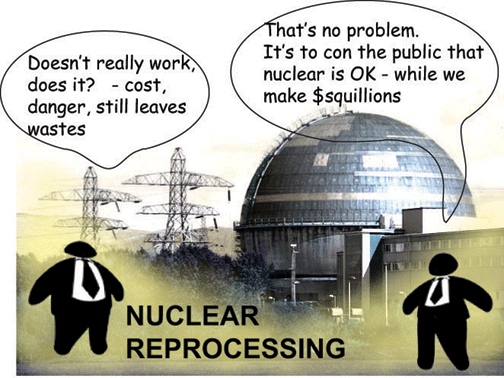
ASN is considering abandoning the reprocessing of nuclear waste, https://reporterre.net/L-ASN-envisage-l-abandon-du-retraitement-des-dechets-nucleaires The director of the Nuclear Safety Authority ( ASN ) described on January 19 the “ fragilities of the fuel cycle and the nuclear fleet ”. It opened up the possibility of eventually stopping the reprocessing of spent fuel, a particularity of French industry.
For the first time, to the knowledge of Reporterre , a nuclear manager in France is openly considering the end of the reprocessing of spent fuel at La Hague (Manche). On Wednesday January 19, during his back-to-school video press conference, Bernard Doroszczuk, Director of the Nuclear Safety Authority ( ASN ), said that this option had to be considered: ” It will be necessary either to provide for the renovation of the installations current if reprocessing is continued ; or anticipate the implementation of alternative solutions for the management of spent fuel, which should be available by 2040, if reprocessing is stopped. »
For the first time, to the knowledge of Reporterre , a nuclear manager in France is openly considering the end of the reprocessing of spent fuel at La Hague (Manche). On Wednesday January 19, during his back-to-school video press conference, Bernard Doroszczuk, Director of the Nuclear Safety Authority ( ASN ), said that this option had to be considered: ” It will be necessary either to provide for the renovation of the installations current if reprocessing is continued ; or anticipate the implementation of alternative solutions for the management of spent fuel, which should be available by 2040, if reprocessing is stopped. »
spent fuel, it has a whole series. Each poses a difficult management problem: plutonium (we can’t manage to use all the stock), minor actinides, reprocessed uranium, spent Mox, etc. By evoking the end of reprocessing, Mr. Doroszczuk therefore attacks a sacred cow of French nuclearists.
Why this new proposal ? Because, explained the director of the ASN , ” a series of events weakens the entire chain of the fuel cycle ” and several of its links are clogged:
• the pool at the La Hague plant (Manche), in which the spent fuel is currently stored, is reaching saturation point ;
• Orano’s Melox plant, in which part of the plutonium is recycled to make fuel, says Mox, works very poorly: “ We have too many breakdowns. Last year, we produced between 50 and 60 tonnes while the order book shows 120 tonnes per year , ” Régis Faure, spokesperson for the Orano Melox site , told Usine Nouvelle . Thus, the plutonium accumulates at the entrance, while at the exit, explained Mr. Doroszczuk, ” these problems that Orano has not mastered lead to the disposal of waste that contains more plutonium than expected. » ;
• finally, revealed the director of the ASN , “ the faster-than-expected corrosion of the evaporators at the Orano La Hague plant weakens the reprocessing capacities ” .
It therefore recommends anticipating the crisis, and either choosing to continue the reprocessing or to stop it. In both cases, this will involve very substantial investments, which we must think about now.
“ A nuclear accident is always possible ”
More generally, the ASN director underlined “ the absolute need to maintain margins so that there is no competition between production needs and safety decisions ” . Indeed, the nuclear situation is very tense, both currently, with ten reactors shut down, and in the future: it is not at all certain that the reactors will be able to operate beyond fifty years, indicated Mr Doroszczuk. And the sector lacks skills, both to manage the current fleet and its future dismantling and waste management: it would be necessary to “ train 4,000 engineers per year ” . We are far from it.The director of the ASN of course wants to stay out of the political debate. But it is clear that the “ messages ” he formulated on January 19 should be carefully listened to and understood by all presidential candidates who believe that nuclear power is the magic answer to climate change. He also repeated throughout his speech the requirement of security. ” A nuclear accident is always possible , ” he said.
13 wards in Cumbria recommended against their will, for UK’s nuclear waste dump
| This week our readers got talking about Allerdale potentially being the host to an underground disposal of nuclear waste. Having a Geological Disposal Facility (GDF) that would store higher level radioactive waste underground is hailed to be the safest and most secure method of disposal. The Allerdale GDF Working Group recommended a Search Area for consideration in 2021 comprised of 13 electoral wards: Aspatria; Broughton St Bridgets; Dalton; Ellen & Gilcrux; Flimby; Harrington & Salterbeck; Maryport North; Maryport South; Moorclose & Moss Bay; Seaton & Northside; St John’s; St Michael’s and Stainburn & Clifton. Cumbrian Lad added: “It is a very strange process which allows one individual, Andy Ross of GenR8 North, to volunteer the part of Allerdale in which he doesn’t live to be the burial site for the UK’s nuclear waste. The 13 wards who have been volunteered against their will, have no say in the matter until 15-20 years of investigations have taken place.” Carlisle News and Star 23rd Jan 2022 https://www.newsandstar.co.uk/news/19865839.nuclear-waste-disposal-allerdale-readers-talking/ |
-
Archives
- February 2026 (228)
- January 2026 (308)
- December 2025 (358)
- November 2025 (359)
- October 2025 (376)
- September 2025 (258)
- August 2025 (319)
- July 2025 (230)
- June 2025 (348)
- May 2025 (261)
- April 2025 (305)
- March 2025 (319)
-
Categories
- 1
- 1 NUCLEAR ISSUES
- business and costs
- climate change
- culture and arts
- ENERGY
- environment
- health
- history
- indigenous issues
- Legal
- marketing of nuclear
- media
- opposition to nuclear
- PERSONAL STORIES
- politics
- politics international
- Religion and ethics
- safety
- secrets,lies and civil liberties
- spinbuster
- technology
- Uranium
- wastes
- weapons and war
- Women
- 2 WORLD
- ACTION
- AFRICA
- Atrocities
- AUSTRALIA
- Christina's notes
- Christina's themes
- culture and arts
- Events
- Fuk 2022
- Fuk 2023
- Fukushima 2017
- Fukushima 2018
- fukushima 2019
- Fukushima 2020
- Fukushima 2021
- general
- global warming
- Humour (God we need it)
- Nuclear
- RARE EARTHS
- Reference
- resources – print
- Resources -audiovicual
- Weekly Newsletter
- World
- World Nuclear
- YouTube
-
RSS
Entries RSS
Comments RSS
 nuclear-news