Dungeness area in England set to go underwater as global heating continues
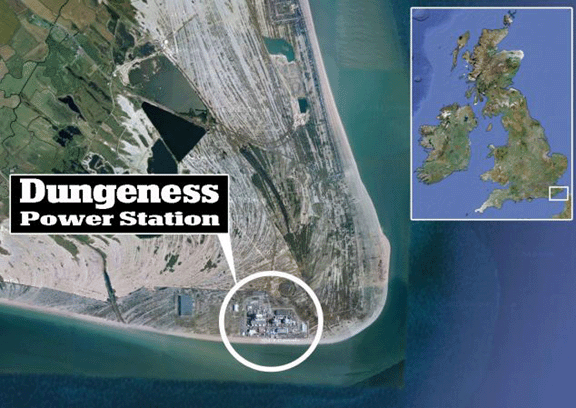
The Kent beaches set to be wiped out in 30 years because of climate
change. New data suggests that large parts of Kent could regularly fall
below sea level by the year 2050. The southern side of Kent looks to be
greatly impacted, with the entire Dungeness area to be underwater.
Kent Live 15th Aug 2021
https://www.kentlive.news/news/kent-news/kent-beaches-set-wiped-out-5789954
UK’s Marine Management Organisation gives the OK for dumping Hinkley radioactive trash in the Bristol Channel
A nuclear power station’s application to deposit hundreds of thousands
of tonnes of sediment as part of works taking place in the Bristol Channel
has been given the go-ahead.
The Marine Management Organisation (MMO), a
government agency which serves to protect and enhance [???] UK marine environment
and sustainable marine activities, has allowed a variation to a marine
licence to Hinkley Point C. This permits the power station to carry out
dredging and disposal of mud at the existing Portishead disposal site in
the Bristol Channel.
North Somerset Times 17th Aug 2021
Small nuclear reactors – questionable on safety, on toxic wastes, and on costs.
Nuclear Energy 101: What Exactly Are Small Modular Reactors? Bridget Reed Morawski EcoWatch Aug. 18, 2021 ”’……………………… While advanced reactor designs like small modular reactors are applauded by some for their potential to dramatically lower the costs and siting requirements for nuclear energy facilities, not everyone is throwing their support behind the technologies.
Edwin Lyman of the Union of Concerned Scientists counts himself among the SMR skeptics. As the non-profits’ nuclear power safety director, Lyman doesn’t believe that small modular reactor developers have “made the safety case that they don’t need a large structure,” even if the federal nuclear regulation agency “seems to be going along with their approach.”
………. Greg Rzentkowski, the IAEA’s nuclear installation safety division director, notes on the forum’s website that “SMRs are in general less dependent on safety systems, operational measures and human intervention than existing reactors,” adding that “the usual regulatory approach, which is based on overlapping safety provisions to compensate for potential mechanical and human failures, may not be appropriate and new ideas should be considered.”
Lyman doesn’t believe that the regulatory approach should be altered for new designs.
“I would say that any of these concepts aren’t necessarily safer and a big part of overall safety is not simply intrinsic aspects of the design, but also what is the set of safety requirements that you impose on that [design]?” said Lyman.
In Lyman’s opinion, “if the [U.S. Nuclear Regulatory Commission] grants exemptions and allows small modular reactors to take credit for these inherent safety features to reduce other aspects of operation that add layers of safety […] the overall outcome may be no better or even worse.” He explained that owners of conventional reactors are required by the NRC to draw up emergency evacuation plans that cover a 10-mile zone around the plant, for example, but that developers argue they don’t need such a plan for small reactors.
“But if they’re wrong, if there’s some unexamined accident sequence that can lead to a worse event than they contemplate, then you don’t have that extra layer of safety by being able to evacuate people,” he said.
The topic of nuclear waste disposal is among Lyman’s other concerns about small modular reactors. Although these smaller reactors may require fewer refuelings, he says that “it doesn’t matter what kind of reactor you have, there is no long-term strategy for nuclear waste disposal in this country, and most other countries in the world.” He added that more research needs to be done on storing certain small modular reactor fuel types in the long-term.
Some SMR developers also point to the added sustainability factor that comes from their recycling of nuclear waste. However, Lyman says “there’s no such thing as a reactor that consumes radioactive waste; what they’re really talking about is reprocessing spent fuel,” another term for nuclear waste.
As Lyman wrote in a March 2021 report, “any nuclear fuel cycle that utilizes reprocessing and recycling of spent fuel poses significantly greater nuclear proliferation and terrorism risks than” reactors that don’t reprocess such waste. Reprocessing “provides far greater opportunities for diversion or theft of plutonium and other nuclear-weapon usable materials.”
Lyman also questions the claims that small modular reactors are lower cost, saying that “it’s a situation where these reactors might be more affordable, but not more economical.” Procuring kilowatts of power from a small modular reactor might be cheaper in terms of how much money the overall facility costs but not in terms of how much it costs to produce a kilowatt of power compared to a much larger facility.
Think about it like your last trip to the grocery store: a single can of soda might have cost $1.50, but an entire 12-pack was priced at $10. That single soda might have a lower price than the entire pack, but you’re also getting a lot less soda per dollar spent. Similarly, Lyman believes the price per unit of electricity generated by a fleet of small modular reactors can’t actually be lower than the cost of a group of larger nuclear reactors generating the same amount of power.
Either way, small modular reactor development has attracted investment dollars from the federal government and private companies alike. Bill Gates, for example, is the main financier behind TerraPower, which plans to locate small modular reactors at the site of a former Wyoming coal plant in partnership with PacifiCorp, an investor-owned utility that operates in the intermountain west.
A competing company, the Oregon-based small modular nuclear reactor developer NuScale, has received roughly $192 million so far this year alone from private companies and investors. In 2020, the U.S. Department of Energy announced an up to $1.4 billion cost-share agreement with NuScale for a demonstration project in Idaho. At the time, Rita Baranwal, the DOE’s then-assistant secretary for nuclear energy, called the project “instrumental in the deployment of SMRs around the world.” https://www.ecowatch.com/nuclear-energy-101-2654710991.html
Exelon Prepares to Shutter Illinois Nuclear Plants

Exelon is a profitable corporation: the latest SEC filings show its CEO, Chris Crane, was compensated to the tune of more than $14 million.
the Illinois Chamber of Commerce is skeptical of another Exelon bailout.
“We become very concerned when a profitable company seeks to lock in profits through the Illinois General Assembly, when those profits are going to be paid for by ratepayers,” said Alec Messina with the chamber’s Energy Council.
And critics of nuclear energy say Exelon’s threats are akin to ransom.
Exelon Prepares to Shutter Illinois Nuclear Plants, wttw, August 17, 2021 Illinois legislators may be back in Springfield soon for another summer special session, to try once again to pass a massive energy package that thus far has proven elusive.
The result – be it passage of a new law, or a continued stalemate — will impact everything from Illinois’ role in climate change to your energy bill.
But the stakes are particularly high in one northern Illinois town.
Byron, Illinois – about 11 miles outside of Rockford — has had various identities since its founding in 1849. It’s been home to canning plants, railroad stops and a milk depot.
Mayor John Rickard says all of those have come and gone. But since 1985, Byron has had a new identity: It’s home to a pair of nuclear generators…………….
“We’re preparing right now to shut down these reactors forever,” Hanson said. “That means shutting the plant down, turning the turbines off, the generators off, shutting down the reactor.”……..
Property taxes from the nuclear plant comprise a whopping 74% of the district’s budget — some $19 million that would be difficult, if not impossible, to replace.
The next few weeks will determine whether it’s a reality Byron will have to face.
Exelon executives say they have no choice, and they’re preparing employees at the station for that possibility…….
The Chicago-based corporation has 21 reactors at a dozen sites nationwide. Nearly half are in Illinois.
Exelon is a profitable corporation: the latest SEC filings show its CEO, Chris Crane, was compensated to the tune of more than $14 million.
But due in part to energy market particulars and cheap natural gas prices, Exelon says its Byron and Dresden stations are losing money.
It’s not just Exelon that says so. The state commissioned a study and found that while they could be profitable in the future, “Byron and Dresden do face real risk of becoming uneconomic in the near term.”
Exelon is moving to close them (in energy parlance, “retire” the plants, decades ahead of their scheduled retirement) unless the Illinois legislature comes through.
A proposal floated in the statehouse would have ratepayers — as in, anyone who uses and pays for electricity in Illinois — pay a subsidy to keep them open. It would take the form of an extra charge on your electric bill, worth nearly $700 million, that Exelon would use to keep the plants open for at least the next five years.
It’s a big ask, especially considering what happened last July, when Exelon subsidiary Commonwealth Edison was charged with bribery.
Former Illinois House Speaker Michael Madigan — repeatedly referenced in court documents as “Public Official A” — has denied any knowledge of a bribery scheme but helped steer through legislation that helped ComEd.
Exelon benefitted too, by way of a law that currently has electricity customers paying a subsidy for two of its other Illinois plants, in Clinton and the Quad Cities……..
the Illinois Chamber of Commerce is skeptical of another Exelon bailout.
“We become very concerned when a profitable company seeks to lock in profits through the Illinois General Assembly, when those profits are going to be paid for by ratepayers,” said Alec Messina with the chamber’s Energy Council.
And critics of nuclear energy say Exelon’s threats are akin to ransom.
“Exelon first started what we’ve dubbed the nuclear hostage crisis. It’s a pattern where a utility will for whatever reasons threaten closure, which gets the workers very upset, then the local community whose tax base depends on it gets upset, they pressure their legislators, and then the legislators grant bailouts,” said Dave Kraft, head of the Nuclear Energy Information Service.
Kraft said rather than continuing to support nuclear energy, Illinois needs to redouble its commitment to wind and solar……….
Where’s the water coming from? In dry East Anglia, EDF has no solution for Sizewell nuclear power’s insatiable thirst.

EDF have announced yet another consultation, running for 3 weeks from 3rd to 27th August, this time it’s …Where’s the water coming from? One would think after nearly a decade of planning and many questions on ‘Where’s the Water coming from?’ EDF would have this sorted but NO.
Northumbrian Water/Essex & Suffolk Water have announced they cannot supply the ever increasing amounts of water needed to build SZC and will need several years to install over 20km of piping from the River Waveney to the site. We all know East Anglia is one of the driest areas in the country and members of TASC have been posing the question for years, see our response to Deadline 2.
As far back as Jan 2017 The Economist published an article on mains water at SZC, it makes for an interesting read, then as far back as 2010 TASC’s own Joan Girling was asking the very same question Where’s the water coming from?’
TASC (accessed) 17th Aug 2021
EDF launch yet another Consultation ~ Respond by 27th August
Public comment period regarding Bradwell nuclear project is drawing to its end.
After nearly four years, just one month remains for members of the public
to comment on the reactor technology for the proposed nuclear power station
at Bradwell B. The China General Nuclear Power Group (CGN) and the French
power company EDF, through their joint venture company General Nuclear
System Limited, initiated the Generic Design Assessment (GDA) process of
the proposed reactor in January 2017.
The public comment process, allowing
the public to provide feedback on the UK HPR1000 reactor technology planned
for use at Bradwell B, opened in November 2017 and is due to finish on
Friday, 17 September 2021. Since it began, a range of concerns have been
raised, including those related to climate change, safety and technical
questions.
Maldon Nub News 16th Aug 2021
Shareholders of Georgia Power Co now at greater risk for Vogtle nuclear station’s escalating costs?
Shareholders of Georgia Power Co. may be at more risk of shouldering the
utility’s share of cost overruns for the two new nuclear reactors being
built at Plant Vogtle. The Georgia Public Service Commission on Tuesday
approved an agreement between the unit of Atlanta-based Southern Co. and
commission staff that says the commission won’t agree that any expenses
above a $7.3 billion cap imposed in 2017 are “reasonable” until the end
of the project. “Since the company has exceeded the approved revised
capital cost of $7.3 billion, it is no longer appropriate for the
commission to verify and approve the dollars invested in the project,”
states the agreement approved by all five commissioners.
News & Observer 17th Aug 2021
https://www.newsobserver.com/news/business/article253546369.html
Australian researchers set new efficiency record for double-sided solar cells — RenewEconomy

Australian National University researchers set new efficiency record for double-sided solar cells and hope deliver a boost solar farm output. The post Australian researchers set new efficiency record for double-sided solar cells appeared first on RenewEconomy.
Australian researchers set new efficiency record for double-sided solar cells — RenewEconomy
The wilful ignorance of Tony Blair — The Earthbound Report

Recently I listened to Michael Liebreich and Tony Blair in conversation about climate change. The topic of degrowth came up, with Liebreich saying that there were roughly two schools of thought on sustainability. There was degrowth, which he characterised as “stop the economy, I want to get off.” And then there’s the view that he […]
The wilful ignorance of Tony Blair — The Earthbound Report
Afghanistan: anatomy of a fool’s errand


The algorithm’s running social media seem to be getting darn smart. Because just the other day, 55 days: the fall of Saigon popped into my feed. And to say this is eerily similar to events in Afghanistan is an understatement. You even had incidences of desperate people trying to hang on to a rescue aircraft as it tried to take off. Then I turn on the news and the very same thing is happening in Kabul.
But its not another Vietnam we are assured by the Americans. And in some respects it isn’t, its actually much worse. The Vietnam war was an attempt by the US to enforce its cold war policy of containment, fought largely for ideological reasons (because they had such confidence in capitalism, they were convinced if Vietnam fell the whole continent would go communist). But the Vietnamese weren’t launch terrorist attacks against the…
View original post 1,737 more words
What were the USA’s costs for the Afghanistan war ?

The Costs of War, WATSON INSTITUTE FOR INTERNATIONAL AND PUBLIC AFFAIRS
Since invading Afghanistan in 2001, the United States has spent $2.26 trillion on the war, which includes operations in both Afghanistan and Pakistan. Note that this total does not include funds that the United States government is obligated to spend on lifetime care for American veterans of this war, nor does it include future interest payments on money borrowed to fund the war.
| The Costs of War Project also estimates that 241,000 people have died as a direct result of this war. These figures do not include deaths caused by disease, loss of access to food, water, infrastructure, and/or other indirect consequences of the war. |
The figures for Afghanistan are part of the larger costs of the U.S. post-9/11 wars, which extend to Iraq, Syria, Yemen, Somalia and elsewhere. The numbers are approximations based on the reporting of several data sources.
The War On Afghanistan Was A $2 Trillion Scam

Americans will hate whoever they’re told to—Vietnam, Cuba, Iran, Iraq, China. After a while they don’t even remember why they hate them, they just do. Getting the war machine going is easy, just throw the press a few bones about ‘terrorism’ and soon enough there’s bones in the ground. The New York Times will even make terrorism up. CNN will film the bombs raining down. It’s a great, hateful show.
It’s important to understand Afghanistan not as a $2.26 trillion failure of good intentions but a $2.26 trillion success of bad. This is what America does. This is who Americans are. They have reduced war to its most crass objective, a way to profit from misery. Afghanistan was no mistake. It was a very successful scam.–
America just pumped-and-dumped an entire country, https://indi.ca/the-us-military-is-a-deadly-scam/
The American war on Afghanistan was a $2.26 trillion scam. Somebody pocketed all that money, and it certainly wasn’t the people of Afghanistan. That amount is 115 years of Afghan GDP, and it mostly went to arms dealers, the corrupt US military, and corrupt US politicians. Meanwhile the Taliban gets to keep the weapons. This wasn’t just a waste, it was a gigantic fraud.
Afghanistan was not an isolated incident. This is the American war machine, working as intended, grinding bones and printing blood money. America has reduced war to one simple fact: war costs money and somebody’s gonna get paid. This is their galaxy brain idea, starting wars with no objective just to make money for arms dealers. You don’t even have to win. In fact, it’s better if you spend 20 years losing. That’s the beauty of the scam.
Just follow the money. American taxpayers have been defrauded well over $6.4 trillion in their wars ‘of’ terror alone. People keep saying this money was ‘lost’ or ‘wasted’ but it didn’t go nowhere. American people had their pockets picked while saluting the flag. This is what America does. This is who they are. The vaunted American military is a fraud.
A Simple Scam
It’s a simple scam, really.
- Pick some random poor country (and get your people to hate it)
- Attack it
- Profit
The entire war machine is an endless grift. Donors throw a little money at Congressmen, Congressmen throw infinite money at the military, and some poor person ends up crushed under a $25,000 bomb. What does it accomplish? Who cares? We made money on the bomb.
In Afghanistan, the waste was insane(ly profitable). The American military transported fuel via helicopter. They kept every single car, truck, and tank idling 24 hours a day. They spent $1 million dollars per soldier shipping Burger Kings, gyms, and bottled water across the Arabian Sea. Nobody cared. The government just kept giving money and the military kept spending it. War machine go brrrr. It wasn’t their money and it’s wasn’t their lives. It was all a bloody scam.
The original article here posts a 2019 Afghanistan document dump which everyone has forgotten about
America invading Afghanistan was just like the mafia taking over a legitimate business and bleeding it dry. The American military is just a global racket of torturers and thugs, doing bust-outs on an international scale.
Suckers And Losers
Continue readingNew research on baby teeth will show the impact of nuclear bomb testing, and the connection with later cancers

Three decades later, [after the 1950s] Washington University staff discovered thousands of abandoned baby teeth that had gone untested. The school donated the teeth to the Radiation and Public Health Project, which was conducting a study of strontium-90 in teeth of U.S. children near nuclear reactors.
Now, using strontium-90 still present in teeth, the Radiation and Public Health Project will conduct an analysis of health risk, which was not addressed in the original tooth study, and minimally addressed by government agencies. Based on actual radiation exposure in bodies, the issue of how many Americans suffered from cancer and other diseases from nuclear testing fallout will be clarified.
Baby teeth collected six decades ago will reveal the damage to Americans’ health caused by US nuclear weapons tests https://peaceandhealthblog.com/2021/08/16/baby-teeth-collected-six-decades-ago-will-reveal-the-damage-to-americans-health-caused-by-us-nuclear-weapons-tests/ AUGUST 16, 2021 by Lawrence Wittner by Lawrence Wittner and Joseph Mangano
In 2020, Harvard University’s T. C. Chan School of Public Health began a five-year study, funded by the National Institutes of Health, that will examine the connection between early life exposure to toxic metals and later-life risk of neurological disease. A collaborator with Harvard, the Radiation and Public Health Project, will analyze the relationship of strontium-90 (a radioactive element in nuclear weapons explosions) and disease risk in later life.
The centerpiece of the study is a collection of nearly 100,000 baby teeth, gathered in the late 1950s and early 1960s by the St. Louis Committee for Nuclear Information.
The collection of these teeth occurred during a time of intense public agitation over the escalating nuclear arms race between the U.S. and Soviet governments that featured the new hydrogen bomb (H-bomb), a weapon more than a thousand times as powerful as the bomb that had annihilated Hiroshima. To prepare themselves for nuclear war, the two Cold War rivals conducted well-publicized, sometimes televised nuclear weapons tests in the atmosphere—434 of them between 1945 and 1963. These tests sent vast clouds of radioactive debris aloft where, carried along by the winds, it often traveled substantial distances before it fell to earth and was absorbed by the soil, plants, animals, and human beings.
Continue readingReclassifying nuclear wastes, and other ethical and technical problems at Hanford

“DOE sort of granted itself the authority to do that reclassifying,”
“We’re not convinced of any need to reclassify any of the high-level wastes,” said Ecology Department spokesman Randy Bradbury.
“We believe this rule lays the groundwork for the department to abandon significant amounts of radioactive waste in Washington State precipitously close to the Columbia River,”
Reclassifying a significant amount of high-level waste into low-activity waste is key to reaching that 80%, the report said.
Ultimately, this project, originally scheduled to be finished this decade, will likely be completed in the latter half of this century. In other words, it could take 70 to 75 years (mid-1990s to 2069) to deal with the 56 million gallons of radioactive tank waste created by 42 years of manufacturing plutonium.
A plan to turn radioactive waste into glass logs has raised a lot of questions, many of which don’t appear to have public answers. CrossCut, by John Stang, August 16, 2021”……………………..Whistleblower alarm
Red flags have also been raised over the quality of construction of the new treatment facilities.
In 2010, Walt Tamosaitis, a senior manager at a subcontractor designing the pretreatment plant, URS Corp., alerted his superiors and managers at lead contractor Bechtel to a risk of hydrogen gas explosions that could bend and burst pipes in the plant, spraying radioactive fluids. He also pointed out that radioactive sludge could clog the pipes and tanks in the plant, increasing the chance of uncontrolled releases of radiation. And he raised the issue of corrosion causing leaks in the pretreatment plant.
Tamosaitis’ superiors told the Energy Department that the design problems were fixed as of July 1, 2010 — over Tamosaitis’ protests, but in time for Bechtel to collect a $5 million bonus from the department.
For raising the alarm, he was demoted and exiled to an insignificant offsite job, Tamosaitis alleged in a lawsuit against Bechtel. He alleged illegal retaliation, eventually reaching a $4.1 million settlement with the company. Meanwhile, in 2011 and 2012, the Defense Nuclear Facilities Safety Board, a technical advisory body monitoring DOE, plus the Government Accounting Office, confirmed Tamosaitis’ concerns.
In 2015, the Energy Department announced that it would not have the entire complex operational by 2022, the deadline at the time. Department officials pointed to the same issues Tamosaitis had identified in 2010.
Also on hold is construction of the pretreatment plant — a prerequisite to the high-level waste glassification project, which is scheduled to begin production in 2023, according to the current state and federal agreement.
What the future holds
The U.S. Department of Energy has been giving contradictory signals about new plans for dealing with some of the high-level waste.
Continue readingOpposition to nuclear power plants in Poland
On the edge of a lake near the Baltic coast, half-flooded and overgrown with fir trees and shrubs, lie the remains of Poland’s last attempt to build a nuclear power plant. Begun in 1982, the project in Zarnowiec was abandoned after years of protests, and its half-finished concrete shell was left to the elements. Four decades on, Poland is trying again.
Last year, the government signed off on a plan to build the country’s first nuclear plant by 2033. Five more are due to follow by 2043 as part of a broader effort to wean Poland’s economy off its increasingly uneconomic dependence on coal. The final location for the first plant has not yet been chosen.
But in villages that dot the wooded countryside around Zarnowiec, there are already placards protesting against the prospect. “Why destroy one of the most beautiful places in Poland?” asks a member of an initiative against a plant near Lubiatowo, a hamlet some 20km from Zarnowiec. “Anyone who comes in here [to build a nuclear plant] will have a war.”
FT 16th Aug 2021
https://www.ft.com/content/6031bd28-5f7e-40ed-9e6d-aef34eade58d
1 This Month
26 April – Chernobyl: Inside the Meltdown airs on National Geographic on Sunday 26th April from 4pm

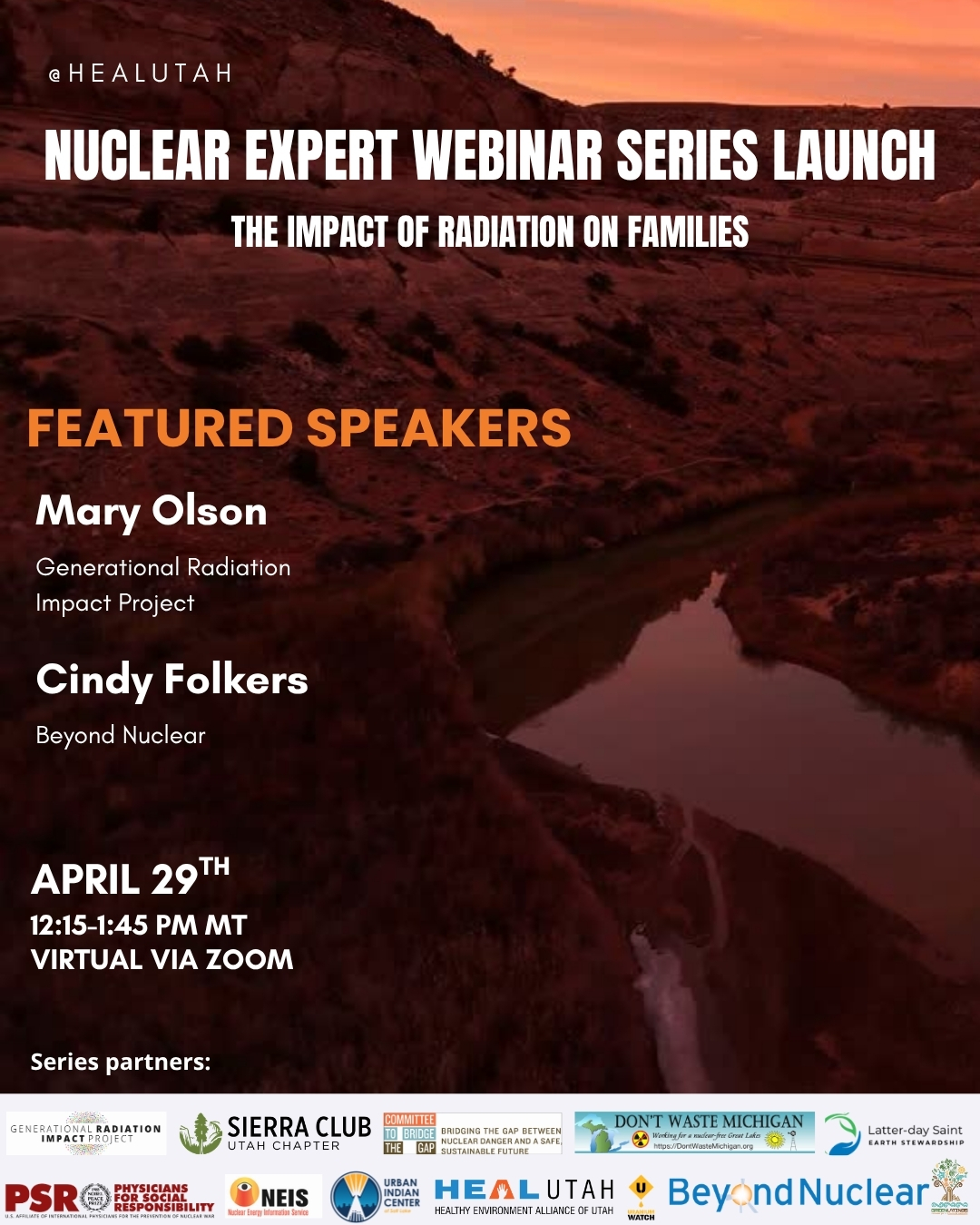
29 April – Nuclear Expert Webinar #1 – Radiation Impacts on Families with Mary Olson and Cindy Folkers
- 12:15 PM MT – 1:45 PM MT
- Location: Virtual – REGISTER TODAY

4 May -West Suburban Peace Coalition to discuss Iran war at May Educational Forum
Monday, May 4, 7:00 – 8:00 PM Central Standard Time
Title: : How Trump’s Narrative Tries to Shape the Reality of the War on Iran.
Contact Walt Zlotow, zlotow@hotmail.com 630 442 3045 for further information
14 May – online event From Bombs to Data Centres: the Face of Nuclear Colonialism

Pine Ridge Uranium is the real threat, not Tehran- Tell Burgum: Stop the Extraction.
Chernobyl: The Lost Tapes – A good documentary on Chernobyl on SBS available On Demand for the next 3 weeks– https://www.sbs.com.au/ondemand/tv-program/chernobyl-the-lost-tapes/2352741955560
To see nuclear-related stories in greater depth and intensity – go to https://nuclearinformation.wordpress.com
-
Archives
- April 2026 (288)
- March 2026 (251)
- February 2026 (268)
- January 2026 (308)
- December 2025 (358)
- November 2025 (359)
- October 2025 (376)
- September 2025 (257)
- August 2025 (319)
- July 2025 (230)
- June 2025 (348)
- May 2025 (261)
-
Categories
- 1
- 1 NUCLEAR ISSUES
- business and costs
- climate change
- culture and arts
- ENERGY
- environment
- health
- history
- indigenous issues
- Legal
- marketing of nuclear
- media
- opposition to nuclear
- PERSONAL STORIES
- politics
- politics international
- Religion and ethics
- safety
- secrets,lies and civil liberties
- spinbuster
- technology
- Uranium
- wastes
- weapons and war
- Women
- 2 WORLD
- ACTION
- AFRICA
- Atrocities
- AUSTRALIA
- Christina's notes
- Christina's themes
- culture and arts
- Events
- Fuk 2022
- Fuk 2023
- Fukushima 2017
- Fukushima 2018
- fukushima 2019
- Fukushima 2020
- Fukushima 2021
- general
- global warming
- Humour (God we need it)
- Nuclear
- RARE EARTHS
- Reference
- resources – print
- Resources -audiovicual
- Weekly Newsletter
- World
- World Nuclear
- YouTube
-
RSS
Entries RSS
Comments RSS
 nuclear-news