This week’s nuclear news
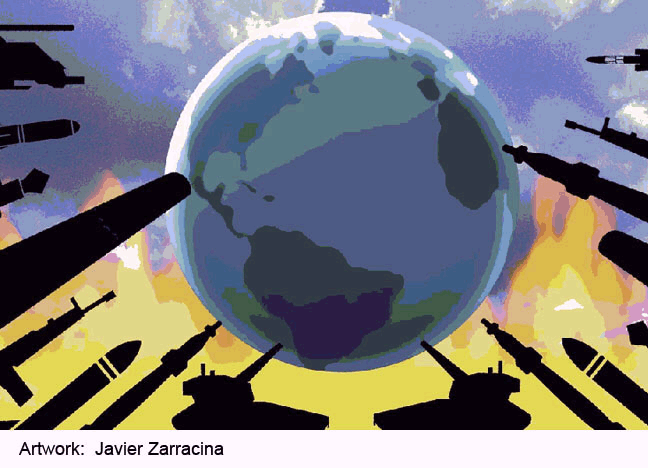
Climate ‘tipping points’ could push us past the point-of-no-return after less than 2 degrees of warming.
Some bits of good news – G7: World leaders promise one billion Covid vaccine doses for poorer nations.
Elimination of the Cold War’s Nuclear Heritage: 20 years of international cooperation.
The G7 meeting of world leaders made some progress on action about the pandemic and climate change. But they ignored that other global menace,nuclear weapons and the threat of nuclear war. Well, not entirely – as they managed to bring the world closer to war, with the focus on ”standing up to China”.
“IT’S VERY PROFITABLE to prepare for omnicide,” A People’s Guide to the War Industry -5: Portfolio of Conflicts. Growing support for the nuclear ban treaty in public opinion polls , voters and lawmakers in NATO’s 30 countries. Nuclear energy – Nuclear weapons – the inseparable link. Nuclear weapons numbers building up again. The world’s narrow escape from nuclear war.
We don’t need nuclear power to tackle climate change – Jonoathon Porritt. Nuclear energy – The solution to climate change?
Pacific Ocean was once a garbage dump for nuclear waste, now Japan’s doing it again.
Is Bill Gates ‘a nice man in a jumper’ or a power-hungry egotist?
ANTARCTICA. Fears Antarctic glacier could melt faster as it speeds up and ice shelf ‘rips apart’.
INDONESIA. Euphoria about nuclear costs, especially about decommissioning – Institute for Energy Economics and Financial Analysis (IEEFA) warns Indonesia.
UK. UK spent more than £8000 every minute on nuclear weapons in 2020, NFLA report on UK plutonium policy amid new concerns over plutonium dumped in the Irish Sea. ‘Unsustainable, unmanageable, unacceptable and unsuitable’- both Bradwell B and Sizewell C projects
FRANCE. France’s problem with nuclear wastes is becoming critical.
HUNGARY. Austria and other European countries concerned about safety aspects of Hungary’s nuclear power plant
ROMANIA. Romania’s dilemma – nuclear power or clean energy.
RUSSIA. Russia beefs up its sub-critical non-nuclear experiments at its top secret far remote Novaya Zemlya site.expansion. How many nuclear weapons does Russia have in 2021? Russia’s Approach to Nuclear Power in Outer Space.
INDIA. Explosion forced Indian Navy to return nuclear submarine to Russia? ‘EU aware of nuclear material proliferation incident in India:’
ISRAEL. Israel’s 1981 bombing of Iraq nuclear reactor may have fuelled Saddam’s nuclear ambitions. Israel’s outgoing top Mossad chief reveals that they caused recent attacks targeting Iran’s nuclear programme and murdering their scientists.
SOUTH AFRICA. ‘Koeberg Nuclear Plant is like an old car that simply can’t be kept on the road’
PHILIPPINES. USA still has ban on major foodstuffs from Fukushima region. Why did Philippines lift their ban?
NEW ZEALAND. Harrowing stories reveal decades of fallout for nuclear test veterans .
AUSTRALIA. Australia’s incompetent leadership – continued subservience to American militarism. Dr Jim Green gives an update on the Australian government’s new strategy to get a nuclear waste dump at Kimba, South Australia. Change in Resource Minister Keith Pitt’s strategy: what’s next for his Kimba nuclear dump project?
The military-industrial-media complex renders the American populus ill-informed in matters regarding war .

[and – it’s the same i Australia C.M.]
“How real is all this influence? Does the military-industrial-media complex (MIMC) actually affect the information we receive and our perception of war?”
The military-industrial-media complex renders the American populus ill-informed in matters regarding war — Rise Up Times
“The media has been a major player in ‘hyping up’ the sense of danger and need for military action in many situations.” https://wordpress.com/read/feeds/34005311/posts/3390423975
By HELEN JOHNSON The Miscellany News, Vassar College May 20, 2021
This is the fifth article in a five-part series about the military-industrial-media complex. The fourth article,“The (im)proper meshing of the corporate media and the military-industrial complex,” can be found here.
I have now examined the military-industrial complex (MIC) and the corporate media each individually; explained how the MIC has expanded to include not only the arms makers, Congress and the military, but also oil companies, service and equipment providers, surveillance and technology companies and think tanks; examined how the consolidation of corporate power within the media industry has resulted in a handful of companies controlling 90 percent of our media, and how these huge corporations hold incredible political power, not just to influence politicians and legislation directly, but to subtly shape entire ideologies. In this installment, I illustrated how the corporate media is linked in many ways to the MIC, including through outright ownership, interlocking directorates, revolving doors and overreliance on the government and the military for information and access to the battlefield during war.
But how real is all this influence? Does the military-industrial-media complex (MIMC) actually affect the information we receive and our perception of war? In this article I’ll explain that yes, because of its enormous reach, the extreme consolidation of its power and its entanglement with the gigantic machine that is the MIC, the media today has failed to properly inform the American citizenry on matters concerning war. The MIMC manufactures pro-military opinion among the public; suppresses information relevant to military activities; provides a sanitized coverage of war; fails to investigate, criticize, or thoroughly debate issues of military involvement; too easily bends to pressure from government and military officials and sometimes even spreads outright lies and false information.
This has resulted in an American populus that, in general terms, is ill-informed, uneducated and misled in matters regarding military involvement, as well as overly militaristic and pro-war. Americans are thus unable to hold their government accountable for unnecessary or inappropriate use of military force, and are complicit in the perpetuation of American imperialism, colossal defense budgets that strip the country of severely lacking social programs and never-ending wars that kill and destroy while a handful of corporations reap immense profits.
The media has been a major player in ‘hyping up’ the sense of danger and need for military action in many situations. Douglas Kellner—American academic and sociologist—explains in his book, Media Spectacle and the Crisis of Democracy: Terrorism, War and Election Battles, how Sept. 11 was a prime example of the media spreading hysteria and fear among an already panicked and traumatized nation. He notes how the media obsessively focused on terrorism, possible threats and retaliation in the weeks and months after Sept. 11. It also handed a megaphone to extremism and did little to weed out the potentially dangerous or incorrect information being spread on its platforms.
Spreading hysteria and panic throughout the population had two effects: First, it made Americans feel heavily reliant on the government for protection and, according to Kellner, made any disagreement with or questioning of the Bush administration seem “unpatriotic and even treasonous.” Second, it was extremely profitable for the media companies themselves; with millions of eyes glued to TVs, newspapers and other media platforms, media consumption spiked and profits went up. Thus, the corporate media and the military-industrial complex both benefited from this collaboration……………
An important note here is that this type of behavior is by no means limited to right-wing or conservative news outlets. In its analysis, FAIR cited The New York Times, The Hill, the Associated Press, and The Washington Post—in addition to Fox News—as all contributing to this culture of hysteria. A separate FAIR article’s headline directs a pointed accusation at CNN: “CNN’s Iran Fearmongering Would Make More Sense Coming Directly From Pentagon.” No mainstream media outlet is innocent of pro-war fear mongering.
The media has also suppressed or downplayed information relevant to military activity on multiple occasions. For example, although the media did everything in their power to vilify Iraq and Saddam Hussein in the lead-up to and during the Iraq war, they completely ignored how the United States backed Hussein in the past. The United States played an integral role in Hussein’s rise to power and actively supported Iraq during the Iran-Iraq War—including going along with Hussein’s use of chemical weapons. However, this seemed to be irrelevant once Bush Jr. had made up his mind to invade Iraq.
Another instance of the U.S. media suppressing or failing to report information came during the middle of the Iraq War in 2004. On Jun. 28, 2004, the United States transferred sovereignty of Iraq in a secret ceremony, immediately after which Paul Bremer—who had been seen by Iraqis as a dictator—left the country. Bremer had heavily controlled Iraqi politics and privatized a huge portion of the economy, including handing out contracts to American firms like Halliburton. However, Bremer’s replacement wasn’t much better. The U.S. chose Ayad Allawi, who had ties to the CIA, to serve as interim prime minister until elections could be held, and the U.S. handpicked the rest of the Iraqi council as well. The two months following the transfer of power saw escalated violence and a continuation of the chaos that had been produced by Bremer.
But watching the news in the United States, you would think “we had turned a corner,” as President Bush repeated over and over again. If the media had thoroughly reported on the situation in Iraq, it could have led to a nationwide understanding that the war was doing more harm than good and serving the interests of huge corporations at the expense of American and Iraqi lives. A truly informed citizenry could have put public pressure on the Bush administration to end the war, or an electorate dissatisfied with the situation could have voted him out of office. Instead, it would be seven more years before the withdrawal of American troops from Iraq.
Suppressing or downplaying information isn’t the only way the mainstream media—in complicity with the MIC—has warped our understanding of war. The media also produces an extremely sanitized coverage of war: it avoids printing and broadcasting images of death and destruction; sidesteps discussions of American casualties and almost entirely refuses to mention casualties on the other side (which are usually much higher); and uses euphemisms like “collateral damage” and “air campaign” that hold very different connotations from what these phrases actually mean—i.e., innocent civilian death and continuous bombing.
Kellner notes that during the Iraq war, “Entire networks like Fox and the NBC cable networks provided little but propaganda and jingoism, as did for the most part CNN. All of the cable networks, as well as the big three U.S. broadcasting networks, tended to provide highly sanitized views of the war, rarely showing Iraqi casualties, thus producing a view of the war significantly different than that shown in other parts of the world.”……………….
Not only do reporters and news anchors oftentimes receive direct instructions from higher-ups on what to and what not to say, but there is also careful screening of experts and guests brought onto the TV networks during wartime. And, as noted in my previous article, many of these “experts” are former generals and Pentagon officials, whose talking points have been carefully scripted and who have been trained on how to speak about matters of war in order to paint the U.S. military and government in the best possible light.
The U.S. corporate media has also chronically failed to properly investigate, criticize and debate issues of war and military involvement. It tends to take the current administration’s account of the situation as fact, and during times of war or military tension, it is branded unpatriotic to criticize the government. Although there are many examples of the media’s failure to investigate and report the truth when it comes to war, the most egregious case was in the lead-up to the invasion of Iraq.
George W. Bush and Dick Cheney had planned from day one of their administration to invade Iraq. As explained in this article, Bush and Cheney—as well as Paul Wolfowitz, Donald Rumsfeld and others in and around the Bush administration—were either directly a part of or tangentially related to the neoconservative think tank PNAC, which was advocating for a regime change in Iraq as early as 1998. The fact that Bush planned to invade Iraq from the get-go has been confirmed by multiple officials close to the administration.
From the immediate aftermath of Sept. 11 up until the 2003 invasion of Iraq, the Bush administration waged a propaganda war to convince the nation that Saddam Hussein was linked to Al Qaeda and that he possessed weapons of mass destruction (WMD). These claims turned out to be false. Not only did Saddam Hussein have nothing to do with the Sept. 11 attacks, but Iraq was not in possession of WMD nor were they in the process of making any.
Even so, these allegations were widely circulated in the mainstream media. The nonpartisan Center for Public Integrity documented a total of 935 false statements made by top administration officials regarding the threat from Iraq before the war, and the majority of these assertions “were broadcast widely by U.S. media with little or no investigation of their credibility, and few rebuttals from war skeptics or dissenters.”
Not only did the media outlets completely fail to properly investigate these claims before broadcasting them to the nation—even The Washington Post and The New York Times admitted that they had uncritically published information fed to them by the Bush administration—but they continued to circulate the misinformation long after it had been disproven. Even after ABC, NBC and The Washington Post reported that the claims were false, Fox Television and other U.S. cable networks continued to play the stories about Iraq’s alleged connection with Al Qaeda and supposedly threatening weapons program.
The Bush administration had accomplished its goal: to convince enough of the American population, still reeling and traumatized from Sept. 11, that Saddam Hussein was dangerous—so that they could have their war. The failure on the part of the corporate media to investigate and criticize the Bush administration’s claims, and the continued circulation of these claims even after they were proven false, would lead to a disastrous eight-year long conflict resulting in hundreds of thousands of deaths.
There are many, many more instances of skewed reporting when it comes to war and military involvement. Not all of these instances involve outright lying to the American public or regurgitating government pro-war propaganda; many of the ways in which the corporate media influences our perception of war are small and relatively unnoticeable……….. more https://riseuptimes.org/2021/06/12/the-military-industrial-media-complex-renders-the-american-populus-ill-informed-in-matters-regarding-war/
Shattered remains — the fallout from the Trinity nuclear bomb test

Tularosa Basin Downwinders continue their fight for recognition
Shattered remains — Beyond Nuclear International The fight to right the injustices of Trinity https://wordpress.com/read/feeds/72759838/posts/3391600721 By Tina Cordova, 14 June 21, In a world searching for sustainable energy infrastructures, the US has still not rectified the injustices that came about with the earliest moments of the nuclear era. On July 16, 1945, when the US government detonated the first atomic bomb at the Trinity Site in South Central New Mexico, officials had little to no concern for the people who lived in the adjacent area.
Most of them were people of color, Native Americans and also Hispanos who had emigrated north from Mexico (or their ancestors had likely done so). These people were warned neither before nor after the so-called “test” as to the dangers they were facing as a result of the bomb.
As we know, this “test” would be the first of many from both Western and Eastern superpowers. Within the US context, other communities considered marginal to the US would be devastated; the atomic explosions on the Marshall Islands and their impacts on Indigenous communities are one of the best-known of these horrific accounts. Debates around nuclear power continue to have great international resonance today.
As documented in written and oral histories recorded by the Tularosa Basin Downwinders Consortium (TBDC), ash fell from the sky for days after the bomb was detonated and settled on everything—the people, the land, and the animals. The TBDC was originally organized to bring attention to the negative health effects suffered by the people of New Mexico as a result of their overexposure to radiation as a result of the “test.” Ultimately, the TBDC’S goals include raising awareness and attaining justice for impacted local communities and families.
Fallout
The bomb detonated at Trinity produced massive fallout that blanketed the earth and became part of the water and food supply that the people of the area rely on for sustenance. The bomb was incredibly inefficient, inasmuch as it was overpacked with plutonium: it incorporated 13 pounds of plutonium when only three pounds were necessary for the fission process. The remaining 10 lbs. of plutonium—with a half-life of 24,000 years—was dispersed in the radioactive cloud that rose over eight miles above the atmosphere, penetrating the stratosphere.
The bomb was detonated on a platform at a height of 100 feet off the ground, the only time a device was ever detonated so close to the ground. At this height the blast did not produce massive destruction—but it did produce massive fallout. In fact, Trinity produced more fallout than any of the atomic bombs detonated at the Nevada Site. In Japan, the bombs were detonated at heights of 1600 (Nagasaki) and 1800 (Hiroshima) feet respectively, which produced massive destruction and the horrific images which we know too well. In contrast, the accounts of communities in southern New Mexico are best characterized by what Rob Nixon calls “slow violence.” Through this concept, Nixon wants us to focus on how environmental degradation that occurs at the hands of human actors can slowly accumulate and impact communities for years after an initial event.
To understand the exposure received by New Mexicans in the area, it is important to understand the lifestyles of the people living there in the 1940s and ’50s. In rural parts of New Mexico in 1945 there was no running water, so people collected rainwater for the purpose of drinking, cooking, and the like. There was no refrigeration, so there were no grocery stores to buy produce, meat, or dairy products. Mercantile stores sold things like sugar, flour, coffee, rice, cereal, and other nonperishables, but all the meat, dairy, and produce that was consumed was grown, raised, hunted locally. Most if not all the food sources were negatively affected by the radioactive fallout that became part of almost everything that was consumed.
The regional water infrastructures included cisterns, sometimes dug into the ground, to collect water directed off of rooftops. Once inside a cistern, radioactive debris would remain effectively forever (having no place else to go) so that water dipped out of a cistern for drinking or cooking would be replete with radioactive isotopes that were then consumed. Even one particle of plutonium inhaled or ingested would remain in the body giving off radiation and destroying cells, tissue, and organs.
Denial
People who have shared with the TBDC their stories of the blast that day have said that they thought it was the end of the world. Imagine: the bomb produced more heat and more light than the sun. It was detonated at about 5:30 a.m. and many reported that the explosion “knocked them out of bed.” They said first the sky lit up brighter than day, and then the blast followed. Many said that they were gathered up by their mothers and made to pray. The light is reported to have been seen all the way to California and the blast was felt as far north as Albuquerque. It was an unprecedented event that no one received warning about, and within days a lie was delivered and perpetuated by the US government: a munition dump at the Alamogordo Bombing Range had accidently exploded but no one was hurt, it claimed.
People who have shared with the TBDC their stories of the blast that day have said that they thought it was the end of the world. Imagine: the bomb produced more heat and more light than the sun. It was detonated at about 5:30 a.m. and many reported that the explosion “knocked them out of bed.” They said first the sky lit up brighter than day, and then the blast followed. Many said that they were gathered up by their mothers and made to pray. The light is reported to have been seen all the way to California and the blast was felt as far north as Albuquerque. It was an unprecedented event that no one received warning about, and within days a lie was delivered and perpetuated by the US government: a munition dump at the Alamogordo Bombing Range had accidently exploded but no one was hurt, it claimed.
The US government has never returned to conduct a full epidemiological study on the impacts of this exposure on the people of New Mexico. Yet in 1990, a bill was passed called the Radiation Exposure Compensation Act (RECA), which provided recognition, an apology, and reparations to the people living downwind of the Nevada Test Site and elsewhere in the Southwest not counting the region around the Trinity site. So while the people of New Mexico were the first to be exposed to this horrific form radiation anyplace in the world, while they lived much closer to the Trinity test site and were therefore exposed to much more higher doses of radiation, and while they were also documented as being downwind of the Nevada Test site, they have never been included in the RECA fund.
Documentation
There has been a recent challenge by the National Cancer Institute to what we know to be true about the people’s use of cisterns in rural parts of New Mexico. To dispel the idea that people in the 1940s and ’50s didn’t use cisterns, the TBDC is now undertaking a process for collecting notarized affidavits in which people recount what they remember about how they acquired water for drinking and cooking purposes. Many of the statements are clear about how rainwater was collected mainly in cisterns and that this water was considered a precious commodity.
This archival work provides the TBDC with the opportunity to document, for the first time, the memories of local and elderly community members about the region’s water infrastructures and support their efforts for environmental justice. This ongoing archival work was even useful for TBDC’s March, 2021, presentation to the US Congress on the importance of expanding RECA.
The collection of affidavits is made public so that there is a record of what has been shared with the TBDC through this process. People who wrote the statements in these affidavits are from varying communities across New Mexico, and it is interesting to note that most of them were typically not familiar with each other, yet their statements have many common themes.
The TBDC believes that there is an imperative to document the truth as told by those who experienced the Trinity bomb and know of their living conditions. It is hoped that the affidavits will inform the public as to the inaccuracies that are often told by the government and agencies that represent the government. All of this is especially crucial today as nuclear energy has continued to be of great importance globally. Numerous administrations have sought to expand US nuclear power abroad, yet as both the US and other governments around the world continue to look towards nuclear, its origins and those present during its origins must no longer be overlooked.
Tina Cordova is a seventh generation native New Mexican born and raised in the small town of Tularosa in south central New Mexico, and is past Vice President of the New Mexico Highlands University Foundation, her Alma Mater. A thyroid cancer survivor, in 2005 Tina co-founded the Tularosa Basin Downwinders Consortium.
Australian group writes to Japanese Ambassador, calls for halt to plan to empty Fukushima nuclear wastewater into the Pacific.

ACE Nuclear Free Collective . Friends of the Earth Australia, 14/06/21
To Ambassador YAMAGAMI Shingo,
We, the undersigned, are sending this letter to express our concern at the recent decision of the Japanese government to release around 1.25 million tons of treated wastewater from the Fukushima Daiichi site into the Pacific Ocean. Treatment cannot remove all radioactive contaminants from the wastewater. We join international calls for the Japanese government to reconsider its decision and pursue alternative options for long term storage.
We are concerned that Japanese government claims that the treated wastewater is “safe” enough to drink, ignores the inability of the Multi-Nuclide Removal Facility used for treatment remove radioactive materials such as tritium. Plans to dilute the wastewater to solve this issue do not change the amount of radioactive material that will be released and could accumulate in parts of the marine environment.
We are concerned about the effects of the wastewater on the wide Pacific region as the Pacific accounts for around 58% of the world’s fisheries, and many of the region’s nations are dependent on these resources. In addition, many of these states have long suffered from the effects of nuclear testing and illicit dumping of nuclear waste by wealthy nations.
We the undersigned call on the Japanese government to:
・Withdraws its plan to release wastewater from the Fukushima Daiichi site into the Pacific Ocean.
・Disclose all relevant information about the wastewater issue in a transparent fashion.
Building Hinkley C, BBC Series Reads Like EDF Press Release, Meanwhile Not Mentioned is the Fact that EDF Plan Mass Destruction For Fish (and much else besides) — RADIATION FREE LAKELAND

Hinkley C = 11 BILLION Dead Fish (and much more besides) photos by Stop Hinkley The PR is relentless for the most dangerous new nuclear build in the UK with a plan for “high burn” uranium fuel made near Preston at Springfields, Salwick, which would take into eternity to cool. The BBC programme “Building Britain’s […]
Building Hinkley C, BBC Series Reads Like EDF Press Release, Meanwhile Not Mentioned is the Fact that EDF Plan Mass Destruction For Fish (and much else besides) — RADIATION FREE LAKELAND
The world’s narrow escape from nuclear war
The world’s narrow escape from nuclear war https://www.bigissue.com/culture/books/the-worlds-narrow-escape-from-nuclear-war/
Author Serhii Plokhy reflects on the world’s closest shave with nuclear war in 1962, and that fact that all that really saved us was ‘plain dumb luck.’ In October 1962 the world experienced the most dangerous crisis in its history. As the Soviet leader Nikita Khrushchev ordered Soviet nuclear armed missiles to be placed in Cuba to protect the island from possible American invasion, and redress the imbalance in the missile power between the United States and his country, US President John F Kennedy declared the naval blockade of Cuba. In the tense days and weeks that followed that decision, Kennedy and Khrushchev managed to avoid nuclear confrontation thanks to the one feature they shared – the fear of nuclear war.
Numerous books have been written on the history of the crisis since its resolution. Almost all of them are focused on the decision-making process in Kennedy’s White House. What is often lost in that analysis is the understanding that Kennedy and Khrushchev had limited control over the actions of their military and more than once lost control over the situation on the ground, on the seas and in the sky.
On a number of occasions, the key decision on whether to start a shooting war that could eventually lead to the nuclear exchange lay not with them, but with their commanders in the theatre. It is not for nothing that a former US secretary of state, Dean Acheson, suggested that John Kennedy avoided war by “plain dumb luck”.
Few events in the history of the Cuban Missile Crisis demonstrate the degree of the danger caused by the actions of the individual commanders, and the importance of the “dumb luck,” in the avoidance of the nuclear war than the drama which played out in the late hours of October 27 and early morning of October 28 1962 when, in the Sargasso Sea, four Soviet nuclear-armed submarines approached the US quarantine line.1962, and that fact that all that really saved us was ‘plain dumb luck.’
Romania’s dilemma – nuclear power or clean energy
Nuclear vs renewable, the debate dividing Romania’s green transition, euronews. By Hans von der Brelie 11/06/2021 ”………………..Member States like Poland, the Czech Republic, Slovakia, Hungary, Bulgaria and Romania have plans to invest heavily in nuclear energy. But Austrian and German officials argue nuclear energy is not a way out of the climate crisis. They insist renewables are the way forward…….Member States like Poland, the Czech Republic, Slovakia, Hungary, Bulgaria and Romania have plans to invest heavily in nuclear energy. But Austrian and German officials argue nuclear energy is not a way out of the climate crisis. They insist renewables are the way forward.
……Romania now wants to build two more reactors there and upgrade the existing ones. That’s an investment of around six billion euros, according to Teodor Chirica, the chairman of the board and former President of FORATOM, a Brussels-based pro-nuclear organisation.
However, the European Commission is shortly expected to label nuclear energy as green or not, thereby putting future investments into the industry in question.
… Teodor Chirica believes that if people don’t accept nuclear energy as a green one, then nuclear won’t have the same access to financing as other competitors. That in turn will “affect the economic part” of the project to increase the nuclear plants’ capacities.
The Anti-Nuclear movement
Lavinia Andrei is the President of Terra Mileniul III, a known figure within Romania’s still small anti-nuclear movement. She tells us that using public funds to invest in nuclear energy will have a negative impact on the development of renewables.
“If you allocate this money for nuclear power, that means that you disadvantage another sector, like renewables. The transport company of energy said that the capacity of the network is not enough for the nuclear power plant and for the renewables”, she explains.
Climate change and nuclear energy
There is one other problem. Climate change means that rivers have less water, water which is needed to cool nuclear plants. Even the Danube has been affected by this. Cernavoda had to close down once already in summer and such scenarios could happen more often in the future……….
Sorin Zamfir is the maintenance supervisor at the ENEL wind park in Dobrogea. He says that “harnessing wind energy implies using a new, modern, high-end technology”. He thinks it’s “very important to bring this kind of new technology to the local community”. It’s something that he feels brings them closer to Europe, “putting them on the map”.
ENEL tells us that for wind energy to fully develop, “the most important factor is the building of new transmission lines which are needed to bring the electricity from the wind/solar power plants to the customers”. A problem at the moment is that “the development speed of wind projects is much higher compared to the development of new transmission lines” and that represents a huge challenge to renewable energies.
Room for development
There is no doubt that Romania’s wind energy potential is not yet fully exploited. Many more turbines could be installed. Sorin believes that wind parks could expand and produce all of Romania’s energy needs.
Romania is also a sunny place, solar power could play a bigger role in the country’s future energy mix. Andrei Bucur is an elected board member of Cooperativa de Energie, Romania’s first 100 percent green energy supplier. The small cooperative has ambitious plans.
Bucur points out that solar energy has huge potential in Romania. He sees the 1.5 million square meters of warehouse roofs as a perfect place for solar panel installation………..
The European Commission must stay neutral regarding the energy sources member states choose to use, but labelling nuclear green or not will have a huge impact on investment decisions for years to come. https://www.euronews.com/2021/06/11/nuclear-vs-renewable-the-debate-dividing-romania-s-green-transition
Nuclear weapons numbers building up again.
Nuclear arms decline stalls as nations modernise arsenals, Johannes LEDELYahoo News, 14 June 2021, ·As nuclear nations commit to renewing and sometimes expanding their arsenals, a decline seen since the early 1990s seems to have stalled, with some signs of a numerical increase, researchers said Monday
“The reduction of nuclear arsenals that we have gotten used to since the end of the Cold War appears to be levelling out,” Hans Kristensen, associate senior fellow at SIPRI’s Nuclear Disarmament, Arms Control and Non-proliferation Programme, told AFP.
The amount of nukes among the nine nuclear-armed states — the US, Russia, the UK, France, China, India, Pakistan, Israel and North Korea — totalled 13,080 at the start of 2021, a slight decrease from 13,400 a year earlier, the Stockholm International Peace Research Institute (SIPRI) estimated.
However, this includes retired warheads waiting to be dismantled, and without them the combined military stockpile of nuclear arms rose from 9,380 to 9,620.
Meanwhile, the number of nuclear weapons deployed with operational forces increased from 3,720 to 3,825, the report said.
Of these, some 2,000 were kept in a “kept in a state of high operational alert,” meaning for launch in a matter of minutes.
“We’re seeing very significant nuclear modernisation programmes all around the world and in all the nuclear weapons states,” Kristensen said.
He added that nuclear states also seem to be raising “the importance they attribute to the nuclear weapons in their military strategies.”
This change can be observed in both Russia and the United States, which together possess over 90 percent of the world’s nuclear weapons, Kristensen said, stressing it was too early to say if the new US administration under President Joe Biden would deviate from the strategy under his predecessor Donald Trump.
I think that the Biden administration is signalling quite clearly that it is going to continue the overwhelming main thrust of the nuclear modernisation programme that was underway during the Trump years,” the researcher said, noting the programme was started under Barack Obama………..
The International Campaign to Abolish Nuclear Weapons (ICAN) this month reported that nuclear nations increased spending on their arsenals by $1.4 billion (1.2 billon euros) to $72 billion in 2020, even as the pandemic raged………..https://au.news.yahoo.com/nuclear-arms-decline-stalls-nations-183906780.html
‘Unsustainable, unmanageable, unacceptable and unsuitable’ – both Bradwelll and Sizewell nuclear projects
‘Unsustainable, unmanageable, unacceptable and unsuitable’. Nuclear waste expert urges Government to ditch both Bradwell B and Sizewell C projects now. 8 June 21,
An international expert on radioactive waste management and sustainable development has written to the Sizewell C Examining Authority declaring that both Bradwell B and Sizewell C should be abandoned as a whole now to avoid falling victims to catastrophic impacts of climate change later.
Andrew Blowers OBE, Chair of the Blackwater Against New Nuclear Group (BANNG), Professor of Social Sciences at the Open University and formerly a member of various Government scientific advisory bodies on nuclear waste, insists that far from being ‘potentially suitable’ sites, as the Government declared a decade ago, Bradwell and Sizewell are ‘totally unsuitable’ for the deployment of nuclear reactors and highly radioactive spent fuel stores which will remain on site until the latter half of the next century.
Professor Blowers states: ‘There is the possibility of calamitous risks being passed on to generations in the far future. This may be acceptable to the developers and Government, in which case they should say so. It is not acceptable to those, like me, who oppose this development’.
Both Bradwell and Sizewell are fragile, low-lying coastal sites vulnerable to inundation and will be increasingly exposed to the impacts of climate change in the form of sea-level rise, storm surges and coastal processes. Both are situated in areas of considerable environmental sensitivity, which will be severely compromised by nuclear development.
In terms of their sheer scale and location, the two power stations would be inappropriate, gross intrusions into the landscape with devastating impacts on habitats, wetlands and the marine environment. These impacts may be individually tackled by adaptation, mitigation or compensation. But, Professor Blowers goes on, ‘such a piecemeal approach is not acceptable in so far as it may lead to an outcome that is wholly unacceptable. That is why I would claim that both projects must be judged as a whole’.
It is the impact of climate change that provides the most compelling reason for abandoning these proposals now. Even in the unlikely event of global warming of 20C being achieved, there will still be global sea-level rise of around a metre by 2100. If present warming trends continue, a rise of 2m. and more is conceivable. It is questionable whether the proposed hard defences will be proof against inundation, storm surges and coastal processes in deteriorating circumstances. In any case, in conditions of increasing uncertainty, it must be questioned whether such colossal infrastructures should be developed on such inappropriate sites on the vulnerable East Anglian shores……
In conclusion, Professor Blowers writes: ‘the proposal for new nuclear power stations at Bradwell and Sizewell must be rejected as a whole on the grounds of their immense scale and environmental impact on sites that will become unsustainable, unmanageable, unacceptable and unsuitable’.
June 13 Energy News — geoharvey

Opinion: ¶ “At G-7 Summit, World Leaders Must Commit To Increasing Climate Finance For Developing Countries” • The G-7 Leaders’ Summit is underway, from June 11–13, in Cornwall. There is one priority that must get urgent attention: Richer nations need to make concrete commitments to increasing climate finance for developing countries. [CleanTechnica] President Biden (White […]
June 13 Energy News — geoharvey
Debunking the myth that anti-Zionism is antisemitic, by Peter Beinart — Rise Up Times

“If antisemitism and anti-Zionism are both conceptually different and, in practice, often espoused by different people, why are politicians such as Macron responding to rising antisemitism by calling anti-Zionism a form of bigotry?”
Debunking the myth that anti-Zionism is antisemitic, by Peter Beinart — Rise Up Times
Nuclear energy – Nuclear weapons – the inseparable link
Nuclear energy – Nuclear weapons – the inseparable link, Jonathon Porritt, 4 June 21

whether we’re talking big reactors or small reactors, fission or fusion. The simple truth is this: we should see nuclear as another 20th century technology, with an ever-diminishing role through into the 21st century, incapable of overcoming its inherent problems of cost, construction delay, nuclear waste, decommissioning, security (both physical and cyber), let alone the small but still highly material risk of catastrophic accidents like Chernobyl and Fukushima. My ‘Net Zero Without Nuclear’ report goes into all these inherent problems in some detail.
So why are the UK’s politicians (in all three major parties) still in thrall to this superannuated technology? It’s here we have to go back to Amchitka! Some environmentalists may still be taken aback to discover that the Government’s principal case for nuclear power in the UK today is driven by the need to maintain the UK’s nuclear weapons capability – to ensure a ‘talent pool’ of nuclear engineers and to support a supply chain of engineering companies capable of providing component parts for the nuclear industry, both civilian and military. The indefatigable work of Andy Stirling and Phil Johnston at Sussex University’s Science Policy Research Unit has established the depth and intensity of these interdependencies, demonstrating how the UK’s military industrial base would become unaffordable in the absence of a nuclear energy programme.
”……….nuclear power plays no part in Greenpeace’s modelling of a rapid transition to a Net Zero carbon world. It’s been very supportive of my new report, ‘Net Zero Without Nuclear’.
I wrote this report partly because the nuclear industry itself is in full-on propaganda mode, and partly because that small caucus of pro-nuclear greens (that’s existed for as long as I can remember) seems to be winning new supporters.
And I can see why. The Net Zero journey we’re now starting out on for real (at long last!) is by far the most daunting challenge that humankind has ever faced. Writing in the Los Angeles Review of Books in June 2019, author and Army veteran Roy Scranton put it like this:
‘Climate change is bigger than the New Deal, bigger than the Marshall Plan, bigger than World War II, bigger than racism, sexism, inequality, slavery, the Holocaust, the end of nature, the Sixth Extinction, famine, war, and plague all put together, because the chaos it’s bringing is going to supercharge every other problem. Successfully meeting this crisis would require an abrupt, traumatic revolution in global human society; failing to meet it will be even worse.’
Not many people see it like that – as yet. But more and more will, as signals of that kind of chaos start to multiply. And we already know that the kind of radical decarbonisation on which our future depends is going to be incredibly hard. So why should we reject a potentially powerful contribution to that decarbonisation challenge?
………….. there is no longer any doubt about the viability of that [renewables] alternative. In 2020, Stanford University issued a collection of 56 peer-reviewed journal articles, from 18 independent research groups, supporting the idea that all the energy required for electricity, transport, heating and cooling, and all industrial purposes, can be supplied reliably with 100% (or near 100%) renewable energy.[i] The solutions involve transitioning ASAP to 100% renewable wind – water – solar (WWS), efficiency and storage.
The transition is already happening. To date, 11 countries have reached or exceeded 100% renewable electricity. And a further 12 countries are intent on reaching that threshold by 2030. In the UK, the Association for Renewable Energy and Clean Technology says we can reach 100% renewable electricity by 2032. Last year, we crossed the 40% threshold.
Continue readingA nuclear plant in a volcano zone? What could possibly go wrong, Mr Gates?

A nuclear power plant, built in partnership with two of the world’s most notorious egoists with funding from questionable sources, using technology developed in tandem with the Chinese, and sited on one of the most active seismic systems on the planet. What could possibly go wrong?
A nuclear plant in a volcano zone? What could possibly go wrong, Mr Gates? ht tps://www.conservativewoman.co.uk/a-nuclear-plant-in-a-volcano-zone-what-could-possibly-go-wrong-mr-gates/ By Kate Dunlop June 11, 2021 NOT content with being the biggest private landowner in the US, blotting out the sun and jabbing the world, Bill Gates is getting over his divorce by building a ‘next-generation’ nuclear power plant in Wyoming.
The Republican state’s governor Mark Gordon announced the deal between Gates’s TerraPower Company, PacifiCorp owned by Warren Buffett’s Berkshire Hathaway, and the US government on June 2.
He said the multi-billion-dollar project, called ‘Natrium’, is to be constructed on the site of a ‘soon-to-be-retired coal-fired plant over the next several years’. TerraPower President Chris Levesque said costs would be split evenly between government and the two billionaires.
No information has been published about the contractual elements of the deal or the likely rate of return to Messrs Gates and Buffett but this is a ‘commercial not a charitable’ effort.
According to the press release, the nuclear plant will feature a 345-megawatt sodium-cooled fast reactor with a molten salt-based energy storage system, which will produce enough power for 250,000 homes. New storage technology will be able to boost output to 500 megawatts of power for about five and a half hours, equivalent to the energy needed to power 400,000 homes.
Wyoming is both a leading coal mining and uranium mining state, and Governor Gordon promised that the development did not signal any lack of commitment to fossil fuels or to making the state ‘carbon negative’.
He said, ‘I am not going to abandon any of our fossil fuel industry – it is absolutely essential to our state and one of the things that we believe very strongly is our fastest and clearest course to being carbon negative. Nuclear power is clearly a part of my all-of-the-above strategy for energy.’
Last month Gates’s TerraPower signed a ‘memorandum of understanding’ with the China National Nuclear Corporation (CNNC) which they called ‘the next step towards developing a prototype’.
Wyoming is a glorious, sparsely populated state of 97,000 square miles and 580,000 people. It is also home to a ‘hyperactive volcanic region’, the 3,472-square-mile Yellowstone National Park.
At the park’s centre lies a bubbling caldera that is the scar of a supervolcano eruption 640,000 years ago. The Norris Geyser Basin to the northwest of the caldera has more than 500 hydrothermal features, with dynamic geysers and pools that often change from day to day, but a much larger transformation has been taking place as well. For more than two decades, an area larger than Chicago centred near the basin has been inflating and deflating by several inches in erratic bursts.
Daniel Dzurisin, a research geologist at the U.S. Geological Survey’s Cascades Volcano Observatory, and a co-author of new research published in the Journal of Geophysical Research: Solid Earth, explains why the land is so unstable.
To be clear, the research does not indicate that the supervolcano that created Yellowstone’s caldera is any more likely to erupt now. Instead, researchers speculate that the changes below Norris may mean an increased chance of hydrothermal explosions taking place throughout the basin.
In March 2014, a magnitude 4.9 earthquake rocked Norris Geyser Basin. The ground fluctuated between sinking and rising until early in 2019, when it began to subside. The basin today is five inches higher than it was in 2000.
Researchers suspect that magma-derived fluids are sitting just beneath the entire surface of the region. Hydrothermal craters caused by geologic pressure cookers of boiling water may violently explode on to the surface, an event that is all but impossible to forecast.
In the Northwest, on the borders of Yellowstone, the Teton Mountain Range rises along the Teton Fault Line which forms part of one of the most seismically active areas in the Intermountain US. The entire area is prone to storms and considerable earthquakes.
These facts will increase the many challenges of delivering a safe nuclear power plant, as well as protecting it from hackers, ‘green activists’, and domestic or foreign terrorists.
An example that Gates and Buffett could learn from happened in Japan on March 11, 2011, when an earthquake and tsunami caused a severe nuclear accident at the Fukushima Daiichi nuclear plant.
The risk of tsunami had been engineered into the plant design but underestimated the potential flood risk. Three of the six reactors sustained severe core damage and released hydrogen and radioactive materials. Explosion of the released hydrogen damaged the reactor buildings and impeded onsite emergency response efforts.
None of this data prevents the building of a nuclear power plant in Wyoming but it highlights the requirement for authentic public consultation, absolute transparency, and perhaps, humility in the face of nature – behaviours that have not hitherto been associated with the global activities of either Gates or Buffett.
A nuclear power plant, built in partnership with two of the world’s most notorious egoists with funding from questionable sources, using technology developed in tandem with the Chinese, and sited on one of the most active seismic systems on the planet. What could possibly go wrong?
NFLA report on UK plutonium policy amid new concerns over plutonium dumped in the Irish Sea
 | |||
| |||
NFLA publishes report on UK plutonium policy amid new concerns over plutonium remobilisation in the Irish Sea https://www.nuclearpolicy.info/news/nfla-report-uk-plutonium-policy-concerns-plutonium-remobilisation-irish-sea/
The UK & Ireland Nuclear Free Local Authorities (NFLA) publishes today on its website an expert overview of national plutonium policy and recent concerns over the potential for plutonium remobilisation in the Irish Sea. (1)
The report was developed by the NFLA Policy Advisor, Pete Roche, and was first published on the website ‘No2nuclearpower.org.uk’. (2) Recent research on this area was also presented by Pete to the most recent meetings of the NFLA English Forum and NFLA All Ireland Sustainable Energy Forum. (3)
The report notes that the Nuclear Decommissioning Authority (NDA) expects the Magnox Reprocessing Plant at Sellafield to close this year (2021) – one year later than previously planned. This follows on from the closure of the Thermal Oxide Reprocessing Plant (THORP) in November 2018. Reprocessing, which NFLA has always argued has been completely unnecessary, is the chemical separation of plutonium and unused uranium from spent nuclear waste fuel.
When reprocessing ends there will be around 140 tonnes of separated civil plutonium stored at Sellafield – the world’s largest stockpile. Since 2008, the NDA has been discussing how to deal with this embarrassment, given that it is highly toxic, poses a permanent risk of proliferation, and will cost taxpayers around £73 million a year to store for the next century. (3) 13 years later, after much dithering, the UK Government has failed to make any decisions, but still appears to favour the re-use option, which would probably involve transporting weapons-useable plutonium or Mixed Oxide Fuel (MoX) fuel to reactor sites, such as Hinkley Point C and Sizewell B (and C if it is ever built) with an armed escort.
The report looks at this sorry saga and the options for dealing with this stockpile. NFLA believe that the plutonium should be immobilised and stored safely. NDA is continuing to investigate how immobilisation and reuse might be implemented, arguing that using the material as MOX fuel in light water reactors is the most mature option from a technical and licensing perspective. The UK government says it can only make a decision when it can be underpinned with sufficient evidence.
When reprocessing ends there will be around 140 tonnes of separated civil plutonium stored at Sellafield – the world’s largest stockpile. Since 2008, the NDA has been discussing how to deal with this embarrassment, given that it is highly toxic, poses a permanent risk of proliferation, and will cost taxpayers around £73 million a year to store for the next century. (3) 13 years later, after much dithering, the UK Government has failed to make any decisions, but still appears to favour the re-use option, which would probably involve transporting weapons-useable plutonium or Mixed Oxide Fuel (MoX) fuel to reactor sites, such as Hinkley Point C and Sizewell B (and C if it is ever built) with an armed escort.
The report looks at this sorry saga and the options for dealing with this stockpile. NFLA believe that the plutonium should be immobilised and stored safely. NDA is continuing to investigate how immobilisation and reuse might be implemented, arguing that using the material as MOX fuel in light water reactors is the most mature option from a technical and licensing perspective. The UK government says it can only make a decision when it can be underpinned with sufficient evidence.
The NFLA report also highlights its concerns that plutonium particles dumped in the Irish Sea from Sellafield could remobilise. Low-level aqueous radioactive waste has been discharged from the Sellafield site into the Irish Sea for more than 50 years.
Unfortunately, it has since emerged that a proportion of such sediment associated radioactivity has remobilised, and is being actively transported around the Irish Sea, while the remainder is temporarily “sequestered” in the seabed but subject to any future disturbance mechanisms such as storm, wave and seismic activity. In addition, a proportion of dissolved nuclides did not necessarily remain dissolved in liquid form in the water column, but it could become incorporated into organic particles and deposited into sedimentary environments where they could be temporarily sequestered, but subsequently recycled back into the environment by dredging, trawling storm and seismic activity.
For NFLA, there remains real concern that this ‘Sellafield Mudpatch’ in the Irish Sea could be disturbed if either a deep-underground coal mine is developed off the coast of Cumbria, or similarly if a deep-underground radioactive waste repository is built under the Irish Sea again off the Cumbrian coast. It calls for the NDA and Radioactive Waste Management (RWM) to study these issues urgently before any such development is ever considered to be developed.
FLA Steering Committee Chair Councillor David Blackburn said:
“This report on the NFLA policy outlines one of the most embarrassing and perplexing elements of UK nuclear policy – what to do with its world record plutonium stockpile. The NFLA report highlights there are no easy answers, but delays on pursuing sensible immobilisation options have cost money and lead to further storage challenge. This report also highlights ongoing scientific and environmental alarm about building deep-underground facilities off the Cumbria coast that could remobilise plutonium and other dangerous particles that lie on the Irish Sea. Real caution and detailed research are required before any decisions are made. I urge councillors and council waste management officers to reads this important report.”
Ends – for more information please contact Sean Morris, NFLA Secretary, on 07771 930196.
Pacific Ocean was once a garbage dump for nuclear waste, now Japan’s doing it again
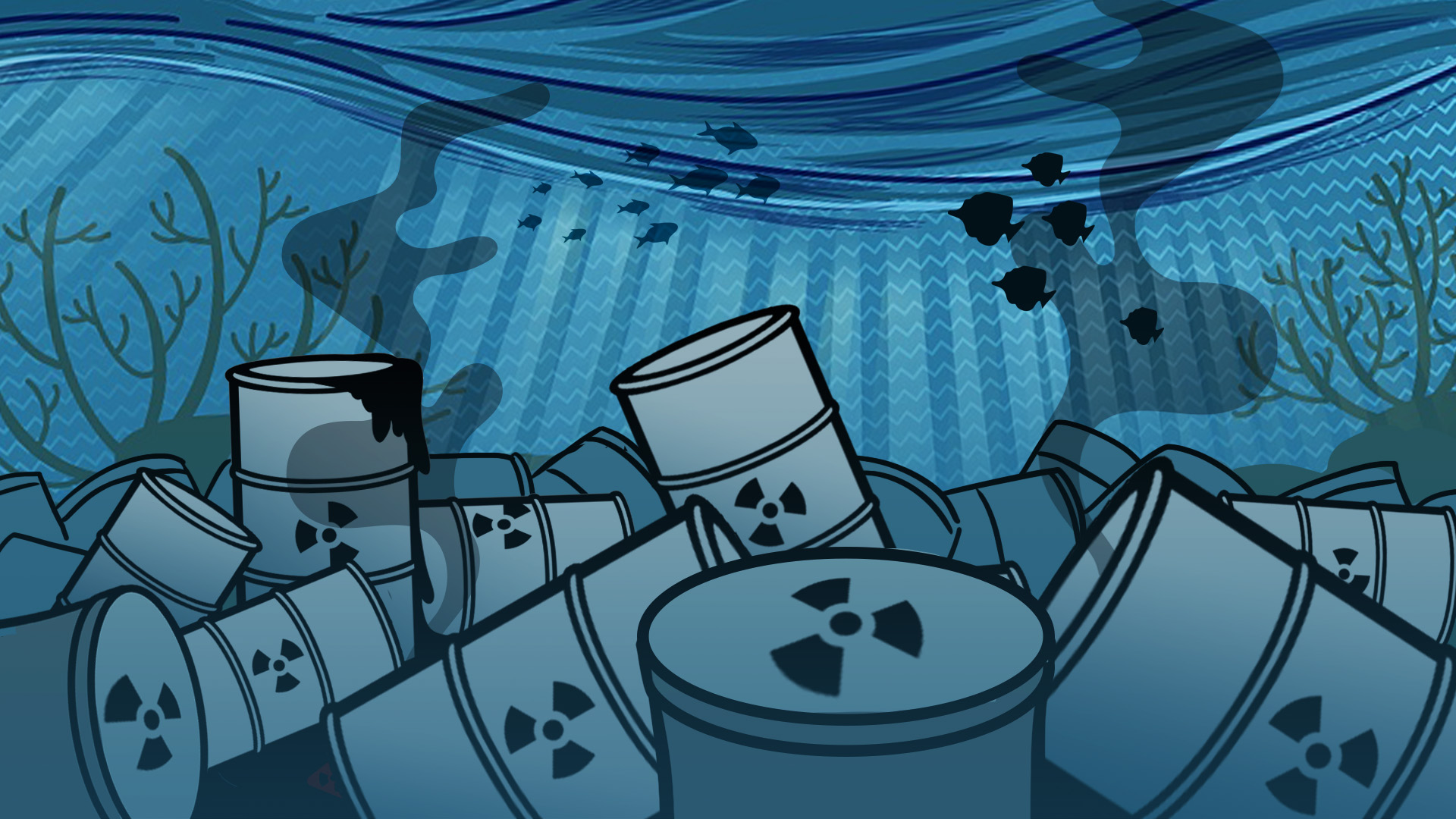
| Pacific Ocean was once a garbage dump for nuclear waste, now Japan’s doing it again. CGTN, Zeng Ziyi 11 June 21, ”………… Japan’s plan, which looked to dilute the contaminated water and pump them into the Pacific Ocean, drew swift condemnations from neighboring countries and environmental organizations. Kazue Suzuki, an energy campaigner at Greenpeace Japan, said the government’s decision has discounted radiation risks and looked over the fact that enough storage space is available in Fukushima and surrounding districts. “Rather than using the best available technology to minimize radiation hazards by storing and processing the water over the long term, they have opted for the cheapest option, dumping the water into the Pacific Ocean,” Suzuki said. In March, a panel of UN experts said that Japan’s nuclear wastewater poses major environmental as well as human rights risks, and any decision to discharge it into the Pacific Ocean cannot be an “acceptable solution.” The panel also pointed out that there’s a lack of meaningful public participation in the decision-making process, especially the populations and communities who are most affected. The Japanese government insists that radioactive elements in the water will be treated and diluted to safe levels before releasing. So far, this plan has received support from the International Atomic Energy Agency (IAEA), which points out that other countries have done so in the past. Besides, Japan’s allies, including the U.S., have also back Tokyo’s decision. The assurance buys little confidence among Pacific nations, whose economies depend heavily on the environment of the ocean. In a statement rebuking Japan’s decision, the Republic of Marshall Islands government pointed out that its entire nation consists of coastal communities whose primary food source comes from surrounding marine life. Sheila Jack Babauta, House member of the Commonwealth of Northern Mariana Islands, said the Pacific Ocean already faces major threats such as unregulated commercial fishing and the activities of the U.S. military, which have severely damaged the environment of the ocean.”We are part of the Pacific, we are intimately connected to the ocean, and therefore, we must be included in all decisions that impact ocean health, ocean sustainability, and ocean recovery,” Babauta told CGTN. “The dumping of nuclear waste is extremely irresponsible and disrespectful to our Pacific Ocean.”Since the dawn of the nuclear age, people of the Pacific island countries have suffered the horrific consequences of nuclear experiments carried out at their doorstep. Continued exposure to radiation has caused many survivors of the initial blasts to develop different types of illnesses, most commonly cancer and reproductive health issues. Even today, their descendants are still suffering the effects of radiation. .The U.S. detonated dozens of nuclear devices in a series of nuclear weapons tests at several test sites sprawling across the atolls of RMI between the 1940s and 1950s, including in the air and underwater. The detonations vaporized at least three atolls – ringlets of islands made of coral – and rendered many more uninhabitable. Ocean dumping of nuclear waste continued to be carried out by Britain, France, and others until 1972 when growing public pressure worldwide gave birth to the London Convention, which prohibited the practice.”The threat of nuclear contamination continues to be of significant concern to the health and security of our Blue Pacific continent,” said Henry Puna, Secretary General of the Pacific Islands Forum, in an address to the IAEA earlier this month.”Our 50-year history as the Forum has been overshadowed by our nuclear legacy issues, which continue to impact affected communities today, and we should not accept anything less.”………https://news.cgtn.com/news/2021-06-11/How-the-Pacific-became-a-garbage-dump-for-nuclear-waste-110rY09VsqY/index.html |
-
Archives
- February 2026 (228)
- January 2026 (308)
- December 2025 (358)
- November 2025 (359)
- October 2025 (376)
- September 2025 (258)
- August 2025 (319)
- July 2025 (230)
- June 2025 (348)
- May 2025 (261)
- April 2025 (305)
- March 2025 (319)
-
Categories
- 1
- 1 NUCLEAR ISSUES
- business and costs
- climate change
- culture and arts
- ENERGY
- environment
- health
- history
- indigenous issues
- Legal
- marketing of nuclear
- media
- opposition to nuclear
- PERSONAL STORIES
- politics
- politics international
- Religion and ethics
- safety
- secrets,lies and civil liberties
- spinbuster
- technology
- Uranium
- wastes
- weapons and war
- Women
- 2 WORLD
- ACTION
- AFRICA
- Atrocities
- AUSTRALIA
- Christina's notes
- Christina's themes
- culture and arts
- Events
- Fuk 2022
- Fuk 2023
- Fukushima 2017
- Fukushima 2018
- fukushima 2019
- Fukushima 2020
- Fukushima 2021
- general
- global warming
- Humour (God we need it)
- Nuclear
- RARE EARTHS
- Reference
- resources – print
- Resources -audiovicual
- Weekly Newsletter
- World
- World Nuclear
- YouTube
-
RSS
Entries RSS
Comments RSS
 nuclear-news