The Rio de Janeiro International Uranium Film Festival 2021 has awarded two film-makers on nuclear disarmament issues.

HONORARY LIFETIME ACHIEVEMENT AWARD WINNERS INTERNATIONAL URANIUM FILM FESTIVAL The Rio de Janeiro International Uranium Film Festival 2021 has awarded two in the world of nuclear disarmament well known personalities with the festival’s Honorary Lifetime Achievement Award: Sérgio Duarte, former Brazilian diplomat who served as Ambassador in several countries and has dedicated his life to end the nuclear threat. And Emmy Award-Winning Producer and Director Robert Frye from New York City who created “The Nuclear World Project“ and directed two important documentaries on Nuclear Disarmament: „The Nuclear Requiem“ and „In My Lifetime“.
Sérgio de Queiroz Duarte
Sérgio de Queiroz Duarte(link is external) is a former Brazilian diplomat who served as Ambassador to Nicaragua, Canada, China and Austria. Duarte was the President of the 2005 Review Conference of the Parties to the Treaty on the Non-Proliferation of Nuclear Weapons and was United Nations High Representative for Disarmament Affairs. He was his country’s Permanent Representative to the UN at Vienna and Chairman of the International Atomic Energy Agency Board of Governors. Duarte is President of „Pugwash Conferences on Science and World Affairs“, an organization founded in 1957 by philosopher Bertrand Russell and Sir Joseph Rotblat to contain the proliferation of atomic weapons. Pugwash won the Nobel Peace Prize in 1995.
Robert E. Frye
Robert E. Frye(link is external) is an Emmy award-winning producer of network news programs and independent documentaries for over five decades. He was born in Syracuse, NY USA, and studied political science and history at Hobart College. In 1958 he joined the U.S. Army. Frye worked on nuclear weapon planning while serving in Germany. The experience fostered a lifelong interest, which led him to create “The Nuclear World Project“.
Starting in the ’60s the Emmy and Peabody Award winner worked in New York City; Toronto; Washington, D.C.and London. His credits at ABC News include Executive Producer of “Good Morning America” and “ABC World News Tonight” with Peter Jennings; senior Producer at CBC’s Weekend, and as an independent director & producer of several films for public television which include “In My Lifetime” and “The Nuclear Requiem”. At the age of 81, Frye said, the obligation of his generation is to tell the story of nuclear weapons, to make clear the indescribable damage they have caused and their potential to end life on the planet entirely. http://www.thenuclearworld.org(link is external)
Robert E. Frye says: “The recognition from the Uranium Film Festival comes as a completely unexpected surprise and may I say honor. The Festival trophy will be a reminder to me of the work ahead. Of course, may I say that the continuing work of Sergio Duarte is so important to the world, especially his words of wisdom and leadership over the years, now as the President of Pugwash International. The Uranium Film Festival is such a unique institution, with all the films chosen that honor the dedicated filmmakers, whose work appears in the Festival, calling the world’s attention to the challenges dealing with the continuing presence of nuclear weapons, as well as, the conundrum of nuclear power. On the wall in my office I have the following quote from musician Leonard Cohen: Ring the bells that still can ring. Forget your perfect offering. There is a crack in everything. That’s how the light gets in. Thank you for providing the opportunity for all these stories to be told. Keep the bells ringing!”
Nuclear Hotseat Radio Show Interview with Robert E. Frey(link is external)
Watch also the festival’s live with Sergio Duarte, Robert E. Frye, Cristian Wittmann & filmmaker Miguel Silveira (Portuguese/English)(link is external)The 10th Rio de Janeiro International Uranium Film Festival has streamed in May 2021 during 10 days 34 films on nuclear weapons and nuclear energy online and free of charge…………….https://uraniumfilmfestival.org/en/honorary-lifetime-achievement-award-winners
France’s government criminalises anti nuclear activists
Hasty translation of part of this article – the rest available only to subscribers
par Nicolas Celnik Liberation 5th June 2021
Sezin Topçu: “The state monitors militants and plutonium with the same fears” For the sociologist of science, the trial of the Bure activists shows that nuclear power is a strategic issue for France, which explains a”criminalization of anti-nuclear action”.
Twelve months firm required for one, 10 to 18 months suspended sentence required for the other six defendants: the anti-nuclear fight could cost them dearly. The judgment of the seven opponents of the disposal project of the National Agency for the Management of Radioactive Waste (Andra), dubbed “Cigeo”, whose trial was held between Tuesday and Thursday, will be delivered on September 21. The means put in place by the justice system (which would have spent nearly a million euros for the investigation, according to Reporterre and Mediapart) have not yet made it possible to prove anything else on this “organized band” of “criminals” that the organization of an unauthorized demonstration, for “willful violence …
Elevated cancer deaths in Monroe may be result of nuclear plant,
Report alleges elevated cancer deaths in Monroe may be result of nuclear plant,
Tyler EagleThe Monroe News, 12 March 2921 A new report has found that Monroe County’s cancer mortality rate is significantly higher than that of the national average.
And the scientist behind it contends the driving force behind that statistic is DTE Energy’s Fermi 2 Nuclear Power Plant in Newport.
A new report has found that Monroe County’s cancer mortality rate is significantly higher than that of the national average.
And the scientist behind it contends the driving force behind that statistic is DTE Energy’s Fermi 2 Nuclear Power Plant in Newport.
Epidemiologist and executive director of the Radiation and Health Project Joseph Mangano unveiled a report titled “Fermi 2 Nuclear Reactor and Rising Cancer Rates” Thursday afternoon during a virtual press conference.
Using mortality data collected by the Centers for Disease Control and Prevention, Mangano’s analysis found that cancer-related deaths in Monroe County were 14.3% higher than the national average.
“We have raised red flags — these are matters of concern,” Mangano said. “There are no other obvious reasons for such an unexpected change. …
You wouldn’t think Monroe County is a (center) for cancer. It’s a suburban county.”
More:DTE Energy decries advocacy group’s report
The national average for cancer-related deaths nationally was about 150 deaths per 100,000, according to Mangano’s report. Monroe County’s most recent metric — which is from 2019 — was 170 per 100,000.
Prior to Fermi 2’s activation in 1985, Monroe County’s cancer death rate was 3% less the national average, according to Mangano. He said the elevated trend has continued to increase in the last ten years, resulting in the most recent and highest metric.
Mangano said elevated risk and mortality of cancer was present in all population groups, including those classified by gender, race and age.
His report shows that in Monroe County, 10 of the 11 most common cancers in the U.S. occurred at a significantly higher rate, including leukemia, brain and central nervous system and bronchus and lung cancers.
The report also indicates that cancer-related mortality among younger populations is also much higher than the national average.
According to the report, cancer-related deaths among those ages 0-24 occurred 40.2% more than the national average.
Among those ages 25-49, the rate was 49.2% above the U.S. average.
Mangano is calling for more research into the matter, saying the federal and state government have not done enough to examine nuclear plants’ impact on those who live near such sites.
“You don’t have to wait for a meltdown for nuclear reactor to harm people,” Mangano said. “Every single day, reactors release a mix of 100 or more (harmful) chemicals into the environment. It gets into people’s bodies through the food chain.”
……….. Mangano also discussed a new initiative to collect donated baby teeth from Monroe County residents in an effort to investigate whether there are increased instances of in-body radioactive contamination.
Mangano said the Tooth Fairy Project will analyze collected specimens for Strontium-90, a harmful substance that is a byproduct of nuclear reaction.
The project will seek to collect 25-50 local specimens, he said. ………..
For more information, to read Mangano’s report in full or to find out how to participate in the Tooth Fairy Project, visit radiaiton.org. https://www.monroenews.com/story/news/2021/03/11/study-elevated-cancer-deaths-monroe-may-result-nuclear-plant/4649665001/
Exelon and NRG share prices fall as U.S. nuclear power firms to be hit by plunge in grid payments

Plunging Payouts on Top U.S. Power Grid Slam Coal, Nuclear, Bloomberg Green, By Will Wade and Mark Chediak3 June 2021,
- Power providers will get $50 a megawatt-day, down from $140
- ‘I can’t imagine how nuclear is going to be able to cover’
Coal plants, nuclear reactors and other generators will take a hit next year on the biggest U.S. power grid as payments designed to ensure the lights remain on from New Jersey to Illinois plunge 64%.
Suppliers to PJM Interconnection LLC’s grid, which serves more than 65 million people, will get $50 a megawatt-day to provide backup capacity for the year starting June 2022, according to the results of an auction released Wednesday. It’s the lowest price in 11 years.
The results are an especially harsh blow for coal plants and nuclear reactors already struggling to compete. The PJM auction is the single most important event for generators across the eastern U.S., including Calpine Corp., NRG Energy Inc. and Exelon Corp., because it dictates a big chunk of their future revenue.
It also plays a pivotal role in shaping the region’s electricity mix, determining how much the region is willing to stick with coal and natural gas plants or replace then with wind and solar.
“I can’t imagine how nuclear is going to be able to cover all their fixed costs with such a low price,” said Brianna Lazerwitz, an analyst for BloombergNEF.
Exelon shares fell as much as 2% before trading opened in New York Thursday. NRG fell 1.6%. And Vistra fell 2%.
“It’s a direct hit to the companies’ income statements,” Gayle Podurgiel, a power markets analyst at Moody’s, said in an interview. She predicted it would push more coal plants to close.
Analysts had expected the auction would hurt renewables and nuclear power, while potentially boosting coal. That’s because of new rules imposed by regulators under Former President Donald Trump were designed to blunt any advantage wind, solar and reactors gained from state subsidies.
But in the end, the rule wasn’t much of a factor, in part because the steep price decline mitigated some participants’ advantages. Plus, many bidders were granted exemptions. As a result, coal plants fared disastrously………..https://www.bloomberg.com/news/articles/2021-06-02/electricity-payouts-on-biggest-u-s-grid-fall-64-in-auction-kpfwja1a
European Commission worried that Belarus will start the Astravets nuclear power plant without the recommended EU safety guidelines
The safety of nuclear power plants is a topic very closely followed by the
Commission, Member States and the EU public. The situation in Astravets has
been a source of heightened concern in the EU.
It is regrettable that Belarus has decided to start the commercial operation of the Astravets
nuclear power plant, without addressing all the safety recommendations
contained in the 2018 EU stress test report. As the Commission has
repeatedly stated, all peer review recommendations should be implemented by
Belarus without delay.
European Commission 2nd June 2021
Secret papers reveal the British spying on Scottish anti-nuclear activists, who were labelled as ”terrorists”
The National 5th June 2021, Secret papers reveal the UK spied on anti-nuclear campaigners. SCOTTISHnanti-nuclear groups were spied upon by the British state in the 1970s and 1980s, according to documents released by police to the spycops inquiry.
Previously secret papers reveal that undercover police officers, known as spycops, claimed to have “penetrated” the Scottish Campaign to Resist the Atomic Menace (SCRAM), Friends of the Earth and the Torness Alliance during protests against the building of a nuclear power station at Torness in East Lothian.
Activists involved with the protests told The Ferret that spycop units had been a “threat to democracy” and “outrageous”. Anti-nuclear campaigners had been wrongly branded as a terror threat “second only to the IRA”, they said. The Metropolitan Police said that undercover policing is “vital” to fight terrorism and “serious crime” in order to keep the public safe. Undercover officers infiltrated campaign groups using dead children’s identities. Some had sexual
relations with women they were spying on and at least three officers fathered children.
They included an officer called Bob Lambert, who operated undercover in Scotland. Lambert’s alter ego was that of a
long-haired anarchist by the name of Bob Robinson. The ongoing inquiry is mostly focused on two disbanded undercover Metropolitan Police units – the Special Demonstration Squad (SDS), which was set up in 1968 by Special
Branch, and the National Public Order Intelligence Unit (NPOIU).
There were calls for the inquiry to be extended north of the Border after it emerged these units operated in Scotland, as reported by The Ferret. But the calls were rejected. The Scottish Government refused to have a public inquiry.
Instead ministers agreed to a review by Her Majesty’s Inspectorate of Policing in Scotland (HMICS), which victims of spycops boycotted.
Pete Roche, who worked at Friends of the Earth (Edinburgh) and SCRAM in the 1970s and 1980s, described the activities of the spycops as a “threat to democracy”.He said: “We always suspected that SCRAM had been infiltrated by the security services, but would have expected them to be a bit more organised and less London-centric than is demonstrated here. “We were always totally open and transparent about what we were planning, so they could have picked up most of this information by attending a couple of our meetings. We can only hope that the kinds of protests we were organising are now seen more as a normal part of the democratic process.”
https://www.thenational.scot/news/19352858.headline/
The Ferret 6th June 2021
The transition to clean energy is held back by subsidies to the nuclear industry
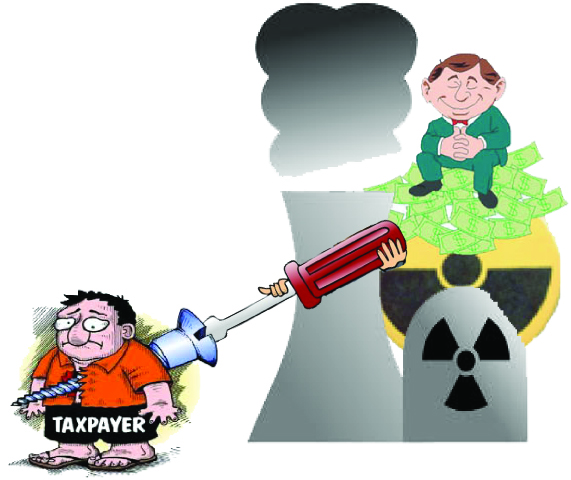
Nuclear Subsidies May Be Slowing Transition to Clean Energy, Advocates Say, BY Leanna FirstArai, Truthout, 6 June 21,
The fight to define what counts as clean energy has grown more contentious as the Biden administration’s infrastructure bill takes shape. Many activists, scientists and lawmakers agree that nuclear energy — which provides one fifth of power in the U.S — is by definition not “clean” or renewable, given that spent fuel remains radioactive and dangerous for thousands of years….. A group of staunch advocates say billions in state and federal subsidies that prop up the nuclear industry — payments that the Biden administration has signaled it may continue to support — may be slowing the transition to a truly clean energy economy…… Four days after Indian Point shuttered, on May 4, the Nuclear Regulatory Commission (NRC) approved a 20-year license renewal for two Dominion Energy reactors in Virginia, now slated to run until May 25, 2052. Half of the United States’ nuclear fleet of 93 remaining reactors will similarly be required to seek license extensions by 2040, or retire.
The Union of Concerned Scientists (UCS) supported the closure of Indian Point, Steve Clemmer, director of research and analysis for the organization’s climate and energy program, told Truthout, noting that other nuclear plants must be considered on a case-by-case basis. Based on data from a September 2019 presentation by a state task force, increases in energy efficiency and renewable generation spanning 2011-2021 were projected to not only replace but exceed Indian Point’s capacity. But Clemmer notes that according to data from the U.S. Energy Information Administration (EIA), output by the shuttered reactor has ultimately been replaced by three new natural gas plants built over the past three years.
Clemmer said California is similarly projected to burn more natural gas when its last nuclear plant closes mid-decade, which would cumulatively raise global warming and air pollution emissions over the next 10 years. But, Clemmer added, it doesn’t have to be that way. “With sufficient planning and strong policies, existing nuclear plants like Diablo Canyon can be replaced with renewables and energy efficiency without allowing natural gas generation and heat-trapping emissions to increase,” he said. In the case of California, a February 2021 UCS analysis called for more rigorous emissions standards, and accelerating wind build-outs while slightly slowing solar and battery storage build-outs.
Elizabeth Moran, environmental policy director for the New York Public Interest Research Group characterized New York’s failure to replace Indian Point’s energy output with clean energy as “a total lack of planning.” Moran is among a group of clean energy advocates who have deemed New York’s ongoing reliance on both nuclear energy and natural gas as unnecessarily postponing the work required to achieve what’s laid out in the state’s climate law, the Climate Leadership and Community Protection Act. “These are bridges to nowhere,” Moran said. “They delay investment in what we truly need to be putting money towards, which is safe, clean, green renewable energy like solar, wind and geothermal.”
With Indian Point now closed, New York has four remaining nuclear reactors at three power stations upstate, all on the southern shore of Lake Ontario. The plants — which are indirectly owned and operated by Exelon Corporation — receive millions in annual subsidy payments — a total of $7.6 billion to be paid from 2017 to 2029. That’s upwards of $1.6 million dollars per day, which Moran estimates shows up on ratepayers’ bills as about three dollars extra each payment period. New York residents pay among the highest rates for electricity in the U.S.
Under the subsidy system, which other states, including Maryland and Pennsylvania, have since considered and is currently under negotiation in Illinois, subsidies for “zero carbon” power, which the nuclear facilities qualify for, have far eclipsed financial support for wind and solar. According to the New York State Energy Research and Development Authority’s latest financial status report, the state’s nuclear facilities received over $500 million in 2020, where renewable energy facilities received only $5 million.
Clean energy advocates highlight that ratepayers’ dollars would stretch further if spent supporting the most affordable energy options. According to a 2020 analysis by the asset management firm Lazard, each megawatt hour of nuclear power generated without subsidy payments cost $129-$198 in comparison with the price of generating the same amount of energy via wind power, estimated at $26-$54, or community solar power, at $63-94. Amory Lovins, founder of energy think tank the Rocky Mountain Institute, explained in Forbes that curbing climate change requires saving the most carbon in the least amount of time, a calculus in which price plays a major role. “Costly options save less carbon per dollar than cheaper options. Slow options save less carbon per year than faster options. Thus, even a low- or no-carbon option that is too costly or too slow will reduce and retard achievable climate protection,” Lovins wrote.
Under the subsidy system, which other states, including Maryland and Pennsylvania, have since considered and is currently under negotiation in Illinois, subsidies for “zero carbon” power, which the nuclear facilities qualify for, have far eclipsed financial support for wind and solar. According to the New York State Energy Research and Development Authority’s latest financial status report, the state’s nuclear facilities received over $500 million in 2020, where renewable energy facilities received only $5 million.
Clean energy advocates highlight that ratepayers’ dollars would stretch further if spent supporting the most affordable energy options. According to a 2020 analysis by the asset management firm Lazard, each megawatt hour of nuclear power generated without subsidy payments cost $129-$198 in comparison with the price of generating the same amount of energy via wind power, estimated at $26-$54, or community solar power, at $63-94. Amory Lovins, founder of energy think tank the Rocky Mountain Institute, explained in Forbes that curbing climate change requires saving the most carbon in the least amount of time, a calculus in which price plays a major role. “Costly options save less carbon per dollar than cheaper options. Slow options save less carbon per year than faster options. Thus, even a low- or no-carbon option that is too costly or too slow will reduce and retard achievable climate protection,” Lovins wrote.
Energy policy analyst and activist Paul Gunter of Beyond Nuclear reinforced Lovins’s point. “Operating economically distressed and deteriorating nuclear power stations diverts critical resources and wastes what precious little time remains for deploying more carbon reduction quicker, more cost effectively,” he told Truthout. Gunter also suggested that replacing nuclear plants with efficiency upgrades to cut down on demand, and renewables, can be a one-to-three-year process. If the owners of the plants don’t give enough public notice about their closure, more natural gas may be burned, but that can be offset over the following years by other carbon-free substitutes, Gunter said.
Jessica Azulay is executive director of the nonprofit Alliance for a Green Economy. She told Truthout state regulators should find a way to end contracts with the nuclear plants earlier than planned, which would enable an accelerated phase-out and save consumers money. “We think that will be more advantageous than delaying the renewable energy transition until 2029 when the nuclear subsidies end.”
Energy policy analyst and activist Paul Gunter of Beyond Nuclear reinforced Lovins’s point. “Operating economically distressed and deteriorating nuclear power stations diverts critical resources and wastes what precious little time remains for deploying more carbon reduction quicker, more cost effectively,” he told Truthout. Gunter also suggested that replacing nuclear plants with efficiency upgrades to cut down on demand, and renewables, can be a one-to-three-year process. If the owners of the plants don’t give enough public notice about their closure, more natural gas may be burned, but that can be offset over the following years by other carbon-free substitutes, Gunter said.
Jessica Azulay is executive director of the nonprofit Alliance for a Green Economy. She told Truthout state regulators should find a way to end contracts with the nuclear plants earlier than planned, which would enable an accelerated phase-out and save consumers money. “We think that will be more advantageous than delaying the renewable energy transition until 2029 when the nuclear subsidies end.”
Activists who have dedicated decades to pushing for the closure of Indian Point, like Manna Jo Greene, environmental director of Hudson River Sloop Clearwater, have said they are not aware of or planning efforts to shut down the state’s remaining nuclear plants ahead of schedule. Rather, helping to ensure a safe decommissioning process at Indian Point is already an all-hands-on-deck effort. “There’s a direct danger to the workers as they’re cutting equipment apart — radioactive dust and isotopes — and that can cause worker and community exposure,” Greene said.
Greene noted that activists are also pushing Congress to closely oversee the NRC, which she described as having a history of granting waivers and exemptions and not following their own safety regulations during decommissioning.
said, there’s still a lot of radioactive material to figure out what to do with. “That is the legacy of 40 years of generating electricity using nuclear power. It’s a very toxic and dangerous legacy with a lot of unanswered questions,” she said. “If we didn’t have all these other solutions, some of this risk might be worth undertaking, but we’ve got plenty of opportunity for renewable energy with storage and efficiency and that’s where we should be investing.” https://truthout.org/articles/nuclear-subsidies-may-be-slowing-transition-to-clean-energy-advocates-say/?eType=EmailBlastContent&eId=9c5e3c09-f9ca-446a-b9ad-869dd4d7b4c7
The fake charity AMDA Foundation is exposed by Michael West Media’s Michelle Fahy. — Nuclear Australia

Landforces’ brothers in arms: how a weapons peddler qualified for charitable status by Michelle Fahy | Jun 4, 2021 The Coalition is cracking down on charitable organisations. However, the Australian charity promoting arms deals on behalf of weapons makers that profit from humanitarian catastrophes is unlikely to be in the government’s sights. With the weapons expo LandForces wrapping up […]
The fake charity AMDA Foundation is exposed by Michael West Media’s Michelle Fahy. — Nuclear Australia
Exactly who is trumpeting nuclear power as a cure for climate change? – theme for June 21
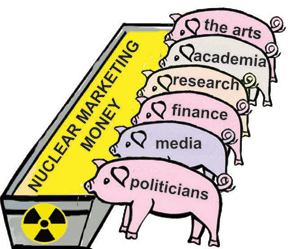
Well, understandably, it starts with the nuclear industry itself, faced with the reality that now, the only real reason for its continued existence is nuclear weapons. It’s the nuclear power and the nuclear weapons companies.
It’s the global array of nuclear -associated agencies – the International Atomic Energy Agency (IAEA) and the rest of them, in each nuclear country.
And don’t forget those billionaire gurus – Bill Gates, Elon Musk, Jeff Bezos, Richard Branson – who use their wealth to promote their own businesses in new nuclear toys

So, don’t be surprised to hear nuclear power executives, nuclear physicists, nuclear engineers and chemists extolling the glory of nuclear power – their careers are in danger!
Their best argument ”Only we, with our superior technical knowledge are capable of having an opinion on this matter”

POLITICIANS. In the USA no President can to be elected without the backing of the nuclear industry. The same surely applies for political leaders in other nuclear nations. Many politicians depend on nuclear industry support, to get elected and stay there.

MEDIA. The nuclear lobby has done a great job of convincing many journalists that they can’t really understand matters nuclear. So, for journalists, the safest course is to just regurgitate the industry handouts. Those who do have confidence often know that their corporate employers have interests in the nuclear-and coal industries.

ACADEMIA. and RESEARCH. Many universities have been, to a degree, bought by the nuclear industry.
BANKS and other financial bodies invest in nuclear power, or, better still, nuclear weapons,
THE ARTS. As with corporations through the past century, nuclear corporations have funded all sorts of arts bodies, – so co-opting their support.
Nuclear lobby spins its frenzied propaganda – with flimsy arguments for new nuclear power.

Nuclear industry’s propaganda war rages on https://climatenewsnetwork.net/nuclear-industrys-propaganda-war-rages-on/
June 3rd, 2021, by Paul Brown With renewable energy expanding fast, the nuclear industry’s propaganda war still claims it helps to combat climate change.
−To maintain the assertion that it is still a key part of the struggle to limit the climate crisis, the global nuclear industry’s propaganda war is unremitting in its attempt to avoid oblivion in the world’s democracies.
At stake are thousands of well-paid power station jobs, but also a potential rise in electricity prices if funds are diverted away from cheaper options for generating power. Central to the debate is how governments can best cut fossil fuel use in time to save the world from catastrophic climate change.
There is not much middle ground. On one side are trade unions with many members in the nuclear industry, large companies with political clout and a vested interest in building the infrastructure needed, and numerous politicians, many of them in nuclear weapons states.
On the other are most climate scientists, environmental campaigners, economists, and cutting edge industries that see wind, solar and tidal power, batteries and other emerging technologies as the path to far more jobs, a cleaner future, and a possible route out of potential disaster. There are also those who fear the proliferation of nuclear weapons.
Lack of balance
Very little of this debate takes place where it should, in national parliaments. In some countries, like the UK and the US, nearly all politicians support the nuclear industry, so there is little discussion of its merits.
Many of the “news” clips and pro-nuclear articles that appear in the media are carefully crafted and come from “think tank” sources close to − and often indirectly funded by − the nuclear industry. They are designed to show nuclear science in a good light.

This lack of balance is not surprising. Journalists find it difficult to penetrate an opaque and highly technical industry that has a wildly optimistic view of its own potential. Its costs, construction timetables, and beliefs in its probable sales have hardly ever actually been met in the industry’s 70-year history. Yet it goes on making its rosy predictions.
There has been a series of announcements in the West in the last five years about SMRs, advanced and IV generation reactors. Lost already? That is the idea: bamboozle politicians and the public with jargon and false hopes of a technical miracle, and you are halfway to getting your hands on taxpayers’ money to fund further research and create a new generation of reactors, to be built some time soon – although that time never seems to arrive.
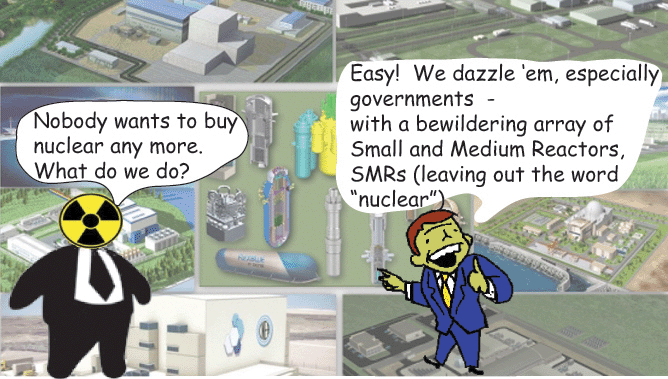
Just to demonstrate what often seems deliberate obscurity: an SMR can be a small modular reactor, or a small to medium reactor. It could also be an advanced reactor. All this is explained on a helpful World Nuclear Association website which takes you through the potential sizes of reactors and explains the 70 or so designs.

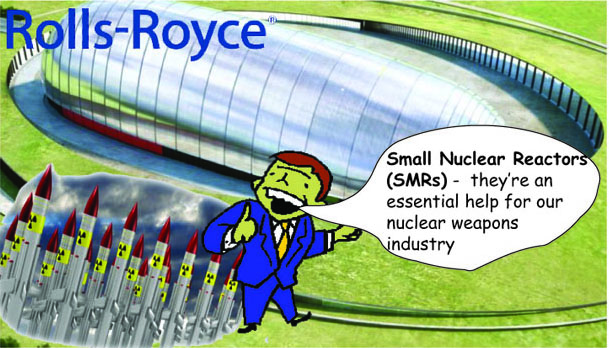
Take one example. Rolls-Royce offers SMRs on its UK website. They turn out not to be small, having grown to 470 megawatts, much larger than the 300 megawatt maximum official definition of a small reactor. The company would now describe them as advanced reactors, although they are based on a generic design as old as the industry.
Modular also has two meanings in this context. It could mean the reactor is made in sections in a factory and assembled on site, thus (it is claimed) dramatically reducing costs. But it can also mean that each reactor becomes a module in a much larger nuclear station.
Rolls-Royce reckons it needs an order book of 16 reactors to justify building a factory that could turn reactors out, like its cars, on a production line. It is both trying to persuade the UK government to place a large number of orders and is combing the world for other governments willing to do so.
Military link
Nuclear detractors point out that creating a factory able to provide production line economies of scale for nuclear reactors is a tall order. Also, neither the UK government nor Rolls-Royce has come up with sites where any reactors could be placed. Perhaps the most telling point is that there is no need for that much expensive electricity when renewables plus energy storage could provide it more cheaply and quickly.
Most nuclear weapons states acknowledge the link between their civil and weapons industries. Canada is one of the few non-nuclear weapons states that has bought into the nuclear industry’s hype and is still actively promoting SMRs.
There is a backlash from academics who fear nuclear proliferation, as well as from those who question the economics and viability of the “new” designs.
In one sense the nuclear enthusiasts are winning the propaganda war because many governments are actively encouraging work on the design of SMRs – and still shelling out billions of dollars in taxpayers’ money to support research and development.
On the other hand everything is still in the prototype stage and has been for years. As yet no foundation stones for nuclear reactor factories have been laid. And while we wait for the long-promised nuclear breakthrough, cheaper wind and solar farms are being built rapidly across the planet. As each comes on stream it helps to erode the already flimsy case for nuclear power. − Climate News Network
Old nuclear grinding to a halt in Britain
nuClear news, No 1333 5 June 21 In February it was reported that Centrica had suspended the sale of its nuclear business. Centrica owns a 20% interest in the UK’s 8.25 GW of operational nuclear power generation fleet. In 2018 it announced it was looking for a buyer for the stake. The Company continues to look at options, but the divestment process has now been paused mainly because of the graphite cracking issue at Hunterston and Hinkley and pipe corrosion at Dungeness.
The company’s nuclear output for 2020 was down 10% year on year to 9.134 TWh, while the achieved price was up 4% to £51.30/MWh. Centrica’s nuclear segment made an operating loss of £17 million, down from a £17 million operating profit in 2019. A £525 million impairment charge on power assets included £481 million relating to nuclear, “largely as a result of a reduction in price forecasts and availability issues at the Hunterston B, Dungeness B and Hinkley Point B power stations.” (1)

Dungeness
EDF Energy is reported to be exploring a range of scenarios for Dungeness B, including bringing forward its decommissioning date of 2028. The Company may decide to start defuelling the reactors seven years early unless a number of “significant and ongoing technical challenges” are overcome.
On 27 August 2018 Dungeness B shut down Reactor 22 for its planned statutory outage. On 23 September 2018 Reactor 21 was also shut down for the planned double reactor outage. Both reactors have been shut since while a multi-million-pound maintenance programme was carried out. This work was due to be completed last year but that timeline changed to August 2021 following a series of delays.
Now EDF say the ongoing challenges and risks “make the future both difficult and uncertain”. As a result, the energy company is now exploring a range of options – including shutting the station down later this year, seven years ahead of schedule. A statement from EDF reads:
“Dungeness B power station last generated electricity in September 2018 and is currently forecast to return to service in August 2021. The station has a number of unique, significant and ongoing technical challenges that continue to make the future both difficult and uncertain. Many of these issues can be explained by the fact that Dungeness was designed in the 1960s as a prototype and suffered from very challenging construction and commissioning delays. We expect to have the technical information required to make a decision in the next few months, as it is important we bring clarity to the more than 800 people that work at the station, and who support it from other locations, as well as to government and all those with a stake in the station’s future.”
EDF Energy said it has spent more than £100 million on the plant during its current outage. (2)
EDF’s latest announcement was that Reactor 21 might restart on June 6, 2022 instead of Aug. 2 this year and Reactor 22 reactor might restart on May 27, 2022 instead of July 23 this year. (3) Dungeness B was the first AGR to be ordered in 1965. It was expected to begin operation in 1970/1, but didn’t produce commercial electricity until 1989. It is thought to have exceeded its budget by 400%. (4)

Hunterston
In April the Office for Nuclear Regulation (ONR) gave EDF permission for reactors 3 and 4 at the Hunterston to return to service for a limited period of operation after scrutiny of EDF’s safety case. Operation is permitted for up to a total of 16.7 terawatt days for reactor 3 and 16.52 terawatt days for reactor 4 – approximately six month’s of operation for each. This will be the final period of operation before the reactors are shut-down and the spent fuel removed. (5)
Reactor 3 has already re-started but Reactor 4 is not expected to be back on-line until 9th June. The end date for Hunterston B will be 7 January 2022 at the latest.

Hinkley Point B
On 17th March Hinkley Point B’s two reactors were granted permission by ONR to restart. Reactor 4 and Reactor 3 were taken offline on 21 February and 8 June 2020, respectively, for a series of planned inspections of the graphite core. The company plans to run Hinkley’s two reactors for six months, pause for further inspections and, subject to ONR approval, generate power for a second six-month period. Last November EDF announced that Hinkley Point B would operate no later than July 2022 before moving into the defuelling phase. EDF has spent £3 million over the past year upgrading the plant while detailed assessments have been completed on the graphite in the nuclear reactors. (6)

Sizewell B
EDF Energy extended the outage at Sizewell B by three months to carry out ‘additional work’. The reactor went offline for planned refuelling and maintenance work on April 16, initially scheduled to end on May 29. This has been updated to 30th August following additional work required on some components identified during the shutdown. (7) This is because some steel components are wearing out more quickly than expected, forcing EDF to carry out lengthy unscheduled repairs. (8)
Plant Life Extensions
A look at the age structure of existing nuclear power plants shows the importance of analysing risks of life-time extension and long-term operation. Some of the world’s oldest plants are located in Europe. Of the 141 reactors in Europe, only one reactor came into operation in the last decade, and more than 80 percent of the reactors have been running for more than 30 years. Nuclear power plants were originally designed to operate for 30 to 40 years. Thus, the operating life-time of many plants are approaching this limit, or has already exceeded it. The ageing of nuclear power plants leads to a significantly increased risk of severe accidents and radioactive releases.
A new study has analysed the risks of life-time extensions of ageing nuclear power plants. At present, life-time extensions in Europe do not have to be comprehensively relicensed according
to the state of the art in science and technology. Time limited licenses can be extended by decision of the competent authorities. However, such decisions do not meet the requirements of Nuclear Power Plant licensing procedures in regard to public participation. More often than not environmental impact assessments with public participation are not carried out. However, the situation has changed with the ruling of the European Court of Justice of 29th of July 2019 on the life-time extension of the Doel NPP (Belgium) and the new guidance under the ESPOO Convention. Accordingly, environmental impact assessments with transboundary public participation are now required for life-time extensions.
However, there are still no binding assessment standards for life-time extensions. It is still up to each regulatory authority to decide what and how to assess. In particular, the authorities are not obliged to carry out a comprehensive licensing procedure in which all safety issues are comprehensively examined according to the current state of knowledge. (9) https://www.no2nuclearpower.org.uk/wp/wp-content/uploads/2021/06/nuClearNewsNo133.pdf
Progressive Democrats slam Joe Biden’s about-face on nuclear weapons spending
Left slams Biden’s nuclear weapons budget Politico, By BRYAN BENDER 06/03/2021
ABOUT-FACE? Biden ran on a platform opposing new nuclear weapons, but his first defense budget goes all in on the Trump-era expansion, including maintaining plans for two new weapons. And leading Democrats and arms control groups are angry at what they see as a betrayal, Lara, Connor and your Morning D correspondent report for Pros.
A number of progressive Democrats, including those who have proposed legislation to curtail several nuclear projects, sounded emboldened. “We must instead spend money on threats that Americans are actually facing like pandemics and climate change, instead of on new destabilizing weapons when we can extend the lifespan of the ones we already have for much cheaper,” progressive Rep. Ro Khanna said in a statement.
Rep. John Garamendi, a senior member of the House Armed Services Committee, told POLITICO he also “strongly” believes “the United States needs to alter its modernization strategy from one that’s predicated on dominance to one that is based on deterrence.”
The strongest backlash came from disarmament advocates, who said they were expecting Biden to live up to his word. “President Biden ran on a campaign to reverse the budget and outrageous policies put forward by the Trump administration,” the Council for a Livable World said in a statement. “However, this budget expands nearly every nuclear program put forward by that administration. This is not acceptable.”
As “a long-time supporter of arms control and nuclear threat reduction,” the group said, Biden “can — and should — do better.”
Biden told the group during the campaign that “our current arsenal of weapons … is sufficient to meet our deterrence and alliance requirements.” The Democratic Party platform in 2020 also bluntly stated that “the Trump Administration’s proposal to build new nuclear weapons is unnecessary, wasteful, and indefensible.” https://www.politico.com/newsletters/morning-defense/2021/06/03/left-slams-bidens-nuclear-weapons-budget-795711
Bill Gates, Warren Buffett’s piddly little ”Natrium” nuclear reactor – greenwashing, while keeping fossil fuels going.

The key to understanding this story is found in Governor Gordon’s use of the words “all of the above.” That’s free market speak for “We’rehappy to have a piddly little 350 MW facility of over here, just so long as we can continue supporting coal- and gas-powered generating plants that churn out hundreds of gigawatts over there.”
In other words, it’s asmokescreen designed to allow fossil fuel interests to kick the can down the road a little further and add some greenwashing to their corporate portfolios at the same time. Being rich does not necessarily make a person all that smart. America needs more nuclear power like a fish needs a bicycle.
People in Wyoming may be fooled by this blather, but CleanTechnica readers aren’t taking the bait. Natrium was probably selected as the name of thus new nuclear technology because it sounds a little like “nature” or “natural.” That’s a great marketing ploy, but we’re not buying it. Frankly, the Bill and Warren show is more than a little disappointing.
Clean Technica 3rd June 2021
Bill Gates & Warren Buffett To Build A New Kind Of Nuclear Reactor — Is That Good News?
Critique No 3 [a boys-with-toys view] -BBC documentary Building Britain’s Biggest Nuclear Power Station

Building Britain’s Biggest Nuclear Power Station, BBC2, review: A boys-and-their-toys view of a divisive build. Much of the programme is devoted to emphasising just how big the plant will be: we are shown a tunnelling machine so enormous it requires a police cavalcade; we are treated to front-row seats for the “largest continuous cement pour in the UK”; we learn that Hinkley’s canteens consume 316 tons of baked beans a year.
iNews 2nd June 2021
Critique No 2 of BBC documentary Building Britain’s Biggest Nuclear Power Station

Building Britain’s Biggest Nuclear Power Station, review: why didn’t this film ask the real questions? It seemed a little odd for one local’s (admittedly very valid) complaints about traffic to be given more airtime than, say, worries over industrial espionage in a project part-funded by the Chinese state, or of ballooning budgets (from £18 billion to
£22 billion).
Two of its three intended predecessors in Finland and France remain on ice owing to “concerns over cost and quality”, a phrase both vague and serious enough to warrant further enquiry, yet any doubts were confined to the voiceover and not put to the people involved.
Telegraph 2nd June 2021
-
Archives
- February 2026 (228)
- January 2026 (308)
- December 2025 (358)
- November 2025 (359)
- October 2025 (376)
- September 2025 (258)
- August 2025 (319)
- July 2025 (230)
- June 2025 (348)
- May 2025 (261)
- April 2025 (305)
- March 2025 (319)
-
Categories
- 1
- 1 NUCLEAR ISSUES
- business and costs
- climate change
- culture and arts
- ENERGY
- environment
- health
- history
- indigenous issues
- Legal
- marketing of nuclear
- media
- opposition to nuclear
- PERSONAL STORIES
- politics
- politics international
- Religion and ethics
- safety
- secrets,lies and civil liberties
- spinbuster
- technology
- Uranium
- wastes
- weapons and war
- Women
- 2 WORLD
- ACTION
- AFRICA
- Atrocities
- AUSTRALIA
- Christina's notes
- Christina's themes
- culture and arts
- Events
- Fuk 2022
- Fuk 2023
- Fukushima 2017
- Fukushima 2018
- fukushima 2019
- Fukushima 2020
- Fukushima 2021
- general
- global warming
- Humour (God we need it)
- Nuclear
- RARE EARTHS
- Reference
- resources – print
- Resources -audiovicual
- Weekly Newsletter
- World
- World Nuclear
- YouTube
-
RSS
Entries RSS
Comments RSS
 nuclear-news