A trillion reasons to scrutinize the US plan for more than $1.5 trillion spend on nuclear weapons

500,000,000,000 reasons to scrutinize the US plan for nuclear weapons. Bulletin of the Atomic Scientists, By Kingston Reif, Mandy Smithberger | May 21, 2021 The public debate about the future of the US nuclear arsenal is largely a controversy about strategy. But the outcome also has major implications for dollars and cents. The United States plans to spend more than $1.5 trillion over the next several decades to sustain and upgrade its nuclear delivery systems, associated warheads, and supporting infrastructure. The biggest bills for this effort, which are slated to hit over the next 10 to 15 years, pose a growing threat to other military and security priorities amid what most experts believe will be flat defense budgets,
The cost of ongoing programs to buy new fleets of ballistic missile submarines, long-range bombers, and intercontinental ballistic missiles has generated the most attention.
Meanwhile, the exploding price tag of the National Nuclear Security Administration’s long-term plan to sustain and modernize the nuclear warheads and production facilities—now an exorbitant $505 billion—flies under the radar.
Now more than ever it’s important to scrutinize the National Nuclear Security Administration, which is a semiautonomous agency of the Energy Department. Most of the agency’s budget goes to contractors, though their contract mismanagement has repeatedly landed them on the Government Accountability Office’s high-risk list. Some projects have significantly exceeded initial cost estimates—in one case nearly eight times more than the initial price tag. While cost breaches of this magnitude at the Defense Department would have triggered a review that might have cancelled the programs, the National Nuclear Security Administration was able to waste billions with no threat of closure.
The agency’s past failures to complete major projects on time and on budget raise questions about its ability to execute a workload that has grown to unprecedented post-Cold War heights. Since the end of the Obama administration, the National Nuclear Security Administration weapon-activity spending has grown by roughly 70 percent. Last year, the agency requested a multibillion-dollar boost while sitting on $8 billion in unspent funds from past years.
Against this backdrop, nuclear-weapon hawks in Congress successfully pushed through a consequential change last year that gave the Pentagon much greater influence over the development of the National Nuclear Security Administration’s budget. This power grab will not only make it harder to rein in increasingly out-of-control agency spending but put other Energy Department national security programs at greater risk. As Congress moves to write annual defense authorization and appropriations legislation this summer, lawmakers should take steps to undo the Pentagon’s expanded authority and institute reforms in an attempt to reign in wasteful spending at the National Nuclear Security Administration.
Recent budget history of the National Nuclear Security Administration. This story begins in February 2020 when the Trump administration prepared its fiscal year 2021 budget request for the National Nuclear Security Administration. It requested $15.6 billion for the nuclear-weapon activities account, a staggering increase of $3.1 billion, or 25 percent, from the fiscal year 2020 appropriations and $2.8 billion more than planned a year earlier. The dramatic increase was propelled in part by cost overruns in programs inherited by the Trump administration and the cost of the additional capabilities the administration proposed………….
If executed as written, the new law effectively makes the Nuclear Weapons Council the decision authority for the National Nuclear Security Administration’s budget. As a result, the energy secretary and the Office of Management and Budget will have reduced leverage in the development of the budget. It will also make it difficult for the president to overrule the council without getting into a messy public spat with congressional nuclear hawks about why they are going against the advice of the Pentagon.
Contrary to Inhofe’s conspiratorial claims, the main problem in need of a solution isn’t that the Defense Department is being cut out of the development of the National Nuclear Security Administration’s nuclear modernization budget or that better coordination is needed. The central problem is that the agency’s nuclear modernization budget is skyrocketing.
The growth of the agency’s weapon-activity budget almost defies belief. Projected spending on nuclear-weapon activities has risen to $505 billion, according to the agency’s 25-year plan published last December. That represents a staggering increase of $113 billion from the 2020 version of the plan.
$113 billion. In one year.
This kind of stunning growth illustrates what critics of the National Nuclear Security Administration’s excessive plans have been warning about for years: low-balled cost estimates, an inexecutable program, damaging opportunity costs, and a significant agency credibility deficit. The mounting price tag and impracticality of the scope of and scheduled goals for many of the agency’s nuclear warhead and infrastructure replacement efforts merit far greater scrutiny than Congress has provided to date.
Needed now: National Nuclear Security Administration budget reform and oversight. The Nuclear Weapons Council does not need expanded authority. Quite the opposite in fact.
……………… If Congress allows Pentagon leaders to add their own spending priorities to other agencies’ budgets without any requirement to propose offsets, spending on nuclear weapons will likely go in only one direction: up.
Instead of giving the Pentagon more free rein, Congress should roll back the Nuclear Weapons Council’s expanded powers and seek greater oversight of how the body generates requirements for the arsenal and for the National Nuclear Security Administration.
………. The National Nuclear Security Administration has a long history of mismanaging its significant resources. In response, Congress should offer reform and oversight, not a blank check to steal resources from other national security priorities. https://thebulletin.org/2021/05/500000000000-reasons-to-scrutinize-the-us-plan-for-nuclear-weapons/
Nuclear newbuild – concrete projects or white elephants?
Nuclear Power in the European Union, Heinrich Boll Stiftung, 26 April 2021 by Mycle Schneider ”………………Nuclear Newbuild – Concrete Projects or White Elephants?
There are more or less credible “plans” for new nuclear plants, most of them in Eastern Europe.
The Czech government in 2020 signed a framework agreement with the national utility ČEZ to organize an international tender in order to have a decision by 2024 and start construction of two units at the Dukovany site in 2029. The potential role of Russian Rosatom is controversial. The Czech government has failed in earlier attempts to launch a new-build program. The outcome of this initiative is uncertain. In March 2021, Vaclav Bartuška, Special Envoy for Energy Security, recalled sarcastically that, as Government Envoy for Temelín [the other operating Czech nuclear plant site], he wrote in his final report to the government, he did “not believe in a nuclear project in a country that is unable to build a motorway network and high-speed train to Berlin or Munich”.[1] Reportedly, he nevertheless thinks the Dukovany project will go ahead.
In Hungary, after some 15 years of preparation, an application for a construction license for two new Russian designed reactors at the Paks site was submitted in June 2020. The project has raised significant controversy over the procedure under which the Russian contractor was chosen. In March 2021 a study published in the Journal of the Association of Hungarian Geophysicists questioned the earthquake safety of the site. At the same time, the Paks II project company has signed a contract with an engineering company to assess until the end of 2022 the conditions under which a construction license could be obtained. Some sources have suggested construction could already start in 2022. Considering the long history of delays of the project, a short-term construction start seems unlikely.
Poland has been contemplating the introduction of nuclear power since the 1970s and has started building two units in 1984, which were abandoned in 1990. No financing plan has yet been established, no technology, no sites chosen for “6–9 Gigawatt” of nuclear power by 2040. As earlier Polish plans, this one is not credible at this point………..https://eu.boell.org/en/2021/04/26/nuclear-power-european-union?dimension1=lisa2021
We already have 95% of the technologies and know how to slash emissions, remove air pollution and provide energy security and jobs

No, we don’t need ‘miracle technologies’ to slash emissions — we already have 95 percent, The Hill 20th May 2021, Mark Jacobson: We have 95 percent of the technologies we need today and the know-how to get the rest to address both energy and non-energy emissions.
As such, no miracle technology, particularly carbon capture, direct air capture, modern bioenergy or modern nuclear power, is needed. By implementing only clean, renewable WWS energy and storage and implementing non-energy strategies, we will address not only climate, but also the 7 million annual air pollution deaths worldwide and energy insecurity.
None of the “miracle technologies” addresses all three. We and 17 other research groups have shown that we can do it with renewables alone worldwide and in the 50 United States. Such a transition reduces energy costs, and land requirements while creating jobs.
The key is to deploy, deploy, deploy existing clean, renewable, safe technologies as fast as possible.
U.S. Climate Envoy John Kerry recently stated, “I am told by scientists that 50 percent of the reductions we have to make to get to net zero are going to come from technologies that we don’t yet have.” This comment echoes recent statements by Bill Gates that solar, wind and batteries are not enough, so we need “miracle technologies” to decarbonize our global economy. They also mimic statements in a 2021 International Energy Agency report that, “in 2050, almost half the reductions come from technologies that are currently at the demonstration or prototype phase.” One might argue that, in all three cases, “new technologies” means improved existing technologies, such as improved
batteries, solar panels, wind turbines, electric vehicles, etc.
However, hidden in the recent U.S. economic revitalization proposal is a call to fund CO2 capture and storage, CO2 direct air capture and small modular nuclear reactors. Similarly, Gates has funded and argued for these technologies plus modern bioenergy, and the IEA report explicitly proposes the use of all four technologies for a decarbonized world. Ironically, the IEA acknowledges, “all the technologies needed to achieve the necessary deep cuts in global emissions by 2030 already exist.” But astonishingly, they then say that those technologies and their improvements are not enough to reach 2050 goals.
Biden must end sanctions against North Korea — and finally end the Korean War
Biden Must End Sanctions Against North Korea — and Finally End the Korean War Simone Chun, Truthout 21 May 21, Noam Chomsky recently argued that the Biden administration’s foreign policy remains committed to maintaining U.S. global hegemony through sanctions and nuclear weapons. Nowhere else in the world is this more evident than in the Korean Peninsula, where the U.S. is pressuring its “ally” South Korea into the front lines of a long-simmering confrontation with China, and where a nuclear standoff between the U.S. and an increasingly isolated North Korea remains a real possibility.
On the early morning of May 13, residents of the central farm town of Seongju, South Korea, joined in protest against the deployment of the latest battery of the U.S. Terminal High Altitude Area Defense (THAAD) missile defense system in their backyard. Chained together to form a human barrier, they physically blocked the road to the nearby U.S. base. Two thousand South Korean police forcibly dispersed them — the second time in a month they had clashed with residents protesting the missile system — injuring dozens, including women and elderly farmers.
In the wake of the ensuing public relations fiasco, South Korea’s Defense Minister reportedly admitted that the forcible removal of the villagers blocking the base was in response to a request by U.S. Secretary of Defense Lloyd J. Austin III. The South Korean government had hoped that acceding to Austin’s request would help secure President Joe Biden’s support for resuming the inter-Korean peace process.
The timing of this incident, just a week before South Korean President Moon Jae-in’s planned May 21 visit to Washington for his first summit with Biden, may foreshadow what is to come. Moon believes it is time to take action on North Korea, and is expected to press Biden to engage in diplomacy with Pyongyang. Nevertheless, in spite of the fact that the stalled denuclearization talks with the North are expected to top the summit’s agenda, odds of a breakthrough at this point seems slim.
Biden will likely tout the U.S.-South Korea alliance, which is the cornerstone of U.S. regional containment policy, and whose framework, according to historian Bruce Cumings, is based on two pillars: isolating North Korea from the rest of the world while pressuring South Korea to serve as a forward base for the U.S.’s ongoing East Asian operations. This “alliance” reduces South Korea to the status of an occupied frontline outpost, saddling it with the burgeoning cost of supporting the massive U.S. military presence on its soil, depriving it of the authority to craft independent state policy and subordinating its military to U.S. command in the event of conflict. Framed by the neocolonial subtext that favors maintenance of this one-sided status quo, inter-Korean diplomacy is dismissed as a high-risk endeavor, leaving the two Koreas in a state of perpetual war.
……….. Biden’s policy amounts to little more than a repackaging of the failed approaches of previous U.S. administrations toward Pyongyang. There has been no mention of security guarantees for North Korea, implementing a peace treaty to end the 70-year-old war or reassessing sanctions that primarily target the civilian sector
In fact, in spite of North Korea’s unilateral 2018 moratorium suspending nuclear weapons tests, Washington has not only refused to reciprocate, but has added hundreds of more brutal sanctions against the North…………… https://truthout.org/articles/biden-must-end-sanctions-against-north-korea-and-finally-end-the-korean-war/?eType=EmailBlastContent&eId=38e75c75-15fe-4ef5-9150-0ebccd5fbf3a
Senator Bernie Sanders Pushes resolution to stop $735 million in US military sales to Israel
Sanders Pushes Resolution Halting $735 Million in US Military Sales to Israel, BY Chris Walker, Truthout. 20 May 21,
Sen. Bernie Sanders (I-Vermont) has drafted a congressional resolution that would disallow the sale of $735 million in precision-guided missiles to Israel.
The draft document by Sanders, first reported on by The Washington Post, would block the planned sale of Joint Direct Attack Munitions (JDAMs) and small diameter bombs — both of which are considered “smart” bomb technology that allows them to track their targets — from the U.S. to Israel.
“At a moment when U.S.-made bombs are devastating Gaza, and killing women and children, we cannot simply let another huge arms sale go through without even a Congressional debate,” Sanders said in a statement…….
The resolution from Sanders comes as demonstrations across the U.S. have called on lawmakers to hold Israel accountable for bombing civilians in Gaza and repressing protests against the forced displacement of Palestinians in Jerusalem.
The massive weapons sale to Israel was planned before recent escalation of Israeli airstrikes in Gaza.
The resolution that Sanders is planning to submit to the Senate is similar in scope to a bill that Rep. Alexandria Ocasio-Cortez (D-New York) and other progressive lawmakers also introduced in the House of Representatives on Wednesday.
“The United States should not be rubber-stamping weapons sales to the Israeli government as they deploy our resources to target international media outlets, schools, hospitals, humanitarian missions and civilian sites for bombing. We have a responsibility to protect human rights,” Ocasio-Cortez said on Twitter about her legislation.
The U.S. sends billions of dollars in weapons and aid to Israel each year. Since 1948, that assistance has totaled around $146 billion, and since 2006 has been almost exclusively “in the form of military assistance,” the Congressional Research Service said…….https://truthout.org/articles/sanders-pushes-resolution-halting-735-million-in-us-military-sales-to-israel/?eType=EmailBlastContent&eId=38e75c75-15fe-4ef5-9150-0ebccd5fbf3a
Sizewell nuclear project will harm Suffolk’s tourism industry
East Anglian Daily Times 20th May 2021, The construction of large-scale energy projects on the coast is of
“significant concern” to Suffolk’s tourism industry, a Planning
Inspectorate hearing on Sizewell C has heard. EDF Energy’s proposals to
build a £20billion nuclear power station are being discussed in a four-day
public hearing.
Katherine Mackie, chairman of the Aldeburgh Society, told
the hearing on Thursday a study had revealed that more than four million
tourists visit the area every year, bringing in more than £160million to
the economy. That number rose to £228m for the wider Suffolk Coast and
Heaths area of outstanding natural beauty (AONB) in 2019 with around 5,000
jobs supported, she added.
Mrs Mackie said the figures would be
“significantly impacted due to the loss of defined AONB characteristics”.
She also cited research by the Suffolk Coast Destination Management
Organisation, which found that construction of the Sizewell C project – as
well as ScottishPower’s proposed windfarm off the Suffolk coast – could
reduce visitor numbers by 17%.
https://www.eadt.co.uk/news/sizewell-c-edf-planning-inspectorate-public-hearing-7988408
Polly Mann: History Lessons — Rise Up Times

Today Washington controls some 800 to 1,000 U.S. military installations in foreign countries and overseas territories, and we know their purpose isn’t peace. By Polly Mann WAMM Newsletter Vol. 39 No. 2 Spring 2021 Polly Mann in a dress that her mother made. High school graduation ball, 1937, Hot Springs, Arkansas. I graduated from high […]
Polly Mann: History Lessons — Rise Up Times
U.S. Pentagon hypes up the ”China threat”, in its deceptive propaganda to get more $billions from Congress

we can expect to be bombarded with Pentagon and industry propaganda on China’s growing air and naval capabilities—requiring, it will be stated, hundreds of billions of dollars in added spending.
Costs for the new intercontinental missile are currently estimated at $100 billion ($10 billion more than a few years ago) and are sure to rise in the years ahead if full-scale production is approved by Congress.
The Pentagon Inflates the Chinese Nuclear Threat in a Push for New Intercontinental Missiles. Every US military service is seeking more money than before, and each one is touting the importance of their weapons in overcoming the Chinese military threat. The Nation, By Michael T. Klare , 19 May 21,
This year, as in every year, the Department of Defense will seek to extract budget increases from Congress by highlighting the severe threats to US security posed by its foreign adversaries. Usually, this entails a litany of such perils, ranging from a host of nation-state adversaries to nonstate actors like ISIS and Al Qaeda. This year, however, the Pentagon is focusing almost entirely on just one threat in its funding appeals: The People’s Republic of China. Sensing that a majority in Congress—Democrats as well as Republicans—are keen to display their determination to blunt China’s rise, senior officials are largely framing the military budget around preparation for a possible conflict with that country. “The Department will prioritize China as our number one pacing challenge and develop the right operational concepts, capabilities, and plans to bolster deterrence and maintain our competitive advantage,” Secretary of Defense Lloyd Austin declared on March 4.
From the Pentagon’s perspective, this means portraying every budgetary item—from Army tanks and Navy ships to Air Force jets and ballistic missiles—in terms of their utility in fighting the Chinese military, the People’s Liberation Army (PLA). Every US military service is seeking more money than before (as they always do), and each one is touting the importance of their weapons in overcoming the Chinese military threat. But this year, after a series of rising budgets during the Trump administration, defense appropriations are expected to remain flat (at a nonetheless colossal $715 billion), meaning that any increase in spending on any given weapons system—be it a major warship, aircraft, or missile—is likely to come at the expense of increases in others. The result, not surprisingly, is a contest among the services to magnify the vital importance of their pet projects in overpowering the PLA.
This means that we can expect to be bombarded with Pentagon and industry propaganda on China’s growing air and naval capabilities—requiring, it will be stated, hundreds of billions of dollars in added spending on new fighter jets, submarines, and surface ships. Although China’s military capabilities still lag far behind those of US forces in terms of their technical proficiency—China’s two aircraft carriers, for example, can launch only a dozen or so combat jets, compared to the 75-plus deployed on America’s 11 carriers—but the PLA has nonetheless acquired many new ships and planes, so promoters of US weaponry have some real data to cite when making their claims of growing Chinese military prowess.
“The PRC maintains the world’s largest naval force, which has tripled in size over the past two decades,” said Adm. Philip S. Richardson on March 21 (while not revealing that most of those ships are coastal frigates with little utility in a conflict with the US Navy). For the advocates of a buildup in US nuclear forces, however, it is hard to justify such claims, and so they have been forced to make wildly exaggerated claims about China’s nuclear capabilities.
This is an especially critical year for America’s nuclear weapons boosters, as plans for modernization of the US strategic “triad”—land-based intercontinental ballistic missiles (ICBMs), sea-launched ballistic missiles (SLBMs) and their submarine platforms, and long-range bombers—are all scheduled to move from the research and development phase to full-scale production. Funds have already been appropriated for a new bomber, the B-21 Raider, and for a new SLBM-carrying submarine, the Columbia class, and now the Pentagon wants to begin work on a new ICBM, which it calls, in its typically obfuscating way, the Ground-Based Strategic Deterrent, or GBSD. Costs for the new intercontinental missile are currently estimated at $100 billion ($10 billion more than a few years ago) and are sure to rise in the years ahead if full-scale production is approved by Congress.
While nuclear modernization enjoys strong support in Congress, questions have been raised about the need for the GBSD, especially given the competition for funds from other favored programs, such as the F-35 fighter and the Los Angeles–class attack submarine, and the fact that an alternative exists in terms of refurbishing the Pentagon’s existing fleet of 400 Minuteman-III ICBMs. Some in Congress have also suggested that land-based missiles would be highly vulnerable in the event of an enemy preemptive strike and that the nation enjoys more-than-adequate deterrence to such attack with its undetectable fleet of missile-carrying submarines. For example, Senator Ed Markey of Massachusetts and Representative Ro Khanna of California have introduced the Investing in Cures Before Missiles (ICBM) Act, which would divert funds from GBSD procurement to development of a universal coronavirus vaccine, while also extending the life of Minuteman missiles. “With all of the global challenges we face,” Khanna declared, “the last thing we should be doing is giving billions to defense contractors to build missiles we don’t need to keep as a strong nuclear deterrence.”
In response to these challenges, the nuclear lobby has gone all-out in touting the threat posed by China’s nuclear capabilities, even though these hardly come close to those possessed by the United States or its principal nuclear adversary, the Russian Federation. According to the latest (and most authoritative) data from the Stockholm International Peace Research Institute, China possesses 320 nuclear warheads in total—none of which is believed to be deployed at present on its ICBMs, SLBMs, or bombers. By comparison, Russia has 6,375 warheads in its stockpile, of which 1,575 are currently deployed on weapons systems, and the United States has 5,800 warheads, with 1,750 deployed. China is said to be increasing the size of its nuclear stockpile, in part because it is replacing some older, single-warhead ICBMs with newer, multiple-warhead versions, but its progress in this direction has been slow and no analyst, inside or outside of government, predicts an increase that will bring the Chinese arsenal anywhere close to those possessed by Russia and the United States………..
Congress members should avoid being swayed by unfounded claims about China’s expanding nuclear arsenal. Of course, any Chinese nuclear weapons—like any nuclear weapons anywhere—pose a threat to US and global security, but we need not embark on a new nuclear arms race simply to overcome an over-hyped increase in Chinese capabilities. https://www.thenation.com/article/politics/pentagon-china-nuclear/
Boris Johnson’s plan for more nuclear weapons in Scotland ‘breaks international law’

Boris Johnson’s plan for more nuclear weapons in Scotland ‘breaks international law’,The National, By Gregor Young 19 May, 21 BORIS Johnson’s plan to increase the UK’s stockpile of nuclear warheads would breach international law, experts have warned.
The Tory government announced in March that it wants to raise the legal limit on the number of the weapons of mass destruction, which would be available to its submarine fleet at Faslane. Currently, the cap is set at 180, but the new defence review revised that up to 260.
Downing Street will also send more troops abroad “more often and for longer” as part of the £24 billion hike in defence spending.
Scotland’s Justice Secretary previously described the proposals as “utterly unacceptable”, while Washington think tank, the Arms Control Association (ACA), said they were inconsistent with the UK Government’s prior pledges under the 1968 Nuclear Non-Proliferation Treaty (NPT).
That conclusion has now been backed by two academics at the London School of Economics who were commissioned to examine Johnson’s pledge by the Campaign for Nuclear Disarmament (CND), the Record has reported.
Led by Professor Christine Chinkin, a long-time consultant for the UN, and Dr Louise Arimatsu, a former fellow at the NATO Cyber Defense Centre, the legal report finds the increase constitutes a breach of article six of the NPT treaty.
CND general secretary Kate Hudson told the Record: “The increase in the UK’s nuclear arsenal has been exposed to intense criticism nationally and internationally, including from the United Nations. Thanks to the work of highly respected academic experts, we now know it is illegal under international law.
“Everything points to the decision costing tens of billions of pounds. During this pandemic, there are other urgent uses for public money.
“The decision breaks with the gradual nuclear reductions implemented by successive governments going back nearly 30 years and is at odds with the decision by Presidents Biden and Putin to continue bilateral nuclear reductions.”……………https://www.thenational.scot/news/19309984.boris-johnsons-plan-nuclear-weapons-scotland-breaks-international-law/
China building uneconomic closed fuel cycle nuclear breeder reactors – for plutonium for nuclear weapons?

the kind of plutonium breeder reactors being built on Changbiao, they are among the least cost-effective ways to derive energy from nuclear power.
That raises the question of why China is developing these reactors for its energy use if it doesn’t make sense economically. ……. “They may be dual-purpose.”
Concerns grow over China nuclear reactors shrouded in mystery
No one outside China knows if two new nuclear reactors that are under construction and that will produce plutonium serve a dual civilian-military use. By Al Jazeera Staff, 19 May 21,
Like many of the over 5,000 small islands dotting China’s coastline, the islet of Changbiao is unremarkable in its history and geography. Jutting out from the shoreline of Fujian province like a small right-footed footprint, it has only gained recognition recently – and even then among a small handful of experts – for being home to China’s first two CFR-600 sodium-cooled fast-neutron nuclear reactors……..
The two reactors being built on Changbiao are closed fuel cycle nuclear breeder reactors. They produce plutonium. That plutonium could be reprocessed and used as a fuel source for other nuclear reactors. It could also be used to produce nuclear warheads, a lot of nuclear warheads, and produce them very quickly.
But no one outside of the Chinese officials and companies overseeing the projects knows if the intended use is purely for civilian energy, or if it serves a dual purpose for the country’s perceived nuclear deterrent needs.
That question gained even more urgency this week after a United States official accused Beijing of resisting bilateral talks with Washington on nuclear risk reduction.
The reason these breeder reactors are shrouded in mystery is that China, which had been transparent about its civilian plutonium programme until recently, stopped annual voluntary declarations to the International Atomic Energy Agency [IAEA] on its stocks of civilian plutonium in 2017 and has not added the reactors to the agency’s database to date.
While there are occasionally reporting delays of up to a year among the nine members party to the IAEA voluntary guidelines for the management of plutonium, Frank von Hippel, a senior nuclear research physicist and co-founder of Princeton University’s Program on Science & Global Security, said China’s lack of transparency is beginning to draw concern among non-proliferation experts and governments around the world.
“This is unique at this point,” von Hippel said of the silence over China’s plutonium activities.
I’m worried’
A recent paper (PDF) co-authored by von Hippel and several other nuclear non-proliferation experts drew attention to this issue. The findings stated that China could “conservatively produce 1,270 nuclear weapons by 2030 simply by exploiting the weapons-grade plutonium this program will produce” or even increase that by a factor of two or more if China used highly enriched uranium or composite uranium-plutonium cores from the reactors in bombs and missiles.
This would feed a huge increase from the number of estimated nuclear warheads in China’s arsenal, currently thought to be around 300 to 350.
“Well, I’m worried,” von Hippel said. “They may be dual-purpose.”
While the IAEA management guidelines have been something of a failure over the years, at least they “did provide transparency”, von Hippel says. Now, everyone but China is in the dark about the plutonium programme and it is starting to draw attention……..
The China Atomic Energy Authority, the agency responsible for reporting to the IAEA, did not respond to Al Jazeera’s questions about why China stopped reporting on its civilian plutonium programme. Similar requests from Al Jazeera made through China’s Ministry of Foreign Affairs, the National Energy Administration and the Ministry of Industry and Information Technology were likewise not acknowledged…….
The country has 50 nuclear reactors operating and 14 other conventional reactors under construction, not counting the two breeder reactors, according to IAEA data. China undershot its previous five-year target by around seven gigawatts, so appears to be making a major push to advance its nuclear power capacity over the next five to ten years.
But both Roth and von Hippel said, based on the experience of other countries that have tried the kind of plutonium breeder reactors being built on Changbiao, they are among the least cost-effective ways to derive energy from nuclear power.
“There’s a strong case, and we’ve seen this in other countries, that reprocessing [spent fuel] is not economical,” Roth said. “The reality is it’s cheaper not to reprocess your fuel than it is to reprocess. A once-through fuel cycle with low enriched uranium is a more economical approach.”
That raises the question of why China is developing these reactors for its energy use if it doesn’t make sense economically.
If the reactors are dual-use, it would, particularly from a China concerned about the adequacy of its nuclear deterrent, says von Hippel.
China’s actions, however, may spur others in the region, namely Japan and Korea, to speed up their own plutonium reactor plans.
“I think it’s in China’s best interest not to go down that path,” Roth said. “From an economic perspective, from an environmental perspective, and the impact it has regionally … they seem set on pursuing this reprocessing path, but I don’t think it is going to help them with their nuclear power goals.”
I think it’s in China’s best interest not to go down that path.
A commercial plutonium ‘timeout’?
The way forward, Roth says, is for the US to engage with China to find out why it stopped the declarations to the IAEA and pursue a path to disincentivise others in the region from pursuing plutonium reprocessing.
“I would hope that the Biden administration is choosing to engage with China on non-proliferation issues,” Roth said.
Requests made by Al Jazeera through the US Embassy in Beijing about whether the administration of US President Joe Biden was engaging with China on its halt in reporting on its civilian plutonium programme were declined.
These questions are becoming acutely important, von Hippel said, at a time of increased tension between the US and China, the potential flashpoint of Taiwan, and a growing chorus suggesting the two superpowers are engaged in a Cold War 2.0.
Whether there is interest in China discussing these matters with the US or countries in the region is unknown.
On Tuesday, the issue was thrown back into the spotlight after Robert Wood, US ambassador and permanent representative to the United Nations Conference on Disarmament, accused Beijing of being unwilling “to engage meaningfully” with Washington on nuclear weapons talks.
“Despite China’s dramatic build-up of its nuclear arsenal, it continues to resist discussing nuclear risk reduction bilaterally with the United States – a dialogue we have with Russia,” Wood told a UN conference.
Beijing’s representative reportedly pushed back on the claim, telling the same conference that China is “ready to carry out positive dialogue and exchange with all parties”.
The increasing acrimony that characterised US-China relations under the administration of President Donald Trump didn’t exactly instil confidence in engagement on nuclear security policy, von Hippel said.
Gregory Kulacki, a senior analyst on nuclear policy at the Union of Concerned Scientists who is now based in Japan, said that the good level of engagement built up between the US and China on nuclear policy prior to the early 2000s is something of a distant memory now, with the US side bearing much of the blame for the shroud of silence from China.
“The [George W] Bush Jr administration’s decision [in 2002] to withdraw from the ABM [1972 Anti-Ballistic Missile] treaty pretty much gutted any real interest in China in pursuing arms control talks of any substance with the United States,” Kulacki said.
The Bush administration’s moves were made due to its commitments to deploy missile
defence systems in what it saw as protecting against “growing missile threats” at the time, from a potentially nuclear-armed North Korea. China saw those actions as restricting its own military capabilities in its back yard.
According to von Hippel and his co-authors, the US should work with Japan, South Korea and China on declaring a “commercial plutonium timeout” with offers to delay breeder reactors and commercial plutonium programmes if China agrees to do the same.
If all of these countries could increase the amount of transparency related to uranium holdings and related activities, it would boost confidence for all parties to scale back those programmes, he said.
The trick is figuring out who would take the first steps. https://www.aljazeera.com/economy/2021/5/19/concerns-grow-over-china-nuclear-reactors-shrouded-in-mystery
Terrific line-up for the first ever ONLINE International Uranium Film Festival

International Uranium Film Festival @URANIUMFESTIVAL
This Week’s Featured Interviews: With the International Uranium Film Festival running online May 20-30 – and free – we bring you interviews with two of the filmmakers. nuclearhotseat.com/2021/05/19/ura… A third interview will run on next week’s show, #518. Register to watch at: UraniumFilmFestival.org. Click on the Rio 2021 link. The two films and directors featured on this week’s show are: In My Lifetime: The Nuclear World Project – Director Robert E. Frye …and … ATOMIC COVER-UP – Director Greg Mitchell is the award-winning author of a dozen books…..
Uranium Film Festival – Online for free from May 20 to May 30, 2021
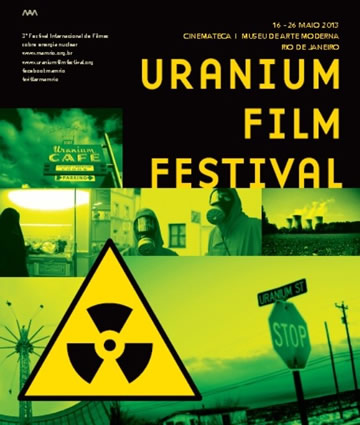
10TH INTERNATIONAL URANIUM FILM FESTIVAL RIO DE JANEIRO https://uraniumfilmfestival.org/en/rio-2021
Online for free from May 20 to May 30, 2021
The 10th International Uranium Film Festival Rio de Janeiro remembers the still unsolved nuclear accident in Fukushima 10 years ago and the UN treaty on the prohibition of nuclear weapons, which has been in force since January of this year. Due to the ongoing Covid-19 restrictions It will be the festival’s first online edition with support by the Cinematheque(link is external) of Rio de Janeiro’s prestigious Modern Art Museum (MAM Rio)(link is external).
The festival has selected 34 documentaries and movies by 26 filmmakers from 15 countries. The films will be screened for free online from May 20 to 30 at the MAM Rio platform. Two live online events complete the program.
On May 20 (7 pm Rio time)(link is external) the festival opening features three atomic bomb survivors from Hiroshima, who live in Brazil, and Akira Kawasaki, coordinator of the Peace Boat Foundation. And on May 24th (4 pm Rio time)(link is external) the festival’s live online guests will be former Brazilian Ambassador Sérgio de Queiroz Duarte who has dedicated his life as a diplomat to end the nuclear threat and Cristian Ricardo Wittmann, member of the International Campaign to Abolish Nuclear Weapons (ICAN).
The video greetings (link is external)for the opening of the online film festival come from Biologist and parliamentarian Klaus Mindrup(link is external), member of the German Bundestag of the Committee for the Environment, Nature Conservation and Nuclear Safety, and from Manfred Mohr(link is external), Professor of International Public Law, spokesman for the International Coalition to Ban Uranium Weapons (ICBUW), founding member of the International Association of Lawyers against Nuclear Weapons (IALANA) and ICAN-member.
SELECTED FILMS (ALPHABETICAL)
- …………
Iran: talks in Austria with UK, France and Germany head towards nuclear agreement
Iran nuclear deal ‘starting to take shape’ Albert Otti AAPThu, 20 May 2021 An agreement to restore the 2015 Iran nuclear deal is beginning to take shape after six weeks of talks, European diplomats say.
“Both on the nuclear side and on the sanctions side, we are now beginning to see the contours of what the final deal could look like,” senior diplomats said after the latest round of talks.
The negotiators from the UK, France and Germany – sometimes referred to as the E3 – have been meeting in working groups in the Austrian capital since early April, aiming to revive the 2015 nuclear deal which was crafted to prevent Iran from developing nuclear weapons.
The nuclear accord has been hanging by a thread since 2018 when then-US president Donald Trump pulled the US out and Iran began to increasingly violate its terms.
“However, success is not guaranteed. There are still some very difficult issues ahead. We do not underestimate the challenges that lay before us,” the diplomats said.
Negotiations are under way on which sanctions the US would be prepared to lift and what steps Iran would be willing to take in return to curb its nuclear program.
Iranian Deputy Foreign Minister Abbas Araghchi said the structure of the agreement had been achieved.
“The content is almost clear although not yet finalised,” he said……… https://thewest.com.au/politics/iran-nuclear-deal-starting-to-take-shape-c-2884918
Flaws found in anti-terror measures at Fukushima No. 2 nuclear plant
Flaws found in anti-terror measures at Fukushima No. 2 nuclear plant, Japan Times, 19 May 21,
Anti-terrorism measures implemented at Tokyo Electric Power Company Holdings Inc.’s Fukushima No. 2 nuclear power plant, which is set to be decommissioned, have been found to be flawed, it was learned Wednesday.
It was discovered that doors leading to the nuclear materials protection areas at the plant, which are under heavy entry-exit surveillance as part of anti-terrorism measures, were not properly managed.
Some security checks conducted when people leave or enter such areas were also neglected.
The flaws were reported to a meeting of the Nuclear Regulation Authority on the same day.
According to the NRA, the flaws have been fixed and there are no signs of intrusion.
The NRA said that a worker at the nuclear plant found a door with inadequate access control measures to the area at the plant’s No. 4 reactor on March 19.
On the following day, a door with a similar flaw was found at the plant’s No. 1 reactor. Plant operator Tepco reported the flaws to the NRA.
The company also found that necessary checks, such as those involving metal detectors, were skipped at some doors to the nuclear materials protection areas.
While the doors in question at the No. 1 and No. 4 reactors were not used on a day-to-day basis and were locked, Tepco said that it was unaware that the doors were on the boundaries…….. https://www.japantimes.co.jp/news/2021/05/19/national/fukushima-antiterror-flaws/
How many nuclear weapons does Britain have? Non-Proliferation explained

How many nuclear weapons does Britain have? Non-Proliferation explained https://www.express.co.uk/news/uk/1437927/How-many-nuclear-weapons-does-Britain-have-non-proliferation-ev
BORIS JOHNSON has been accused of infringing international laws with his plans for British nuclear proliferation. How many nuclear weapons does Britain have?, By LIAM DOYLE May 18, 2021
The current crop of roughly 195 warheads sits in an ocean-based fleet of Vanguard-class ballistic missile submarines.
They operate on a continuous patrol to preserve the UK’s deterrence policy from the sea.
Britain has previously committed to non-proliferation and intended to limit its stockpile.
Mr Johnson’s predecessors outlined these intentions in the 1968 Treaty on Non-Proliferation and the Strategic Defence and Security Review.
The latter policy, brought forward by the Conservative-Liberal Democrat coalition, aimed to reduce national stockpiles by 65 percent during the 2020s.
The Government’s 2021 Integrated Review found it could no longer commit to this policy.
The Prime Minister intends to push the UK’s stockpile up by 40 percent to “no more than 260 warheads”.
The review cites the current “security environment” as its primary reason for proliferation.
And this is where the earlier 1968 treaty comes into play.
Nuclear and non-nuclear powers alike signed the Treaty on Non-Proliferation as a collaborative pledge to limit nuclear technologies.
The treaty attracted the UK, US, the then Soviet Union and a further 59 other signatories.
The ratified document prevents non-nuclear states from acquiring weapons, commits nuclear states to push for disarmament, and allowed all participants to access technology for peaceful purposes.
Hans Kristensen, director of the Nuclear Information Project, said the Government’s latest pursuit would break parameters set by the treaty.
He cited Article 6, which commits signatories to step-by-step disarmament, specifically.
Beatrice Fihn, executive director of the International Campaign to Abolish Nuclear Weapons (ICAN), added the “dangerous” decision “violates international law”.
She added: “While the majority of the world’s nations are leading the way to a safer future without nuclear weapons by joining the Treaty on the Prohibition of Nuclear Weapons, the United Kingdom is pushing for a dangerous new nuclear arms race.”
1 This Month





PLEASE OPPOSE HR 8255 AND S.3639 – bills would accelerate satellite deployment, with no environmental review or safeguards – https://ncstd5li.quorum.us/campaign/169331/
To see nuclear-related stories in greater depth and intensity – go to https://nuclearinformation.wordpress.com
-
Archives
- October 2026 (67)
- September 2026 (339)
- August 2026 (330)
- July 2026 (355)
- June 2026 (287)
- May 2026 (306)
- April 2026 (356)
- March 2026 (251)
- February 2026 (267)
- January 2026 (308)
- December 2025 (358)
- November 2025 (359)
-
Categories
- 1
- 1 NUCLEAR ISSUES
- business and costs
- climate change
- culture and arts
- ENERGY
- environment
- health
- history
- indigenous issues
- Legal
- marketing of nuclear
- media
- opposition to nuclear
- PERSONAL STORIES
- politics
- politics international
- Religion and ethics
- safety
- secrets,lies and civil liberties
- spinbuster
- technology
- Uranium
- wastes
- weapons and war
- Women
- 2 WORLD
- ACTION
- AFRICA
- Atrocities
- AUSTRALIA
- Christina's notes
- Christina's themes
- culture and arts
- Events
- Fuk 2022
- Fuk 2023
- Fukushima 2017
- Fukushima 2018
- fukushima 2019
- Fukushima 2020
- Fukushima 2021
- general
- global warming
- Humour (God we need it)
- Nuclear
- RARE EARTHS
- Reference
- resources – print
- Resources -audiovicual
- Weekly Newsletter
- World
- World Nuclear
- YouTube
-
RSS
Entries RSS
Comments RSS

