France’s nuclear emergency plans are inadequate
Europe1 4th May 2021, The French not sufficiently prepared in the event of a nuclear accident. The ANCCLI – responsible for informing the population about nuclear risks – warned Tuesday morning of the ineffectiveness of existing prevention campaigns and calls on the government to review the entire nuclear emergency plan.
Small nuclear reactors- a very problematic ”solution” to climate change
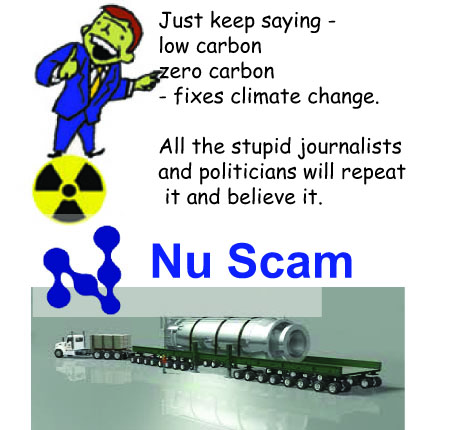
The controversial future of nuclear power in the U.S. National Geographic, 5 May 21, ”……………. In the U.S., a company called NuScale has recently received design certification approval from the Nuclear Regulatory Commission for its SMR, the first and only company to do so. Its reactor is a miniaturized version of a traditional reactor, in which pressurized water cools the core where nuclear fission is taking place. But in the NuScale design, the whole reactor is itself immersed in a pool of water designed to protect it from accidental meltdown.
NuScale hopes to build 12 of these reactors to produce 720 megawatts at the Idaho National Laboratory as a pilot project. It’s been supported by the U.S. Department of Energy, which has approved up to $1.4 billion to help demonstrate the technology. NuScale plans to sell the plant to an energy consortium called Utah Associated Municipal Power Systems.
Last year, eight of the 36 utilities in the consortium backed out of the project, citing the cost. The company recently announced the project would be delayed to 2030, and the cost would rise from $4.2 billion to $6.1 billion.
Nuclear opponents point to this latest disappointment as yet another example of why nuclear isn’t up to the task.
“If your first SMR isn’t built until the late 2020s, and then you have to turn it on, not to mention set up a whole new global supply chain, are you going to reach zero emissions by 2035?” asks IEER’s Makhijani. “You can’t make a significant contribution in time.” He adds that the industry’s long history of overruns and delays are especially problematic when considering climate commitments. “There’s no room for significant mistakes.”
……. The future of nuclear power will depend in part on how well it can balance a grid that increasingly relies on renewables….. Unlike gas turbines, which can be turned on and off in seconds to “follow the load,” reactors take an hour or more to cut their production in half.
It’s not that reactors can’t follow the load; they’re just slower. “They can and do, because they have to,” Buongiorno says. “It’s just never an attractive economic proposition.”
Last fall, the DOE awarded $80 million each to two companies working on advanced reactor designs intended in part to address this problem.
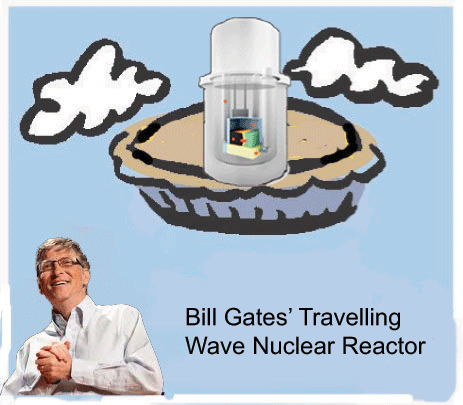
The first, TerraPower, a startup founded by Bill Gates, is working on a sodium-cooled reactor……… The second grant went to a company called X-energy for a gas-cooled reactor that operates at very high temperatures.
…… The high-level radioactive waste they produce, however, would need to be transported to a centralized location for management.
.. none of these new designs are moving quickly enough to meet Biden’s targets. DOE officials called their decision to support these two pilot projects, which aim to be fully operational by 2028, “their boldest move yet.”
Meanwhile, there’s a more direct way to balance the variability of renewables: store electricity in batteries. The market for utility-scale battery storage is exploding; it increased by 214 percent in 2020, and the EIA predicts that battery capacity will surge from its current 1,600 megawatts to 10,700 by 2023.
Makhijani thinks nuclear power isn’t going to be needed to balance the grid. A study he conducted in 2016 for the state of Maryland found that increased battery storage, combined with incentives to consumers to reduce their electricity use at peak times, would almost allow utilities to balance the variability of renewables.
They’d just need to store a little energy as hydrogen, which can be produced by running renewable electricity through water and then converted back to electricity in a fuel cell. That process is currently very expensive, Makhijani says, but “as long as it’s not giant amounts, it’s affordable.”……
France desperate to sell its flawed nuclear technology to India, Time for India to cancel Jaitapur nuclear power project.

Time for India to cancel Jaitapur nuclear power project, France keen on flogging its ‘messy’ tech to India Business May 2, 2021 By Ranvir Nayar Media India Group France remains desperate to sell its severely troubled EPR nuclear reactors to India, even though its own project at home and at both the sites outside of France have had severe cost and time overruns and continue to face safety issues.
On March 3, 2021, Electricité de France, EDF, the sole operator of nuclear power plants in France, informed the country’s nuclear safety body, Autorité de Sûreté Nucléaire (ASN), of a design anomaly on three nozzles of the main primary system of the European Pressurised Reactor that it has been building at Flamanville in north-west France.
The design flaw is serious as the main primary system contains water used to cool the reactor core and transfer energy from the nuclear reaction to the steam generators. The design dates back to 2006 and the nozzles were manufactured in 2011.
https://mediaindia.eu/business/jaitapur-nuclear-france/
Millions of fish to be destroyed by UK’s new nuclear stations, but Centre for Environment, Fisheries and Aquaculture Science (Cefas) is in the pay of nuclear firm EDF.
| Climate News Network 4th May 2021, The high fatality rate which the cooling systems of two British nuclear power stations may impose on marine life is worrying environmentalists, who describe the heavy fish toll they expect as “staggering”. The twostations, Hinkley Point C, under construction on England’s west coast, and Sizewell C, planned for the eastern side of the country, will, they say, kill more than 200 million fish a year and destroy millions more sea creatures. But the stations’ builders say their critics are exaggerating drastically. Objectors to the fish kill had hoped that the UK government agency tasked with conserving fish stocks in the seas around Britain, the Centre for Environment, Fisheries and Aquaculture Science (Cefas), would be on their side. They have been disappointed to learn that Cefas is a paid adviser to the French nuclear company EDF, which is building the stations, and would raise no objections to the company’s method of cooling them with seawater. https://climatenewsnetwork.net/uk-nuclear-plants-will-exact-heavy-fish-toll/ |
Further delay, more costs, for Finland’s nuclear power station, Fennovoima
Helsinki Times 4th May 2021, THE NUCLEAR POWER PROJECT of Fennovoima in Pyhäjoki, North Ostrobothnia,
is set to be delayed further, writes YLE. The Finnish consortium of power
and industrial companies stated last week that its effort to ensure the
design and licencing materials meet the Finnish standards has taken longer
than expected, predicting that a building permit for the plant could be
secured by mid-2022 instead of 2021.
The construction would therefore start
in the summer of 2023 and the plant start commercial operation in 2029. The
timetable is set forth in a supplement attached last week to the building
permit application the consortium filed with the Ministry of Employment and
the Economy in 2015. Fennovoima, the supplement reveals, has also raised
its cost estimate for the project from 6.5–7.0 to 7.0–7.5 billion
euros, citing its own operational and administrative costs.
Breakthrough Institute comes apart – Michael Shellenger started new nuclear front propaganda group – Environmental Progress

The New Denial Is Delay at the Breakthrough Institute (Part 3)
The DisInformation Chronicle, 5 May 21,
This is Part Three of “The New Denial Is Delay at the Breakthrough Institute,” a three-part series examining the Breakthrough Institute and ecomodernism. In Part Two, we discussed their annual meetings to which they invite climate skeptics and Monsanto propagandists, the odd credentials for many of their affiliates, and their promotion of nuclear energy and GMO agriculture as techno-fixes to electrify and feed the world. To start at Part One, click here.
Months after the Breakthrough Institute released their 2015 ecomodernist manifesto, the declaration’s ideological binding started coming unglued. Breakthrough’s Ted Nordhaus and Michael Shellenberger met ridicule trying to sell the manifesto at a public event in England, and the duo later parted ways, as Shellenberger founded a new organization called Environmental Progress to publicize nuclear energy. The split has been somewhat acrimonious as both try to break from a past that neither seems capable of escaping.

The event in England focused on restoring science to environmentalism, and it was there that they planned to sell ecomodernism to British reporters. Conservative MP Owen Paterson, a climate denier who almost halved the UK’s climate preparedness budget when he was environmental secretary, hosted the media event.
When announcing the press conference, Paterson called on the public to abandon the “relentless pessimism of the environmental movement” and warned in a Telegraph op-ed that “the Green Blob still infests the official bureaucracy with its influence.” Other conference panelists included Mark Lynas, a co-author of the the ecomodernist manifesto, and Matt Ridley, a British science writer noted for climate denial screeds.
But after critics argued that the event provided a platform for climate denialists, DesmogBlog reported that Shellenberger dismissed those who warned the group not to participate in a press conference with Paterson.
Fuck you all, we’re going to go to the press conference,” Shellenberger said. “Owen will say his thing, we’re going to say our thing, if people can’t deal with it, fuck ‘em. I’m done with the tribalism on this.”
Shellenberger’s cavalier attitude did not seem to impress the crowd, however, and many complained that Breakthrough had made the wrong decision by choosing to associate with climate denialists and anti-environmentalists.
In a recent interview, Nordhaus explained this strategy as sort of a means to an end. “I’ve given talks to groups of climate skeptics, climate deniers—you know, real climate deniers,” he said. “You can have a variety of viewpoints on this question without having to put a tin foil hat on. And the thing is, you get to the end of those talks and if you go, ‘OK, so who supports nuclear energy?’ Everybody in the room supports nuclear energy.”
Neither Nordhaus nor Shellenberger responded to detailed questions sent by e-mail.
By late 2015, Shellenberger had left the Breakthrough Institute and started Environmental Progress. A photo at the organization’s website shows Shellenberger clad in a yellow t-shirt giving a Ted Talk. The summer after founding his group, Shellenberger partnered with employees of the nuclear energy industry to lead the March for Environmental Hope, which was billed as the “first-ever pro-nuclear march.”
As part of their march, the group held protests outside the Bay area offices of Greenpeace, the Sierra Club, and the Natural Resources Defense Council, and attendees included a half dozen Exelon employees, who flew in from jobs working at nuclear reactors scattered across the country.
Months later, Shellenberger led a pro-nuclear march in Chicago that was said to be inspired by the Civil Rights March on Washington, the Stonewall Riots, and Gandhi’s Salt March. Counter protestors denounced Environmental Progress as “astroturf.”
When not writing for the Environmental Progress website, Shellenberger sometimes has his views echoed on Spiked, a British website funded in part by the Koch Brothers that traffics in climate denial. He also runs a blog at Forbes where he ridicules climate policy while advocating for nuclear energy. In one example at Forbes, he cited studies by Ed Calabrese, a professor of toxicology at the University of Massachusetts Amherst, as proof that fears of nuclear radiation are overblown. Shellenberger’s story picked up on a theme first introduced by the Breakthrough Institute where they interviewed Calabrese about his research.
As reported by The Los Angeles Times and HuffPost Investigations, Calabrese has long excited the tobacco, chemical, and nuclear industries with research called “hormesis” that argues tiny amounts of pollution and radiation are actually good for people. Public health experts have dismissed Calabrese’s hormesis studies as a type of religion, although Trump officials showed interest.
Shellenberger is a propagandist,” said Paul Dorfman, Founder and Chair of the Nuclear Consulting Group and Honorary Senior Research Associate at the University College London. Dorfman said that while some experts can make a case for nuclear energy that he disagrees with, Shellenberger is not one of them.
“He’s not a scientist. He just comes up with stuff,” said Dorfman. Dismissing the hormesis theory as “quasi science” and “tosh,” Dorfman said there is no safe dose of radiation. “This is a fact. And all the regulatory bodies know this.” ………
To promote his recent book “Apocalypse Never,” Shellenberger added another piece to the canon of environmental apologist lit, with a post on his Forbes blog titled “On behalf of environmentalists, I apologize for the climate scare.” Forbes removed the blog shortly after, which Shellenberger decried as censorship. Nonetheless, Shellenberger references his blogging at Forbes to claim that he is a “leading environmental journalist.”
But once again, reality diverges from the Shellenberger storyline.
Forbes has long been a breeding ground for industry messaging and corporate propaganda. Back in 1997, Forbes ran a takedown of EPA Administrator Carol Browner, warning the public that she was ignoring science to gain control over American lives. “Watch out for this woman,” read the scary headline splashed across the cover of Forbes magazine, “The EPA’s Carol Browner is exploiting health and the environment to build a power base.”
The story’s co-author was Bonner R. Cohen, who also operated EPA Watch, a newsletter that Philip Morris described as an “asset” that they established to attack the EPA on second hand smoke. After EPA Watch disappeared, Cohen then joined various climate denial groups, including the Heartland Institute. ………
“We flood the American public with a tsunami of crap every day in the media,” said Gary Schwitzer, an adjunct professor at U of Minnesota School of Public Health, and Publisher of Health News Review. He said Forbes is particularly terrible because it hosts fringe contributors with undeclared industry ties, and who write dreck. This is harmful, Schwitzer said, because it distracts the public from real news: “That’s what really pisses me off.”
“In some ways, it’s just like a fabulous performance art piece that he’s doing right now,” Nordhaus told Drilled News of Shellenberger’s campaign to promote his latest book. “It’s like Andy Kaufman doing environmentalism in a way that environmentalists could sort of see how dogmatic it gets. How sort of shrill it gets, and how angry it gets. How kind of dark and conspiratorial it gets.”
Despite attempts to create space between themselves and Shellenberger, Breakthrough has also helped to prop him up. When both Shellenberger and Bjorn Lomborg published books last year, climate scientists rushed to condemn them. Writing in The Guardian, climate expert Bob Ward dismissed both books as “classic examples of political propaganda.” ………
Breakthrough’s troubling ties to climate denial continue to this day as a member of their board is Reihan Salam, president of the Manhattan Institute. Four years back, 19 Senators took to the Senate floor in a week-long event to denounce the Manhattan Institute and other fossil fuel-funded groups that deny climate science and stymie legislation. According to Exxon Secrets, the Manhattan Institute has received $1.39 million from Exxon since 1992, with $75,000 donated in 2018, the last year for which records are available.
…….. Breakthrough has other links to the fossil fuel industry, through the chair of their advisory board, the heiress Rachel Pritzker. Besides funding the Breakthrough Institute, the Pritzker Innovation Fund supports the Natural Gas Initiative at Stanford University. Other Natural Gas Initiative funders include Anadarko Petroleum, Gulf Energy, The Cynthia and George Mitchell Foundation, ExxonMobil and the American Petroleum Institute.
………. “If there’s one thing these guys are good at, it is getting the media to move a story for them,” said Kert Davies of the Climate Investigations Center. Complimenting Breakthrough’s skills in public relations, Davies said that their counterintuitive “man bites dog” message gives Breakthrough an advantage over environmental organizations, which keep selling the same tired story.

“They are good at PR,” he said. “It’s where they came from. They’re good PR guys pretending to be policy experts.”https://disinformationchronicle.substack.com/p/the-new-denial-is-delay-at-the-breakthrough-c97
The manipulative propaganda tactics of Michael Shellenger,Mark Lynas and Rachel Pritzker of the Breakthrough Institute

The New Denial Is Delay at the Breakthrough Institute (Part 2)
Ten years after jumping on the scene, contrarianism, public stumbles, and “debate-me-bro” tactics remained core to the group’s brand, The DisInformation Chronicle, Mar 23 2021,
This is Part Two of “The New Denial Is Delay at the Breakthrough Institute” a three-part series examining the Breakthrough Institute and ecomodernism. In Part One, we scrutinized Breakthrough’s early years, their attacks on traditional environmental groups, and their awkward defense of the oil and gas industry. To find Part One, click here.
From its 2003 beginning, the Breakthrough Institute weathered constant criticism for contrarian hot-takes on complex environmental topics. But 2014 saw two major stumbles: Breakthrough Institute Fellow Roger Pielke Jr. got bounced from Nate Silver’s 538 after writing an error-riddle column on climate change; another fiasco followed when Breakthrough invited Kieran Suckling of the Center for Biological Diversity to one of its much-ballyhooed meetings.
Having one of your senior fellows bounced from 538 after an eminent MIT scientist pointed out errors would embarrass any normal organization. But not Breakthrough…….
Attempting to debate facts that don’t land in their favor is boilerplate Breakthrough. More common is goading well-known experts to debate dense policy matters, because joining the stage with authorities perfumes Breakthrough with a whiff of their opponents’ expertise.
The “debate-me-bro” maneuver remains critical to polishing Breakthrough’s brand.
“In the end, they know they don’t have to win all those debates,” said Sam Bliss, a graduate student in environmental economics at the University of Vermont, who published a study in the Journal of Political Ecology examining Breakthrough. “Just getting in the debates with actual experts, and getting attention for their ideas, puts those ideas into people’s heads.”
Breakthrough Institute co-founder Michael Shellenberger also relies on debate-me-bro when called out for misstatements. As catastrophic fires torched the West Coast last fall, reporters began quoting scientists who linked these fires with climate change. Nonetheless, Shellenberger hopped on Fox News to shout this science down.
When someone then tweeted that he was wrong, Shellenberger, of course, challenged that person to a debate…………….
Breakthrough hosted a talk by Alex Berezow of the American Council on Science and Health (ACSH). Leaked documents and court records find that ACSH’s funders have included Chevron, Coca-Cola, Bayer Cropscience, McDonald’s, Monsanto, and the tobacco conglomerate Altria……….
In 2015, Nordhaus and Shellenberger released “An Ecomodernist Manifesto”, a sparkly, tectonic-shifting declaration. In reality, the document rehashed arguments that, as humans sculpt the planet, the Earth has entered a new era.
Many of the 18 signatories were Breakthrough affiliates, with a smattering of professors and others who orbit Breakthrough as a means to pump up their personal brands as innovative thinkers. Two signatories bear greater scrutiny: Mark Lynas and Rachel Pritzker…………..
He [Lynas] issued this very dramatic, but essentially, fabricated reinvention of his own biography to springboard into a new phase of his career,” Wilsdon said of Lynas. “He isn’t an expert in any of this.”
“He’s done a very impressive marketing campaign internationally,” agreed Mayer, who signed the letter calling Lynas’s claims false. “He’s not at all important in our country. But it fits into a nice story that gets lapped up by certain constituents.”
In recent years, Lynas has turned to writing for the Cornell Alliance for Science, a GMO and pesticide advocacy group at Cornell University. After the WHO’s IARC listed the pesticide glyphosate as a probable carcinogen, Monsanto and its allies began attacking the agency. The head of IARC told Politico that the agrichemical industry’s campaign reminded him of tobacco industry attacks when IARC categorized second-hand smoke as cancerous.
Lynas later published a piece at the Cornell Alliance for Science that dismissed IARC as “a little-known and rather flaky offshoot of the World Health Organization” and defended Monsanto as the victim of a “witch hunt.”
Lynas did not respond to detailed questions sent to him by e-mail.
Rachel Pritzker joined Breakthrough as the chair of its board in 2011. After co-authoring “An Ecomodernist Manifesto,” she achieved peak Breakthrough glory with two Ted Talks. In one talk, she flacked ecomodernism and recounted her transformation from little girl raised by hippies on a goat farm “where we grew our own vegetables and heated with wood” to Breakthrough-style tech modernist. After reaching this inflection point on the Ted Talk stage, Pritzker then toggled through talking points similar to what one would expect from a nuclear energy lobbyist, while also slapping down wind and solar energy.
“That’s the essential message of ecomodernism,” she said. “It’s a cause for optimism.”
Ms. Pritzker seems to have little scientific training, which makes her an odd choice to jump on stage and teach an audience about nuclear energy. According to news reports and her bio at the Pritzker Innovation Fund, Ms. Pritzker majored in Latin American studies. During the 2008 election, NPR reported that she was a “liberal nutritionist” who helped dump $1.1 million into an Ohio political action committee that opposed Senator John McCain, then running for President. …….
Besides chairing the board of the Breakthrough Institute, Ms. Pritzker has also supported several groups that collaborate with Breakthrough to promote nuclear energy and GMO agriculture, including Third Way and the Information Technology and Innovation Foundation (ITIF).
This ends Part Two of “The New Denial Is Delay at the Breakthrough Institute,” a three part series examining the Breakthrough Institute and ecomodernism. To continue with Part Three, click here. https://disinformationchronicle.substack.com/p/the-new-denial-is-delay-at-the-breakthrough-c1d
Breakthrough Institute climate sceptics – Ted Nordhaus and Michael Shellenberger – ‘bright, shiny objects to some journalists’.

The New Denial Is Delay at the Breakthrough Institute, How ecomodernism’s attempt to revolutionize environmentalism became a tragic slide into techno-hype lobbying and endless bickering with “Big Green” The DisInformation Chronicle 5 May 21,
In 2004, Ted Nordhaus and Michael Shellenberger, the founders of a scrappy Bay Area think tank called the Breakthrough Institute, shot to prominence when they published “The Death of Environmentalism,” an essay that argued the environmental movement had failed……….
Because they ….. defined themselves against climate science deniers, they found a sympathetic audience among mainstream intellectuals……….
But it turns out they weren’t so different from run-of-the-mill climate skeptics after all……
Breakthrough’s antics and loose relationship with facts have caused most environmental groups and climate change experts to give them the cold shoulder.
“They had this idea of molding environmentalism to attract conservatives and what actually happened was they turned into conservatives themselves—writing for Forbes, Quillete, National Review, and the Wall Street Journal,” said Sam Bliss a graduate student in environmental economics at the University of Vermont. Along with research professor Giorgos Kallis, Bliss published a study in the Journal of Political Ecology that documents the Breakthrough Institute’s promotion of a strange idea called ecomodernism. Bliss describes it as a tragic tale, where Nordhaus and Shellenberger turn into exactly who they didn’t want to be: conservative lobbyists for techno-fixes who engage in endless battles with environmentalists.
But while Breakthrough may have become a pariah in much of the environmental movement, ignoring them is not the smartest strategy. Most of their early critics have vanished after becoming exasperated at the group’s constant failure to correct errors, granting Nordhaus and Shellenberger an open license to peddle “ecomodernism” as a gadget to address the world’s environmental challenges.
Indeed, while it’s been 12 years since Shellenberger and Lomborg shared a stage to promote their “alternative voices,” the veracity and quality of their scientific advice has not improved. Both Shellenberger and Lomborg released new books in 2020—and as in the past, experts immediately savaged them. In a review at Yale 360, Pacific Institute emeritus president Peter Gleick wrote, “Bad science and bad arguments abound in ‘Apocalypse Never’ by Michael Shellenberger.” Taking a pickaxe to Lomborg’s book “False Alarm,” Nobel Prize-winning economist Joseph Stiglitz wrote in the New York Times, “This book proves the aphorism that a little knowledge is dangerous. It’s nominally about air pollution. It’s really about mind pollution.”
But despite criticism of the Breakthrough Institute’s ideas and turmoil within it — Shellenberger left the group in 2015 — Breakthrough shows an uncanny knack to survive and spread bad ideas, even managing to attract the occasional reasonable scientist such as Steven Pinker, an attention-starved Harvard professor, who is sometimes touted as one of his generation’s leading minds.
Neither Nordhaus nor Shellenberger responded to detailed questions sent by e-mail.
……………….. A recently retired Hill staffer, who did not want his name in the media, said he worked for decades on appropriations for the House but never heard of the Breakthrough Institute. He wondered how Shellenberger—or anyone—could claim personal credit for passing billions of dollars in renewable energy policy with just one or two meetings, when the Hill is swarming with hundreds of professional lobbyists working around the clock.
“He’s constantly reinventing his story to build the appearance of power and access,” said Kert Davies, who spent 13 years at Greenpeace examining energy policy, before founding the Climate Investigations Center in 2013. Davies said he first met Shellenberger in the early 2000s, when Shellenberger was vying to get a communications contract with Greenpeace. “He takes credit for things [that happened] years after he was boosted from the Apollo Alliance. He can say whatever he wants, and it’s all vapor because the organization is now gone.”
“They aren’t players up here on the Hill,” said a senior Democratic Committee staffer, who has spent decades working on climate policy and is not authorized to speak to the media. “They spend most of their time shooting spitballs at mainstream environmental organizations and that makes them a bright, shiny object to some journalists.”
………. Shellenberger’s denial that Exxon suppressed or spun what it knew about climate change is now referenced by mainstream climate denialists,
……….. since launching the Breakthrough Institute in 2003, Nordhaus and Shellenberger have generated gigawatts of media buzz — along with a pile of disapproval taller than a West Virginia coal mountain. Scientists and environmentalists have noted the duo’s penchant for portraying the fossil fuel industry as a tiny corporate Goliath picked on by David, the environmental giant. But Breakthrough’s counterintuitive narratives, headlined with sparkly buzzwords and backfilled with selective facts, make sense when you remember that Nordhaus and Shellenberger forged their expertise in public relations.
In the tech-crazed, libertarian San Francisco of the early 2000s, Breakthrough’s ideology perhaps made sense to those who saw the environmental movement as stuck in the past, unwilling to embrace necessary technology, and too resistant to corporate solutions. This has caused a few moments of public embarrassment for Breakthrough such as promoting fracking as a “clean energy” alternative.
Last year, medical experts writing in the New England Journal of Medicine dismissed fracking as a clean energy false promise that data show is less a bridge to future, than a tether to the past. Today, Breakthrough promotes fracking and eagerly embraces nuclear and solar energy, while cheerleading for GMO agriculture, as preferred technologies to electrify and feed the world.
……….. over the years, Breakthrough also began defending oil companies and cozying up to climate contrarians. Denying that they traffic in climate denial, while constantly ending up in the same room with contrarians and climate denialists, is a constant dilemma for the Breakthrough crowd, as are spine twisting arguments to soften human impacts on the planet and to hype technology solutions. It’s a subtle, more modern version of denial and catnip to some journalists. When celebrated data cruncher Nate Silver relaunched his 538 website in 2014, one of his first hires was Breakthrough Fellow Roger Pielke Jr.
A professor of science policy at the University of Colorado, Pielke Jr. has a long track record of wildcat contrarian writing on climate change and receiving invites to promote his views at congressional hearings from Republicans who deny climate science.
……… It’s a subtle, more modern version of denial and catnip to some journalists. When celebrated data cruncher Nate Silver relaunched his 538 website in 2014, one of his first hires was Breakthrough Fellow Roger Pielke Jr.
A professor of science policy at the University of Colorado, Pielke Jr. has a long track record of wildcat contrarian writing on climate change and receiving invites to promote his views at congressional hearings from Republicans who deny climate science. …… https://disinformationchronicle.substack.com/p/the-new-denial-is-delay-at-the-breakthrough
Nobel prize winner Beatrice Fihn urges Australia to join the Nuclear Weapons Ban Treaty, as public support for it grows

Australian government urged to heed public support for treaty banning nuclear weapons. Nobel prize-winning anti-nuclear campaigner Beatrice Fihn says ‘change is not only possible, it’s inevitable’ https://www.theguardian.com/australia-news/2021/may/06/australian-government-urged-to-heed-public-support-for-treaty-banning-nuclear-weaponsDaniel Hurst Foreign affairs and defence correspondent@danielhurstbne Thu 6 May 2021
The Australian government is being urged to rethink its opposition to a new international treaty banning nuclear weapons, with a leading campaigner warning of the “indiscriminate destructiveness” of such arms.
Beatrice Fihn, the head of the Nobel prize-winning International Campaign to Abolish Nuclear Weapons (Ican), will use a speech in Tasmania on Thursday to implore the government to heed strong public support for joining the treaty.
“Change is not only possible; it’s inevitable,” Fihn will say when she presents the annual Red Cross Oration at the University of Tasmania.
The Australian government has not joined the Treaty on the Prohibition of Nuclear Weapons, a relatively new agreement that requires parties not to develop, test, produce, acquire, possess, stockpile, use or threaten to use nuclear weapons.
So far, the treaty has been signed by 86 countries, of which 54 have formally ratified it – but it has been snubbed by the nuclear weapons states including the US, Russia and China.
“Australia does not support the Treaty on the Prohibition of Nuclear Weapons,” a spokesperson for the Department of Foreign Affairs and Trade said on Wednesday.
The Australian government argues the new treaty “would not eliminate a single nuclear weapon” because none of the nuclear weapons states have signed it and because it “ignores the realities of the global security environment”.
The government also says the treaty would be inconsistent with its US alliance obligations. However, campaigners point out that several US allies, such as New Zealand, Thailand and the Philippines, have already ratified the treaty.
Fihn, who is based in Geneva and will be addressing the University of Tasmania via video link, will call on the government to act on the “strong and growing support that exists in Australia for this crucial new piece of international law”.
According to prepared remarks provided to Guardian Australia in advance, she will describe the treaty as an “incredible step forward towards a world without nuclear weapons”.
Fihn will say the countries that have joined the treaty are “leading the way forward to a world without nuclear weapons”.
“Meanwhile, in countries that have not yet joined the treaty, including Australia, people are speaking up against nuclear weapons and calling on their countries to join,” she will say.
“Cities around the world, including Berlin, Paris and Washington DC are adopting resolutions calling on their governments to join. In fact, the very first city to sign our Cities Appeal was Melbourne, followed soon after by Sydney – and we’re delighted that the City of Hobart is also on board.”
Polling commissioned by Greenpeace in 2017 found 72.7% of 1,669 Australians surveyed said they supported a ban on nuclear weapons as a step towards the elimination of all nuclear weapons.
“From Australia to Canada, Germany, Japan and the United Kingdom, polls show that the majority of people want their government to join,” Fihn will say.
“Thousands of parliamentarians have pledged to work to bring their respective countries on board. In Australia, 88 of the current members of parliament have taken Ican’s pledge.”
The Ican pledge commits parliamentarians “to work for the signature and ratification of this landmark treaty by our respective countries”.
The federal MPs and senators who have signed up are mostly Labor politicians, including the opposition leader, Anthony Albanese, who has been campaigning against nuclear weapons since early in his political career.
The list also includes the Greens leader, Adam Bandt, and crossbenchers. The Liberal National party MP for Flynn in central Queensland, Ken O’Dowd, has also signed up.
In Thursday’s speech, Fihn will also emphasise the need to “amplify the voices of First Nations peoples in Australia and the Pacific who continue to suffer the horrendous impacts of nuclear tests carried out on their lands and in their waters by the United Kingdom, the United States and France”.
More than 75 years after the US bombing of the Japanese cities of Nagasaki and Hiroshima in 1945, she says, nuclear-armed states are spending billions of dollars each year to build new weapons and to keep the 13,000 existing weapons.
But Fihn says nuclear-armed states “do not prepare for what comes next, after the bombs are dropped”, citing reports that about 80% of hospitals were destroyed in Hiroshima. Out of 300 doctors in the city, 270 died or were injured; out of 1,780 nurses, 1,654 were killed or injured.
“They do not prepare for the hundreds of thousands of burn victims, for the blasted hospitals, for the injured and dying medical professionals left to heal an entire city,” Fihn says.
“The trauma of overwhelmed hospitals and overburdened doctors and nurses around the world who are struggling to meet the needs of patients during the Covid-19 pandemic shows just how impossible it would be for medical infrastructure to respond to even one nuclear weapon detonation.” The Australian government and other non-signatories are being encouraged to send officials to attend, as observers, the first meeting of parties in Vienna early next year.
Guardian Australia understands Australia will consider attendance closer to the event.
Faster glacier melting raises hunger threat
Climate News Network 5th May 2021, Glacial retreat − the rate at which mountain ice is turning to running
water − has accelerated. In the last two decades, the world’s 220,000
glaciers have lost ice at the rate of 267 billion tonnes a year on average,
and this faster glacier melting could soon imperil downstream food and
water supplies.
To make sense of this almost unimaginable volume, think of
a country the size of Switzerland. And then submerge it six metres deep in
water. And then go on doing that every year for 20 years.
European scientists report in the journal Nature that, on the basis of satellite
data, they assembled a global snapshot of the entire world’s stock of
land-borne ice, excluding Antarctica and Greenland. And then they began to
measure the impact of global heating driven by profligate fossil fuel use
on the lofty, frozen beauty of the Alps, the Hindu Kush, the Andes, the
Himalayas and the mountains of Alaska.
They found not just loss, but a loss
that was accelerating sharply. Between 2000 and 2004, the glaciers together
surrendered 227 billion tons of ice a year on average. By 2015 to 2019, the
annual loss had risen to 298 billion tonnes. The run-off from the
retreating glaciers alone caused more than one-fifth of observed sea level
rise this century.
The dramatic economic failure of America’s nuclear industry

The controversial future of nuclear power in the U.S. National Geographic, 45 May 21, ”……….debates rage over whether nuclear should be a big part of the climate solution [[the nuclear industry’s confidence trick] in the U.S. The majority of American nuclear plants today are approaching the end of their design life, and only one has been built in the last 20 years. Nuclear proponents are now banking on next-generation designs …….
Yet an expansion of nuclear power faces some serious hurdles, and the perennial concerns about safety and long-lived radioactive waste may not be the biggest: Critics also say nuclear reactors are simply too expensive and take too long to build to be of much help with the climate crisis.
Bombs into plowshares
A test reactor at the Idaho National Laboratory, where Finan now works, produced the first electrical power from nuclear energy in 1951. Its success was soon trumpeted in President Dwight Eisenhower’s famous “atoms for peace” speech to the United Nations in 1953. Arjun Makhijani, a nuclear physicist who runs the non-profit Institute for Energy and Environmental Research, points out that the speech was given shortly after a thermonuclear test blast in the Soviet Union, when atomic fears were at a peak.
The United States, still the world’s largest producer by far of nuclear electricity, currently has 94 reactors in 28 states. But after the Three Mile Island accident in 1979, when a reactor partially melted down near Middletown, Pennsylvania, enthusiasm for nuclear energy dimmed.
The average age of American power plants, which are licensed to run for 40 years, is 39; in the last decade, at least five have been retired early, largely because maintenance costs and cheaper sources of power made them too expensive to operate.
The most recent closure came just last week, on April 30, when the second of two reactors was shut down at the Indian Point power plant, on the Hudson River north of New York City. …
Late and over budget
While environmental opposition may have been the primary force hindering nuclear development in the 1980s and 90s, now the biggest challenge may be costs. Few nuclear plants have been built in the U.S. recently because they are very expensive to build here, which makes the price of their energy high.
Jacopo Buongiorno, a professor of nuclear science and engineering at MIT, led a group of scientists who recently completed a two-year study examining the future of nuclear energy in the U.S. and western Europe. They found that “without cost reductions, nuclear energy will not play a significant role” in decarbonizing the power sector.
“In the West, the nuclear industry has substantially lost its ability to build large plants,” Buongiorno says, pointing to Southern Company’s effort to add two new reactors to Plant Vogtle in Waynesboro, Georgia. They have been under construction since 2013, are now billions of dollars over budget—the cost has more than doubled—and years behind schedule. In France, ranked second after the U.S. in nuclear generation, a new reactor in Flamanville is a decade late and more than three times over budget………
Biden administration to subsidise nuclear reactors on the pretext of stopping climate change?

An activist group slammed the of tax credits for aging plants saying it would slow deployment of renewable energy like wind and solar power. “A nuclear bailout is wrong for taxpayers, wrong for ratepayers, and wrong for the climate,” said Lukas Ross, program manager at Friends of the Earth.
U.S. eyes nuclear reactor tax credit to meet climate goals -sources, Reuters, Timothy GardnerJarrett Renshaw , 4 May 21, The White House has signaled privately to lawmakers and stakeholders in recent weeks that it supports taxpayer subsidies to keep nuclear facilities from closing and making it harder to meet U.S. climate goals, three sources familiar with the discussions told Reuters.
New subsidies, in the form of “production tax credits,” would likely be swept into President Joe Biden’s multi-trillion-dollar legislative effort to invest in infrastructure and jobs, the sources said…….
The United States leads the world with more than 90 nuclear reactors, the country’s top source of emissions-free power generation. Yet aging plants have been closing due to rising security costs and competition from plentiful natural gas, wind and solar power, which are becoming less pricey…….
New York state’s Indian Point nuclear power plant, owned by Entergy Corp (ETR.N), closed its last reactor on April 30. In Illinois, Exelon Corp (EXC.O) has said it might close four reactors at two plants by November, if the state does not implement subsidies.
Nuclear plants provide thousands of union jobs that pay some of the highest salaries in the energy business. Biden’s allies in building trades unions have lobbied for the production tax credits.
The credits also have the support of Democratic Senator Joe Manchin from the energy-rich state of West Virginia, two of the sources said.He holds outsized power in the evenly divided Senate because he can block his party’s agenda.
Manchin’s office did not immediately respond to a request for comment.
Preliminary plans for a federal nuclear power production tax credit in deregulated markets bar companies from double-dipping in states that offer similar assistance, according to one of the sources. Companies also would have to prove financial hardship, the source said.
While Biden pledged in his campaign to boost spending for research on new generation of advanced nuclear plants, his White House, like the preceding Trump and Obama administrations, has struggled to devise a blueprint to save the existing reactors.
The Biden administration has also supported a Clean Energy Standard (CES) in the infrastructure plan, a mechanism that could support existing nuclear plants.
The production tax credit could be implemented on a faster timetable and could help save even the Illinois plants, some experts say. Exelon, however, believes that the only way they can be saved is by Illinois taking action.
We’re racing to cut emissions, create jobs, and shore up local economies — allowing nuclear plants to close sets us back on all three fronts,” said Ryan Fitzpatrick, director of the climate and energy program at Third Way, a moderate think tank. [moderate – my foot – Third Way is nothing but a pro nuclear front group]

An activist group slammed the of tax credits for aging plants saying it would slow deployment of renewable energy like wind and solar power. “A nuclear bailout is wrong for taxpayers, wrong for ratepayers, and wrong for the climate,” said Lukas Ross, program manager at Friends of the Earth. https://www.reuters.com/business/sustainable-business/white-house-eyes-subsidies-nuclear-plants-help-meet-climate-targets-sources-2021-05-05/
Sweden’s nuclear waste problem may mean closure of 5 reactors by 2028
| Five Swedish reactors risk closure by 2028 due to tardy nuclear waste decision, Reuters, 6 May 21Five Swedish nuclear reactors may need to close between 2024 and 2028 because a temporary site for storing spent fuel will soon be full and the government has yet to approve a final waste repository, their operating companies said on Wednesday. The Forsmark 4 reactor risks closure in 2024, followed in 2025 by Forsmark 3, Ringhals 3 and 4 and finally Forsmark 1 in 2028, the operators said in urgent market messages posted via power exchange Nord Pool.Ringhals is owned by a consortium comprising Vattenfall (VATN.UL) and Uniper (UN01.DE), while Forsmark is owned by the same two companies in addition to Fortum (FORTUM.HE) and Skelleftea Kraft.A Swedish government decision on used nuclear fuel storage must be made no later than Aug. 31 this year to avoid exceeding the permit for the interim storage site a Oskarshamn, the firms added…….. https://www.reuters.com/world/europe/five-swedish-reactors-risk-closure-by-2028-due-tardy-nuclear-waste-decision-2021-05-05/ |
NRC extends lifespans of nuclear reactors (it’s cheaper than closing them down)

NRC approves 80-year lifespans for Surry nuclear units 1 and 2 Power Engineering By Clarion Energy Content Directors -5.4.2021 The Surry Units 1 and 2 nuclear power reactors will operate into the 2050s unless Dominion Energy pulls the plug for other reasons.
The U.S. Nuclear Regulatory Commission announced Tuesday it was approving the utility’s application on a 20-year renewal of its operating licenses for the Surry nuclear plant in Virginia. The renewed licenses authorize reactor lifetime operation from 60 to 80 years….
The Squad and Their Allies Should Unite to Block Biden’s Massive Military Budget,
The Squad and Their Allies Should Unite to Block Biden’s Massive Military Budget,
This is the moment to put a stop to runaway spending on war and the nuclear arsenal. Common Dreams, byMedea Benjamin, Marcy Winograd 5 May 21, A month before the vote on the federal budget, progressives in Congress declared, “We’ve studied President Biden’s proposed $753 billion military budget, an increase of $13 billion from Trump’s already inflated budget, and we can’t, in good conscience, support this.”
Now that would be a show stopper, particularly if they added, “So we have decided to stand united, arm in arm, as a block of NO votes on any federal budget resolution that fails to reduce military spending by 10-30 percent. We stand united against a federal budget resolution that includes upwards of $30 billion for new nuclear weapons slated to ultimately cost nearly $2 trillion. We stand united in demanding the $50 billion earmarked to maintain all 800 overseas bases, including the new one under construction in Henoko, Okinawa, be reduced by a third because it’s time we scaled back on plans for global domination.”
“Ditto,” they say, “for the billions the President wants for the arms-escalating US Space Force, one of Trump’s worst ideas, right up there with hydroxychloroquine to cure COVID-19, and, no, we don’t want to escalate our troop deployments for a military confrontation with China in the South China Sea. It’s time to ‘right-size’ the military budget and demilitarize our foreign policy.”
Progressives uniting as a block to resist out-of-control military spending would be a no-nonsense exercise of raw power reminiscent of how the right-wing Freedom Caucus challenged the traditional Republicans in the House in 2015. Without progressives on board, President Biden may not be able to secure enough votes to pass a federal budget that would then green light the reconciliation process needed for his broad domestic agenda.
For years, progressives in Congress have complained about the bloated military budget. In 2020, 93 members in the House and 23 in the Senate voted to cut the Pentagon budget by 10% and invest those funds instead in critical human needs. A House Spending Reduction Caucus, co-chaired by Representatives Barbara Lee and Mark Pocan, emerged with 22 members on board.
Meet the members of the House Defense Spending Reduction Caucus:
Barbara Lee (CA-13); Mark Pocan (WI-2); Bonnie Watson Coleman (NJ-12); Ilhan Omar (MN-5); Raùl Grijalva (AZ-3); Mark DeSaulnier (CA-11); Jan Schakowsky(IL-9); Pramila Jayapal (WA-7); Jared Huffman (CA-2); Alan Lowenthal (CA-47); James P. McGovern (MA-2); Peter Welch (VT-at large); Alexandria Ocasio-Cortez (NY-14); Frank Pallone, Jr (NJ-6).; Rashida Tlaib (MI-13); Ro Khanna (CA-17); Lori Trahan (MA-3); Steve Cohen (TN-9); Ayanna Pressley (MA-7), Anna Eshoo (CA-18).
We also have the Progressive Caucus, the largest Caucus in Congress with almost 100 members in the House and Senate. Caucus Chair Pramila Jayapal is all for cutting military spending. “We’re in the midst of a crisis that has left millions of families unable to afford food, rent, and bills. But at the same time, we’re dumping billions of dollars into a bloated Pentagon budget,” she said. “Don’t increase defense spending. Cut it—and invest that money into our communities.”
Now is the time for these congresspeople to turn their talk into action.
Consider the context. President Biden urgently wants to move forward on his American Families Plan rolled out in his recent State of the Union address. The plan would tax the rich to invest $1.8 trillion over the next ten years in universal preschool, two years of tuition-free community college, expanded healthcare coverage and paid family medical leave.
President Biden, in the spirit of FDR, also wants to put America back to work in a $2-trillion infrastructure program that will begin to fix our decades-old broken bridges, crumbling sewer systems and rusting water pipes. This could be his legacy, a light Green New Deal to transition workers out of the dying fossil fuel industry.
But Biden won’t get his infrastructure program and American Families Plan with higher taxes on the rich, almost 40% on income for corporations and those earning $400,000 or more a year, without Congress first passing a budget resolution that includes a top line for military and non-military spending. Both the budget resolution and reconciliation bill that would follow are filibuster proof and only require a simple majority in the House and Senate to pass.
Easy.
1 This Month





PLEASE OPPOSE HR 8255 AND S.3639 – bills would accelerate satellite deployment, with no environmental review or safeguards – https://ncstd5li.quorum.us/campaign/169331/
To see nuclear-related stories in greater depth and intensity – go to https://nuclearinformation.wordpress.com
-
Archives
- October 2026 (74)
- September 2026 (339)
- August 2026 (330)
- July 2026 (355)
- June 2026 (287)
- May 2026 (306)
- April 2026 (356)
- March 2026 (251)
- February 2026 (267)
- January 2026 (308)
- December 2025 (358)
- November 2025 (359)
-
Categories
- 1
- 1 NUCLEAR ISSUES
- business and costs
- climate change
- culture and arts
- ENERGY
- environment
- health
- history
- indigenous issues
- Legal
- marketing of nuclear
- media
- opposition to nuclear
- PERSONAL STORIES
- politics
- politics international
- Religion and ethics
- safety
- secrets,lies and civil liberties
- spinbuster
- technology
- Uranium
- wastes
- weapons and war
- Women
- 2 WORLD
- ACTION
- AFRICA
- Atrocities
- AUSTRALIA
- Christina's notes
- Christina's themes
- culture and arts
- Events
- Fuk 2022
- Fuk 2023
- Fukushima 2017
- Fukushima 2018
- fukushima 2019
- Fukushima 2020
- Fukushima 2021
- general
- global warming
- Humour (God we need it)
- Nuclear
- RARE EARTHS
- Reference
- resources – print
- Resources -audiovicual
- Weekly Newsletter
- World
- World Nuclear
- YouTube
-
RSS
Entries RSS
Comments RSS

