Climatic and Humanitarian Impacts of Nuclear War. Alan Robock to talk for Friends of Oak Ridge National Laboratory
Nuclear war impacts topic of FORNL talk https://oakridgetoday.com/2021/05/07/nuclear-war-impacts-topic-of-fornl-talk/ MAY 7, 2021, BY CAROLYN H KRAUSE,
The Climatic and Humanitarian Impacts of Nuclear War” is the topic of the monthly meeting of Friends of Oak Ridge National Laboratory. The virtual meeting, which is open to the public, will start at 12 noon on Tuesday, May 18. The Zoom link (meeting ID) can be found by clicking on the lecture title on the home page of the new FORNL website at www.fornl.org and then clicking the link just below the title on the talk’s descriptive page.
The speaker will be Alan Robock, a distinguished professor of climate science in the Department of Environmental Sciences at Rutgers University in New Brunswick, N.J. In describing the theory he will present, he said:
The world as we know it could end any day as a result of an accidental nuclear war between the United States and Russia. The fires produced by attacks on cities and industrial areas would generate smoke that would blow around the world, persist for years and block out sunlight, producing a nuclear winter.
“Because temperatures will plunge below freezing, crops would die and massive starvation could kill most of humanity. Even a nuclear war between new nuclear states, such as India and Pakistan, could produce climate change unprecedented in recorded human history and massive disruptions to the world’s food supply.”
In this talk Robock will show climate and crop model simulations, as well as analogs that support this theory. He will discuss policy changes that can immediately reduce the chance of the scenarios he will describe and that can lead to the abolition of nuclear weapons.
“The myth of nuclear deterrence has allowed nuclear weapons to persist for too long,” he said. Robock will be joined in his talk by a representative from the Physicists Coalition for Nuclear Threat Reduction.
As a result of international negotiations pushed by civil society led by the International Campaign to Abolish Nuclear Weapons (ICAN), which referenced Robock’s work, the United Nations passed the Treaty on the Prohibition of Nuclear Weapons on July 7, 2017. On Dec. 10, 2017, ICAN accepted the Nobel Peace Prize “for its work to draw attention to the catastrophic humanitarian consequences of any use of nuclear weapons and for its groundbreaking efforts to achieve a treaty-based prohibition of such weapons.”
The treaty went into effect on Jan. 22, 2021. Robock will discuss the prospects that humankind might successfully pressure the United States and the other eight nuclear nations to sign this treaty.
Robock has three degrees, including a Ph.D., in meteorology from the University of Wisconsin and the Massachusetts Institute of Technology. He has published more than 400 articles on his research on climate change, including on climate intervention (also called geoengineering), impacts of volcanic eruptions on climate and climatic effects of nuclear war. He was a lead author of the Fifth Assessment Report of the Intergovernmental Panel on Climate Change, which was awarded the Nobel Peace Prize in 2007.
Talks ‘intensify’ on bringing US back to Iran nuclear deal
Talks ‘intensify’ on bringing US back to Iran nuclear deal
World powers have held a fourth round of high-level talks aimed at bringing the United States back into a landmark nuclear deal with Iran,abc news, DAVID RISING and PHILIPP JENNE , Associated Press, 8 May 21,
VIENNA — World powers held a fourth round of high-level talks Friday aimed at bringing the United States back into the nuclear deal with Iran, with both sides signaling a willingness to work out the major stumbling blocks.
The talks began in Austria in early April. Russian delegate Mikhail Ulyanov tweeted following Friday’s meeting that “the participants agreed on the need to intensify the process.”
“The delegations seem to be ready to stay in Vienna as long as necessary to achieve the goal,” he wrote……..
U.S. President Joe Biden says he wants to rejoin the deal, known as the Joint Comprehensive Plan of Action, or JCPOA, but that Iran needs to return to compliance.
Speaking to reporters at the White House on Friday, Biden said he believed the Iranians were approaching the talks seriously…..
The pact is meant to prevent Iran from obtaining a nuclear bomb, something the country insists it does not want to do, and the government in Tehran has said it is prepared to reverse all of its violations but that Washington must remove all sanctions imposed under Trump.
Still unresolved is what Iran’s return to compliance would look like. Delegates to the Vienna talks concede, for example, that Iranian nuclear scientists cannot unlearn the knowledge they acquired in the last three years, but it is not clear whether Iran’s new centrifuges would need to be destroyed, mothballed and locked away, or simply taken offline.
Because the U.S. is currently out of the deal, there were no American representatives at the talks. Diplomats involved are shuttling between the Iranian side and a delegation from Washington elsewhere in Vienna.
Iran’s delegate to the talks, Deputy Foreign Minister Abbas Araghchi, told Iranian state television after the meeting that his impression was that all sides were committed to finding a solution.
“The reports that are being conveyed to us from Americans is that they are also serious about returning to JCPOA. So far, they have announced that they are ready to lift most of their sanctions, but we do not think it is enough,” Araghchi said.
“That is why the negotiations will continue until we reach all our demands in this regard,” he added. “If our demands are met, Iran will be quite serious about returning to its obligations in the full implementation of JCPOA.”
Between the high-level meetings in Vienna of the so-called Joint Commission, expert groups have been meeting to try and come up with solutions to the outstanding issues.
Alain Matton, a spokesperson for the EU delegation, which is chairing the meetings, said the expert discussions will continue in the days ahead.
“And the EU as a coordinator and facilitator of the JCPOA talks will continue with separate talks with all participants and with the U.S.,” Matton told reporters. “The participants are continuing with discussions, which are held on various levels and which have as their objective the full and effective implementation of the deal by all sides and the U.S. return to the JCPOA.”…….. https://abcnews.go.com/International/wireStory/high-level-talks-resume-returning-us-iran-nuclear-77550806
Russia to test powerful new nuclear weapon
RUSSIA ANNOUNCES PLANS TO TEST NUCLEAR WEAPON CALLED “SATAN II”AFTER YEARS OF DEVELOPMENT, RUSSIA IS READY TO LAUNCH THE POWERFUL NEW NUKES. Futurism, by DAN ROBITZSKI 7 May 221, Son of Satan,
The Russian military is prepared to launch three tests of its powerful new nuclear weapon, the RS-28 Sarmat, which has earned the nickname “Satan II.”
Tests for the new intercontinental ballistic missile will begin within the next few months, military insiders told TASS, a news outlet owned by the Russian government that refers to the weapon as “invulnerable.” That’s alarming news — while the Sarmat has been under development for years, the fact that it’s now ready for test launches brings us into a dangerous new era of ultra-powerful nuclear weapons……….. https://futurism.com/the-byte/russia-test-nuclear-weapon-satan
U.S. Nuclear Weapons Upgrade Sees Delay on Leaky Silos, Old Tech
U.S. Nuclear Weapons Upgrade Sees Delay on Leaky Silos, Old Tech,
Tony Capaccio, Bloomberg News, (Bloomberg) 7 May 21, — Upgrading America’s nuclear missile arsenal will likely take longer than expected because of the complexities of pulling 1970s-era ICBMs out of aging silos and testing and installing replacement missiles and technology to run the system for decades to come, according to a congressional audit.
The Air Force faces the complicated challenge of removing a total of about 400 Minuteman-III intercontinental ballistic missiles and their command-and-control electronics at the rate of about 50 per year from silos and support buildings in various states of deterioration, some with water damage, the Government Accountability Office said in a report Thursday.
The difficulties — which include extracting the missiles and nuclear payloads from the silos, repairing any structural decay, and installing customized electronics and the new weapon, all while maintaining other nuclear systems on alert — mean the new ICBM won’t likely meet an initial 2029 deadline, the declassified GAO report warned.
“The Air Force is using multiple strategies to ensure on-time fielding, including financial incentives for the contractor to meet milestones,” of the Northrop Grumman Corp. program, according to the report. “Nevertheless, program schedule delays are likely” for reasons such as the complicated replacement process.
Modernizing the nation’s Cold War-era capacity to deliver nuclear weapons by air, land and sea — the so-called nuclear triad — remains a key Pentagon priority under the Biden administration after it was jumpstarted by President Barack Obama and continued by President Donald Trump. The effort is expected to cost as much as $1.2 trillion through 2046 for development, purchase and long-term support, the Congressional Budget Office estimated in 2018.
Read the full GAO report on the nuclear triad here………. https://www.bnnbloomberg.ca/u-s-nuclear-weapons-upgrade-sees-delay-on-leaky-silos-old-tech-1.1600134
Texas Bill prevented – one that would have ”opened the floodgates for uncontrolled amounts of radioactive waste”
Craddick kills Landgraf’s nuclear waste bill,
Stewart Doreen, MRT.com/Midland Reporter-Telegram, May 6, 2021 A point of order by state Rep. Tom Craddick ultimately killed Brooks Landgraf’s radioactive nuclear waste bill.
Craddick reported late Wednesday night that Landgraf, a state representative from Odessa, told Craddick that he will not pursue this legislation further during the 87th Legislature.
“(Wednesday), in the interest of the Permian Basin and House District 82, I called a point of order on House Bill 2692 by Rep. Brooks Landgraf”, Craddick stated in a press release. “The point of order was well taken and sustained by the speaker of the House. This legislation would have not added the protections needed to prevent a high-level radioactive waste ban in Texas.”
Landgraf co-authored the bill that he said would ban the storage and disposal of high-level nuclear waste away from civilian nuclear power plants or university research reactors in Texas. Craddick wrote Wednesday night the bill was filed “with the guise of banning high level radioactive waste. However, the decision as to whether Texas is a viable storage site for high level radioactive waste is reserved to the federal government.
The bill has been a struggle for Landgraf and its backers in Andrews County. Last week, the Republican Party of Texas called HB 2692 – a “BAD BILL” on its official party Twitter account. Previously, Craddick of Midland and Tommy Taylor of Fasken Oil and Ranch publicly opposed the passage of the legislation.
Craddick added that Landgraf’s bill was “a tax and fee reduction for Waste Control Specialists. In addition, it allowed for Class A Radioactive waste to be transported and stored without containerization. It eliminated many of the contract requirements for the permit holder and opened the floodgates for uncontrolled amounts of radioactive waste in Texas.”
“When the low-level radioactive waste site in Andrews County was passed in prior legislative sessions these were all important elements to its passage. Craddick said, “Walking back on a promise to the Permian Basin is not an option.”
House Bill 2692 is not eligible for further consideration at this time, Craddick wrote.
It was the second-straight session that Craddick, the dean of Texas House members, used a point of order to kill a Landgraf-led item. In 2019, Craddick used the measure to kill House Bill 2154 — “enabling legislation” to House Joint Resolution 82, the so-called GROW Fund — because Landgraf had changed the bill to include agencies and “stuff we told people we wouldn’t do,” Craddick said at the time. AT TP https://www.mrt.com/business/energy/article/Craddick-kills-Landgraf-s-nuclear-waste-bill-16156948.php
Scientists refute Exelon’s claim about costs of replacing nuclear with renewable energy.
Exelon CEO: Replacing nuclear with renewables, storage to meet carbon goals could cost Illinois $80B Utility Dive, May 6, 2021 ”………..Achieving the same amount of zero emissions power through renewables and storage would be 12 times more expensive than continuing to run Illinois’ nuclear plants and cost the state’s consumers $80 billion, Exelon CEO Chris Crane said during the company’s Q1 earnings call on Wednesday………….
the Union of Concerned Scientists disputed Crane’s remarks regarding the cost of replacing nuclear with renewables and storage in Illinois.
“Crane’s comment that renewables plus storage would cost 12 [times] or $80 billion more than keeping the existing nuke plants running is ridiculous. I’m guessing he’s comparing the incremental cost of keeping them running (basically the subsidies) to the all-in cost of adding new renewables plus storage and the tax credits,” said Steve Clemmer, director of energy research for the UCS Climate and Energy Program. …….
In addition to the governor’s proposal, several other energy policy reform bills have been introduced in Illinois to drive the state’s energy transition and tackle climate change. Legislative leaders are meeting to develop a package from the various bills that can be considered this session,
Biden backs subsidies to keep nuclear plants alive, says Jennifer Granholm, energy chief.

Biden backs subsidies to keep nuclear plants alive, energy chief says, Washington Examiner. by Josh Siegel, Energy and Environment Reporter | | May 06, 2021 The Biden administration is “eager” to work with Congress on subsidizing economically struggling nuclear plants to keep them from retiring, Energy Secretary Jennifer Granholm said Thursday.
“The DOE has not historically subsidized plants, but this is a moment to consider to make sure we keep the current fleet active,” Granholm said in testimony about her agency’s budget request before an energy subcommittee of the House Appropriations Committee……
The Biden administration is “eager” to work with Congress on subsidizing economically struggling nuclear plants to keep them from retiring, Energy Secretary Jennifer Granholm said Thursday.
“The DOE has not historically subsidized plants, but this is a moment to consider to make sure we keep the current fleet active,” Granholm said in testimony about her agency’s budget request before an energy subcommittee of the House Appropriations Committee……..
The White House has signaled privately to lawmakers and stakeholders in recent weeks that it supports taxpayer subsidies to keep nuclear facilities from closing, Reuters reported this week, but no Biden administration official had said so on the record.
Granholm, on Thursday, did not propose a specific type of subsidy, only floating that help for nuclear could be included as part of President Joe Biden’s $2.3 trillion infrastructure and climate spending proposal.
The White House is interested in working with Congress to provide production tax credits to nuclear plants, sources following the conversations have confirmed to the Washington Examiner. https://www.washingtonexaminer.com/policy/energy/biden-subsidizing-nuclear-plants-energy
Bitcoin’s dirty little secret – its danger to the environment and the climate

Bitcoin’s dirty little secret: It’s not easy being green, The Age,
By Nick O’Malley and Chris Zappone, May 8, 2021 Depending on who you ask bitcoin, the digital currency at the heart of the crypto craze is either a currency or a commodity, a speculative bubble or a safe tool for storing and building wealth.
One thing everyone agrees on is that it has become a staggering consumer of energy and producer of climate wrecking carbon dioxide. Debate between its champions and detractors grows with its price and value, intensified by accelerating global efforts to tackle climate change.
Bitcoin supporters must now grapple with the reality that built into the cryptocurrency’s design is a seemingly endless demand for energy in the form of computing power.
……. “One of the biggest risks to the climate today is that people keep demanding more bitcoin,” says Macquarie University associate professor Sean Foley.
To understand why bitcoin requires so much energy, you have to understand how it is verified – in ever-growing banks of computer “mines”.
……… As each computer is in effect competing with the entire pool of computers engaged in proof of work, there is an incentive for miners to keep growing their banks of computers, especially when the value surges.
……. As the money has flowed, the enterprises engaged in mining are growing larger and moving into energy-rich but regulation-light environments like China, Russia and Iran in a race to confirm more calculations and “mine” more bitcoin.
In April 2020, about 65 per cent of all bitcoin mining in the world happened in China, according to figures from the Cambridge Centre for Alternative Finance, with a third of it in Xinjiang.
…………..The network of computers mining bitcoin across the world currently emits about 60mn tons of CO2, the same as the nation of Greece
………..Bank of America analysts say the rising complexity of transactions that underpin bitcoin is “the biggest flaw of the entire system” because this demands ever more power to function………. https://www.theage.com.au/environment/climate-change/bitcoin-s-dirty-little-secret-it-s-not-easy-being-green-20210506-p57pki.html
Hypocrisy, climate bullshit, and the push for hydrogen+fossil fuels.
| Guardian 6th May 2021, So it’s goodbye climate deniers, hello – and you’ll pardon me for being blunt here – climate bullshitters. The impacts of the climate emergency are now so obvious, only the truly deluded still deny them. Instead, we are at the point where everyone agrees something must be done, but many are making only vague, distant promises of ineffective action. As a result, we are currently on track for a 0.5% cut in global emissions from 2010 levels by 2030, when a 45% drop is needed to avoid climate catastrophe. So how to spot this greenwash. A good rule of thumb is whether the proposal actually cuts emissions, by a significant amount, and soon, and whether the proposer is in fact making the climate emergency worse elsewhere. Let’s start at the top, with the world’s governments, which have been setting out more targets than an archery competition. The global leader is the UK, which recently pledged a world-beating emissions cut of 78% by 2035. Targets are a necessary first step, but need action to be me and the instant, universal response: “Show me the policies!” The problem is some actual UK policies are pushing emissions up, not down: massive road building, a scrapped home energy efficiency programme and slashed electric car incentives, new oil and gas exploration, a failure to halt airport expansions and block a new coalmine (instead, the government belatedly ordered a public inquiry). But it is not just Boris Johnson’s government that says one thing while doing another. All are talking tough on climate, but China is building one large coal-fired power station a week, Japan remains one of the biggest Companies are, if anything, even better bullshitters than governments, and the fossil fuel giants are masters. Many are still exploring for new reserves, when we already have more than can ever be safely burned. Chevron touts capturing CO2 emissions and storing them underground as a solution – one that of course enables the continued burning of its products. But its plans for carbon capture and storage cover less than 1% of its 2019 carbon emissions. ExxonMobil wants public money to help with its carbon capture project to store 50m tonnes of CO2 by 2030. That’s just 8% of the 2020 emissions its products resulted in. Another technological fix promoted is hydrogen, , in theory a clean fuel when generated using renewable energy. But its most enthusiastic backers are incumbent fossil fuel companies. Members of the global Hydrogen Council include Saudi Aramco, BP and Total, while the UK parliament’s hydrogen group is funded by Shell and gas network and boiler-making firms. Why? Because hydrogen is a way for oil companies to move towards green energy without giving up fossil fuels. Pierre-Etienne Franc, co-secretary of the Hydrogen Council until 2020, explained: “It’s a way to avoid having stranded assets from the current fossil fuel-based system.” financiers of overseas coal plants and Norway is developing giant new oil and gas fields. https://www.theguardian.com/commentisfree/2021/may/06/difference-real-climate-policy-greenwashing-emissions |
Whistleblowers: Plenary Panel with Daniel Ellsberg and Edward Snowden, moderated by Amy Goodman — Rise Up Times

Snowden talks about why he decided to whistleblow and how he landed in Moscow where he now lives. Ellsberg talks about the Pentagon Papers and along the way the courage and necessity of whistleblowers.
Whistleblowers: Plenary Panel with Daniel Ellsberg and Edward Snowden, moderated by Amy Goodman — Rise Up Times
Truth, Dissent & the Legacy of Daniel Ellsberg — Rise Up Times

In a keynote address by Daniel Ellsberg and seven roundtable discussions, presenters explored the major issues that have engaged Ellsberg’s life: the Vietnam War, nuclear weapons, antiwar resistance, the Pentagon Papers, Watergate, whistleblowing, and the wars of the 21st century.
Truth, Dissent & the Legacy of Daniel Ellsberg — Rise Up Times
Anti-nuclear resistance in Russia: problems, protests, reprisals
 Anti-nuclear resistance in Russia: problems protests, reprisals Anti-nuclear resistance in Russia: problems protests, reprisals |

Standing up to Rosatom
https://beyondnuclearinternational.org/2020/06/21/standing-up-to-rosatom/ June 21, 2020 by beyondnuclearinternational
Anti-nuclear resistance in Russia: problems protests, reprisals
The following is a report from the Russian Social Ecological Union (RSEU)/ Friends of the Earth Russia, slightly edited for length. You can read the report in full here. It is a vitally important document exposing the discrimination and fear tactics used against anti-nuclear organizers in Russia and details their courageous acts of defiance in order to bring the truth of Russia’s nuclear sector to light.
Rosatom is a Russian state-owned corporation which builds and operates nuclear power plants in Russia and globally. The state-run nuclear industry in Russia has a long history of nuclear crises, including the Kyshtym disaster in 1957 and Chernobyl in 1986. Yet Rosatom plans to build dozens of nuclear reactors in Russia, to export its deadly nuclear technologies to other countries, and then to import their hazardous nuclear waste.
This report is a collection of events and details about the resistance to Russian state nuclear corporation, Rosatom, and other activities that have led to the pollution of the environment and violation of human rights. Social and environmental conflicts created by Rosatom have been left unresolved for years, while at the same time, environmental defenders who have raised these issues, have consistently experienced reprisals.
Nuclear energy: failures and LiesIn the autumn of 2017, the International Atomic Energy Agency (IAEA) discovered a concentration of the technogenic radionuclide ruthenium–106 in the atmosphere of several European countries. A number of experts linked the ruthenium release to the Mayak plant in the Chelyabinsk Region2 3, but Rosatom continues to deny this.
On the 8th of August 2019, an explosion occurred during a test of a liquid rocket launcher at a marine training ground in Nenoksa Village of Arkhangelsk Region. The administration of the city of Severodvinsk, 30 km from the scene, reported an increase in radiation levels, but later denied the claim. The Ministry of Emergency registered an increase of 20 times (to2 μSv/h) around Severodvinsk, while the Ministry of Defense reported the radiation level as normal. Only two days later, Rosatom reported that five employees were killed and three were injured at the test site. According to media reports, two employees of the Ministry of Defense were also killed and three were injured, and medical personnel who helped the victims were not informed about the risk of radiation exposure.
Expired reactorsMore than 70% of Russian nuclear reactors are outdated. They were developed in the 1970s and were designed to operate for only 30 years. The lifetimes of such reactors have been extended by twice the design limit. Rosatom’s strategy also includes a dangerous increase of the reactor’s thermal power. Rostekhnadzor (Federal Environmental, Industrial and Nuclear Supervision Service) grants licenses for lifetime extensions without an environmental impact assessment and without public consultations.
Especially worrying are the lifetime extensions of reactor-types with design flaws. Chernobyl–type (RBMK) reactors in Leningrad, Smolensk and Kursk regions are still in operation after exceeding their lifetimes, as well as VVER–types, such as at the Kola nuclear power plant (NPP) in Murmansk region. Neither type has a sufficient protective shell to contain radioactivity in case of an accident or to protect the reactor from an external impact or influence.
For many years, Murmansk regional environmental groups have opposed the aging Kola NPP reactor’s lifetime extension. They have participated in public hearings, have organised many demonstrations, and appealed to and received support from the prosecutor’s office, but this was all ignored by Rosatom.
Activists also called on the governor to shut down the old NPP, but environmental organisations were shut down instead. One such organisation is Kola Environmental Center (KEC) – listed as a Foreign Agent in 2017 – and subject to two trials and fined 150,000 rubles. KEC was forced to close down as a legal entity in 2018, but has continued its environmental work as a public movement.
Decommissioning problemsMost of the Russian nuclear power plants, despite their lifetime extensions, are approaching inevitable closure. Over the next 15 years, the NPP decommissioning process will take place. Currently, 36 power units are in operation at 11 NPPs in Russia, and 7 units have been shut down. While the fuel was removed from 5 of these units, the NPPs have not yet been decommissioned. This process will lead to enormous amounts of nuclear waste. Moreover, sufficient funds for the decommissioning process have not yet been earmarked.
The public organisation, Green World, has worked for many years in Sosnovy Bor, Leningrad Region, a city dominated by the nuclear industry and closed to outsiders. Since 1988, activists of the organisation have opposed dangerous nuclear projects in the Baltic Sea region and have provided the public with independent information on the environmental situation.
Green World has consistently called for the decommissioning of Leningrad NPP and took an early lead in collecting and preparing information on how decommissioning should take place, studying the experience of other countries. They have paid particular attention to information transparency and to wide participation in decision–making, including, for example, former employees of the nuclear industry.
Rather than be met with cooperation, the organisation and its activists have, since the beginning, experienced pressure from the authorities and the dirty nuclear industry. Activists faced dismissal, lawsuits and even attempts on their lives.In 2015, Green World was listed as a Foreign Agent and forced to close. In its place, another organisation was opened – the Public Council of the South Coast of the Gulf of Finland. Activists have continued their work as before under this new name.
Uranium mining protest
In the Kurgan region, Rosatom’s subsidiary company, Dalur, has been mining uranium and the local communities fear an environmental disaster. In the summer of 2019, the state environmental appraisal revealed a discrepancy between Dalur’s documentation and the Russian legislation requirements, but the company started the deposit’s development anyway at the end of 2019.
- The ‘Dobrovolnoe’ uranium deposit is located in a floodplain of the Tobol river basin. This means that all the water that flows into the river will pass through the aquifer, flushing out radioactive and toxic compounds into the surrounding environment.
- Since 2017, Kurgan activists have been protesting against the development of the deposit. They have appealed to the authorities and begun protests. One of their videos, ‘Uranium is Death for Kurgan’, has already reached 50,000 views. Several times, activists have tried to start a referendum and demand an independent environmental review, but so far, have received only refusals from the local officials.
- In February 2018, Natalia Shulyatieva, the spouse of activist Andrey Shulyatiev and mother of three children, died after falling into a coma. Activists believe this occurred in reaction to learning that Dalur had filed a lawsuit against her husband, accusing him of undermining the company’s reputation. The lawsuit was withdrawn following Shulyatieva’s death.
Rosatom Importing uranium waste
In the fall of 2019, environmentalists revealed that radioactive and toxic waste (uranium hexafluoride, UF6) were being imported from Germany through the port of Amsterdam into Russia. This is the waste from the uranium enrichment process which will be sent to the Urals or Siberia and stored in containers above the ground. Thus, under the auspices of a commercial transaction, the German uranium–enriching enterprise, Urenco, avoids its nuclear waste problem,
while Rosatom profits by taking the hazardous waste into Russia.In response to this transaction, the groups Russian Social–Ecological Union, Ecodefense and Greenpeace Russia called on Russian civil society to protest. More than 30 organisations and movements joined the common statement, and various demonstrations have taken place in Russia, as well as in Germany and the Netherlands.
As a result of protests, the question of importing radioactive waste was taken up by the Legislative Assembly of St. Petersburg and the transportation of the waste was delayed for three months.
However, in March 2020, when people in Russia were further restricted from protests during the COVID–19 virus quarantine, the import of radioactive waste was resumed through the port of the less populated town of Ust–Luga in Leningrad Region. Additional organisations and residents of the Leningrad region then decided to join the earlier anti–nuclear statement and protest.
Following these protests, a number of activists have faced persecution. Novouralsk is a nuclear industry–dominated and closed city of Sverdlovsk region, and is the end destination of the transported uranium hexafluoride. In response to a series of one–person protests, authorities initiated legal cases against three pensioners at the beginning of December 2019. Charges were later dismissed.
Another example is Rashid Alimov, an expert from Greenpeace Russia, who protested in the center of Saint Petersburg. Later the same day, two police officers together with six other people without uniform detained Alimov in front of his house. He then faced charges and a substantial fine. Charges were later dropped.
Environmental organisations that had previously opposed the import of uranium waste were listed as Foreign Agents. Ecodefense was the first of such, listed in 2014. In 2019, the pressure continued and the organisation’s leader, Alexandra Korolyova, was targeted. Five criminal cases were initiated against her, which forced her to leave the country.
The Mayak plant: Rosatom’s dirty face
The Mayak plant in the Chelyabinsk region is a nuclear waste reprocessing facility, arguably one of the places most negatively affected by the Russian nuclear industry. Firstly, radioactive waste was dumped into the Techa river from 1949 to 2004, which has been admitted by the company. According to subsequent reports by the local organisation For Nature however, the dumping has since been ongoing. As a result, 35 villages around the river were evacuated and destroyed. Secondly, the explosion at the plant in 1957, known as the Kyshtym tragedy, is among the 20th century’s worst nuclear accidents.
One of the first organisations that raised the problem of radiation pollution in the Ural region was the Movement for Nuclear Safety, formed in 1989. During its work, the Movement was engaged in raising awareness, social protection of the affected population, and publishing dozens of reports. After unprecedented pressure and persecution, the organisation’s leader, Natalia Mironova, was forced to emigrate to the United States in 2013. Since 2000, another non–governmental organisation, Planet of Hope, has held thousands of consultations with affected citizens. Nadezhda Kutepova, a lawyer and head of the organisation, won more than 70 cases in defence of Mayak victims, including two cases in the European Court of Human Rights. However, some important cases have still not been resolved. These include 2nd generation victims, cases involving pregnant women who were affected during liquidation, as well as the many schoolchildren of Tatarskaya Karabolka village who were sent to harvest the contaminated crop after the accident.
The state and Rosatom have reacted against the actions of Nadezhda Kutepova, persecuting both her and Planet of Hope. The organisation survived arbitrary inspections in 2004 and 2009, but was labelled a Foreign Agent in 2015 and closed in 2018. After being accused of ‘industrial espionage’ under the threat of criminal prosecution, Nadezhda was forced to flee the country with her children. She nevertheless continues her struggle to bring justice for the victims of Mayak.
Since 2002, the public foundation For Nature has been disputing nuclear activity in the region. The organisation appealed to the Supreme Court of the Russian Federation on the import of spent nuclear fuel from the Paks nuclear power plant in Hungary. The court declared the Governmental Decree to be invalid, thus preventing the import of 370 tons of Hungarian radioactive waste.
In March 2015, For Nature was also listed as a Foreign Agent and fined. In 2016, the court shut down the organisation. In its place, a social movement of the same name was formed, and continues to help the South Ural communities.
Struggle against a nuclear repositoryIn the city of Krasnoyarsk, Rosatom plans to build a national repository for high–level radioactive waste. A site has been selected on the banks of Siberia’s largest river, the Yenisei, only 40 km from the city. Environmental activists consider this project, if implemented, to be a crime against future generations and violates numerous Russian laws. Activists are also concerned that waste from Ukraine, Hungary, Bulgaria (and in the future from Belarus, Turkey, Bangladesh, and other countries) could be transported there as well.
The community is understandably outraged, as no one wants to live in the world’s nuclear dump. Since 2013, for more than 7 years, the people of Krasnoyarsk have been protesting. To date, more than 146,000 people have signed the petition to the President of the Russian Federation protesting against the construction of this federal nuclear repository.
Most of the producing nuclear power plants are located in the European part of Russia, but the waste is going to be sent for ‘the rest of its lifetime’ to Siberia. Local activists refer to this, with good reason, as Rosatom’s “nuclear colonisation” of Siberia.
In 2016, Fedor Maryasov, an independent journalist and leader of the protest, was accused of inciting hatred against ‘nuclear industry workers’ as a social group. A criminal case was initiated under the article on extremism. The basis for this accusation was 125 publications on social networks and the press about nuclear topics. The activist’s apartment was searched and his computer seized, along with a printed report on Rosatom’s activities in the Krasnoyarsk region.
The federal security service also issued Maryasov an official warning for treason. Only wide publicity in the media and the active support of human rights lawyers has thus far prevented further criminal prosecution of the activist.
Conclusion:
Nuclear power is a problem, not a solution.
Despite the nightmare described above, Rosatom is trying to convince us of the nuclear industry’s purity and purported carbon neutrality. In addition, Rosatom is building nuclear plants abroad using money from the Russian Federation’s budget. Nuclear not only won’t save our climate, but will continue to create even more insoluble problems of radioactive waste for thousands of years.
We demand that:
Russia must abandon all further development of nuclear energy.
Current nuclear power plants should be closed and decommissioned as soon as possible.Current funds from the development of nuclear energy should be redirected to the development of local renewable energy sources, to the restoration of contaminated territories and as support for those affected by the activities of the nuclear industry.
The problem of nuclear waste should be discussed widely, openly and inclusively, with the participation of all interested parties, and decisions should be made democratically, taking into account the principles of environmental justice.
Pressure on all activists, including environmental defenders and defenders of victims’ rights, should cease immediately.
And finally, Rosatom should be held responsible for environmental pollution and violation of human rights.
The Russian Social Ecological Union (RSEU)/ Friends of the Earth Russia is a non-governmental, non-profit and member based democratic organization, established in 1992. RSEU brings together environmental organizations and activists from across Russia. All RSEU activities are aimed at nature conservation, protection of health and the well-being of people in Russia and around the world. In 2014, RSEU became the Russian member of Friends of the Earth International. Read the full report.
Amid Widespread Disease, Death, and Poverty, the Major Powers Increased Their Military Spending in 2020
| |||
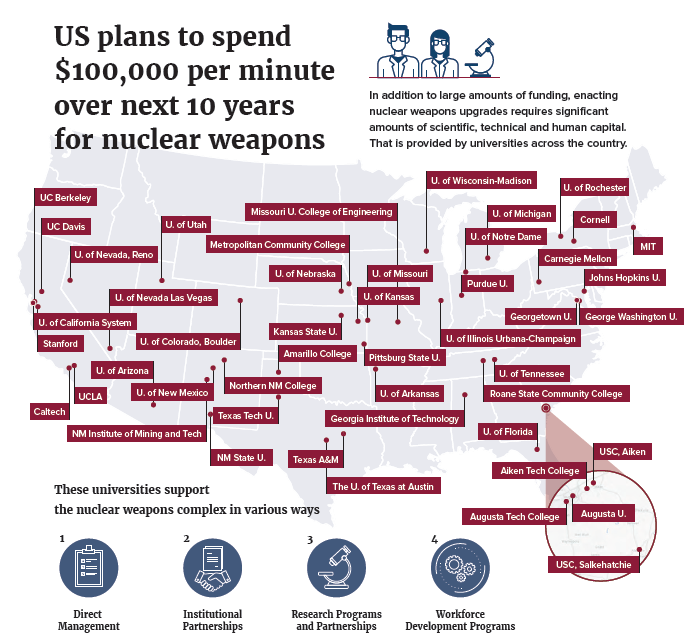
Amid Widespread Disease, Death, and Poverty, the Major Powers Increased Their Military Spending in 2020 https://www.commondreams.org/views/2021/04/28/amid-widespread-disease-death-and-poverty-major-powers-increased-their-military?utm_campaign=shareaholic&utm_medium=Social&utm_source=twitter
The existence of widespread poverty in the world’s mightiest military powers raises the question of what could have been done to alleviate or eliminate it, if during 2020 they had not poured nearly $1.1 trillion into preparations for war.
byLawrence Wittner Last year was a terrible time for vast numbers of people around the globe, who experienced not only a terrible disease pandemic, accompanied by widespread sickness and death, but severe economic hardship.
Even so, the disasters of 2020 were not shocking enough to jolt the world’s most powerful nations out of their traditional preoccupation with enhancing their armed might, for once again they raised their military spending to new heights.
Someday people will ask whether increasing preparations for war by these nations—mostly designed to destroy one another—was the best these governments could do as their populations sank into widespread disease, death, and poverty.
During 2020, world military expenditures increased to $1,981,000,000,000—or nearly $2 trillion—with the outlays of the three leading military powers playing a major part in the growth. The U.S. government increased its military spending from $732 billion in 2019 to $778 billion in 2020, thus retaining its top spot among the biggest funders of war preparations. Meanwhile, the Chinese government hiked its military spending to $252 billion, while the Russian government raised its military outlay to $61.7 billion.
As a result, the U.S. government remained by far the most lavish spender on the military in the world, accounting for 39 percent of the global total. Even so, the Chinese government continued its steady role in the worldwide military buildup, with its military disbursements rising for the 26th consecutive year. Indeed, China’s 76 percent increase in military spending between 2011 and 2020 was the largest among the world’s top 15 big spenders. When added together, the 2020 military expenditures of the United States, China, and Russia accounted for 55 percent of the global total.
This upward spiral in military spending coincided with a sharp rise in the number of the world’s people living in poverty, which soared by an estimated 131 million to 803 million by the end of the year.
In the United States, the richest nation in the world, 2020 produced the largest increase in poverty since the U.S. government began tracking it in 1960. By the end of the year, an estimated 50 million people were struggling with hunger, including 17 million children. Plunged into severe privation, vast numbers of Americans lined up, sometimes in caravans that stretched for miles, to obtain free food at private and public food pantries and other distribution centers. Ignoring the terrible human costs of the economic crisis plaguing the nation during his re-election campaign, President Donald Trump boasted instead of his administration’s “colossal” increase in military spending.
In Russia, where real incomes fell for five of the previous seven years, they dropped still further in 2020. In that year, the average Russian had 11 percent less to spend than in 2013. Indeed, during the first nine months of 2020, as poverty grew, an estimated 19.6 million Russians reportedly lived below the poverty line, equivalent to 13.3 percent of the population. According to a leading economist at Russia’s Institute of International Finance, the authorities “were so concerned about their external threats that they completely forgot about the domestic population.”
The situation was apparently quite different in China. Thanks to the government’s successful efforts to limit the spread of Covid-19, the Chinese economy had an easier time of it in 2020 than did the economies of other major nations. This factor, plus four decades of rapid economic growth and an ongoing campaign to improve the government’s popularity by reducing the country’s worst poverty, led to the Communist Party’s announcement that November that President Xi Jinping and the party had accomplished the miracle of eliminating severe poverty in China.
But all was not as it seemed. In 2020, China, despite its Communist pretensions, had one of the largest gaps between rich and poor throughout the world. By October, its number of billionaires had soared to 878, the highest total in any nation. In contrast, as a New York Times article reported that month, “millions of people on low incomes are working fewer hours at lower pay, depleting savings, and taking out loans to survive.” Moreover, claims as to the eradication of poverty in China were dubious, for the official poverty measuring line there was much lower than in nations with a similar level of economic development. A Brookings Institution economist pointed out that, if China used the same standard as other upper middle-income countries, between 80 and 90 percent of its population would be considered poor. “Even if you aren’t out of poverty, the country will say you’re out of poverty,” remarked a bitter Chinese farmer. “That’s the way it is.”
The existence of widespread poverty in the world’s mightiest military powers raises the question of what could have been done to alleviate or eliminate it if, during 2020, had they not poured nearly $1.1 trillion into preparations for war.
Also, of course, the vast resources used for the military buildup could have bankrolled other programs that would have substantially improved the lives of their citizens. In the United States, as the National Priorities Project noted, the military budget could have funded healthcare for 208 million adults, or 21 million scholarships for university students, or 84 million public housing units, or the employment of 9.2 million elementary school teachers, or 10 million clean energy jobs, or VA medical care for 72 million military veterans.
But, sadly, building the mightiest military forces in world history had greater appeal to the governments of the United States, China, and Russia. Perhaps, someday, people will ask whether increasing preparations for war by these nations—mostly designed to destroy one another—was the best these governments could do as their populations sank into widespread disease, death, and poverty.
The toll on marine life of radioactive water poured into the Pacific Ocean.
Beyond Nuclear 2nd May 2021, Tepco and the Japanese government are once more preparing to “dispose” of 1.25 million tonnes — translating to hundred of millions of gallons — of radioactive water accumulating at the Fukushima Daiichi nuclear power plant site by pouring it into the Pacific Ocean. I say “accumulating” because this water, needed to constantly cool the stricken reactors that exploded and melted down during and after March 11, 2011 — and that also runs down neighboring hillsides and across the site, picking up radioactive contamination — will continue to accumulate.
This is not a one-stop-toss. Citizens groups and fishing unions have been up in arms about this ever since it was first mooted. The actual dumping of the water always seems to be about two years away, and is always threatened as
the only “solution,” which it is not. It is almost certainly the cheapest solution, but not the only choice.
Even if we never ate the fish that comes out of the Pacific; and even if the fish and higher marine mammal predators never ate each other; contaminating sea life with radioactive toxins is wrong. We made it. Why dump it on creatures who had nothing whatever to do with its production and never needed to turn on a light?
This is not the only instance of total disregard for marine life when it comes to nuclear power. Just by using what is known as the “once-through” cooling intake system at coastal nuclear power plants, the toll on sea life is immense.
Billions of fish, fingerlings and spawn are drawn into the plant with the cooling water (the water rate can be as high as a million gallons a minute) and duly pulverized. Their “remains” are discharged at the other end as sediment. No fishing license required. New nuclear power plants promise to be even bigger marine predators.
Fission folly
France, the most nuclearised country in the world, is poorly prepared for nuclear emergencies.
ANCCLI 4th May 2021, People living near nuclear plants in France are not sufficiently aware of what to do to in the event of a nuclear accident, according to an organisation that collects information on the nuclear industry. The ANCCLI,
which aims to inform ordinary citizens about the nuclear industry, wants better simulation exercises and a more efficient distribution of iodine tablets so that those living and working near nuclear sites are better equipped to deal with any such accident.
“In the country that is the most nuclearised in the world in relation to the number of inhabitants, methods of public protection are unsuitable and insufficient,” says the ANCCLI in a report released on Tuesday. France is home to 19 nuclear power stations run by EDF, as well as nuclear reprocessing sites and nuclear plants used for research. The ANCCLI also expressed concern that local people are not availing of supplies of iodine tablets, which can mitigate the effects of radiation by saturating the thyroid with stable iodine so that it rejects radioactive iodine.
ANCCLI’s White Paper 9 – The post-accident: anticipation and preparation,
at the heart of cross-border CLI discussions.
1 This Month





PLEASE OPPOSE HR 8255 AND S.3639 – bills would accelerate satellite deployment, with no environmental review or safeguards – https://ncstd5li.quorum.us/campaign/169331/
To see nuclear-related stories in greater depth and intensity – go to https://nuclearinformation.wordpress.com
-
Archives
- October 2026 (74)
- September 2026 (339)
- August 2026 (330)
- July 2026 (355)
- June 2026 (287)
- May 2026 (306)
- April 2026 (356)
- March 2026 (251)
- February 2026 (267)
- January 2026 (308)
- December 2025 (358)
- November 2025 (359)
-
Categories
- 1
- 1 NUCLEAR ISSUES
- business and costs
- climate change
- culture and arts
- ENERGY
- environment
- health
- history
- indigenous issues
- Legal
- marketing of nuclear
- media
- opposition to nuclear
- PERSONAL STORIES
- politics
- politics international
- Religion and ethics
- safety
- secrets,lies and civil liberties
- spinbuster
- technology
- Uranium
- wastes
- weapons and war
- Women
- 2 WORLD
- ACTION
- AFRICA
- Atrocities
- AUSTRALIA
- Christina's notes
- Christina's themes
- culture and arts
- Events
- Fuk 2022
- Fuk 2023
- Fukushima 2017
- Fukushima 2018
- fukushima 2019
- Fukushima 2020
- Fukushima 2021
- general
- global warming
- Humour (God we need it)
- Nuclear
- RARE EARTHS
- Reference
- resources – print
- Resources -audiovicual
- Weekly Newsletter
- World
- World Nuclear
- YouTube
-
RSS
Entries RSS
Comments RSS

