Russia planning to test a ‘doomsday’ nuclear-powered torpedo in the Arctic.
Russia sends ‘doomsday’ nuclear-powered torpedo for test in the Arctic, Marc Bennetts, Moscow, Wednesday April 07 2021, 12.00pm BST, The Time The United States has said that it is watching Russia’s military build-up in the Arctic “very closely” as the Kremlin presses ahead with the testing of a nuclear-powered torpedo.
Russia is believed to be planning to deploy the Poseidon 2M39 missile, nicknamed the “doomsday nuke”, to its Arctic region by the summer of next year. The underwater drone has a range of 10,000km and is designed to detonate off the coastline of enemy cities, flooding them with radioactive waves that would render them uninhabitable for decades. In February President Putin asked the defence ministry for an update on a “key stage”’ of the tests of the Poseidon torpedo. Additional testing is due this year……… (Subscribers only) https://www.thetimes.co.uk/article/russia-sends-doomsday-nuclear-powered-torpedo-for-test-in-the-arctic-wf5ttr260
UK losing credibility with its new, ambiguous, nuclear weapons policy.
U.K. NUCLEAR WEAPONS: BEYOND THE NUMBERS, War On The Rocks, HEATHER WILLIAMS, APRIL 6, 2021, Sometimes numbers only tell part of the story, even when talking about nuclear weapons. For instance, the United Kingdom recently announced that it was increasing the cap on its nuclear stockpile from 225 to 260 warheads. The move — outlined in its government’s highly anticipated review of security and defense policy, Global Britain in a Competitive Age: The Integrated Review of Security, Defence, Development and Foreign Policy — largely took nuclear policy experts by surprise and reversed decades of British reductions. The government explained that the decision to increase its nuclear stockpile for the first time in decades was due to a worsening strategic landscape and technological threats, particularly Russian advances in missile defense and hypersonic weapons. The fact that the United Kingdom decided to make this decision now should be a wakeup call to those concerned about the security of the West and the global nuclear order.
The decision to boost the number of warheads in its arsenal wasn’t the only major nuclear policy change that the United Kingdom included in the Integrated Review. The document explained that the United Kingdom would no longer provide specifics about its nuclear stockpile or the conditions under which it would consider nuclear weapons use. In other words, the United Kingdom has now fully committed to a doctrine of strategic ambiguity. This approach is similar in some respects to what the United States, NATO, Russia, and China have done. But the increase in the warhead stockpile and reliance on strategic ambiguity come at a cost to nuclear diplomacy, and it will be difficult for the United Kingdom to balance these changes with its commitment to being a responsible nuclear power.
The announcement of an increase in the warhead stockpile, in particular, could not have come at a worse time for nuclear diplomacy. In August 2021, the United Kingdom and 190 other states will gather for a meeting of the parties to the Nuclear Non-Proliferation Treaty, which includes a commitment to the “cessation of the nuclear arms race” and “general and complete disarmament.” It will be a challenge for the United Kingdom to demonstrate progress towards nuclear disarmament five months after it has announced an increase in its stockpile cap. The reliance on strategic ambiguity also potentially undermines the country’s efforts to promote nuclear transparency among the treaty’s signatories. Obviously there are other considerations for the United Kingdom’s nuclear doctrine than the Nuclear Non-Proliferation Treaty, but these changes could damage its credibility on disarmament matters. The United Kingdom, therefore, should take additional steps to demonstrate its commitment to transparency, including providing more information on its nuclear modernization plans and leading on risk reduction efforts in the context of the Nuclear Non-Proliferation Treaty.
Reasons for a Larger Stockpile: Security and Technology
In its strategic reviews published in 2010 and 2015, the United Kingdom set a cap of 225 warheads and committed to reducing its stockpile ceiling to 180 warheads by the mid-2020s. The new Integrated Review increases the country’s nuclear stockpile ceiling to 260 warheads, a potential increase of approximately 15 percent from the current stockpile and 45 percent from the previous target.
The U.K. decision reverses decades of progress towards nuclear disarmament. …………
The Price of Ambiguity
Alas, the increased nuclear stockpile and the doctrine of strategic ambiguity will undermine the United Kingdom’s nuclear diplomacy. The move will open the country up to charges of hypocrisy. Future British delegations to international nonproliferation and disarmament negotiations should expect to be asked why other countries should make progress on these issues when the United Kingdom is building up its own nuclear arsenal. While this may seem relatively inconsequential compared to deterring Russian nuclear forces, it will make it harder for the United Kingdom to advance its interests in other areas that it cares about, especially within the Nuclear Non-Proliferation Treaty…………………….. https://warontherocks.com/2021/04/u-k-nuclear-weapons-beyond-the-numbers/
Explanation of a nonsense tweet from U.S. Strategic Command
Cryptic ‘;l;;gmlxzssaw’ tweet from official US nuclear agency account sparks confusion, https://www.sbs.com.au/news/cryptic-l-gmlxzssaw-tweet-from-official-us-nuclear-agency-account-sparks-confusionThe US Strategic Command runs the country’s powerful nuclear weapons force. 31/03/2021, Headquartered in Offutt Air Force Base, Nebraska, Stratcom manages the US military’s strategic deterrence – that is, the massive nuclear weapons force and missile defenses that are designed to discourage any attack against the country by other powers.
So its media comments are closely watched for signs of any change in its current defense stance….
Filed a FOIA request with U.S. Strategic Command to see if I could learn anything about their gibberish tweet yesterday. Turns out their Twitter manager left his computer unattended, resulting in his “very young child” commandeering the keyboard.
But Stratcom told reporter Mikael Thalen of the Daily Dot that the tweet was no secret message, and was instead was the result of a Stratcom social media editor working from home.
“The Command’s Twitter manager, while in a telework status, momentarily left the Command’s Twitter account open and unattended. His very young child took advantage of the situation and started playing with the keys and, unfortunately, and unknowingly, posted the tweet,” Stratcom official Kendall Cooper said in a letter Thalen posted online.
“Absolutely nothing nefarious occurred, ie no hacking of our Twitter account.”
The “innocence” of early capitalism is another fantastical myth — Systemic Disorder

It is not unusual for critics of United States foreign policy, whether or not they feel free to use the term “imperialism,” to express regret that a previously rational system has soured. Such sentiments are routine for liberals and hardly unknown among social democrats. Such sentiments are, to anyone who cares to pursue a study […]
The “innocence” of early capitalism is another fantastical myth — Systemic Disorder
Greenpeace warns European Commission on nuclear energy classification.

Greenpeace warns European Commission on nuclear energy classification
Move follows scientific expert group’s conclusion that ‘the fuel qualifies as sustainable’ under green investments, Irish Times, 5 Apr 21,
Kevin O’Sullivan Environment & Science Editor, Greenpeace Europe has warned the European Commission against reinstating nuclear power on the list of activities deemed sustainable by the European Union.
The call was made after the commission’s scientific expert group, the Joint Research Centre (JRC), was reported to have concluded “the fuel qualifies as sustainable” under green investments – notably in the context of making Europe net-zero in terms of its greenhouse gas emissions by 2050.
Greenpeace EU policy adviser Silvia Pastorelli said: “It’s become more and more clear that the nuclear industry cannot stand on its feet without massive funding and that is why they’re desperate for EU support, as nuclear power is too expensive and new projects are evaporating.”
In its report, the JRC “is dangerously optimistic about the renovation of operating nuclear power plants. Independent scientists have already told the EU that the unsustainable environmental hazard of nuclear waste is enough reason to drop the technology”, she said.
“Rather than let a dying industry swallow up vital funding, the European Commission should back real climate action, excluding all fake green ‘solutions’ like nuclear, gas and biomass,” Ms Pastorelli suggested.
In March 2020, the Technical Expert Group on Sustainable Finance established by the commission recommended excluding nuclear power from “the green taxonomy”; a European classification of low-carbon and transitional economic activities designed to guide investment.
Greenpeace noted, however, that after intense lobbying by pro-nuclear stakeholders, the commission asked the JRC to assess “the absence of significant environmental harm of nuclear power”, which it claimed is paving the way to the sector’s reinstatement on the list of activities deemed sustainable by the EU.
According to the environmental NGO, however, the JRC’s structural links with the Euratom treaty, its relations with the nuclear industry and the views expressed publicly by its members on nuclear energy “call into question the JRC’s ability to conduct an objective assessment of the sustainability of nuclear energy”.
The commission should have entrusted this study to an impartial structure and included civil society, it insisted. Two expert committees will scrutinise the JRC’s findings – which were leaked to Reuters – for three months before the commission takes a final decision.
Harm assessment
Achieving climate-neutrality requires compensating by 2050 not only any remaining CO2 but also any other GHG emissions, as set out in its “A Clean Planet for All” strategy, and confirmed by the European green deal.
To facilitate this, establishment of a framework to facilitate sustainable investment that provides appropriate definitions to companies and investors on which economic activities can be considered environmentally sustainable is required.
Given its extensive technical expertise on nuclear energy and technology, the JRC was asked to conduct this analysis and to draft a technical assessment report on the “do no significant harm” aspects of nuclear energy including long-term management of high-level radioactive waste and spent nuclear fuel…….
Brussels’ expert advisers last year were split over whether nuclear power deserved a green label, recognising that while it produces very low planet-warming emissions, more analysis was needed on the environmental impact of radioactive waste disposal………
EU countries are split over nuclear. France, Hungary and five other countries last month urged the commission to support nuclear in policies including the taxonomy. Other states including Austria, and some environmental groups, oppose the fuel, pointing to its hazardous waste and the delays and spiralling costs of recent projects.
“The nuclear industry is desperate for funds as nuclear power is too expensive and new projects are evaporating,” the Greenpeace adviser Silvia Pastorelli underlined…… https://www.irishtimes.com/news/environment/greenpeace-warns-european-commission-on-nuclear-energy-classification-1.4529442
Crookedness, fraud, in 10 years of Fukushima nuclear clean-up

How the Cleanup of the Fukushima Nuclear Accident Got So Expensive, The Asia Pacific Journal Philip Brasor and Masako Tsubuku, April 2921,
Abstract: Drawing on Japanese press and TV reports, the authors explain the extraordinary costs of the decade long cleanup of the 3.11 earthquake, tsunami, and nuclear meltdown, with no end to the process in sight.
………………………. According to a documentary special that aired on public broadcaster NHK in February, ¥5.6 trillion has so far been spent on decontaminating the areas surrounding the Fukushima Daiichi nuclear power plant, but not all of this money has been spent directly on cleanup activities, the goal of which was to bring the affected area back to “normal” as soon as possible so that evacuees could return to their homes. But ten years later that hasn’t happened, or, at least, not to the degree originally envisioned. After 90% of the work was finished, an estimated 60% of the radiation had been reduced, and the cleanup had become a self-generating public works project with its own profit motives for contractors and sub-contractors.
The central problem was the way the work was allocated. Ideally, the trade or education ministry should have been in charge, since both have experience in the nuclear energy field; or the construction ministry, which has extensive experience in large public works projects. However, the government chose the environment ministry, which has never carried out any large-scale public works. The other ministries, apparently, were loath to take on a job involving “waste.”
Usually, when a government entity orders work to be done, they set up a bidding process. In this case, there were multiple distinct areas targeted for cleanup, as well as various stages in the cleanup process. Under such circumstances, general contractors try to get all the work in a given area in order to maximize profits, and ideally, they will have no competition for bids, which means they can essentially charge whatever they want. When NHK examined the bid documents for the areas targeted for cleanup and related work, they found that 68 percent of the work orders only had one bidder. These sorts of public works normally generate a profit margin of 5%, but in this case, it was about 10%. As one environment ministry official admitted to NHK, they had no real idea about the competitive situation and didn’t know how to oversee the work.
As a result, there was a lot of misuse of funds. NHK looked at one subcontractor headquartered in the city of Iwaki, Fukushima Prefecture, that was investigated by the tax authorities. The company’s president was described by others as being a big-hearted individual who had once worked at the nuclear power station himself and wanted to help his neighbors move back into the area. That’s why he started the company, with the intention of reconstructing the area. The company grew quickly. After only two years, its profits exceeded ¥10 billion, at which point, according to one employee, “the original motivation” for starting the company “disappeared.” The company was freely padding receipts and spending money to entertain contractors who controlled work orders so that they could get even more lucrative jobs.
The president started giving away new cars to valued employees. After six years, one of the contractors discovered that the Iwaki subcontractor had bribed several of its employees and dropped the subcontractor. Subsequently, the subcontractor started laying off people as profits decreased sharply, and they weren’t the only ones. Two employees of another large general contractor were arrested for fraud for having reported fake costs and pocketing the difference. As one subcontractor explained, it was easy to do. The manager of a particular job asks the subcontractor to forge receipts saying that twice as many people worked on the job or asks a company that supplies lodging for workers to inflate the room charge on the receipts. At least 15 employees of one general contractor were accused of fraud or failure to report income. The total amount of money swindled in these cases was about ¥4 billion.
One contractor told NHK that he knew the environment ministry was understaffed so he didn’t worry about getting audited. The ministry asked for more personnel and the government always refused, saying the cleanup was only a short-term project. As initially planned, it would be finished in three years and cost a little over ¥1 trillion, but after 10 years it’s still not finished and actual costs have soared past ¥3 trillion, not counting the money spent for processing waste and constructing storage facilities. The ministry planned to build only two incinerators for waste disposal, but the local governments said they would only allow waste collected within their borders to be burned, so the ministry ended up building 16 incinerators in Fukushima Prefecture alone. And while they were built to last 20 years, half of them have since been demolished in order to alleviate local anxieties, so in many areas the work was not completed, though the cost of waste incineration ended up being more 5 times the original estimate.
Public funds paid for all of this, but direct tax money was used mainly for mid-term storage of irradiated materials. Everything else related to the cleanup is supposed to be paid for by capital gains made from the government selling Tokyo Electric Power Co. (Tepco) stock. NHK says that the government bought ¥1 trillion worth of Tepco stock at ¥300 per share and estimates that in order to pay off the cleanup costs they would need to sell that stock at ¥1,500 per share. Unfortunately, the stock hasn’t gone up in price since the government bought it. As of February 20, it was about one-fourth what it needed to be, so they have simply put off sale of the shares. One expert NHK talked to, a scholar who has done extensive research into nuclear accidents, said that if the stock doesn’t go up in price, then the government will end up using tax money anyway to pay for the cleanup; either that, or Tepco is going to have to cover more of the cost, which means utility bills will go up again. So, the public—more specifically, future generations—pays for it either way.
This pay structure was built into the law quite recently. Originally, Tepco was legally responsible for cleaning up any situations caused by an accident at their facilities, and thus were expected to pay for the Fukushima disaster, but since the job was so huge the government borrowed money and paid for the operations on behalf of Tepco. In turn, all of Japan’s electric power companies were supposed to reimburse the government. But in March 2013, Tepco talked the government into changing the pay structure, convincing it to shoulder more of the burden by saying that making utilities pay for everything is unfair to their shareholders, since nuclear power is a “national policy.”
A letter that NHK uncovered from Tepco to the trade ministry said that Tepco would not be able to “revive” itself if the government didn’t take more responsibility for the cleanup. Nine months later, the Cabinet decided on the capital gains strategy. According to various officials interviewed by NHK, the government knew that the capital gains plan wouldn’t be able to cover the costs of the cleanup, even before it ballooned out of proportion, but that they had to come up with something quickly “on paper.” As one trade ministry official said, the plan puts the government in a double bind, since in order for the stock to go up appreciably, it has to guarantee not only Tepco’s survival, but its success as a private corporation in the short run. And that, presumably, means getting nuclear power plants back online as soon as possible, a task that has run up against a wall of public opposition in the wake of the Fukushima disaster. ………..https://apjjf.org/2021/7/Brasor.html
In a positive move, Polish utilities remove their investment in nuclear power development.

Nuclear Project Divestment Positive for Polish Utilities, Fitch Ratings, Tue 30 Mar, 2021. -London-. The announced divestment of shares in the first nuclear power plant project in Poland to the State Treasury is positive for the credit profiles of divesting utilities, Fitch Ratings says.
For utilities, this step takes away the risk of being involved in high-risk, long-term and very capital-intensive nuclear generation projects, which are beyond the capacity of even a consortium of utilities if not backed by price-support mechanisms or state guarantees to debt. It will also let utilities concentrate on expansion in much less capital-intensive and much shorter time-to-EBITDA wind, solar and gas-fired generation……….
As per Poland’s new energy policy, the first nuclear power block is expected to start generation in 2033….
The government is planning to make nuclear generation a source of baseload electricity……….
the adoption of the country’s new energy policy in February 2021, new nuclear power programme in October 2020 and negotiations with suppliers of nuclear technology. The US’s Westinghouse Electric Company (B/Stable) is leading the race………
However, even after the final decisions with respect to location and construction are taken, the process will be lengthy and technically complex, so delays beyond the planned delivery date of 2033 are a real possibility. Most of the ongoing nuclear generation projects in Europe face multi-year delays. This strengthens our view that the announced withdrawal of PGE, ENEA and Tauron from the nuclear project company is positive for their credit profiles.
Contact:
Artur Galbarczyk
Director
+48 22 338 6291
Fitch Ratings Ireland Limited Sp. z o.o. Branch in Poland
Krolewska 16, 00-103 Warsaw
Arkadiusz Wicik
Senior Director
+48 22 338 6286
Media Relations: Adrian Simpson, London, Tel: +44 20 3530 1010, Email: adrian.simpson@thefitchgroup.com
Additional information is available on www.fitchratings.com https://www.fitchratings.com/research/corporate-finance/nuclear-project-divestment-positive-for-polish-utilities-30-03-2021
Ohio’s Electric Power Association happy to see the end of customer-funded nuclear subsidies
EPSA expresses support for Ohio’s end of customer-funded nuclear subsidies, https://dailyenergyinsider.com/news/29767-epsa-expresses-support-for-ohios-end-of-customer-funded-nuclear-subsidies/?amp Chris Galford, With Gov. Mike DeWine’s approval last week, Ohio House Bill 128 officially put an end to nuclear energy subsidies in the state and amended existing law to better benefit solar resources instead, earning praise from the Electric Power Supply Association (EPSA).
Specifically, H.B. 128 took aim at the provisions of another bill, H.B. 6, from the last General Assembly.
“Today is a long-awaited day for Ohio families and businesses,” Todd Snitchler, head of the EPSA, said. “The nuclear subsidies included in H.B. 6 were unnecessary and unjustified, and only passed due to the alleged unprecedented corruption in the legislative process and referendum effort. The H.B. 6 debacle shows that politically motivated efforts to subsidize favored energy resources at the behest of powerful and well-funded interests invites malfeasance, undermines competition and innovation, and drives up costs for consumers without ensuring better energy solutions for those paying the bill.”
H.B. 6 had, at the time, been widely promoted by FirstEnergy Corp. and FirstEnergy Solutions. It categorized nuclear power alongside other renewable energy sources. It allowed providers to draw credits for each megawatt hour of electricity reported and to draw from a $20 million annual disbursement fund for renewable sources, among other things.
The EPSA staunchly opposed that fact, and even now, Snitchler added that the rest of H.B. 6 should be taken up by the Legislature and resolved. However, the national trade association did call the current moves a win for fair market competition and consumer choice.
H.B. 128 was sponsored by state Reps. Jim Hoops (R-Napoleon) and Dick Stein (R-Norwalk)
Niigata governor wants Japan’s Nuclear Regulator to reassess Tepco, following security lapses
| Governor asks nuclear regulator to reassess TEPCO, https://www3.nhk.or.jp/nhkworld/en/news/20210405_31/ 5 Apr 21, The prefectural governor of Niigata has asked Japan’s Nuclear Regulation Authority, NRA, to reassess the capability of a local nuclear power plant’s operator after a series of security lapses.Governor Hanazumi Hideyo requested on Monday that the regulator re-examine Tokyo Electric Power Company. His move followed the revelation that multiple sensors at the Kashiwazaki-Kariwa plant had been broken for months and alternative measures were insufficient, leaving the facility vulnerable to intruders. A TEPCO employee also improperly entered the plant’s central control room using another employee’s ID card. Four years ago, the NRA endorsed the operator’s safety measures and gave the green light to restart two of the plant’s reactors. In response to the governor’s request, NRA Secretary-General Ogino Toru said the authority will scrutinize the operator’s ability. The NRA has instructed TEPCO to compile a report on its probe into the security breaches by September. The authority plans to conduct additional inspections after the report is submitted to see whether the company is technically capable of running the plant. As a penalty for the security lapse, the NRA is expected to ban the utility from transferring nuclear fuel, which would make it impossible to restart the plant. |
Let’s get rid of nuclear weapons before they ruin us
Let’s get rid of nuclear weapons before they ruin us, https://brookingsregister.com/article/lets-get-rid-of-nuclear-weapons-before-they-ruin-us, By: Carl Kline – Apr 5, 2021 Maybe others remember reading about it back in January 1966. I missed it, or at least don’t remember it. There was an accident in the skies over the Mediterranean Sea. An airborne B52 carrying four hydrogen bombs was being refueled. Something went wrong and the refueling plane exploded, killing all four crew members aboard and sending the B52 crashing to the earth in pieces.
Three of those seven crew members lost their lives.
Three of the hydrogen bombs were found on land, near the Spanish fishing village of Palomares. The non-nuclear explosives in two of the bombs detonated when they hit the ground and spread highly radioactive, carcinogenic, pulverized plutonium over the surrounding countryside. The fourth bomb was found in the ocean after a 2 1/2 month search.
The reason this has come to my attention so many decades later is an ongoing court case. The Air Force sent some 1,500 personnel into the Palomares area to clean up the debris in the midst of all the plutonium dust. They were there for weeks handling that dust, washing it off village surfaces, putting contaminated soil in barrels, cleaning it from clothes, incinerating truckloads of poisoned debris. One small particle of plutonium, inhaled or ingested, can cause cancer.
That was 56 years ago. Some of those veterans are still struggling to get some compensation for their illnesses. Many have died. And only now has a judge ordered the Department of Veterans Affairs to revise how it evaluates disability claims from the accident. The Air Force never even included the plutonium cleanup in its list of “radiation risk activities.”
Thank you for your service.” Sometimes they seem hollow words indeed. I’ll always remember the member of my congregation, laying in the hospital bed where he would soon lose his leg, after years of pain and illness, one of those Army personnel who entered the nuclear testing ground, assured by the Army it was “safe” to do so.
We don’t have to return to the 60s to recognize the consequences of our nuclear death wish. Back in the Cold War era, the French government conducted both underground and above- ground nuclear weapons tests in the Algerian Sahara, contaminating local populations, the surrounding desert and French troops carrying out the tests.
This February 2021, strong winds blew north from the Sahara, carrying dust over Spain, France, the UK and Ireland. Sometimes the large quantity of dust turned the sky orange. In the meantime, the French Association for Control of Radioactivity in the West, announced the dust was radioactive, blowback from those earlier French tests. Researchers gathered the dust from car windshields and found cesium-137, a radioactive isotope not found in nature but produced in nuclear weapons ests. Some 60 years after using their colony for testing, France receives the fallout.The British have a massivesubmarine base near Helensburgh, Scotland. They are intending to increase the discharge of radioactive waste into the ocean, up to 50 times the present discharges.
The liquid radioactive waste is generated by the nuclear reactors that drive the submarines and the processing of the nuclear weapons. The increased waste will contain cobalt-60 and tritium.
One supposes the Atlantic should share in our nuclear nonsense. The Pacific has its own problems with the continuing saga at Fukushima. When will all that radioactive water flow unceasingly into the ocean? How many more water tanks can be constructed and where will Tepco place them? What happens in the next earthquake or Tsunami? The last earthquake, in February of this year, caused 20 of those tanks to “slide.
The Kings Bay Plowshares tried to disturb our conscience almost four years ago with their nuclear disarmament action. The group of seven Catholic activists entered the Kings Bay Naval Submarine Base and carried out a series of symbolic actions, like spray painting “love one another” on the sidewalk. After almost two hours on the base they were willingly arrested.
They were charged with conspiracy, destruction of government property, degradation of a naval battalion, and trespassing. Several have been in jail awaiting sentencing.
They take their Plowshares name from the prophet Isaiah, who famously said to “beat swords into plowshares.” During their time on the base, one of them read the statement of Pope Francis denouncing nuclear weapons.
One wonders where the rest of the Christian community is? Too busy preaching individual salvation to address social salvation? Too focused on worshipping God in sanctuaries and too blind to the work of the devil in the world?
Now that nuclear weapons have been declared illegal by the United Nations and the 50 countries who have signed the treaty, we need an outcry of “enough,” in this country and around the world, before the blowback hits us all
North Korea’s new tactical nuclear weapons means new dangers, new U.S. strategy needed
| North Korea’s tactical nuclear weapons expand deterrence, risk Experts say sanctions relief would get North Korea’s attention to return to negotiations as the country faces economic downfall. Aljazeera, By Frank Smith3 Apr 2021 Seoul, South Korea – North Korea appears to be well on its way to becoming a mature nuclear state despite longstanding United Nations sanctions, after Pyongyang’s tests in late March of cruise and ballistic missiles capable of carrying tactical nuclear warheads. North Korea’s nuclear development increased dramatically under leader Kim Jong Un, who took power in 2010 following the death of his father, Kim Jong Il. Kim Il Sung, the founder of North Korea and Kim Jong Un’s grandfather, conducted 15 ballistic missile tests between 1983 and 1993, according to the database of the Nuclear Threat Initiative, a Washington think-tank.Kim Jong Il oversaw two nuclear tests and 16 missile tests. Kim Jong Un has presided over four nuclear tests and 91 ballistic missile tests, as well as the launches of cruise missiles and the firing of rocket-propelled artillery. “They clearly see this type of weapons development as a key to their survival, and they will not stop,” Eric Gomez, director of defence policy studies at the Cato Institute, told Al Jazeera, while at the same time suggesting there was a window through which the US could at least reduce the threat with greater efforts and compromise. North Korean missile development has continued even as the North has been subject to strict UN Security Council sanctions and through on-and-off talks on denuclearisation.Negotiations have now been stalled for about two years and North Korea has rebuffed offers to resume discussions from the new US administration under Joe Biden. Predictable patternThe development of nuclear and missile programmes has followed a somewhat predictable pattern……….. ……Kim’s wish listTactical nuclear weapons are one of the items on Kim’s wish list that elicit concern, because, despite Kim Jong Un’s assumed preference to maintain personal “assertive control” over any launch of North Korea’s nuclear weapons, with tactical nuclear weapons that expectation changes.“Tactical nuclear weapons are a big headache when it comes to command and control … as they lend themselves to pre-delegation to officers in the field,” explained Panda. That means tactical nuclear weapons could be more widely distributed throughout the country, to more officials capable of launching them in the case of a perceived attack, which raises additional concerns, according to analysts………… ………..the US will have to give more concessions than it has been willing to in the past. Experts said sanctions relief would get North Korea’s attention, particularly with the deterioration of the country’s economy as a result of the COVID-19 pandemic and the closure of borders with China, its key trading partner.It’s an “important source of leverage … a door the North Koreans would be looking to crack open,” said the Carnegie Endowment’s Panda, advocating talks aimed at risk reduction. The Biden administration has said it will soon conclude its policy review on North Korea, which will provide some clarity concerning the new US president’s strategy towards Pyongyang……. https://www.aljazeera.com/news/2021/4/3/north-korea-expanding-and-enhancing-its-weaponry |
Japanese engineering firm EPC joins with NuScale in small modular reactor investment

Japanese EPC firm takes $40M stake in nuclear SMR developer NuScale Power, Power EngineeringBy Rod Walton -4.5.2021
| A Japanese energy project engineering, procurement and construction (EPC) contractor is the latest industry firm making a major investment in a nuclear small modular reactor (SMR) firm. Majority investor Fluor Corp. announced Monday that JGC Holdings Corp. invested $40 million in NuScale Power LLC. NuScale is a SMR developer which already is reachintg U.S. federal regulatory approval to move forward on project deployment. Portland, Oregon-based NuScale will advance its global development with investments and EPC partnerhips with companies like JGC and Fluor………. https://www.power-eng.com/nuclear/japanese-epc-firm-takes-40m-stake-in-nuclear-smr-developer-nuscale-power/ |
This week: unrelenting propaganda that nuclear power is ”green”

Coronavirus news? I confess to not being able to keep up with the latest on this. More infections in Brazil, other South American countries, Europe, …. USA? Vaccine rollouts happening, amid dissent….
Climate change keeps rolling on – are we near the ”tipping point”, where ocean currents weaken, affected by melting ice in the Norrth Atlantic ?
NUCLEAR. It might seem that nothing is happening. BUT, the relentless and well-funded nuclear lobby is now working overtime. They find the media a good sucker. You see, all you need to believe is that ”only the experts can have an opinion on this”. Never mind the fact that blind Freddie could see that ”nuclear power as a cure for climate change” is like ”cigarette smoking as a cure for obesity”. Mainstream journalists just play safe, regurgitating the spin of the nuclear lobby.
As it will be gargantuanally costly to clean up the nuclear industry – politicians find it easier to embrace it instead. Especially in France, where “This atomic energy is like a huge corpse hidden in a family house” see article below – in which France leads the push for a pro nuclear decision by the European Commission by 21st April.
As for America, from the nuclear point of view, Joe Biden could be seen as more sinister than Trump – carrying out the same policies, but with an appealing and decent presentation.
Anyway, it’s a revelation to me, as in every country, journalists are vigourously touting nuclear as essential to fix climate change, -presumably because it’s ”safer for” them to do this, when they really know little about it.
INTERNATIONAL
No greenwashing’: Fossil gas and nuclear must not be defined as clean, ministers tell IEA summit. Nuclear power, eligible for green investments? An environmental and climatic aberration, based on cynical and dishonest reasoning!.
Fusion nuclear reactors – a boondoggle run by bureaucrats. Every type of nuclear fusion still requires more energy put in than it gives out!
The IAEA is getting worried about nuclear safety, in view of climate extremes, and especially of earthquakes.
SOUTH ASIA. Nuclear weapons potential triggers escalation in South Asia.
EUROPE. By 21st April, will the European Commission be sucked in by a shonky anonymous report that pretends that nuclear power is ”green”?
FRANCE. Nuclear power- the killer of our future. The “Sortir du nuclear” Network denounces the attempts by France and the industrial nuclear lobby to include this technology in the European taxonomy (classification) project supposed to define “green” investments. France’s President Macron leads East European leaders in the pack to get the European leaders to call nuclear power ”green”.
CANADA. Secretive and corrupt plan to make Labrador, Canada, the world’s nuclear toilet. Labrador’s Inuit Regional Government kept in the dark about nuclear waste dump plan. Busting the spin that promotes ‘Small Nuclear Reactors’.
USA.
Joe Biden’s support for the nuclear industry is stated, but it’s not clear. Global nuclear industry delighted that Joe Biden pushes ”new nuclear for jobs”.
The massive tax-payer funding for security of nuclear reactors – and this will be just as bad for Small Nuclear Reactors. U.S. nuclear weapons are aging quickly. With few spare parts, how long can they last? U.S. Democrats introduce Bill to stop nuclear missile funding, switch funding to universal Covid vaccine development.
NRC considers nuclear reactors running for 100 years (saves the big costs of decommissioning)
Montana bill wrongly overturns right of voters to decide nuclear energy.
New Mexico sues US over proposed nuclear waste storage plans. Boom in ”decommissioning” nuclear reactors brings worries about financial costs, and safety.
Review: How government, corporations shaped our ‘Nuclear Suburbs’. Ohio nuclear bailout ends – showing the folly of subsidising nuclear power. Lawsuit over Alabama nuclear plant appears headed to trial after judge’s ruling.
US, Iran say they’ll begin indirect talks on nuclear program.
The long -term job of cleaning up the radioactive corpse of the only (short-term) nuclear-powered cruise ship.
Florida declares state of emergency due to potential radioactive material leak.
UK. Boris Johnson’s decision to increase nuclear warheads -concern around the world and within UK. ”Bairns not Bombs”Scotland’s Nicola Sturgeon speaks out. Concerted opposition in Scotland to nuclear weapons, and to banks lending for them.
Universities in UK captured by the nuclear weapons industry.
Unexploded WW2 bomb on seabed uncomfortably close to Hinkley Point C nuclear station.
No need for a nuclear reactor at Bradwell. In view of the pandemic situation, the examination of Sizewell C nuclear project should be delayed.
IRELAND. An example of the international aspect of nuclear developments – Ireland’s complaint to Britain on the Sizewell nuclear risks.
ISRAEL. New Work Underway at Israeli Nuclear Site.
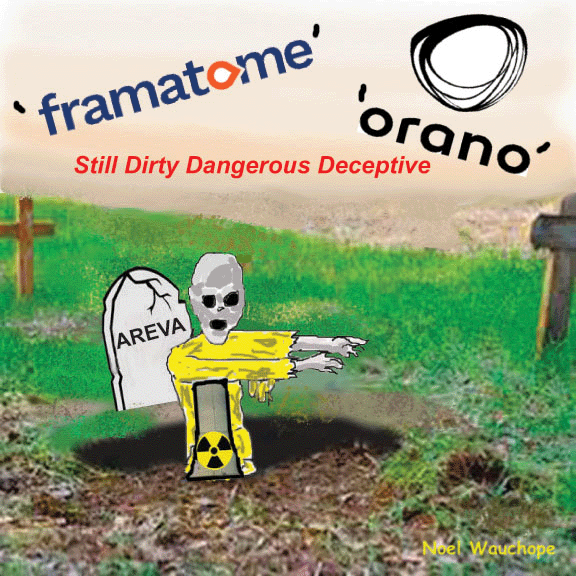
NIGER. Failed AREVA, failed ORANO leave a toxic uranium mess in Niger.
AUSTRALIA.
Labor Party’s platform on uranium/nuclear and radioactive waste issues. Scott Morrison’s $billion missile spend, a gift to foreign war companies and their sponsor, the Australian Strategic Policy Institute, (ASPI). Greenland might reject Australian-Chinese company Greenland Minerals in its bid to mine rare earths.
By 21st April, will the European Commission be sucked in by a shonky anonymous report that pretends that nuclear power is ”green”?

Ouest France 2nd April 2021, https://www.ouest-france.fr/environnement/climat/finance-verte-il-n-y-a-plus-de-limites-a-l-obsession-francaise-pour-le-nucleaire-70a744b2-9190-11eb-954a-acefbc765f05
Luxembourg’s Energy Minister, Claude Turmes, does not like the turn taken by the European Commission’s future tool to direct investments towards the low-carbon transition, called “taxonomy”. States, including France and Hungary, are campaigning to include nuclear and gas. At the expense of the climate emergency.
Europe will be the first carbon neutral continent in 2050, announced in December Ursula von der Leyen, President of the European Commission. To achieve this, its Green Pact notably includes taxonomy, which must direct investments. Claude Turmes, Minister of Energy of Luxembourg and former MEP for the Greens, is worried about the turn of the future tool.
The European Commission will soon say what is and what is not “a green investment”. What does this green taxonomy represent?
Money is the crux of the matter, even for climate change. It is important, alongside regulatory laws that governments or Europe can make, to direct billions of euros of investment towards appropriate infrastructure for the environment.
This work was well underway. The Technical Expert Group on Sustainable Finance (TEG) in March 2020 produced a report, widely accepted by the financial world, to which this taxonomy is first addressed.
Of course, financiers do not form a homogeneous whole, but the major central banks, especially since Christine Lagarde took over the reins of the European Central Bank, now know everything about carbon risk.
Since then, a report has been published in favor of nuclear power, which Luxembourg rejects. How do you react ?
I’m not surprised. The JCR (Joint Research Center), commissioned for this report, was created by Euratom and 25% of its activities are nuclear. But it is extraordinary to have withdrawn the evaluation of this dossier from a group that had worked transparently to hand it over to another, pro-nuclear and which the authors do not agree to sign. What regime are we in, to publish an anonymous report?
Nuclear power [purports to be] is low-carbon energy, with many jobs, which France defends …
Yes, Emmanuel Macron signed a letter with Hungarian Orban or Kazcynski’s Poland for the European executive… I will leave aside the issue of human rights and the questionable attachment of these countries to the EU. The fact remains that the French government is making an alliance with pro-gas, pro-fossils, for the cause of nuclear power. There are no longer any limits to the French obsession with nuclear power which, economically, is dead.
Off-shore wind power is half the cost, takes half the time and is creating as many jobs, without risk for the population. By persisting, France is missing out on a market of the future. With the Benelux, Germany and Denmark, we have agreed on a target of 350 GW (the French nuclear fleet: 60 GW) in the North Sea and the Baltic. And the United States is coming.
How can we get along between European neighbors, some of whom are pro and others anti-nuclear?
From my window, I can see the Cattenom power station (in Thionville, in Moselle). Building nuclear reactors at the borders, I don’t call it good neighborliness. We have known from Prime Minister Tony Blair’s 2003 White Paper affair that the British military sector lobbied to save nuclear (in 2007) and submarine engines. This link between civilian and military nuclear power, no politician will ever say it in France.
This atomic energy is like a huge corpse hidden in a family house. Unlike Germany, France has not yet dismantled a large power plant and has not provided enough money to do so, this was the subject of Barbara Pompili’s report in 2018 (when she was deputy). When this is done, the real cost will be apparent. For now, we bury it and it’s the big headlong rush.
Gas could also be classified as green under certain conditions …
When you know the climate emergency, it is sad to see the taxonomy, which can make the EU a world leader on climate, destroyed by lobbying work. The beauty of taxonomy is its clarity that we risk losing by including conditions, like some plants, but not others. The financial world and the citizens who want to invest their money in green funds need clarity
All this lobbying is a diversion. But we don’t have time anymore. We must move quickly on renewable energies, energy security, infrastructure and electric public transport, and green the cities against the heat waves that are coming. Money invested elsewhere is a problem.
The Commission is due to return its copy on April 21. Do anti-nuclear European countries like Luxembourg plan to react?
We see that the Foratom lobby and the French government are already claiming victory. We hope that the President of the Commission, Ursula von der Leyen, has understood that this will seriously “froth”, that she is risking a lot, by accepting nuclear power. We’re getting organized, we won’t give up.
France’s President Macron leads East European leaders in the pack to get the European leaders to call nuclear power ”green”
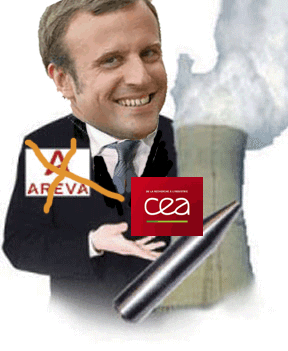
Oil Price 3rd April 2021, Together with Eastern European leaders, French President Emmanuel Macron
co-signed a letter calling on the European Commission to include nuclear energy in its Green taxonomy. The letter was written on March 19th and was public after a European Council summit held on March 25th.
The European taxonomy establishes an extensive list of “sustainable” activities which will help achieve the carbon neutrality target by 2050 and will benefit from targeted investments. In the framework of that classification, nuclear energy currently finds itself under the “does not harm” label,which doesn’t make it eligible for investments with lower tax rates.
-
Archives
- February 2026 (233)
- January 2026 (308)
- December 2025 (358)
- November 2025 (359)
- October 2025 (376)
- September 2025 (258)
- August 2025 (319)
- July 2025 (230)
- June 2025 (348)
- May 2025 (261)
- April 2025 (305)
- March 2025 (319)
-
Categories
- 1
- 1 NUCLEAR ISSUES
- business and costs
- climate change
- culture and arts
- ENERGY
- environment
- health
- history
- indigenous issues
- Legal
- marketing of nuclear
- media
- opposition to nuclear
- PERSONAL STORIES
- politics
- politics international
- Religion and ethics
- safety
- secrets,lies and civil liberties
- spinbuster
- technology
- Uranium
- wastes
- weapons and war
- Women
- 2 WORLD
- ACTION
- AFRICA
- Atrocities
- AUSTRALIA
- Christina's notes
- Christina's themes
- culture and arts
- Events
- Fuk 2022
- Fuk 2023
- Fukushima 2017
- Fukushima 2018
- fukushima 2019
- Fukushima 2020
- Fukushima 2021
- general
- global warming
- Humour (God we need it)
- Nuclear
- RARE EARTHS
- Reference
- resources – print
- Resources -audiovicual
- Weekly Newsletter
- World
- World Nuclear
- YouTube
-
RSS
Entries RSS
Comments RSS
 nuclear-news