Time to clean up Bikini Atoll,to right the nuclear wrongs done to the Pacific islands people.
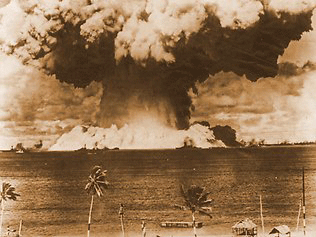 After 75 years, it’s time to clean Bikini https://thebulletin.org/2021/03/after-75-years-its-time-to-clean-bikini/?utm_source=Newsletter&utm_medium=Email&utm_campaign=ThursdayNewsletter03112021&utm_content=NuclearRisk_CleanBikini_03082021
By Hart Rapaport, Ivana Nikolić Hughes | March 9, 2021, Due to their remote location in the Northern Marshall Islands, the people of Bikini Atoll were spared the worst of the mid-Pacific fighting between the American and Japanese armies in the final years of World War II. Their millennia-old culture and sustainable way of life ended abruptly when, in early 1946, Commodore Ben Wyatt, a representative of the occupying United States Navy, informed King Juda and other Bikini residents that the US would begin to test nuclear weapons near their homes. Wyatt asked the Bikinians to move elsewhere, stating that the temporary move was for “the good of mankind and to end all wars.” Though Wyatt may have believed his words to be true, the show of might by the US that followed neither ended all conflict, nor was the exodus short-lived. Seventy-five years later, Bikinians have yet to return.
Nuclear testing in Bikini and other Marshall Islands, which lasted from 1946 to 1958, received international attention at the time. In those early Cold War days, America demonstrated its nuclear prowess through images of mushroom cloud blasts towering over the Pacific on the cover of Time magazine and other prominent publications. The word Bikini infiltrated popular culture via the name of a two-piece swimsuit (named by a French designer to be “explosive”) and SpongeBob’s home, without simultaneously suffusing our conscience with an awareness of the injustices and suffering those blasts caused the Marshallese people.
It is time, finally, to recognize and right the wrongs perpetrated by the US government in the Marshall Islands. The US forced a new and dangerous technology on the native lands and peoples, without fully comprehending the short- and long-term consequences. The Marshall Islands–and Bikini specifically–ended up the site of most of the tests of US hydrogen bombs, weapons up to a thousand times more powerful than atomic bombs used in attacks on Japan in 1945. Later, when the refugees were briefly returned to Bikini after testing ended, they were exposed to harmful radiation amounts with devastating health effects.
To be sure, the US government has taken steps to monitor and address the contamination that resulted from these nuclear detonations. However, the status quo—studies by the Energy Department for the sake of scientific publications and reports, while Bikinians continue to live on other islands—is not only inadequate, but morally repugnant. Bikini is a native land and water that, over thousands of years, was critical to the people’s sustenance and the bedrock of their culture. While some of those who survived the decades of relocations are still alive, their children and grandchildren, including the descendants of King Juda, have yet to resettle their ancestral home. Without an immediate US-government-funded plan to resettle the living refugees, the millennia-long culture and history tied to the atoll may be lost forever. Also, as one of the highest lying islands in the region, Bikini could be the solution to challenges the Marshallese face from global warming and corresponding rise of sea levels.
But it’s not as simple as saying: “Let’s move the Bikinians back.” A permanent return to the atoll by a multi-generational community would risk serious health effects unless sources of remaining radiological contamination in Bikini’s fruit, soil, and lagoon are addressed and removed, according to our research at Columbia University’s K=1 Project, Center for Nuclear Studies. We have found radioactive materials throughout Bikini Atoll, resulting in background gamma radiation above the limit agreed upon by the Republic of the Marshall Islands and US and levels of cesium-137 in various fruits that violate most relevant international and domestic safety standards. Even the waters surrounding Bikini, a formerly plentiful source of food, are riddled with radioisotopes from the detonations. The cleanup may require a novel scientific approach on par with that used after the Chernobyl and Fukushima nuclear accidents. That said, a modern nuclear testing cleanup protocol may prove useful in the event of future nuclear incidents in the United States or elsewhere.
The Biden administration has promised to lead in domestic and international spheres with morals and compassion. To do so, it must engage in a truthful, comprehensive accounting of past missteps in the Marshall Islands, regardless of whether the cost of reparations and resettlement exceeds its current pledge of roughly $110 million to Bikini. Commodore Wyatt’s allegedly “temporary” displacement of Bikinians from their native land has lasted 75 years and counting. Will the Biden administration act with morals to clean remaining radioactive material from US detonations? Will it act with compassion to help Bikinians find their way home?
Global nuclear industry in decline since 1996, even without Fukushima disaster
 Clean Energy Wire 11th March 2021, Germany right to stick to nuclear exit despite revival plans abroad – media comments. On the tenth anniversary of the Fukushima nuclear desaster, a majority of media commentators in Germany praised the country’s decision to exit the technology for good. Clean Energy Wire 11th March 2021, Germany right to stick to nuclear exit despite revival plans abroad – media comments. On the tenth anniversary of the Fukushima nuclear desaster, a majority of media commentators in Germany praised the country’s decision to exit the technology for good.Nuclear power may be gaining new advocates and investors around the world due to its [very dubiously] potential role in enabling a climate neutral economy, but the technology’s days are numbered, Christoph von Eichhorn writes in the Süddeutsche Zeitung.
“When the devastating wave hit Japan’s shores and destroyed the Fukushima-Daiichi nuclear plant, it hit a technology that was in decline already – even without having experienced three nuclear meltdowns at once,” von Eichhorn argues, adding that the global nuclear power share reached a peak at around 17 percent in 1996 and has declined ever since to around ten percent today.
Almost no country announced a nuclear exit after the disaster, but it led to higher regulatory hurdles, tighter safety measures, and cost increases that make the technology less and less profitable, von Eichhorn adds.
|
|
Japan’s main opposition party -”Japanese society is viable without operating nuclear power plants”
|
Mainichi 12th March 2021, Yukio Edano, leader of the main opposition Constitutional Democratic Party of Japan (CDP), expressed his intention to aim for the elimination of
nuclear power in Japan on March 11 — the 10th anniversary of the 2011 Great East Japan Earthquake and tsunami — after earlier stating it was no easy task. Edano’s declaration appeared to be a response to criticism over
his recent comment that “ending nuclear power is not easy.” Edano told reporters at the Diet, “It has been demonstrated during these 10 years that Japanese society is viable without operating nuclear power plants. I intend to make a society that does not depend on nuclear power permanent.” https://mainichi.jp/english/articles/20210312/p2a/00m/0na/002000c |
|
Fukushima: “How Japan was blinded to the predicted certainty of disaster”.
Impossible timetable set for returning Fukushima nuclear site to ‘greenfield”
Greenpeace 11th March 2021, Nine months after the triple reactor meltdown at the Fukushima Daiichinuclear plant in March 2011, Tokyo Electric Power Company (TEPCO) announced that decommissioning of the site will be completed within 30-40 years.
Practically, the people of Japan were told that some time between 2041 and 2051, the site would be returned to ‘greenfield.’ In the past decade, the complexity and scale of the challenge at the Fukushima Daiichi site has become slowly clearer. The decommissioning task at the Fukushima Daiichi site is unique in its challenge to society and technology. But still, the
official time frame for TEPCO’s Road Map for decommissioning remains that set in 2011.
Small modular reactors not the solution, says German nuclear authority
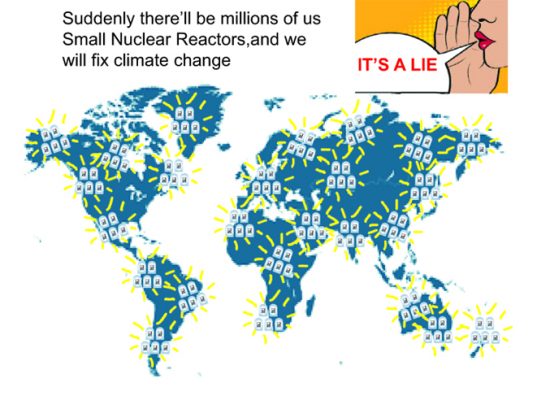
advanced reactor designs and can be operated with converted short-lived radioactive materials, solving the waste problem.
proliferation of weapons-grade materials and will probably never be as cheap as their advocates claim”, Michael Bauchmüller writes. The paper by the Institute for Applied Ecology (Öko-Institut) found that in order to replace the 400 or so large reactors today, “many thousands to tens of thousands of SMR plants” would have to be built. But this raises questions for proliferation, the spread of dangerous nuclear material.
https://reneweconomy.com.au/small-modular-reactors-not-the-solution-says-german-nuclear-authority/
‘Every euro invested in nuclear power makes the climate crisis worse’.

|
Deutsche Welle 11th March 2021, ‘Every euro invested in nuclear power makes the climate crisis worse’. Can nuclear energy help us meet climate goals? The editor of the World Nuclear Industry Status Report, Mycle Schneider, says no. Mycle Schneider:
Today we need to put the question of urgency first. It’s about how much we can reduce greenhouse gases and how quickly for every euro ($1.21) spent. So, it’s a combination between cost and feasibility, while doing it in the fastest possible way. And if we’re talking about the construction of new power plants, then nuclear power is simply excluded.
Not just because it is the most expensive form of electricity generation today, but, above all,
because it takes a long time to build reactors. In other words, every euro invested in new nuclear power plants makes the climate crisis worse because now this money cannot be used to invest in efficient climate protectionoptions. The world’s lowest price for solar power in currently in Portugal, at 1.1 cents per kilowatt hour. And we now have the first results from Spain with costs for wind and solar power at around 2.5 cents per kilowatt hour. These are below the basic operating costs of the vast majority of
nuclear power plants around the world. It would often even be affordordable to pay 1 – 1.5 cents per kilowatt hour for electricity storage in addition to the generation costs for wind and solar power and still be below the operating costs of nuclear power plants. And here we have to ask the same question: How many emissions can I avoid with one euro, one dollar or one yuan? https://www.dw.com/en/nuclear-climate-mycle-schneider-renewables-fukushima/a-56712368 |
|
Public Inquiry MUST Include Nuclear Impacts —

Originally posted on Keep Cumbrian Coal in the Hole: Public Inquiry MUST Include Nuclear Impacts Great news that Robert Jenrick the Communities Secretary of State has called in the coal mine plan for a public inquiry. This must be a no holds barred inquiry which includes nuclear impacts and vested nuclear interests of government rather…
Public Inquiry MUST Include Nuclear Impacts —
1.2 million tonnes of contaminated water and nowhere to put it – Fukushima’s continued legacy

Japan grappling with 1.2 million tonnes of contaminated water and nowhere to put it Japan has a crisis on its hands at the site of the country’s worst natural disaster. One challenge it faces has been deemed near-impossible. NZ Herald, Rohan Smith– 11 March 21,
On the site of Japan’s nuclear disaster, 10 years on from the meltdown that changed the world forever, authorities are grappling with impossible choices.
Today marks a decade since the 2011 Fukushima nuclear disaster. Towns surrounding the Tokyo Electric Power Company’s Fukushima Daiichi plant have long since been abandoned but the fallout from the March 11, 2011 event is far from over.
Every single day, 100 tonnes of groundwater seeps into one of the broken reactor basements at the site of the world’s worst nuclear disaster since Chernobyl.
That’s a problem because the water is mixing with radioactive debris and needs to be treated and stored. But TEPCO has more than 1.2 million tonnes of contaminated water sitting in storage tanks that are very quickly running out of capacity.
Estimates suggest the tanks will reach overflow point next year. And one of the choices on the table for Japanese authorities is hugely unpopular and potentially devastating: Release more than 1 million tonnes of the treated radioactive water into the sea.
On the site of Japan’s nuclear disaster, 10 years on from the meltdown that changed the world forever, authorities are grappling with impossible choices.
It is not the only problem that needs solving. There is a far more dangerous situation unfolding in several of the plant’s damaged reactors.
The plan is to decommission the plant by 2051.
Pictures from abandoned properties in the original exclusion zone show weeds growing around homes that were vacated in a hurry. …. more https://www.nzherald.co.nz/world/japan-grappling-with-12-million-tonnes-of-radioactive-water-and-nowhere-to-put-it/33TKZUD6JM4GHFJSMIBZ3WZKVY/
The long-term problem of “peaceful” plutonium
 The long-term problem of “peaceful” plutonium https://thebulletin.org/2021/03/the-long-term-problem-of-peaceful-plutonium/?fbclid=IwAR1T1BwrLHnDoN3IBw7SxlR8H8-Hzy-auzsmNuYbPy3IZrzSXrWBW4Zfop8 The long-term problem of “peaceful” plutonium https://thebulletin.org/2021/03/the-long-term-problem-of-peaceful-plutonium/?fbclid=IwAR1T1BwrLHnDoN3IBw7SxlR8H8-Hzy-auzsmNuYbPy3IZrzSXrWBW4Zfop8
By Robert Alvarez | March 8, 2021 In the early decades of the atomic age, using the enormous energy in plutonium atoms for the peaceful generation of electricity became a multibillion-dollar quest that shaped US energy research and development policies. In 1970, Glenn Seaborg, the discoverer of plutonium and then-chairman of the US Atomic Energy Commission, declared that “within the lifespan of a single generation this newcomer plutonium born on a humble research budget and cradled in a cigar box will have become the energy giant of the future.” Seaborg and the AEC projected the growth of nuclear-powered electricity would be so great that global supplies of uranium would be exhausted, paving the way for the recovery of plutonium from spent power reactor fuel for the next generation of power plants, which would dot the global landscape. Seaborg estimated by the end of the 20th century, power reactors would cumulatively produce 1,600 metric tons of plutonium with the potential to fuel half the nation’s electrical generation. With this much plutonium flowing through commerce, the possibility that some of it might be diverted for nefarious purposes was not lost on prominent members of the US national security establishment. Losing track of just .0003 percent of the amount estimated by Seaborg would be enough to fuel a Nakasaki-sized nuclear weapon. Opposition by America’s Cold War nuclear policy makers was galvanized following India’s nuclear weapons test in May 1974. India’s bomb was fueled with plutonium produced from “peaceful atom” technology provided by the United States and Canada. Albert Wohlstetter, a prominent American nuclear strategist and cold warrior, concluded that the U.S. pursuit of plutonium fuel could result in “life in an armed nuclear crowd. In response to the Indian test, the Carter administration banned chemical separation of plutonium from irradiated power reactor fuel—the process known as reprocessing—in 1977. The US “plutonium economy” was also dealt a major blow by the 1982 Nuclear Waste Policy Act, which underscored the Carter Administration’s non-proliferation goals by giving priority to the direct geologic disposal of spent nuclear fuel, without reprocessing. President Reagan lifted the ban and President George W. Bush attempted to revive reprocessing, but those efforts collapsed in the United States under the weight of the expense, safety problems, and security risks of a widespread reprocessing program. Since the early 1980s, the US Congress has shown little appetite for resuming support of the commercial development of plutonium as a reactor fuel. In response to the Indian test, the Carter administration banned chemical separation of plutonium from irradiated power reactor fuel—the process known as reprocessing—in 1977. The US “plutonium economy” was also dealt a major blow by the 1982 Nuclear Waste Policy Act, which underscored the Carter Administration’s non-proliferation goals by giving priority to the direct geologic disposal of spent nuclear fuel, without reprocessing. President Reagan lifted the ban and President George W. Bush attempted to revive reprocessing, but those efforts collapsed in the United States under the weight of the expense, safety problems, and security risks of a widespread reprocessing program. Since the early 1980s, the US Congress has shown little appetite for resuming support of the commercial development of plutonium as a reactor fuel. As of the end of 2018, US spent power reactor fuel contained about 824 metric tons of plutonium—the world’s largest single inventory of that element. The intense radiation of used nuclear fuel assemblies makes them essentially impervious to theft or diversion to weapons use. But after 300 years, a great deal of the radiation barrier protecting them will have decayed. The Nuclear Waste Policy Act lays out a process for geologically directly disposing of spent nuclear power fuel in an underground repository, rather than allowing plutonium to be separated from it. Reprocessing “would incur a substantial cost penalty,” concluded an industry study in 2006 and would be far more costly more expensive than direct spent nuclear fuel disposal. “[Re]processing would have to be accompanied by deployment of fast reactor plants. But demonstration fast reactor plants to-date has mostly proved expensive and unreliable, which aggravates [re]processing’s economic handicap.” But nearly 40 years later, geologic disposal of spent power reactor fuel remains uncertain after President Obama’s cancellation in 2010 of the proposed Yucca Mountain repository site in Nevada. By the mid-21st century, the amount of plutonium in spent power reactor fuel could grow to more than 1,400 metric tons. The 300-year clock measuring off the time until the radiation barrier diminishes to the point that this vast amount of weapons-usable plutonium can be readily obtained is still ticking.
|
|
Ten years on from Fukushima, nuclear power continues to struggle with deeper problems.
Ten years on from Fukushima, nuclear power continues to struggle with deeper problems. Renew Economy,
Ketan Joshi 10 March 2021 ”……….. Why couldn’t the power plant withstand the tsunami? The official Japanese government inquiry found that it was “collusion between the government, the regulators and TEPCO, and the lack of governance by said parties. They effectively betrayed the nation’s right to be safe from nuclear accidents”.
The Fukushima accident has been at times framed as a turn-around point – a disaster exploited by cynical Greens. It was exploited at times, but at most it accelerated pre-existing trends.
In some places in the world, it seems important to sweat nuclear plants for as long as possible. In the US, for instance, the boom of cheap fossil fuels and an absence of strong renewable policies mean gaps will be filled by higher-polluting plants. In Europe, the drumbeat of closures is essentially inevitable, and that means deploying replacement clean energy portfolios as quickly as possible to ensure fossil fuels don’t take hold.
The Fukushima disaster simply catalysed a collection of deep, systemic factors that were already in place, and remain in place today. Nuclear will certainly play some role in the world’s future electricity grids, most likely in countries like China and India. But elsewhere, it is wind and solar that have become the most favoured to serve as the workhorses of grids. They too are not immune to public backlash, to poor economics or to industry headwinds, and there must be far more effort put in to ensuring they don’t suffer a similar fate. https://reneweconomy.com.au/ten-years-on-from-fukushima-nuclear-power-continues-to-struggle-with-deeper-problems/
French Nuclear tests: revelations about a cancer epidemic

|
Nuclear tests: revelations about a cancer epidemic https://www.mediapart.fr/journal/international/090321/essais-nucleaires-revelations-sur-une-epidemie-de-cancers MARCH 9, 2021 BY DISCLOSE
In a confidential report, the Polynesian government acknowledges the existence of a “cluster of thyroid cancers” directly linked to French nuclear tests.On July 2, 1966, in the greatest secrecy, France carried out its first nuclear test in the Polynesian sky. That day, at 5:34 am, Aldebaran, the name given to the bomb, was fired from a barge installed on an azure lagoon, near the Mururoa atoll. A few microseconds after the explosion, a fireball appears. This incandescent mass of several thousand degrees rises in the sky and forms, as it cools, a huge cloud of radioactive dust dispersed by the winds. No less than 46 “atmospheric” tests like this one have been carried out in the space of eight years. Each time, the explosion generated fallout contaminating everything in their path. Starting with the inhabitants of the islands. In total, they were exposed 297 times to intense levels of radioactivity. The general staff have always held to the same line of defense. The atmospheric tests, presented as “clean”, would not have had “consequences for the health” of the Polynesians. For years, the associations defending the victims of the trials have been convinced to the contrary. As for the scientific community, it has tried several times to verify this position through in-depth analyzes of official data, without success. Latest illustrations of this failure: the study published by the National Institute of Health and Medical Research (Inserm) on February 18. At the end of this work commissioned by the Ministry of Defense eight years ago, Inserm considered that the “links between the fallout from atmospheric tests and the occurrence of radiation-induced pathologies” were difficult to establish, due to a lack of data. reliable on the contamination of the archipelagos. Cluster of cancers ” However, a confidential report submitted to the Polynesian government a year earlier, in February 2020, argues the opposite. Disclose has obtained a copy of this never-before-released document. Soberly titled “Health consequences of French nuclear tests in the Pacific”, this eight-page report was written by a French military doctor at the request of the Monitoring Medical Center, an administration created in 2007 by the French and Polynesian governments and responsible for screening radiation-induced diseases. In other words, pathologies linked to repeated exposure to ionizing radiation. According to the author, some 10,000 Polynesians, including 600 children under the age of 15 living in the Gambier Islands, Tureia or even Tahiti have thus received a dose of radioactivity of 5 millisieverts (mSv), that is to say five times more than the minimum threshold (1 mSv) above which exposure is considered dangerous for human health. But the most embarrassing information is on page 5 of the document. For the first time, an official report establishes a direct link between nuclear tests and the extent of the number of cancers in the population. “The presence of a ‘cluster’ of thyroid cancers focused on the islands subjected to fallout during aerial shots, and in particular in the Gambier Islands, leaves little doubt about the role of ionizing radiation, and in particular of thyroid exposure to radioactive iodine, in the occurrence of this excess of cancers, ”says the author. The thyroid, an organ at the base of the neck, is particularly sensitive to ionizing radiation, especially in childhood, when the risk of developing thyroid cancer is greatest. The incidence of thyroid cancer and the link with the atmospheric gunfire campaign were precisely the subject of an Inserm analysis in 2010. According to this study, 153 thyroid cancers were diagnosed between 1985 and 1995 in the population born before 1976 and residing in French Polynesia. As a result, the number of people with thyroid cancer was two to three times higher than in New Zealand and Hawaii. Without being able to establish a direct link with nuclear tests, the college of experts already deplored the lack of available data. Based on data from the time, Disclose and Interprt, in partnership with the Science and Global Security program at Princeton University (United States), reassessed the doses of radioactivity received in the thyroid by the inhabitants of the Gambier, of Tureia and Tahiti during six of the most contaminating nuclear tests. Our estimates show that the doses received would be between two and ten times higher than the estimates established by the French Atomic Energy Commission (CEA) in 2006. How can we explain such a gap between our results and those of the CEA? The answer lies in the details of the calculation options chosen by the scientists at the Atomic Energy Commission. Take the example of Aldebaran, the first test in the open air. The CEA estimated that the population of the Gambier Islands, very exposed to toxic fallout, only drank river water, but no rainwater, which is much more loaded with radioactive particles. Many witnesses met in Polynesia question this assertion. This is the case with Julie Lequesme, 12 years old at the time of the events. “We had only that, rainwater,” says the resident of Taku, a village northeast of Mangareva, the main island of the Gambier archipelago. The same goes for Rikitea, the capital of the island, where “the running water network was not completed until the end of the 1970s”, specifies Jerry Gooding, the former president of the association. , the main organization supporting civilian victims of nuclear tests. Rainwater consumption is also confirmed by at least four official documents we obtained. A study by the Office for Scientific and Technical Research Overseas (Orstom) published in August 1966, one month after the start of the tests, thus notes that some of the islanders only consumed rainwater, in particular in because of their isolation. Same conclusion in a report from the Joint Biological Control Service (SMCB), an army service, dated April 24, 1968. By reintegrating the consumption of rainwater after Aldebaran, our estimates for the exposure of a child aged 1 to 2 at the time are 2.5 times higher than official calculations. Of the six tests we reconstructed, the consumption of rainwater was the main source of exposure to radioactivity for five of them. By choosing not to incorporate this data or by minimizing its importance, the state has therefore knowingly underestimated the extent of the contamination. In the Gambiers, cancer as a legacy According to the Ministry of the Armed Forces, the Gambier Islands have been affected by atmospheric fallout 31 times. In fact, the archipelago was struck by all the tests carried out between 1966 and 1974. Since then, cancer has spread everywhere. From Rikitea to Taku, to the shore of Taravai, the inhabitants are convinced: this plague is directly linked to atomic experiments. By investigating the field and meeting dozens of witnesses, Disclose was able to map the disease in Mangareva, the main Gambier island. Although we have not been able to establish a direct link between the trials and the number of cancers on site, the result is instructive. Yves Salmon developed carcinoma, a radiation-induced cancer of the blood, in 2010. His wife contracted breast cancer. She was recognized as a victim of French nuclear tests. The same goes for his sister. Utinio, Yves Salmon’s neighbor, contracted thyroid cancer in 2001. The man, who still lives near the village of Taku, spent his childhood in the Gambiers. In 2010, the French state finally recognized him as a victim of nuclear tests. Monique, 69, is Utinio’s cousin. She was a thyroid cancer survivor after two years in hospital and received state compensation in August 2011. Monique has six children, four of whom have thyroid cancer. Her two daughters have sought compensation from the Nuclear Test Victims Compensation Committee (Civen) without having received any answers yet. Sylvie (first name has been changed) and her older sister, born in 1972 and 1971, both suffered from breast cancer. “It was when our elders started dying that we really began to wonder,” said the eldest. Their mother died of the same disease in 2009. She was recognized as a victim of nuclear tests, just like Sylvie. This resident of Mangareva now fears for her daughter. Julie Lequesme’s father, an elder from Taku village, died of throat cancer in 1981 after working in Mururoa. “The island doctor told me that based on my father’s X-rays, he was a heavy smoker,” she says. However, my father never touched a cigarette. Her husband, a CEA alumnus, also died of cancer in 2010. In the family of Catherine Serda, a former resident of the small village of Taku, eight people suffered from cancer between the end of the 1970s and the beginning of the 1990s. Their common point: they all lived in Mangareva at the time. tests. If you have any information to give us, you can contact us at enquete@mediapart.fr. If you wish to send documents through a highly secure platform, you can connect to the frenchleaks.fr site |
|
110, 000 people in French Polynesia affected by the radioactive fallout from atomic bomb tests
BBC 9th March 2021, Researchers used declassified French military documents, calculations and testimonies to reconstruct the impact of a number of the tests. They
estimated that around 110,000 people in French Polynesia were affected by
the radioactive fallout. The number represented “almost the entire”
population at the time, the researchers found.
Australian uranium fuelled Fukushima

The Nuclear Accident Independent Investigation Commission ‒ established by the Japanese Parliament ‒ concluded in its 2012 report that the accident was “a profoundly man-made disaster that could and should have been foreseen and prevented” if not for “a multitude of errors and wilful negligence that left the Fukushima plant unprepared for the events of March 11”.
The accident was the result of “collusion between the government, the regulators and TEPCO”, the commission found.
Mining
But overseas suppliers who turned a blind eye to unacceptable nuclear risks in Japan have largely escaped scrutiny or blame. Australia’s uranium industry is a case in point.
Yuki Tanaka from the Hiroshima Peace Institute noted: “Japan is not the sole nation responsible for the current nuclear disaster. From the manufacture of the reactors by GE to provision of uranium by Canada, Australia and others, many nations are implicated.”
There is no dispute that Australian uranium was used in the Fukushima reactors. The mining companies won’t acknowledge that fact — instead they hide behind claims of “commercial confidentiality” and “security”.
But the Australian Safeguards and Non-Proliferation Office acknowledged in October 2011 that: “We can confirm that Australian obligated nuclear material was at the Fukushima Daiichi site and in each of the reactors — maybe five out of six, or it could have been all of them”.
BHP and Rio Tinto, two of the world’s largest mining companies, supplied Australian uranium to TEPCO and that uranium was used to fuel Fukushima. Continue reading
This Is How the Biggest Arms Manufacturers Steer Millions to Influence US Policy — Rise Up Times

“Since Biden’s inauguration, the report states, the State Department has approved the sale of $85 million in missiles from Raytheon to Chile, and a $60 million deal between Lockheed Martin and Jordan to provide F-16 Fighting Falcons and services.”
This Is How the Biggest Arms Manufacturers Steer Millions to Influence US Policy — Rise Up Times
-
Archives
- February 2026 (228)
- January 2026 (308)
- December 2025 (358)
- November 2025 (359)
- October 2025 (376)
- September 2025 (258)
- August 2025 (319)
- July 2025 (230)
- June 2025 (348)
- May 2025 (261)
- April 2025 (305)
- March 2025 (319)
-
Categories
- 1
- 1 NUCLEAR ISSUES
- business and costs
- climate change
- culture and arts
- ENERGY
- environment
- health
- history
- indigenous issues
- Legal
- marketing of nuclear
- media
- opposition to nuclear
- PERSONAL STORIES
- politics
- politics international
- Religion and ethics
- safety
- secrets,lies and civil liberties
- spinbuster
- technology
- Uranium
- wastes
- weapons and war
- Women
- 2 WORLD
- ACTION
- AFRICA
- Atrocities
- AUSTRALIA
- Christina's notes
- Christina's themes
- culture and arts
- Events
- Fuk 2022
- Fuk 2023
- Fukushima 2017
- Fukushima 2018
- fukushima 2019
- Fukushima 2020
- Fukushima 2021
- general
- global warming
- Humour (God we need it)
- Nuclear
- RARE EARTHS
- Reference
- resources – print
- Resources -audiovicual
- Weekly Newsletter
- World
- World Nuclear
- YouTube
-
RSS
Entries RSS
Comments RSS
 nuclear-news