After 3/11, emergency import of a concrete pump vehicle from China allowed for nuclear power plant cooling

Translated from Japanese by Dennis Riches
March 13, 2021
In order to prevent further damage caused by the accident at the Fukushima Daiichi Nuclear Power Plant, caused by the Great East Japan Earthquake that occurred on March 11, 2011, it was urgent to cool the reactors. At that time, a concrete pump vehicle from China was used to perform this critical task. This is the story of how it came to be used.
At that time, TEPCO and the Japanese government searched for various ways to cool the reactors, and none of the attempts, such as dropping water from helicopters or releasing water using fire engines, were successful. Because it had to avoid radiation exposure as much as possible, the helicopter was almost completely ineffective. It had to drop water from a fairly high position and it was pushed back by the wind. The fire engine was not high enough at all, so it had no effect.
Therefore, it was understood that the sort of vehicle used for pumping concrete through a long boom would be needed. A concrete pump truck is a machine used in construction that can pump concrete to a high height through a collapsible boom. Thus TEPCO wondered if this machine could be used to pump water into the reactors. This would be more effective than using fire trucks and helicopters, but there was one big problem.
Regulations of the Road Transport Vehicle Act limited the angle and total vehicle weight to 25 tons, so the length of the boom on machines in Japan was limited to a maximum of 36 m, and there were no 60m-class pump vehicles in Japan that could be used for water-pouring work at a nuclear power plant.
As a result of searching around the world, they found a concrete pump vehicle with a boom of 62 meters in length manufactured by a construction machinery manufacturer called Sanshi Heavy Industries in China. In addition, it was a pump vehicle with very good performance, and it was possible to remotely operate it from two kilometers away. TEPCO immediately told Sanshi Heavy Industries in China that it would like to purchase it through Sanshi Heavy Industries’ Japanese subsidiary, but Mr. Liang Onkon, president of Sanshi Heavy Industries, gave a surprising response.
“Please do not sell to Japan. Don’t sell. Japan is a neighboring country. We share the ocean to our east. Now is the time to reach out to help. The pump vehicle will be donated to the disaster-stricken areas of Japan.” In other words, instead of selling a concrete pump vehicle worth 150 million yen, he replied that he wanted to provide it free of charge. And they didn’t just send vehicles. He said that three expert engineers from Sanshi Heavy Industries would also come to Japan to give lessons on how to operate the machine.
The president of WWB Co., Ltd., a Japanese agent of Sanshi Heavy Industries, looks back on the situation at that time. “When the donation was decided, soon Sanshi Heavy Industries searched for a pump truck with a 62m boom. We found that, very fortunately, there happened to be a concrete pump truck in the port of Shanghai that matched the requirements. The machine was due to be shipped to a client in Germany. I was about to leave for Germany, but the German company readily agreed and decided to send it to the disaster-stricken areas of Japan through the Red Cross Society. The concrete pump vehicle was taken from the ship heading to Germany and immediately put on the Suzhou (a ship going from Shanghai to Osaka) and headed for Japan. After arriving in Japan, I spent two days learning how to operate it in Noda City, Chiba Prefecture, and then I left for Fukushima.”
In this interview, we were able to talk in detail with Tomohiro Kawazoe, then president of Sanichi Japan, a Japanese subsidiary of Sanichi Heavy Industries. “I made a trip by myself from Osaka to Chiba to Fukushima because I had to examine the route in detail to check road width, bridges, tunnels, etc. It is a vehicle with a total weight of 55 tons.”
The police in the prefectures along the route also cooperated fully, and traffic restrictions such as 100 blockades of roads were also carried out in some areas so that they could move safely to Fukushima. Police cars in each prefecture escorted the concrete pump vehicle.
Originally, there were various regulations and it would ordinarily take time to travel on public roads in Japan with such an unusual cargo, but this time the issuance of provisional permits was done smoothly. These were extrajudicial measures because the machine was donated with the Red Cross Society as an intermediary. The project was realized in an unusually short period of about two weeks.

https://news.yahoo.co.jp/articles/75482f8d957a3609194000b3cf87145debe1ecc4
The truth about Fukushima today – and the cover-up – Thomas A Bass
 Fukushima today: “I’m glad that I realized my mistake before I died.” Bulletin of the Atomic Scientists, By Thomas A. Bass | March 10, 2021After the nuclear disaster at Fukushima, evacuees were put in what was supposed to be temporary housing built in parking lots and fields on the outskirts of inland towns. These metal structures were measured by the size of Japan’s traditional tatami sleeping mats, typically about 36 by 71 inches.
Takenori and Tomoko Kobayashi lived in an eight-tatami-mat house for the next five years—nuclear refugees inhabiting 132 square feet of living space.
In 2016, Mr. and Mrs. Kobayashi were allowed to return to their former home in Odaka, a village on the edge of Fukushima’s 20-kilometer exclusion zone, where Tomoko is a third-generation innkeeper. Owner of a small ryokan—a traditional Japanese hotel with common baths and a dining room holding a long table for family and guests—she invited volunteers to help her scrub down the inn, plant flowers along the roadside, open a gift shop, and rescue some of the area’s famous “samurai horses,” which are now branded with the white mark that labels radioactive livestock.
The operator of the plant, the Tokyo Electric Power Company, or TEPCO, evacuated its workers from F1 and ordered the site abandoned. The Japanese prime minister, in a dawn visit to TEPCO headquarters in Tokyo, effectively seized the company and demanded that they keep working. As a result, a suicide squad of older workers struggled to contain the disaster. Known as the “Fukushima Fifty” (which actually numbered 69) they tried to cool the reactors with fire trucks brought from Tokyo, 140 miles to the south. The command center for managing the disaster was moved to J-Village.
No one can say with 100-percent certainty the amount of radiation that came from Fukushima, since most of this radiation has been carried eastward into the ocean. At the high end, Fukushima may be worse than Chernobyl in terms of global contamination. At the low end, the Nuclear Energy Institute estimates that Fukushima’s release is one-tenth that of the accident at Chernobyl—which is estimated to have scattered between 50 and 200 million curies of radiation over Russia and Central Europe says Kate Brown, the MIT historian who published a book on Chernobyl in 2019. (One curie equals 37 billion becquerels, the standard unit of measurement for radioactive decays per second.) To give a sense of scale, this amount of radiation is the equivalent of what would have been emitted by at least 400 Hiroshima bombs, according to the International Atomic Energy Agency. As Nobel laureate Kenzaburō Ōe says of the Fukushima disaster, unlike Hiroshima and Nagasaki, this time Japan bombed itself.
Compounding the problem, most of Fukushima’s dosimeters were swept away in the flood or knocked offline. Readings from US military planes flying overhead and ships sailing offshore differed dramatically from those reported by TEPCO. The same is true for spot readings of air and soil samples around the plant………..
F1’s reactors are still radioactively hot. They are lethal to humans who approach them and even the robots sent to explore the melting cores are quickly fried; in 2017, TEPCO lost two robots in two weeks. But some of the nuclear exclusion zone has been re-opened—at least officially—to resettlement, and the Japanese government is paying two million yen (about $20,000) to people who move into the area.
Ouside the core but still in the zone. An army of about 100,000 workers has spent a decade scraping up and bagging radioactively contaminated soil. Consequently, what were once the emerald green rice paddies of Fukushima’s coastal plain are now filled with black plastic garbage bags holding mountains of radioactive dirt…………..
casual attitude toward radiation is widespread. “We found a disregard for global trends and a disregard for public safety,” said the parliamentary report on the Fukushima disaster, known as The Official Report of The Fukushima Nuclear Accident Independent Investigation Commission. “Across the board, the commission found ignorance and arrogance unforgivable for anyone or any organization that deals with nuclear power,” the report’s authors concluded.
They went on to note: “What must be admitted—very painfully—is this was a disaster ‘Made in Japan.’ ”
If Japan covered up the risks involved in building 54 nuclear reactors on its geologically unstable shores, it is now covering up the consequences. A government-sponsored study of radiation exposure in Fukushima prefecture undercounted people’s exposure by two-thirds. Australian physician Tilman Ruff, co-founder of the International Campaign to Abolish Nuclear Weapons (which won the 2017 Nobel Peace Prize), wrote me to say that doctors have left the area because the government refuses to reimburse them when they list radiation sickness as the cause for nose bleeds, spontaneous abortions, and other ailments resulting from ionizing radiation. (The only acceptable diagnoses are so-called “radiophobia,” nervousness, and stress.) The spike in thyroid cancer among children in Fukushima is dismissed as a survey error, produced by examining too many children.
The government has mounted no epidemiological study in Fukushima. It has established no baseline for comparing public health before and after the disaster. Instead, it has greenlighted the use of radioactive ash and soil from Fukushima in construction projects throughout the country, the Japan Times reported.
The generally accepted safety standard for radiation exposure is one milliSievert, or one-thousandth of a Sievert, per year. Different countries have different standards, but in the United States, the Nuclear Regulatory Commission requires that the operators of nuclear power plants limit the amount of their incidental radiation exposure to individual members of the public to 1 milliSievert (1,000 microSieverts) per year above the average annual background radiation, and this figure has become a sort of rough international average benchmark. (For comparison’s sake, the natural level of background radiation usually averages in the range of up to as much as 3 milliSieverts annually.)
But in its haste to deal with the Fukushima emergency in the months after the accident, the Japanese government simply raised the limit of what was considered an acceptable amount of incidental radiation coming from the now-defunct nuclear power plant.
The Japanese government now allows individuals in Fukushima prefecture to be exposed to 20 milliSieverts per year of incidental radiation, above and beyond what was emitted naturally, reported Scientific American. Figures like these are a far cry from that international average benchmark of 1 milliSievert annually.
To give a sense of scale, a figure in the 20 milliSieverts range means that a schoolchild in Fukushima can be exposed to the same amount of radiation as the average adult working full-time in a nuclear power plant.
The limit in the rest of Japan, outside of Fukushima’s environs, remains 1 milliSievert per year.
21st-century versions of hibakusha, or “bomb-affected people”? Anyone objecting to Fukushima’s 20-fold increase in allowable radiation exposure is criticized for promoting “harmful rumors.” After China and 50 other countries banned the importation of food from Fukushima on the grounds that it might be radioactive, the Japanese authorities reacted vehemently, and critics of the Japanese government’s response to the handling of anything related to Fukushima were treated like economic saboteurs. Similarly, refugees from Fukushima are scorned in other parts of Japan, and the Asahi Shimbun reported “widespread bullying and stigmatization of evacuees.” This finding was echoed by the UK newspaper The Independent, which said that “discrimination suffered by evacuee pupils [is] likened to that faced by those who lived through the atom bomb blasts of the Second World War.”
Women from Fukushima are shunned as marriage partners, and a new kind of Fukushima divorce has emerged, with men returning to the area in greater numbers than their wives, who want to keep their children as far away as possible.
“Japan has clamped down on scientific efforts to study the nuclear catastrophe,” said Alex Rosen, a pediatrician who co-chairs the German affiliate of International Physicians for the Prevention of Nuclear War. “There is hardly any literature, any publicized research, on the health effects on humans, and those that are published come from a small group of researchers at Fukushima Medical University, which are centered around the scientist Shunichi Yamashita, who in Japan is called ‘Mr. 100 milliSieverts.’ ” (Yamashita was the spokesman for the Japanese government in the early months of the catastrophe and led the Fukushima health survey for two years, before being forced to resign in 2013. Contradicting his earlier research and instructions to his own staff, Yamashita told the public that 100 milliSieverts of radiation was harmless. He recommended against administering iodine pills to prevent thyroid cancer, and told people that their best protection against radiation poisoning was literally to smile and be happy.)
Four thousand people continue to labor daily to contain the ongoing disaster at F1. They pump cooling water into reactor cores and fuel pools, while struggling to keep the damaged buildings from collapsing. More than a billion liters of contaminated water—the equivalent of 480 Olympic-sized swimming pools—are stored on-site in rusting tanks. Claiming that it has run out of storage room, TEPCO is planning to release this water directly into the ocean. For years, TEPCO maintained that the water stored at F1 had been scrubbed of radioactivity, save for tritium, a water-soluble isotope that is said to be relatively safe. In 2014, TEPCO was forced to admit that its cleaning process had failed, and Fukushima’s cooling water is actually contaminated with high levels of strontium-90 and other radioactive elements.
From the day it opened, Fukushima Daiichi struggled to contain the groundwater that rushed down from the nearby mountains and flowed through the plant. Fukushima today is a swamp of groundwater and cooling water contaminated with strontium, tritium, cesium, and other radioactive particles. Engineers have laced the site with ditches, dams, sump pumps, and drains. In 2014, TEPCO was given $292 million in public funds to ring Fukushima with an underground ice wall—a supposedly impermeable barrier of frozen soil. This, too, has failed, having “limited, if any effect,” Japan’s Nuclear Regulation Authority said.
In 2019, the Japan Institute for Economic Research estimated that the cost of cleaning up the Fukushima disaster could reach $747 billion. But there is actually no such thing as saying that a nuclear disaster has been cleaned up. Lumps of radioactive fuel, concrete, and cladding remain lethal for tens of thousands of years. At Chernobyl, this lava-like mass, called the “Elephant’s Foot,” has been buried under a mountain of concrete and covered again by a second, $1.5 billion shield financed by the European Union, which some have dubbed the “sarcophagus.” Sensitive about looking like a failed nuclear power, Japan has vetoed the building of a similar concrete sarcophagus over Fukushima. Instead, relying upon technology yet to be invented, TEPCO plans to scoop up the fuel in its failed reactors and store the waste in some undisclosed location. In the meantime, Fukushima sits like an open wound on Japan’s eastern shore.
The takeaway? Among the new buildings meant to lure settlers back to Fukushima are two museums. In Tamioka, directly to the south of the power plant, a former energy museum has been converted into something called the Decommissioning Archive Center. Films depict actors replaying scenes from the disaster on one floor of the museum and demonstrate TEPCO’s “Progress of the Work” on another floor.
In the village of Futaba, directly to the north of the reactors, the government has erected a three-story building called The Great East Japan Earthquake and Nuclear Disaster Memorial Museum. A former boomtown filled with workers from the plant, Futaba used to have an archway over its main street, declaring, in bold letters, “Atomic Power: Energy for a bright future.” Yuji Onuma created this slogan for a ninth-grade homework assignment. He received a prize from the mayor.
Now living far from Fukushima and running a business installing solar panels, Onuma returned to Futaba one day a few years after the disaster. A photo from that visit shows him wearing a white Tyvek suit, booties, hat, and facemask. Behind him is Futaba’s main street, filled with crumbling buildings and overgrown with weeds. Above him is the archway that TEPCO financed. Over his head, Onuma holds a placard with red-letter writing on it, so the sign instead reads, “Atomic Power: Energy for a destructive future.”
The archway has since been removed and stored in Futaba’s new museum. Onuma wants it reinstalled, where the irony of having his slogan floating over the ruins of a dead city will remind everyone of their original mistake. At the least, he wants the sign put on display in the museum. “I made the wrong slogan,” he recently told an American interviewer. “But I’m glad that I realized my mistake before I died.” https://thebulletin.org/2021/03/fukushima-today-im-glad-that-i-realized-my-mistake-before-i-died/?utm_source=Newsletter&utm_medium=Email&utm_campaign=ThursdayNewsletter032021&utm_content=NuclearRisk_Bass_03102021
Fukushima Nuclear Disaster Nearly ‘Ended The Japanese State’
 This article from Russian publication ‘Sputnik News.It makes insightful poits about the collusion between the nuclear industry and government – in Japan, and the USA. But it’s a pity that the Russian media doesn’t shed light on the situation in Russia, which is probably just as bad – perhaps worse.
Fukushima Nuclear Disaster Nearly ‘Ended The Japanese State’, Radioactive Waste Specialist Explains, Sputnik News, by Mohamed Elmaazi 12 Mar 21, 10 years ago, on 11 March 2011, an earthquake measuring 9.0 on the Richter scale triggered a tsunami that crashed into Japan’s Fukushima Daiichi nuclear power plant. The effect of the resultant meltdown will continue to be felt for generations to come, although it could easily have been far worse, Kevin Kamps of Beyond Nuclear tells Sputnik.
United Nations Scientific Committee on Atomic Radiation (UNSCEAR) report on Fukushima health effects -rushed, inadequate, inconsistent

Dr Ian Fairlie, 12 Mar 21, more https://www.ianfairlie.org/news/latest-unscear-report-on-the-fukushima-nuclear-disaster-in-2011/ On March 9, the United Nations Scientific Committee on Atomic Radiation (UNSCEAR) published an advance copy of its latest (third) report on the health effects from the Fukushima Daichi nuclear accident which commenced on March 11, 2011. UNSCEAR 2020 Report – Annex B – Advance Copy
The report shows signs of having been rushed out as it is an advance copy and is unfinished. It states 23 electronic attachments with supplementary information on detailed analyses of doses to the public and their outcomes are currently in production and will be available soon on the UNSCEAR website.
I shall look at the Report in more detail when the additional information is published. However at the 10th anniversary of the nuclear catastrophe at Fukushima in 2011, it’s necessary to have an initial look at the Report’s comments on contentious issues arising from the accident – (a) the number of expected fatal cancers and (b) the continuing controversy over the cause(s) of the large observed increases in thyroid cancers (TCs) in Japan since 2011.
On (a), the 2020 Report concludes that there are no observed ill health effects from the accident but this conclusion is inconsistent with UNSCEAR’s own estimates of high collective doses from the accident. Table 13 (page 72) of UNSCEAR’s 2020 report shows that, in the first 10 years after the accident, the whole body collective dose from the accident was 32,000 man Gy. When we apply the widely-accepted fatal cancer risk estimate of 10% per Gy to this figure, we see that about 3,000 fatal cancers will have occurred due to the accident, correct to one significant figure. The report’s strange, unscientific conclusion to the contrary is inconsistent with these estimates. The only assumption used here is that radiation’s dose-response relationship follows the linear-no-threshold model, as recognised and used by all the world’s radiation protection authorities.
On (b), the 2020 Report (page 107, para q) concludes that the sharp increase in observed thyroid cancers post-Fukushima was not due to thyroid intakes of iodine isotopes from the accident but due to increased surveillance.
However large collective doses to the thyroid are also published in UNSCEAR’s new 2020 report. In the first 10 years after the accident, the 2020 report states the collective thyroid dose to the Japanese population from the accident was 44,000 man Gy. Again, this is a high number, but the absence of an authoritative risk factor for thyroid cancer – especially among young children aged 0 to 4 who were exposed to both internal intakes of radioactive iodine plus external exposures to ground-deposited Cs-134 and C-137 means that reliable estimates of the actual numbers of thyroid cancer cases due to the accident are unfortunately not possible. The supplementary information yet to be released may enable such calculations to be made. However the large collective dose to the thyroid from Fukushima casts doubt on UNSCEAR’s conclusion that the observed increases are not due to the accident.
I would not be surprised to learn that the negative conclusions in the UNSCEAR 2020 Report might be a reason why an advance copy was rushed out in unfinished form before the anniversary of the Fukushima accident.
I add the caveat that the above analysis is a (second) draft and has not yet been fully peer-reviewed. However many requests have been made for views on the UNSCEAR’s 2020 report, so I’m publishing this quickly. Any errors which are pointed out will be corrected in a later post.
UN report claiming no connection between thyroid cancer and Fukushima disaster is not credible

|
Beyond Nuclear 11th March 2021, A new UN report which dismisses the March. 11, 2011 Fukushima disaster as the cause of elevated rates of thyroid cancer in that region’s childrennleaves serious questions unanswered and appears to be a rush to press to maximize publicity around the nuclear accident’s 10th anniversary, concluded Beyond Nuclear today. An advance publication of a section of the 2020 United Nations Scientific Committee on Atomic Radiation (UNSCEAR) report —Sources, effects and risks of ionizing radiation, Scientific Annex B, Advance Copy — claims that “a rise in thyroid cancer among children in the last decade was not related to increased radiation,” and nstead attributes the increases to more thorough and sophisticated testing.
But according to Dr. Ian Fairlie, a leading radiation scientist, the doses delivered by the Fukushima disaster — and as established by UNSCEAR’s own estimates— would be high enough to cause thyroid cancer among exposed children. Dr.Fairlie asserts the report’s conclusion, that “the increase…is not the result of radiation exposure”, is
“scientifically unsound..[and] inconsistent with UNSCEAR!s own estimates of high collective doses to the thyroid published in its 2012 and 2013 reports.”–http://www.beyondnuclear.org/home/2021/3/11/un-report-claiming-no-connection-between-thyroid-cancer-and.html |
|
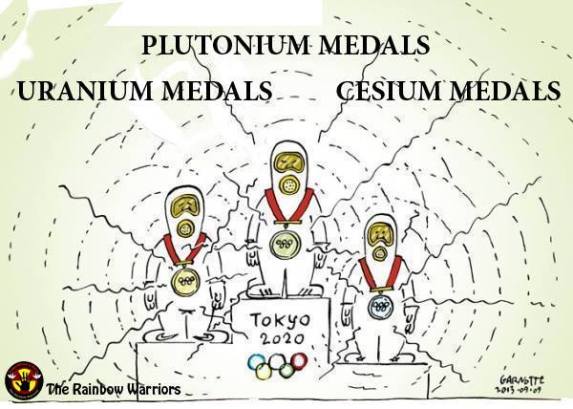
Tokyo Olypics: is it safe to promote Japan’s so-called “recovery” by sending athletes into a nuclear exclusion zone?
|
‘Fukushima today: “I’m glad that I realized my mistake before I died.” Bulletin of the Atomic Scientists, By Thomas A. Bass | March 10, 2021”……….After a lighting ceremony at J-Village, the Olympic torch will be run for three days through Fukushima’s nuclear exclusion zone. The zone is now a checkerboard of remediated areas and other places that are closed off behind accordion fences. Japan hopes to focus our attention on the refurbished schools and town halls, re-opened train stations, and two new museums that have been built in Fukushima, while trying to keep the TV cameras away from the ruined houses and radioactive cars lying nearby. The torch will then be run to Fukushima City, 40 miles to the northwest, where the first six Olympic games in softball and baseball are scheduled to be played after the games officially open July 23. But is it safe to promote Japan’s so-called “recovery” by sending athletes into a nuclear exclusion zone? The area has been tidied up and dotted with LED monitors showing the latest cesium releases from F1, comparable to the devices that measure airborne radiation levels found in other parts of the world. But these airborne releases are only part of the story—and not the most worrisome part. In 2013, scientists discovered that Fukushima’s exploding reactors had showered Japan with microparticles, or little glassy beads, of radioactive cesium and uranium. Hot spots from these microparticles can be found in vacuum cleaner bags and automobile air filters as far away as Tokyo. Fukushima prefecture is full of radioactive hot spots, and these hot spots keep moving as microparticles are washed down from the forested mountains that make up 70 percent of the prefecture, researchers said in Nature Scientific Reports. In 2019, a survey conducted for Greenpeace found hot spots in the J-Village parking lot, where children participating in a youth soccer match were eating their lunch. Greenpeace measured radiation levels at over 71 microSieverts per hour (one microSievert is one-millionth of a Sievert, or one-thousandth of a milliSievert)—1,775 times higher than the normal reading in this area before the Fukushima disaster of about 0.04 microSieverts per hour. The elevated reading, which translates to roughly about 0.62 Sieverts over the course of a year, meant that anyone breathing dust from the J-Village playing fields could be ingesting radioactive particles—little death stars lighting the way to cancer and genetic mutation. Since then, researchers have found radioactive hot spots at the Azuma baseball stadium in Fukushima City and all along the route to be run by the Olympic torch bearers….. https://thebulletin.org/2021/03/fukushima-today-im-glad-that-i-realized-my-mistake-before-i-died/?utm_source=Newsletter&utm_medium=Email&utm_campaign=ThursdayNewsletter032021&utm_content=NuclearRisk_Bass_03102021 |
|
Report: Cancer death rates rising near Fermi nuclear plant
 Report: Cancer death rates rising near Fermi nuclear plant https://www.13abc.com/2021/03/11/report-cancer-death-rates-rising-near-fermi-nuclear-plant/
A new study is looking to test baby teeth from children living near the plant. NEWPORT, Mich. (WTVG) – A new report from the Radiation and Public Health Project claims that the cancer death rate in Monroe County, Michigan is on the rise and it’s tying that growth to the Fermi 2 nuclear plant in Newport.
According to the report, which uses public health data from the Centers for Disease Control and Prevention, the rate of death due to cancer in Monroe County was roughly equal to that of the rest of the United States. Since 1988, that rate has risen steadily, reaching 11.3% higher than the national average in the most recent 10 years (2009-2018). From 2014-2018, that rate was 14.3% higher than the national average, amounting to 1,794 deaths. In the period between 1969 and 1978, outlines the report, that rate was 4.5% lower than the national average.
The Fermi 2 nuclear power plant went online in June of 1985, and while the report has no concrete evidence that the plant is the definitive cause of the rise in cancer deaths in the county, it does provide a correlative pattern. 13abc has reached out to DTE Energy, owners of the Fermi 2 plant, for comment.
“The trends in Monroe County cancer rates since the mid-1980s cannot overlook the startup of the Fermi reactor, and the potential role of radioactive emissions on health,” says Joseph Mangano MPH MBA, Executive Director of RPHP and study author.
“The report needs to be taken seriously, and follow-up measures are urgently needed,” adds Christie Brinkley, a long-time activist on nuclear issues, Board member of RPHP, and a native of Monroe County. “In particular our children must be protected, as they are most vulnerable.”
In an effort to further understand the role the reactor may have had in the rise in cancer rates in the area, the RPHP is conducting a “Tooth Fairy” study. They’re collecting baby teeth from children living near the power plant to test for levels of Strontium-90, a chemical created by nuclear reactors. They’re hoping to test up to 50 teeth and will compare the results to Sr-90 levels in Detroit-area residents from a 1950s-era study of atomic bomb test fallout. Information about the study, including how to participate, can be found at their website.
Nuclear disasters? – a calculated gamble , collusion between governments and the nuclear industry

Fukushima Nuclear Disaster Nearly ‘Ended The Japanese State’, Radioactive Waste Specialist Explains, Sputnik News, by Mohamed Elmaazi 12 Mar 21, ”………Sputnik: In what sense was ‘collusion’ between the state and the nuclear industry responsible for the disaster?
Kevin Kamps: [According to the Japanese parliamentary report] Tokyo Electric Power Company and the Japanese national government, specifically its nuclear safety regulatory agency, had plenty of warnings that a large-scale earthquake, and even a tall tsunami, could hit that plant, and other nuclear plants across Japan for that matter. Yet way too little was done about it.
They just hoped it would never happen. But it did. The sea wall they had built was woefully inadequate, for example. It was easily overtopped by the tsunami. All the mistakes that led up to the catastrophic consequences had to do with this collusion. Wink wink, nod nod, between industry lobbyists and executives, safety regulators at all levels, government officials at all levels. Short cuts on safety and security, to save money, that is, boost profits, which pay astronomical executive salaries, even handsome take home pay for nuclear industry workers, kickbacks to local municipalities, revolving doors between industry and government.
And what’s so frightening about that conclusion is that we have such collusion here in the United States, [with] massive campaign contributions to office seekers, and lobbyist expenditures. The media even gets hoodwinked in all this, both in Japan and in the US. In Japan, they call this “the Nuclear Village.” Perhaps, in the US we’d call it the military-industrial-governmental-academic-media-nuclear power complex.
We [in the US] also have a couple three dozen, identical or similar nuclear power plants in design. These are General Electric boiling water reactors of the Mark I or Mark II design. The biggest in the world, for example, just south of Detroit by 25 miles, called Fermi Unit 2. So, I’ve described what happened and the consequences of what happened, where one of the largest releases of hazardous ionizing radioactivity in the environment that has ever occurred, into the ocean, into the air. Japan was hard hit with contamination.
The rest of the Pacific basin was hard hit with contamination, including the west coast of North America and the health implications of that, the genetic implications of that, will unfold for a very long time to come because these radioactive isotopes, which are hazardous caesium and strontium, for example, have at least a 300-year hazardous persistence, tritium 123 years, at least, plutonium, 240,000 years. So, in a sense, nuclear power disasters have beginnings, but they don’t really have endings when you’re talking about centuries or millennia or hundreds of thousands of years of hazard unleashed into the environment.
Sputnik: Could this be considered a freak accident? One that’s unlikely to be repeated?
Kevin Kamps: Unfortunately, not. There have been now several major nuclear power reactor meltdown disasters: Three Mile Island in Pennsylvania USA in 1979, Chernobyl in Ukraine in the Soviet Union in 1986. So many close calls to reactor meltdowns. It’s almost too many to enumerate and there’ve been other nuclear power related and nuclear weapons related disasters over the decades. So, these are actually fairly predictable. And I have colleagues who now refuse to call these accidents because these are foreseeable. This is a calculated gamble. That’s being taken every day at some 400 plus atomic reactors across the world, with more planned…… https://sputniknews.com/interviews/202103111082310108-fukushima-nuclear-disaster-nearly-ended-the-japanese-state-radioactive-waste-specialist-explains/
Trident nuclear warhead numbers set to increase for first time since cold war
|
Trident nuclear warhead numbers set to increase for first time since cold war https://www.theguardian.com/uk-news/2021/mar/12/trident-nuclear-warhead-numbers-set-to-increase-for-first-time-since-cold-war
Defence and foreign policy review expected to signal rise, in move analysts say is diplomatically provocative Dan Sabbagh Defence and security editor Downing Street’s integrated review of defence and foreign policy is expected next week to signal a potential increase of the number of Trident nuclear warheads for the first time since the end of the cold war.
Whitehall sources indicated that a cap on total warhead numbers – currently set at 180 – is expected to increase, although the exact figure is not yet known, in a move that analysts said was diplomatically provocative. The UK’s stockpile of nuclear weapons peaked at about 500 in the late 1970s, but had been gradually decreasing ever since as the perceived threat from the Soviet Union and now Russia had been assumed to be decreasing. The last strategic defence review, in 2015, committed the UK to “reduce the overall nuclear weapon stockpile to no more than 180 warheads” by the mid 2020s – and reducing the numbers of operationally available warheads to 120. Each warhead is estimated to have an explosive power of 100 kilotons. The atomic bomb dropped on Hiroshima at the end of the second world war was about 15 kilotons. The full reasons for the anticipated move are not yet clear but it comes amid speculation it is designed to help persuade the US to co-fund aspects of a Trident replacement warhead for the the 2030s. Its costs, too, are uncertain. “If this is confirmed, this would be a highly provocative move,” said David Cullen, the director of the Nuclear Information Service. “The UK has repeatedly pointed to its reducing warhead stockpile as evidence that it is fulfilling its legal duties under the nuclear non-proliferation treaty. “If they are tearing up decades of progress in reducing numbers, it will be a slap in the face to the 190 other members of the treaty, and will be regarded as a shocking breach of faith.” Britain has operated its own nuclear weapons since the 1950s but for the past 60 years, following an agreement between the then prime minister, Harold Macmillan, and the then US president, John F Kennedy, the UK has been heavily dependent on US technology. Trident missiles are deployed in four submarines, one of which is continuously at sea to make sure it can strike back in the event of an unprovoked nuclear attack. It relies on an existing US W76 warhead, based on a 1970s design, called Holbrook. However, the W76 is ageing, and the US has proposed developing a more powerful replacement, called the W93. The UK is particularly keen for the US to start work on the W93 and last summer the defence secretary, Ben Wallace, lobbied Congress for the work to go ahead. British MPs voted to renew Trident in principle in 2016, but the Commons is expected to have to vote on a new warhead at some point. In 2016, the Conservatives almost uniformly backed renewal, the SNP voted against, while Labour was split. The MoD has said developing the next generation of Dreadnought submarines to carry the new warhead would cost £30bn plus a £10bn contingency. But officials have so far refused to say how much the warhead would cost. An MoD spokesperson said: “The UK is committed to maintaining its independent nuclear deterrent, which exists to deter the most extreme threats to our national security and way of life. “Replacing the warhead and building four new Dreadnought class submarines are UK sovereign programmes that will maintain the deterrent into the future. We will not comment on speculation about the integrated review, which will be published on Tuesday.” |
|
Every hour, Fukushima reactor 2 emits more than 10,000 times the yearly allowable dose for radiation workers

|
Fukushima today: “I’m glad that I realized my mistake before I died.” Bulletin of the Atomic Scientists, By Thomas A. Bass | March 10, 2021 ”………..What we know about nuclear disasters at Chernobyl, Fukushima, and elsewhere comes primarily from modelling what is known as the “source term”—the types and amounts of radioactive material that were in a reactor’s core and then released to the environment by an accident. These models are revised as we learn more about the prevailing winds and other factors but are still only models; ideally, one wants to examine the reactors’ cores themselves. Unfortunately, even 10 years later, no one can get close to Fukushima’s reactor cores, and we do not even know precisely where they are located. As recently as December 2020, Japan’s Nuclear Regulatory Authority (NRA) announced “extremely serious” developments at Fukushima that were far worse than previously thought, the Asahi Shimbun newspaper reported. TEPCO had discovered that the massive shield plugs covering the reactors were emitting 10 Sieverts of radiation per hour—a lethal dose for humans (though it should be noted that reactor cores are normally examined by robots, unless these, too, are destroyed by radiation). Because Fukushima now has more contaminated material at higher doses than previously estimated, “this will have a huge impact on the whole process of decommissioning work,” said NRA chairman Toyoshi Fuketa. The effective dose of radiation required to sicken or kill you is measured in Sieverts, a unit named after Rolf Sievert, the Swedish physicist who first calibrated the lethal effects of radioactive energy. A dose of 0.75 Sieverts will produce nausea and a weakened immune system. (Sieverts are used to measure the relative biological damage done to the human body, while becquerels and curies are units that describe the amount of radiation emitted by radioactive material.) A dose of 10 Sieverts will kill you, if absorbed all at once. A dose somewhere in-between 0.75 and 10 Sieverts gives you a fifty-fifty chance of dying within 30 days. Guidelines for workers in the nuclear industry limit the maximum yearly dose to 0.05 Sieverts, or 50 milliSieverts—the equivalent of five CT scans, says Harvard Health Publishing. (This is a high figure compared to the 1 milliSievert per year that is considered acceptable for the general public; a physicist familiar with the industry explained that the thinking is that workers in the nuclear energy industry are implicitly being paid to take on the risk.) So how many Sieverts are currently being produced by Fukushima’s melted reactors? The latest reading from reactor No. 2 is 530 Sieverts per hour. This means that every hour the heart of the reactor is emitting more than 10,000 times the yearly allowable dose for radiation workers…… https://thebulletin.org/2021/03/fukushima-today-im-glad-that-i-realized-my-mistake-before-i-died/?utm_source=Newsletter&utm_medium=Email&utm_campaign=ThursdayNewsletter032021&utm_content=NuclearRisk_Bass_03102021 |
|
Nuclear power is unpopular: promoted only by those with vested interests/
Bellona 12th March 2021,Nuclear advocates point to the development of new technologies, such as small modular reactors, which can be deployed locally, and whose small scale limits the potential for Fukushima-sized accidents.
month for Nature, the influential US scientific journal, they assert that the nuclear industry has long ago lost touch with the public it is meant to serve.
Is nuclear waste safely managed and disposed of so that it no longer poses any danger?
 Fukushima Nuclear Disaster Nearly ‘Ended The Japanese State’, Radioactive Waste Specialist Explains, Sputnik News, by Mohamed Elmaazi 12 Mar 21,……….How is it that nuclear waste safely managed and disposed of so that it no longer poses any danger?
Kevin Kamps: Well, it’s not. We don’t know what to do with it. High-level radioactive waste is stored in indoor wet storage pools. That’s where the majority of American high-level radioactive waste is stored. What almost happened at Fukushima Daiichi, another lucky break, was that the wet indoor storage pool at unit four nearly caught fire, and it was sheer luck that it did not. And just to give you an idea of what that could have meant for Japan, there have been 160,000 nuclear evacuees due to the meltdowns, the failures of the containments.
If that pool had caught fire, and pools are not even inside containment, the Japanese prime minister serving at the time, Naoto Kan, a year after the disaster began, admitted that he had a secret contingency plan, if that pool had caught fire, to evacuate 35 million to 50 million people from North-eastern Japan and metro Tokyo. He said it would have been the end of the Japanese state.
Here in the United States where the majority of our high-level radioactive waste is still in this vulnerable indoor wet pool storage, our pools are much more densely packed than Fukushima Daiichi Unit four was on March 11th, 2011. So, we don’t have an answer. We do not have deep geologic disposal repositories. Yucca mountain, Nevada, has proven to be a failure. Besides the Western Shoshone Indians [Native Americans] did not consent, it violated their treaty rights to that site, but it’s also scientifically unsuitable. So, we’re right where we began in 1942, when Enrico Fermi first split the atom, created the first high-level radioactive waste during the Manhattan Project race for the atomic bomb. We don’t know what to do with the first cup full of high-level radioactive waste in this country. https://sputniknews.com/interviews/202103111082310108-fukushima-nuclear-disaster-nearly-ended-the-japanese-state-radioactive-waste-specialist-explains/
Slovenia’s hazardous old nuclear reactor in an earthquake zone
|
A nuclear reactor in an earthquake zone NEW EUROPE
By Otmar Lahodynsky, President of the Association of European Journalists (AEJ) and former European Editor of the Profil news magazine in Austria , 12 Mar 21, Ten years after the Fukushima nuclear disaster, an old power plant in Slovenia is about to be allowed to run till 2043. Austrian politicians and environmental organizations want to prevent that.The Slovenian nuclear power plant in Krsko actually should be decommissioned in two years. The reactor, built 40 years ago in the old Communist-era Yugoslavia with technology from the American company Westinghouse – has reached the end of its life. Nevertheless, the Slovenian-Croatian operating company, GEN Energija d. o. o., wants to keep the reactor running for 22 more years – until 2043. This week, an environmental impact study has started, a procedure that is being run under international scrutiny.
The nuclear power plant is located on the Croatian-Slovenian border, but what is truly alarming is that it is located in an area that is particularly at risk from earthquakes. Krsko is 85 kilometres from the epicentre of an earthquake that shook Croatia on December 29, 2020. The previous March, the Croatian capital Zagreb was hit hardest by an earthquake; with an epicentre that was only 40 km away from Krsko. Earthquake safety has always been one of the most discussed concerns regarding the Krsko plant. …….. https://www.neweurope.eu/article/a-nuclear-reactor-in-an-earthquake-zone/ |
|
How the world came close to nuclear war catastrophe
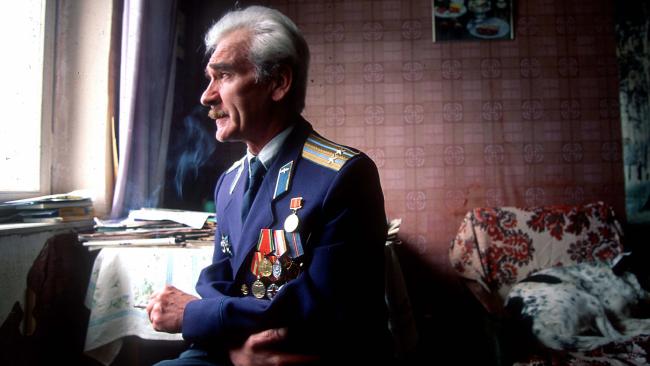
Stanislav Petrov.
Bilinovich: Averting nuclear apocalypse https://observer.case.edu/bilinovich-averting-nuclear-apocalypse/ How the world came close to catastrophe, Beau Bilinovich, Staff Columnist, March 12, 2021
No one wants to be the cause of a nuclear apocalypse. It is our responsibility to avoid one at all costs. But what happens when we don’t have a choice?
There have been numerous times throughout history where we have, by some stroke of luck and fortune, avoided catastrophe. Each of these instances tells a story, an insightful tale of human folly that culminates in one important lesson: We cannot trust ourselves with the most dangerous weapon ever invented.
There is one story which is bittersweet—in the end, everything is okay, yet it leaves everyone with a feeling of unease and urgency. Nonetheless, this story must be told, because we absolutely should learn from it.
The story began on Sept. 26, 1983 and took place deep inside the former Soviet Union. Operations were normal at Serpukhov-15, a military outpost just outside Moscow. The hero of the story was Stanislav Petrov, the officer on duty at the military installation. He and a group of other officers were monitoring Oko, the Soviet Union’s nuclear alert system.
Suddenly, the computer flashed a bright red warning: “Launch.” Alarms wailed. The officers were in shock. The United States had launched an intercontinental ballistic missile (ICBM). Oko detected no doubt.
The officers stood there, frozen, despite being trained for such a harrowing event. They could not believe what was happening.
Two, three, four, five—Oko had detected more missiles. In total, five ICBMs were reported to have been launched towards the Soviet Union on a path of destruction. Petrov had to make a decision soon: inform his higher-ups or wait.
In those crucial moments, Petrov decided not to do anything at all, despite the possibility of catastrophe looming over him. He did not even notify those higher in the chain of command. He waited.
Minutes passed, but no strike ever occurred. Relief. The warning was just a false alarm. No need to worry anymore.
Investigations concluded that the false alarm was triggered by the reflection of sunlight off the tops of clouds. Though this seems like a small mistake, it was not an isolated incident. There have been many other times where the world came close to nuclear war. One false alarm was caused by a computer playing a military training tape, and another by a faulty computer chip—tiny errors that could have bore serious consequences.
But simple mistakes are only one element that makes nuclear weapons so unfathomably dangerous and risky.
Just as concerning is the gross negligence of nuclear missile launch officers. A two-star general responsible for America’s nuclear arsenal was caught on a drunken bender while on a visit to Russia in 2013. Two launch officers were investigated as part of a narcotics scandal, where they reportedly used drugs and other illegal substances. Around 100 officers were implicated in cheating on their proficiency exams; only nine of the officers were duly dismissed.
There are also threats from outside the U.S.
Andrew Futter, associate professor at the University of Leicester, suggested that America’s nuclear weapons system could be hacked to gather information, shut down the system and even launch missiles. In fact, the National Nuclear Security Administration, which controls and maintains the nuclear weapons system, was hacked in December by Russian intelligence services, exposing the country’s most sensitive information regarding nuclear weapons.
Nuclear weapons are risky, dangerous and destructive. In total, there are 14,525 nukes across the world, with the U.S. and Russia possessing the vast majority—over 6,000 each. That is enough explosive power to end the world multiple times over. Humanity would cease to exist in the event of a nuclear war.
This is precisely why the exceptional judgment of Stanislav Petrov is heroic. Most people don’t know him, yet he secretly saved the entire world from a disastrous future. Despite his commendable behavior, we should not rely on one person to protect us.
We are left with no other option than to confront the truth.
Those entrusted with the authority to deploy and launch these missiles at a moment’s notice cannot be trusted. The systems designed to monitor attacks cannot be trusted. Foreign nations in possession of this same deadly tool cannot be trusted. While we may think we can handle nuclear weapons, reality shows the opposite. In truth, no one can be trusted with nuclear weapons. If we do not realize this, we may not have any more stories to tell.
Our inability to trust anyone with these weapons demands that we abolish them. The sooner we accomplish this goal, the safer the world becomes. Getting rid of these weapons is the only way to avoid a nuclear apocalypse.
Germany pledgse to work towards a nuclear free Europe
Ten years after the Fukushima nuclear disaster in Japan, German environment minister Svenja Schulze insisted that the country does not consider nuclear energy an option for low-carbon power production. “Nuclear power is neither safe nor clean,” Schulze said, rejecting the “myth” that the technology could help to find a way out of the climate crisis. “The future is for renewable energy,” she said. Germany’s phase-out decision, originally taken in the year 2000 and confirmed after the 2011 meltdown of the power plant in Japan, had “brought peace to a social conflict that raged for decades” and helped minimise a major risk at least nationally, Schulze said.
Nuclear power could not be in Germany’s interest when it is generated abroad either, “be it in our immediate neighbourhood, in the EU or globally”, the minister said, adding that “our work has not ended with the German nuclear exit”. The environment ministry published a position paper listing 12 key objectives required to reduce nuclear risk even further. They include actions under the three sections of a) completing the German nuclear phase-out: Close nuclear plants, promote final storage, accelerate the expansion of renewable energies; b) reducing nuclear risks in Europe, strengthen cooperation; and c) increasing nuclear safety worldwide, maintain nuclear risk competence and provide appropriate information.
Today we commemorate the catastrophic #nuclear accident that took place in #Fukushima 10 years ago. This disaster has shown us the risks of #NuclearEnergy. Also @SvenjaSchulze68
With a view to the decision by Germany’s largest neighbour country France to extend the running time of old nuclear reactors, she said that while the “principle of energy sovereignty” would have to be respected, there are “technical and economic limits to retrofitting”. Especially plants near the German border would be “monitored very closely and critically”, the minister said, adding that the German government expected France to enable “comprehensive cross-border cooperation” on the matter. More than half of all EU states do not use nuclear power at all or are considering a phase-out, Schulze said.
“Together with likeminded countries in Europe, I will actively work towards more countries joining the phase-out of nuclear power,” she stated. Schulze minister colleagues from Austria and Belgium, Leonore Gewessler and Tinne van der Straeten, joined her German counterpart in a joint message published on Twitter, in which the three state representatives said they will work towards ending the use of nuclear power in Europe and pave the way for an energy system solely based on renewables.
Nuclear “poison for a secure and climate-just future” – NGOs
Ten years after the disaster, Japanese officials in Fukushima still grapple with key questions regarding the removal, storage and processing of the plant’s nuclear waste. These problems remain unresolved and many former residents are still not allowed to return to their homes, Schulze said. “If we’ve learned something from all this then it has to be the common goal to protect people from further devastation from nuclear power.” For Germany, nuclear power’s “residual risk” simply had been too significant to carry on with the technology, she argued. Of the six remaining reactors in the country, three will go offline as planned in 2021 and the remaining three at the end of 2022. A 2019 survey found that 77 percent of people in Germany support the nuclear phase-out and 60 percent also its quick finalisation by the end of next year.
A group of more than 50 civil society and environmental groups backed the government’s stance on excluding nuclear energy from Germany’s emissions reduction plans, arguing that claims about the technology being “climate neutral” and “environmentally friendly” would be “poison for a secure and climate-just future”. In a joint letter, the group including NGOs like Germanwatch, BUND, NABU or PowerShift said nuclear power could have no future in energy systems and called on the government to double down on its efforts to phase-out the technology, including a shutdown of uranium enrichment facilities in Germany and an end of EU nuclear power project funding. Investments instead should flow into renewable power, storage technology and efficiency gains, the group argued.
1 This Month

of the week – Shut Down Drone Warfare!


Tell the Ukrainian Government to Drop Prosecution of Peace Activist Yurii Sheliazhenko

Petition to revoke the licensing of the Near Surface Nuclear Disposal Facility (NSDF) at Chalk River. https://www.ourcommons.ca/petitions/en/Petition/Details?Petition=e-7247
To see nuclear-related stories in greater depth and intensity – go to https://nuclearinformation.wordpress.com
-
Archives
- April 2026 (114)
- March 2026 (251)
- February 2026 (268)
- January 2026 (308)
- December 2025 (358)
- November 2025 (359)
- October 2025 (376)
- September 2025 (257)
- August 2025 (319)
- July 2025 (230)
- June 2025 (348)
- May 2025 (261)
-
Categories
- 1
- 1 NUCLEAR ISSUES
- business and costs
- climate change
- culture and arts
- ENERGY
- environment
- health
- history
- indigenous issues
- Legal
- marketing of nuclear
- media
- opposition to nuclear
- PERSONAL STORIES
- politics
- politics international
- Religion and ethics
- safety
- secrets,lies and civil liberties
- spinbuster
- technology
- Uranium
- wastes
- weapons and war
- Women
- 2 WORLD
- ACTION
- AFRICA
- Atrocities
- AUSTRALIA
- Christina's notes
- Christina's themes
- culture and arts
- Events
- Fuk 2022
- Fuk 2023
- Fukushima 2017
- Fukushima 2018
- fukushima 2019
- Fukushima 2020
- Fukushima 2021
- general
- global warming
- Humour (God we need it)
- Nuclear
- RARE EARTHS
- Reference
- resources – print
- Resources -audiovicual
- Weekly Newsletter
- World
- World Nuclear
- YouTube
-
RSS
Entries RSS
Comments RSS
 nuclear-news