1. Figures for the 10th anniversary of the Fukushima disaster: Fukushima Daiichi
An article from ACRO translated by Hervé Courtois
February 22, 2021
As we approach the tenth anniversary of the nuclear disaster at the Fukushima power plant, here is a numerical assessment based on the media, official sites and the 2,700 articles on this site. Updates will be made regularly.
Situation at the Fukushima Daiichi nuclear plant
The latest report from the Ministry of Industry on the progress of work at the Fukushima dai-ichi power plant dates from December 24, 2020 and was put online in English on January 28, 2021 (direct link https://www.meti.go.jp/english/earthquake/nuclear/decommissioning/pdf/mp202012.pdf).
See the damaged nuclear power plant
Two fixed webcams, installed in 2014, allow to have the nuclear power plant live. https://www.tepco.co.jp/en/hd/decommission/progress/about/livecamera/index-e.html
It is possible to take a virtual tour in English and Japanese of the Fukushima dai-ichi nuclear power plant (direct link : https://www.tepco.co.jp/en/insidefukushimadaiichi/index-e.html). But the images and documents do not seem to have been updated since February 2020. Some balance sheets date back to 2018.
As we have already reported, TEPCO has put online on its website (in Japanese and English : https://photo.tepco.co.jp/en/date/2020-e/202012-e/201222_01e.html) hundreds of aerial photos of the crashed Fukushima dai-ichi power plant taken in March 2011. Fukushima’s blog has extracted a selection of them from its website and has made a video montage of the 714 photos http://www.fukushima-blog.com/2020/12/photos-aeriennes-de-fukushima-daiichi-de-mars-2011.html. However, some of the photos are partially blurred, as if there was some secret, while unblurred aerial views are available since the very beginning of the disaster on the cryptome.org website.
Status of nuclear reactors
TEPCO has a digital timeline in English with the main events related to reactor safety and dismantling. https://www4.tepco.co.jp/en/decommissiontraject/index-e.html
The portal in English for dismantling works ; https://www.tepco.co.jp/en/hd/decommission/index-e.html
The page in English concerning the removal of fuel from swimming pools ; https://www.tepco.co.jp/en/hd/decommission/progress/removal/index-e.html
Reactor n°4
The vessel was empty on March 11, 2011 and there was no core meltdown, but a hydrogen explosion destroyed the reactor building. The hydrogen came from the neighboring reactor No. 3 via the common discharge stack.
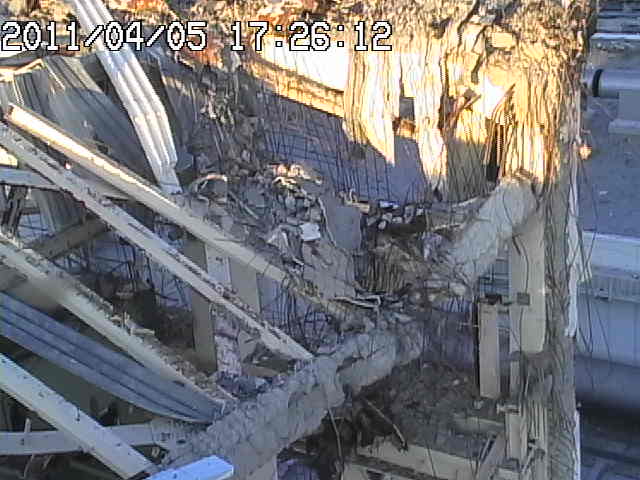
The upper part of the reactor building was dismantled, the debris removed, and a new structure was built to remove the fuel from the pool, which has been empty since December 2014. Since then, the work has been stopped because the reactor is no longer a threat.
The map with some ambient dose rate values dates from 2016. https://www4.tepco.co.jp/en/nu/fukushima-np/f1/surveymap/images/sv-u4-20160630-e.pdf
Reactor n°3
There was a core meltdown and a hydrogen explosion destroyed the reactor building. All the debris in the upper part of the building was removed with the help of remote-controlled devices. A new building with a cylindrical roof was constructed. The removal of fuel began in April 2019, four years later than originally planned. The operations proved to be more complicated than expected, but they completed by the end of February 2021.
There were 566 assemblies in the pool (52 new, all removed, and 514 used). Some were damaged by falling debris. TEPCO’s dedicated page is here in English https://www7.tepco.co.jp/responsibility/decommissioning/action/spent_fuel/unit3-e.html. A video presentation of the operations, here in English https://youtu.be/iTDuc4Gq-0c
There would be, in this reactor, between 188 and 394 tons of corium (a highly radioactive mixture of molten fuel and debris), with a nominal value of 364 tons. The latter contains MOX fuel, based on plutonium. TEPCO has estimated that the recovery of corium from two reactors 2 and 3 will take 12 years and cost 1,370 billion yen (11.5 billion euros). In 2017, TEPCO had published photos taken inside the containment of this reactor, under the vessel, and a video: https://photo.tepco.co.jp/en/date/2017/201707-e/170719-01e.html & https://youtu.be/nDsjwCdtzHM
Since September 2020, the Nuclear Regulatory Authority has resumed its investigations to understand the course of the triple nuclear accident at the Fukushima dai-ichi power plant. This includes visits to the accident reactors, despite the high ambient radiation levels. It has brought back videos:
– Including this one, of Unit 3 taken on September 18, 2020, which shows the dilapidated state of the reactor building, almost 10 years after the accident: https://youtu.be/2ogtUCOnQDg
– And of Unit 2 on October 8, 2020 : https://youtu.be/xgN2kCOrn9k
– And of Unit 1 on October 9, 2020 : https://www.youtube.com/watch?v=7KX-mmwh93c&list=PLmEL1pMVzxvfOzFQXY-josH28sjv1zACb
During these visits, the Nuclear Regulatory Authority discovered very high dose rates, of the order of 10 Sv/h, above the protection slabs of reactors 2 and 3 http://www.asahi.com/ajw/articles/14071742. A lethal dose in one hour on site. It estimates that the slab of Reactor 3 contains about 30 petabecquerels (1015 Bq) of cesium-137. This will complicate the dismantling work.
Reactor n°2
There was a core meltdown, but the reactor building is whole. Ambient radiation is particularly high in this reactor, making access to humans very difficult. A delegation from the Nuclear Regulatory Authority went to visit the interior of the reactor building for the first time since the accident, but it had to turn around prematurely because of the dose rates that reached 11 to 12 mSv/h on the fifth level. This would be due, in particular, to suspended radioactive dust, which is surprising after so many years. Even higher dose rates, of the order of 10 Sv/h, were measured above the protection slabs of reactors 2 and 3. The Regulatory Authority estimates that the slab of Reactor 2 contains about 20 to 40 petabecquerels (1015 Bq) of cesium-137.
TEPCO has not begun to remove spent fuel from the pool, which contains 615 assemblies. This is now planned around 2024 and 2026 because of the ambient dose levels in the reactor building. Images were published in June 2020 https://photo.tepco.co.jp/en/date/2020-e/202006-e/200610-01e.html

The company sent several robots into the containment to locate the corium, this mixture of molten fuel and debris. There would be between 189 and 390 tons of corium in this reactor, with a nominal value of 237 tons. For more information http://www.fukushimaminponews.com/news.html?id=739. Several series of images have been put online by the company. One clearly sees the corium and a fuel assembly element that has fallen to the bottom of the containment:

TEPCO had sent a robot in contact with the corium in February 2019. The images were impressive :
The authorities hoped to be able to begin the removal of the corium before the 10th anniversary. This was the goal set in December 2011. But the technology has yet to be developed and the ambitions had already been revised downwards in 2019: it was only a matter of recovering a few grams of corium from reactor No. 2 in 2021. In December 2020, TEPCO announced a delay of at least one year in the start of operations, officially due to the COVID-19 epidemic in the United Kingdom. The articulated arm of a robot, which must collect the corium, is being developed jointly by Veolia Nuclear Solutions in the United Kingdom and Mitsubishi Heavy Industries in Japan.
TEPCO dismantled half of the chimney common to Reactors 1 and 2, which was 120 m high https://photo.tepco.co.jp/en/date/2020-e/202004-e/200429-01e.html. The work turned out to be more complex than expected, in particular due to a calculation error on the height of the crane. The chimney being highly contaminated, the work was carried out by remote-controlled machines.
Reactor n°1
There was a core meltdown and a hydrogen explosion destroyed the reactor building. This building had been covered with a new structure in 2011, which was completely dismantled in November 2016 https://photo.tepco.co.jp/en/date/2016/201611-e/161110-01e.html. TEPCO began to remove the debris from the upper part of the reactor, and then rebuilt a new structure to empty the fuel pool. Since then, the company has not been very prolific about the progress of the work.
On the other hand, the removal of spent fuel from the pool of reactor No. 1 has been delayed: at best, it will be 2027, or even 2028. The first date envisaged for beginning this withdrawal was 2018… The cost of these operations has not been estimated because the company does not yet know how to go about it. In the meantime, TEPCO has covered this pool to protect it with air bags https://photo.tepco.co.jp/date/2020/202006-j/200611-01j.html:
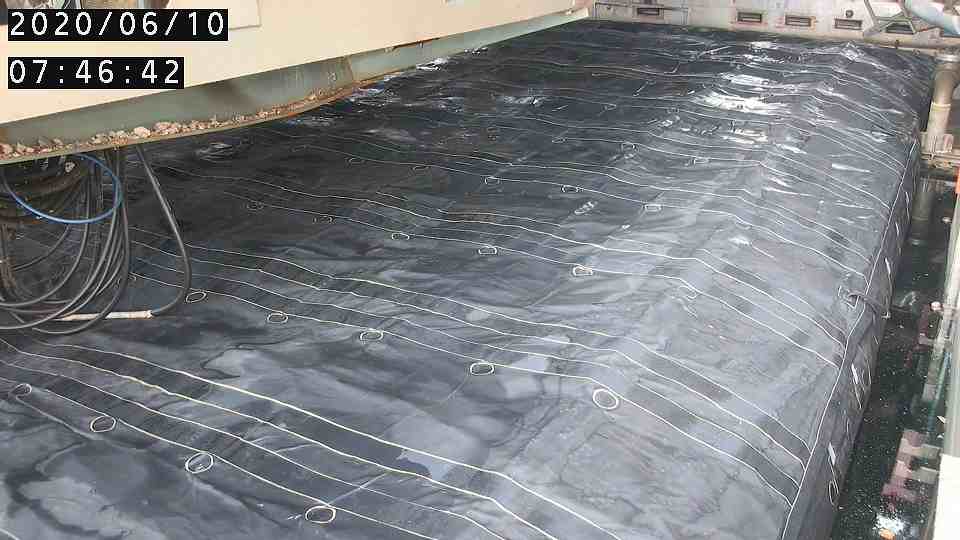
The hydrogen explosion fractured the concrete slab 12 m in diameter and 60 cm thick which is particularly contaminated in reactors 2 and 3. Very high dose rates had been recorded in 2017, up to 2.2 Sv/h, i.e. a lethal dose in a few hours on site. For the broken slab of reactor No. 1, there would be “only” about 0.16 petabecquerels of cesium-137.
There would be between 232 and 357 tons of corium in this reactor, with a nominal value of 279 tons. For more information: http://www.fukushimaminponews.com/news.html?id=739
Réacteurs 5 et 6
Les réacteurs 5 et 6 étaient arrêtés et partiellement déchargés le 11 mars 2011. Comme un générateur diesel de secours était encore fonctionnel, cela a permis d’éviter la fusion du cœur. Ces réacteurs sont maintenant entièrement déchargés et vont être démantelés.
Contaminated water
In 2011, the water injected to cool the reactors ended up overflowing and causing the greatest marine radioactive pollution in history. In April 2011, it was the contaminated water from Reactor No. 2 discharged into the sea via an underground gallery. And, in May 2011, it was the turn of Reactor No. 3.
TEPCO estimated that 520 m3 of highly radioactive water, or 4,700 terabecquerels (1 terabecquerel represents one million million becquerels) or 20,000 times the annual discharge authorization, was released in April. More precisely, there were 2,800 terabecquerels of iodine-131, 940 terabecquerels of cesium-134 and as many of cesium-137. This release alone would deserve to be classified at level 5 or 6 on the international INES scale. The IRSN had estimated that it was 20 times higher.

The year 2013 was marked by a series of scandals following the late discovery of a leak from a contaminated water tank and discharges into the sea. The authorities reacted and the Prime Minister of the time had declared before the International Olympic Committee that the situation was under control. In 2021, the situation is still not under control and the Olympics could be cancelled because of the pandemic…
The other major challenge facing TEPCO is the contaminated water that continues to accumulate.
Summary of the situation
Fuel that has melted and pierced the tanks must always be cooled. To this end, TEPCO injects about 70 m3 of water per day into each of reactors 1, 2, and 3 (see the balance sheet dated February 8, 2021 https://www.tepco.co.jp/en/hd/decommission/information/newsrelease/watermanagement/pdf/2021/watermanagement_20210208-e.pdf). This water becomes highly contaminated on contact with the molten fuel and seeps into the basements of the reactor and turbine buildings where it mixes with the water from the water tables that seeps in.
After the strong earthquake of February 13, 2021 https://fukushima.eu.org/fort-seisme-a-fukushima-pas-dalerte-au-tsunami/, TEPCO noticed that the level of water in the containments of reactors 1 and 3 had dropped https://www.tepco.co.jp/en/hd/newsroom/announcements/archives/2021/20210214_01.html.

The cracks have probably widened and the company may be forced to increase the injected flow rate. For Reactor 2, it is not known because the sensors were removed to prepare for the removal of the corium.
At the beginning of the disaster, underground infiltrations amounted to about 400 m3 per day and this contaminated water had to be stored in tanks. Conversely, the water in the basement, heavily contaminated, leaked to the water table and then to the ocean.
To reduce groundwater infiltration, TEPCO pumps into the water table upstream of the reactors, before this water is contaminated and releases it directly into the ocean. It has also built a barrier along the entire coastline and also pumps groundwater at the foot of the reactors. Some of this water is partially decontaminated and released into the ocean. Another part, too contaminated, is mixed with the water pumped from the basements of the reactors to be put into tanks after treatment, while waiting for a better solution. This flow is of the order of 5 m3/d according to the report dated February 8, 2021 https://www.tepco.co.jp/en/hd/decommission/information/newsrelease/groundwaterdrain_transition/pdf/2021/groundwaterdrain_20210208-e.pdf (between 3 (source https://www.tepco.co.jp/en/hd/decommission/information/newsrelease/groundwaterdrain_transition/pdf/2021/groundwaterdrain_20210118-e.pdf) and 8 m3/d (source https://www.tepco.co.jp/en/hd/decommission/information/newsrelease/groundwaterdrain_transition/pdf/2021/groundwaterdrain_20210107-e.pdf) in the previous reports available here https://www.tepco.co.jp/en/hd/decommission/information/newsrelease/groundwaterdrain_transition/2021-e.html).
The last barrier put in place is the freezing of the ground all around the 4 accident reactors, over 1.4 km in order to stop infiltration. After many setbacks, the frost has been over since November 2017. It has reduced the infiltrations, but not stopped them. The implementation of the frozen wall cost taxpayers 34.5 billion yen (265 million euros) to which must be added more than a billion yen (8 million euros) per year for electricity.

Since then, infiltration has been less than 100 m3/d (see the balance sheet of February 8, 2021 https://www.tepco.co.jp/en/hd/decommission/information/newsrelease/groundwaterdrain_transition/pdf/2021/groundwaterdrain_20210208-e.pdf), except in the case of heavy rainfall.
Flows and stocks
TEPCO pumps the water contained in the basements of the reactor and turbine buildings of the 4 accident reactors to avoid overflows. As this water is highly contaminated, it is treated and then stored in tanks on the power plant site. Some of it is re-injected for cooling. Here is the water circuit at the Fukushima daï-ichi power plant, as represented by TEPCO https://www.tepco.co.jp/en/hd/decommission/information/newsrelease/watermanagement/document-e.html:

The last one of February 8, 2021 reports a surplus to be stored of 90 m3/d https://www.tepco.co.jp/en/hd/decommission/information/newsrelease/groundwaterdrain_transition/pdf/2021/groundwaterdrain_20210208-e.pdf. It rose to more than 350 m3/d in the fall of 2020 and even 600 m3/d when the typhoons passed in October 2019. In 2019, the Ministry of Industry reported an increase in water storage from 50,000 to 60,000 m3/d per year (source https://www.meti.go.jp/english/earthquake/nuclear/decommissioning/pdf/20200203_current_status.pdf). Here it appears that it has accumulated 1.243 million cubic meters of contaminated water TEPCO has a dedicated portal for treated contaminated water https://www.tepco.co.jp/en/decommission/progress/watertreatment/index-e.html# . There are 1061 tanks on the power plant site, 1018 of which contain water treated by the ALPS plant. In another 29 tanks there is water where only caesium and strontium have beenn “filtered”. There is also about 4,800 m3 of untreated water in the basements of the reactors (as of February 8, 2021 https://www.tepco.co.jp/en/hd/decommission/information/newsrelease/watermanagement/pdf/2021/watermanagement_20210208-e.pdf).
TEPCO estimates that it will no longer have room on the site of its power plant to put in new tanks from 2022. The preferred option is discharge into the sea.
What to do with this treated water?
After considering several unrealistic options, the authorities are gradually restricting the options to the discharge of treated water into the ocean, which is not a surprise. Prior to any treatment, the balance sheet shows a concentration of 65 MBq/L in the pumped water https://www.tepco.co.jp/en/hd/decommission/information/newsrelease/watermanagement/pdf/2021/watermanagement_20210208-e.pdf.
With its ALPS station, TEPCO then removes 62 radioelements. And, officially, only tritium (radioactive hydrogen) remains in this water, because it is difficult to remove it. Since this element is released by all nuclear facilities, there must have been more problems, except for a few bad rumors …
However, as discovered in September 2018 , a large portion of the stock (currently about 72%) has not been adequately treated, and residual concentrations for some elements exceed the maximum concentrations allowed for discharge at sea https://www.japantimes.co.jp/news/2018/08/19/national/alps-system-fukushima-no-1-plant-failing-remove-tritium-toxic-cooling-water/.
The chart below, taken from the TEPCO portal shows that for 6% of the stock, the residual contamination for 7 major radioelements is 100 times higher than what is allowed for discharge https://www4.tepco.co.jp/en/decommission/progress/watertreatment/index-e.html. It is between 10 and 100 times for 15% of the stock.
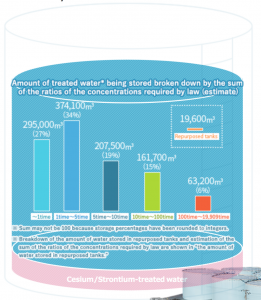
Repurposed tanks” are tanks that contained partially treated contaminated water, where only strontium-90 had been removed. This water having been treated, the tanks are reused for water fully treated by the ALPS plant. But, as explained by TEPCO in this document (https://www4.tepco.co.jp/en/decommission/progress/watertreatment/images/200827.pdf), there was still sludge at the bottom of the tank which significantly raised the contamination of the water! These tanks are therefore counted separately in the above chart.
TEPCO is committed to treating a second time the water that exceeds the discharge authorizations and has started tests in September 2020. And it was only then that the company recognized that there were other radioelements that were not removed, such as carbon-14 https://fukushima.eu.org/wp-content/uploads/2020/09/200910.pdf. This element was never measured or mentioned in the results published by the company, without disturbing the Japanese nuclear regulatory authority or the IAEA, which ruled on the management of contaminated water https://www.iaea.org/newscenter/pressreleases/iaea-reviews-management-of-water-stored-at-fukushima-daiichi-nuclear-power-station. However, carbon-14 will not be removed for all that…
Tests conducted by TEPCO show that the process can lower the residual concentration of contaminated water below the release thresholds, with the exception of tritium https://www.tepco.co.jp/en/decommission/progress/watertreatment/images/201116.pdf. In fact, this is not really a novelty, since part of the stock had already been properly treated. The high residual contaminations were due to bad practices (economy on ion exchange resins, poor monitoring…). TEPCO offers no guarantee that its practices will improve and the Japanese government refuses any independent measurement of the water it wishes to discharge into the ocean http://www.tepco.co.jp/en/decommission/progress/watertreatment/images/tankarea_en.pdf.
Tritium contamination, which is not removed, is, on average, 730,000 Bq/L and thus exceeds the maximum allowable concentration for ocean discharge, which is 60,000 Bq/L. TEPCO therefore wants to dilute this water before discharge to one-fortieth of the limit, i.e. 1,500 Bq/L. In addition, the inventory of tritium in the tanks would be 860 TBq, which is well above the annual discharge limit of 22 TBq. TEPCO therefore wants to spread its releases over about 30 years to meet this limit https://www7.tepco.co.jp/wp-content/uploads/handouts_200324_01-e.pdf.
By way of comparison, the authorization to discharge tritium into the sea at Areva’s La Hague plant is 18,500 TBq for tritium alone, and actual discharges in recent years have varied between 11,600 and 13,400 TBq per year http://www.areva.com/activities/liblocal/docs/BG%20aval/Recyclage/La%20hague/2015/Rapport-environnement-LH-2014.pdf. The stock of tritium in the Fukushima tanks therefore represents two and a half weeks of discharges at La Hague. The total stock, with what remains in the fuels, is two months… This is enough to make the Japanese authorities jealous, and they are happy to point out the tritium releases from many other nuclear installations around the world (page 13 of this report from the Ministry of Industry https://www.meti.go.jp/english/earthquake/nuclear/decommissioning/pdf/20200210_alps_sum.pdf):
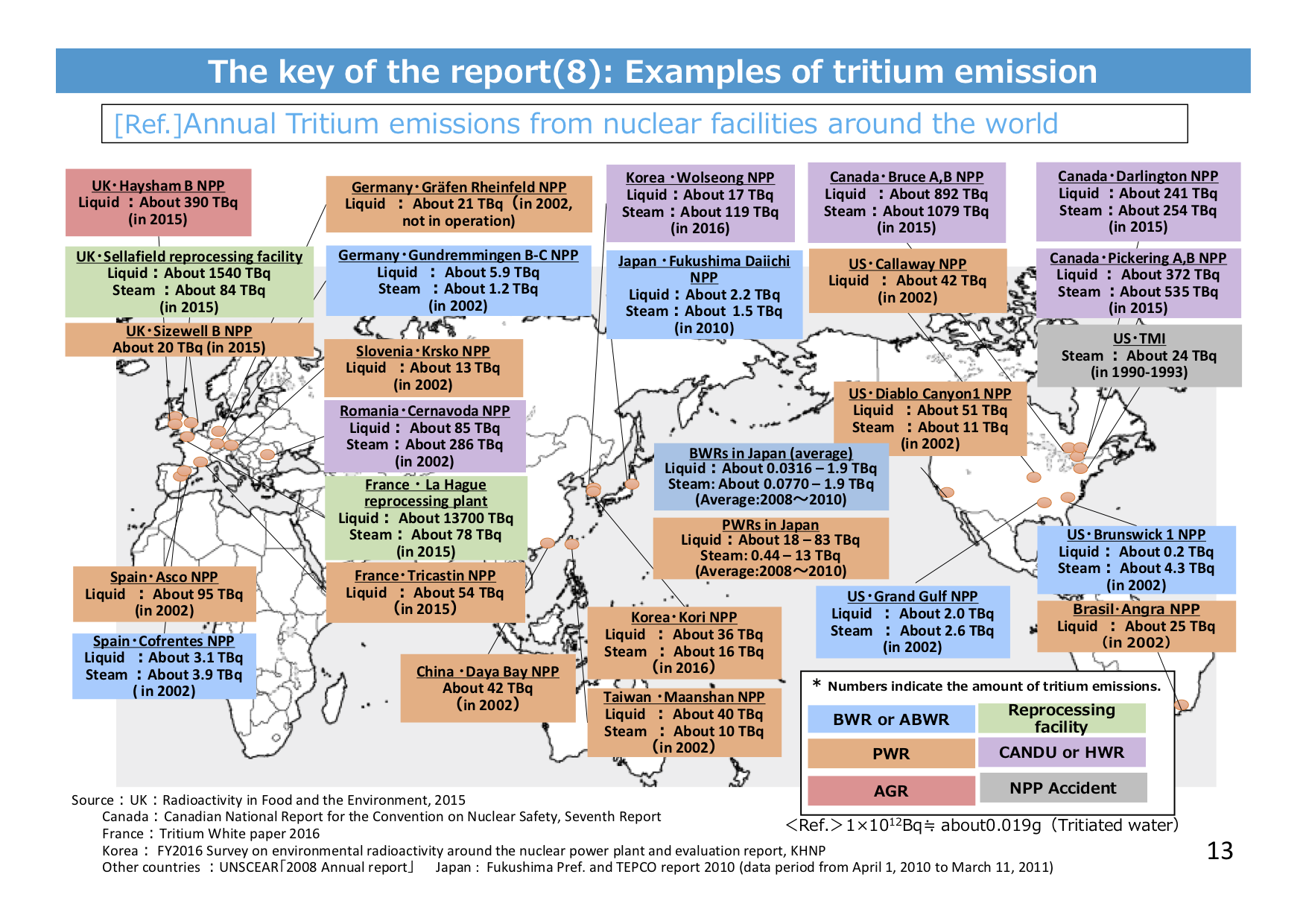
This map does not mention any releases in Japan! In particular, it does not mention the expected discharges from the Japanese reprocessing plant at Rokkashô-mura. The target value there is 9,700 TBq per year for tritium (source http://kakujoho.net/npt/tritm6f.html#ref1). But, the plant has never started…
This was not enough to convince the people of Fukushima, who are, for the most part, opposed to dumping in the ocean. By June 2020, 17 municipalities in Fukushima had also taken a stand against it http://www.fukushimaminponews.com/news.html?id=1013, as had the fishing industry https://fukushima.eu.org/lindustrie-de-la-peche-a-fukushima-fermement-opposee-au-rejet-en-mer-de-leau-partiellement-decontaminee/. Even Baskut Tuncak, UN Special Rapporteur since 2014 on the human rights implications of the environmentally sound management and disposal of hazardous substances and wastes, took part in a panel discussion. During the public consultation, 4,011 opinions were tabled and almost all were opposed to the rejection. As a result, the government decided to postpone announcing its decision http://www.asahi.com/ajw/articles/13866474.
On January 28, 2021, the Japanese Ministry of Industry opened a special page dedicated to the management of the water treated by the ALPS plant https://www.meti.go.jp/english/earthquake/nuclear/decommissioning/atw.html, which is less detailed than its last report dated December 2020 https://www.meti.go.jp/english/earthquake/nuclear/decommissioning/pdf/mp202012.pdf. A photo of this water is available on this page:

Feeling better?
Nuclear Power’s Prospects Cool a Decade After Fukushima Meltdowns
Nuclear Power’s Prospects Cool a Decade After Fukushima Meltdowns
Disaster at the Japanese reactors marked a turning point for an industry that once promised to give the world a nearly unlimited source of energy WSJ, By Peter Landers, March 3, 2021
OMAEZAKI, Japan—At a seaside nuclear-power plant here, a concrete wall stretching a mile along the coast and towering 73 feet above sea level offers protection against almost any conceivable tsunami. Two reactors are ready to start splitting atoms again to heat water into steam and generate power, the operator has told regulators.
Yet despite safety measures set to cost nearly $4 billion, the Hamaoka plant hasn’t produced a single kilowatt since May 2011, and it has no target date to restart. The paint on billboards is fading and an old “no trespassing” sign outside the barbed wire lies on the ground—signs of creeping neglect.
Even a local antinuclear leader, Katsushi Hayashi, said he spent more time these days fighting an unrelated rail line in the mountains, confident that regulators and public opinion wouldn’t let the plant open any time soon. “Fukushima gave us all the proof we need. It’s dangerous,” Mr. Hayashi said.
The triple meltdowns at Japanese nuclear reactors in Fukushima after the March 11, 2011, earthquake and tsunami marked a turning point in an industry that once dreamed of providing the world with nearly unlimited power.
A decade after Fukushima, just nine reactors in Japan are authorized to operate, down from 54 a decade ago, and five of those are currently offline owing to legal and other issues. All of Fukushima prefecture’s reactors are closed permanently or set to do so. Chubu Electric Power Co. , owner of the Hamaoka plant, declined to make an executive available for comment. It has formally applied to reopen two reactors at the plant and told regulators that new measures such as the wall, mainly completed in 2015, make them safe to operate…… (subscribers only) https://www.wsj.com/articles/nuclear-powers-prospects-cool-a-decade-after-fukushima-meltdowns-11614767406
Fukushima’s Olympic makeover: Will the ‘cursed’ area be safe from radioactivity in time for Games?

|
Fukushima’s Olympic makeover: Will the ‘cursed’ area be safe from radioactivity in time for Games? VIDEO, https://www.france24.com/en/asia-pacific/20200626-fukushima-s-olympic-makeover-will-the-cursed-area-be-safe-from-radioactivity-in-time 26/6/ 20 The Olympic Games, dubbed the “reconstruction Olympics”, should allow Japan to move on from the Fukushima tragedy. The region, a symbol of the 2011 disaster, has officially been cleaned up but many problems remain, such as radioactivity and “forbidden cities”. Over the course of several months, our reporters followed the daily lives of the inhabitants of this “cursed” region. In recent months, Japanese authorities have been working hard to finish rebuilding the Fukushima region in time for the Summer Games. This huge reconstruction and decontamination project is never-ending and is expected to cost nearly €250 billion. Although the work undertaken over the past 10 years is colossal and the region is partly rebuilt, it’s still not free from radioactivity. The NGO Greenpeace has detected radioactive hotspots near the Olympic facilities. And at the Fukushima power plant, Tepco engineers continue to battle against radioactive leaks. They also face new issues such as contaminated water, which is accumulating at the site and poses a new-fangled problem for Japan. Our reporters were able to visit the notorious nuclear power plant. They bring us a chronicle of daily life in Fukushima, with residents determined to revive their stricken region. |
|
Elon Musk and Bill Gates: beware of gurus toting solutions to climate change.
https://www.onlineopinion.com.au/view.asp?article=21339–4 March 21, Elon Musk has grand plans to save the world. Bill Gates has just published his book How To Avoid a Climate Disaster. They both envisage tax-payer funding for their solutions. But beware of gurus toting the  solution to the planet’s crisis.
If you don’t think that our home planet is in an ecocidal crisis, then you’ve been blissfully unaware of global heating, over-population, biodiversity loss, waste crises, plastic pollution, overconsumption of energy, water shortages, deforestation, nuclear danger, space junk danger, perpetual nuclear war risk…….
Visionaries like Bill Gates and Elon Musk have brought extraordinary, and beneficial advances to our human society. On the way, they have become billionaires. And good luck to them. But their wealth and fame has made them all too ready to be seen as world leaders, and to see themselves as having the solutions to world problems. This can be problematic, as in effect, some of their solutions exacerbate the problems.
The future envisioned by both Bill Gates and Elon Musk has one huge blind spot. They both foresee ever-expanding energy use, and they plan for that – problems can be fixed with technology.
On a finite planet, endless energy use just cannot work. But the concept of enough is just not in their plans. If the human species does not take up the concept of enough, we could just become an extinct species. Technology could be used to reduce energy use, but that idea fades away as Gates, Musk, and other technocratic leaders see progress as being to have ever more exciting and energy-guzzling gimmicks and activities.
The digital revolution. It should be a benefit, enhancing our lives, and in many ways, it IS. But an energy price is paid in our unbridled use of digital technology. Every email, emoji, Facebook post, tweet, blogpost, Youtube, uses electricity. It’s not as if these actions just disappear ”into the cloud”. What a dishonest term that is! There is no such cloud. What there actually IS – is a host of vast areas of dirty great data” farms”. There’s another dishonest term. They’re not farms. They are soulless collections of great metal servers, using ever growing amounts of electricity, and of water, to keep them cool.
Then there’s the price at the end. It’s very hard to find out the details and the extent of toxic materials from digital technology, that are dumped in poor countries.
And, to be fair, companies like Apple, have made some efforts to reduce their ewaste.
However, planned obsolescence is rampant in the high tech world, resulting in the utter tragedy of ewaste pollution, – from discarded smartphones, laptops, computers, printers, TVs, fidbits, smart fridges, robots etc, the tragedy of the thousands of children working as waste-pickers in India and Africa, in slum conditions. E-waste includes many toxic materials such as lead, arsenic, cadmium, and mercury, that release dioxins. . ”With no health or environmental protections in the slum, the toxins contaminate the air, water, and the food consumed in the slum…….. The area is constantly covered in thick, toxic smoke from the burning of electrical cables that goes on all day and night,” – High-tech hell: new documentary brings Africa’s e-waste slum to life

Both Gates and Musk are enthusiasts for renewable energy, and in the climate crisis, they are to be applauded for their work in this direction. Yet, as with all kinds of digital technology, renewables should not be unlimited, and do have their downsides, both in the production (pollution from rare earths mining/processing), and in the final disposal, with toxic wastes, and components that are difficult to recycle. . The International Renewable Energy Agency (IRENA) estimates that solar panels produced 250,000 metric tonnes of waste in 2018 alone.
Bill Gates and Elon Musk do show their awareness of the planet’s grave environmental problems, but we don’t hear from them about energy conservation, or about moving away from the consumer society. Both talk quite enthusiastically about the great increase in energy use that we can expect. They complacently predict endless energy use, just as the nuclear lobby did in its glossy advertising film ”Pandora’s Promise”
Elon Musk now plans to put 24,000 satellites into space, and is well known for his dream of colonising Mars, and This idea has, of course, been taken up by many others, and there’s a sort of general public delight in space travel and interstellar rocketry. People seem oblivious to the fact that this will require huge amounts of energy, and that the space scientists already are turning away from clean solar power, to the far more dangerous source of nuclear fission. They’re also oblivious of the state of affairs in near space, where the trillions of bits of space debris pose dangers, floating about just like the plastic pollution in the oceans. Meanwhile the military planners in USA, Russia, China are already planning for nuclear weapons and war in space.
No surprise then that Elon Musk sees nuclear power as necessary – not just for his predicted need for much more electricity on Earth, but for this obsession with satellites and rockets.
Less well understood than his push for electric cars and Tesla technologies, is Elon Musk’s investment in the cryptocurrency, Bitcoin. Running Bitcoin demands enormous amounts of 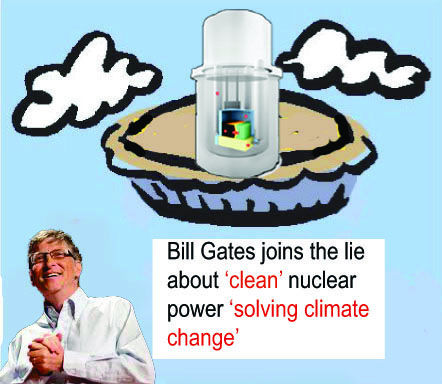 electricity, as Timothy Rooks explained recently.
Bill Gates, while motivated to help fight climate change, has also long been trying to make a success of his nuclear technology company Terra Power. The climate emergency presents him with the perfect opportunity to promote this, and especially, to get tax–payer funding to do it, as he suggests in his new book.
Wake up people! These two gurus have done some good stuff. But don’t let them manipulate us into dangerous territory – with nuclear technology, so connected with weaponry, and with its dangers, and the unsolved problem of radioactive trash. Sure, technology has got to be part of solving the planet’s crises. But we need much more imaginative leadership to steer our species away from infinite consumption and infinite energy use.
Fukushima resident still can’t return home 10 years after nuclear disaster
|
Fukushima resident still can’t return home 10 years after nuclear disaster, March 3,
 2021 (Mainichi Japan) FUKUSHIMA — Yasuko Sasaki’s house lies just 30 kilometers away from the Fukushima Daiichi Nuclear Power Station, where a meltdown took place following the 2011 Great East Japan Earthquake and tsunami. On Feb. 1, Sasaki temporarily returned to clean up leaves that had fallen on the grave at the back of the property. 2021 (Mainichi Japan) FUKUSHIMA — Yasuko Sasaki’s house lies just 30 kilometers away from the Fukushima Daiichi Nuclear Power Station, where a meltdown took place following the 2011 Great East Japan Earthquake and tsunami. On Feb. 1, Sasaki temporarily returned to clean up leaves that had fallen on the grave at the back of the property.
Once a month, the 66-year-old visits her house in the Tsushima district in the Fukushima Prefecture town of Namie from the prefectural village of Otama — 50 kilometers away — where she is currently evacuated to. It has been almost 10 years since she became unable to live at her own residence. Due to high radiation levels, Tsushima was designated a “difficult to return” zone, where restrictions for entering are in place, and people are barred from living there. Homes without their owners living in them have been ransacked by wild animals. While Sasaki has been away, wild animals chewed up stuffed turtle and bird specimens kept at her house. She continues to clean her house so that she “can return at any time.”………… The Reconstruction Design Council in response to the Great East Japan Earthquake, an advisory panel to the prime minister, deemed that “recovery from the devastating disaster will not be completed until Fukushima soil recovers.” The government has set up Specified Reconstruction and Revitalization Bases within difficult-to-return zones and is carrying out decontamination work and developing infrastructure so that people can reside in the area once again. It aims to lift evacuation orders for the bases in between 2022 and 2023. However, the areas designated as reconstruction bases are limited. In the Tsushima district, a 153-hectare space surrounding the town hall’s Tsushima branch is designated — just 1.6% of the whole district. Of the 532 households in the district at the time of the disaster, 80% including Sasaki’s house are not included in the reconstruction base area, and there are no prospects for these people to be able to return to their homes. Sasaki said, “Everything’s still the same, even 10 years after the (nuclear) disaster. I wonder for how many more years I’ll have to continue cleaning (my house).” (Japanese original by Rikka Teramachi, Fukushima Bureau, Suyon Kimu, City News Department) https://mainichi.jp/english/articles/20210302/p2a/00m/0na/012000c |
|
|
Nuclear power bailout Bill to be eliminated by Ohio law-makers
 Ohio Senate passes proposal to eliminate nuclear bailout at heart of House Bill 6 Ohio Senate passes proposal to eliminate nuclear bailout at heart of House Bill 6
https://www.cincinnati.com/story/news/politics/2021/03/03/ohio-senate-eliminate-nuclear-bailout-heart-house-bill-6/6892339002/ Jessie Balmert, Cincinnati Enquirer
COLUMBUS – Ohio lawmakers unanimously passed a proposal to eliminate a controversial $1 billion bailout for nuclear plants – with the apparent blessing of the company that owns them.On Wednesday, the Ohio Senate passed Senate Bill 44, 32-0, which would eliminate subsidies for two nuclear plants in northern Ohio tacked onto Ohioans’ electric bills. The bailout is a key component of House Bill 6, which was at the heart of a federal bribery investigation. Former Ohio House Speaker Larry Householder, R-Glenford, and four others were accused of participating in a nearly $61 million scheme to elect Householder as leader of the House, pass House Bill 6 and defend it against a ballot initiative to block the law. In the seven months since their arrests, Ohio lawmakers have done little to change the underlying law, which also subsidized coal plants, eliminated incentives for renewable energy and energy efficiency and guaranteed profits for Akron-based FirstEnergy Corp. “We need to use this as a learning opportunity,” said Sen. Rob McColley, R-Napoleon, of House Bill 6. “This is something that will undo what I feel is an awful lot of damage that has been done not just to our institution but to the state of Ohio.” Senate Bill 44 would eliminate the subsidies for the Perry and Davis-Besse plants owned by Energy Harbor, which was previously called FirstEnergy Solutions. Energy Harbor now says it doesn’t need those fees, which were slated to be added to Ohioans’ electric bills through 2027. A change from federal utility regulators in late 2019 effectively penalizes companies that accept state subsidies when those companies sell their power. Energy Harbor also expects it can compete with natural gas under Democratic President Joe Biden’s policies, lawmakers said. Sen. Michael Rulli, R-Salem, said Energy Harbor appears to have benefitted from its bankruptcy proceedings, too. Fees on Ohioans’ electric bills never took effect because lawsuits brought by Ohio Attorney General Dave Yost, Cincinnati and Columbus blocked them. The bill keeps $20 million in subsidies for solar companies, which would drop the monthly fee from 85 cents to 10 cents for residential customers and from $2,400 to $242 for industrial customers. Sen. Sandra Williams, D-Cleveland, offered an amendment to put utility shutoffs on hold during the COVID-19 emergency, but it was rejected. Sen. Matt Dolan, R-Chagrin Falls, said Ohio recently authorized $50 million for help with utility bills and he would work with Gov. Mike DeWine’s administration to ensure it gets to the people who need it. One lesson Senate President Matt Huffman, R-Lima, said he’s learned from House Bill 6 is Ohio lawmakers aren’t all experts on energy policy and should leave some decisions to the Public Utilities Commission of Ohio. “These complex issues regarding utilities should be decided by the public utilities commission and not, from time to time, with legislation,” Huffman said. “It’s sort of a cautionary tale to a lot of complex issues.” The Ohio Senate recently passed Senate Bill 10, which eliminates the decoupling provision from state law and refunds about $17 million collected from customers before the court ruling. FirstEnergy could still seek that benefit from state utility regulators. Both bills would need approval from the Ohio House of Representatives and Gov. Mike DeWine to become law. Going forward, Huffman said Ohio lawmakers could do more to limit the influence of dark money in politics. “We have to find a way to minimize it, but so much of that is controlled by the federal government,” he said. |
|
Public Service Enterprise Group trying to force ratepayers to act as guarantors for nuclear power debts
 Obligating ratepayers to act as guarantors…
…. they seek to leverage the subsidies as a means to obligate ratepayers to act as guarantors of the plants’ profitability,
It is noteworthy that PSEG never offered to return any stranded-cost payments to ratepayers and now has the temerity to argue that this $3 billion wealth transfer should not be considered in determining whether the nuclear plants require further subsidization.
Despite the efforts of PSEG and Exelon to ignore precedent and establish their preferred regulatory structure, the fact remains that the BPU and Legislature removed precisely these types of costs and risks from ratepayer responsibility long ago.
|
Ratepayers held up their side of nuclear deal. PSEG must do the same https://www.njspotlight.com/2021/03/nj-board-public-utilities-must-decide-massive-nuclear-subsidies-pseg-drumbeat-no-justification-responsibility-costs-risks/ STEVEN S. GOLDENBERG | MARCH 3, 2021
There is no justification for PSEG’s effort ‘to require ratepayers to assume responsibility for the costs and risks associated with the continued operation’ of its nuclear plants
With the issue regarding the propriety of nuclear subsidies — known as Zero Emission Certificates or ZECs — again before the Board of Public Utilities, the predictable PSEG-inspired public drumbeat supporting its nuclear plants has begun. News outlets, including NJ Spotlight News, have recently featured articles and editorials that tout the benefits the nuclear plants confer on the state, and are intended to gin up support for extending the current $300 million annual ratepayer subsidies. Continue reading
|
Ohio Senate votes unanimously to repeal nuclear plant bailout
 Ohio Senate votes to repeal nuclear plant bailout, Toledo Blade https://www.toledoblade.com/local/politics/2021/03/03/ohio-senate-votes-to-repeal-nuclear-plant-bailout/stories/20210303112, JIM PROVANCE
COLUMBUS — Making its biggest statement yet in the wake of a $61 million Statehouse bribery scandal, the Ohio Senate voted unanimously Wednesday to kill a controversial $1 billion bailout of two northern Ohio nuclear power plants.
The chamber, however, kept the portion of the now tainted House Bill 6 passed in 2019 that provides $20 million a year to support qualifying utility-scale solar projects.
If the House of Representatives agrees, the bill would remove provisions of the law requiring electricity customers to pay $150 million a year in surcharges to support operation of the Davis-Besse nuclear power plant near Oak Harbor and the Perry plant east of Cleveland. Together, the two plants along Lake Erie directly employ about 1,400 people.
“This is something that will undo what I feel is an awful lot of damage that has been done, not just to our institution but to the state of Ohio,” he said.The decision to end the nuclear credits was made easier by the decision of the plants’ owner, Energy Harbor, to forgo the money after federal rules were changed to penalize providers in the competitive electricity marketplace if they accept state subsidies.
Two individuals and a nonprofit corporation involved in the bribery scheme have already pleaded guilty to federal racketeering charges. Charges are still pending against three others, including former Ohio House Speaker Larry Householder (R., Glenford), in connection with the scheme to hide the flow of cash from Akron-based FirstEnergy Corp. and related entities.
The money was used to help elect representatives loyal to Mr. Householder, help elect him speaker, and then enact the nuclear bailout sought by what was then a FirstEnergy subsidiary but is now the independent Energy Harbor.
The Senate’s move Wednesday does not undo provisions of House Bill 6 that roll back and then eliminate prior statutory mandates that utilities produce more of their power from renewable sources and reduce energy consumption overall.
There also are competing bills, including one that passed the Senate and is now in the House that would repeal House Bill 6 provisions that would have locked in FirstEnergy Corp. profits regardless of what happened in the electricity marketplace. FirstEnergy has already agreed not to take advantage of that provision this year.
The House also has its own bill pending to repeal the nuclear and revenue guarantee provisions.
Senate President Matt Huffman (R., Lima) said no agreement has been reached with the House as to which vehicle legislation will be sent to Gov. Mike DeWine’s desk.
“I was part of the discussion in the last month or so of the last General Assembly, and in general conversations with Speaker [Bob] Cupp at that time, about things that collectively the House and Senate could get enough votes to pass,” he said. “Those are the first two things that we have done….
“I think those things are supported by a significant majority,” Mr. Huffman said. “You can see they were passed unanimously out of the Senate, so we can deal with those two significant problems of House Bill 6…. It certainly doesn’t mean it’s the end of the discussion regarding those things.”
With the initial passage of House Bill 6, the plants’ owner, then FirstEnergy Solutions, proceeded with refueling Davis-Besse, clearing a potential major hurdle in the plant’s continued operation.
Dust with French nuclear test residue threatens Turkey
|
Dust with French nuclear test residue threatens Turkey https://www.dailysabah.com/turkey/dust-with-french-nuclear-test-residue-threatens-turkey/news
BY DAILY SABAH WITH AGENCIES, ISTANBUL TURKEY , MAR 03, 2021 France is not the only country to be affected by sandstorms carrying the residues of cesium 137, used in nuclear tests by the country in the 1960s in the Sahara desert. Experts warn the dust, expected to move eastward and make a landing in Turkey soon, may be harmful for the population. Bekir Taşdemir, a nuclear medicine expert from Dicle University, says though it is unclear how much cesium residue there is in the dust sandstorms brought, people need to be cautious. “Possible high rate (of cesium) will necessitate people to stay indoors. They should not breathe the air outside and not open their windows,” Taşdemir warned. French experts had revealed that cesium was found in dust hailing from the Sahara Desert after a sandstorm on Feb. 6 traveled to the Jura Mountains. The same pattern of sandstorms is forecast for Turkey in the coming days. Taşdemir told Demirören News Agency (DHA) on Wednesday that the movement of dust particles, when combined with rainfall, will be more dangerous. “You should take an umbrella or have protective clothing if it is necessary to go out. If it rains, you should rapidly remove your clothes and wash them and take a shower when you return home. If radioactive residues are accumulated on your body or clothes, it poses a risk. There is also the possibility that those residues will settle on fruits and vegetables and you should be careful washing them thoroughly before consumption, in case of such a sandstorm,” he added. Cesium 137, a lethal chemical element, is used in the nuclear industry. When touched with bare hands, it can kill the person within seconds. It was emitted into the atmosphere after the 2011 nuclear plant accident in Fukushima, according to researchers. France had conducted its first nuclear test in the Sahara desert on Feb. 13, 1960. It carried out 17 nuclear explosions in the Algerian part of the Sahara Desert between 1960 and 1966. Eleven of the tests came after the 1962 Evian Accords ended the six-year war of independence and 132 years of French colonial rule. The issue of nuclear tests remains a major bone of contention between France and Algeria which claims the nuclear tests claimed the lives of a large number of people among the local population and damaged the environment. The Sahara dust that has blanketed parts of southern and central Europe last month has caused a short, sharp spike in air pollution across the region according to researchers. |
|
Russia’s most high-tech multi-purpose nuclear submarine further delayed
Russia’s most high-tech multi-purpose nuclear sub further delayed
The first upgraded cruise missile submarine of the Yasen-M class, the Kazan, will for unknown reasons have to sail another test-voyage before being handed over to the Northern Fleet. Barents Observer, 3 Mar 21, By Thomas Nilsen
New date for possible handover is set for May-June 2021, TASS reports with a source in the military-industrial complex. The state-affiliated news agency is known voicing military insights, but also for sugarcoating facts.
Another factory sea trial is planned, to be followed by an audit of the components and mechanisms, the source said without elaborating on which technical design flaws are to be fixed this time.
The “Kazan” was expected to be handed over from the submarine builder Sevmash yard to the Northern Fleet last Friday.
“The lead nuclear submarine “Kazan” can be handed over to the Russian Navy on February 26, the head of the United Shipbuilding Corporation, Aleksey Rakhmanov told RIA Novosti as late as on February 10.
Why the prestigeous submarine is hold back for more testing is unkown……..
Since first scheduled for delivery to the navy in 2017, the submarine has been notoriously delayed. A planned delivery in 2018 was postponed to 2019. That year came with another announcement that the “Kazan” would probably need all of 2020 to fix a number of auxiliary parts and assemblies which did not met the tactical and technical requirements set by the Ministry of Defense, the Barents Observer reported at the time……… https://thebarentsobserver.com/en/security/2021/03/russias-most-high-tech-multi-purpose-nuclear-sub-further-delayed
1 This Month

of the week – Shut Down Drone Warfare!


Tell the Ukrainian Government to Drop Prosecution of Peace Activist Yurii Sheliazhenko

Petition to revoke the licensing of the Near Surface Nuclear Disposal Facility (NSDF) at Chalk River. https://www.ourcommons.ca/petitions/en/Petition/Details?Petition=e-7247
To see nuclear-related stories in greater depth and intensity – go to https://nuclearinformation.wordpress.com
-
Archives
- March 2026 (237)
- February 2026 (268)
- January 2026 (308)
- December 2025 (358)
- November 2025 (359)
- October 2025 (376)
- September 2025 (257)
- August 2025 (319)
- July 2025 (230)
- June 2025 (348)
- May 2025 (261)
- April 2025 (305)
-
Categories
- 1
- 1 NUCLEAR ISSUES
- business and costs
- climate change
- culture and arts
- ENERGY
- environment
- health
- history
- indigenous issues
- Legal
- marketing of nuclear
- media
- opposition to nuclear
- PERSONAL STORIES
- politics
- politics international
- Religion and ethics
- safety
- secrets,lies and civil liberties
- spinbuster
- technology
- Uranium
- wastes
- weapons and war
- Women
- 2 WORLD
- ACTION
- AFRICA
- Atrocities
- AUSTRALIA
- Christina's notes
- Christina's themes
- culture and arts
- Events
- Fuk 2022
- Fuk 2023
- Fukushima 2017
- Fukushima 2018
- fukushima 2019
- Fukushima 2020
- Fukushima 2021
- general
- global warming
- Humour (God we need it)
- Nuclear
- RARE EARTHS
- Reference
- resources – print
- Resources -audiovicual
- Weekly Newsletter
- World
- World Nuclear
- YouTube
-
RSS
Entries RSS
Comments RSS
 nuclear-news