Biden Must Take Immediate Action to Reduce the Risk of Nuclear War
Biden Must Take Immediate Action to Reduce the Risk of Nuclear War
The continuing proliferation of atomic weapons threatens the safety of billions
https://www.scientificamerican.com/article/biden-must-take-immediate-action-to-reduce-the-risk-of-nuclear-war/ By THE EDITORS | Scientific American March 2021 Issue
When Joe Biden was sworn in as the 46th U.S. president on January 20, he inherited major crises, including a raging pandemic, a planet gripped by escalating climate change, a ravaged economy and a nation riven by hyperpartisanship, worsened by what amounted to an attempted coup inspired by his predecessor. But it is an older existential threat, the fearsome power of nuclear weapons, that should still be the most terrifying. Immediately after his inauguration, the new president gained official control over the “nuclear football,” a 20-kilogram satchel containing launch codes and strike options for unleashing the nation’s vast atomic arsenal on his sole authority, at a moment’s notice. But the intricate international web of agreements and strategies used to restrain this world-destroying power—held by other countries as well as the U.S.—has become dangerously frayed.
Some 9,500 warheads are currently in military service among the world’s nine nuclear-armed states, with over 90 percent held by the U.S. and Russia. Just a minuscule fraction of that alarming total could bring about millions of deaths, unfathomable suffering and a new Dark Age from which recovery would not be guaranteed. And unlike the most significant impacts of climate change, which manifest over decades and centuries, the devastation from nuclear warfare could unfold in mere minutes and hours.
This modern-day sword of Damocles has hung over humanity’s head for generations, held at bay by diplomacy, carefully orchestrated international agreements and the chilling zero-sum game of mutually assured destruction. Yet today, after years of neglect if not outright opposition by those who believe nuclear warfare can be “winnable,” those intertwined threads of safety are worn, loose and about to come apart.
Treaties to limit the proliferation and use of nuclear weapons have expired, more nations than ever before are poised to develop new arsenals, and potential destabilizing factors such as antiballistic missile defense systems and novel hypersonic weapons platforms continue to multiply.
The Biden administration can take several steps to tiptoe back from the brink of disaster while maintaining national security. The first should be Biden’s fulfillment of his campaign promise to extend the New Strategic Arms Reduction Treaty (New START), the sole remaining arms-control agreement with Russia, set to expire on February 5. It is a vital component in curtailing each nation’s existing nuclear forces and the possibility of a new nuclear-arms race. More broadly, extending the treaty should be part of a much needed attempt to improve the perilous state of U.S.-Russia relations—exemplified by Russia’s recent, massive cyberattack on U.S. institutions, including the federal agencies charged with maintaining the national nuclear stockpile. Such efforts could serve as a model for dialogues with other nuclear-armed nations, especially China, which could in turn yield a wider range of solutions to the vexing problem of how to denuclearize North Korea.
And Biden should make good on his promise to reenter the Joint Comprehensive Plan of Action, also known as the Iran nuclear deal, an agreement from which then President Donald Trump withdrew the U.S. in 2018. The 2015 deal sought to extend Iran’s “breakout time”—its capability to produce bombs from enriched fissile material—from a few months to at least a year. But after Trump reinstated severe sanctions, Iran resumed vigorous uranium enrichment. The assassination of Iran’s top nuclear scientist last November and substantial congressional opposition to the deal all set high barriers to the U.S. rejoining. Nevertheless, the consensus view among arms-control experts is that the agreement is the least-worst option for ensuring a nuclear-free Iran.
Yet if such efforts are met with intransigence from Congress—a not unlikely event—Biden should take unilateral actions designed to reduce risks and bolster international cooperation. Drawing down the nation’s number of deployed strategic weapons; reevaluating its byzantine “command and control” systems; and declaring a “no first use” policy for nuclear weapons—something U.S. presidents have so far been unwilling to do—all fall within his purview. Most consequentially, however, Biden should order sweeping changes to what is now the president’s sole authority for launching nuclear weapons. He should insist that it be made in consultation with executive branch officials and congressional leaders, a step that can be taken without weakening deterrent ability, arms-control experts say. If this move were eventually formalized through federal legislation, it could be the most meaningful act of Biden’s presidency toward ensuring a safer world.
Germany concerned about Poland’s nuclear energy plans
|
Germany concerned about Poland’s nuclear energy plans, DW, 17 Feb 21, The Polish government wants to start producing nuclear energy in 2033 and has agreed to deals with the US and France. But Germany is increasingly alarmed by its neighbor’s energy plans……….
A seemingly perfect solutionNuclear reactors are considered by many to be the perfect solution. Plans to develop nuclear energy go back to the 1970s and construction had begun on two reactors of Soviet design in Zarnowiec, some 80 kilometers (50 miles) northwest of Gdansk, but was stopped after the 1986 Chernobyl disaster. All subsequent attempts to relaunch the project failed. Now, the new reactors will probably be built in Zarnowiec and nearby Lubiatowo-Kopalino. However, Poland cannot fund the reactors, whose capacity will be six to nine gigawatts and which are estimated to cost €30 billion ($36 billion). Last year, Prime Minister Mateusz Morawiecki said that the ideal partners for the project, both in terms of technology transfer and funds, would be “proven partners from NATO and the western world.” US or France?An ideal partner for Poland would be the US. Former President Donald Trump raised great hopes when he visited his Polish counterpart Andrzej Duda in June 2020 and promised support from US companies. The prime minister said that the meeting had “moved Poland in the right direction.” The two countries signed a preliminary agreement to cooperate on the development of Poland’s nuclear energy program less than a month before Trump’s election defeat. But with Trump out of office, Poland lost its closest ally. Now France has come into play. On February 2, the day the government approved the energy strategy, French Foreign Trade Minister Franck Riester visited Poland to offer support. The CEO of the state-owned Electricite de France (EDF) spoke to the Polish media and proposed a deal to fund two-thirds of the project while promoting the European Pressurized Reactor (EPR), which is already in operation in Taishan, China. With a capacity of over 1000 MW (1 GW) the gigantic reactor corresponds to what the government is looking for. Potential risks…..Other experts said that Poland’s plans went against the current trend in the EU to move towards gas and renewable energies. “With current technologies, it would not be difficult to raise the share of renewables in the energy mix to 80%. The missing 20% is due to the Polish winter, when there is little wind and little sun,” Marcin Popkiewicz, a nuclear physicist at Warsaw University, told DW, pointing out that it’s also very expensive to build nuclear power plants. “For customers, the cost of nuclear energy could be five times the cost of renewables.” Lagging behindThe government’s energy strategy already includes renewables, but progress has been slow. Their share of the energy mix has stagnated at 14% for years. This is lower than the EU average of 20% (2020). This could change in 2025 when Poland’s first wind farm on the Baltic coast goes into operation. It’s slated to reach a capacity of 8 GW by 2040……….. For the time being, fossil fuels account for the bulk of Poland’s energy supply Germany wants to be kept in the loopPoland’s plans are already causing resentment in neighboring Germany. According to an expert report commissioned by the Green Party’s parliamentary faction in the German Bundestag in January, the Polish nuclear power plants, just a few hundred kilometers from the German border, would pose a high risk to the population. “Experts evaluated everything on the basis of weather data over the past three years. There is a 20% probability that Germany would be affected by an accident at the planned nuclear power plant,” the chairwoman of the Bundestag Committee on the Environment, Ursula Kotting-Uhl, told DW. “In the worst-case scenario, 1.8 million Germans would be exposed to radiation of over 20 millisieverts. At that level, we would have to start evacuating. Berlin and Hamburg could be affected, which are densely populated.” https://www.dw.com/en/germany-concerned-about-polands-nuclear-energy-plans/a-56603782 |
|
Nuclear industry very nervous about EU evaluation of its’green’ claims
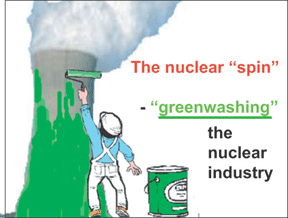 Nuclear faces ‘a lot of uncertainty’ as EU green evaluation looms, By Frédéric Simon https://www.euractiv.com/section/energy-environment/news/nuclear-faces-a-lot-of-uncertainty-as-eu-green-evaluation-looms/ EURACTIV.com 16 Feb 2021 (updated: 17 Feb 2021) The industry is growing increasingly nervous about European Commission plans to evaluate the safety of radioactive waste handling as an expert report is expected next month on how to classify nuclear energy under the EU’s green finance taxonomy.
The European Commission’s in-house research body, the Joint Research Centre (JRC), is putting the finishing touches to a report about the safe handling of radioactive waste that could be fateful for the future of Europe’s nuclear industry.
The report, expected by the end of February or beginning of March, could end up recognising nuclear power as a “transition fuel” under the EU’s green finance rulebook, or on the contrary irreversibly stigmatise it as a polluting form of energy that does “significant harm” to the environment.“The big issue for us with the taxonomy is that it will enable eligible companies to have access to bonds and funds that have a lower interest rate,” said Jessica Johnson, communications director at Foratom, the trade association representing the nuclear industry in Brussels.
“It means that the cost of finance could potentially be lower if they have access to these funds because the amount of interest they will have to pay back is a lot less,” she told journalists during an online press briefing on Wednesday (9 February).
Poland, the Czech Republic and Bulgaria are planning to build new nuclear reactors to decrease their reliance on coal and meet the EU’s climate goals.
But the classification of nuclear under the EU’s green finance taxonomy could have implications on the amount of financial support that governments will be allowed to provide for new projects under the EU’s state aid rules, which are being revised this year.
“We have seen recent consultations on state aid where reference is made to the taxonomy regulation, suggesting that there could be some link there in the future,” Johnson said. “We don’t know what they will do with that”.
Private banks are reluctant to provide loans for new nuclear projects unless governments back them with substantial financial guarantees and state aid. Renewables, by contrast, are cheaper to build and offer much faster delivery timetables and quicker returns – increasingly without state support.
“We see little economic rationale for new nuclear builds in the US or Western Europe, owing to massive cost escalations and renewables cost-competitiveness,” said rating agency S&P in a note released in 2019.
New highly radioactive particles found in Fukushima
|
New highly radioactive particles found in Fukushima https://www.sciencedaily.com/releases/2021/02/210217134852.htm
|
|
|
Is this the end of the road for UK’s Bradwell nuclear project?
|
16 February, 2021, The Blackwater Against New Nuclear Group (BANNG) considers the announcement by BRB, the UK division of China General Nuclear (CGN), that engagement and all active project work on Bradwell B will be paused for at least a year indicates a significant reversal for the project. Despite urging the developer to suspend public engagement during the pandemic, BANNG was told the national need was ‘urgent’ and it was in the public interest that the proposed development ‘is not indefinitely or even substantially delayed’.
‘Now it seems, the project is slowing down and no longer so vital. The indefinite pause makes one wonder if this could be the beginning of the end for a project for which there is no vital need and which will create irretrievable damage and danger to the coastal communities of Essex’, said Prof. Andy Blowers, Chair of BANNG. Until a year ago CGN was claiming it was ramping up its plans for Bradwell B to take pole position in the UK’s civil nuclear programme as other projects fell by the wayside. This acceleration has apparently been impeded by the problem of travel for engineers between the UK and China during the pandemic and the risk that work is being delayed and getting out of sequence. It may be that this is the precipitating cause of the delay but there were already signs that the project was encountering difficulties that could lead to ultimate abandonment. First among these was the massively negative public reaction to the proposals that were revealed on the eve of the first lockdown. People were shocked by the sheer scale of the project and its massive impact on environment, communities and wellbeing. Even the Environment Agency (EA) was scathing in its criticism emphasising the contrast between the plan’s economic ambitions and the inadequate ambition for the environment and lack of detailed information given by the developer. In the last few weeks the EA has produced a cautious assessment of the reactors planned for Bradwell indicating there are a number of issues to be resolved before the project gets design approval. On top of this came the loss of political support. Initially, all the main local authorities welcomed the power station for the potential jobs and wealth it would bring but making clear support was contingent on environmental protection and improvement. First Colchester Borough and then Maldon District, which had been a major protagonist for Bradwell B, declared total opposition to the proposals. Maldon went further, turning down BRB’s planning application for land investigations at the site. The company has appealed but the long delay by the planning inspector in determining the appeal suggests there may be problems with environmental impacts. Elsewhere, the nuclear industry is running into trouble. The recent decision by the infrastructure planning inspectorate to recommend refusal of planning for the Wylfa project in North Wales on environmental grounds bodes ill for both Sizewell and Bradwell where environmental sensitivities are at least as strong. The threat to the iconic Colchester Native Oyster and Brent Geese are among the many environmental impacts posed by Bradwell B. The potential suitability of the Bradwell site has long been contested by BANNG and it is currently under review by the Government. Recent climate change predictions indicate that the site could be overwhelmed by sea-level rise and storm surges before the end of this century and well before the site could be cleared of spent fuel and other highly radioactive wastes during the next century. And the Government’s support for nuclear power as set out in its Energy White Paper is hardly evangelical: the Government ‘will remain open to other projects if the nuclear industry demonstrates that it is able to reduce costs and deliver to time and budget’. On Bradwell B specifically the White Paper is silent. Lastly, in the geopolitical sphere, there are serious concerns about security risks in inviting Chinese participation in the development of the UK’s critical infrastructure. It is quite possible, some would say likely, that the project will be withdrawn as part of the fall out in deteriorating Chinese and UK relations. Andy Blowers commented: ‘Taking all these issues together, it is quite possible that the pause will provide the prelude to final abandonment of the project. Covid-19 may be the final straw. For far too long this black cloud has been hanging over the Blackwater. At last there are signs of a silver lining’. |
|
EPA awards $220 million for uranium mine cleanup on Navajo Nation
WASHINGTON — The Environmental Protection Agency said Thursday it will award contracts worth up to $220 million to three companies for the cleanup of some of the hundreds of abandoned uranium mines on the Navajo Nation.
Work could start later this year following the completion of assessments for mining sites coordinated between the EPA and the Navajo Nation’s environmental agency, the federal agency said.
This week’s announcement is just the latest in years of efforts to clean up the mines, the toxic legacy of Cold War mining in the region. More than 30 million tons of uranium ore were mined in the region, according to the EPA, which said more than 500 mines were ultimately abandoned.
“From World War II until the end of the Cold War, millions of tons of uranium were mined on Navajo lands, exposing mine workers and their families to deadly radiation,” said Rep. Tom O’Halleran, D-Sedona, whose district includes the Arizona portion of the Navajo Nation.
“As a result, high rates of cancer, birth defects, and contaminated water sources remain a reality for residents of the Navajo Nation even now,” O’Halleran said in a statement on the contracts.
The agency said it worked closely with Navajo Nation to develop contracts that would incentivize the creation of employment opportunities for Navajo residents in order to build local economic and institutional capacity.
The majority of funding for the contracts comes from a nearly $1 billion settlement made in 2015 with Kerr McGee Corp. for the cleanup of more than 50 mines in Nevada and on the Navajo Nation that the company and its successor, tronox, were responsible for.
From the late 1940s through the 1960s, Kerr-McGee mined more than 7 million tons of ore on or near the Navajo Nation, leaving behind uranium mine sites that included contaminated waste rock piles. Exposure to uranium in soil, dust, air, and groundwater, as well as through rock piles and structural materials used for building can pose risks to human health, according to the EPA
Mining stopped for the most part decades ago, and the Navajo Nation banned uranium mining on its lands in 2005. But the cleanup effort has lingered. The EPA launched five-year programs in 2007 and 2014 to study the issue and identify the biggest risks, and the agency last year added abandoned Navajo uranium mines to its list of Superfund sites “targeted for immediate, intense action.”……. https://www.12news.com/article/news/local/arizona/epa-awards-220-million-for-uranium-mine-cleanup-on-navajo-nation/75-154a0fae-53e3-477d-a5ce-0a678d97d
Japan town mayor OKs restarting nuclear reactor over 40 years old
|
Japan town mayor OKs restarting nuclear reactor over 40 years old
February 16, 2021 (Mainichi Japan) TSURUGA, Fukui — The mayor of a central Japan town hosting a nuclear power plant operated by Kansai Electric Power Co. informed the speaker of the municipal assembly on Feb. 15 that he would approve the restart of a reactor at the plant that is more than 40 years old. Mayor Hideki Toshima of the Fukui Prefecture town of Mihama told Mihama Municipal Assembly Speaker Yoshihiro Takenaka that he would approve the restart of the No. 3 reactor at Mihama Nuclear Power Station, which began operating in the 1970s. The assembly had already approved the reactivation of the aging reactor. Meanwhile, Mayor Yutaka Nose of the prefectural town of Takahama, home to Kansai Electric’s Takahama Nuclear Power Station, whose No. 1 and 2 reactors are also over 40 years old, has given the green light for resuming the operations of the two rectors, while the Takahama Municipal Assembly has also approved of the move. Now that local consent has been secured, the focus has shifted to the decisions expected from Gov. Tatsuji Sugimoto and the prefectural assembly………. As a general rule, a nuclear power plant operator is expected to obtain consent for restarting a rector from the local governments around the plant as well as local assemblies. As a condition for approving the restart, the Fukui Prefectural Government said Kansai Electric would need to present candidate sites outside the prefecture for interim spent nuclear fuel storage facilities. The prefectural government maintained that until that condition was achieved, the parties were “not even at the starting line of discussion.” However, after Kansai Electric proposed on Feb. 12 that it would finalize a planned site for the storage facilities by the end of 2023, the prefectural government demonstrated a positive attitude toward reactivation. Discussion on restarting the aging reactor may develop further at the prefectural assembly session convening on Feb. 16. (Japanese original by Hidetoshi Oshima, Tsuruga Resident Bureau) https://mainichi.jp/english/articles/20210216/p2a/00m/0na/008000c |
|
Hiroshima 1945, Fukushima 2011, – Japan’s nuclear horrors – theme for March 21
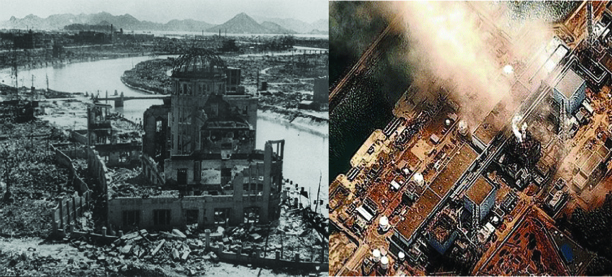
As World War 2 neared its end, with 20 million Russian soldiers killed, fighting with the Allies against Hitler, America’s government was already planning its military superiority over Russia.
What they needed was to demonstrate a weapon of huge mass destruction, that would frighten the Russians. Germany surrendered on 7 May 1945. Too late to try one out on Germany , but Japan was still in the war, (though near to giving up). So they had to hurry. Japan would be the test case – selecting the city of Hiroshima , both to test the effects of atomic bombing, and to show the Russians, on August 6th. To emphasise the USA’s military superiority, they plutonium bombed Nagasaki 3 days later.
After the war, how to get Japan ”on side” against Russia , and equally important, to show the Japanese that nuclear is really quite good.? USA helped Japan to now get an ‘economic miracle’, and better still, give Japan the benefit of ‘good nukes’.
To these crowded, seismically dangerous Japanese islands, USA promoted clusters of nuclear power stations. The nuclear industry’s image was miraculously enhanced – to Japan, and to the world.
BUT, 66 years later, Japan suffered another disastous nuclear blow, with the meltdown at the Fukushima nuclear power station. With the 10 year anniversary of this disaster, on March 11, the real cleanup is nowhere in sight, vast amounts of contaminated water are still accumulating, areas are uninahitable, and most evacuees don’t want to return. Radioactive pollution in forests is still a problem.
Sad to reflect that this one country, Japan, has suffered two great nuclear horrors – 75 years apart, with the tragic effects of both continuing. The world needs, not a celebratory, cosmetic, Olympic Games, but real international help for the people of Fukushima, and for the environmental remediation. Japan needs help to shut down the toxic nuclear industry and move to clean energy
Community fights Canadian govt’s slick propaganda pushing for high-level radioactive waste dump
Radio — A community’s fight to stop a high-level radioactive waste storage facility
Since the dawn of the nuclear age in the 1940s, humanity has faced stark questions of risk and safety. Some of those questions have to do with the dangers of acute catastrophe, but others are about the less dramatic but no less serious risk posed by the waste that the nuclear industry generates. Among the most challenging of that waste to deal with – designated “high-level radioactive waste” by the industry – is spent fuel bundles from nuclear reactors. Comprised of a highly toxic and radioactive mix of isotopes, the material in these bundles will be dangerous to living things for at the very least hundreds of thousands of years.
Though it has been decades since the industry first started producing radioactive waste, there has yet to be a fully satisfactory answer to the question of what to do with it. The organization currently tasked with figuring that out for the millions of used nuclear fuel bundles in the Canadian context is the Nuclear Waste Management Organization (NWMO). Currently, used fuel bundles are kept in interim storage facilities on reactor sites, but the long-term plan is to put them in a “deep geological repository” (DGR), a location that is deep underground and geologically stable. A number of countries are currently developing DGRs for high-level radioactive waste, but none are currently operational.
The NWMO is in the middle of an elaborate selection process to find a site for both the plant that will repackage the fuel bundles for long-term storage and the storage facility itself. They began with 22 possible host communities in 2010 – mostly, it should be noted, small financially distressed communities – and they have narrowed their possibilities down to two, Ignace in northwestern Ontario and South Bruce in southern Ontario, near Lake Huron. They hope to announce their decision in 2023.
The concerns that Stein, Noll, and other members of their group have with the facility are many. Despite assurances from the NWMO that it will all be safe, their own investigation of processes for transporting and storing nuclear waste around the world have convinced them that very real risks remain under the NWMO’s plans. They fear that the facility could endanger human and environmental health, local agriculture, local drinking water, and the larger Great Lakes basin. And they argue that it is not just about their community being the wrong choice, but that the whole approach is flawed.
 Moreover, they are quite concerned about the process. They have identified a pattern of what they say is incomplete and one-sided information from the NWMO, and a process that takes advantage of communities by downplaying risk and promising economic benefits that they say seem unlikely. The NWMO insists that whatever community ends up hosting the DGR must be willing, but they have refused to clarify exactly what that means.
Much of the group’s work has focused on mounting a local grassroots response to the slick and well-funded PR efforts of the NWMO. Before COVID, that involved knocking on doors. They’ve brought in speakers and hosted events, lobbied politicians, done media work, and made presentations to other local organizations. Last summer, they presented a petition against the DGR with signatures from more than 1500 residents to the local municipal council – and to put that in perspective, the current mayor got fewer votes than that in the last local election. They commissioned Mainstreet Research to do an opinion survey that found 64% of local residents would vote against locating a DGR for high-level radioactive waste in the community. The group is demanding a binding referendum on the issue.
Stein said, “Since they won’t give us a definition of what ‘willing’ is, we are going to just continue to show them what ‘not willing’ looks like.”
Illegal and opposed — Beyond Nuclear International

Besides threatening public health, safety, and the environment, evading federal law to license the ISP facility would also impact the public financially. Transferring title and liability for irradiated fuel from the nuclear utilities that generated it to DOE would mean that federal taxpayers would have to pay many billions of dollars for so-called “interim” storage of the waste. That’s on top of the many tens of billions of dollars that ratepayers and taxpayers have already paid to fund a permanent geologic repository that hasn’t yet materialized.
 Beyond Nuclear files suit to stop massive radioactive waste dump https://beyondnuclearinternational.org/2021/02/15/illegal-and-opposed/
From Beyond Nuclear staff. Beyond Nuclear has filed suit in federal court to prevent the U.S. Nuclear Regulatory Commission (NRC) from licensing a massive “consolidated interim storage facility” (CISF) for highly radioactive waste in Andrews County, West Texas.
In its Petition for Review filed in the U.S. Court of Appeals for the District of Columbia Circuit, Beyond Nuclear asked the Court to dismiss the NRC licensing proceeding for a permit to build and operate a CISF proposed by Interim Storage Partners (ISP), a business consortium. ISP plans to use the facility to store 40,000 metric tons of highly radioactive irradiated fuel generated by nuclear reactors across the U.S., (also euphemistically known as “used” or “spent” fuel), amounting to nearly half of the nation’s current inventory.
The irradiated fuel would be housed on the surface of the land, on the site of an existing facility for storage and disposal of so-called “low-level radioactive waste” (LLRW). The LLRW facility is owned and operated by Waste Control Specialists (WCS). WCS and Orano (formerly Areva) comprise ISP. ISP’s CISF is located about 0.37 miles from the New Mexico border, and very near the Ogallala Aquifer, an essential source of irrigation and drinking water across eight High Plains states.
The Beyond Nuclear petition charges that orders issued by the NRC in 2018 and 2020 violate federal law by contemplating that the U.S. government will become the owner of the irradiated fuel during transportation to and storage at the ISP facility. Under the Nuclear Waste Policy Act, the government is precluded from taking title to irradiated fuel unless and until a repository is licensed and operating. No such repository has been licensed in the U.S. The U.S. Department of Energy’s (DOE) most recent estimate for the opening of a geologic repository is the year 2048 at the earliest.
In its 2020 decision, in which the NRC rejected challenges to the license application, the NRC Commissioners admitted that the Nuclear Waste Policy Act would indeed be violated if title to irradiated fuel were transferred to the federal government so it could be stored at the ISP facility. But they refused to remove the proposed license provision which contemplates federal ownership of the irradiated fuel.
Instead, they ruled that approving ISP’s application would not directly involve NRC in a violation of federal law – according to the NRC, that violation would occur only if DOE acted on the approved license – and therefore they could approve it, despite the fact the provision is illegal. The NRC Commissioners also noted with approval that “ISP acknowledges that it hopes Congress will change the law to allow DOE to enter storage contracts prior to the availability of a repository” (December 17, 2020 order, page 5).
But the petition contends that the NRC may not approve license provisions that violate federal law in the hope the law will change. “This NRC decision flagrantly violates the federal Administrative Procedure Act (APA), which prohibits an agency from acting contrary to the law as issued by Congress and signed by the President,” said Mindy Goldstein, an attorney for Beyond Nuclear.
“The Commission lacks a legal or logical basis for its rationale that it may issue a license with an illegal provision, in the hopes that ISP or the Department of Energy won’t complete the illegal activity it authorized. The buck must stop with the NRC,” Goldstein said. Co-counsel Diane Curran stated, “Our claim is simple. The NRC is not above the law, nor does it stand apart from it.” Continue reading
Continued use of nuclear energy brings pollution, cancers and birth defects
 A growing body of evidence supports a grim reality: that living in radioactively contaminated areas over multiple years results in harmful health impacts, particularly during pregnancy.
This is borne out in a recent study by Anton V. Korsakov, Emilia V. Geger, Dmitry G. Lagerev, Leonid I. Pugach and Timothy A. Mousseau, that shows a higher frequency of birth defects amongst people living in Chernobyl-contaminated areas (as opposed to those living in areas considered uncontaminated) in the Bryansk region of Russia.
Because the industry and governments are pushing to spend more money on new nuclear reactors — or to keep the old ones running longer — they have been forced to come up with a deadly workaround to surmount the strongest argument against nuclear power: its potential for catastrophic accidents.
Even the nuclear industry and the governments willing to do its bidding understand that you cannot really clean up after a nuclear catastrophe. For example, in Japan, where the March 2011 nuclear disaster has left lands radioactively contaminated potentially indefinitely, there is an attempt to mandate that people return to live in these areas by claiming there are no “discernible” health impacts from doing so.
 Bodies that are supposed to protect health and regulate the nuclear industry, including the U.S. Environmental Protection Agency, the International Commission on Radiological Protection and Nuclear Regulatory Commission are raising recommended public exposure limits, considering halting evacuations from radiation releases, and encouraging people to live on, and eat from, contaminated land.
The public justification for continued nuclear energy use is, ostensibly, to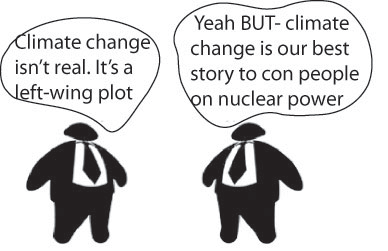 address the climate crisis. The reality is more likely a desperate last-ditch effort by the nuclear industry to remain relevant, while in some countries the nuclear energy agenda remains inextricably linked to nuclear weapon programs.
Forcing people to live on and consume produce grown from radioactively contaminated land is contrary to scientific evidence indicating that these practices harm humans and all animals, especially over the long-term. By the time these health impacts are unearthed, decades later, the false narratives of “harmless low radiation doses” and “no discernible impact” have solidified, covering up the painful reality that should be a touchstone informing our debate over nuclear power.
The recent joint study, whose implementation, says Korsakov, would not have happened without the support and efforts of co-author Mousseau, found that birth defects like polydactyly (having more than five fingers or toes), and multiple congenital malformations (including those that are appearing for the first time — called de novo), were “significantly higher… in newborns in regions with elevated radioactive, chemical and combined contamination.”
Uniquely, Korsakov also examines areas contaminated by both Chernobyl radioactivity and industrial chemicals. Multiple congenital malformations (MCM) were much higher in areas of combined contamination, indicating an additive and potentially synergistic effect between pollutants for these birth defects.
Congenital malformations (CM) are thought to originate in the first trimester of pregnancy and represent a main cause of global disease burden. They are considered “indicators of adverse factors in the environment,” including radioactive pollution, and can afflict numerous organs (heart, brain, lungs, bones, intestines) with physical abnormalities and metabolic disorders. Counted among these are clubfoot, hernias, heart and neural tube defects, cleft palate and lip, and Down syndrome.

CMs are the leading cause of infant mortality in many developed nations, accounting for 20% of U.S. infant deaths. For those living past infancy, the effects can be lifelong. While a number of CMs are obvious early in life, some may not be identified until later, even into adulthood. Countries of low- and middle-income are affected disproportionately.
In the Bryansk region of Russia, birth defects were examined over the 18-year period from 2000-2017. For areas contaminated with radiation alone, dose estimations from Chernobyl radiation (released from the 1986 nuclear catastrophe) ranged from 0.6 mSv to 2.1 mSv per year, while in areas contaminated with radiation and chemicals, dose ranges were 1.2 to 2.0 mSv per year.
As the Bryansk study authors point out, “[n]early all types of hereditary defects can be found at doses as low a [sic] 1–10 mSv indicating that current radiation risk models are inadequate for low dose environments.”
In comparison, Japan and the U.S. maintain that there is little risk to resettling or inhabiting areas contaminated by nuclear catastrophe where estimated doses would range from 5-20 mSv/year. Yet harm was found among Bryansk populations exposed to doses far lower than the much higher ones proclaimed “livable” by nuclear proponents.
One explanation for the disconnect between the expected and actual health effects is an underestimate of the impact of ingesting or inhaling manmade radioactive isotopes, particularly beta emitters, a large source of exposure following radiation releases from nuclear power catastrophes.
A number of these isotopes mimic nutrients that our bodies need such as calcium (radiostrontium) and potassium (radiocesium), so our body doesn’t know to avoid them. Of course, nuclear proponents recognize that economic recovery of polluted places will be difficult without being able to grow, sell and consume food that might be contaminated with isotopes that give off this radiation,.
Korsakov et al. point to yet another explanation for the disconnect — the assumption that dose reconstruction models properly fit all realistic exposures. When experts estimate doses they often do so without adequate knowledge of local culture and habits. Therefore, they fail to capture variations in exposure pathways, creating enormous errors in dose reconstruction. As a starting point, radiation science would be better served by directly measuring contamination levels where people actually live, play, breathe and eat.
But it seems dose models also fail to adequately represent the damage done to fetuses and neonates, not least because damage can be random (stochastic) making it difficult to predict. Stochastic health impacts include cancer and other genetic damage, and may be severe even at low doses. During pregnancy, one hit from radiation could damage or destroy cells meant to form entire organs, making accounting for stochastic impacts during fetal development extremely important — especially as fetal tissue collects some radionuclides in greater amounts than maternal tissue.
Health impacts in the Bryansk region could be a result both of direct radiation exposure during pregnancy and of cumulative impact over a “series of generations (genetic load)” raising the specter of heritability of genetic damage. Past studies have indicated that radiation damage can be heritable — passing from parents to offspring; that living in environments of elevated natural background radiation will increase mutations and disease; that the ability to withstand radiation doses appears to diminish as continually-exposed generations progress; and that doses from catastrophic releases should be accounted for across generations, not just in the generation initially exposed.
These currently sparse, yet growing data, support long-held conclusions that humans do not differ significantly from every other animal and plant — they, too, suffer heritable damage from radiation.
The Korsakov study projects that overall, multiple congenital malformations will increase in the next few years in the contaminated regions. Increases in birth defects are occurring despite access to free in-depth medical exams for pregnant women residing in areas of higher contamination and, if warranted, pregnancy termination. Such access has apparently greatly decreased the number of stilbirths in the region, as did a similar program at the end of the 1990s in Belarus, the country which bore the brunt of radioactive Chernobyl contamination. But even with such programs, overall birth defects have increased in the contaminated areas in Russia.
So not only is it unhealthy to live in radiologically-contaminated areas, attempts at mitigating the effects, particularly those on pregnancy, have limited impact. Encouraging, or worse yet, forcing people to live in contaminated areas and eat contaminated food, is foolishly cruel (particularly to people of reproductive age who may face wrenching decisions about wanted pregnancies) and not in the interest of public health.
Meanwhile, the continued use of nuclear energy that has forced us into this Faustian bargain in the name of mitigating climate change, is both unnecessary and downright harmful.
Iran vows to limit nuclear inspections if partners fail to act
Iran vows to limit nuclear inspections if partners fail to act
Iran said it will scale back its comprehensive international nuclear inspections next week if world powers fail to move. https://www.aljazeera.com/news/2021/2/15/fm-iran-will-limit-nuclear-inspections-if-others-fail-to-act, By Maziar Motamedi15 Feb 2021
Foreign ministry spokesman Saeed Khatibzadeh said President Hassan Rouhani’s government is obliged by law to stop voluntarily implementing the Additional Protocol – which gives the UN’s nuclear watchdog more inspection authority – if US sanctions on Iran’s oil and banking sectors are not lifted by February 21.
The nuclear deal was signed between Iran and world powers, but former US President Donald Trump unilaterally withdrew his country from it in 2018 and reimposed harsh sanctions on Iran. One year later, Iran gradually scaled back its commitments under the deal.
Iran has boosted uranium enrichment to 20 percent and is planning further breaches of its commitments in compliance with December legislation ratified by the conservative parliament.
The bill was passed quickly after top nuclear scientist Mohsen Fakhrizadeh was assassinated near Tehran in late November in a sophisticated attack that Iran blames on Israel.
As Khatibzadeh also reiterated on Monday, nuclear inspectors will still have access to Iranian sites as part of the country’s commitments under the Non-Proliferation Treaty.
“All these measures are easily reversible with the condition that other parties return to their commitments,” he said.
Iranian officials have said they will consider sanctions effectively lifted if Iran is able to freely sell its oil and receive its earnings through international banking channels.
But the foreign ministry spokesman said the Joe Biden administration is effectively continuing his predecessor’s hawkish policy on Iran by refusing to lift sanctions until Iran returns to commitments first.
“Unfortunately, the US is still moving based on the wrong approach of the previous administration and what is happening today is no different than before January 20,” Khatibzadeh said, citing the date Trump left office.
“Maximum pressure and crimes against the Iranian people and the disregard for international human rights still persist today.”
Lancaster City Council will call on UK to join nuclear weapons ban
 Lancaster City Council will call on government to join nuclear weapons ban
City councillors have voted in favour of writing to the government to urge it to sign up to the United Nation’s Treaty on Prohibition of Nuclear Weapons, which came into force last month. Lancaster Guardian, By Nick Lakin, Monday, 15th February 2021, The motion was brought to council by Green Councillor Mandy Bannon, who represents Marsh ward.
South Lakeland and Lancaster District Campaign for Nuclear Disarmament (CND), has praised the council for its decision.
The motion brought to council was in response to a global campaign organised by the International Campaign for the Abolition of Nuclear Weapons (ICAN) which was awarded the Nobel Peace Prize in 2017………
Lancaster will join 16 other UK councils who already support the ICAN campaign including Leeds, Manchester, Edinburgh, Oxford, Norwich, and several authorities in London and Scotland…….https://www.lancasterguardian.co.uk/news/uk-news/lancaster-city-council-will-call-government-join-nuclear-weapons-ban-3134898
Big trouble ahead, on regulation issues, for countries desperately trying to export small nuclear reactors
 Regulatory Harmonization: An Upcoming Hurdle for SMRs?
Nuclear developers may have problems selling small modular reactors abroad. GreenTech Media JASON DEIGN FEBRUARY 15, 2021 The nuclear industry is betting on small modular reactors (SMRs) to regain its competitive edge in markets such as the U.S. and Canada. Proponents say the reactors can be built cheaply once multiple units start being ordered and can even lead to lucrative export opportunities.There’s just one problem. If you build an SMR in the U.S., for example, you can’t sell it in Canada until Canadian regulators have approved the design. And the same goes for every other nuclear market in the world. Even nuclear insiders recognize that this could be a big issue for SMRs.
Regulatory harmonization has a lot to do with whether or not SMRs are going to be able to achieve cost competitiveness,” stated John Gorman, president and CEO of the Canadian Nuclear Association, in an interview.
… national regulations cover everything from food safety to vehicle emissions.
But the hyper-safety-conscious nuclear industry takes regulation to a whole new level. The SMR manufacturer NuScale, for example, claims to have spent more than $500 million, plus 2 million labor hours, in the process of passing its U.S. Nuclear Regulatory Commission Design Certification Application…….
National regulations are not just highly detailed but also wildly divergent. The differences between the regulatory regimes in the U.S. and the U.K., for example, reflect not just different jurisdictions but entirely different safety philosophies.
……… even a regulatory approval from the Canadian Nuclear Safety Commission won’t pass muster in the U.S.,,,,, https://www.greentechmedia.com/articles/read/regulatory-harmonization-an-upcoming-hurdle-for-smrs
Iran foiled series of assassinations planned by Israel – says Iranian Intelligence Minister Mahmoud Alavi
Iranian minister: Israel planned series of hits against officials in nuclear program https://www.israelhayom.com/2021/02/15/iranian-minister-israel-planned-series-of-hits-against-officials-in-nuclear-program/– By Neta Bar
Iranian Intelligence Minister Mahmoud Alavi says his officers had “recognized and foiled” several alleged attempts by Israel to eliminate Iranian officials in the wake of last year’s hit on the country’s nuclear mastermind – who he says was killed by a disgruntled co-worker, not Israel.
“After Fakhrizadeh was killed, the Zionists attempted to carry out additional acts of terrorism and evil in the country, including more assassinations. These attempts were recognized and foiled by Iranian intelligence,” he said.
“The man responsible for the assassination of Mohsen Fakhrizadeh was fired from the intelligence service and left the country shortly before it [the hit] actually took place. He is now wanted by Iranian authorities,” the minister said.
He did not elaborate as to whether Iranian authorities think the suspect was working with Israel.
-
Archives
- February 2026 (228)
- January 2026 (308)
- December 2025 (358)
- November 2025 (359)
- October 2025 (376)
- September 2025 (258)
- August 2025 (319)
- July 2025 (230)
- June 2025 (348)
- May 2025 (261)
- April 2025 (305)
- March 2025 (319)
-
Categories
- 1
- 1 NUCLEAR ISSUES
- business and costs
- climate change
- culture and arts
- ENERGY
- environment
- health
- history
- indigenous issues
- Legal
- marketing of nuclear
- media
- opposition to nuclear
- PERSONAL STORIES
- politics
- politics international
- Religion and ethics
- safety
- secrets,lies and civil liberties
- spinbuster
- technology
- Uranium
- wastes
- weapons and war
- Women
- 2 WORLD
- ACTION
- AFRICA
- Atrocities
- AUSTRALIA
- Christina's notes
- Christina's themes
- culture and arts
- Events
- Fuk 2022
- Fuk 2023
- Fukushima 2017
- Fukushima 2018
- fukushima 2019
- Fukushima 2020
- Fukushima 2021
- general
- global warming
- Humour (God we need it)
- Nuclear
- RARE EARTHS
- Reference
- resources – print
- Resources -audiovicual
- Weekly Newsletter
- World
- World Nuclear
- YouTube
-
RSS
Entries RSS
Comments RSS
 nuclear-news