Japan town mayor OKs restarting nuclear reactor over 40 years old
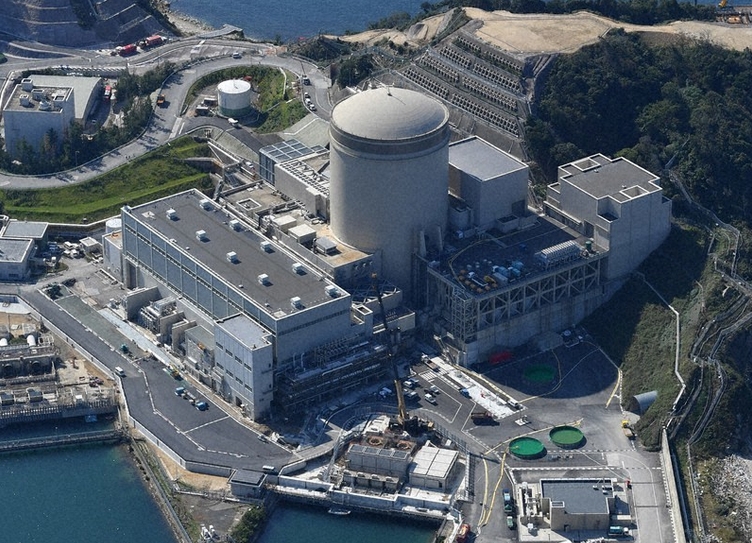
The No. 3 reactor at Kansai Electric Power Co.’s Mihama Nuclear Power Station is seen from a Mainichi Shimbun helicopter on Oct. 20, 2020.
February 16, 2021
TSURUGA, Fukui — The mayor of a central Japan town hosting a nuclear power plant operated by Kansai Electric Power Co. informed the speaker of the municipal assembly on Feb. 15 that he would approve the restart of a reactor at the plant that is more than 40 years old.
Mayor Hideki Toshima of the Fukui Prefecture town of Mihama told Mihama Municipal Assembly Speaker Yoshihiro Takenaka that he would approve the restart of the No. 3 reactor at Mihama Nuclear Power Station, which began operating in the 1970s. The assembly had already approved the reactivation of the aging reactor.
Meanwhile, Mayor Yutaka Nose of the prefectural town of Takahama, home to Kansai Electric’s Takahama Nuclear Power Station, whose No. 1 and 2 reactors are also over 40 years old, has given the green light for resuming the operations of the two rectors, while the Takahama Municipal Assembly has also approved of the move.
Now that local consent has been secured, the focus has shifted to the decisions expected from Gov. Tatsuji Sugimoto and the prefectural assembly.
The Mihama plant’s No. 3 reactor went online in December 1976. In response to the meltdowns at Tokyo Electric Power Co.’s Fukushima Daiichi Nuclear Power Station following the March 2011 Great East Japan Earthquake and tsunami, the Japanese government limited the operational life of nuclear reactors to “40 years in principle” in July 2013, while allowing a one-time extension of up to 20 years if the reactor fulfilled safety standards. The No. 3 reactor at the Mihama power station, along with the No. 1 and No. 2 rectors at the Takahama plant, have passed screening by the Nuclear Regulation Authority.
Mayor Toshima said on Feb. 15 that conditions to approve the restart “have all been met, including understanding from the townspeople and consent from the municipal assembly, as well as promising feedback over regional development by the central government and Kansai Electric.” He added, “Both supporters and skeptics of the reactor restart are concerned about its safety. I will make sure to pay attention to the process.”
Toshima had spoken with Economy, Trade and Industry Minister Hiroshi Kajiyama online three days prior. He had then expressed his intension to approve the reactivation, saying that the central government had given him positive responses about regional development and other measures he had requested.
As a general rule, a nuclear power plant operator is expected to obtain consent for restarting a rector from the local governments around the plant as well as local assemblies. As a condition for approving the restart, the Fukui Prefectural Government said Kansai Electric would need to present candidate sites outside the prefecture for interim spent nuclear fuel storage facilities. The prefectural government maintained that until that condition was achieved, the parties were “not even at the starting line of discussion.”
However, after Kansai Electric proposed on Feb. 12 that it would finalize a planned site for the storage facilities by the end of 2023, the prefectural government demonstrated a positive attitude toward reactivation. Discussion on restarting the aging reactor may develop further at the prefectural assembly session convening on Feb. 16.
https://mainichi.jp/english/articles/20210216/p2a/00m/0na/008000c
Fukushima spillage raises questions about threat of future earthquakes
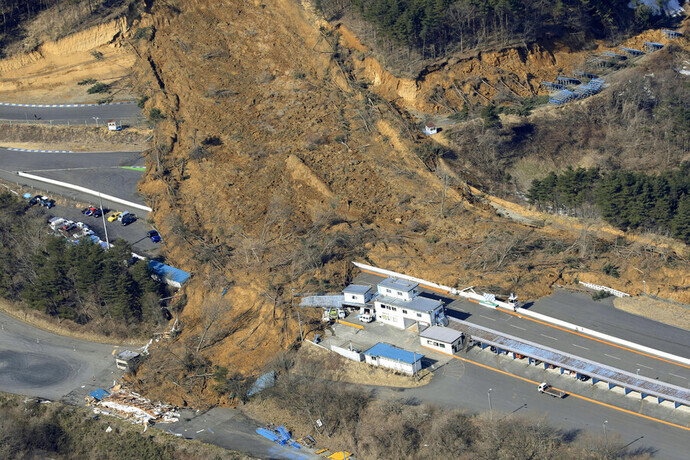
A road in Nihonmatsu has been blocked by a landslide on Feb. 14 following a 7.3-magnitude earthquake the day before in Japan’s Fukushima Prefecture.
Feb.16,2021
The occurrence of a 7.3-magnitude earthquake in the waters off of Fukushima on Feb. 13 is prompting growing concerns about the safety of the Fukushima Daiichi Nuclear Power Plant, as some mention the possibility of other quakes at a similar scale.
Experts said that with no way of knowing how large future earthquakes will be, swift preparations are needed to prevent damage to the plant.
According to reporting by Japan’s NHK television network on Feb. 15, the Japanese government’s Earthquake Survey Committee stressed the need to be on the alert over the next week or so for earthquakes at a “strong 6” on the Japanese seismic intensity scale. The warning suggested the possibility of additional quakes on par with the one on Feb. 13, which was a strong 6.
“We need to prepare,” the committee said, noting the possibility of eastern Japan being “ambushed by strong vibrations and/or a tsunami caused by a large-scale earthquake.”
In an interview with NHK, Tohoku University professor Shinji Toda said there was the “possibility of a 9.0-magnitude earthquake and tsunami occurring in the waters off of Fukushima and Miyagi, as well as the north and south of the area where the [2011 Tohoku] earthquake occurred 10 years ago and the area outside of the Japan Trench.”
Hong Tae-kyung, a professor of earth system sciences at Yonsei University, warned that the associated ground motion could be large relative to the scale of the earthquake itself.
“The scale of this earthquake was within a predictable level for the region, but the fact that the ground motion was so much larger gives pause,” he explained.
“Ground motion differs according to earthquake scale, sedimentary layer thickness, observation position and other factors, and it’s common for ground motion to be larger near the coast due to the sedimentary layer’s thickness. But even when you take all of that into account, the ground motion was very large,” he said.
“There’s a possibility the ground motion exceeded what the Fukushima nuclear power plant could withstand in terms of its design.”
With predictions that additional large-scale earthquakes could occur, observers are calling for swift preparations to prevent damage to the Fukushima plant. According to Kyodo News and other Japanese media, some spillage was determined to have occurred during the earthquake in tanks holding spent nuclear fuel at the upper layers of the No. 5 and 6 reactors at the Fukushima plant.
Japanese nuclear power authorities and the Tokyo Electric Power Company (TEPCO), which operates the plant, stated that there had been no radiation exposure as a result of the tank spillage.
Institute of Nuclear Safety director Han Byeong-seop agreed that the “nuclear power plant safety issues resulting from the earthquake were not at a concerning level,” but stressed the “need to prepare for a compound disaster in the wake of an earthquake.”
“The amount of water that spilled from the spent nuclear fuel in this earthquake was minute, so it wasn’t at a worrisome level, and there does not appear to have been any damage to the power plant,” he said.
“But with the Tohoku earthquake in 2011, there was major damage resulting from a compound disaster involving both an earthquake and tsunami, and there’s no way of predicting the scale of additional earthquakes that we might see this time,” he added.
“There need to be continued preparations for a compound disaster.”
Oh Chang-whan, a professor of earth and environmental sciences at Jeonbuk National University, said, “Nuclear power plants are designed to be safe during earthquakes, yet even so we saw issues with water spillage.”
“Nobody can predict for certain what kind of damage an earthquake or tsunami might cause. We need to prepare,” he urged.
http://english.hani.co.kr/arti/english_edition/e_international/983206.html
At the nuclear power plant in Fukushima found a leak of radioactive water
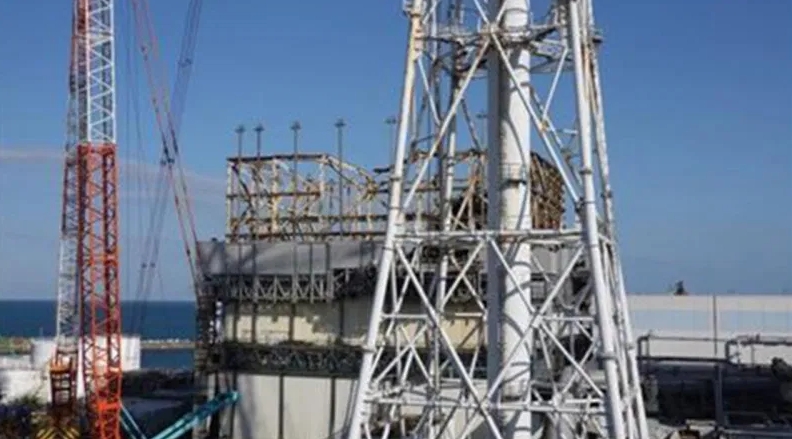
February 14, 2021
A radioactive water leak was discovered at the Fukushima nuclear power plant. It is reported by RIA Novosti citing a press release from TEPCO (Tokyo Electric Power Company).
TEPCO specialists found out that due to the earthquake in northeast Japan, a small amount of water poured out of the pools for storing spent nuclear fuel at various units of the Fukushima-1 and Fukushima-2 nuclear power plants.
Representatives of the company said that about 160 milliliters of water were spilled at the first power unit of the Fukushima-2 nuclear power plant, and another 1.4 liters spilled from another pool. They assured that this incident should not affect the cooling of the spent fuel. Local media also reported that about 600 milliliters of water spilled out at the fifth power unit of the emergency nuclear power plant “Fukushima-1”, and 1.6 liters of liquid at the sixth. Another 600 milliliters were missing in the common pool for the two power units.
It is noted that the spilled water does not pose a threat to the environment, since its volumes are too small, and the content of radioactive substances in it is insignificant.
Earlier it was reported that in northeast Japan happened powerful earthquake. The magnitude of the earthquake was 7.1, the epicenter was recorded in the area of Fukushima prefecture. The number of victims of the disaster exceeded 100 people.
Nuclear lobby planning to take over the U.N Climate Change Conference

Meet the Young Generation Network and its group of nuclear schills who will lead the attempted nuclear takeover of the 26th UN Climate Change Conference of the Parties (COP26) in Glasgow on 1 – 12 November 2021.
Just by chance? They all happen to be ambitious young people who hope to have a big career in the nuclear industry. Well, you can’t blame them for that. But let’s be wary of their advice on nuclear power as the solution for global heating.
Arun Khuttan. End States Engineer at Magnox Ltd.UKAlice Cunha da Silva. Latin America Nuclear Leader | Westinghouse Electric Company.
Hannah Paterson, Technology Manager at Sellafield Ltd UK
Matthew Mairinger Technical Engineer with Ontario Power Generation, Canada
Miguel Trenkel-Lopez Assistant Engineer at Magnox Ltd,Bristol, UK
Saralyn Thomas Formerly at AREVAnuclear company, now at Abbott Risk Consulting (ARC) Risk Management consultancy services to the Nuclear Industry
Vicki Dingwall of EDF nuclear company
Water leaks indicate new damage at Fukushima nuclear plant
 Water leaks indicate new damage at Fukushima nuclear plant Water leaks indicate new damage at Fukushima nuclear plant
By MARI YAMAGUCHI TOKYO (AP) — Cooling water levels have fallen in two reactors at the wrecked Fukushima nuclear plant since a powerful earthquake hit the area last weekend, indicating possible additional damage, its operator said Friday.
New damage could further complicate the plant’s already difficult decommissioning process, which is expected to take decades. Tokyo Electric Power Co. spokesman Keisuke Matsuo said the drop in water levels in the Unit 1 and 3 reactors indicates that the existing damage to their primary containment chambers was worsened by Saturday’s magnitude 7.3 quake, allowing more water to leak. The leaked water is believed to have remained inside the reactor buildings and there is no sign of any outside impact, he said. In 2011, a powerful magnitude 9.1 earthquake and tsunami damaged the Fukushima plant’s cooling systems, causing three reactor cores to melt and nuclear fuel to fall to the bottom of their primary containment vessels. TEPCO will monitor the water and temperatures at the bottom of the containment vessels, Matsuo said. Since the 2011 disaster, cooling water has been escaping constantly from the damaged primary containment vessels into the basements of the reactor buildings. To make up for the loss, additional cooling water has been pumped into the reactors to cool the melted fuel remaining inside them. The recent decline in the water levels indicates that more water than before is leaking out, TEPCO said…….. TEPCO initially reported that there was no abnormality at the plant from Saturday’s quake. Matsuo said the cooling water level fell as much as 70 centimeters (27 inches) in the primary containment chamber of the Unit 1 reactor and about 30 centimeters (11 inches) in Unit 3. TEPCO wasn’t able to determine any decline in Unit 2 because indicators have been taken out to prepare for the removal of melted debris, it said. Increased leakage could require more cooling water to be pumped into the reactors, which would result in more contaminated water that is treated and stored in huge tanks at the plant. TEPCO says its storage capacity of 1.37 million tons will be full next summer. A government panel’s recommendation that it be gradually released into the sea has faced fierce opposition from local residents and a decision is still pending. Meanwhile, the Tokyo High Court on Friday held the government as well as TEPCO accountable for the 2011 nuclear disaster, ordering both to pay about 280 million yen ($2.6 million) in compensation to more than 40 plaintiffs forced to evacuate to Chiba, near Tokyo, for their lost livelihoods and homes. Friday’s decision reverses an earlier ruling by the Chiba district court that excluded the government from responsibility. Judge Yukio Shirai said the government could have foreseen the risk of a massive tsunami and taken measures after a long-term assessment in 2002 of seismic activities. Lawyers representing the plaintiffs welcomed the decision and said it would affect other pending cases. “The case raises the question of whether we should tolerate a society that prioritizes economic activities over people’s lives and health,” said Izutaro Mangi, a lawyer representing the plaintiffs. https://apnews.com/article/water-leaks-fukushima-new-damage-a7ecf765d0233b1cad7332ff9fed5ffe |
|
On nuclear power as climate solution, Bill Gates shows alarming ignorance
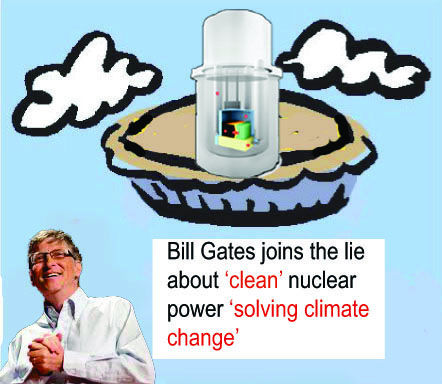
David Lowry’s Blog 16th Feb 2021 The multi-billionaire Bill Gates, founder of Microsoft, in his new book, “How to Avoid a Climate Disaster”, is sceptical of the Green New Deal.(Allen Lane/Penguin) published on 16 February. Gates secured much pre-publication publicity for his new tome, including an interview in the Guardian Weekend Magazine, which wrote “Of the Green New Deal, the proposal backed by Alexandria Ocasio-Cortez [the Congresswoman who has promoted the merits of the GND in the US] that raises the goal of carbon neutrality in a decade, he is flatly dismissive, with Gates telling the interviewer. “Well, it’s a fairytale. It’s like saying vaccines don’t work – that’s a form of science denialism. Why peddle fantasies to people?”
Gates also opined: “I’m not a survivalist.” Instead his version of survivalism is to fund innovation, the reporter noted. “I’m putting money into carbon capture and nuclear fission” Gates told her. (Bill Gates: ‘Carbon neutrality in a decade is a fairytale. Why peddle fantasies?’, Guardian, 13 February 2021; https://www.theguardian.com/technology/2021/feb/15/bill-gates-carbon-neutrality-in-a-decade-is-a-fairytale-why-peddle-fantasies)
Indeed, his book is laced with positive, if inaccurate, mentions of nuclear power. For example, he asserts on page 84, in a section on “Making Carbon-Free Electricity”, uns der a sub-section titled ‘ Nuclear Fission’ he writes: “”Here’s the one sentence case for nuclear power: It’s the only carbon-free energy sources that can reliably deliver power day and night, through every season.”
I am appalled at the idea of ”Mothers For Nuclear”


As a mother myself, I am appalled that such a group as ”Mothers For Nuclear” even exists. Dont

Christina Macpherson’s websites & blogs
they know about the effects of ionising radiation on women, especially pregnant women? Don’t they know about the breast cancers, the birth deformities in irradiated areas such as Pacific atomic bomb sites, and Belarus-Ukraine, near the Chernobyl site. No, they don’t seem to. (Perhaps that ‘s the beauty of a narrowly S.T.E.M. education?)
Both Heather Hoff and Kristin Zaitz work at the Diablo Nuclear Power Plant. Hoff worked as a plant operator, and now as a procedure writer. Zaitz works as a civil engineer.
Hoff was inspired by none other than that top nuclear schill Michael Shellenberger, and by the glossy nuclear advertising film ”Pandora’s Promise”.
They sound very sincere, but also very ignorant of the negative issues around the nuclear industry.
Why am I not surprised? The nuclear industry is busting its guts trying to get women onside. Their favourite thing is getting (preferably young and attractive) women into engineering, and at the top of nuclear companies. (This is good in two ways – good to promote the industry’s ‘gender equality’ image, and good if they muck up, as Leslie Dewan did, in her bogus claims for Transatomic’s molten salt reactor – let a woman take the flak!)
The thing is – lots of women have expertise in biology, genetics – and an understanding of the effects of ionising radiation. But the nuclear industry has got us all conned that these are ”soft”sciences. So – if you’ve got ”hard” scienvce knowledge – like engineering, then you can be an authority on nuclear issues.
These two women sound very sincere – alarmingly so.
The Activists Who Embrace Nuclear Power, New Yorker, By Rebecca Tuhus-Dubrow, February 19, 2021
To be fervently pro-nuclear, in the manner of Hoff and Zaitz, is to see in the peaceful splitting of the atom something almost miraculous. It is to see an energy source that has been steadily providing low-carbon electricity for decades—doing vastly more good than harm, saving vastly more lives than it has taken—but which has received little credit and instead been maligned. It is to believe that the most significant problem with nuclear power, by far, is public perception. ………..—the pro-nuclear world view can edge toward dogmatism. Hoff and Zaitz certainly seem readier to tout studies that confirm their views, and reluctant to acknowledge any flaws that nuclear energy may have. ……https://www.newyorker.com/tech/annals-of-technology/the-activists-who-embrace-nuclear-power
Natural gas, not renewable energy, was most responsibe for Texas power failure in freezing conditions
Why is Texas suffering power blackouts during the winter freeze?
The oil- and gas-rich state is experiencing what officials call a ‘total failure’ of its electricity infrastructure Guardian, Lauren Aratani, Thu 18 Feb 2021 “…...Did renewable energy play a role in the grid’s malfunction?
While Republicans have been blaming frozen wind turbines for the state’s blackouts, officials and experts say that malfunctions in natural gas operations played the largest role in the power crisis.
Ercot said all of its sources of power, including those from renewable sources, were affected by the freezing temperatures. The state largely relies on natural gas for its power supply, though some comes from wind turbines and less from coal and nuclear sources.
Natural gas can handle the state’s high temperatures in the summer, but extreme cold weather makes it difficult for the gas to flow to power plants and heat homes. Michael Webber, an energy resources professor at the University of Texas Austin, told the Texas Tribune that “gas is failing in the most spectacular fashion right now”.
With the climate crisis likely to trigger more freak weather events like the one Texas is suffering it is noteworthy that there are places that experience frigidly cold weather that rely heavily on wind turbines and manage to have electricity in the winter. In Iowa, a state which sees freezing temperatures more often than Texas, nearly 40% of electricity is generated by wind turbines……. https://www.theguardian.com/us-news/2021/feb/18/why-is-texas-suffering-power-blackouts-during-the-winter-freeze
In Texas freezing temperatures, the major power loss was from coal, gas, nuclear facilities, not renewables
major power failures across Texas as increased demand for heating has overwhelmed the energy grid. Supplies of both electricity and gas have been intermittent, with the authorities saying they need to “safely manage the balance of supply and demand on the grid” to avoid another major power cut.
Advancing the Treaty on the Prohibition of Nuclear Weapons — IPPNW peace and health blog

There are many things to be done to build the legal, political and moral force of this historic treaty; grow its membership and implementation; and use it as effectively as possible to advance the eradication of nuclear weapons and reduce the likelihood and scale of their use in the meantime. Important work for all treaty supporters is increasing the number of states signing the treaty and converting those signatures to ratifications. A key moment will come when the first nuclear-armed or accomplice state chooses to get on the right of history and become part of the solution rather than the problem.
Advancing the Treaty on the Prohibition of Nuclear Weapons — IPPNW peace and health blog
February 19 Energy News — geoharvey

Opinion: ¶ “Lies, Damned Lies, And Greg Abbott” • While people were suffering and even dying in Texas, Governor Abbott was on Fox News talking to Sean Hannity about the situation. He said the Green New Deal would be a “deadly deal” for the US, and blamed renewables for the shortfall. But renewables aren’t to […]
February 19 Energy News — geoharvey
Government Appointment of Coal Mine CEO to UK Nuke Dump Plans – Not Dodgy At All ?!! —

Letter sent today to MP Tim Farron from Radiation Free Lakeland first published on our dedicated campaign website Lakes Against Nuclear Dump Dear Tim, West Cumbria Mining is in Bed with BEIS (Dept of Business, Energy & Industrial Strategy) BEIS are Responsible for the “Delivery of a Geological Disposal Facility in the UK” . BEIS […]
Government Appointment of Coal Mine CEO to UK Nuke Dump Plans – Not Dodgy At All ?!! —
Relief that Bradwell nuclear project has stalled
altogether.
announced engagement and active project work on Bradwell B will be paused
for at least a year and says it indicates a “significant reversal” for
the project.
Generation Company – a collaboration between China General Nuclear (CGN)
and EDF – have stalled. The Bradwell group said, in order to tightly
control expenditure, it needs to pause aspects of the project it is not yet
ready to progress. But BANNG chairman Prof Andy Blowers said: “Despite
urging the developer to suspend public engagement during the pandemic,
BANNG was told the national need was urgent and it was in the public
interest that the proposed development is not indefinitely or even
substantially delayed.
https://www.gazette-news.co.uk/news/19094101.baang-reacts-positively-bradwell-b-talks-paused/
Israel expands Dimona nuclear facility previously used for weapons material
|
Israel expands nuclear facility previously used for weapons material, https://www.theguardian.com/world/2021/feb/18/israel-nuclear-facility-dimona-weapons Julian Borger in Washington, Fri 19 Feb 2021 Satellite images show significant expansion of desert site over past few years Israel is carrying out a major expansion of its Dimona nuclear facility in the Negev desert, where it has historically made the fissile material for its nuclear arsenal. Construction work is evident in new satellite images published on Thursday by the International Panel on Fissile Material (IPFM), an independent expert group. The area being worked on is a few hundred metres across to the south and west of the domed reactor and reprocessing point at the Shimon Peres Negev Nuclear Research Center, near the desert town of Dimona. Pavel Podvig, a researcher with the programme on science and global security at Princeton University, said: “It appears that the construction started quite early in 2019, or late 2018, so it’s been under way for about two years, but that’s all we can say at this point.” The Israeli embassy in Washington The Israeli embassy in Washington had no comment on the new images. Israel has a policy of deliberate ambiguity on its nuclear arsenal, neither confirming nor denying its existence. The Federation of American Scientists estimates that Israel has about 90 warheads, made from plutonium produced in the Dimona heavy water reactor.
Avner Cohen, a leading expert on the Israeli nuclear programme called the new images “intriguing” and noted that the footprint of the Dimona site had remained essentially unchanged for decades. The nuclear facility is reported to have been used by Israel to create replicas of Iran’s uranium centrifuges to test the Stuxnet computer worm used to sabotage the Iranian uranium enrichment programme in Natanz. But that more than 10 years ago, long before the current expansion began. Israel built the Dimona reactor in the 1950s with extensive, clandestine help from the French government. By the end of the decade there were an estimated 2,500 French citizens living in Dimona, which had its own French lycées but all under the cover of official deniability. According to The Samson Option, by the investigative journalist Seymour Hersh, French workers were not allowed to write home directly but had their letters sent via a phoney post-office box in Latin America. Dimona’s role in Israel’s nuclear weapons programme was first disclosed by a former technician at the site, Mordechai Vanunu, who told his story to Britain’s Sunday Times in 1986. Before publication, he was lured from Britain to Italy by a female Israeli agent and abducted by Mossad. Vanunu spent 18 years in prison, 11 of them in solitary confinement, for revealing Dimona’s secrets. |
|
The world came much closer to nuclear war than we realized in 1983.
Apocalypse Averted, The world came much closer to nuclear war than we realized in 1983. https://slate.com/news-and-politics/2021/02/able-archer-nuclear-war-reagan.html-19 Feb 21, BY FRED KAPLAN
The revelations aren’t mere details of history; they also hold relevant lessons for how leaders should think and act in ongoing crises in hot spots around the world today.
The documents, released this week by the State Department historian’s office, focus on a massive military training exercise known as Able Archer, in which NATO simulated the transition from conventional to nuclear conflict in the event of a war in Europe.
It turned out, top Soviet leaders thought that the war game was real—that the U.S. and NATO really were about to launch a nuclear first strike against the USSR—and top Soviet military commanders took steps to retaliate.
In one of those steps, the new documents reveal, the commander of the Soviet 4th Army Air Forces in Eastern Europe ordered all of his units to make “preparations for the immediate use of nuclear weapons.” As part of that order, crewmen loaded actual nuclear bombs onto several combat planes.
Much about the Able Archer war game was first made public just six years ago, when, after more than a decade of legal battles, the National Security Archive, a private research organization, obtained a lengthy, extremely classified U.S. intelligence report detailing exactly what NATO forces did, and how Soviet commanders responded, during the exercise.
But the fact that the Soviets armed their aircraft with nuclear bombs—a discovery based on U.S. and British intelligence intercepts of Soviet communications at the time—has not been declassified until now. The new fact elevates to a higher level the danger that the world briefly faced, even though—unlike with other nuclear near misses, such as the Cuban missile crisis—almost nobody knew it at the time.
The Able Archer crisis might not have been a near miss—it might easily have escalated to a shooting war—had it not been for a single American officer, Lt. Gen. Leonard Perroots, the intelligence chief for U.S. Air Forces in Europe, who saw the Soviet moves, interpreted them correctly, and stopped what might otherwise have been a deadly escalation.
Most U.S. officers viewed Able Archer as a typical war game, nothing that would throw Soviet officers into a panic. But Perroots saw that, in fact, it was something different. It was a lot bigger than most of these games, involving a fleet of cargo transport planes flying 19,000 soldiers in 170 sorties from the United States to bases in Europe. And it was more realistic as well. The cargo planes maintained radio silence. B-52 bomber crews taxied their planes to their runways and loaded them with dummy bombs that looked remarkably real. The Strategic Air Command raised its nuclear alert levels to the highest level. The Soviets were monitoring all of this, of course, as they generally did and as the U.S. commanders knew they would. But they reacted in ways that they never had before—in ways similar to how they might have acted if the U.S. were gearing up for a real attack—including, as we now know, loading nuclear bombs on aircraft in Eastern Europe.
Ordinarily, when the Soviets took such actions, U.S. intelligence agencies would notify senior military officers, either on the scene or back in Washington, who would respond with similar actions, if just to let the Soviets know that we were watching what they were doing and were ready to repel an attack.
When Perroots informed his boss, the commander in chief of U.S. Air Forces in Europe, Gen. Billy Minter, of the Soviets’ “unusual activity” at the start of Able Archer, Minter was about to respond in the usual way, but Perroots advised him to hold off. He recognized that the Soviets were probably reacting to what we were doing—and any further escalation on our part would worsen the situation, might even trigger war. Let’s wait and see what happens next, he suggested.
Ordinarily, when the Soviets took such actions, U.S. intelligence agencies would notify senior military officers, either on the scene or back in Washington, who would respond with similar actions, if just to let the Soviets know that we were watching what they were doing and were ready to repel an attack.
When Perroots informed his boss, the commander in chief of U.S. Air Forces in Europe, Gen. Billy Minter, of the Soviets’ “unusual activity” at the start of Able Archer, Minter was about to respond in the usual way, but Perroots advised him to hold off. He recognized that the Soviets were probably reacting to what we were doing—and any further escalation on our part would worsen the situation, might even trigger war. Let’s wait and see what happens next, he suggested.
And indeed, after Able Archer ended a few days later and the thousands of American troops flew home and SAC lowered its nuclear alert, the Soviets unloaded their bombs and canceled their nuclear alert as well.
One of the newly declassified documents is a memo that Perroots wrote in 1989, as he was retiring from his final career post as director of the Defense Intelligence Agency, detailing what he’d seen and done during Able Archer six years earlier. The National Security Archive has long been trying to obtain the Perroots memo; DIA officials have told the archive’s lawyers that the memo was lost. On their own initiative, State Department historians found it in a file at the CIA.
The Able Archer near miss did come to have consequences—in a good way. While the war game was unfolding, Oleg Gordievsky, a London-based KGB officer who had turned double agent, was providing his British handlers in MI6 with documents revealing that Soviet officials were viewing the exercise as a prelude to an attack by the United States and NATO. The British, as was customary, shared the intelligence with their American cousins. At first, and for more than a year after, the CIA’s top officials were skeptical, dismissing the Soviets’ “war scare” as “propaganda,” designed to inflame anti-American sentiment in Western Europe.
But President Ronald Reagan took the war scare seriously. Just days after the wrap-up of Able Archer, his national security adviser, Robert “Bud” McFarlane, showed him Gordievsky’s reports, which Reagan read with—as McFarlane recalled years later—“genuine anxiety.”
Reagan had been pushing hard against the Kremlin, hoping the pressure might bring down the Soviet system. In 1981, his first year in office, an armada of 83 U.S., British, Canadian, and Norwegian ships sailed near Soviet waters, undetected. In April 1983, seven months before Able Archer, 40 U.S. warships, including three aircraft carriers, approached Kamchatka Peninsula, off the USSR’s eastern coast, maintaining radio silence and jamming Soviet radar. As part of the operation, Navy combat planes simulated a bombing run over a military site 20 miles inside Soviet territory. An internal NSA history noted, “These actions were calculated to induce paranoia, and they did.”
Still, as Reagan read the Gordievsky report, “it did bother him,” McFarlane later recalled, that the Soviets would seriously entertain “the very idea” that he would launch a nuclear first strike. On Nov. 18, 1983, one week after Able Archer was over, he wrote in his diary, “I feel the Soviets are so defense minded, so paranoid about being attacked that without being in any way soft on them we ought to tell them no one here has any intention of doing anything like that.”
The same day, Reagan met with his secretary of state, George Shultz (who died this month at the age of 100), to discuss setting up a back channel of communication with Moscow. The next morning, 12 senior officials met for breakfast in Shultz’s dining room at the State Department to discuss reopening long-moribund talks with Moscow—a topic so sensitive at the time that Shultz told them not to tell anybody that the meeting had even taken place. Two months later, on Jan. 16, 1984, Reagan gave a televised speech. The key line—a dramatic departure from previous pronouncements on the Soviet Union as an “evil empire”—was this: “If the Soviet government wants peace, then there will be peace. … Let us begin now.”
He had to wait a little while. Two Soviet leaders, Yuri Andropov and Konstantin Chernenko, died while Reagan’s diplomats tried to arrange meetings. But then came Mikhail Gorbachev, a genuine reformer, looking for peace with the West so he could finance his politico-economic perestroika, and, soon enough, the Iron Curtain shattered and the Cold War ended.
This might not have happened if Reagan hadn’t realized, in the wake of Able Archer, that his belligerent rhetoric and aggressive actions had gone too far—that he had to dial things back and see if the two countries might get along, before their myriad causes for mutual distrust unleashed catastrophe.
In some ways, the world today is less fraught with ultimate danger than it was 38 years ago. There is no cause for fear of a massive nuclear attack by or against the United States, Russia, or, really, any other country. But at the same time, the world is more densely laced with hot spots that could erupt into war, and war zones that could spread like lethal firestorms, and there are fewer power blocs—no real “superpowers,” in the sense that the term once meant—that might contain the conflagration. Intelligence is scanty or ambiguous about many of these potential crisis areas. Assumptions about an adversary’s ambitions or odd actions can more easily harden into dogma.
-
Archives
- February 2026 (228)
- January 2026 (308)
- December 2025 (358)
- November 2025 (359)
- October 2025 (376)
- September 2025 (258)
- August 2025 (319)
- July 2025 (230)
- June 2025 (348)
- May 2025 (261)
- April 2025 (305)
- March 2025 (319)
-
Categories
- 1
- 1 NUCLEAR ISSUES
- business and costs
- climate change
- culture and arts
- ENERGY
- environment
- health
- history
- indigenous issues
- Legal
- marketing of nuclear
- media
- opposition to nuclear
- PERSONAL STORIES
- politics
- politics international
- Religion and ethics
- safety
- secrets,lies and civil liberties
- spinbuster
- technology
- Uranium
- wastes
- weapons and war
- Women
- 2 WORLD
- ACTION
- AFRICA
- Atrocities
- AUSTRALIA
- Christina's notes
- Christina's themes
- culture and arts
- Events
- Fuk 2022
- Fuk 2023
- Fukushima 2017
- Fukushima 2018
- fukushima 2019
- Fukushima 2020
- Fukushima 2021
- general
- global warming
- Humour (God we need it)
- Nuclear
- RARE EARTHS
- Reference
- resources – print
- Resources -audiovicual
- Weekly Newsletter
- World
- World Nuclear
- YouTube
-
RSS
Entries RSS
Comments RSS
 nuclear-news