ICAN chief: Japan sabotaging nuclear disarmament
 Beatrice Fihn, Executive Director of the International Campaign to Abolish Nuclear Weapons, or ICAN, spoke to NHK about the possible game changers in the drive to get rid of the weapons of mass destruction.
Aug. 15, 2020
Hiroshima and Nagasaki in southwestern Japan are the only two cities to have suffered attacks using nuclear weapons. For people around the country, the anniversary month of August is a time to remember the tens of thousands of lives erased in the twin flashes in 1945, as well as the countless others affected by the subsequent radiation.
Fihn’s organization won the Nobel Peace Prize in 2017 for its efforts to bring people to the negotiating table to pledge to work toward nuclear disarmament. The adoption of the Treaty on the Prohibition of Nuclear Weapons at the United Nations was a step forward, in which ICAN played a major role.
Fihn says the next few months are crucial, as her team has given itself until the end of the year to get enough signatures to put the treaty into effect. Just this month, Ireland, Nigeria, Niue, and Saint Kitts and Nevis have signed up, bringing the total number on board to 44.
“We always aimed that we would be getting 50 in 2020.” She says. “And obviously COVID-19 has slowed down some processes, but we still think that there’s a really good chance that we can get the 50 ratifications needed this year. So we’re working very very hard on this.”
What about Japan?
But Japan remains one of the countries that’s yet to sign the treaty. Prime Minister Abe Shinzo has said every year at the memorial ceremonies that it’s Japan’s mission to, “realize a world without nuclear weapons.”
But Fihn wonders why the commitment hasn’t been backed up by action. “There is no leadership right now on nuclear disarmament from Japan’s side — rather the opposite,” she says. “Japan is going backwards as well and undermining its own resolutions that it’s supported for a long time ago, weakening language and documents.”
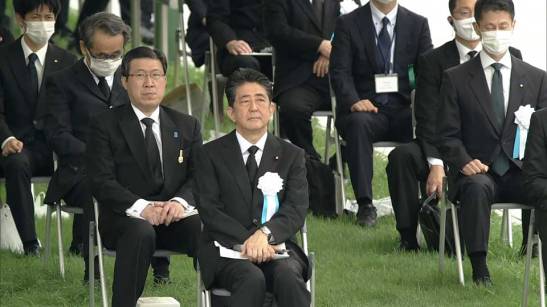 Japanese Prime Minister Abe Shinzo made another pledge this year that the country would commit to achieving a world without nuclear weapons.
“That’s very serious. And I think that’s an insult to the survivors — to the hibakusha,” Fihn says. “We really know the Japanese people want the government to sign the treaty.”
“It’s very often that we look at nuclear armed states as the problem, but we have to recognize that the nuclear-allied states, like Japan for example, are protecting them. They are standing in a circle around them and protecting nuclear weapons. Until those countries stop doing that, it’s going to be very hard to convince the nuclear armed states.”
“How am I going to convince North Korea, the United States and Russia to disarm, if Japan cannot say that nuclear weapons should be illegal?”
Nuclear war ‘like the coronavirus’
Fihn says the coronavirus pandemic is proof that a global emergency could happen anytime. “Health experts have warned about this, and they have been preparing, thinking about it,” she says. “Yet people have been surprised that it happened. It’s the same thing with nuclear weapons. We don’t know when, we don’t know how exactly, but experts say it’s going to happen.”
She warns that nuclear weapons will be far more lethal than the coronavirus. “What we have to do with nuclear weapons — there’s no mitigating it once it happens.” she says. “When we feel the consequences, when the bombs are starting to fall on cities again, then it’s going to be too late to prevent it.”
Nuclear weapons don’t protect us
Fihn says the ongoing pandemic further highlights why governments should be investing in people, not weapons. “This pandemic has shown us where the threats to our security are and how we can’t absorb these things with nuclear weapons,” she says. “Nuclear armed states spend 73 billion dollars on nuclear weapons. Just imagine how many ventilators, doctors, nurses ICU, beds we can have… how many vaccinations we could develop.”
Listen to the hibakusha
She credits atomic bomb survivors for helping spread the message of a nuclear-free world. But she says their time is running out: “Given that it’s probably one of the last milestones where we will still have survivors who are able to speak about it in the first person. I really do think that it’s up to us to use this moment as much as possible to share their stories.”
For the first time, ICAN organized online tours of the Hiroshima and Nagasaki atomic bomb museums this year.
Fihn ended our interview with a message for the hibakusha. “Thank you for doing the incredibly difficult work of sharing your very traumatic experiences so that we can survive, and we can prevent it from happening again,” she says. “ICAN and the millions of people that support us are pledging to take action. We are going to honor the hibakusha, not through words, but through action to eliminate nuclear weapons.”
Sea level rise from melting ice sheets match worst-case climate warming scenarios.
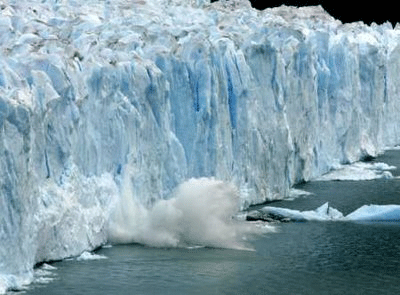
Sea level rise from ice sheets track worst-case climate change scenario, https://www.sciencedaily.com/releases/2020/08/200831112101.htm August 31, 2020
 Source: University of Leeds
- Summary:
- Ice sheets in Greenland and Antarctica whose melting rates are rapidly increasing have raised the global sea level by 1.8cm since the 1990s, and are matching the Intergovernmental Panel on Climate Change’s worst-case climate warming scenarios.
-
Ice sheets in Greenland and Antarctica whose melting rates are rapidly increasing have raised the global sea level by 1.8cm since the 1990s, and are matching the Intergovernmental Panel on Climate Change’s worst-case climate warming scenarios.
According to a new study from the University of Leeds and the Danish Meteorological Institute, if these rates continue, the ice sheets are expected to raise sea levels by a further 17cm and expose an additional 16 million people to annual coastal flooding by the end of the century.
Since the ice sheets were first monitored by satellite in the 1990s, melting from Antarctica has pushed global sea levels up by 7.2mm, while Greenland has contributed 10.6mm. And the latest measurements show that the world’s oceans are now rising by 4mm each year.
“Although we anticipated the ice sheets would lose increasing amounts of ice in response to the warming of the oceans and atmosphere, the rate at which they are melting has accelerated faster than we could have imagined,” said Dr Tom Slater, lead author of the study and climate researcher at the Centre for Polar Observation and Modelling at the University of Leeds.
“The melting is overtaking the climate models we use to guide us, and we are in danger of being unprepared for the risks posed by sea level rise.”
- The results are published today in a study in the journal Nature Climate Change. It compares the latest results from satellite surveys from the Ice Sheet Mass Balance Intercomparison Exercise (IMBIE) with calculations from climate models. The authors warn that the ice sheets are losing ice at a rate predicted by the worst-case climate warming scenarios in the last large IPCC report.Dr Anna Hogg, study co-author and climate researcher in the School of Earth and Environment at Leeds, said: “If ice sheet losses continue to track our worst-case climate warming scenarios we should expect an additional 17cm of sea level rise from the ice sheets alone. That’s enough to double the frequency of storm-surge flooding in many of the world’s largest coastal cities.”
-
So far, global sea levels have increased in the most part through a mechanism called thermal expansion, which means that volume of seawater expands as it gets warmer. But in the last five years, ice melt from the ice sheets and mountain glaciers has overtaken global warming as the main cause of rising sea levels.
Dr Ruth Mottram, study co-author and climate researcher at the Danish Meteorological Institute, said: “It is not only Antarctica and Greenland that are causing the water to rise. In recent years, thousands of smaller glaciers have begun to melt or disappear altogether, as we saw with the glacier Ok in Iceland, which was declared “dead” in 2014. This means that melting of ice has now taken over as the main contributor of sea level rise. ”

Nuclear waste – another great injustice to indigenous people, and people of color
|
Add nuclear waste to list of social injustices, https://calmatters.org/commentary/my-turn/2020/08/add-nuclear-waste-to-list-of-social-injustices/, 31 Aug 20, – By Chelsi Sparti As national attention centers on racial injustices, a report by Rep. Mike Levin of California exposes yet another assault upon Black, Indigenous and people of color: they are especially vulnerable to harm from our handling and storage of radioactive waste. Across the country, as waste from aging nuclear power plants piles up by the ton, investor-owned utilities and their contractors continue to eye Indigenous lands as dumping sites. To reach these sites, the deadly material would travel unannounced on railways through hundreds of socioeconomically-disadvantaged neighborhoods. From the initial extraction of raw uranium to the eventual, millennia-long storage of spent nuclear fuel, the nuclear industry relies upon the exploitation of rural, Indigenous lands, states the June report by Levin, a Democrat from San Juan Capistrano. The “Report of the San Onofre Nuclear Generating Station Task Force” urges Congress to approve a siting process that aligns with recommendations of the Blue Ribbon Commission on America’s Nuclear Future, which calls for tribal leaders and local governments to have a “meaningful consultative role in important decisions” on nuclear waste storage. Those decisions will determine the permanent disposition of nuclear waste from 65 low-quality storage sites in 33 states. Drafted by scientists and policymakers over 18 months, the task force report contains new scientific discoveries and 30 policy recommendations. Action is expected on eight of them this year. Across the nation, Americans of all income levels are surrounded by radioactive material that remains deadly for more than 200,000 years and is impossible to clean up. In California, spent fuel stockpiles have accumulated at the Humboldt Bay, Diablo Canyon, Rancho Seco and San Onofre reactor sites. At San Onofre alone, 3.6 million pounds of radioactive waste is lodged in temporary storage about 100 feet from the rising ocean. Radioactive waste is an issue made worse by decades of inaction. Clearly, the nuclear industry is determined to unload its waste at the doorsteps of working-class, BIPOC communities. Even today, as the federal government deploys forces to U.S. cities to impose its will upon protesters for racial justice, the next generation of nuclear energy – in the form of “advanced reactors” – is poised to move closer to urban centers, according to an NRC memo. Black, Indigenous and people of color communities have a lot to be angry about. Their outrage should include demands to protect people of color from exposure to hazardous waste for the sake of nuclear industry profits.
|
|
|
It’s time to be fearful of nuclear war again
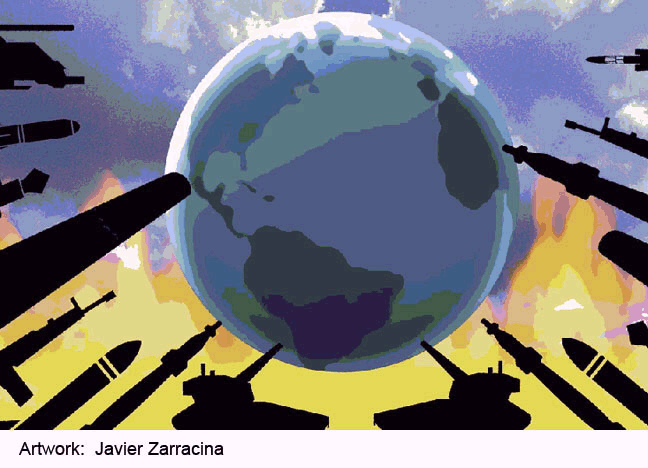 Nuclear War Makes a Comeback https://www.sierraclub.org/sierra/nuclear-war-makes-comeback It’s time to revisit the old fear that kept your parents up at night, BY CAROL POLSGROVE | AUG 31 2020 On websites where policymakers, scholars, and military leaders gather, concern about the possibility of nuclear war has been rising sharply in recent months as China, the United States, and Russia develop new weapons and new ways of using old ones.
On War on the Rocks, an online platform for national security articles and podcasts, Tong Zhao, a senior fellow at the Carnegie-Tsinghua Center for Global Policy, reported August 11 on public calls in China “to quickly and massively build up its nuclear forces” on the theory that only a “more robust nuclear posture” would prevent war with the United States.
The biggest nuclear arms budget ever is nearing approval in the US Congress, and the Trump administration has raised the possibility of resuming nuclear tests. President Trump has pulled the United States out of the 1987 Intermediate-Range Nuclear Forces (INF) treaty with Russia, while the New Start Treaty capping Russian and US nuclear warheads and delivery systems is set to expire next February if the two countries don’t agree to extend it.
For its part, Russia appears poised to equip its navy with hypersonic nuclear strike weapons, and according to the British newspaper The Independent, “The Russian premier has repeatedly spoken of his wish to develop a new generation of nuclear weapons that can be targeted anywhere on the planet.”
Meanwhile, momentum to stop the proliferation of nuclear weapons has faltered. Nine nations now hold nuclear arms in an increasingly unsettled international scene. Recent research has shown that a nuclear exchange between just two of those with lesser arsenals—India and Pakistan—“could directly kill about 2.5 times as many as died worldwide in WWII, and in this nuclear war, the fatalities could occur in a single week.” Burning cities would throw so much soot into the upper atmosphere that temperatures and precipitation levels would fall across much of the earth—bringing widespread drought, famine, and death.
Clashes between India, Pakistan, and other nuclear-armed states have become frequent enough that the International Red Cross marked the 75th anniversary of the bombings of Hiroshima and Nagasaki with a warning: “[T]he risk of use of nuclear weapons has risen to levels not seen since the end of the Cold War.”
For 75 years, the nuclear Sword of Damocles has dangled over the earth. There is widespread agreement among analysts that the long lull may soon be over—owing, in part, to the end of the Cold War. During those decades, the United States and the USSR cooperated not only to avoid bombing each other into oblivion but also to discourage other nations from gaining their own nuclear arms, in part by spreading their nuclear umbrellas over their allies.
That international system has dissolved. In addition to the United States, Russia, and China, other nations have nuclear weapons and more are likely to soon acquire them. And a new possibility has appeared on the horizon: the increased likelihood that nuclear weapons could be introduced into conventional warfare in regional wars.
In a monograph published by Lawrence Livermore Laboratory, US defense policy and strategy analyst John K. Warden writes that “in the capitals of potential adversary countries,” the idea is taking hold “that nuclear wars can be won because they can be kept limited, and thus can be fought—even against the United States.”
What can the United States do to convince adversaries not to introduce nuclear weapons into a conventional war—to make clear, in advance, that taking such a step would lead to fatal consequences for the country that took it?
The answer from the US national security establishment, as the fiscal 2021 defense budget suggests, is a readiness to fight fire with fire: If the “adversaries” of the United States hold out the threat of introducing nuclear weapons in a conventional war, then (the argument goes) they should expect that the United States will respond in kind.
How many weapons and delivery systems would that require? A lot, according to the nuclear budget for the Departments of Defense and Energy now going through Congress. At a time when COVID-19 has shaken the foundations of the federal budget, Congress is close to approving $44.5 billion for fiscal 2021 to modernize nuclear warheads, delivery systems, and the infrastructure that supports them.
Sierra Club nuclear policy director John Coequyt has called on Congress “to resist the current renewal of the nuclear arms race and to ban the use of nuclear weapons,” and Sierra Club members have mobilized to try to stop funding for nuclear war projects in their neighborhoods.
In South Carolina, for instance, Tom Clements, Sierra Club member and director of Savannah River Site Watch, has joined other groups in challenging plans for expanded plutonium pit production at the Savannah River Site. And the Ohio Sierra Club’s Nuclear Free Committee has opposed production at the Portsmouth Nuclear Site in Piketon of “high-assay low-enriched uranium” that could be upgraded for weapons use, in the United States or elsewhere.
While such efforts often focus on local effects of nuclear weapons production, they also manifest a larger concern. Says the Club’s Nuclear Free Core Team’s Mark Muhich, the renewed nuclear arms race is “an existential threat both to human civilization and to the earth.”
Join the conversation in the Nuclear Free Campaign room of the Sierra Club Grassroots Network.
Read the Sierra Club’s policy statements on nuclear weapons here.
Increasing climate risks threaten nuclear reactors

 Analysis: Nuclear operators face growing climate risks, https://www.michiganradio.org/post/analysis-nuclear-operators-face-growing-climate-risks
In the report, analysts found the Cook, Fermi, and Palisades nuclear power plants in Michigan and the nearby Davis-Besse plant in Ohio fall into the High Risk category (although Palisades is scheduled to close in 2022).
The analysis says that means the nuclear power plants will face relatively high changes in temperature extremes compared to the global average, according to the report.
“If the temperature goes up a little bit too high, the plan would either have to lower its output for a given period or maybe shut down if things are extreme,” said David Kamran one of Moody’s analysts.
The trickiest part for the nuclear power plant operators is reacting to how quickly changes in the climate happen. Recently, some models show the planet is getting warmer faster than previously thought.
“As these entities, the plants, want to have their licenses extended over many years, they may need to make additional investments to keep up with new information regarding climate and temperature and water, that sort of thing,” Kamran said.
The nuclear power plants use massive amounts of water. While the supply is not an issue, the temperature of the water could be an issue in the future depending on how fast the climate changes.
“Fallout: The Hiroshima Cover-up and the Reporter Who Revealed It to the World.” – new book
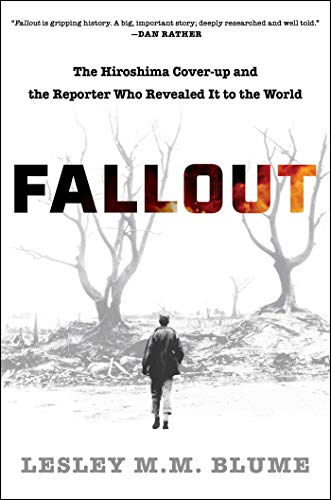 Fallout’: New book sobering reminder of nuclear devastation 75 years after entering atomic age https://www.dailylobo.com/article/2020/08/fallout-new-book-sobering-reminder-of-nuclear-devastation-75-years-after-entering-atomic-age By Hevyn Heckes 31 Aug 20, New Mexicans are perhaps more acutely aware of U.S. nuclear capabilities and the bomb, “Little Boy,” dropped on Hiroshima, since its predecessors were developed and tested in our own backyard. However, most people alive today will not remember the immediate aftereffects of the outsized attack on Japanese citizens that capped off the second world war.
Modern awareness of the atomic bomb and the events of WWII are mostly relegated to fictionalized accounts contained in films such as “Pearl Harbor” and “Schindler’s List.” The events surrounding WWII have long since become a cultural legend, and first-person memories of these events no longer exist. We’ve simply forgotten the horrors of global war — until now.
Leslie M. M. Blume set out to refresh our collective memory regarding the widely recognized end of WWII in “Fallout: The Hiroshima Cover-up and the Reporter Who Revealed It to the World.” She has done so in spectacular fashion – recalling our consciousness to the famous New Yorker article written by one John Hersey.
Blume details the difficulties Hersey confronted in reporting the truth of the atomic bomb’s lingering effects on Japanese citizens and the censorship levied against war correspondents prior to and during Hersey’s investigative presence in Japan.
Blume somehow manages to insert the reader in a manner usually only employed by fiction novels. She plies the reader with insight into how Hersey was able to convince Japanese victims to talk to him – a man they had every reason to hate and mistrust as a representative of their enemies in the U.S.
She explains that Hersey’s interviewees found him affable, educated and empathetic. His personal qualities endeared him to these people who would otherwise have gladly sent him on his way without a word.
Reading this book provides a timely and poignant reminder on the 75th anniversary of the bombings. One is forced to confront the human cost of nuclear weapons. Blume brilliantly interweaves Hersey’s reporting with her own so the reader is able to feel present with Hersey during his research and the victims of Little Boy’s aftereffects.
It becomes more and more clear that those who perished immediately with the bomb’s initial blast were the lucky ones.
Hersey and Blume graphically recount the physiological and psychological trauma Little Boy’s victims endured. One particularly memorable excerpt states, “(Japanese soldiers’) eyes had melted away in their sockets; the liquid had run in rivulets down their faces, which were burned beyond recognition.” Other excerpts tell of victims whose faces had “melted” with the blast so that their appearance seemed blurred.
Clearly, this novel contains sensitive and graphic depictions of physical trauma suffered by Japanese citizens of Hiroshima. This fact takes nothing away from the importance of the reader confronting these depictions to truly understand the catastrophic risks of nuclear war.
Fictional chaos theorist Dr. Ian Malcolm (played memorably by Jeff Goldblum) said in the film “Jurassic Park,” “Your scientists were so concerned with figuring out if they could that they didn’t stop to ask themselves whether or not they should.” This concept and ethical philosophy is perhaps more applicable to the invention of the atomic bomb — a weapon capable of far more devastating effects, up to and including nuclear winter, environmental devastation and species annihilation, than a few stray T-Rexes in a theme park.
As Hersey conveys and Blume emphasizes, nuclear weapons are a tool that could potentially bring about humanity’s self-inflicted extinction. Hersey’s reporting on the atomic bomb’s effects on the citizens of Hiroshima is perhaps a deterrent preventing nuclear disaster, but we must keep these consequences at the front of our minds to continue avoiding the doomsday clock finally tolling the midnight hour. “Fallout” is the poignant reminder we need right now.
Hevyn Heckes is a freelance reporter at the Daily Lobo. She can be contacted at culture@dailylobo.com or on Twitter @H_Squared90
Wylfa nuclear project – a contentious issue in Wales
Wales’ controversial nuclear history and what comes next as D-Day approaches for Wylfa One of Wales’ most contentious projects is facing a possible D-Day next month but opinion remains divided about nuclear power on the isle of Anglesey, Wales Online, 31 AUG 2020
….since its announcement it has been met with a mixture of hope, optimism, and concern from campaigners and local politicians.
It has also been dogged by delays and uncertainty in the decade since it was confirmed Wylfa would get a new nuclear plant……. as we approach possible clarity on a long-proposed and controversial project, what do those closest to the project think?
People Against Wylfa B (or Pawb, meaning ‘everyone’ in Welsh) was set up in the late 1980s and opposes the establishment of a new nuclear plant in north Wales.
One of its leading members, Robat Idris, explained that the history of nuclear power’s prominence in the Anglesey region goes back more than 60 years.
“The development of the UK nuclear programme was part of the Cold War strategy of the government at the time,” he said.
“The Thatcher government wanted to start a programme of building nuclear reactors, which were then shelved. At the time there was strong opposition across the political parties, except the Tories, to nuclear in Wales.”………
the concerns shared by Pawb go deeper than local politics and economics. The dangers associated with nuclear power are well-documented.
Despite being more than 2,000 miles away, farms over 53,000 hectares in north Wales felt the effects of the 1986 Chernobyl disaster, with many restrictions placed on farms due to radioactive particles in the soil and vegetation.
This threatened livelihoods across Wales for decades. Some restrictions in areas like Snowdonia were only lifted as recently as 2012.
Often smaller incidents at nuclear stations are not reported on a national scale or are discovered belatedly. At the Sellafield nuclear site, off the coast of Cumbria, between 1950 and 2000 there were 21 incidents or accidents involving off-site radiological releases that warranted a rating on the International Nuclear Event Scale.
“Historical effects like Chernobyl and Fukushima show that if things go wrong they go wrong dramatically,” Mr Idris said.
“With capitalist extractive models you take what you want and leave the rest. Even though nothing has been built yet there has already been changes to the topography of the area – flattening of hills and demolishing of houses and purchasing of land from farmers.”…….
“We have concerns about the idea that nuclear energy is low-carbon. But it is only low-carbon in the actual production – not in the building and construction, mining of uranium, or other elements,” Mr Idris said.
“There is also an unknown element to the decommissioning process – you are talking about centuries after production stops before a site is safe.”……………………………….
Not all are convinced that Wylfa is the magic pill that will transform Anglesey’s fortunes ……….
we’ve had this salvation of nuclear in the 60s and 70s, and Anglesey is still one of the poorest areas.
“Renewables are coming in more – falling costs, improvements in storage technology. The technology is there and just needs to be purchased.
“It comes back to a lack of a plan B – why haven’t other credible scenarios been presented?”……..
With the impending decision from the UK Government it appears increasingly likely that clarity is coming either way.
If permission is granted then the final hurdle will be arranging funding between the UK Government and the company – something which has proven elusive thus far……… https://www.walesonline.co.uk/news/wales-news/nuclear-power-wales-anglesey-wylfa-18836063
Nuclear Regulatory Commission bans TVA executive over whistleblower retaliation
Nuclear Regulatory Commission bans TVA executive over whistleblower retaliation, Jamie Satterfield, Knoxville News Sentinel, 31 Aug 20
The nation’s nuclear power watchdog says a Tennessee Valley Authority executive’s retaliation against a safety whistleblower was so egregious he is banned from the industry for five years.
TVA Vice President Joseph Shea is barred from working for five years in any activities that require licensing by the U.S. Nuclear Regulatory Commission, the agency said in a news release. The agency said the penalty is warranted to protect the public.
Shea, the regulatory agency concluded, “played a significant role” in the 2018 firing of nuclear engineer Beth Wetzel after she repeatedly raised safety concerns about TVA’s nuclear power program.
The U.S. Department of Labor last year ruled TVA executives, including its corporate attorney, cooked up a fake reason to fire Wetzel after she criticized one of her bosses. TVA later brokered a secret settlement with her……….. https://www.knoxnews.com/story/news/crime/2020/08/31/nuclear-regulatory-commission-bans-tva-executive-joseph-shea-over-whistleblower-retaliation/3442778001/
Nuclear waste in Japan – an environmental worry
 Nuclear waste disposal is a matter of environmental concern, https://www.japantimes.co.jp/opinion/2020/08/31/reader-mail/nuclear-waste-disposal-matter-environmental-concern/ It has been reported that the town of Suttsu in Hokkaido is considering applying for a two-year “literature research” into the possibility of storing high-level radioactive nuclear waste. A maximum of ¥2 billion in subsidies will be granted by the central government.
“The future of the town is financially precarious,” said Haruo Kataoka, the mayor of Suttsu, in an interview.
But the money that is thought to revive the town cannot reverse what the nuclear waste is likely to cause.
It is, in my opinion, never a financial issue, but a matter of environmental concern.
What is in question here is high-level radioactive nuclear waste, which can be dangerous for at least 200,000 years and therefore must be handled with the utmost care. It is indeed a problem that any country with nuclear power plants needs to address, however thorny it is. Any indiscreet decision is deemed extremely irresponsible and profoundly unethical.
“Financially precarious,” I must stress, is by no means comparable to environmentally threatening. Besides, it is specifically stated in a Hokkaido ordinance that nuclear waste is hardly acceptable in the prefecture.
Before a final disposal site is selected, or even before an application for research is submitted, the scientific facts ought to be thoroughly understood and the residents properly informed.
The span of recorded history is merely 5,000 years, while 200,000 years is far beyond human experience and comprehension. We certainly cannot live to see what is going to become of the nuclear waste, but I believe that we do not want to leave the thorny problem unaddressed to haunt our future generations.
Santee Cooper finalizes settlement over leftover material at failed SC nuclear project
Santee Cooper finalizes settlement over leftover material at failed SC nuclear project, Post and Courier, By Andrew Brown abrown@postandcourier.com, Aug 31, 2020
Santee Cooper may finally be able to recover some of the money it dumped into two unfinished nuclear reactors in South Carolina.
The board of the Moncks Corner power provider finalized a settlement this weekend with Westinghouse Electric that will enable the state-run utility to sell off leftover parts and materials from the failed expansion of the V.C. Summer project.
The settlement, which has been in the works for months, requires Santee Cooper and Westinghouse to split the profits from any remaining equipment that could be used on another site. …….
The V.C. Summer project is widely considered one of the worst business failures in South Carolina history.
Santee Cooper was the minority owner of the project. It partnered on the unfinished reactors with Cayce-based South Carolina Electric & Gas, which was sold to Dominion Energy after construction was halted in mid-2017 after years of delays and cost overruns.
The two South Carolina utilities spent more than $9 billion on construction before the reactors were abandoned in July 2017.
By that time, Westinghouse had filed for bankruptcy and left the struggling project in the laps of SCE&G and Santee Cooper. As a result, electric customers for both utilities are still paying off debt tied to the abandoned project.
The amount of material left over from the two unfinished nuclear reactors is vast, and there’s one big reason for that. By the time SCE&G and Santee Cooper pulled the plug on the project, they had already purchased more than 90 percent of the parts. Yet only a third of the reactors were actually built. ………….https://www.postandcourier.com/business/santee-cooper-reaches-settlement-over-leftover-material-at-failed-sc-nuclear-project/article_8d01c2e4-eba1-11ea-a8d5-5fad5583ac38.html…..
Vatican representative calls on U.S. to sign nuclear-test-ban treaty
|
Vatican representative calls on U.S. to sign nuclear-test-ban treaty, National Catholic Reporter, Aug 31, 2020
VATICAN CITY — The COVID-19 pandemic has highlighted the absurdity of “pouring valuable resources into the maintenance of weapons of destruction while so many on this planet are struggling to survive,” a Vatican representative told a U.N. meeting to commemorate and promote the International Day Against Nuclear Tests.”It is impossible to make a moral case for continued nuclear weapon testing,” said Msgr. Fredrik Hansen, charge d’affaires at the Permanent Observer Mission of the Holy See to the United Nations. “There should never be another nuclear test explosion,” he told the online meeting Aug. 26. The United Nations has designated Aug. 29 as the International Day Against Nuclear Tests, and Msgr. Hansen used the occasion to call on China, Egypt, India, Iran, Israel, North Korea, Pakistan and the United States to ratify the 1996 Comprehensive Nuclear-Test-Ban Treaty. Visiting Hiroshima in November, Pope Francis said that “the use of atomic energy for purposes of war is today, more than ever, a crime not only against the dignity of human beings but against any possible future for our common home. The use of atomic energy for purposes of war is immoral, just as the possessing of nuclear weapons is immoral,” Hansen said. “Furthermore, the pope has also underscored the need to ‘reject heightening a climate of fear, mistrust and hostility fomented by nuclear doctrines,'” he noted. “Peace and international stability are incompatible with attempts to build upon the fear of mutual destruction or the threat of total annihilation,” the monsignor said, continuing to quote the pope………. https://www.ncronline.org/news/vatican/vatican-representative-calls-us-sign-nuclear-test-ban-treaty |
|
Republicans in Ohio House create new committee for nuclear bailout repeal debate
Ohio House Creates New Committee For Nuclear Bailout Repeal Debate, Cincinnati Public Radio, By ANDY CHOW, 31 Aug 20, Republican leaders in the Ohio House have announced the creation of a new committee to hold hearings on the potential repeal of HB6, a nuclear power plant bailout bill at the center of an alleged $60 million corruption scheme…….
House Democrats criticize the new committee as just another hurdle towards a full repeal.
Rep. Michael Skindell (D-Lakewood) says the legislature should act quickly in order to stop further implementation of the law, such as increased electric bills next year.
Duke Energy Has Squandered Billions in Failed Natural Gas and Nuclear Projects,
Report: Duke Energy Has Squandered Billions in Failed Natural Gas and Nuclear Projects, Alex Formuzis, alex@ewg.org, EWG, 31 Aug 20, WASHINGTON – Since 2013, Duke Energy and its partners have scrapped natural gas pipelines and nuclear power plants totaling $11.6 billion, according to a new report by the Environmental Working Group.
For most businesses, this record of blowing billions of dollars on one failed project and boondoggle after another would send finances reeling and the executives in charge packing.
But not when you are the nation’s largest investor-owned electric utility, with a captive ratepayer base of 7.7 million across six states, and state lawmakers and regulators in your pocket who let you pass those losses onto customers through new fees and rate increases………………
Failed, costly projects like the ACP and the Edwardsport plant are business as usual for Duke, from the cancelled Lee nuclear plant in South Carolina to the cancelled Levy and shuttered Crystal River nuclear plants in Florida.
Plans for the construction of the Levy plant first began in 2006 under Progress Energy, which merged with Duke in 2012. The original estimate was $5 billion to $6 billion. By the time of the merger, the price tag had grown to $24 billion and the in-service date was pushed back eight years, to 2024.
Even in the face of overruns nearly five times higher than the original cost estimates, Duke was unfazed, pressing the Nuclear Regulatory Commission for a license to build and operate the plant. The NRC granted Duke’s request in 2016, but that same year the utility announced it would halt production. Florida regulators allowed Duke to charge customers $800 million for a plant that never delivered a kilowatt of electricity.
To drag Duke and other utilities into the clean energy future, politicians and regulators must disrupt the monopoly model that has ceded control of energy to profit-first corporations. Electricity rates should be tied to efforts to increase efficiency and promote renewables like rooftop and community solar – both of which Duke has fought to deny the captive ratepayers in its vast expansive service area. And stockholders, not ratepayers, should bear the costs and risks of big capital projects.
###
The Environmental Working Group is a nonprofit, non-partisan organization that empowers people to live healthier lives in a healthier environment. Through research, advocacy and unique education tools, EWG drives consumer choice and civic action. Visit www.ewg.org for more information. https://www.ewg.org/energy/release/23293/report-duke-energy-has-squandered-billions-failed-natural-gas-and-nuclear
Monroe County, Wegmans hand out KI pills to people living near Ginna Nuclear Power Plant
The pills, which help to protect the thyroid gland from radioactive iodine that could be released in the event of a nuclear event, will be handed out at no cost.
KI pills are being distributed at the Holt Rd., Eastway, and Penfield Wegmans stores, which fall within the 10-mile emergency planning zone for the plant. Ginna would use its Emergency Alert System if such an event were to arise.
“Providing KI to residents who live in close proximity to the Ginna Nuclear Power Plant is an important step we can take to help protect our community in the unlikely event an emergency situation should arise at the plant,” Bello said……… https://13wham.com/news/local/monroe-county-wegmans-hand-out-ki-pills-to-people-living-near-ginna-nuclear-power-plan
1 This Month

of the week – Shut Down Drone Warfare!


Tell the Ukrainian Government to Drop Prosecution of Peace Activist Yurii Sheliazhenko

Petition to revoke the licensing of the Near Surface Nuclear Disposal Facility (NSDF) at Chalk River. https://www.ourcommons.ca/petitions/en/Petition/Details?Petition=e-7247
To see nuclear-related stories in greater depth and intensity – go to https://nuclearinformation.wordpress.com
-
Archives
- April 2026 (103)
- March 2026 (251)
- February 2026 (268)
- January 2026 (308)
- December 2025 (358)
- November 2025 (359)
- October 2025 (376)
- September 2025 (257)
- August 2025 (319)
- July 2025 (230)
- June 2025 (348)
- May 2025 (261)
-
Categories
- 1
- 1 NUCLEAR ISSUES
- business and costs
- climate change
- culture and arts
- ENERGY
- environment
- health
- history
- indigenous issues
- Legal
- marketing of nuclear
- media
- opposition to nuclear
- PERSONAL STORIES
- politics
- politics international
- Religion and ethics
- safety
- secrets,lies and civil liberties
- spinbuster
- technology
- Uranium
- wastes
- weapons and war
- Women
- 2 WORLD
- ACTION
- AFRICA
- Atrocities
- AUSTRALIA
- Christina's notes
- Christina's themes
- culture and arts
- Events
- Fuk 2022
- Fuk 2023
- Fukushima 2017
- Fukushima 2018
- fukushima 2019
- Fukushima 2020
- Fukushima 2021
- general
- global warming
- Humour (God we need it)
- Nuclear
- RARE EARTHS
- Reference
- resources – print
- Resources -audiovicual
- Weekly Newsletter
- World
- World Nuclear
- YouTube
-
RSS
Entries RSS
Comments RSS
 nuclear-news