Call to Indonesia to ratify UN Nuclear Weapons Ban Treaty
 “Indonesia running in circles in bid to ratify anti-nuclear weapons treaty”. Dian Septiari The Jakarta Post Jakarta / Fri, October 2, 2020
Indonesia is still dragging its feet in the ratification of an international treaty to prohibit nuclear weapons that it signed more than three years ago, even as its neighbors have one by one made good on their commitments. Malaysia was the latest to submit its instrument of ratification of the Treaty on the Prohibition of Nuclear Weapons (TPNW) on Wednesday, making it the 46th country to pass the treaty into law. Malaysian Foreign Minister Hishammuddin Hussein said the country’s ratification brought the international community one step closer to amassing the 50 national endorsements needed to bring the treaty into force, Bernama reports.
Adopted on July 7, 2017, the treaty prohibits all activities related to nuclear weapons, including their development, testing, manufacturing, acquisition, possession, stockpiling, use and stationing. In Southeast Asia, Thailand was the first nation to sign and ratify the treaty, only a few months after it was adopted. Vietnam ratified it the following year, followed by Laos in 2019. Indonesian Foreign Ministry spokesperson Teuku Faizasyah said Indonesia was one of the first 50 countries to sign the treaty in 2017, but the ratification itself was still ongoing. “Of course, ratification cannot be done instantly, because it involves many stakeholders and progress is currently a bit constrained by the COVID-19 pandemic,” he said on Wednesday.
………. As the de facto leader of ASEAN, Indonesia is expected to shore up resources against global nuclear proliferation, which the bloc collectively agrees to oppose through the Southeast Asia Nuclear Weapon-Free Zone (SEANWFZ) treaty. As a member of the Non-Aligned Movement (NAM) and a coordinator of its working group on disarmament and nonproliferation since 1994, Indonesia was among cosponsors of the 2017 United Nations General Assembly resolution to enforce the Nuclear Weapons Ban Treaty. Various observers have since called on Indonesia to make good on its
October 2 Energy News — geoharvey

Of Special Note: ¶ “Coronavirus: Donald Trump And Melania Test Positive” • US President Donald Trump has said he and First Lady Melania Trump have tested positive for coronavirus and are now in quarantine. The president, aged 74 and therefore in a high-risk group, announced the news in a tweet. “We will get through this […]
October 2 Energy News — geoharvey
Brazil has 1.2 million renewable energy jobs. — GO ECO GREEN21

ENERGIA LIMPIA XXI. Renewable energy continues to bring socio-economic benefits by creating numerous jobs worldwide, according to the latest figures released by the International Renewable Energy Agency (IRENA) today. The seventh edition of Renewable Energy and Jobs – Annual Review shows that jobs in the sector reached 11.5 million globally last year, led by solar […]
Brazil has 1.2 million renewable energy jobs. — GO ECO GREEN21
Cost and safety dangers should rule out nuclear power for the Philippines
A report this year placed the cost of reviving the BNPP, as estimated by a foreign group, at $3 billion to $4 billion. Reviving it will go against a trend in other countries to reduce nuclear power in their energy mix, because of safety concerns in the power plants as well as the risks posed by nuclear waste, which remains radioactive and cannot be destroyed or recycled……..
Like Japan, the Philippines sits along the Pacific Ring of Fire. Before the start of this year’s pandemic, Taal Volcano’s powerful phreatic explosion emptied surrounding communities, displaced thousands and blanketed towns and cities all the way to Metro Manila with toxic, suffocating ash. Earthquakes and aftershocks continue to be recorded in Taal, with seismologists warning of the possibility of a cataclysmic eruption.
If the BNPP is revived, at great cost to a cash-strapped government, what happens if Mount Natib also acts up, or if an earthquake hits Bataan? If all the proponents of nuclear energy will live together with their immediate families near the BNPP – and not just for show, buying a house nearby while the kids live in an exclusive village far from harm’s way – then by all means, go ahead with the project. https://www.philstar.com/opinion/2020/10/03/2046802/editorial-going-nuclear
Nano diamond batteries from nuclear waste? Impractical and not likely to ever happen
Arkenlight “surprised” by NDB’s grand nuclear diamond battery claims, New Atlas By Loz Blain, September 30, 2020 Totally safe, self-charging batteries that generate power for thousands of years … It’s an exciting thought, and when we wrote about California’s NDB in August, the story generated all kinds of feedback. A lot of people felt some of NDB’s claims were outrageously false, contravening the laws of physics and vastly overstating the capabilities of a device that was already well understood.
IWe ended up having a very informative chat with Morgan Boardman, an Industrial Fellow and Strategic Advisory Consultant with the Aspire Diamond Group at the South West Nuclear Hub of the University of Bristol.
He is also – and this is much less of a tongue twister – the CEO of a new company called Arkenlight, which has been created to commercialize the Bristol team’s diamond battery technologies, among other radioisotope-driven power sources.
In short, Boardman broadly agreed with the position that these “betabatteries” produce power far too slowly to replace the cells in your iPhone or Tesla; yes, you could build a betabattery for a phone or a vehicle, but only if you’re prepared to have the battery be several times the size of the device it’s powering.
What’s more, he pointed out that the University of Bristol took out patents covering all devices that embed radioisotopes in diamond structures, and that Arkenlight now holds those patents. So if NDB is talking about using the same kind of nuclear diamond technology – which it sure sounds like it is – it could have some licensing issues ahead of it.
So it seems it’s time to pump the brakes on some of NDB’s more exciting claims ……….. https://newatlas.com/energy/arkenlight-nuclear-diamond-batteries/
In September, French nuclear production reached its second lowest level on record
record – also its second lowest this year – at 21.6 TWh, down 21.5%
compared to 2019, while outages several reactors have been extended, RTE
data said Thursday. Nuclear output last month was thus slightly higher, by
0.3 TWh, the lowest recorded in June, at 21.3 TWh, according to Montel’s
calculations. And it has decreased by 1.2 TWh compared to August. On
average, nuclear represented 68.4% of electricity production in France,
against 69% in August. https://www.montelnews.com/fr/story/production-nuclaire-%C3%A0-un-2me-plus-bas-record-en-septembre/1153335
Two new appeals against the Flamanville EPR
have decided to seize the Council of State in order to cancel the decree
extending the construction of the Flamanville EPR until 2024. On March 25,
in the confinement, the government issued a decree extending to 2024 the
validity of the creation authorization decree of the EPR in Flamanville,
which set earlier in April 2020 its deadline for commissioning.
France, France Nature Environnement Normandy, Crilan, Stop EPR neither in
Penly nor elsewhere) “strongly denounce this government obstinacy in
tolerating the continuation of this catastrophic project.”
Refuting the nuclear lobby’s nonsense on risks of ionising radiation
Clean Technica 28th Sept 2020, Recently, a report appeared on BBC News, titled “Nuclear power: Are we too anxious about the risks of radiation?” It has been re-posted or restated at a number of news sites since. It says that 28 people died as a direct result of the Fukushima explosion and exposure to the immediateradiation. It goes on to say that there were 15 deaths in the region from thyroid cancer. And the conclusion that it bases on these figures is specifically stated: “[A]ccording to the UN in 2005, just 43 deaths could be directly attributed to the worst nuclear disaster the world has ever seen.”
Really? Just 43 deaths? And this is according to the UN? There is a lot of well documented material on the Chernobyl Disaster available. One article at Wikipedia is, “Deaths due to the Chernobyl disaster.” It states, “[T]here is considerable debate concerning the accurate number of projected deaths due to the disaster’s long-term health effects; long-term death estimates range from up to 4,000 (per the 2005 and 2006 conclusions of a joint consortium of the United Nations) for the most exposed people of Ukraine, Belarus, and Russia, to 16,000 in total for all those exposed on the entire continent of Europe, with figures as high as 60,000 when including the relatively minor effects around the globe.”
https://cleantechnica.com/2020/09/28/is-nuclear-power-as-safe-as-the-bbc-claims/
The human cost of the Trump pandemic response? More than 100,000 unnecessary deaths. — limitless life

The human cost of the Trump pandemic response? More than 100,000 unnecessary deaths. By Michael Riordan, September 30, 2020 President Trump, joined by Vice President Pence and CDC director Robert R. Redfield, takes questions during a Coronavirus Task Force update on February 29, 2020. Credit: White House photo by D. Myles Cullen In early January 2018, […]
The human cost of the Trump pandemic response? More than 100,000 unnecessary deaths. — limitless life
The Julian Assange Hearings: National Security on Trial and Plan to Spy on Assange — Rise Up Times

After hearing four weeks of evidence in the extradition trial of Julian Assange, District Judge Vanessa Baraitser announced on Thursday she will pronounce judgement on January 4.
The Julian Assange Hearings: National Security on Trial and Plan to Spy on Assange — Rise Up Times
New START: Arms Control or Arms Racing? — IPPNW peace and health blog

Largely held under the radar, the talks between the USA and Russia have been spectacularly unsuccessful so far. If they do not succeed, then the last bilateral arms control treaty New START will expire in February, going the same way as the INF Treaty before it and taking the last vestiges of our security with […]
New START: Arms Control or Arms Racing? — IPPNW peace and health blog
Court rules Fukushima nuclear disaster preventable, increases liabilities
Fukushima nuclear disaster preventable, court rules, with more damages claims likely
Government and company Tepco ordered to pay some damages for 2011 event, but ruling could spur further claims
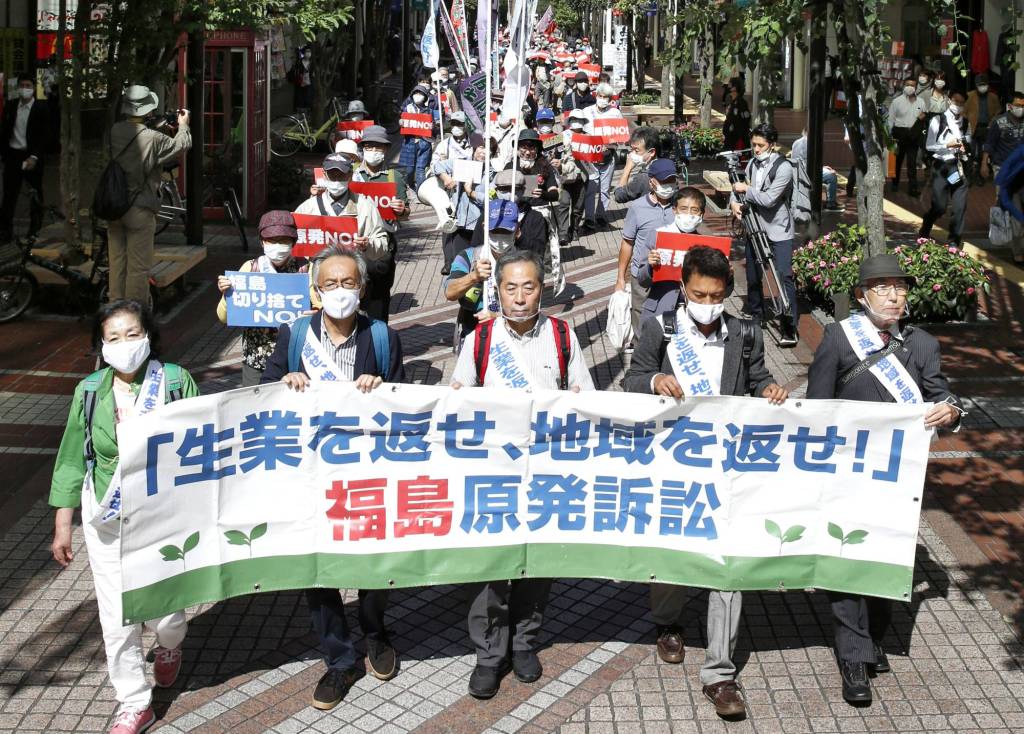
Plaintiffs and their supporters march in Japan ahead of the court ruling in Sendai on the tsunami-crippled Fukushima Daiichi nuclear power plant disaster on Wednesday.
Oct 1, 2020
A Japanese court has found the government and Tepco, the operator of the wrecked Fukushima nuclear plant, negligent for failing to take measures to prevent the 2011 nuclear disaster, and ordered them to pay 1bn yen ($9.5m) in damages to thousands of residents for their lost livelihoods.
The ruling on Wednesday by Sendai high court could open up the government to further damage claims because thousands of other residents evacuated as reactors at the coastal power station overheated and released a radioactive cloud, following the devastating tsunami. While some people have returned home, areas close to the plant are still off limits.
The plaintiffs had sought monthly compensation of about 50,000 yen ($470) per person until radiation levels subside to pre-disaster levels, seeking a total of 28bn yen ($265m).
The plaintiffs’ head lawyer, Izutaro Managi, hailed the ruling as a major victory, saying: “We ask the government to extend relief measures as soon as possible, not only for the plaintiffs but for all victims based on the damage they suffered.”
The latest ruling follows 13 lower court decisions, which were divided over government responsibility in the disaster. The latest ruling doubles the amount of damages against Tepco ordered by a lower court in 2017
In 2011, 3,550 plaintiffs were forced to flee their homes after a magnitude-9 earthquake triggered a tsunami that devastated the country’s north-east and crippled the Fukushima nuclear plant, known as the triple disaster.

Decommissioning work is underway at the Fukushima Daiichi nuclear power plant in Okuma town, north-eastern Japan.
Radiation that spewed from the plant’s melted reactors contaminated the surrounding areas, forcing about 160,000 residents to evacuate at one point. More than 50,000 are still displaced because of lingering safety concerns. The plant is being decommissioned, a process expected to take decades.
The court said that the government could have taken measures to protect the site, based on expert assessments available in 2002 that indicated the possibility of a tsunami of more than 15 metres, reported public broadcaster NHK, which aired footage of the plaintiffs celebrating outside the court after the ruling.
The government has yet to say whether it will appeal in the supreme court against the decision. “We will consider the ruling and take appropriate action,” chief cabinet secretary Katsunobu Kato said after the ruling.
Officials at Tepco were unavailable when Reuters tried to reach them outside regular business hours.
In court, the government argued it was impossible to predict the tsunami or prevent the subsequent disaster. Tepco said it had fulfilled its compensation responsibility under government guidelines.
Plaintiffs said the ruling brought some justice, but that their lives could never return to normal and their struggle was far from over.
“For more than nine years, I have planted seeds on the contaminated soil and grown vegetables, always worrying about the effects of radiation,” plaintiff Kazuya Tarukawa, a farmer from Sukagawa in Fukushima, said at a meeting after the ruling. “Our contaminated land will never be the same.”
Court increases state liability, compensation for nuclear disaster

Plaintiffs hold up signs in front of the Sendai High Court on Sept. 30 stating victory in their lawsuit against the central government and Tokyo Electric Power Co.
October 1, 2020
SENDAI—A high court here on Sept. 30 more than doubled the amount of compensation awarded to victims of the Fukushima nuclear disaster and issued a scathing critique against the central government for its inaction.
The Sendai High Court found the central government equally at fault as plant operator Tokyo Electric Power Co. for failing to take anti-tsunami measures and ordered the defendants to pay a total of about 1.01 billion yen ($9.6 million) to around 3,550 evacuees and residents living in Fukushima Prefecture and elsewhere.
It was the first high court ruling in various lawsuits seeking compensation from TEPCO and the central government for the triple meltdown at the Fukushima No. 1 nuclear power plant caused by a quake-triggered tsunami in March 2011.
In October 2017, the Fukushima District Court ordered the defendants to pay about 500 million yen to about 2,900 evacuees. That decision was appealed to the Sendai High Court, which increased both the compensation amount and the number of recipients.
“We won a total victory over the central government and TEPCO,” Izutaro Managi, a lawyer for the plaintiffs, said. “The effect on the various lawsuits to be decided in the future will be huge.”
A major point of contention in the case was a long-term assessment of the probability of major earthquakes released by the science ministry’s Headquarters for Earthquake Research Promotion in 2002. The report pointed out that Fukushima Prefecture could be hit by a major tsunami.
The high court found the assessment to be a “scientific finding that had a considerable level of objective and rational basis,” making it an important perspective that differed greatly from various views presented by individual scholars or private-sector organizations.
The court ruled that if the economy minister at the time had immediately ordered TEPCO to calculate the height of a possible tsunami, a forecast could have been made of the likelihood of a tsunami striking the nuclear plant.
But the ruling said, “The regulatory authority did not fulfill the role that was expected of it” and that “not exercising regulatory powers was a violation of the law regarding state compensation.”
The Fukushima District Court found that the central government only had a secondary responsibility to oversee the utility.
The high court, however, ruled that the government had the same level of responsibility. It said both the central government and TEPCO avoided making tsunami calculations because they feared the effects that would arise if the urgent measures were taken.
The high court ruling also expanded the range of plaintiffs who could receive compensation to people living in the Aizu district of Fukushima Prefecture as well as Miyagi and Tochigi prefectures where evacuation orders were not issued.
Experts said the high court ruling is a game-changer because of the positive assessment given to the long-term evaluation about possible tsunami.
Other district courts have ruled that the central government was not responsible because even if it had ordered measures to be taken, there would not have been enough time to complete such steps to prevent damage from the tsunami.
“Plaintiffs in the other lawsuits have provided testimony at a similar level so this could turn the tide in the recent trend of plaintiffs losing their cases,” said Masafumi Yokemoto, a professor of environmental policy at Osaka City University who is knowledgeable about nuclear plant issues.
Yotaro Hatamura, a professor emeritus of engineering at the University of Tokyo who headed the government panel that investigated the Fukushima nuclear accident, said, “This was an unprecedented ruling that pointed out in a rational manner the stance of both the central government and TEPCO of not looking at data that they did not want to see.”
Chief Cabinet Secretary Katsunobu Kato said at his Sept. 30 news conference that the central government would carefully go over the court ruling before making a decision on whether to appeal.
TEPCO also issued a statement with similar wording.
Japanese Government Is Ordered to Pay Damages Over Fukushima Disaster
The Sendai High Court said the state and the plant’s operator must pay $9.5 million to survivors of the 2011 nuclear accident. They have until mid-October to appeal to the country’s Supreme Court.

A damaged reactor building at the Fukushima Daiichi nuclear power plant in Japan in 2011.
September 30, 2020
TOKYO — A high court in Japan on Wednesday became the first at that level to hold the government responsible for the 2011 Fukushima nuclear disaster, saying in a ruling that the state and the plant’s operator must pay about $9.5 million in damages to survivors.
The overpowering earthquake and tsunami that ripped through northern Japan in March 2011 caused a triple meltdown at the Fukushima Daiichi plant, leading to the worst nuclear crisis since Chernobyl.
Under Wednesday’s ruling by the Sendai High Court, the government and the Tokyo Electric Power Company, known as Tepco, must compensate 3,550 plaintiffs, the Kyodo news agency reported. The plaintiffs had sought monthly compensation payments of about $475 per person until radiation at their homes returns to pre-crisis levels.
In 2017, a lower court had ordered the government and Tepco to pay about half that amount to about 2,900 plaintiffs. But the ruling by Sendai’s high court, one of eight such courts in Japan, is significant because it could set a legal precedent for dozens of similar lawsuits that have been filed across the country.
The government has long argued that it could not have prevented the tsunami or the nuclear accident, while Tepco says it has already paid any compensation that was ordered by the government. Last year, a Japanese court acquitted three former Tepco executives who had been accused of criminal negligence over their roles in the accident.
Hiroshi Kikuchi, a lawyer for the plaintiffs, called Wednesday’s decision “groundbreaking.”
“The court carefully collected facts for this judgment,” Mr. Kikuchi said at a news conference. “We feel now it will largely impact on other actions nationwide.”

Workers removing the top soil from a garden in Naraha, inside Fukushima’s evacuation zone, in 2013.
Izutaro Managi, another lawyer on the team, said in a brief interview that if the government and Tokyo Electric Power appeal the decision, he expects it to go to the country’s Supreme Court. The deadline for filing that appeal is Oct. 14.
Tepco said in a statement on Wednesday that it would examine the judgment before responding to it.
“We again apologize from our heart for giving troubles and concerns to people in Fukushima as well as in the society largely caused by our nuclear power plant’s accident,” the statement said.
Toyoshi Fuketa, the chairman of the Nuclear Regulation Authority, an agency that was created after the Fukushima accident, said on Wednesday that he would not comment until the details of the judgment were released.
“The Nuclear Regulation Authority was set up based on reflection over, and anger against, the nuclear accident in Fukushima,” Mr. Fuketa added. “I would like to advance strict rules on nuclear power so that a nuclear accident will never happen again.”
Takashi Nakajima, one of the plaintiffs in the case, told reporters that the ruling was a reminder that the consequences of the Fukushima disaster were still real, even if many people in Japan were starting to forget about it.
“Some people say that I’m damaging Fukushima’s reputation,” Mr. Nakajima said. “But now I think we are encouraged by the court to say what we think.”
Another plaintiff, Kazuya Tarukawa, said in a tearful statement that he had been tilling contaminated soil in the area for nearly a decade, and waiting for the government and the plant’s operator to take responsibility.
He said the money was beside the point, and that the ruling raised a larger question about the long-term risks of nuclear energy.
“What will come of Japan if there is another nuclear disaster like that?” he asked.

A roadblock in a contaminated area northwest of the nuclear plant in 2013.
Sendai court upholds ruling that state and Tepco must pay Fukushima evacuees
A group of plaintiffs demanding compensation for the Fukushima No. 1 nuclear plant disaster rally in Sendai on Wednesday prior to the high court’s ruling that held the state and Tepco responsible.
September 30, 2020
Sendai – The Sendai High Court on Wednesday ordered the state and the operator of the crippled Fukushima No. 1 nuclear plant to pay ¥1 billion ($9.5 million) in damages to residents over the 2011 earthquake- and tsunami-triggered disaster.
It was the first time a high court has acknowledged the state’s responsibility for the incident in about 30 similar lawsuits filed nationwide.
The Sendai court told the government and Tokyo Electric Power Company Holdings Inc. to pay about ¥1.01 billion to 3,550 out of some 3,650 plaintiffs, up from the sum of ¥500 million that a lower court ordered them to pay to around 2,900 plaintiffs in an October 2017 ruling.
In line with the 2017 ruling by the Fukushima District Court, the high court made its decision based on three points in dispute, including whether a major tsunami could have been foreseen.
The two other points were whether countermeasures could have been implemented to prevent a disaster, and whether the compensation levels outlined by the government were sufficient.
The plaintiffs had sought monthly compensation payments of around ¥50,000 per person until radiation at their residences returns to the pre-crisis level, bringing their total final demand to approximately ¥28 billion.
The state, meanwhile, argued it was impossible to predict the tsunami and prevent the subsequent disaster. Tepco claimed it had already paid compensation in accordance with government guidelines.
In the district court ruling, the government and Tepco were both blamed for failing to take steps to counter the huge tsunami.
It ruled that the two should have been able to foresee the risks of a maximum 15.7-meter-high wave, based on a quake assessment issued in 2002, and that the disaster could have been prevented if the state had instructed the operator to implement measures that year.
The magnitude 9.0 earthquake and ensuing tsunami struck Tohoku on March 11, 2011, causing multiple meltdowns and hydrogen blasts at the nuclear power plant.
Around 55,000 people remained evacuated both within and outside Fukushima Prefecture as of the end of August.
The Nuclear Regulation Authority issued a comment that said, “We will consider appropriate ways to respond while closely examining the ruling and consulting with relevant authorities.”
Tepco said in a statement, “We deeply apologize again for causing great trouble and worries to the people of Fukushima Prefecture and the whole of society because of the nuclear power plant accident. We will closely examine the ruling by the Sendai High Court and consider ways to respond.”
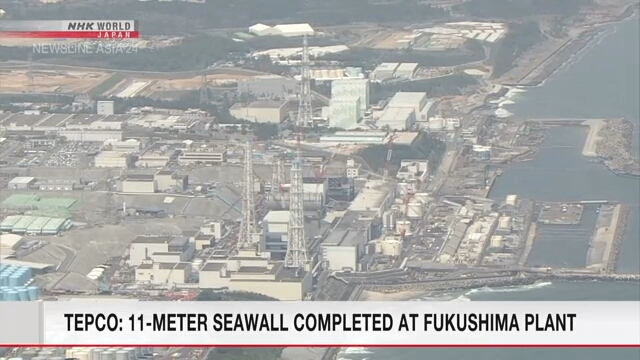
TEPCO: 11m seawall completed at Fukushima plant
September 29, 2020
The operator of the damaged Fukushima Daiichi nuclear power plant says it has completed an 11-meter-high seawall to protect the facility from tsunami waves.
Tokyo Electric Power Company, or TEPCO, erected the barrier based on a government panel warning three years ago. It said that a mega-quake along the Chishima Trench, beneath the sea near northern Japan, could cause a tsunami to hit the compound.
TEPCO announced that a 1.7-meter-high concrete wall was built atop elevated ground stretching 600 meters on the sea side of the No.1 to No.4 reactors.
The firm says the barrier stands 11 meters above sea level and it was completed on Friday.
TEPCO next plans to build another seawall measuring up to 16 meters high, based on a new projection made by a government panel in April.
The projection says if a mega-quake were to occur along the Japan Trench off the northeastern coast, a tsunami could be higher than the newly-built seawalls.
TEPCO says it aims to complete the taller seawall by fiscal 2023.
1 This Month

of the week – Shut Down Drone Warfare!


Tell the Ukrainian Government to Drop Prosecution of Peace Activist Yurii Sheliazhenko

Petition to revoke the licensing of the Near Surface Nuclear Disposal Facility (NSDF) at Chalk River. https://www.ourcommons.ca/petitions/en/Petition/Details?Petition=e-7247
To see nuclear-related stories in greater depth and intensity – go to https://nuclearinformation.wordpress.com
-
Archives
- April 2026 (57)
- March 2026 (251)
- February 2026 (268)
- January 2026 (308)
- December 2025 (358)
- November 2025 (359)
- October 2025 (376)
- September 2025 (257)
- August 2025 (319)
- July 2025 (230)
- June 2025 (348)
- May 2025 (261)
-
Categories
- 1
- 1 NUCLEAR ISSUES
- business and costs
- climate change
- culture and arts
- ENERGY
- environment
- health
- history
- indigenous issues
- Legal
- marketing of nuclear
- media
- opposition to nuclear
- PERSONAL STORIES
- politics
- politics international
- Religion and ethics
- safety
- secrets,lies and civil liberties
- spinbuster
- technology
- Uranium
- wastes
- weapons and war
- Women
- 2 WORLD
- ACTION
- AFRICA
- Atrocities
- AUSTRALIA
- Christina's notes
- Christina's themes
- culture and arts
- Events
- Fuk 2022
- Fuk 2023
- Fukushima 2017
- Fukushima 2018
- fukushima 2019
- Fukushima 2020
- Fukushima 2021
- general
- global warming
- Humour (God we need it)
- Nuclear
- RARE EARTHS
- Reference
- resources – print
- Resources -audiovicual
- Weekly Newsletter
- World
- World Nuclear
- YouTube
-
RSS
Entries RSS
Comments RSS
 nuclear-news