New Civil Engineer 11th Nov 2020, A consortium led by Bechtel is reportedly in talks with the government
about acquiring the Wylfa Newydd site on Anglesey earmarked for nuclear
development. Plans for a £20bn nuclear plant were recently scrapped by
developer Horizon after 18 months of talks with government about a funding
mechanism eventually fizzled out. The site is however still safeguarded and
the project could theoretically be restarted by a third party. Led by the
Bechtel, the consortium includes Southern Company, an electricity utility,
and Westinghouse, a nuclear engineering company.
https://www.newcivilengineer.com/latest/bechtel-led-consortium-in-talks-about-wylfa-site-11-11-2020/
City AM 10th Nov 2020, A group of US companies has reportedly approached the government about
taking over the development of a nuclear power plant at Wylfa in north
Wales. Engineering giant Bechtel will lead the consortium, and will be
joined by utility firm Southern and nuclear engineers Westinghouse.
https://www.cityam.com/us-consortium-mulls-taking-on-abandoned-wylfa-nuclear-project/
November 12, 2020
Posted by Christina Macpherson |
business and costs, politics, UK |
Leave a comment

Christina Macpherson’s websites & blogs
Despite the enormous and present threats of pandemic and climate change, it’s now time for this site to return to its original focus – the NUCLEAR horror.
Others are covering well those two other related dangers.
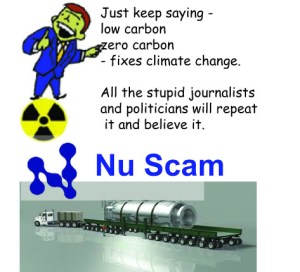
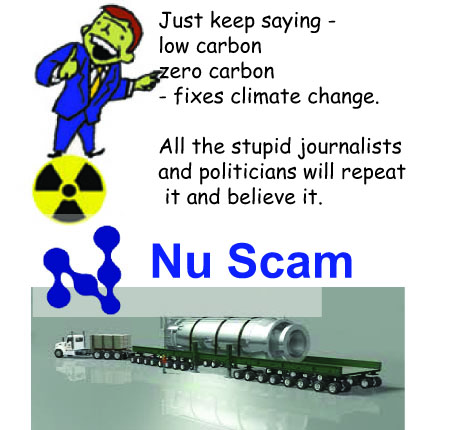
The nuclear danger stays in the backround. And the mindless cringing mainstream media keeps on regurgitating handouts from NuScam and the rest of the global nuclear salesmen.
The switch in the USA to a Democrat administration will make the nuclear lobby’s path just so much smoother and easier. Biden and Harris look so much nicer than Trump, (and they are nicer). So much easier for progressive people to support their pro nuclear policies.
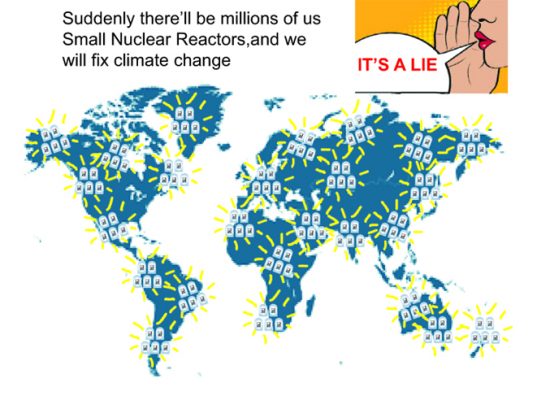
And hey shucks – we all worry about climate change – and NuScale’s small nuclear reactors are going to fix that – aren’t they?

November 10, 2020
Posted by Christina Macpherson |
Christina's notes |
Leave a comment

NJ Ratepayers Unite to Stop More Nuclear Corporation Bailouts, Energy Monopolies https://www.insidernj.com/press-release/nj-ratepayers-unite-stop-nuclear-corporation-bailouts-energy-monopolies/ November 9, 2020,
Diverse energy users and consumer advocate groups create NJ Ratepayers United
Trenton, N.J. –– As a $300 million annual nuclear subsidy continues to burden New Jersey consumers, a coalition has formed to oppose another proposed major energy policy initiative from PSEG and Exelon that would enable the companies to transform the state’s electricity capacity market and obtain windfall profits.
NJ Ratepayers United (NJRU) is a diverse coalition of New Jersey consumers, business groups, consumer advocates, grassroots organizations and energy providers that have joined forces to stop the proposed Fixed Resource Requirement (FRR). This proposed overhaul would transform how the state procures power, eliminating ratepayer protections and empowering select companies to leverage their market power to further increase electricity costs. Continue reading →
|
|
|
|
|
November 10, 2020
Posted by Christina Macpherson |
business and costs, opposition to nuclear, USA |
Leave a comment
 Iran’s president calls on Biden to return to nuclear deal
November 9, 2020, TEHRAN, Iran (AP) — Iran’s president called on President-elect Joe Biden to “compensate for past mistakes” and return the U.S. to Tehran’s 2015 nuclear deal with world powers, a state-run news agency reported Sunday.
Hassan Rouhani’s comments mark the highest-level response from Iran to Biden and Vice President-elect Kamala Harris clinching the Nov. 3 election.
“Now, an opportunity has come up for the next U.S. administration to compensate for past mistakes and return to the path of complying with international agreements through respect of international norms,” the state-run IRNA news agency quoted him as saying.
Under President Donald Trump, tensions between the U.S. and Iran have escalated, reaching a fever pitch earlier this year. One of Trump’s signature foreign policy moves was unilaterally withdrawing the U.S. from Iran’s nuclear deal in 2018, which had seen Tehran limit its enrichment of uranium in exchange for the lifting of economic sanctions.
The U.S. has since reimposed punishing sanctions on Iran that have crippled its economy, which was further battered by the coronavirus outbreak. In an effort to pressure Europe to find a way around the sanctions, Iran has slowly abandoned the limits of the nuclear deal…….. https://apnews.com/article/joe-biden-donald-trump-iran-foreign-policy-tehran-da8c870cacf6109ae1cad62108535634
November 10, 2020
Posted by Christina Macpherson |
Iran, politics international, USA |
Leave a comment
|
Belarus shuts down its newly inaugurated nuclear power plant to replace equipment, VILNIUS, Nov 9 (Reuters) – Belarus has shut down production at its new nuclear power plant, inaugurated on Saturday by President Alexander Lukashenko, to replace some of its equipment, its Ministry of Energy said in a statement on Monday.It did not say when the need to replace the equipment was first discovered. Lithuanian grid operator (TSO) Litgrid , located 20km from the plant, said it had detected a production stoppage at the plant at 1000 GMT on Sunday. The power plant was built by Russian state-owned firm Rosatom and financed by Moscow with a $10 billion loan…… https://www.reuters.com/article/belarus-nuclearpower-stoppage/belarus-shuts-down-its-newly-inaugurated-nuclear-power-plant-to-replace-equipment-idINL1N2HV26T
|
|
November 10, 2020
Posted by Christina Macpherson |
Belarus, politics, safety |
Leave a comment
 S. Africa Regulator to Consider Approving Nuclear Power Plan, Bloomberg, By Antony Sguazzin,10 November 2020,
-
- Program envisages addition of 2,500 megawatts of atomic power
- Country’s renewable-energy lobby opposes expansion of industry
The National Energy Regulator of South Africa will on Nov. 11 consider approving the procurement of 2,500 megawatts of nuclear power, marking another step toward the expansion of the industry.
The regulator will consider approving a so-called section 34 determination for the program, which enables the Department of Mineral Resources and Energy to undertake a bidding process for private producers to build nuclear-power facilities, it said in a Twitter posting outlining the agenda for the meeting.
South Africa, which destroyed its atomic weapons prior to the end of apartheid, already operates Africa’s only nuclear-power plant, the 1,800 megawatt Koeberg facility in Cape Town, as well as the Pelindaba research facility north of Johannesburg.
While the expansion of nuclear power has the support of the ministry and labor unions, it’s opposed by environmentalists and backers of the country’s expanding renewable-energy program.
NuScale Power LLC, a U.S. nuclear-energy firm, has said it will propose small, modular reactors for installation in South Africa. The U.S. International Development Finance Corp. has announced that it will support a bid by NuScale, approving the procurement of 2,500 megawatts of nuclear power, marking another step toward the expansion of the industry.
The regulator will consider approving a so-called section 34 determination for the program, which enables the Department of Mineral Resources and Energy to undertake a bidding process for private producers to build nuclear-power facilities, it said in a Twitter posting outlining the agenda for the meeting.
South Africa, which destroyed its atomic weapons prior to the end of apartheid, already operates Africa’s only nuclear-power plant, the 1,800 megawatt Koeberg facility in Cape Town, as well as the Pelindaba research facility north of Johannesburg.
While the expansion of nuclear power has the support of the ministry and labor unions, it’s opposed by environmentalists and backers of the country’s expanding renewable-energy program. https://www.bloomberg.com/news/articles/2020-11-09/south-african-regulator-to-consider-approving-nuclear-power-plan
November 10, 2020
Posted by Christina Macpherson |
marketing, South Africa |
Leave a comment
|
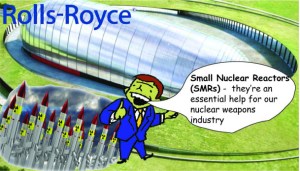 Rolls-Royce and Exelon sign MoU on nuclear power stations operations, Power Rolls-Royce and Exelon sign MoU on nuclear power stations operations, Power Technology, 9 November 2020 ,Industrial technology company Rolls-Royce has signed a memorandum of understanding (MoU) with Exelon Generation for the operation of compact nuclear power stations in the UK and overseas locations. Technology, 9 November 2020 ,Industrial technology company Rolls-Royce has signed a memorandum of understanding (MoU) with Exelon Generation for the operation of compact nuclear power stations in the UK and overseas locations.
Industrial technology company Rolls-Royce has signed a memorandum of understanding (MoU) with Exelon Generation for the operation of compact nuclear power stations in the UK and overseas locations.
Under the contract, Exelon Generation agreed to assist Rolls Royce in the development and deployment of UK small modular reactors (UKSMR)……
In January, Rolls-Royce announced that it will be leading a consortium to build and install small modular reactors (SMRs) on former nuclear sites to power the UK by 2029.
Members part of the consortium are Assystem, Atkins, BAM Nuttall, Jacobs, Laing O’Rourke, National Nuclear Laboratory, Nuclear Advanced Manufacturing Research Centre, Rolls-Royce and TWI.
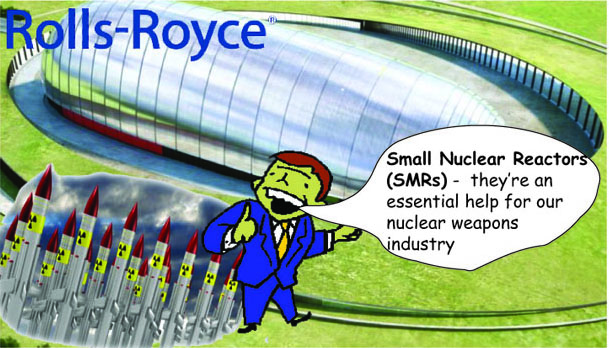
Working with its partners, as well as the UK government, the consortium will secure a commitment for a fleet of factory-built nuclear power stations, each with a 440MW capacity, developed inside a weatherproof canopy…….. https://www.power-technology.com/news/rolls-royce-exelon-mou/
|
|
November 10, 2020
Posted by Christina Macpherson |
marketing, Small Modular Nuclear Reactors, UK |
Leave a comment

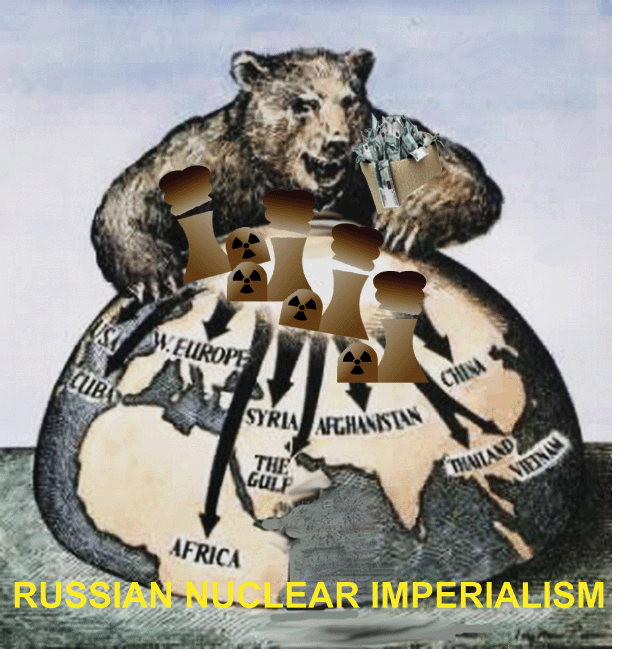
 China and Russia lead world ranking for supplying new nuclear reactors, Bloomberg, 9 Nov 20, Source: UxC ResearchThe former Cold War frontier of eastern Europe is becoming a battleground in the $500 billion business of building nuclear power plants.
Four months after lifting a prohibition on financing nuclear-energy deals overseas, the U.S. is finding an opening for companies such as General Electric Co., Westinghouse Electric Co. and Bechtel Group Inc.
In the span of a few weeks, the U.S. signed a memorandum with Romania for the financing of a new reactor and other accords with Poland as well as Bulgaria, which plans to revive an older reactor project.
The plan to win business for U.S. companies in this geopolitically key market started under Donald Trump is poised to survive the transition to a new U.S. administration under President-elect Joe Biden. That may nudge eastern European partners to move forward with stalled nuclear projects.
Greater access to financing may be the chief advantage on the American side as it pushes back against Russian and Chinese interests in the region.
“The projects in countries such as Romania, Bulgaria and Poland could be accelerated if the U.S. helps them come up with funding sources at competitive costs and, eventually, without the need for state aid or guarantees,” said Razvan Nicolescu, a Bucharest-based partner at Deloitte specializing in the energy industry.
Eastern European nations, which are dependent on fossil fuels from Russia and their own coal deposits, have even more reasons than others to seek nuclear options. Being subject to stringent European Union emissions standards also creates additional incentives.
The recent change in regulation is allowing the U.S. to compete for a larger share of the market, whose value it estimates at $500 billion-$740 billion over the next 10 years.
Barriers to expansion remain formidable.
Westinghouse, which was one of the leading nuclear industry suppliers in the U.S., went bankrupt in 2017 as it faced billions in potential liabilities related to domestic projects in Georgia and South Carolina. After the South Carolina project was canceled in 2017, the two at Southern Co.’s Plant Vogtle remained the only reactors under construction in the world using Westinghouse’s flagship AP1000 technology, though that is also behind schedule and over budget.
Political rhetoric may prevail over actual investment decisions, said Martin Vladimirov, an analyst at the Sofia-based Center for the Study of Democracy.
“While the U.S. seeks to counter Russian and Chinese economic interference, those projects may not follow the market logic and will need significant state support,” Vladimirov said.
Nuclear Love Affair in Europe’s Poorer East Is Hitting the Rocks
Russia doesn’t see current U.S. nuclear deals in Europe as a threat to its flagship Rosatom Corp. because the U.S. companies don’t have the bandwidth to build new plants now, a government official close to Russia’s nuclear industry said. The U.S. projects in Europe will likely be limited to servicing agreements, the official added, asking for anonymity as they’re not authorized to speak publicly.
State-owned Rosatom itself also played down the risk from increased competition, saying there’s room for many projects in the region.
“We believe that the U.S. nuclear sector has a great potential,” Rosatom said. “The most important thing now for the U.S. vendors is to grow skills by building more in the markets where they have presence and experience.”
Romania’s need to refurbish an existing reactor makes it the most likely candidate to tap U.S. funding or start work with backing from the U.S., Canada and France. There are bigger doubts over the economics and political will behind the nuclear push announced by Poland and Bulgaria.
Some have stuck by Russia as their main technological and financing partner, such as Hungary for its 10 billion-euro ($12 billion) nuclear expansion deal, though GE will get a chance to supply turbines there.
Others have turned away from the long-standing deals with Russia and rebuffed newer attempts by China to step in as financier and supplier.
Funding will be the key determinant whether these projects can get off the ground, according to Bloomberg Intelligence analyst Elchin Mammadov.
“It’s a very risky and expensive venture that is unlikely to be funded by anyone but the state,” Mammadov said.
Even with state backing, most of the projects flagged across eastern Europe may face years of delay and many may be eventually abandoned.
Russia and China have an edge because they offer package deals. The U.S. is “entirely absent” from the global new build reactor market, the U.S. Energy Department said in an April report.
The U.S. has “lost its competitive global position as the world leader in nuclear energy,” the American department concluded.
— With assistance by Will Wade, Zoltan Simon, Maciej Martewicz, Daryna Krasnolutska, Stepan Kravchenko, and Zoe Schneeweiss https://www.bloomberg.com/news/articles/2020-11-09/u-s-goes-nuclear-to-compete-with-russia-china-in-europe-s-east
November 10, 2020
Posted by Christina Macpherson |
marketing, Russia, USA |
Leave a comment

Inundation of news this week, mostly about the USA election. But also about coronoavirus and climate.
***************
The nuclear issue is less covered, and could be seen as less important than those two present world crises.
***************
But here’s the problem. The global nuclear lobby is quietly organising, and the impending Biden-Harris administration in America is giving that lobby new impetus. It has been easier for the anti-nuclear and clean energy movement to oppose the policies of that bullying sociopath Donald Trump. It will be harder to oppose Biden and Kamala, who, like Barack Obama, are supporters of, and beholden to, the nuclear industry.
***************
I have found all the news quite overwhelming this week. While I acknowledge the urgency and importance of coronavirus and climate, I think that, from now on, I might need to confine my news to nuclear issues, (which is where this newsletter started). The nuclear threat is going on, as it were, under the radar. Politicians and communities are being sucked in by clever pro nuclear propaganda and financial incentives, all this helped along by slick and uncritical media coverage.
***************
***************
November 9, 2020
Posted by Christina Macpherson |
Christina's notes |
Leave a comment
|
In desperate search of disposal sites for its nuclear waste, Japan offers poisonous grants to two small villages, https://www.equaltimes.org/in-desperate-search-of-disposal#.X6mapGgzbIU By Carmen Grau, 9 November 2020, One morning in September, 87-year-old retiree Masao Takimoto was reading the newspaper in his house in Kamoenai when a news story captured his attention, ruined his day and changed the course of this quiet fishing village on the island of Hokkaido, in northern Japan: the mayor of the village of 822 had agreed to a preliminary study to host a disposal site for highly radioactive nuclear waste, for which the Japanese government would award 2 billion yen (€16 million, US$19 million) in subsidies.Mr Takimoto didn’t waste a single minute. He wrote a letter of protest and delivered it by hand to the mayor’s house. Over the following days, he produced and distributed leaflets alerting others to the dangers of the nuclear disposal site and tried to gain access to the meetings that were being hastily held. His journey to activism resulted in tensions and anonymous threats. Ultimately he was unable to stop the mayor from signing on 9 October an application with the Nuclear Waste Management Organisation (NUMO), a quasi-governmental body charged with managing Japan’s radioactive waste.
Meanwhile, just 40 km away, another fishing village of 2,900 inhabitants quickly mobilised to prevent their mayor from volunteering for the same study. Suttsu, 40 per cent of whose inhabitants are over 65 years old, announced in August its interest in applying for the large subsidy to combat depopulation.
Haruo Kataoka, 71, the town’s mayor since 2001, has been accused of ignoring civil society groups, national anti-nuclear organisations, fishers’ associations, leaders of neighbouring municipalities, the think tank CEMIPOS and even the governor of Hokkaido. The region, a major source of fishing and agricultural resources, has an ordinance opposing nuclear waste in its territory.
“We want to vote on the proposal. We’re worried about our fishing industry. If nuclear waste is stored here and there are problems in the future, we won’t be able to protect the environment or our jobs,” says Toshihiko Yoshino, a fishing entrepreneur in Suttsu. Yoshino processes and sells the local specialty, oysters, young sardines and anchovies. On 10 September, with a group of residents both young and old, he founded the organisation ‘No to Nuclear Waste for the Children of Suttsu.’ They collected signatures to request a referendum. On the eight day they launched a campaign to implement it, in collaboration with civil groups in the region. Their efforts were in vain: the mayor signed the application in Tokyo the following day. The previous morning, a Molotov cocktail exploded at the mayor’s house, an incident that left no one injured.
Someone broke the bicycle that Junko Kosaka, 71, was using to hand out leaflets against the nuclear disposal site. She has been a member of the opposition in the Suttsu council for nine years and laments the tension and discord between neighbours. “The village has no financial problems. There are fishing companies and profitable sales of fish. We receive a large budget from Japanese citizens who support rural areas through the Hometown Tax scheme.” She was surprised by the age of NUMO’s managers, all of whom are elderly, and believes that young people should decide their own future. “I would like the managers to reflect, to rethink nuclear energy. We are a country of disasters.”
Emptying villages and poor employment prospects
Japan is the world’s fourth largest producer of nuclear power after the United States, France and China. Distributed across the archipelago, 54 reactors generated 30 per cent of electricity until 2011. Despite having shut down the majority of reactors following the fatal accident of Fukushima, Japan’s commitment to nuclear energy remains firm, though not without controversy. Nine reactors are still in operation and 18 are waiting to be reactivated to generate 20 per cent of the country’s electricity in 2030.
Since 2002, the government has been looking for a location for a permanent geological repository, concrete structures at least 300 metres below ground that will store radioactive waste for millennia so as not to affect life and the environment. Desperate to solve a global and irreversible problem of the nuclear age, Japan is offering subsidies to encourage localities to host the repository. Small villages with declining populations and uncertain futures are attracted by the promise of money and jobs. The first phase will consist of two years of feasibility research. For the following phase, a four-year preliminary geological investigation, villages will receive an additional 7 billion. The final phase will consist of digging and the construction of the underground facility, a process that will last 14 years.
But where is the waste? “It cools off in overflowing pools while time runs out,” say many frustrated opponents of nuclear energy in Japan.
For decades Japan has been shipping tons of spent fuel to France and England for reprocessing, but the resulting radioactive waste must be returned to the country of origin for disposal by the IAEA. Japan only has a temporary repository (between 30 and 50 years – and half of that time is already up) in the village of Rokkasho, but 40,000 highly polluting cylinders are waiting for a permanent storage (the construction of which could take at least 20 years). The central government must also find storage for low-intensity waste occupying the equivalent of eight Olympic-size swimming pools. Every time a power plant operator uses gloves, a suit or tools, the earth fills with rubbish that contaminates for generations. France, Belgium, Sweden and Spain already have disposal sites for several centuries and Finland has just opened a permanent site in one of the oldest rock formations in Europe.
In 2007, the city of Toyo asked to enter the preliminary study but soon backed out after facing strong local opposition. In 2017, the central government released a map of potentially suitable sites. It ruled out sites near active volcanoes and fault lines, as well as areas with recent seismic activity. A wide area of Suttsu and a small portion of Kamoenai are seen to be favourable. Both locations are very close to the Tomari nuclear power plant, which is currently inactive.
The residents of Suttsu turned to experts for help. On 2 October, Hideyuki Ban, co-director of the Citizens’ Nuclear Information Centre came to the town with a renowned geologist to provide information to residents. According to the nuclear expert: “There is no space for the nuclear repository in Suttsu. We have to reclaim land from the sea and there hasn’t been enough research. Our country is not a geologically stable territory.” He says that 200 people attended the seminar, including the mayor “who must have already made the decision.” Is it safe? “It is not safe, there could be leaks. Currently there is no appropriate technology in the world for handling radioactive waste. The only way to reduce it is to shut down the plants.” So what should be done with the waste? “More research should be done and it should be buried using deep borehole disposal at more than 3,000 metres below the earth’s surface.”
A debated that is not promoted
Nobody in Kamoenai wants to talk to the press. By mid-morning, the boats have returned and the women are cleaning the salmon for sale. There are empty houses and closed businesses which have seen better days. In the main street, an imposing building is under construction: the new town hall, just opposite the old one. “I’m an employee of the town hall and I’m not authorised to respond,” says one young woman. “I’m not an expert, I can’t give an opinion,” says a young man. “I don’t want to talk, I could lose my job,” says a worried woman. “We have the power plant nearby and nothing bad has ever happened,” says another evasively.
Takimoto is the only person willing to speak out without fear: “It’s an obscure and cowardly process, nothing is transparent. The political administration is stifling the voices of the people. It’s strange that the most important thing, safety, isn’t being mentioned. We have to think about future dangers.”
“The government claims that it will be safe for years to come, that’s their argument. But should we believe it? The experts say the opposite. Just this year, on the 75th anniversary of the bombings of Hiroshima and Nagasaki, I was reading testimonies that made me cry. I have seen the effects of radiation on patients. I don’t want the children of Fukushima or of my village to suffer from it. We have to imagine a village without a nuclear power station or nuclear waste and that’s what I’m going to dedicate myself to,” he adds.
“I’ve been booed at local meetings, but there are people who support me in secret. Many of them pretend to be in favour but deep down they’re not. They don’t speak out for fear of losing their jobs, like the relatives of plant employees.” Takimoto refuses to give up. He has offered his experience in the health sector as a resource to help revitalise the town through projects such as medical tourism, but he has been unable to prevent the application from going through.
The Japanese government has welcomed the two locations (Kamoenai and Suttsu) and NUMO’s president expressed gratitude “for the courageous step”. The Minister of Industry said that they “will do their best to win the support of the people.” But the governor of Hokkaido has firmly stated that he will oppose the second phase. Those who oppose the disposal site fear that receiving the subsidies will make it difficult to back out due to government pressure. According to local journalists Chie Yamashita and Yui Takahashi of the Mainichi Shinbun: “Without going into whether or not applying is the right thing to do, there needs to be a debate about the management of radioactive waste and the process of selecting a location.” Everyone consulted for this article is calling for a national debate, which the government has not yet set in motion.
Some residents, like Takimoto, continue to protest: “No to nuclear waste. Life is more important than money.” On the poster, a baby dreams of a world and an ocean without pollution.
This article has been translated from Spanish.
|
|
November 9, 2020
Posted by Christina Macpherson |
Japan, opposition to nuclear, wastes |
Leave a comment
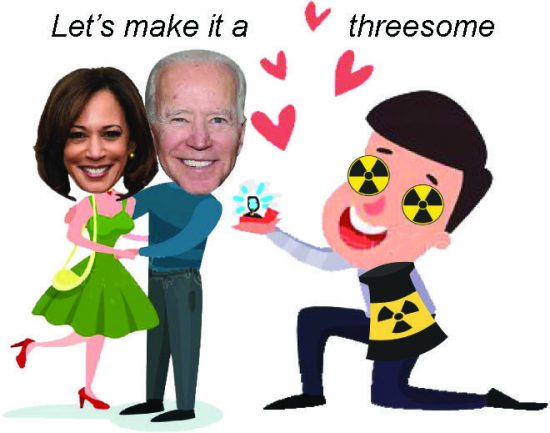
The nuclear lobby is quite happy with the Biden -Harris win. More on this later, as I try to delve deeper into a possibly cosy relationship
Christina Macpherson’s websites & blogs
between Kamala Harris and the global nuclear lobby.
Meanwhile, the Atlantic Council writes confidently of the nuclear industry’s plans for future development under the new American administration.
The Atlantic Council, 8 Nov 20, “…………legislation that encourages the rapid deployment of nuclear energy technology represents an area where Democrats and Republicans can continue to work together—as they have over the last four years …….
legislation that encourages the rapid deployment of nuclear energy technology represents an area where Democrats and Republicans can continue to work together—as they have over the last four years……..
*********
Strong bipartisan congressional support for nuclear reactors—both the existing fleet and also the next generation of advanced reactors.
November 9, 2020
Posted by Christina Macpherson |
politics, USA |
Leave a comment
|
 Biden could take swift action on transgender ban, nuclear weapons, It would take only an executive order to reverse Trump’s 2017 ban on most transgender Americans from joining the military. Politico, By BRYAN BENDER, 11/07/2020 Biden could take swift action on transgender ban, nuclear weapons, It would take only an executive order to reverse Trump’s 2017 ban on most transgender Americans from joining the military. Politico, By BRYAN BENDER, 11/07/2020
President-elect Joe Biden could get some quick wins by using executive orders to roll back several of President Donald Trump’s Pentagon policies.
For example, very little will stand in the way of Biden’s pledge to allow transgender service members to serve openly in the military. It would take only an executive order to reverse Trump’s 2017 ban on most transgender Americans from joining the military.
Nuclear weapons
The Pentagon budget, like other federal spending, will be under new pressure regardless of the outcome of the election, forcing some major acquisition programs to be cut or scaled back. The Biden administration is expected to take an especially close look at one particular set of programs: nuclear weapons.
One program considered especially vulnerable is the Long-Range Standoff Weapon, or LRSO, an air-launched cruise missile slated to be outfitted on the Air Force’s B-2 and future B-21 bombers and under development by Raytheon.
The land-based leg of the nuclear triad, the intercontinental ballistic missiles deployed in underground silos throughout the American West, is also expected to come under new scrutiny.
But a $13 billion contract was awarded by the Air Force on Sept. 8 to Northrop Grumman for the so-called Ground Based Strategic Deterrent and may be difficult for the incoming administration to roll back.
Still, “I know in the Biden administration the necessity for the ICBM force would be a point of debate, as would the LRSO,” said Robert Work, who served as deputy secretary of defense in both the Obama and Trump administrations. “There’ll be debates over whether those are necessary.”
Arms control
Along with changes to the nuclear weapons portfolio will likely be a fresh emphasis on arms control treaties.
The Democratic party platform takes aim at what party leaders consider the Trump administration’s reckless abandonment of several nuclear and other arms treaties with Russia, including the Intermediate-range Nuclear Forces Treaty and the Open Skies Treaty. Trump withdrew from both.
“Its brash nuclear threats, ill-considered withdrawals from critical arms control treaties and nuclear agreements, and reckless embrace of a new arms race have made the United States, and the world, less safe,” the platform states.
Biden may have an early opportunity to go in a different direction.
The New Strategic Arms Reduction Treaty, which limits the number of deployed nuclear weapons on both sides to 1,550, is set to expire Feb. 5, 2021, just a few weeks after inauguration, unless Washington and Moscow agree beforehand to extend it for up to five years.
Trump administration officials have signaled that they are open to an extension if they can get Russian agreement to temporarily freeze all nuclear weapons while negotiating a new pact that covers more classes of atomic arms. But Biden pledged last year to extend it regardless for the full five years permitted, calling New START “an anchor of strategic stability” and “a foundation for new arms control agreements.”
War powers
Biden also pledges to reverse course from the Trump administration when it comes to presidential war powers. That means reengaging with Congress to repeal and rewrite the Authorizations for the Use of Military Force. Congress first adopted that in 2001 to wage the war on terrorism, and then again in 2002 before the U.S.-led in invasion of Iraq.
We will only use force when necessary to protect national security and when the objective is clear and achievable — with the informed consent of the American people, and where warranted, the approval of Congress,” the Democratic Party platform states. “That is why we will work with Congress to repeal decades-old authorizations for the use of military force and replace them with a narrow and specific framework that will ensure we can protect Americans from terrorist threats while ending the forever wars.”
To be sure, it’s something the Obama administration tried but failed to find bipartisan consensus on, on Capitol Hill. https://www.politico.com/news/2020/11/07/joe-biden-policies-defense-433632
|
|
November 9, 2020
Posted by Christina Macpherson |
politics, USA, weapons and war |
Leave a comment

A secret military agenda. UK defence policy is driving energy policy – with the public kept in the dark, Beyond Nuclear
By David Thorpe, 8 Nov 20,The UK government has for 15 years persistently backed the need for new nuclear power. Given its many problems, most informed observers can’t understand why. The answer lies in its commitment to being a nuclear military force. Here’s how, and why, anyone opposing nuclear power also needs to oppose its military use.
“All of Britain’s household energy needs supplied by offshore wind by 2030,” proclaimed Prime Minister Boris Johnson at a recent online Conservative Party conference. This means 40 per cent of total UK electricity. Johnson did not say how, but it is likely, if it happens, to be by capacity auctions, as it has been in the recent past.
But this may have been a deliberate distraction: there were two further announcements on energy – both about nuclear power.
16 so-called “small nuclear reactors”
Downing Street told the Financial Times, which it faithfully reported, that it was “considering” £2 billion of taxpayers’ money to support “small nuclear reactors” – up to 16 of them “to help UK meet carbon emissions targets”.
It claimed the first SMR is expected to cost £2.2 billion and be online by 2029.
The government could also commission the first mini power station, giving confidence to suppliers and investors. Any final decision will be subject to the Treasury’s multiyear spending review, due later this year.
The consortium that would build it includes Rolls Royce and the National Nuclear Laboratory.
Support for this SMR technology is expected to form part of Boris Johnson’s “10-point plan for a green industrial revolution” and new Energy White Paper, which are scheduled for release later in the autumn.
Johnson will probably also frame it as his response to the English citizens assembly recommendations– a version of the one demanded by Extinction Rebellion in 2019 – which reported its conclusions last month.
While the new energy plan will also include carbon capture and storage, and using hydrogen as vehicle fuel, it’s the small modular reactors that are eye-popping.
They would be manufactured on production lines in central plants and transported to sites for assembly. Each would operate for up to 60 years, “providing 440MW of electricity per year — enough to power a city the size of Leeds”, Downing Street said, and the Financial Times copied.
The SMR design is alleged to be ready by April next year. The business and energy department has already pledged £18 million (US $23.48 million) towards the consortium’s early-stage plans.
They are not small
The first thing to know about these beasts is that they are not small. 440MW? The plant at Wylfa (Anglesey, north Wales) was 460MW (it’s closed now). 440MW is bigger than all the Magnox type reactors except Wylfa and comparable to an Advanced Gas-cooled Reactor.
Where will they be built? In the town of Derby – the home of Rolls Royce – where, as nuclear consultant Dr. David Lowry points out, the government is already using the budget of the Housing and Communities Department to finance the construction of a new advanced manufacturing centre site.
When asked why this site was not being financed by the business and energy department (BEIS), as you’d expect, a spokesperson responded that it was part of “levelling up regeneration money”.
Or perhaps BEIS did not want its budget used in such a way. Throwing money at such a “risky prospect” betrays “an irrationally cavalier attitude” according to Andrew Stirling, Professor of Science & Technology Policy at the University of Sussex Business School, because an “implausibly short time” is being allowed to produce an untested reactor design.
Only if military needs are driving this decision is it explicable, Stirling says. “Even in a worst case scenario, where this massive Rolls Royce production line and supply chain investment is badly delayed (or even a complete failure) with respect to civil reactor production, what will nonetheless have been gained is a tooled-up facility and a national skills infrastructure for producing perhaps two further generations of submarine propulsion reactors, right into the second half of the century.
“And the costs of this will have been borne not by the defence budget, but by consumers and citizens.”
Yes, military needs
UK defence policy is fully committed to military nuclear. The roots of civil nuclear power lay in the Cold War push to develop nuclear weapons. Thus has it ever been since the British public was told nuclear electricity would be “too cheap to meter”.
The legacy of empire and thrust for continued perceived world status are at the core of a post-Brexit mentality. It’s inconceivable to the English political elite that this status could exist without Great Britain being in the nuclear nations club, brandishing the totem of a nuclear deterrent.
“The civil-military link is undisputable and should be openly discussed,” agrees Dr Paul Dorfman at the Energy Institute, University College London.
Andrew Stirling talks of the “tragic relative popularity of (increasingly obsolescent) nuclear weapons”. The coincidental fact that civil nuclear installations are also crumbling provides a serendipitous opportunity for some.
The stores of plutonium in the UK are already overflowing and the military has its own dedicated uranium enrichment logistics.
Any nation’s defence budget in this day and age cannot afford a new generation of nuclear weapons. So it needs to pass the costs onto the energy sector.
“Clearly, the military need to maintain both reactor construction and operation skills and access to fissile materials will remain. I can well see the temptation for Defence Ministers to try to transfer this cost to civilian budgets,” observes Tom Burke, Chairman of think tank E3G.
The threat of nuclear proliferation
The threat of nuclear proliferation is therefore linked to the spread of civil nuclear power worldwide, says Dr David Toke, Reader in Energy Politics, Department of Politics and International Relations at the University of Aberdeen. David Lowry agrees: “India, Pakistan and above all Israel are obvious examples, each of which certainly has built nuclear weapons.”
It’s impossible to separate the tasks of challenging civil nuclear power without also challenging military nuclear interests, Stirling strongly believes. “The massive expense of increasingly ineffective military nuclear systems extend beyond the declared huge budgets. They are also propped up by large hidden subsidies from consumer and taxpayer payments for costly nuclear power.
“Huge hidden military interests will likely continue to keep the civil nuclear monster growing new arms. Until critics reach out and engage the entire thing, we’ll never prevail in either struggle.”
How new plants would be paid for still remains a question. Nuclear power is prohibitively expensive………..https://wordpress.com/read/feeds/72759838/posts/3011373103
November 9, 2020
Posted by Christina Macpherson |
politics, secrets,lies and civil liberties, Small Modular Nuclear Reactors, UK |
Leave a comment
Six Million dead, The Congo Holocaust has its origins in minerals plunder and colonialism https://wordpress.com/read/feeds/72759838/posts/3011373848, By Linda Pentz Gunter, 8 Nov 20,
When you’ve lost family members to the Nazi death camps, it’s a pain that never goes away. Six of my relatives were killed there, four more shot in Polish ghettos and at Forlì. They died long before I was born and were people I never knew. But we have their photographs. Their pain stares out from those images, a perpetual ache.
But what use is endless mourning if no lessons are learned? The most important one surely is that no such Holocaust must ever be allowed to happen again? And yet it has. To almost universal silence. No one speaks of today’s six million dead. They lie beneath the mineral-rich soil of the Democratic Republic of Congo (DRC), invisible and unmourned by the world beyond their country’s borders.
“The Holocaust continues in DRC with the complicity of the international community,” Rodrigue Muganwa Lubulu wrote to me in an email exchange. “Women and girls are raped every day and the dead are counted by tens each day.” He is the program director for CRISPAL Afrique and gave a zoom talk recently hosted by ICAN Germany.
The tragedy of the DRC, the second largest country in Africa, began with the discovery in 1915 of the Shinkolobwe uranium deposit, the richest ever discovered at the time. Its plunder, from 1921 until its closure in 2004, “has been a curse for the powerless community” around the mine, said Lubulu, “because not only have they been forced to abandon their lands, houses and fields in favor of uranium mining, but also all the men were forced to dig out those extremely radioactive materials without protective equipment.”
The cancers and other illnesses that killed those uranium workers are still harming the community today, Lubulu says, even though the mine is now shut down.
The DRC was first colonized by Belgium in 1908 and known as the Belgian Congo until it gained independence in 1960. (It was known as Zaire between 1971 and 1997.) It rapidly became a country of great interest, especially to the United State and the then Soviet Union, engaged in a growing Cold War arms race. Then, as now, the country promised riches to its White pillagers. In the Eastern part of the country, wrote Armin Rosen, in a June 26, 2013 article in The Atlantic, “just feet beneath the surface of the earth are enough minerals to keep the global technology and defense industries humming.”
But during World War II, the uranium mined from Shinkolobwe went to the American Manhattan Project. “More than 70 percent of the uranium in the Hiroshima bomb came from Shinkolobwe,” says Lubulu, whose organization is holding workshops and other events in an effort to persuade the government of the DNC to ratify the Treaty on the Prohibition of Nuclear Weapons (TPNW).
He is haunted by what might have been if the “ore of death” as he calls uranium, had instead been left where it belongs; in the ground. “Without the uranium of Shinkolobwe, the 5th of August 1945 would have been a perfect and productive day in Hiroshima,” he said during his ICAN presentation.
This is supported by a recollection from the Manhattan Project’s Colonel Ken Nichols, who wrote: “Without Sengier’s foresight in stockpiling ore in the United States and aboveground in Africa, we simply would not have had the amounts of uranium needed to justify building the large separation plants and the plutonium reactors.” Edgar Sengier was the then director of Union Minière du Haut Katanga, and had stockpiled 1,200 tonnes of uranium ore in a warehouse in New York. This ore and an additional 3,000 tonnes of ore stored above-ground at the mine was purchased by Nichols for use in the Manhattan Project.
That connection between his homeland and Hiroshima, and the haunting reminders of its outcome so movingly expressed by Japan’s Hibakusha, as the atomic bomb survivors are known, is what spurs Lubulu and CRISPAL to urge on the ratification and implementation of the TPNW.
“You cannot separate nuclear weapons from uranium,” Lubulu said. “Once you have one, you get the other. Once you dig it out, it becomes a monster and you can’t control it anymore.”
Tragically, that monster could be unleashed again at Shinkolobwe. Both France and China are interested in mineral rights there. CRISPAL needs to move fast to educate people about these renewed dangers. But they face dangers of their own in doing so.
Since 1997, when internal and cross-border strife took hold in the DRC, at least six million people have died. Trying to leaflet or hold meetings in such communities, especially if it is in opposition to uranium mining, is fraught with danger. No one involved has forgotten the brutal treatment of Congolese anti-uranium mining activist, Golden Misabiko, who was arrested, imprisoned twice, poisoned by his own government in an apparent, and mercifully unsuccessful, assassination attempt, separated from his family and forced into exile.
Despite this, Lubulu believes that, above all, love will find a way. “There is no door that enough love cannot open,” he said in concluding his presentation. Hopefully, the rest of the world will start sending some love in Congo’s direction.
November 9, 2020
Posted by Christina Macpherson |
AFRICA, history, indigenous issues, Uranium |
Leave a comment
9 Nov 20, There were 88 articles under the search headline ”nuclear” today. Of these, 31 concerned nuclear weapons. Most of these were articles opposing nuclear weapons. A large number also dealt with international politics, and described events and policies in a factual and neutral way. There were 4 that were pro nuclear in that they stated the need for more nuclear weapons, and/or national pride in having them
Of the 47 pieces about commercial nuclear power, only 6 were clearly factual or neutral.

Most (30) were promoting or enthusing about nuclear power, mainly about ”new nuclear”, which usually means ”small” nuclear reactors. Arguments given were – new nukes will be ‘clean’, ‘fight climate change’ economical’ . Also mentioned – fusion, medical use, hydrogen development, space travel.
The 11 anti nuclear articles dealt mostly with new small nuclear reactors, discussed as expensive, and useless against climate change. Also pieces on toxic wastes.
November 9, 2020
Posted by Christina Macpherson |
Christina's notes, media |
Leave a comment










 nuclear-news