How Ontario can get out of nuclear power, and reduce carbon emissions
 Ontario can phase out nuclear and avoid increased carbon emissions, The Conversation, January 6, 2020 MV Ramana, Simons Chair in Disarmament, Global and Human Security at the Liu Institute for Global Issues, University of British Columbia, Xiao Wei, MITACS Globalink Research Intern, University of British Columbia As wind and solar energy have become cheaper, they’ve become a more prominent and important way to generate clean electricity in most parts of the world.The Ontario government, on the other hand, is cancelling renewable energy projects at a reported cost of at least $230 million while reinforcing the province’s reliance on nuclear power via expensive reactor refurbishment plans.
As researchers who have examined the economics of electricity generation in Ontario and elsewhere, we argue that this decision is wasteful and ill-advised, and the unnecessary cost differential will rise further in the future.
One concern about renewables has been the intermittency of these energy sources. But studies have shown it’s feasible to have an all-renewable electric grid.
These feasibility studies, however, are always location specific. In that spirit, we have carried out detailed modelling and found that it’s possible to meet Ontario’s electricity demands throughout the year with just a combination of renewables, including hydropower, and storing electricity in batteries.
We also found that dealing with the intermittency of wind and solar energy by adding batteries would be more economical than refurbishing nuclear plants in the foreseeable future, well before the current refurbishment projects are completed.
That’s because of the expected decline in the cost of batteries used to store the electricity during the hours when the wind is blowing or the sun is shining in order to supply electricity during the periods when they aren’t. The cost of different kinds of battery technologies, such as lithium-ion or flow batteries, have come down rapidly in recent years.
Essential results
In all scenarios, the bulk of the demand was met by solar and wind power, with a lower fraction met by hydropower. Even in the scenarios with no batteries, less than 20 per cent of the electricity demand was met by nuclear power…….
In summary, our results show that for reasonable assumptions about future battery costs and the current price tag for solar and wind power, scenarios involving nuclear power are more than 20 per cent higher than the cheapest scenario involving only batteries, solar, wind and the current hydropower capacity. …
nuclear power isn’t needed to meet Ontario’s electricity needs. And the absence of nuclear power won’t have any impact on emissions in Ontario’s energy sector.https://theconversation.com/ontario-can-phase-out-nuclear-and-avoid-increased-carbon-emissions-128854?fbclid=IwAR20ANW_yAmpR7zZVw113hUp9bl7Xt2h0v1XiB1K815lFIKctZiaR8xB5Ew
Very unwise plan: UK’s Bradwell B nuclear project vulnerable to climate extremes
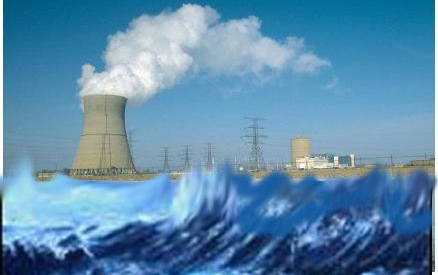 BANNG 2nd Jan 2020, It may appear that all has been quiet on the eastern front in the recent past but CGN seems intent on carrying out its plans to build Bradwell B and is continuing with its site investigations. 2020 will be an important, probably crucial, year in terms of whether plans for new nuclear power plants move forward. The Bradwell B Generic Design Assessment (GDA) will be at its peak. EDF will apply for Development Consent (DCO) for Sizewell C.
We anticipate there will be a big push by the new Government and the
nuclear industry for new nuclear development. And Bradwell B will be slowly
approaching its pre-application stage, which could begin within the next
two years.
growing and BANNG will need all supporters to play a part.
erosion.
The rise and rise of global offshore wind capacity
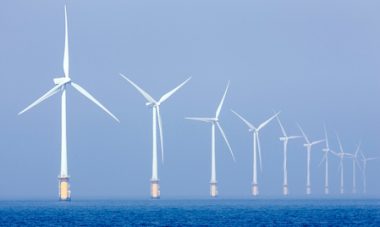
Renew Extra 4th Jan 2020, Dave Elliott: The International Energy Agency says global offshore wind capacity may increase 15-fold and attract around $1 trillion of cumulative investment by 2040, driven by falling costs, supportive government policies and some remarkable technological progress, such as larger turbines and floating foundations.
https://renewextraweekly.blogspot.com/2020/01/offshore-wind-and-pv-will-be-big-says.html
Egypt’s solar energy success
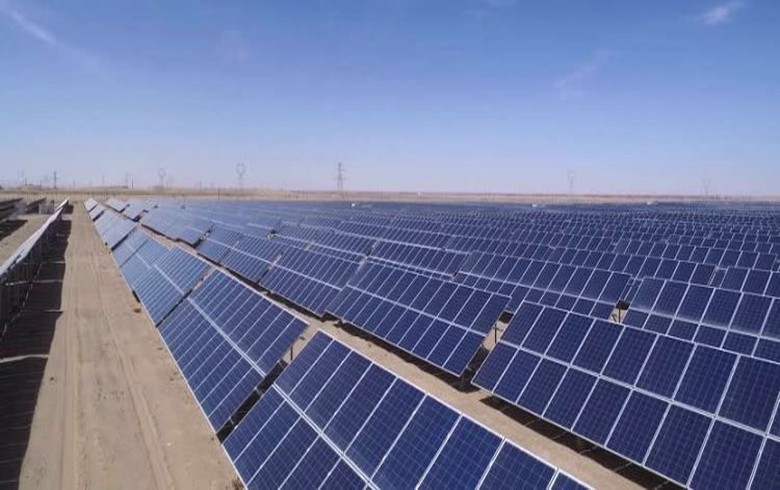
Reuters 17th Dec 2019, Near the southern Egyptian city of Aswan, a swathe of photovoltaic solarpanels spreads over an area of desert so large it is clearly visible from space. Designed to anchor a renewable energy sector by attracting foreign and domestic private-sector developers and financial backers, the plant now provides nearly 1.5 GW to Egypt’s national grid and has brought down the price of solar energy at a time when the government is phasing out electricity subsidies.
Suleimani’s Gone, and the Iran Nuclear Deal May Be Next
Suleimani’s Gone, and the Iran Nuclear Deal May Be Next
Europe fears that its faltering efforts to preserve the 2015 pact have been dealt a fatal blow with the United States’ killing of a top Iranian commander. NYT, By Steven Erlanger, Jan. 3, 2020
-
- BRUSSELS — How Iran will respond to the American assassination of Maj. Gen. Qassim Suleimani remains a matter of speculation, but one outcome seems almost certain: the end of Europe’s long effort to keep the 2015 Iranian nuclear deal alive.
In interviews on Friday, European analysts envisioned a number of baleful results from the killing of the general, who was a national hero and potential political leader in Iran, and whose death Tehran has vowed to avenge.
Among those were the downgrading of diplomacy, the destabilization of Iraq and the further strengthening of Iran’s hard-liners and the Islamic Revolutionary Guards Corps.
Prime Minister Netanyahu almost blew the secret of Israel’s nuclear arsenal
|
In momentary slip, Netanyahu breaks Israel’s nuclear ambiguity Hailing gas pipeline deal, PM trips up in calling Jewish state a ‘nuclear power,’ but quickly clarifies, Times of Israel, By TOI STAFF, 5 Jan 2020 Prime Minister Benjamin Netanyahu on Sunday called Israel a “nuclear power” before correcting himself mid-word to say “energy power.” The premier’s comment came during the weekly cabinet meeting as he briefed ministers about the deal signed Thursday between Israel, Greece and Cyprus on Thursday for a huge pipeline project to ship gas from the eastern Mediterranean to Europe. Israel has never acknowledged possessing nuclear weapons, instead maintaining a policy of “strategic ambiguity.” Foreign reports have put the size of Israel’s nuclear arsenal in the dozens to hundreds of weapons…….. https://www.timesofisrael.com/in-momentary-slip-netanyahu-breaks-israels-nuclear-ambiguity |
|
Chris Hedges: War With Iran — Rise Up Times

“A war with Iran would see it use its Chinese-supplied anti-ship missiles, mines and coastal artillery to shut down the Strait of Hormuz, which is the corridor for 20% of the world’s oil supply. Oil prices would double, perhaps triple, devastating the global economy.”
An assassination, uranium and the fate of a country — Beyond Nuclear International

Congo’s exploitation to fuel nuclear weapons
via An assassination, uranium and the fate of a country — Beyond Nuclear International
Nuclear colonialism — Beyond Nuclear International

Country’s nuclear waste could be dumped in New Mexico
January 5 Energy News — geoharvey

Opinion: ¶ “Ten Cool Solar Power Stories You May Have Missed” • Too much cleantech news is a good thing, but it sometimes means I need to stuff a bunch of big stories into one article. Here’s a roundup of some cleantech stories no one wanted to take and write full pieces about. This particular […]
UK’s Sizewell C nuclear project not viable, due to escalating costs?

Could escalating costs mean ‘game over’ for nuclear power and Sizewell C? East Anglian Daily Times, January 2020, Andrew Hirst
The growing cost of nuclear power could mean ‘game over’ for Sizewell C, experts claim. While much of the debate in Suffolk around EDF Energy’s proposals have focussed on the local impacts, recent reports from energy forums have started to question how viable the industry is for the UK – and globally.
At a recent debate, Paul Dorfman of the University College London’s Energy Institute went head to head with Paul Spence, director of strategy and corporate affairs at EDF to discuss the future of the sector.
Dr Dorfman, who also founded the Nuclear Consulting Forum, said the “massive cost escalations” of nuclear power together with the increasing competiveness of renewables meant there was “little rationale for new nuclear builds”.
Costs for offshore wind have plummeted to around £40 per MWh – making it now one of the cheapest forms of power available.
Meanwhile, the costs government agreed to pay EDF for Hinkley Point C, is more than twice as expensive at £92.50 per MWh.
The latest World Nuclear Industry Status Report warned of “substantial challenges” and a decline in usage, with fewer reactors in operation today than 30 years ago.
Globally, while investment in renewables has increased to around $350bn per year, nuclear fell to just $17bn. Dr Dorfman said: “In this context, nuclear power at the expense of more flexible, safe, productive, cost-effective and affordable technologies really does seem to be rather foolish.”
He said it could mean “game over” for nuclear projects, including Sizewell…….
The government consulted earlier this year on the “Regulated Asset Base model”, which is intended to incentivise private investment in public projects by guaranteeing a return for developers. It would mean developers can raise revenue, potentially though customer bills, and reduces their risk. ……
although EDF claims RAB could save money for consumers – critics say it merely leaves the public with all the risk.
“Under RAB, the plan is for the burden of risk to pass to hard-pressed UK consumers and/or taxpayers labouring under post-Brexit conditions,” said Dr Dorfman.
“Not only that, but the revenue stream will include a variable strike price – with taxpayers and/or electricity consumers forced to write, what is essentially, a ‘blank cheque’.
Earlier this year it was reported a “Sizewell surcharge” could add £6 to annual energy bills under the RAB model. A petition opposing the surcharge was signed by more than 36,000 people.
Concerns were further compounded by EDF’s precarious financial position. The company is €37.4billion net debt and its stock lost 34% of its value this year.
Professor Steve Thomas, a researcher in energy policy at the University of Greenwich, questioned the company’s credentials ahead of a seminar organised by the Nuclear Free Local Authorities in Colchester last month.
“EDF is in deep financial crisis and will only be able to survive with heavy French government support and radical restructuring,” he said. “It is unclear how EDF will be able to finance Hinkley Point C, much less Sizewell C, and the UK government must resist pressures to throw more public money at these ill-conceived projects and abandon them now.”
Environmental and technical worries, as Russia extends the life of old Kola Nuclear Power Plant
One of Russia’s oldest nuclear reactors set to run until 2034 https://bellona.org/news/nuclear-issues/2020-01-one-of-russias-oldest-nuclear-reactors-set-to-run-until-2034
The second reactor unit at the Kola Nuclear Power plant near Murmansk has received the nod from Russian regulators to operate until 2034, making it one of the longest running commercial reactors in the world and raising a host of environmental and technical concerns. January 2, 2020 by Charles Digges
The second reactor unit at the Kola Nuclear Power plant near Murmansk has received the nod from Russian regulators to operate until 2034, making it one of the longest running commercial reactors in the world and raising a host of environmental and technical concerns.
Currently, the longest serving reactor ever is the Oyster Creek Nuclear Generating Station in the United States, which, after running for 49 years, was finally shut down in 2018. Should the Kola plant’s No 2 reactor run out the term of its new lifetime extension, it would be 59 by the time it is retired.
Kola’s No 2 reactor, which came online in 1975, is not alone. The plant’s other three units, which are all VVER-440 reactors, are likewise operating on sometimes numerous lifetime extensions that would bring them to ripe old age before their operations are stopped. The No 1 reactor at the Kola plant, which started generating power 1973, was granted a second runtime extension two years ago, and won’t retire until 2033. The No 3 and No 4 reactors – which came online in the early 1980s – will operate until 2027 and 2029, respectively.
The prolonged operations of these reactors has been cause for concern among some experts, who say that bringing the units into step with current industry safety demands is difficult, given their aging design.
n the shadow of the 2011 Fukushima disaster, which resulted in a triple reactor meltdown, worldwide nuclear building standards have tightened across the board in ways that some fear have left the Kola Nuclear Power Plant’s reactors behind.
Yet more and more often, extending runtime extensions is becoming a general practice throughout the nuclear industry – and not only in Russia. Throughout central and western Europe, there are some 90 nuclear reactors that are currently under review for lifespan extensions, including many in countries like France, the United Kingdom, the Netherlands, Switzerland and Finland. Six of the 15 Soviet-built nuclear reactors in Ukraine are operating on extended lifespans, with the remaining expected to follow.
For its part, Germany has elected altogether to shutter its nuclear power plants – a goal it hopes to reach by 2022. But the move is proving politically and technically complex. The waste resulting from the closures – thought to eventually comprise some 2,000 containers – must be stored in safely the same spot for 1 million years, and experts are short on ideas about where, exactly, to do that. The costs, too, are astronomical, with the phase-out expected to reach nearly $73 billion.
t is expenses like these that are so deviling to Russia’s nuclear industry, which has failed to build up a robust savings account for decommissioning expenses. Like other countries, Russia collects decommissioning funding through electricity tariffs charged to customers. But unlike other countries, Russia has only been doing this since 1995, shortly after the fall of the Soviet regime and the introduction of a market-based economy. As a result, issuing lifetime extension to elderly reactors offers Moscow a cheap – and what many countries consider a safe – alternative to the more costly route of dismantlement.
Still, environmentalists are right to be nervous. Scientific research on how nuclear reactors age – and on the kinds of problems that emerge as they do – has come mostly from studies in research reactors. While these studies have offered some insight on how reactors weather over time, many experts say that the data on how commercial reactors behave in their twilight years are still too inconclusive to be trusted.
But Rosatom officials insist that the extended reactors at the Kola Nuclear Power Plant are safe, and offers figures to back up its claims. According to a report in the Barents Observer, the corporation spent some 4.5 billion rubles – or about $72 million – on upgrades to the No 2 reactor before regulatory officials granted the runtime extension. Plant officials likewise eliminated numerous safety violations and are in the process of eliminating them.
Tennessee Valley Authority unfairly fired a nuclear whistleblower
|
Labor department rules TVA cooked up cause to fire nuclear whistleblower, Jamie Satterfield, Knoxville News Sentinel Jan. 3, 2020 The U.S. Department of Labor says the Tennessee Valley Authority fired a nuclear engineer who blew the whistle on safety concerns and lied about it.The labor department is ordering TVA to give Beth Wetzel her job back and shell out more than $200,000 in back pay, lost bonuses and benefits, compensatory damages and legal fees.
TVA said it fired Wetzel for badmouthing supervisor Erin Henderson, but the labor department ruled Wetzel properly raised safety concerns about the nuclear program and – when asked by a TVA attorney – gave her “honest” opinion Henderson was too inexperienced for her post and ignored safety complaints…….. https://www.knoxnews.com/story/news/crime/2020/01/03/labor-department-tva-cooked-up-cause-fire-nuclear-whistleblower/2794793001/ |
|
|
The escalation of nuclear tension between USA and Iran
Timeline: How tensions escalated with Iran since Trump withdrew US from nuclear deal
President Trump’s decision to leave the 2015 nuclear deal with Iran was followed by an escalation of rhetoric, sanctions and attacks between the countries. George Petras, Jim Sergent, Janet Loehrke, Karl Gelles and Javier Zarracina, USA TODAY, 3 Jan 2020,
July 25, 2015
Iran, the United States and other nations approve a deal in which Iran agrees to shift its nuclear program from weapons production to peaceful commercial use for 10 years. Iran allows international inspectors on its nuclear weapons sites.
In exchange, the United States and the United Nations Security Council lift energy, trade, technology and financial sanctions against Iran.
The pact, established during the tenure of President Barack Obama, is an executive agreement, not a treaty, which means it isn’t formally approved by Congress. Republicans oppose the deal and question its legality.
Leaving the deal
October 2016
Presidential candidate Donald Trump says Iran should write the United States a thank you letter for “the stupidest deal of all time.” Trump says the United States will withdraw from the deal if he’s elected.
May 8, 2018
President Trump announces the withdrawal from the Iran deal. Iran, France, Britain and Germany say they will stay in the pact.
US increases pressure
August-November 2018
The United States reimposes economic sanctions targeting Iran’s energy, financial, shipping and shipbuilding industries. Iran says it will take unspecified actions regarding the nuclear deal if Britain, France, Germany, Russia and China don’t help it engage in international trade.
April 8, 2019
Trump says he will designate Iran’s Islamic Revolutionary Guards as a foreign terrorist organization. The Pentagon opposes the change, saying it increases the possibility of retaliation against American military and intelligence personnel.
April 22
May 5
John Bolton, Trump’s national security adviser, says the United States will send an aircraft carrier strike force and Air Force bombers to the Middle East. The deployment shows Iran that “any attack on United States interests or on those of our allies will be met with unrelenting force.”
Iran retaliates
May 8
Iran says it will increase its production of enriched uranium and heavy water.
May 12
Four oil tankers – two from Saudi Arabia, one from the United Arab Emirates and one from Norway – are attacked in the Persian Gulf. The United States says Iran is behind the attacks.
June 13
Two oil tankers – one from Norway, the other from Japan – are attacked in the Gulf of Oman. The United States blames Iran, which denies responsibility.
June 20
Iran shoots down a U.S. surveillance drone it says violated Iranian airspace. The U.S. Central Command says the aircraft was in international territory.
June 20
Trump orders retaliatory attacks against Iran but cancels the strikes shortly before they are to be launched. Four days later, he imposes more sanctions against Iran.
July 1
Iran says it’s exceeded the amount of low-enriched uranium it was allowed to build under the 2015 agreement.
US-Iranian tensions rise………
Jan. 2 2020
Iranian military leader Qasem Soleimani and five others are killed in a U.S. drone strike at Baghdad airport. U.S. officials call it a “defensive action,” saying Soleimani planned attacks on U.S. diplomats and troops. https://www.usatoday.com/in-depth/news/2020/01/03/us-iran-conflict-since-nuclear-deal/2803223001/
Nuclear’s ‘safe and green’ image is the industry’s devious hoax
 Nuclear’s ‘safe and green’ image is the industry’s devious hoax, https://www.barnstablepatriot.com/opinion/20200103/nuclears-safe-and-green-image-is-industrys-devious-hoax Dana Franchitto, South Wellfleet, Jack Edmonston is hardly alone in embracing the nuclear industry’s hoax that such energy is a “safe and green” fossil fuel alternative (“Climate change is scarier than nuclear power,” My View, Dec. 28).Writing in a 2008 issue of Extra, a publication of the watchdog group Fairness and Accuracy in Reporting, journalism professor Karl Grossman reveals the links among the media, the government and the industry. For example, nuclear plant manufacturer General Electric owned NBC until 2013, while Westinghouse for years owned CBS. The New York Times systemically promotes nuclear energy. And “liberal,” “independent” National Public Radio “has received hundreds of thousands of dollars from nuclear operator Sempra Energy and Constellation Energy,” according to Grossman. Nuclear’s ‘safe and green’ image is the industry’s devious hoax, https://www.barnstablepatriot.com/opinion/20200103/nuclears-safe-and-green-image-is-industrys-devious-hoax Dana Franchitto, South Wellfleet, Jack Edmonston is hardly alone in embracing the nuclear industry’s hoax that such energy is a “safe and green” fossil fuel alternative (“Climate change is scarier than nuclear power,” My View, Dec. 28).Writing in a 2008 issue of Extra, a publication of the watchdog group Fairness and Accuracy in Reporting, journalism professor Karl Grossman reveals the links among the media, the government and the industry. For example, nuclear plant manufacturer General Electric owned NBC until 2013, while Westinghouse for years owned CBS. The New York Times systemically promotes nuclear energy. And “liberal,” “independent” National Public Radio “has received hundreds of thousands of dollars from nuclear operator Sempra Energy and Constellation Energy,” according to Grossman.
The lie, lately gaining momentum, is that nuclear energy is carbon-free. Not so. True, up-and-running plants emit no greenhouse gases. However, what the Nuclear Energy Institute and its puppet, the Nuclear Regulatory Commission, fail to mention is that the nuclear fuel cycle, from uranium mining and milling to enrichment, fuel fabrication and disposal of radioactive waste are greenhouse gas-intensive, according to Michel Lee, chairwoman of the Council of Intelligent Energy and Conservation Policy. She adds that nuclear power “is actually a chain of highly energy-intensive industrial processes.” Sobering in light of an MIT study postulating the construction of 1,500 new plants in the coming years. Grossman nailed it: “The only thing green about nuclear power is the nuclear establishment’s dollars.”
|
|
1 This Month
26 April – Chernobyl: Inside the Meltdown airs on National Geographic on Sunday 26th April from 4pm

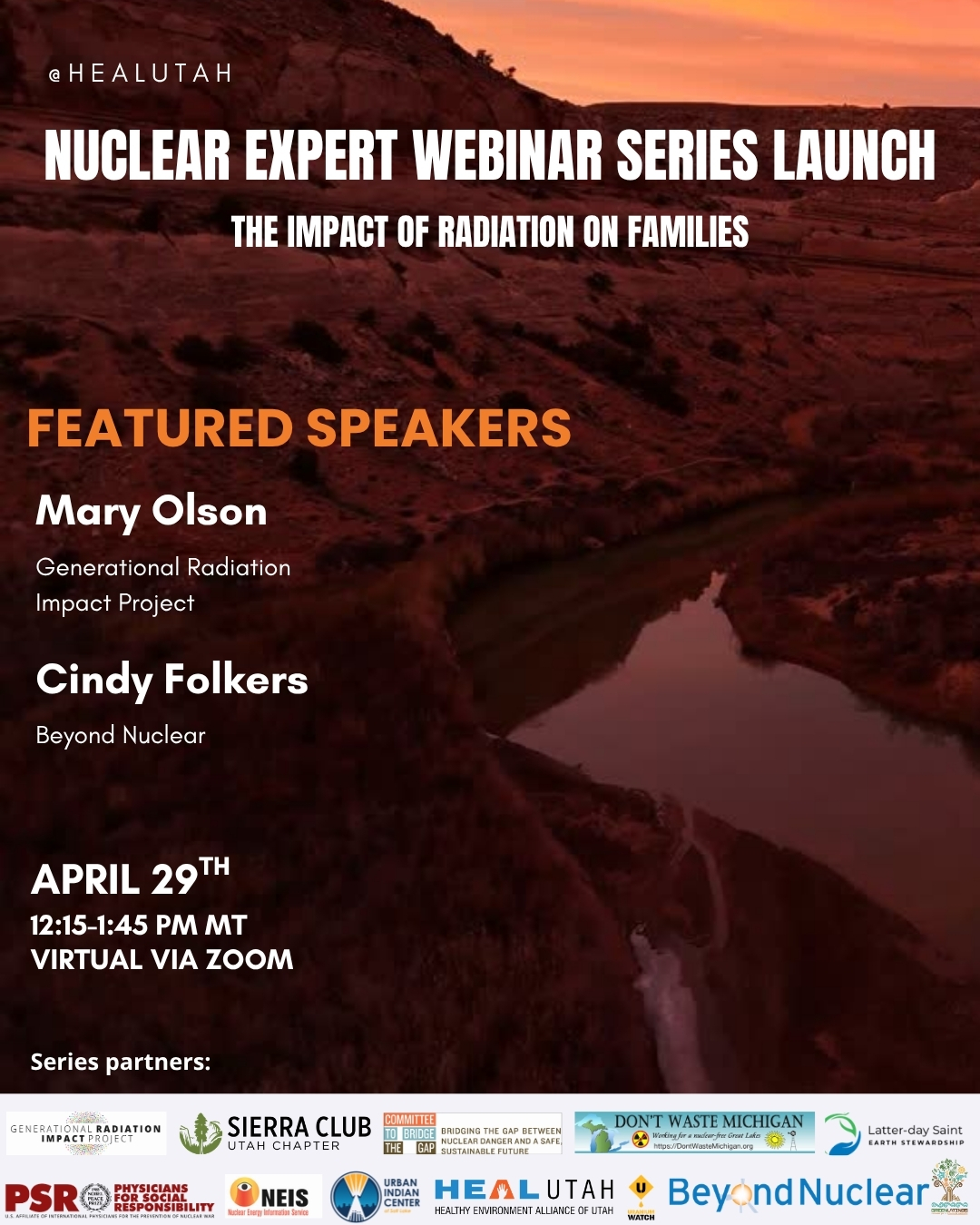
29 April – Nuclear Expert Webinar #1 – Radiation Impacts on Families with Mary Olson and Cindy Folkers
- 12:15 PM MT – 1:45 PM MT
- Location: Virtual – REGISTER TODAY

4 May -West Suburban Peace Coalition to discuss Iran war at May Educational Forum
Monday, May 4, 7:00 – 8:00 PM Central Standard Time
Title: : How Trump’s Narrative Tries to Shape the Reality of the War on Iran.
Contact Walt Zlotow, zlotow@hotmail.com 630 442 3045 for further information
14 May – online event From Bombs to Data Centres: the Face of Nuclear Colonialism

Pine Ridge Uranium is the real threat, not Tehran- Tell Burgum: Stop the Extraction.
Chernobyl: The Lost Tapes – A good documentary on Chernobyl on SBS available On Demand for the next 3 weeks– https://www.sbs.com.au/ondemand/tv-program/chernobyl-the-lost-tapes/2352741955560
To see nuclear-related stories in greater depth and intensity – go to https://nuclearinformation.wordpress.com
-
Archives
- April 2026 (317)
- March 2026 (251)
- February 2026 (268)
- January 2026 (308)
- December 2025 (358)
- November 2025 (359)
- October 2025 (376)
- September 2025 (257)
- August 2025 (319)
- July 2025 (230)
- June 2025 (348)
- May 2025 (261)
-
Categories
- 1
- 1 NUCLEAR ISSUES
- business and costs
- climate change
- culture and arts
- ENERGY
- environment
- health
- history
- indigenous issues
- Legal
- marketing of nuclear
- media
- opposition to nuclear
- PERSONAL STORIES
- politics
- politics international
- Religion and ethics
- safety
- secrets,lies and civil liberties
- spinbuster
- technology
- Uranium
- wastes
- weapons and war
- Women
- 2 WORLD
- ACTION
- AFRICA
- Atrocities
- AUSTRALIA
- Christina's notes
- Christina's themes
- culture and arts
- Events
- Fuk 2022
- Fuk 2023
- Fukushima 2017
- Fukushima 2018
- fukushima 2019
- Fukushima 2020
- Fukushima 2021
- general
- global warming
- Humour (God we need it)
- Nuclear
- RARE EARTHS
- Reference
- resources – print
- Resources -audiovicual
- Weekly Newsletter
- World
- World Nuclear
- YouTube
-
RSS
Entries RSS
Comments RSS
 nuclear-news