Tonight’s debate: Nuclear weapons policy and the US presidential election

|

View original post 666 more words
Is climate heating becoming irreversible?
 I started this website many years ago, because I was appalled at the lies promoting nuclear power – lies that minimised the horror of nuclear weapons, nuclear accidents, and the radioactive legacy that we are passing on to our grandchildren and beyond.
Well – those lies are still being spread, by writers paid by the nuclear industry.
A big one is the story that nuclear will beat climate change. (the irony of it – as it’s the other way around).
Nuclear is irrelevant to climate change, except for taking funding from real solutions.
But – my dilemma now is that climate change is the biggie, because it is sure close to irreversible. (Theoretically, nuclear could be stopped, now)
Perhaps it’s because I am Australian, that I am feeling this problem so acutely right now. Yes, nuclear is still a horror threat, and still must be covered.
But – omigawd! Greta Thunberg is so right! Surely we all know this, in our hearts. We must all act on climate change.
The oceans are getting hot

 Oceans are as hot as humans have known them and we’re to blame. We must use energy more wisely going forward and trust in the actions of our youth, https://www.theguardian.com/environment/climate-consensus-97-per-cent/2020/jan/13/oceans-are-as-hot-as-humans-have-known-them-and-were-to-blame [excellent graph] John Abraham Tue 14 Jan 2020 Oceans are as hot as humans have known them and we’re to blame. We must use energy more wisely going forward and trust in the actions of our youth, https://www.theguardian.com/environment/climate-consensus-97-per-cent/2020/jan/13/oceans-are-as-hot-as-humans-have-known-them-and-were-to-blame [excellent graph] John Abraham Tue 14 Jan 2020 Each year, unfathomable amounts of energy are added to the oceans. Scientists measure heat in joules; the amount of heat in the oceans is so large that we report it in zettajoules. What is a zettajoule? It is 1,000,000,000,000,000,000,000 joules. The amount of heat we are putting into the oceans is equivalent to about five Hiroshima atom bombs of energy every second.
I am part of the team of researchers that published a paper on ocean warming that shows the total heat of Earth is increasing with global heating, as scientists have predicted for decades. Each year, we take Earth’s temperature to try to determine what is happening to our climate. Each year the news is worse than the year before. There is hope, which I will discuss later. But first, let’s talk about the new study. As humans emit heat-trapping gases into the atmosphere, it creates an energy imbalance. There is more heat coming in than going out. That means the Earth is out of balance, and temperatures are rising. The vast majority of the excess energy – more than 90% – ends up in the oceans. Consequently, ocean temperatures are rising, and we can measure it. Global warming is really ocean warming, and it has severe consequences. First, it makes ocean levels rise, because warming water expands. Scientists estimate that by the year 2100, oceans will be about 3ft higher than they were in the year 2000, displacing 150 million people around the world. Warmer oceans also make our weather more extreme. They supercharge typhoons and hurricanes. They make rains more deadly and flooding more severe. The rising temperatures are also threatening sea life. We are experiencing major die-offs of coral reefs, which are incredibly important to ocean biodiversity. Rising ocean water is not just a problem for fish and sea life, it is a problem for everyone. The leader of our team, Dr Lijing Cheng, developed an innovative way to measure ocean temperatures. We only get data where we place temperature sensors, and sophisticated mathematics are used to fill in the gaps and create a continuous picture of what is happening. His method of filling in the data gaps has been shown to be very accurate and scientists around the world have adopted the techniques. Often when scientists report climate data, they try to show trends. It isn’t so important what the ocean temperatures were last year or what they will be this year. What really matters is the trend: are the oceans getting hotter or colder? Using the late 1990s as a reference, we see that years prior are colder and years after are warmer. In fact, we see that the oceans have warmed continuously since about 1990. This long-term trend is what climate breakdown looks like, and it is terrible news for the future of the planet. All reasonable people know that the climate is warming and humans are the cause. Sometimes, I am asked for proof of warming, and there are many things I can point to: ice is melting, air temperatures are increasing, sea levels are rising, etc. But the best proof of warming is in the oceans. No one can dispute the data. The oceans are unequivocally warming. So, what do we do about it? Well, we can begin to use energy more wisely. This will not only help with the climate crisis but save money as well. Secondly, we can maximise our energy from renewable sources such as wind, water, and solar. One of the things that gives me hope is that energy from solar and wind power is now cheaper than dirty coal. The benefits of solar and wind depend, of course, on how sunny or windy the conditions are, but with the drop in green energy prices, it no longer makes economic sense to build coal plants. Another bit of hope is represented by the growing actions of our youth. Make no mistake, the Greta Thunbergs of the world will change things in ways that privileged middle-aged white men like me cannot. Their generation will inherit a dire situation, but they have the passion to act, and decades of unarguable evidence that they must. So yes, 2019 set yet another dire record for Earth’s climate. But the fight continues to make the future more habitable for our children and their children.
|
|
Significant drop in France’s nuclear energy production
 Reuters 10th Jan 2020, EDF’s French nuclear power generation fell by a more than expected 3.5 percent last year, the state-owned utility said on Friday. The French company’s domestic nuclear output power dropped to 379.5 terawatt hours (TWh), missing a revised production target of between 384 TWh and 388 TWh.
power output tumbling in the final month of 2019 by 15.2% to 33 TWh. The
operator of France’s 58 nuclear reactors, covering about 75% of the
country’s electricity needs, had revised its 2019 nuclear production
target from 390 TWh to between 384 TWh and 388 TWh in November because of reactor maintenance and safety checks after an earthquake.
Britons want real action on climate change, but Boris Johnson’s govt missing in action on this
  UK Energy Policy, Independent 12th Jan 2020 UK Energy Policy, Independent 12th Jan 2020Boris Johnson was today facing calls to step up action on global warming, after a poll for The Independent found overwhelming support for radical change to end the UK’s net carbon emissions by the end of the decade. Some 70 per cent of those questioned by pollsters BMG said they supported the target of net-zero emissions by 2030, with only 7 per cent opposing it. And support for swift action over the next 10 years was high across all age ranges, social groups and parts of the country, countering perceptions of a generational or urban/rural split on the climate emergency. Independent 8th Jan 2020, Ministers are under fire after revealing their strategy to achieve net-zero carbon emissions by 2050 will not be released until the end of the year. It means the plans – which will require huge and potentially unpopular changes to transport, energy and agriculture – will only emerge more than a year after the legal commitment was made. “If this is true, it doesn’t really smack of a government treating this issue as a climate emergency,” said Clive Lewis, Labour’s Treasury spokesman and a
leadership candidate. And Wera Hobhouse, the Liberal Democrat climate emergency spokesperson, pointing to the wildfire crisis in Australia, said: “While the world is waking up to the dangers of climate change, this Tory government is still on holiday. |
|
Britain’s Sizewell nuclear project in jeopardy, as EDF struggles to get funding
 Sizewell, Times 13th Jan 2020, EDF is in a race against time to secure a funding deal for its proposed nuclear power station in Suffolk as delays risk making the project prohibitively expensive. The French energy giant has hired Rothschild as financial adviser for the Sizewell C project and says it wants a “definitive way forward” from the government this year so it can start construction in 2022. The company building the £22 billion Hinkley Point C plant in Somerset has promised it can significantly reduce the cost of the sister plant in Suffolk, including by transferring workers and equipment Sizewell, Times 13th Jan 2020, EDF is in a race against time to secure a funding deal for its proposed nuclear power station in Suffolk as delays risk making the project prohibitively expensive. The French energy giant has hired Rothschild as financial adviser for the Sizewell C project and says it wants a “definitive way forward” from the government this year so it can start construction in 2022. The company building the £22 billion Hinkley Point C plant in Somerset has promised it can significantly reduce the cost of the sister plant in Suffolk, including by transferring workers and equipmentbetween the two. Delays to funding that result in a hiatus between the
projects would erode such savings and jeopardise Sizewell, which the government has said must be cheaper than Hinkley. A senior executive at Sizewell recently admitted that if funding proposals ended up “outside an acceptable price range for the government, then the project probably won’t go ahead — it’s as simple as that”.
EDF has proposed an alternative, funding model for Sizewell C, under which consumers would pay for the project while it is still under construction. This would cut borrowing costs but also put consumers on the hook for cost overruns.
The government ran a consultation last year on adopting the model but is yet to give its verdict. An EDF spokeswoman said: “We hope to see a way forward on nuclear financing in 2020 ahead of COP26 [the Glasgow climate change summit]. This would ensure we can maximise the benefits of replicating the design of Hinkley Point C at Sizewell C.”
|
Letter from Canberra: The apocalyptic fires in Australia signal another future — RenewEconomy

It’s impossible to suppress an incipient rage against the political leaders and coal lobbyists who have only pretended to take the scientific warnings seriously, or dismissed them as fantasies. The post Letter from Canberra: The apocalyptic fires in Australia signal another future appeared first on RenewEconomy.
via Letter from Canberra: The apocalyptic fires in Australia signal another future — RenewEconomy
Bottled Water Use – Many West Cumbrians frightened to drink the tap water —

The Guardian reports in the news on Friday – Harrogate Spring Water plans expansion threatening woodlands. Why are so many people drinking bottled water? In West Cumbria there is a reason. People are frightened to drink the tap water for fear of it making them ill – this is not hysteria – it is being […]
via Bottled Water Use – Many West Cumbrians frightened to drink the tap water —
January 13 Energy News — geoharvey

Science and Technology: ¶ “Can solar geoengineering mitigate both climate change and income inequality?” • Research from the University of California San Diego finds that solar geoengineering – the intentional reflection of sunlight away from the Earth’s surface – may reduce income inequality between countries. The study was published in Nature Communications. [EurekAlert] World: ¶ “EIB […]
The fallout from a false nuclear alarm
Associate Professor of Disaster and Emergency Management, York University, CanadaJanuary 14, 2020 On Sunday at 7:23 a.m., residents of the Greater Toronto Area were abruptly awakened by an alert issued by Ontario’s Emergency Alert Ready System stating: “An incident was reported at the Pickering Nuclear Generating Station. There has been NO abnormal release of radioactivity from the station and emergency staff are responding to the situation.”At 8:06 a.m., the Ontario Power Generation released a statement that the alert was issued in error and that there was no danger to the public or the environment. At 9:11 a.m., another message from the Provincial Alert Ready System stated that the initial nuclear alert was “in error.”………..
Other false nuclear alerts This false alarm is not the first time that a nuclear-related alert has been issued during in error during an exercise. In January 2018, an alert was issued in Hawaii warning of an impending ballistic missile attack. Thirty-eight minutes later, the alert was rescinded as a false alarm.
In the Hawaii case, similar to what happened in Ontario on January 12, a public alert was accidentally issued during a routine internal test of the Emergency Alert System. The Hawaii Emergency Management Agency released a statement that the false alert was due to human error.
Jeopardizing trust
Within hours of the false nuclear alarm, the office of Ontario’s Solicitor General released a statement of apology and said a full investigation has been launched into the error made during the routine training exercise. Those initial actions are only the first steps in attempting to repair the damage.
If we take the incident in Hawaii as a guide, the fallout was far-reaching. In the immediate term, all upcoming emergency drills and exercises were suspended. Changes were put in place, such as a two-person verification rule along with a new cancellation command system for public alerts. As the false alarm became a scandal, state-level emergency management officials resigned. Human error and poor software design were identified as root causes, and investigations suggested revamping the system, specifically in terms of oversight of the Integrated Public Alert & Warning System in the United States.
The bottom line is that a false alarm for an incident at a nuclear power station erodes public safety efforts. Fortunately, the risks realized from the Ontario emergency alert were not related to actual radioactive fallout. The fallout from the false alarm is that the public’s trust in emergency alert systems was jeopardized. https://theconversation.com/the-fallout-from-a-false-nuclear-alarm-129766
Nuclear/climate news this week
After days of denial from Iran, President Rouhani on Saturday admitted to “human error” in bringing down the Boeing 737, and the Guards’ aerospace commander General Amirali Hajizadeh accepted full responsibility. Rouhani agreed with Qatar and Pakistani leaders on de-escalation and dialogue as ‘only solution’ to solve the crisis with US. As Europe tries to preserve the Iran nuclear deal, Donald Trump is currently a bigger headache for Europe than Iran is.
The global importance of Australia’s bushfires – climate impacts wildfires, and wildfires impact climate. The concentration of climate-heating greenhouse gases is at a record high. Nations are not meeting their already inadequate climate commitments, and if Trump is re-elected in 2020, America will continue to lead the way in sabotage of action on climate.
A bit of good news – Fukushima Japan Vows to Achieve 100% Renewable Energy Use in 20 Years.
- ‘Error of judgement’: UK police recall guide which listed Extinction Rebellion among extremist groups.
- UK nuclear weapons programme £1.3bn over budget.
- Jeremy Corbyn was smeared for rejecting the use of nuclear weapons – but he was right. UK Leading Labour leadership candidate Rebecca Long-Bailey would use nuclear weapons.
- UK’s planned Sizewell power station likely to become a ‘nuclear island’.
- UK’s competition watchdog to investigate Jacobs’ acquisition of Wood Nuclear Limited.
Despite USA, the European Union is determined to preserve the Iran nuclear deal
 EU willing to maintain Iran nuclear deal, risking rift with the US, By Alexandra Brzozowski | EURACTIV.com 11 Jan 2020, With the prospects of a potential US-Iran war fading, EU foreign minister during an emergency session on Friday (10 January), said they are willing to maintain the Iran nuclear deal as long as Tehran fulfils its commitments in order to achieve it.
In an attempt to avoid an escalation between Iran and the US, EU leaders in the recent week have intensified diplomatic activities, trying to salvage the EU-brokered nuclear deal while making sure the US-led anti-IS coalition continues to operate in Iraq after Iraq’s parliament called for the withdrawal of all foreign troops from the country.
“The region cannot afford another war, we call for an urgent de-escalation and maximum restraint,” EU’s chief diplomat Josep Borrell told reporters following the meeting in Brussels on Friday, that had reaffirmed European commitments preserving the Joint Comprehensive Plan Of Action (JCPOA).
“We have been saying in the past and we continue to say that we regret the US decision to withdraw from the deal,” Borrell said, “And we continue believing that this deal is a key element of the global nuclear non-proliferation architecture and critical for the regional stability.”
He also warned that negotiating a new pact would be a “very complex, highly technical process” that would take a long time………
Since the Trump administration decided to exit the deal in 2018, all three European parties to the pact – Britain, France and Germany – have repeatedly stressed their commitment to saving it, even after a call by Trump this week urging them to join him in walking away.
One of the contentious points between Europe and Washington has been the Instrument in Support of Trade Exchanges (INSTEX), which was born as the brainchild of France, Germany and the UK in January 2019, and recently joined by further European countries.
It was created as a special purpose vehicle to help EU companies do business with Iran and facilitate non-USD transactions to avoid breaking US sanctions against the country.
European efforts, however, to ensure that Iran can keep trading in spite of the sanctions have had little impact.
The Trump administration on Friday (10 January) imposed new sanctions on Iran, with the latest round set to target multiple sectors of the Islamic Republic’s economy, including construction, manufacturing, textiles and mining…….
U.S. Senate must reaffirm that the power to make war rests with Congress, NOT the President
 The U.S. Public Doesn’t Want War With Iran. The U.S. Public Doesn’t Want War With Iran.  TheSenate Must Reaffirm That. Hassan El-Tayyab, Truthout, January 12, 2020 As early as this coming week, the U.S. Senate may vote on whether to join the House of Representatives in asserting the rightful role of the U.S. Congress in deciding whether the president is authorized to wage war against Iran. TheSenate Must Reaffirm That. Hassan El-Tayyab, Truthout, January 12, 2020 As early as this coming week, the U.S. Senate may vote on whether to join the House of Representatives in asserting the rightful role of the U.S. Congress in deciding whether the president is authorized to wage war against Iran.
It’s not looking likely that the Senate will vote on the same bill passed by a bipartisan majority of 224-194 in the House on Thursday because Republicans leadership may not allow this bill to get out of committee. The passage of that bill, H.Con.Res.83, which was introduced by Rep. Elissa Slotkin, was a critical move by Congress at this moment of escalating tensions, making clear that the House doesn’t want more military aggression against Iran. Senate Republicans should obey the law and bring this up for a vote, as the War Powers Act of 1973 explicitly states that this concurrent resolution is privileged and must be brought to the floor. If not, the Senate will have the chance to vote on Senator Tim Kaine’s Iran War Powers Resolution, S.J.Res.68, regardless. A Symbolic Victory in the House or Something More?The bill passed by the House on Thursday invoked the War Powers Act of 1973 to limit the president’s ability to launch unauthorized war against Iran by forcing him to obtain congressional authorization before taking further military action. Three Republicans voted in favor of the resolution, including Republicans Reps. Matt Gaetz and Francis Rooney of Florida as well as Rep. Thomas Massie of Kentucky. It was less than many supporters of the bill had hoped for, as a similar provision to the FY2020 Defense policy bill had 27 Republicans vote in support, but it was still a significant statement of bipartisanship in support for congressional war powers……….. The Senate Vote AheadNow that the House has spoken out, the question of Iran War Powers goes to the Senate, which is expected to vote on Sen. Kaine’s Iran War Powers Resolution either this week or next. Kaine’s resolution was structured as a joint resolution and will not face the same legal criticisms as Rep. Slotkin’s concurrent resolution, since there is no question that a joint resolution can be enacted into law……… A Momentous Moment While we wait for the Senate to act, it’s important to reflect on the importance of this House vote and this moment. The War Powers Act reaffirms what’s already in Article 1, Section 8 of the Constitution and makes explicitly clear where war powers reside – Congress. The law was passed in 1973, not just as a rebuke to President Nixon for bombing Cambodia in secret and the unpopular Vietnam war, but to also ensure that Congress going forward had a mechanism to force votes and debates on where and when we go to war. It’s a welcome sign to see members reasserting a constitutional power that has been left on the shelf to gather dust for decades without use. The House has made it clear that Trump does not have the authority to attack Iran. The House vote also showed that members of Congress are with the American people, who according to recent polling, overwhelmingly want no war with Iran and a diplomacy-based approach for easing tensions. …….https://truthout.org/articles/the-u-s-public-doesnt-want-war-with-iran-the-senate-must-reaffirm-that/?eType=EmailBlastContent&eId=fb6a8c04-9558-40e1-acbf-c48a6b025c64 |
|
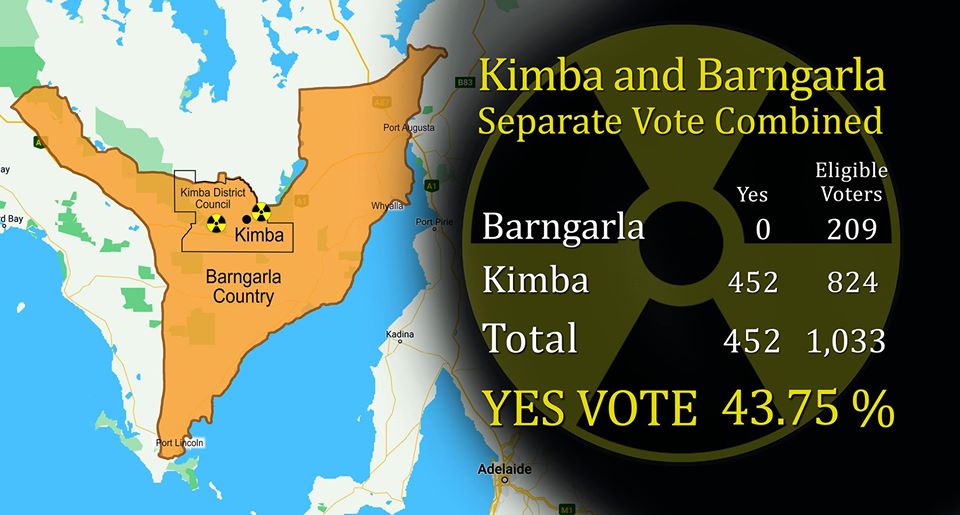
White Kimba, Australia, voted “Yes” to a nuclear waste dump, but the traditional Aboriginal owners held a separate ballot, with a “No” result
“Barngarla Speak Out” : vimeo.com/382855709
“SAVE SA Farmland – Kimba, Eyre Peninsula” : vimeo.com/381938156
U.S. Republican law-maker opposes Canada storing high-level nuclear waste near Lake Huron
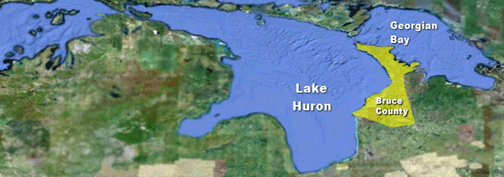
Resolution calls on Canada to nix proposal to bury nuclear waste near the Great Lakes
State Rep. Gary Howell, R-North Branch, has introduced a resolution to prevent the Canadian government from proceeding with the proposed construction of an underground nuclear waste repository on the shores of Lake Huron. Howell serves as chairman of the House Committee on Natural Resources. The Resolution is cosponsored by State Rep. Shane Hernandez, R-Port Huron.
Howell’s House Concurrent Resolution 12 calls on Congress to prevent Canada’s most dangerous nuclear waste from being buried near the shores of Lake Huron. The nuclear waste dump is being proposed by the Ontario Power Generation Company for a site directly across the lake from Michigan’s Thumb.
“It is not in the best interest of the people of the United States or Canada to allow this outrageous proposal to proceed,” Howell said. “This would be high-level nuclear waste from every nuclear plant in Canada. The waste would be placed at Kincardine, Ontario less than a mile from the Lake Huron shore and only 1,300 feet below the lake level – making for a potential catastrophe waiting to happen. We cannot jeopardize the safety of our citizens – especially when the Great Lakes provide drinking water for more than 40 million people.
“This is a high-risk venture that could have long-term devastating effects on millions of lives,” Howell said. “To construct an underground waste repository in limestone, the very first of its kind, would be totally irresponsible. Limestone has never been tested to demonstrate that it will work in practice. The potential damage to the Great Lakes from any leak of radioactivity far outweighs any benefits that could be derived from disposing of radioactive waste at this site.
“The ecology of the Great Lakes is valuable beyond measure to the health and economic well-being of our entire region,” Howell said. “I strongly urge Congress to take every legal action possible to prevent this from happening. Just look at Germany – it is spending billions of dollars right now to dig up low-to-intermediate radioactive waste stored in a salt mine due to a leakage and other environmental concerns. This proposal involves much more serious high-level nuclear waste – the worst of the worst. We don’t need to create these types of problems on the Great Lakes.”
If adopted, House Concurrent Resolution 12 would be sent to the President of the United States, the members of the Michigan congressional delegation, the United States Nuclear Regulatory Commission, and Canadian officials
1 This Month
26 April – Chernobyl: Inside the Meltdown airs on National Geographic on Sunday 26th April from 4pm

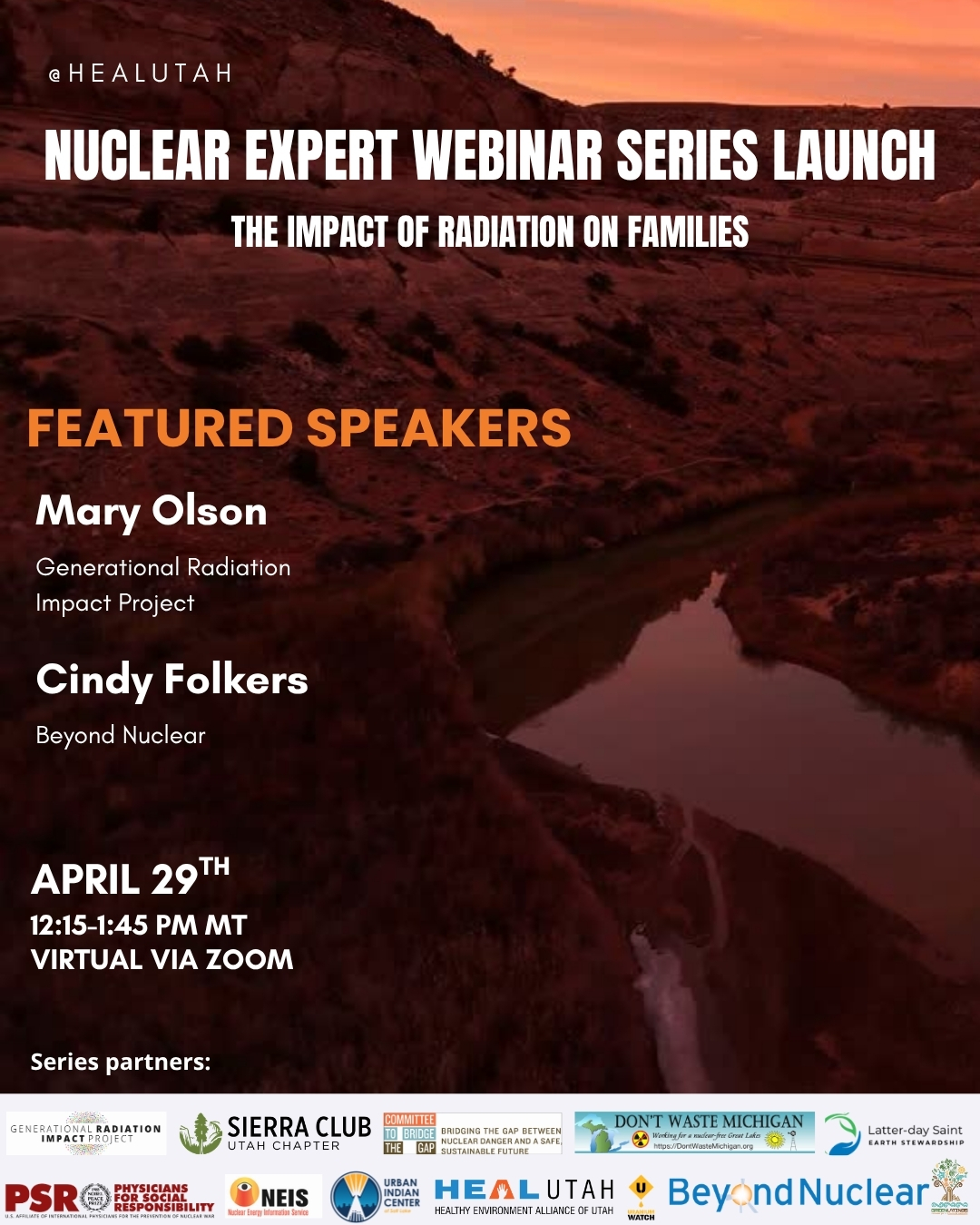
29 April – Nuclear Expert Webinar #1 – Radiation Impacts on Families with Mary Olson and Cindy Folkers
- 12:15 PM MT – 1:45 PM MT
- Location: Virtual – REGISTER TODAY

4 May -West Suburban Peace Coalition to discuss Iran war at May Educational Forum
Monday, May 4, 7:00 – 8:00 PM Central Standard Time
Title: : How Trump’s Narrative Tries to Shape the Reality of the War on Iran.
Contact Walt Zlotow, zlotow@hotmail.com 630 442 3045 for further information
14 May – online event From Bombs to Data Centres: the Face of Nuclear Colonialism

Pine Ridge Uranium is the real threat, not Tehran- Tell Burgum: Stop the Extraction.
Chernobyl: The Lost Tapes – A good documentary on Chernobyl on SBS available On Demand for the next 3 weeks– https://www.sbs.com.au/ondemand/tv-program/chernobyl-the-lost-tapes/2352741955560
To see nuclear-related stories in greater depth and intensity – go to https://nuclearinformation.wordpress.com
-
Archives
- April 2026 (317)
- March 2026 (251)
- February 2026 (268)
- January 2026 (308)
- December 2025 (358)
- November 2025 (359)
- October 2025 (376)
- September 2025 (257)
- August 2025 (319)
- July 2025 (230)
- June 2025 (348)
- May 2025 (261)
-
Categories
- 1
- 1 NUCLEAR ISSUES
- business and costs
- climate change
- culture and arts
- ENERGY
- environment
- health
- history
- indigenous issues
- Legal
- marketing of nuclear
- media
- opposition to nuclear
- PERSONAL STORIES
- politics
- politics international
- Religion and ethics
- safety
- secrets,lies and civil liberties
- spinbuster
- technology
- Uranium
- wastes
- weapons and war
- Women
- 2 WORLD
- ACTION
- AFRICA
- Atrocities
- AUSTRALIA
- Christina's notes
- Christina's themes
- culture and arts
- Events
- Fuk 2022
- Fuk 2023
- Fukushima 2017
- Fukushima 2018
- fukushima 2019
- Fukushima 2020
- Fukushima 2021
- general
- global warming
- Humour (God we need it)
- Nuclear
- RARE EARTHS
- Reference
- resources – print
- Resources -audiovicual
- Weekly Newsletter
- World
- World Nuclear
- YouTube
-
RSS
Entries RSS
Comments RSS
 nuclear-news