Orano, formerly Areva, targeted by judicial investigation for corruption.

Orano, formerly Areva, targeted by judicial investigation for corruption. 25 Nov 20, A new case shakes the French nuclear group Orano, formerly known as Areva. An
investigation was opened by the Paris prosecutor’s office for facts “of
corruption of a foreign public official”, implicating in particular one of
the providers of Orano, the company Eurotradia International. “We had not
noticed anything abnormal and we are now at the disposal of justice,” said
the spokesperson for Orano, who claims to have terminated his contracts
with Eurotradia.
Concern in France over lack of expert inspection of nuclear sites
Montel News 24th Nov 2020, The lack of inspections at nuclear sites by safety experts, due to the
coronavirus pandemic, raises fears for the safety of the facilities, union
officials in the energy sector told Montel.
The Nuclear Safety Authority
(ASN) canceled all its physical inspections of nuclear power plants, except
the inspections considered essential, during the first containment in the
spring. Since then, some inspections have resumed in the field but many are
still carried out remotely.
This reduction in on-site checks is
exacerbating a situation where the workforce is already limited and
communication with workers is lacking, say some union officials.
Precious Suffolk Coast bird habitat to be destroyed by Sizewell C nuclear ptoject
 Bird Guides 22nd Nov 2020, Despite the UK Government this week announcing “greater protections for England’s iconic landscapes”, concerns are increasing over plans for a new twin nuclear reactor at Sizewell, on the Suffolk coast, with The Wildlife Trusts expressing deep worry. The Sizewell C project would cut through the Suffolk Coast and Heaths Area of Outstanding Natural Beauty and its associated important wildlife designations.
ahead. Christine Luxton, Chief Executive of Suffolk Wildlife Trust, commented: “Sizewell C would destroy a vast swathe of the Suffolk coastline in one of the most beautiful natural parts of the UK.
https://www.birdguides.com/news/the-wildlife-trusts-raise-concerns-over-sizewell-c/
UK could save £660m through to 2030 by scrapping Sizewell nuclear plan, switcing to flexible eneegy technologies
 Edie 23rd Nov 2020, If the UK government were to back renewable generation and flexible energy technologies like battery storage instead of a new nuclear plant, some £660m could be saved through to 2030, a new analysis has concluded. Edie 23rd Nov 2020, If the UK government were to back renewable generation and flexible energy technologies like battery storage instead of a new nuclear plant, some £660m could be saved through to 2030, a new analysis has concluded.The publication of the paper, by Wärtsilä Energy, comes shortly after the UK Government confirmed plans to back small nuclear projects with more than £525m of funding over the next year. A proportion is expected to go to Rolls-Royce. In the same week, EDF confirmed plans to move the Hinkley B nuclear plant into decommissioning by the end of 2022.
By Wärtsilä Energy’s calculations, the UK could invest in adding 7GW of flexible energy capacity through utility-scale battery storage, advanced flexible gas plants and technologies like vehicle-to-grid (V2G) by 2030, if it scrapped plans for Sizewell C nuclear power station. This would enable the UK to reach 62% clean power in the energy mix, mitigating two million tonnes of CO2e emissions annually from 2030.
…..green groups including Greenpeace have argued that the risk of radioactive waste releases and weapons proliferation should not be ignored and that the Government would be better off investing in green hydrogen and geothermal power.
|
Serious technical problems for the much hyped molten salt nuclear reactor
 Advanced reactor developers trying to expand nuclear power’s selling points Advanced reactor developers trying to expand nuclear power’s selling points
Molten salt reactor developers believe they can solve nuclear’s cost problem. Utiity Dive, Matthew Bandyk, 12 March 2020, “……….. the passage of the Nuclear Energy Innovation and Modernization Act (NEIMA) has given the nuclear industry a new boost in confidence that advanced reactors will make significant progress soon. Signed into law by President Trump in early 2019, NEIMA requires the Nuclear Regulatory Commission to create a new regulatory structure by the end of 2027 that will ease the licensing process for new reactor designs. ……..More federal legislative support for advanced reactors is possible ……… Despite the enthusiasm for the technology, commercialization could be many years away. Molten salt reactors still have several technical challenges that must be solved before they can become accepted in the power industry, according to Jacopo Buongiorno, TEPCO Professor of Nuclear Science and Engineering at the Massachusetts Institute of Technology /
…….. The MIT Energy Initiative study found that…. “less mature reactor concepts, including lead fast reactors, gas-cooled fast reactors, and molten salt systems, however, would not be expected to reach commercialization before 2050 .
……. One of the biggest challenges that extends the timeline is determining the structural materials that would go into a molten salt reactor core, which may be very different than the materials used in conventional reactors because of the completely different chemical environment.
While the Oak Ridge National Laboratory operated an experimental molten salt reactor for several years in the 1960’s, that project was for research and not for producing power, so it only partially answers the many technical questions needed to determine how a molten salt reactor could operate as a power plant, according to Buongiorno. “We don’t know exactly yet how long the materials used for molten salt reactors will last before they corrode,” he said. “Another important issue to be resolved is access and maintenance of the reactor components during power operations and outages, since the molten salts can become highly radioactive.” ….https://www.utilitydive.com/news/nuclear-energy-storage-advanced-reactor-developers-trying-to-expand-nuclea/573570/
|
|
Nuclear news – week to 23 November
 As I decided previously, I’m leaving out the news on Coronavirus and Global Heating, important though they are.
Even so, this newsletter is too long. Especially as we seem to be in a sort of timewarp, waiting for a resolution in the USA, waiting for a new direction in the pandemic.
Some bits of good news – Future Crunch’s summary of good news. Jeff Bezos Created $10 Billion ‘Earth Fund’ to Meet Climate Crisis, First Grants of $800M Go to Iconic Environmental Groups
Correcting 5 wrong opinions about the Treaty on the Prohibition of Nuclear Weapons.
Nuclear power hinders fight against climate change.
Standard nuclear reactor designs are still too costly, and safety features are only a third of nuclear costs.
Solar energy is bullish in the market; the same can’t be said for nuclear.
The creeping carbon costs of digital communication.
Book review: The Case for Degrowth.
Extradition hearing of Julian Assange – defence witnesses destroy myths, demonstrate his integrity
JAPAN. No. 2 reactor at Tohoku Electric Power Co’s Onagawa nuclear power plant for restart, despite problems. Resident against Japanese nuclear reactor OK’d for restart says safe evacuation impossible. Surveys to identify nuclear waste disposal site begin in Hokkaido.
Nuclear disaster: Fukushima schools frozen in time. Forests affected by Fukushima Daiichi nuclear accident. Japan Set to Decide Timing of Fukushima Water Release As Early As This Year. Release of Fukushima’s radioactive water into sea will harm entire Asia’s coasts: Indian experts.
TAIWAN. Taiwanese protest plan to dump water from Japan nuclear plant into sea.
UK –
- Boris Johnson’s government adding nuclear power to its long list of failures. UK government losing enthusiasm for new nuclear power stations, as grim financial realities set in. British govt produced no evidence that nuclear plants are essential, in secret deals for the convenience of the nuclear industry
- Large and small nuclear reactors should not be included in UK’s ‘clean, green’ 10 point plan. Inaccuracies in Boris Johnson’s document supporting nuclear power development. Britain’s enthusiasm for nuclear power stations is waning.
- Cheap and effective, but solar energy is omitted from UK govt’s 10 point plan. Mayor of London announces solar and energy efficiency projects funded by ‘Green New Deal’.
- British govt’s foolhardy plan to pay up for non existent Rolls Royce small nuclear reactors. UK government wastes tax-payer money on small and large nuclear reactors that will never be cheap or safe.
- Sizewell C nuclear plant ‘not value for money’, and would sabotage the govt’s pledge for nature. Destruction of habitat, Coronation Wood to be felled, for Sizewell C nuclear project. 30-day public consultation about UK’s Sizewell nuclear reactor project. Bankrupt AREVA, resuscitated as ‘Framatome’, joins the the Sizewell C nuclear build Consortium. £525 million pledged to build UK small nuclear reactors, no funding package yet revealed for £20 billion Sizewell plant. UK government’s plans for Sizewell and Wylfa nuclear stations are wavering, with doubts about costs.
- Hazardous plan for Peel Ports to take over the decommissioning of Britain’s dead nuclear submarines .
- Hinkley Point B nuclear reactor offline now, and will be shut down earlier than planned. Both Hinkley Point B and Hunterston B nuclear power stations will close early due to cracks in graphite cores.
- The Irish sea – plagued by dumped munitions and radioactive trash.
USA.
- Could a mad, unhinged US president, push the nuclear button? Trump still has the awesome power to launch America’s nuclear arsenal. European security officials fear that Trump may trigger a war against Iran. Trump’s Impact on Nuclear Proliferation, Treating Foreign Policy as a Business. Trump administration pulls out of Open Skies treaty with Russia.
- The Biden- Harris administration can change nuclear weapons policy, make it safer, and much cheaper. For Joe Biden – an early trial problem – the UN Treaty on the Prohibition of Nuclear Weapons. How a nuclear weapons officer came to support the Treaty Prohibiting Nuclear Weapons. A New U.S. Missile Defense Test May Have Increased the Risk of Nuclear War. Investigative journalism – Joe Biden’s ” transition team”includes men with strong links to the weapons industry With Joe Biden in Charge, No More Flashy Kim Jong Un Summits.
- Prison, big fines, for Catholic anti nuclear activists. Anti-Nuclear Pacifists Get Federal Prison Terms for Nonviolent Protest.
- USA revives plan for fast reactor, despite terrorism risks .
- USA looks to get $18billion now, maybe $40billion later, in flogging off nuclear reactors to Poland.
- Ohio Attorney General Dave Yost has filed a second lawsuit to stop bailout of nuclear reactors. Ohio likely to require nuclear reactor audit before renewing bailout.
- 30 more years for Wisconson’s old nuclear power station? Is this a good idea?
- Unanswered questions cloud the future of NuScam’s Small Modular Nuclear Reactor project. Concerns in Utah cities about costs and safety of NuScam’s small nuclear reactor scheme.
- The intractible problem of San Onofre’s, and indeed, America’s, nuclear waste. Lack of safety documents in Los Alamos National Laboratory’s handling of radioactive wastes.
- Slowly moving lawsuit on the health impacts of a national nuclear laboratory.
FRANCE. Extended shutdown for work on Flamanville nuclear reactor build. Greenpeace launches legal appeal against French nuclear safety authority allowing extension of lifetime of nuclear reactors.
CANADA. Small Modular Nuclear Reactors, the nuclear industry’s latest pipe dream. Canadian government’s misplacing funding into unviable small nuclear reactors
IRAN. Tehran’s UN ambassador says rival Saudi Arabia is looking for an excuse to build nuclear weapons and blaming Iran. Iran admits breach of nuclear deal discovered by UN inspectorate. Iran slams European criticism on expanding nuclear programme.
BANGLADESH. Bangladesh draws up a nuclear disaster response plan.
GERMANY. Uranprojekt –The Nazi Nuclear Program.
RUSSIA. Russia’s latest nuclear icebreaker had to abort maiden Arctic voyage.
UKRAINE. First canister of used nuclear fuel loaded into Chernobyl storage facility.
SAUDI ARABIA. Saudi minister says nuclear armament against Iran ‘an option’.
NORTH KOREA. North Korea sparks new nuclear weapons fears.
AUSTRALIA. Australia’s Department of Defence captured by foreign weapons makers Thales, BAE.
Will Trump attack Iran’s nuclear center? — Beyond Nuclear International

Bombing Natanz could lead to fatal escalation
Will Trump attack Iran’s nuclear center? — Beyond Nuclear International
Nuclear power hinders fight against climate change

Nuclear Power Hinders Fight Against Climate Change https://goodmenproject.com/featured-content/nuclear-power-hinders-fight-against-climate-change/ Countries investing in renewables are achieving carbon reductions far faster than those which opt to back nuclear power. November 21, 2020 by Climate News Network By Paul Brown
Countries wishing to reduce carbon emissions should invest in renewables, abandoning any plans for nuclear power stations because they can no longer be considered a low-carbon option.
That is the conclusion of a study by the University of Sussex Business School, published in the journal Nature Energy, which analysed World Bank and International Energy Agency data from 125 countries over a 25-year period.
The study provides evidence that it is difficult to integrate renewables and nuclear together in a low-carbon strategy, because they require two different types of grid. Because of this, the authors say, it is better to avoid building nuclear power stations altogether.
A country which favours large-scale nuclear stations inevitably freezes out the most effective carbon-reducing technologies − small-scale renewables such as solar, wind and hydro power, they conclude.
Perhaps their most surprising finding is that countries around the world with large-scale nuclear programmes do not tend to show significantly lower carbon emissions over time. In poorer countries nuclear investment is associated with relatively higher emissions.
“This raises serious doubts about the wisdom of prioritising investment in nuclear over renewable energy”
The study found that in some large countries, going renewable was up to seven times more effective in lowering carbon emissions than nuclear.
The findings are a severe blow to the nuclear industry, which has been touting itself as the answer to climate change and calling itself a low-carbon energy. The scientists conclude that if countries want to lower emissions substantially, rapidly and as cost-effectively as possible, they should invest in solar and wind power and avoid nuclear.
Benjamin Sovacool, professor of energy policy at the University of Sussex and the study’s lead author, said: “The evidence clearly points to nuclear being the least effective of the two broad carbon emissions abatement strategies, and coupled with its tendency not to co-exist well with its renewable alternative, this raises serious doubts about the wisdom of prioritising investment in nuclear over renewable energy.
“Countries planning large-scale investments in new nuclear power are risking suppression of greater climate benefits from alternative renewable energy investments.”
The report says that as well as long lead times for nuclear, the necessity for the technology to have elaborate oversight of potentially catastrophic safety risks, security against attack, and long-term waste management strategies tends to take up resources and divert attention away from other simpler and much quicker options like renewables.
Consistent results
The nuclear industry has always claimed that countries need both nuclear and renewables in order to provide reliable power for a grid that does not have input from coal- or gas-fuelled power stations.
This study highlights several other papers which show that a reliable electricity supply is possible with 100% renewables, and that keeping nuclear in the mix hinders the development of renewable.
Patrick Schmidt, a co-author from the International School of Management in Munich, said: “It is astonishing how clear and consistent the results are across different time frames and country sets. In certain large country samples the relationship between renewable electricity and CO2 emissions is up to seven times stronger than the corresponding relationship for nuclear.”
As well as being a blow to the nuclear industry, the paper’s publication comes at a critical time for governments still intending to invest in nuclear power.
For a long time it has been clear that most advanced democratic countries which are not nuclear weapons states and have no wish to be have been investing in renewables and abandoning nuclear power, because it is too expensive and unpopular with the public. In Europe they include Germany, Italy and Spain, with South Korea in the Far East.
Nuclear weapons needs
Nuclear weapons states like the UK and the US, which have both admitted the link between their military and civilian nuclear industries, continue to encourage the private sector to build nuclear stations and are prepared to provide public subsidy or guaranteed prices to induce them to do so.
With the evidence presented by this paper it will not be possible for these governments to claim that building new nuclear power stations is the right policy to halt climate change.
Both Russia and China continue to be enthusiastic about nuclear power, the cost being less important than the influence gained by exporting the technology to developing countries. Providing cheap loans and nuclear power stations gives their governments a long-term foothold in these countries, and involves controlling the supply of nuclear fuel in order to keep the lights on.
Andy Stirling, professor of science and technology policy at Sussex and also a co-author, said: “This paper exposes the irrationality of arguing for nuclear investment based on a ‘do everything’ argument.
Our findings show not only that nuclear investments around the world tend on balance to be less effective than renewable investments at carbon emissions mitigation, but that tensions between these two strategies can further erode the effectiveness of averting climate disruption.” − Climate News Network
Joe Biden’s ” transition team” contains men with strong links to the weapons industry
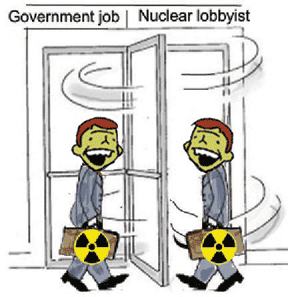 A Washington Echo Chamber for a New Cold War, Reader Supported News, By Cassandra Stimpson and Holly Zhang, TomDispatch, 20 November 20 Yes, tensions are still rising between the world’s greatest emitter of greenhouse gases, historically speaking, and the country emitting the most at this very moment — not that the emerging cold war between the United States and China is often thought of in that context. Still, in the Trump era, now ending so ingloriously, the U.S. moved ever closer to just such a new cold war, as the president got ever angrier at China and the “plague” it had “unleashed on to the world,” his secretary of state denounced its policies, and U.S. aircraft carriers began repeatedly making their way into the disputed South China Sea.
As trade wars loomed and The Donald boomed, the Pentagon also began issuing documents deemphasizing the “forever wars” it had been involved in for nearly two decades and emphasizing instead the dangers of China (and Russia). Now, this country is preparing, however chaotically, to enter the Biden years, even if that other old man is still bitterly camped out in the White House. President Trump, who was perfectly ready to set the planet on fire (more or less literally), is nearly gone and you might think that the globe’s two largest carbon emitters would be ready to consider some kind of accommodation or even coordination to stop this world from going down in intensifying storms, rising sea levels, raging wild fires, and… well, you know the story.
Unfortunately, that would be logic, not interests — and the interests couldn’t be more real or, as Cassandra Stimpson and Holly Zhang of the Foreign Influence Transparency Initiative (FITI) at the Center for International Policy suggest today, more grimly lined up to promote that very cold war.
Only recently, for instance, we’ve had a look at Joe Biden’s 23-person “transition team” for the Pentagon, most of whom come from the hawkish think tanks that are so much a part of official Washington and eight of whom, as In These Times has reported, “list their ‘most recent employment’ as organizations, think tanks, or companies that either directly receive money from the weapons industry, or are part of this industry,” including the Center for Strategic and International Studies, discussed in today’s TomDispatch post. And so it goes, sadly enough, in Washington whoever the president may be…………
-Tom Engelhardt, TomDispatch https://readersupportednews.org/opinion2/277-75/66316-a-washington-echo-chamber-for-a-new-cold-war
UK government losing enthusiasm for new nuclear power stations, as grim financial realities set in
|
The government’s latest thinking on how to replace its aging fleet of nuclear plants marks a dramatic shift from 2013, when David Cameron agreed to funding for new reactors at the Hinkley Point site with support from China. Since then, relations with China have deteriorated, electricity demand slumped and renewables such as wind and solar farms became much cheaper than new atomic plants……
|
|

Greenpeace launches legal appeal against French nuclear safety authority allowing extension of lifetime of nuclear reactors
  GREENPEACE CHALLENGES FRENCH NUCLEAR AUTHORITYhttps://delano.lu/d/detail/news/greenpeace-challenges-french-nuclear-authority/212454, 18.11.2020 • CORDULA SCHNUER Environmental group Greenpeace has lodged an appeal with the French Council of State, claiming the country’s nuclear safety authority acted illegally by failing to assess environmental risks linked to extending the lifespan of nuclear power plants. GREENPEACE CHALLENGES FRENCH NUCLEAR AUTHORITYhttps://delano.lu/d/detail/news/greenpeace-challenges-french-nuclear-authority/212454, 18.11.2020 • CORDULA SCHNUER Environmental group Greenpeace has lodged an appeal with the French Council of State, claiming the country’s nuclear safety authority acted illegally by failing to assess environmental risks linked to extending the lifespan of nuclear power plants.The nuclear safety authority (ASN) is in the process of evaluating whether power plants can continue operating past the 40-year lifespan initially programmed for their reactors. “French nuclear power plants currently in operation were designed to operate for 40 years,” Greenpeace said in a statement on Wednesday. “Beyond that, nuclear reactors enter an ageing phase not foreseen by their engineers and unknown to the operator EDF, with increased risks for the environment and the population.” The Council of State acts as the supreme court for administrative justice and Greenpeace hopes it will take into account a decision by the Court of Justice of the European Union against Belgium. The country in 2015 had decided to prolong the lifespan of reactors 1 and 2 at the Doel power plant but had to overturn the decision after the EU court in July 2019 faulted the operators for not carrying out an environmental risk assessment. French energy provider EDF has already begun works to strengthen safety and security at the power plant, it says. But without an environmental risk assessment, Greenpeace said it could not be guaranteed that the works are sufficient. The activists have long campaigned for France to exit nuclear energy. The legal challenge, if successful, could also benefit Luxembourg. The reactors of the Cattenom plant–just across the border–went into service between 1986 and 1991, meaning they should be shut off between 2026 and 2031. But operator EDF has launched a procedure to extend Cattenom’s lifespan until at least 2035. Luxembourg opposes delaying the power plant’s shutting down, even though it procures around 10% of the electricity in its grid from nuclear power and is an investor in EDF through its national pension fund. |
|
Trump administration pulls out of Open Skies treaty with Russia,
|
Trump administration pulls out of Open Skies treaty with Russia, THe Hill, BY DOMINICK MASTRANGELO – 11/22/20 The Trump administration has officially withdrawn from the Open Skies treaty, six months after starting the process to leave.“On May 22, 2020, the United States exercised its right pursuant to paragraph 2 of Article XV of the Treaty on Open Skies by providing notice to the Treaty Depositaries and to all States Parties of its decision to withdraw from the Treaty, effective six months from the notification date,” State Department deputy spokesman Cale Brown said in a statement.
“Six months having elapsed, the U.S. withdrawal took effect on November 22, 2020, and the United States is no longer a State Party to the Treaty on Open Skies,” Brown added. The post-Cold War agreement was struck to allow nations to conduct flyovers of other allies in an attempt to collect military data and other intelligence on neighboring foreign enemies. In a statement issued on Sunday, Sen. Bob Menendez (D-N.J.) called the administration’s withdrawal “reckless” and encouraged President-elect Joe Biden‘s administration to rejoin the pact once he is inaugurated. ………. https://thehill.com/homenews/administration/527056-us-withdraws-from-open-skies-treaty-with-russia |
|
Influence of weapons makers on U.S. policy, whether a Democrat or Republican administration
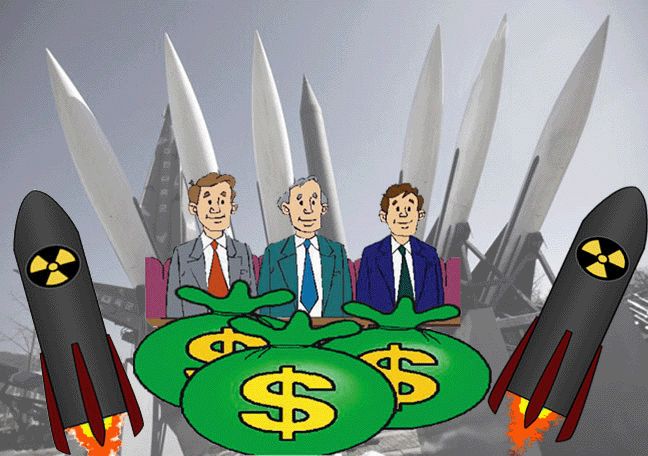 A Washington Echo Chamber for a New Cold War, Reader Supported News, By Cassandra Stimpson and Holly Zhang, TomDispatch, 20 November 20
 ar: what is it good for? Apparently, in Washington’s world of think tanks, the answer is: the bottom line.
In fact, as the Biden presidency approaches, an era of great-power competition between the United States and China is already taken for granted inside the Washington Beltway. Much less well known are the financial incentives that lurk behind so many of the voices clamoring for an ever-more-militarized response to China in the Pacific. We’re talking about groups that carefully avoid the problems such an approach will provoke when it comes to the real security of the United States or the planet. A new cold war is likely to be dangerous and costly in an America gripped by a pandemic, its infrastructure weakened, and so many of its citizens in dire economic straits. Still, for foreign lobbyists, Pentagon contractors, and Washington’s many influential think tanks, a “rising China” means only one thing: rising profits.
Defense contractors and foreign governments are spending millions of dollars annually funding establishment think tanks (sometimes in secret) in ways that will help set the foreign-policy agenda in the Biden years. In doing so, they gain a distinctly unfair advantage when it comes to influencing that policy, especially which future tools of war this country should invest in and how it should use them.
Not surprisingly, many of the top think-tank recipients of foreign funding are also top recipients of funding from this country’s major weapons makers. The result: an ecosystem in which those giant outfits and some of the countries that will use their weaponry now play major roles in bankrolling the creation of the very rationales for those future sales. It’s a remarkably closed system that works like a dream if you happen to be a giant weapons firm or a major think tank. Right now, that system is helping accelerate the further militarization of the whole Indo-Pacific region.
In the Pacific, Japan finds itself facing an increasingly tough set of choices when it comes to its most significant military alliance (with the United States) and its most important economic partnership (with China). A growing U.S. presence in the region aimed at counterbalancing China will allow Japan to remain officially neutral, even as it reaps the benefits of both partnerships.
To walk that tightrope (along with the defense contractors that will benefit financially from the further militarization of the region), Japan spends heavily to influence thinking in Washington. Recent reports from the Center for International Policy’s Foreign Influence Initiative (FITI), where the authors of this piece work, reveal just how countries like Japan and giant arms firms like Lockheed Martin and Boeing functionally purchase an inside track on a think-tank market that’s hard at work creating future foreign-policy options for this country’s elite.
How to Make a Think Tank Think
Take the prominent think tank the Center for Strategic and International Studies (CSIS), which houses programs focused on the “China threat” and East Asian “security.” Its Asia Maritime Transparency Initiative, which gets funding from the governments of Japan and the Philippines, welcomes contributions “from all governments in Asia, as well as corporate and foundation support.”
Unsurprisingly, the program also paints a picture of Japan as central “to preserving the liberal international order” in the face of the dangers of an “increasingly assertive China.” It also highlights that country’s role as Washington’s maritime security partner in the region. There’s no question that Japan is indeed an important ally of Washington. Still, positioning its government as a lynchpin in the international peace (or war) process seems a dubious proposition at best.
CSIS is anything but alone when it comes to the moneyed interests pushing Washington to invest ever more in what now passes for “security” in the Pacific region. A FITI report on Japanese operations in the U.S., for instance, reveals at least 3,209 lobbying activities in 2019 alone, as various lobbyists hired by that country and registered under the Foreign Agents Registration Act targeted both Congress and think tanks like CSIS on behalf of the Japanese government. Such firms, in fact, raked in more than $30 million from that government last year alone. From 2014 to 2019, Japan was also the largest East Asian donor to the top 50 most influential U.S. think tanks. The results of such investments have been obvious when it comes to both the products of those think tanks and congressional policies.
Think-tank recipients of Japanese funding are numerous and, because that country is such a staunch ally of Washington, its government can be more open about its activities than is typical. Projects like the Carnegie Endowment for International Peace’s “China Risk and China Opportunity for the U.S.-Japan Alliance,” funded by the Japanese Ministry of Foreign Affairs, are now the norm inside the Beltway. You won’t be surprised to learn that the think-tank scholars working on such projects almost inevitably end up highlighting Japan’s integral role in countering “the China threat” in the influential studies they produce. That threat itself, of course, is rarely questioned. Instead, its dangers and the need to confront them are invariably reinforced.
Another Carnegie Endowment study, “Bolstering the Alliance Amid China’s Military Resurgence,” is typical in that regard. It’s filled with warnings about China’s growing military power — never mind that, in 2019, the United States spent nearly triple what China did on its military, according to the Stockholm International Peace Research Institute. Like so many similarly funded projects inside the Beltway, this one recommended further growth in military cooperation between the U.S. and Japan. Important as well, it claimed, was developing “the capability to wage combined multidomain joint operations” which “would require accelerating operational response times to enhance firepower.”
The Carnegie project lists its funding and, as it turns out, that foundation has taken in at least $825,000 from Japan and approximately the same amount from defense contractors and U.S. government sources over the past six years. And Carnegie’s recommendations recently came to fruition when the Trump administration announced the second-largest sale of U.S. weaponry to Japan, worth more than $23 billion worth.
If the Japanese government has a stake in funding such think tanks to get what it wants, so does the defense industry. The top 50 think tanks have received more than $1 billion from the U.S. government and defense contractors over those same six years. Such contractors alone lobby Congress to the tune of more than $20 million each election cycle. Combine such sums with Japanese funding (not to speak of the money spent by other governments that desire policy influence in Washington) and you have a confluence of interests that propels U.S. military expenditures and the sale of weapons globally on a mind-boggling scale.
A Defense Build-Up Is the Order of the Day
An April 2020 report on the “Future of US-Japan Defense Collaboration” by the Atlantic Council’s Scowcroft Center for Strategy and Security offers a typical example of how such pro-militarization interests are promoted. That report, produced in partnership with the Japanese embassy, begins with the premise that “the United States and Japan must accelerate and intensify their long-standing military and defense-focused coordination and collaboration.”
Specifically, it urges the United States to “take measures to incentivize Japan to work with Lockheed Martin on the F-2 replacement program,” known as the F-3. (The F-2 Support Fighter is the jet Lockheed developed and produced in partnership with Mitsubishi Heavy Industries for the Japanese Defense Forces.) While the report does acknowledge its partnership with the embassy of Japan, it fails to acknowledge that Lockheed donated three quarters of a million dollars to the influential Atlantic Council between 2014 and 2019 and that Japan generally prefers to produce its own military equipment domestically.
The Atlantic Council report continues to recommend the F-3 as the proper replacement for the F-2, “despite political challenges, technology-transfer concerns,” and “frustration from all parties” involved. This recommendation comes at a time when Japan has increasingly sought to develop its own defense industry. Generally speaking, no matter the Japanese embassy’s support for the Atlantic Council, that country’s military is eager to develop a new stealth fighter of its own without the help of either Lockheed Martin or Boeing. While both companies wish to stay involved in the behemoth project, the Atlantic Council specifically advocates only for Lockheed, which just happens to have contributed more than three times what Boeing did to that think tank’s coffers.
A 2019 report by the Hudson Institute on the Japan-U.S. alliance echoed similar sentiments, outlining a security context in which Japan and the United States should focus continually on deterring “aggression by China.” To do so, the report suggested, American-made ground-launched missiles (GCLMs) were one of several potential weapons Japan would need in order to prepare a robust “defense” strategy against China. Notably, the first American GCLM test since the United States withdrew from the Cold War era Intermediate-Range Nuclear Forces Treaty in 2019 used a Lockheed Martin Mark 41 Launch System and Raytheon’s Tomahawk Land Attack Cruise Missile. The Hudson Institute had not only received at least $270,000 from Japan between 2014 and 2018, but also a minimum of $100,000 from Lockheed Martin.
In 2020, CSIS organized an unofficial working group for industry professionals and government officials that it called the CSIS Alliance Interoperability Series to discuss the development of the future F-3 fighter jet. While Japanese and American defense contractors fight for the revenue that will come from its production, the think tank claims that American, Japanese, and Australian industry representatives and officials will “consider the political-military and technical issues that the F-3 debate raises.” Such working groups are far from rare and offer think tanks incredible access to key decision-makers who often happen to be their benefactors as well.
All told, between 2014 and 2019, CSIS received at least $5 million from the U.S. government and Pentagon contractors, including at least $400,000 from Lockheed Martin and more than $200,000 from Boeing. In this fashion, a privileged think-tank elite has cajoled its way into the inner circles of policy formation (and it matters little whether we’re talking about the Trump administration or the future Biden one). Think about it for a moment: possibly the most crucial relationship on the planet between what looks like a rising and a falling great power (in a world that desperately needs their cooperation) is being significantly influenced by experts and officials invested in the industry guaranteed to militarize that very relationship and create a twenty-first-century version of the Cold War.
Any administration, in other words, lives in something like an echo chamber that continually affirms the need for a yet greater defense build-up led by those who would gain most from it.
Profiting from Great Power Competition……. https://readersupportednews.org/opinion2/277-75/66316-a-washington-echo-chamber-for-a-new-cold-war
Standard nuclear designs are still too costly, and safety features are only a third of nuclear costs.
Ars Technica 21st Nov 2020, Should any discussion of nuclear power go on for long enough, it becomes inevitable that someone will rant that the only reason they’ve become unaffordable is a proliferation of safety regulations. The argument is rarely (if ever) fleshed out—no specific regulation is ever identified as problematic, and there seems to be no consideration given to the fact that we might have learned something at, say, Fukushima that might merit addressing through regulations.
But there’s now a paper out that provides some empirical evidence that safety changes have contributed to the cost of building new nuclear reactors. But the study also makes clear that they’re only one of a number of factors, accounting for only a third of the soaring
costs. The study also finds that, contrary to what those in the industry seem to expect, focusing on standardized designs doesn’t really help matters, as costs continued to grow as more of a given reactor design was built.
Slowly moving lawsuit on the health impacts of a national nuclear laboratory
BNL lawsuit and the impacts of national nuclear laboratory
Brookhaven National Laboratory “continues to show almost no regard for its neighbors…Is this any way for a government-funded agency to treat its neighbors?” Nation of Change, By Karl Grossman, November 20, 2020
BNL after negotiations agreed to settlements of approximately $600,000 for the first two groups of plaintiffs, each with about 18 persons. However, last month a settlement was not agreed to involving the final group of 18 plaintiffs, and New York State Supreme Court Justice Joseph Farneti ordered that a trial be scheduled.
It accuses BNL of “failure to observe accepted relevant industry standards in the use, storage and disposal of hazardous and toxic substances” and says BNL itself had been “improperly located” by the U.S. Atomic Energy Commission “on top of an underground aquifer which supplies drinking water to a large number of persons.”
Lead attorneys are A. Craig Purcell of Smithtown, Long Island who is a former president of the Suffolk County Bar Association, and Richard J. Lippes, whose Buffalo, New York law firm successfully represented residents of the Love Canal neighborhood near Niagara Falls, severely polluted by the Hooker Chemical Co.
The lawsuit’s title is Osarczuk, et. al, vs. Associated Universities. Barbara Osarczuk had lived in North Shirley, just outside the BNL boundaries, for 28 years and attributed her thyroid and breast cancer to BNL.
A book on radioactive pollution from BNL causing health impacts to residents of Shirley was published in 2008. Welcome to Shirley: A Memoir from an Atomic Town was authored by Kelly McMasters of Hofstra University, who grew up in Shirley. The book was the basis of the 2012 TV documentary Atomic States of America.
As Professor McMasters has related in an interview: “I do believe there was a watershed moment in 1960, after the first radioactive leaks occurred, that the federal government or the scientists themselves should have realized that Shirley was the fastest growing town in the county, with a population that doubled within ten years, and that the middle of one of the largest sole-source drinking water aquifers in the country was not the best place for a nuclear laboratory.” http://www.smithmag.net/memoirville/2008/05/11/interview-kelly-mcmasters-welcome-to-shirley-a-memoir-from-an-atomic-town/
Purcell declares that the lawsuit, “now, nearly 25 years later…has still not been resolved despite Judge Farneti’s urging that the interests of justice would be better served by a fair and final resolution.” BNL and its lawyers “continue to nickel and dime their neighbors to this very day.” He charges that BNL “continues to show almost no regard for its neighbors…Is this any way for a government-funded agency to treat its neighbors?” https://www.nationofchange.org/2020/11/20/bnl-lawsuit-and-the-impacts-of-national-nuclear-laboratory/?fbclid=IwAR0Q0RKD6eJuJL4jNn19c-afztaMbdVNA2btXEzW16z0My0KtQW6TiWPKJY
1 This Month
Chernobyl: The Lost Tapes – A good documentary on Chernobyl on SBS available On Demand for the next 3 weeks– https://www.sbs.com.au/ondemand/tv-program/chernobyl-the-lost-tapes/2352741955560

of the week–London Campaign for Nuclear Disarmament

Tell the Ukrainian Government to Drop Prosecution of Peace Activist Yurii Sheliazhenko
To see nuclear-related stories in greater depth and intensity – go to https://nuclearinformation.wordpress.com
-
Archives
- April 2026 (127)
- March 2026 (251)
- February 2026 (268)
- January 2026 (308)
- December 2025 (358)
- November 2025 (359)
- October 2025 (376)
- September 2025 (257)
- August 2025 (319)
- July 2025 (230)
- June 2025 (348)
- May 2025 (261)
-
Categories
- 1
- 1 NUCLEAR ISSUES
- business and costs
- climate change
- culture and arts
- ENERGY
- environment
- health
- history
- indigenous issues
- Legal
- marketing of nuclear
- media
- opposition to nuclear
- PERSONAL STORIES
- politics
- politics international
- Religion and ethics
- safety
- secrets,lies and civil liberties
- spinbuster
- technology
- Uranium
- wastes
- weapons and war
- Women
- 2 WORLD
- ACTION
- AFRICA
- Atrocities
- AUSTRALIA
- Christina's notes
- Christina's themes
- culture and arts
- Events
- Fuk 2022
- Fuk 2023
- Fukushima 2017
- Fukushima 2018
- fukushima 2019
- Fukushima 2020
- Fukushima 2021
- general
- global warming
- Humour (God we need it)
- Nuclear
- RARE EARTHS
- Reference
- resources – print
- Resources -audiovicual
- Weekly Newsletter
- World
- World Nuclear
- YouTube
-
RSS
Entries RSS
Comments RSS
 nuclear-news