As UK’s Torness nuclear power station deteriorates, – cheaper to build renewables than to repair aging reactors
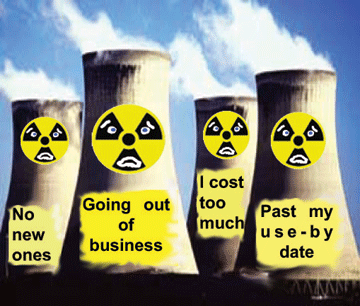 The Ferret 6th May 2020, Cracks that could increase the risk of a radioactive accident at Torness
nuclear power station in East Lothian will start appearing six years sooner than previously thought, according to the UK government’s safety watchdog. The Office for Nuclear Regulation (ONR) said that cracking which could cause debris to inhibit vital cooling of highly radioactive reactor fuel is now predicted to begin in 2022 rather than 2028.
After a major review ONR has given Torness permission to keep operating until 2030 –
but only if inspections to check for cracks are intensified. ONR promises
to “robustly challenge” the plant’s operators, EDF Energy, to ensure
that it “remains safe”.
Campaigners fear that Torness will become
increasingly unsafe, and warn it may have to close down sooner than
expected. EDF, however, insists that the station will keep generating
electricity safely until 2030. The coalition of 50 nuclear-free local
authorities in the UK has called on ONR to keep Torness under close
scrutiny. “These safety reservations surrounding the Torness periodic
safety review need to be cleared up as soon as possible,” said the
group’s Scotland convenor, SNP Glasgow councillor, Feargal Dalton.
“Whilst EDF is having to spend large resources trying to persuade the
regulator that it is safe to restart the Hunterston B reactors, this report
emphasises that similar issues with ageing are likely to arise at Torness
over coming years.” Councils would press ONR “to forensically
scrutinise what look like significant weaknesses in the EDF safety case,”
Dalton added.
“In the meantime, the Scottish Government should start
discussions about a ‘just transition’ for the workers at both
Hunterston and Torness so that Scotland can move to a safe, sustainable and
non-nuclear economy as quickly as possible.” The Edinburgh-based nuclear
consultant, Pete Roche, argued that it could be cheaper to build new
renewable capacity instead of continuing to operate ageing reactors.
“This could soon be the case with Torness, especially if it has to keep
being turned on and off to inspect the graphite core,” he said.
“Scotland clearly needs to be prepared for the possibility that Torness
might be forced to close not long after 2022.”
https://theferret.scot/torness-nuclear-reactors-cracking-2022/
Time extended by 60 days for comment on planned New Mexico nuclear waste dump
 US Regulators Grant More Time to Consider Nuclear Fuel Plan https://www.usnews.com/news/best-states/new-mexico/articles/2020-05-05/us-regulators-grant-more-time-to-consider-nuclear-fuel-plan
The public will have more time to comment on an environmental review related to a proposed multibillion-dollar complex in New Mexico that would store spent nuclear fuel from commercial power plants around the U.S. The Nuclear Regulatory Commission has granted a request by members of New Mexico’s congressional delegation, providing another 60 days for the process. By Associated Press, Wire Service Content May 5, 2020,
ALBUQUERQUE, N.M. (AP) — The public will have more time to comment on an environmental review related to a proposed multibillion-dollar complex in New Mexico that would store spent nuclear fuel from commercial power plants around the U.S
The Nuclear Regulatory Commission recently granted a request by members of New Mexico’s congressional delegation, providing another 60 days for the process. The delegation had argued for more time and a delay of any public meetings given the health emergency that has resulted from the coronavirus outbreak.
The delegation said in a statement that full public participation is particularly important for projects involving nuclear waste.
Any proposal to store commercial spent nuclear fuel raises a number of health, safety and environmental issues, including potential impacts on local agriculture and industry, issues related to the transportation of nuclear waste, and disproportionate impacts on Native American communities,” they said.
The commission plans to hold a nationwide webinar and five public meetings in New Mexico during the revised public comment period.
Commission Chairwoman Kristine Svinicki said in a recent letter to the delegation that as the health emergency evolves, staff will continue to re-evaluate plans for public participation and will consider whether additional extensions are warranted.
In a preliminary recommendation, the commission favors approval of a license for Holtec International to build the facility in southeastern New Mexico.
The New Jersey-based company is seeking a 40-year license to build what it has described as a state-of-the-art complex near Carlsbad. The first phase calls for storing up to 8,680 metric tons of uranium, which would be packed into 500 canisters. Future expansion could make room for as many as 10,000 canisters of spent nuclear fuel.
Holtec has said the U.S. currently has more than 80,000 metric tons of used nuclear fuel in storage at dozens of sites around the country and the inventory is growing at a rate of about 2,000 metric tons a year.
Gov. Michelle Lujan Grisham and other elected officials are among those with concerns about the potential environmental effects and the prospects of New Mexico becoming a permanent dumping ground for spent nuclear fuel. They point to the lack of a permanent plan by the federal government phase calls for storing up to 8,680 metric tons of uranium, which would be packed into 500 canisters. Future expansion could make room for as many as 10,000 canisters of spent nuclear fuel.
Holtec has said the U.S. currently has more than 80,000 metric tons of used nuclear fuel in storage at dozens of sites around the country and the inventory is growing at a rate of about 2,000 metric tons a year.
Gov. Michelle Lujan Grisham and other elected officials are among those with concerns about the potential environmental effects and the prospects of New Mexico becoming a permanent dumping ground for spent nuclear fuel. They point to the lack of a permanent plan by the federal government for dealing with the waste piling up at power plants around the country.
The governor and others also have questions about whether the facility would compromise oil and gas development in the Permian Basin, one of the world’s most prolific energy production regions.
The NRC staff’s preliminary recommendation states there are no environmental impacts that would preclude the commission from issuing a license for environmental reasons.
Big drop in France’s nuclear power generation.
The fall in output is “due to a drop in demand and prolonged (nuclear reactor) outages linked in particular to the health crisis,” EDF said.
Electricity consumption has plunged across Europe due to shutdown measures ordered by governments to halt the spread of the virus.
The utility added that its nuclear generation in Britain fell 18.7% year-on-year in April to 3.7 TWh, while total output since January was at 15.6 TWh, down 5.3% compared with the same period in 2019.
EDF’s subsidiary in Britain, EDF Energy has been asked to temporarily reduce output at its Sizewell B nuclear plant in the east of England to help balance the grid and prevent blackouts, due to the fall in energy demand, EDF and grid operator National Grid said separately on Wednesday. (Reporting by Bate Felix; Editing by GV De Clercq and Elaine Hardcastle) AT TOP https://af.reuters.com/article/commoditiesNews/idAFL8N2CO843
Planet of the Humans – Film Review —
Review of Planet of the Humans Michael Moore’s film produced in 2019 called the ‘Planet of the Humans’ comprehensively demonises all renewables, has recently been streamed online and now watched by millions. I agree with the underlying premise of the film that Big business on a Big multinational scale looks primarily at the bottom […]
Survivors of nuclear radiation exposure are at greater risk from COVID-19.

Nuclear Frontline Communities
Our race for nuclear dominance during WWII and the Cold War left many casualties in its wake: workers in the uranium industry, workers and those downwind of nuclear production sites, soldiers and civilians exposed to above-ground nuclear testing, those who attempt to clean-up and dispose of nuclear waste, and those unlucky enough to live near that waste. These people were exposed to radiation and other toxic chemicals, in many cases causing severe health problems, while never being told by their government or their employers about the risks. To add insult to injury, these exposed populations are disproportionately from Indigenous communities, communities of color, low-income, or rural communities, and often face significant barriers to receiving adequate health care even in the best of times.
Today, the injustice of their exposure stings a little sharper because they have an added fear of contracting COVID-19. Many factors may increase their risk: age, radioactive and toxic chemical exposures, air, soil, and water pollution, existing health conditions such as cancer, poverty, institutionalized racism, etc. These factors can also all contribute to a suppressed immune system.
The Radiation Exposure Compensation Act
Some of the individuals in these communities are able to apply for compensation from the US government through a program called the Radiation Exposure Compensation Act (RECA). RECA is meant to offset what are often debilitating health care costs, though the funds can be hugely insufficient. The program is set to expire in 2022, and many exposed communities are still not covered by RECA. This includes those downwind of the 1945 Trinity Test in New Mexico, downwinders of the Nevada Test Site in states and counties originally excluded from RECA, residents of Guam, veterans who cleaned up radioactive waste in the Marshall Islands, uranium workers past 1971, and civilians downwind of nuclear production sites.
The deficiencies of RECA, and the threat of it disappearing entirely, are already a huge disservice to these communities. But in the face of an international pandemic, those already struggling to manage extreme health consequences from radiation exposure must now also face the spectre of COVID-19.
One of the most common illnesses suffered by those exposed to radiation is cancer. Recent studies show that those with cancers are up to three times as likely to die of COVID-19 than those without cancer – especially blood and lung malignancies, two common cancers that are eligible for RECA compensation.
Tina Cordova, a downwinder of the Trinity Test and co-founder of Tularosa Basin Downwinders Consortium adds: “Many of us live in fear of the virus now not only because it is highly infectious and deadly to most but because we also know we are highly susceptible to getting the virus and dying from it due to our underlying health issues as a result of being exposed to radiation. Once you’ve been diagnosed with cancer and been through the radiation and chemotherapy necessary to save your life you know your immune system has been compromised.”
While flawed, RECA is a crucial program. It can mean the difference between care and no care, financial stability or bankruptcy, losing or keeping your house, and even life or death.
These communities must not be left without health care. The good news is that there is a solution. The Radiation Exposure Compensation Act Amendments Act of 2019 – HR 3783 and S. 947 – would extend RECA to 2045 and expand access to many of the communities currently excluded. Many members of Congress have already been championing the effort to pass this bipartisan legislation, including Congressman Lujan (D-NM), Senator Crapo (R-ID), and Senator Udall (D-NM).
Given the urgency of health care access for these communities today, UCS is calling on Congress to include the provisions of the RECA Amendments Act in upcoming stimulus packages……….. https://allthingsnuclear.org/guest-commentary/covid-19-nuclear-weapons
As with viruses, containment of atomic weapons may be good, but eradication is best.
The Novel Coronavirus and Nuclear Weapons As with viruses, containment of atomic weapons may be good, but eradication is best. Common Dreams by Sergio Duarte , Ira Helfand 4 May 20
The entire international community is justifiably concerned and disturbed with the serious consequences of the novel coronavirus pandemic. Thousands have already died and many more are in danger. Local and national governments find it increasingly difficult to deal adequately with the sanitary and social emergency deriving from the spread of the virus. It will take many months before the situation can come back to normal.
What has this to do with nuclear weapons?
In the current climate of fear, uncertainty and helplessness, it is impossible not to think about what would happen in the case of a different and more ominous disaster: a nuclear conflagration, albeit of limited proportions. The possessors of nuclear weapons are relentlessly increasing the destructive power of their arsenals and seem willing to use them as they see fit to respond to their perceived security concerns. This, in fact, brings insecurity to all. Command and control systems are not immune against cyber viruses and accidents, nor are they protected against whimsical or emotionally unstable rulers. ……..
The entire international community is justifiably concerned and disturbed with the serious consequences of the novel coronavirus pandemic. Thousands have already died and many more are in danger. Local and national governments find it increasingly difficult to deal adequately with the sanitary and social emergency deriving from the spread of the virus. It will take many months before the situation can come back to normal.
What has this to do with nuclear weapons?
In the current climate of fear, uncertainty and helplessness, it is impossible not to think about what would happen in the case of a different and more ominous disaster: a nuclear conflagration, albeit of limited proportions. The possessors of nuclear weapons are relentlessly increasing the destructive power of their arsenals and seem willing to use them as they see fit to respond to their perceived security concerns. This, in fact, brings insecurity to all. Command and control systems are not immune against cyber viruses and accidents, nor are they protected against whimsical or emotionally unstable rulers.
It may well be impossible to eliminate all disease-causing viruses; yet nuclear disarmament is not only possible, but a legally binding obligation embedded in Article VI of the NPT. Fifty years after the Treaty’s inception, it is high time for the possessors of nuclear weapons to effectively comply with this obligation. As with viruses, containment may be good, but eradication is best. https://www.commondreams.org/views/2020/05/04/novel-coronavirus-and-nuclear-weapons, Common Dreams
Workers at ‘most toxic place in America’ – Hanford nuclear site – in fear of coronavirus
|
A nuclear waste site where the biggest fear isn’t radiation, but coronavirus
Workers at ‘most toxic place in America’ are terrified to return to a site where there has been very little protection from the outbreak, Guardian, Hallie Golden in Seattle, 4 May, 20 For more than a month, coronavirus has brought cleanup of a 586-square-mile decommissioned nuclear production complex in south-eastern Washington state to a near standstill. Most of the more than 11,000 employees at the Hanford site were sent home in late March, with only essential workers remaining to make sure the “most toxic place in America” stays safe and secure. Now with signs that Washington has turned a corner with the virus and the state’s governor slowly starting to relax some safety measures, Hanford workers are looking at the very real possibility of returning to work. But after facing those initial few weeks of Washington’s coronavirus crisis on-site at Hanford, workers say they received little information and even fewer safety measures from leadership, and some employees are terrified by the prospect. “When you come back to work, what’s the expectation [for protections]?” asked a maintenance and operations worker at Hanford, who asked not to be identified by the Guardian to protect his job. “There are none.”…….. After Washington health officials reported the first US death associated with coronavirus in late February and then, with each passing week, were documenting the most cases in the country, employees say it remained business as usual at Hanford, where the cleanup project is run by the federal Department of Energy, with work completed through contractors. During those first few weeks, workers recall receiving little guidance on site-specific coronavirus safety measures. They say information from Hanford officials tended to be overly broad, focusing on the nationwide situation rather than the unique needs of workers in a state that was at that time at the center of the US coronavirus crisis. A radiological control technician, who has worked at Hanford for more than 15 years, said trailers continued to be shared by as many as 50 people and each Monday morning 200 employees would come together for a meeting in a single room. When workers finished at one of the many contaminated areas of Hanford, they needed to be checked for radiation before leaving. Technicians would stand next to them, without a mask on, running a handheld device over their body – being sure to stay within a quarter of an inch of their skin to ensure accurate readings. In a single hour, one of these radiological control technicians, may have surveyed as many as 30 people. “There’s no way to keep that social distancing. You’re right up in somebody’s face, they’re breathing on you, they’re sweaty,” said the technician, who asked to remain anonymous for fear of retaliation at work. Tom Carpenter, executive director of the Hanford Challenge, a not-for-profit watchdog organization in Seattle, said he received at least 10 emails and phone calls in two weeks in March from employees worried about Hanford not providing face masks or gloves or requiring social distancing to protect them from coronavirus. “Workers were highly distressed about their own health and safety, and felt that management was not taking this issue seriously,” he said. “Stop works”, a protocol at Hanford in which an employee notices something is unsafe or hazardous and work is halted until officials can fix the problem, became so frequent on issues related to coronavirus, said the radiological control technician, that little work was actually getting done. …….. It wasn’t until 25 March – after Governor Jay Inslee’s stay-at-home mandate, which involved the closure of all non-essential companies (Hanford is considered essential) – that the site switched to a state of essential mission-critical operations. The site will remain functioning in this capacity through at least Friday. It’s unclear whether this will be renewed beyond then. Carpenter said the concern over the lack of protection is about more than keeping workers safe from coronavirus. He said if the virus were to get passed throughout Hanford, it could put the highly sensitive work being done there in jeopardy. …… Carpenter said Hanford officials have reported that two workers have been diagnosed with coronavirus, but he said, “there’s almost assuredly more”….. https://www.theguardian.com/us-news/2020/may/04/hanford-nuclear-waste-site-coronavirus-washington Mon 4 May 2020 20.00 AESTLast modified on Tue 5 May 2020 02.36 AEST |
|
A small window of opportunity to stave off rapid global heating

|
‘Blown away’: Safe climate niche closing fast, with billions at risk, https://www.theage.com.au/environment/climate-change/blown-away-safe-climate-niche-closing-fast-with-billions-at-risk-20200504-p54pod.html By Peter Hannam, May 5, 2020 As much as one-third of the world’s population will be exposed to Sahara Desert-like heat within half a century if greenhouse gas emissions continue to rise at the pace of recent years.Scientists from China, the US and Europe found that the narrow climate niche that has supported human society would shift more over the next 50 years than it had in the preceding 6000 years. As many as 3.5 billion people will be exposed to “near-unliveable” temperatures averaging 29 degrees through the year by 2070. Less than 1 per cent of the Earth’s surface now endures such heat. That heat compares with the narrow 11- to 15-degree range that has supported civilisation over the past six millennia, according to research published Tuesday in the journal Proceedings of the National Academy of Sciences. “Absent climate mitigation or migration, a substantial part of humanity will be exposed to mean annual temperatures warmer than nearly anywhere today,” the paper said. Xu Chi, a researcher at China’s Nanjing University and one of the paper’s authors, said: “We were frankly blown away by our own initial results. As our findings were so striking, we took an extra year to carefully check all assumptions and computations.” “Clearly we will need a global approach to safeguard our children against the potentially enormous social tensions the projected change could invoke.” Among the most exposed nations will be India – where many people live in “already-hot places” – with as many as 1.2 billion people likely to be forced to move if population and warming trends continue. For Nigeria, the number exposed could be 485 million, according to a media release distributed along with the paper. The scenario used projected the total populations in India and Nigeria to reach 2.2 billion and 600 million, respectively, by 2070, Dr Xu told the Herald and The Age. In Australia, areas of Western Australia and the Northern Territory home to about 200,000 people will be at risk. The research extended current population and greenhouse gas emissions trends into the future, and excluded impacts from the coronavirus pandemic on both. The researchers also considered possible rainfall changed. “The global pattern of population distribution seems less constrained by precipitation – while there is also an optimum around 1000 mm [of rainfall a year ] – so we focused on temperature,” Dr Xu said. “Changes of precipitation regime would definitely have impacts, but such impacts together those of temperature change would be more complex to foresee.”
Compared with pre-industrial-era conditions, temperatures globally will be about 3 degrees hotter by 2070. But as land warms faster than the oceans, the rise for people on average will be about 7.5 degrees, the paper found. Should the world adopt strong emissions reductions – the so-called Representative Concentration Pathway 2.6 – it would “substantially reduce the geographical shift in the niche of humans and would reduce the theoretically needed movement to about 1.5 billion people”, the paper said. Still, that number would account for about one in seven of the world’s population. “Each degree of temperature rise above the current baseline roughly corresponds to 1 billion humans left outside the temperature niche, absent migration,” it said.
The researchers added that upheavals among populations – and the ecosystems that support them – could happen well before 2070. “Migration inevitably causes tension, even now, when a relatively modest number of about 250 million people live outside their countries of birth.” Tim Lenton, director of the Global Systems Institute at the University of Exeter and one of the paper’s authors, said: “The good news is that these impacts can be greatly reduced if humanity succeeds in curbing global warming.” Marten Scheffer, a professor at Wageningen University and an author of the report, said the response to the coronavirus should give cause for some optimism that climate change’s looming threats could also be tackled. “The COVID-19 response revealed that if a problem appears to be urgent and serious, humanity globally is able to act massively if needed, even if there are economic costs,” he told the Herald and The Age. “Perhaps this may serve to make it feel more doable to address global warming too. Our findings indicate that that would be worthwhile.” |
|
Pacific Islanders, victims of nuclear radiation from bomb tests, are more susceptible to coronavirus
|
“…………The Marshall Islands is one of three countries under the Compacts of Free Association (COFA), which allows citizens of these countries to live and work in the US in exchange for the US military’s exclusive use of and access to these nation’s lands, airspace, and waters. COFA was also supposed to give these communities access to federal benefits, including Medicaid. But in 1996, Medicaid was stripped from COFA communities in what has been called an “oversight.” In the face of an international pandemic, this “oversight” is made all the more severe. Even before the pandemic, studies are showing that in COFA communities, higher death rates are associated with the loss of Medicaid after 1996. Today, data shows that Pacific Islanders in the US, including the Marshallese, are contracting COVID-19 at rates two to three times higher than other Americans. On the importance of addressing this issue in the stimulus now, David Anitok, Project Coordinator at COFA Alliance National Network of WA (CANN-WA) said, “Timing is highly crucial and far too many people are dying that could’ve been prevented had everyone had health equity access and resources.” There is also a simple solution for this oversight: bills have been introduced in Congress to restore Medicaid to COFA communities – HR 4821 and S.2218. Already, nearly 300 organizations across the country have supported this effort. In light of the pandemic, there is no time to wait. Congress should include the provisions to reinstate Medicaid for COFA Residents in a future stimulus package. I am constantly inspired by the advocates in these communities. Even before the pandemic, they stared death in the face every day. Those who have survived are fighters, working tirelessly for the care they deserve, battling illness after illness, yet miraculously maintaining their compassion, community, and resilience. They attend too many funerals; they wonder if their government is simply waiting for them all to die. Now facing a pandemic, there is no more time to wait. It’s time for Congress to act. https://allthingsnuclear.org/guest-commentary/covid-19-nuclear-weapons |
|
|
SPD, junior partner in Germany’s coalition government, calls to withdraw US nuclear arms
|
Germany: SPD call to withdraw US nuclear arms stokes debate, DW, 4 May 20, The parliamentary leader of the SPD, the junior partner in Germany’s coalition government, has called for US atomic weapons to be withdrawn from the country. But other parties remain opposed to such a move.The presence of US nuclear weapons on German soil is a danger to Germany’s security and should be terminated, according to the parliamentary leader of the Social Democratic Party (SPD), Rolf Mützenich.
Read more: US military in Germany: What you need to know Mützenich, whose party is junior partner to Chancellor Angela Merkel’s conservative CDU/CSU bloc in Germany’s coalition government, told the paper Tagesspiegel am Sonntag that “atomic weapons on German territory do not heighten our security, on the contrary.” “It is time that Germany ruled out their deployment in future,” he added, stressing that such a move would not call Germany’s membership in NATO into question. Read more: US set to upgrade controversial nukes stationed in Germany Changed US nuclear strategy He justified his call largely by referring to the change in US nuclear strategy under President Donald Trump, saying that Trump’s administration saw atomic weapons not solely as deterrents but as weapons of aggression, making the risk of escalation “incalculable.”……. https://www.dw.com/en/germany-spd-call-to-withdraw-us-nuclear-arms-stokes-debate/a-53314883 |
|
|
NRC rejects contentions raised by Beyond Nuclear and others against nuclear waste proposed site
Federal government rejects contentions to nuclear waste site near Carlsbad and Hobbs https://www.abqjournal.com/1450836/federal-government-rejects-contentions-to-nuclear-waste-site-near-carlsbad-and-hobbs.html BY ADRIAN HEDDEN / CARLSBAD CURRENT-ARGUS, N.M. (TNS) Monday, May 4th, 2020 A proposed nuclear waste repository near Carlsbad and Hobbs proceeded through the federal licensing process despite protests from environmental groups who questioned the legality of the project.
Holtec International applied to the Nuclear Regulatory Commission (NRC) for a license to build and operate a facility that would temporarily store spent nuclear fuel rods in a remote location of southeast New Mexico while a permanent repository is developed.
The consolidated interim storage facility was challenged by Beyond Nuclear and other organizations who questioned Holtec’s application for suggesting the U.S. Department of Energy could take ownership of the waste.
Opponents argued federal law prohibited the government from taking legal possession of spent nuclear fuel.
They also argued against Holtec’s plan to transport the waste via rail, potentially putting communities along the route at risk of exposure to radiation.
Kevin Kamps, radioactive waste specialist at Beyond Nuclear argued Holtec’s application was in violation of the federal Nuclear Waste Policy Act (NWPA), and the proposed temporary storage facility could become permanent as so such repository exists.
“(The NWPA) is the public’s best protection against an interim storage facility becoming a de facto permanent, national radioactive waste dump at the surface of the Earth.” Kamps said. “Congress knew, in passing the NWPA, that the only safe long-term strategy for care of irradiated reactor fuel is to place it in a permanent repository for deep geologic isolation.
Last year, the NRC’s Atomic Safety and Licensing Board rejected about 50 contentions raised by various organizations, citing their lack of standing or adequate factual basis.
And in an April 23 decision the NRC upheld several of the rejects on appeal as either being irrelevant to the licensing process or already addressed in the application itself.
A proposed new contention issued by Fasken Oil and Ranch, questioning if Holtec owned the mineral rights beneath the surface of the proposed site location was remanded by the NRC for further consideration, along with
Against contentions that the Holtec facility would require “illegal” contracting with the federal government to take ownership of the waste, the NRC contended the application assured regulators that Holtec “committed to not contract unlawfully with DOE.”
“Holtec envisions that its customers will either be nuclear plant operators or DOE, depending on which entity holds title to the spent nuclear fuel,” read the NRC report. “Holtec also acknowledged that it hopes Congress will change the law to allow DOE to enter into temporary storage contracts with Holtec.
“The Board concluded that Holtec seeks a license that would allow it to enter into lawful customer contracts today, but also permit it to enter into additional customer contracts if and when they become lawful in the future.”
While the NRC affirmed the Sierra Club’s standing in the proceedings, as some members of the organization live in close proximity to the proposed site, it found that Sierra Club’s contentions around the transportation of the waste and risk of an accident or release were unfounded.
The NRC contended that the National Environmental Policy Act (NEPA) does not require a “worst-case-scenario” analysis be conducted in issuing the license and that the Sierra Club presented “no expert opinion” to support its assertions on the danger of rail transportation.
Against arguments that the storage casks were flawed or insufficient to hold the waste safely, the NRC upheld that Holtec’s HI-STORM UMAX system that it would use at the facility was already federally certified and cannot be questioned in the proceedings unless a rule waiver was granted.
No such waiver was granted at the time of the NRC’s recent decision.
“Because certified designs are incorporated into our regulations, they may not be attacked in an adjudicatory proceeding except when authorized by a rule waiver,” the report read.
“A contention cannot attack a certified design without a rule waiver because this would challenge matters already fully considered and resolved in the design certification review.”
See what others are reading in Carlsbad news:
Mindy Goldstein, a lawyer from Beyond Nuclear said the NRC’s denial of the appeals was illegal as it contemplated the hope that the law would change to allow the DOE to take title to the waste but was still contrary to present law.
“The NRC’s decision flagrantly violates the federal Administrative Procedure Act (APA), which prohibits an agency from acting contrary to the law as issued by Congress and signed by the President,” she said.
“The Commission lacks a legal or logical basis for its rationale that the illegal provisions could be ignored in favor of other provisions that are legal, or that an illegal license could be issued in ‘hopes’ that the law might change in the future.”
Adrian Hedden can be reached at 575-628-5516, achedden@currentargus.com or @AdrianHedden on Twitter.
More delay for Japan to open Onagawa nuclear power plant Unit 2: Unit 1 to be closed
|
Onagawa 2 upgrade faces further delay, WNN, 04 May 2020
The completion of safety countermeasures at unit 2 of the Onagawa nuclear power plant in Miyagi Prefecture, in Japan, will not be completed until March 2023, two years later than previously scheduled, Tohoku Electric Power Company announced on 30 April. Japan’s nuclear regulator concluded in February the unit meets revised safety standards, clearing the way for it to resume operation.
Tohoku expects to spend about JPY340 billion (USD3.2 billion) on the countermeasures, which include seismic reinforcement of Onagawa 2 and construction of a 29-metre high and 800m long sea wall to protect the plant from tsunamis. The company had originally planned to complete this construction work by April 2017, but the schedule has been pushed back a number of times. The latest plan had been for the countermeasures to be in place by the end of financial year 2020 (ending March 2021). However, Tokohu has now announced it has reviewed its upgrade works plan for Onagawa 2’s operation. Based on discussions it has had with the Nuclear Regulation Authority (NRA), Tohoku has decided to expand or revise its construction works for improving the facilities at the plant. As a result, the entire plan of construction work has been delayed and is now expected to be completed in FY2022 (ending March 2023). ……..
Tohoku has already decided to decommission unit 1 of the plant and is considering applying to restart unit 3. https://www.world-nuclear-news.org/Articles/Further-delay-in-completion-of-Onagawa-2-safety-up
|
|
Indian Point nuclear power station – Unit 2 permanently closed
|
Indian Point 2 permanently closes, Nuclear Engineering International 4 May 2020 Unit 2 at the US Indian Point nuclear power plant closed on 30 April as part of a deal reached in January 2017 between Entergy, the state of New York and the environmental group Riverkeeper. The plant’s two pressurised water reactor (PWRs) generated a quarter of the electricity used in New York City and Westchester County in 2017.Indian Point 2, with a net generating capacity of 998MWe, began commercial operation in 1974. Indian Point 3, a 1030MWe unit began operating in 1976 and is due to retire in April 2021. New natural gas power plants and efficiency measures are expected to up the slack.
Entergy has agreed to sell the plant to Holtec International, a New Jersey-based decommissioning firm. But the licence transfer, which is pending Nuclear Regulatory Commission approval, will take place only after the plant closes in 2021…… Entergy said in a statement that it is committed to continued operation of the nuclear fleet in Louisiana, Arkansas and Mississippi. It shut down Pilgrim in Massachusetts last year and plans to close the Palisades nuclear plant in Michigan in 2022. Both these facilities will be decommissioned by Holtec, through its affiliate Comprehensive Decommissioning International…..https://www.neimagazine.com/news/newsindian-point-2-permanently-closes-7904262
|
|
Trilateral Track 2 Nuclear Dialogues Consensus Statement
Trilateral Track 2 Nuclear Dialogues Consensus Statement https://www.rusi.org/rusi-news/trilateral-track-2-nuclear-dialogues-consensus-statement News, 4 May 2020
United States, Americas, France, Proliferation and Nuclear Policy, UK, Europe
The 2019 Consensus Statement, signed by all track 2 delegates and published on 13 March 2020, can be found here. Topics discussed during the 2019 dialogues include: the future of the rules-based international nuclear order; the role of alliances; new risks and challenges for escalation and strategy; nuclear responsibility and transparency.
Professor Malcolm Chalmers, RUSI’s Deputy Director-General, states:
Tom Plant, Director of RUSI’s Proliferation and Nuclear Policy programme, observed that:
The 2019 Consensus Statement makes several striking recommendations – on the need for extension of New START, on the role of the Iran nuclear deal as the starting point for any new arrangement, and on the importance of reaffirming at the highest levels the principle that “a nuclear war cannot be won and must never be fought” – but perhaps most significant is its call for the UK, US and France to be more open on nuclear weapons issues. In highlighting the potential for information operations to exploit unnecessary secrecy to weaken public and international trust, and to undermine efforts to maintain stability and deterrence, it indicates a valuable and urgent area of focus for our three governments.
Peter Watkins, formerly Director General in the UK Ministry of Defence responsible for strategic defence policy, and currently an Associate Fellow with Chatham House, comments that:
At a time of growing risks to international stability and increasing pressure on the international arms control framework, it is more critical than ever to build political and public understanding of the achievements of arms control – not least the Nuclear Non-Proliferation Treaty itself – and the role of credible, responsible deterrence policies. That is the essential mission of these trilateral talks.
Sir Tony Brenton, formerly the British Ambassador to Russia, and currently a Fellow at Wolfson College Cambridge, highlights that:
In the last few years North Korea has become the world’s ninth nuclear armed state, Russia has announced a radical modernisation of its nuclear arsenal, the deal holding Iran back from going nuclear has collapsed, and the world’s nuclear arms control regime may be on its deathbed. These are deeply worrying developments which underline the importance of the trilateral nuclear dialogue as a way of helping the three Western nuclear powers to stay in close touch on them.
Professor Sir David Omand of the War Studies Department of King’s College London states:
These trilateral discussions provide a unique opportunity to bring together those in the US, UK, and France who had long experience in maintaining responsible nuclear stewardship over many years with current officials who are carrying the responsibility today. It is important that governments, amongst all the other pressing issues facing them, recognise the importance of the nuclear policy and arms control issues that were raised in these discussions.
Tom McKane, formerly Director General for strategy in the UK Ministry of Defence, and currently a Distinguished Fellow at RUSI, outlines that:
At a time when the world felt increasingly unsafe and there are well-founded concerns about the potential for miscalculation and misunderstanding in relation to nuclear deterrence and proliferation, the Trilateral discussions promote real understanding of these important subjects.
Sam Dudin, the UK Nuclear Policy Research Fellow at RUSI, comments that:
These dialogues have called on P3 governments to do more to develop and communicate a narrative supporting their nuclear deterrence policies and nuclear arms control, as part of a genuine, substantive and well-informed debate on nuclear weapons, facilitated by greater transparency with our publics. At a time when the old architecture of nuclear arms control is collapsing, such a debate might outline where there is potential to strike a new arms control deal.
Bahrain’s new environmental bill – strict laws against nuclear waste dumping
New environmental bill referred to Parliament
1 This Month
23 April – WEBINAR – Why new nuclear reactors are the wrong tools for decarbonization Thursday, April 23 • 1 AM – 2 AM AEST


Pine Ridge Uranium is the real threat, not Tehran- Tell Burgum: Stop the Extraction.
Chernobyl: The Lost Tapes – A good documentary on Chernobyl on SBS available On Demand for the next 3 weeks– https://www.sbs.com.au/ondemand/tv-program/chernobyl-the-lost-tapes/2352741955560
To see nuclear-related stories in greater depth and intensity – go to https://nuclearinformation.wordpress.com
-
Archives
- April 2026 (241)
- March 2026 (251)
- February 2026 (268)
- January 2026 (308)
- December 2025 (358)
- November 2025 (359)
- October 2025 (376)
- September 2025 (257)
- August 2025 (319)
- July 2025 (230)
- June 2025 (348)
- May 2025 (261)
-
Categories
- 1
- 1 NUCLEAR ISSUES
- business and costs
- climate change
- culture and arts
- ENERGY
- environment
- health
- history
- indigenous issues
- Legal
- marketing of nuclear
- media
- opposition to nuclear
- PERSONAL STORIES
- politics
- politics international
- Religion and ethics
- safety
- secrets,lies and civil liberties
- spinbuster
- technology
- Uranium
- wastes
- weapons and war
- Women
- 2 WORLD
- ACTION
- AFRICA
- Atrocities
- AUSTRALIA
- Christina's notes
- Christina's themes
- culture and arts
- Events
- Fuk 2022
- Fuk 2023
- Fukushima 2017
- Fukushima 2018
- fukushima 2019
- Fukushima 2020
- Fukushima 2021
- general
- global warming
- Humour (God we need it)
- Nuclear
- RARE EARTHS
- Reference
- resources – print
- Resources -audiovicual
- Weekly Newsletter
- World
- World Nuclear
- YouTube
-
RSS
Entries RSS
Comments RSS
 nuclear-news