wide and growing coalition of real concern about EDF’s Sizewell C nuclear project
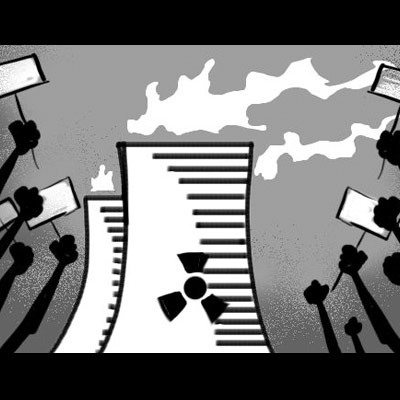
 East Anglian Daily Times 9th May 2020. NFLA, Cllr David Blackburn Councillors are right, EDF should delay its Sizewell C application. I warmly welcome the joint letter of opposition
councillors on Sizewell County Council calling on the Government to halt
EDF moving forward with a Development Consultation Order for Sizewell C
(EADT, 28th April).
The letter mirrors our own concerns noted last week in
our own letter to the EADT, and that of many parish, town and East Suffolk
District Councillors as well. Democratic discussions have to be put on hold
at the moment as the country deals with the worst public health emergency
in living memory.
It suggests an arrogance and a desperation within EDF to
want to move forward with the Sizewell C development at the moment. The
four rounds of local consultation on EDF’s Sizewell C plans showed a large
level of concern and opposition from across local government, much of which
stating that EDF have not provided adequate information to explain how they
would mitigate many of the harmful environmental effects of the
development. Indeed, all local environmental groups have raised huge
concern on its impact, particularly to the likes of wildlife gems like the
RSPB Minsmere site.
Just today, 60 prominent local people have added
similar concerns in a joint letter to The Times. It is clear there is a
wide and growing coalition of real concern about Sizewell C. EDF should not
just halt the DCO application, it should listen to local opinion and cancel
the project altogether. There is no need for Sizewell C. It is time EDF
listened to its critics and halted it.
$25 million settlement coming, over failed V.C. Summer nuclear project, with no SCANA admission of wrongdoing

Dominion Energy, which bought SCANA Corp. and South Carolina Electric & Gas in 2019, could soon reach a $25 million settlement with stock market regulators over the failed V.C. Summer nuclear project that the acquired businesses abandoned nearly three years ago.The proposed deal would allow Dominion to remove itself from a high-profile civil case that the U.S. Securities and Exchange Commission filed in February. That lawsuit alleges that SCANA, the majority owner of the two partially built reactors in Fairfield County, “repeatedly deceived” investors and furthered a “historic” case of securities fraud. Dominion Energy South Carolina, the successor of SCE&G, was named in the lawsuit. Richmond, Va.-based Dominion inherited the company’s legal liability, along with all of SCE&G’s ratepayers in South Carolina, when it sealed its takeover of SCANA early last year. When the SEC filed the case in February, Dominion called the lawsuit a “disappointing development.” Since then, the utility giant has worked behind the scenes to cut a deal with the federal agency. The company announced the potential settlement with the SEC as part of a quarterly earnings report this week. Dominion’s leaders said they struck the $25 million deal with officials at the agency’s Division of Enforcement in April. The company emphasized the settlement would still need to be finalized by the SEC and a federal judge in South Carolina. According to Dominion, the deal would allow the company to settle the case without admitting any wrongdoing by SCANA over the course of the failed V.C. Summer expansion project. |
|
Lockdown in Tamil Nadu: 800 guest workers stage protest at Kudankulam Nuclear Power Plant, attack cops
TIRUNELVELI: A section of construction workers at……Read more at:
http://timesofindia.indiatimes.com/articleshow/75647668.cms?utm_source=contentofinterest&utm_medium=text&utm_campaign=cpp
Ukraine’s Energy ministry limits operations of nuclear power plants
Energy ministry limits operations of nuclear power plants UNIAN Information Agency 9 May 20 Ukraine “…..This week, the issue of a nuclear power units’ shutdown widely reverberated in a public discourse. From May 5, only 10 of 15 nuclear power units have been operating in Ukraine (four were put on scheduled repairs and one was put into reserve mode). According to the operating schedule for 2020, nine nuclear power units will operate at limited capacities. The government decided to take such a step in connection with the drop in electricity consumption caused by quarantine and record generation from renewables.
The search for the 4th hydrogen bomb dropped over Palomares, Spain
|
Who Do You Call When Nuclear Weapons Go Missing? Mathematicians. Here’s What You Need To Remember: With no witnesses, no debris and a search area in the least understood part of the world’s ocean, there’s little even mathematical wizards can do. But even then, few thought 50 years ago that the lost bomb of Palomares would ever turn up. National Interest, 10 May 20
When a routine Cold War operation went terribly wrong, two planes and seven men died, a village got contaminated and a hydrogen bomb disappeared.
The search and cleanup required 1,400 American and Spanish personnel, a dozen aircraft, 27 U.S. Navy ships and five submarines. It cost more than $120 million and a lot of diplomatic capital. And it made an obscure 18th-century mathematical theorem a practical solution to finding veritable needles in haystacks. Around 10 a.m. on Jan. 17, 1966, two B-52Gs of the 31st Bomb Squadron based out of North Carolina approached two KC-135 tankers over the Spanish coast southwest of Cartagena.
The bombers each carried four 1.5-megaton B-28 hydrogen bombs as part of Operation Chrome Dome, a U.S. deterrence mission that placed nuclear-armed bombers on the Soviet Union’s doorsteps. The resulting breakup destroyed the tanker in a fireball of blazing jet fuel. All four crew on board the tanker died. One hundred tons of flaming wreckage fell upon the arid hamlet of Palomares, near the Mediterranean Sea.
Three of the four H-bombs aboard the bomber fell there, too. Within 24 hours, a U.S. Air Force disaster team arrived from Torrejon Air Base near Madrid. Specialists from the Los Alamos and Sandia weapons labs — and Air Force logistics units — descended on the tiny rural town.
The search teams found the three H-bombs within a day. One landed on a soft slope, its casing relatively intact. The high explosives within the other two bombs detonated on impact, blowing 100-foot-wide craters in the dry soil and scattering plutonium, uranium and tritium across the landscape. The region’s long history of human habitation complicated the land search. Almeria, the province where Palomares sits, hosted a mining industry for more than 5,000 years. Countless mine shafts, diggings and depressions pepper its dry landscape made famous by the spaghetti westerns filmed there. ,,,,,,, https://nationalinterest.org/blog/buzz/who-do-you-call-when-nuclear-weapons-go-missing-152441
|
|
America’s very dangerous $multibillion plan for a nuclear-powered fighter plane
|
America Really Wanted A Nuclear-Powered Fighter (Flying Chernobyl, Anyone?) Does great reward really come with great risk? National Interest, by Steve Weintz 10 May 20, Here’s What You Need To Remember: Looking back a half century to an era of greater faith in nuclear energy, it’s easy to shake one’s head in wonder. What were they thinking? Surely crashes, combat and carelessness were going to keep it all from ending well. Ah, the Atomic Age, when nuclear energy seemed the ticket to a future of limitless possibilities. For a generation after 1945 the United States explored all kinds of nuclear propulsion concepts. Some, like naval power plants for subs and ships, proved both revolutionary and effective. Others proved possible to develop but impractical to pursue.
Of these concepts the nuclear-powered aircraft now seems the most fanciful, but billions of dollars and years of top-flight research sunk into the Aircraft Nuclear Propulsion (ANP) program chased the idea before its demise. Between the end of World War II and the dawn of Camelot American engineers figured out how to fit a reactor in an airplane and make it generate thrust without frying the crew. American leaders couldn’t figure out how to pay for it or why they needed it.
Today the ANP program is remembered as an Atomic Age boondoggle whose only remains consist of three-story-tall experimental units and giant hangars with six-foot-thick walls. ……. https://nationalinterest.org/blog/america-really-wanted-nuclear-powered-fighter-flying-chernobyl-anyone-152496 |
|
South Africa’s financially difficult nuclear ambitions
South Africa to develop plan for new 2,500 MW nuclear plant, CAPE TOWN, May 7 (Reuters) – South Africa will soon start developing a plan for a new 2,500 megawatt (MW) nuclear power plant, the energy ministry told lawmakers on Thursday.
Africa’s most industrialised economy, which operates the continent’s only nuclear power plant near Cape Town, said last year that it was considering adding more nuclear capacity in the long term, after abandoning in 2018 a massive nuclear expansion championed by former president Jacob Zuma.
Analysts had expressed serious concern about Zuma’s project for a fleet of nuclear plants totalling 9,600 MW because it would have put massive additional strain on public finances at a time of credit rating downgrades. …..
The presentation showed South Africa wanted to complete the procurement of the new nuclear plant by 2024 but gave no indication as to when it wanted construction of the plant to start or for when the plant would come online……
financing those nuclear ambitions could be difficult at a time that the country’s recession-hit economy is being hammered by the coronavirus pandemic, with this year’s budget deficit expected to stretch into double digits.
Answering questions, Energy Minister Gwede Mantashe said on Thursday that the government would first “test the market” and hear what potential investors or consortia had to say about building the new nuclear facility…… https://af.reuters.com/article/southAfricaNews/idAFL8N2CP8M8
France’s Strategic Nuclear Forces
|
Is France’s Nuclear Shield Big Enough to Cover All of Europe? Modern Diplomacy
Alexander Yermakov 10 May 20, At the end of the third year of his presidency, Emmanuel Macron delivered his long-awaited policy speech on the country’s defence and deterrence strategy. The long-awaited indeed: many have been expecting France to step up its nuclear role in recent years, including heading up the establishment of the EU Nuclear Forcete. Did the President deliver on these expectations? Yes and no. From the get-go, Macron has been keen to play up the historical significance of his February 7 speech. The eighth president of the Fifth Republic noted that the last head of state to visit the École de Guerre in Paris was Charles de Gaulle himself, who delivered his famous speech on the creation of the Force de frappe, or the French Strategic Nuclear Forces (SNF), here on November 3, 1959.
The previous resident of the Élysée Palace, François Hollande, delivered his address on the nuclear deterrence at the Istres-Le Tubé Air Base on February 19, 2015, where one of the French Air Force’s two nuclear squadrons was stationed at the time. Macron’s predecessor gave a speech that was rather typical of the French nuclear policy, reminding his fellow countrymen that the world is still full of threats and that, despite the commitment to nuclear disarmament (someday, like other powers), it was vital to “keep the powder dry.” The President reiterated the promise to not use nuclear weapons against those countries that had signed and honoured the Nuclear Non-Proliferation Treaty (NPT). According to Hollande, the French Strategic Nuclear Forces contribute to the pan-European security, yet remain ‘sovereign:’ Paris will neither, as a matter of principle, be part of the NATO Nuclear Planning Group nor will it participate in the NATO’s Nuclear Sharing [1]. Notwithstanding European solidarity and the special nuclear cooperation that France enjoys with the United Kingdom, Hollande stressed that, “our [France’s] deterrence is our own; it is we who decide, we who evaluate our vital interests.”……. Thermonuclear Assets What does France have to offer to Europe? According to conservative estimates, the third largest nuclear arsenal in the world after that of Russia and the U.S., no less, with almost 300 warheads (the actual number is not known:….. The French Strategic Nuclear Forces currently consist of two components: an airborne and a seaborne. …… much of France’s nuclear potential is concentrated on a hidden yet permanently combat-ready component of its Strategic Nuclear Forces, namely its fleet of Triomphant-class nuclear-powered missile submarines…… Of course, Macron did not utter these exact words, but he did make an extremely important message that most commentators have missed: “France’s vital interests now have a European dimension.” This is not a throw-away sentence, because according to France’s military doctrine, a perceived threat to the country’s “vital interests” is an enough reason to resort to the nuclear force [10]. Macron could not have made a more explicit offer to extend his country’s nuclear umbrella to cover the rest of the European Union as he suggested opening a strategic dialogue on this issue.,,,,,,,, https://moderndiplomacy.eu/2020/05/10/is-frances-nuclear-shield-big-enough-to-cover-all-of-europe/ |
|
Satellite images reveal North Korean leader Kim Jong-un’s new nuclear facility
|
Satellite images reveal North Korean leader Kim Jong-un’s new nuclear facility, DNA India 10 May 20, The United States think tank has earlier stated that North Korea is almost finished with the making of a ballistic missile facility having the capacity to test-fire intercontinental ballistic missiles.
Satellite images have revealed North Korean leader Kim Jong-un’s massive nuclear facility outside the capital Pyongyang He is planning to stockpile on his nuclear weapons after nuclear talks between the North Korean dictator and US President Donald Trump last year broke down.,,,,,, Satellite images have revealed North Korean leader Kim Jong-un’s massive nuclear facility outside the capital Pyongyang He is planning to stockpile on his nuclear weapons after nuclear talks between the North Korean dictator and US President Donald Trump last year broke down…… According to the report, the construction for the ‘previously undisclosed facility’ started in mid-2016 which is capacious enough to house all known North Korean ballistic missiles, their associated launchers, and support vehicles. ….https://www.dnaindia.com/world/report-satellite-images-reveal-north-korean-leader-kim-jong-un-s-new-nuclear-facility-2824299 |
|
Delay in preparations for Wylfa nuclear plant
North Wales Chronicle 7th May 2020, The firm behind a planned multi-billion-pound nuclear plant has asked for more time to carry out significant improvements to a 16 kilometre stretch
of road linking the development with the A55. In July 2018 Anglesey
Council’s planning committee approved the plans which include widening
and putting down a new surface on the A5025 between Valley and
Llanynghenedl, Llanfachraeth and Llanrhuddlad, and Cefn Coch to the
proposed Wylfa Newydd power plant site. But with the project officially on
hold and a UK Government decision on a Development Consent Order (DCO) not
expected until at least September, developers have now asked to extend the
condition ruling that work would have to start within two years.
A potential US extradition of Assange poses existential threats to democracy.
In his fight against extradition to the US, where he faces 175 years in prison and being subjected to harsh conditions under “Special Administrative Measures”, Assange is rendered defenseless. He is in effective solitary confinement, being psychologically tortured inside London’s maximum-security prison. With the British government’s refusal to release him temporarily into home detention, despite his deteriorating health and weak lung condition developed as consequences of long detention, Assange is now put at risk of contracting coronavirus. This threatens his life.
Now, as the world stands still and becomes silent in our collective self-quarantine, Assange’s words spoken years ago in defense of a free internet call for our attention from behind the walls of Belmarsh prison:
“Nuclear war, climate change or global pandemics are existential threats that we can work through with discussion and thought. Discourse is humanity’s immune system for existential threats. Diseases that infect the immune system are usually fatal. In this case, at a planetary scale.”

Assange’s US extradition, Threat to Future of Internet and Democracy, CounterPunch by NOZOMI HAYASE 8 May 20 On Monday May 4, the British Court decided that the extradition hearing for WikiLeaks publisher Julian Assange, scheduled for May 18, would be moved to September. This four month delay was made after Assange’s defense lawyer argued the difficulty of his receiving a fair hearing due to restrictions posed by the Covid-19 lockdown. Monday’s hearing at Westminster Magistrates’ Court proceeded without enabling the phone link for press and observers waiting on the line, and without Assange who was not well enough to appear via videolink.
Sunday May 3rd marked World Press Freedom Day. As people around the globe celebrated with online debates and workshops, Assange was being held on remand in London’s Belmarsh prison for publishing classified documents which exposed US war crimes in Iraq and Afghanistan. On this day, annually observed by the United Nations to remind the governments of the importance of free press, Amnesty International renewed its call for the US to drop the charges against this imprisoned journalist.
The US case to extradite Assange is one of the most important press freedom cases of this century. The indictment against him under the Espionage Act is an unprecedented attack on journalism. This is a war on free speech that has escalated in recent years turning the Internet into a battleground.
Privatized censorship Continue reading
Pandemic may force USA to cut back on bloated spending on nuclear weapons
|
Pandemic spending will force US defense budget cuts—some of which should come from nuclear weapons programs https://thebulletin.org/2020/05/pandemic-spending-will-force-us-defense-budget-cuts-some-of-which-should-come-in-nuclear-weapons-programs/#
By Lawrence J. Korb, May 8, 2020 Even supporters of increased US defense budgets expect that, because the US government will likely spend trillions of dollars trying to rescue the economy from the effects of the COVID-19 pandemic, military spending in the United States is likely to decline significantly over the next couple of years. Those predicting such a decline include experts at the Stockholm International Peace Research Institute (SIPRI), the Center for Strategic and International Studies, (CSIS), American Enterprise Institute (AEI), the Center for Strategic and Budgetary Analysis, the RAND Corporation, and retired generals like David Barno and Hawk Carlisle. According to SIPRI’s latest report, global defense spending has grown for five straight years and in 2019 amounted to almost $2 trillion. US defense spending has also grown significantly over this period. Since President Trump took office, the annual defense budget—which, at $740 billion, consumes more than half of federal discretionary spending—has increased by almost $100 billion compared to Obama’s last budget, and during the Trump presidency, total US defense spending has amounted to almost $3 trillion. As a result, the US alone now accounts for about 40 percent of the world’s total military expenditures and spends more than the next 10 highest defense spenders combined (seven of whom are our allies). In real terms—that is, taking inflation into account—the US defense budget is higher than it was during the Reagan military buildup or the wars in Korea and Vietnam. In 2019, the combined budget of our two primary strategic competitors, Russia and China, was $326 billion—less than half of the Pentagon’s annual spending. Continue reading |
Global heating – lethal heat plus humidity already coming to areas across the world
 Potentially fatal bouts of heat and humidity on the rise, study finds
Scientists identify thousands of extreme events, suggesting stark warnings about global heating are already coming to pass, Guardian, Nina Lakhani 9 May 2020 Intolerable bouts of extreme humidity and heat which could threaten human survival are on the rise across the world, suggesting that worst-case scenario warnings about the consequences of global heating are already occurring, a new study has revealed.Scientists have identified thousands of previously undetected outbreaks of the deadly weather combination in parts of Asia, Africa, Australia, South America and North America, including several hotspots along the US Gulf coast.
Humidity is more dangerous than dry heat alone because it impairs sweating – the body’s life-saving natural cooling system.
The number of potentially fatal humidity and heat events doubled between 1979 and 2017, and are increasing in both frequency and intensity, according to the study published in Science Advances.……
The ominous findings come as something of a surprise to scientists, as previous studies had projected such extreme weather events would occur later in the century, mostly in parts of the tropics and subtropics where humidity is already a problem. ….. https://www.theguardian.com/environment/2020/may/08/climate-change-global-heating-extreme-heat-humidity
“Get the Hell Off”: The Indigenous Fight to Stop a Uranium Mine in the Black Hills

An unidentified member of AIM Native American woman sits with her rifle at ready on steps of building in Wounded Knee, South Dakota, March 2, 1973. Indians still have control of town having seized it on Tuesday. Eleven hostages they had taken were finally released. (AP Photo/Jim Mone)
Get the Hell Off”: The Indigenous Fight to Stop a Uranium Mine in the Black Hills
Can the Lakota win a “paper war” to save their sacred sites?
Mother Jones, BY DELILAH FRIEDLER; PHOTOS BY DANNY WILCOX FRAZIER, MARCH/APRIL 2020 ISSUE, Regina Brave remembers the moment the first viral picture of her was taken. It was 1973, and 32-year-old Brave had taken up arms in a standoff between federal marshals and militant Indigenous activists in Wounded Knee, South Dakota, on the Pine Ridge Indian Reservation. Brave had been assigned to guard a bunker on the front lines and was holding a rifle when a reporter leaped from a car to snap her photo. She remembers thinking that an image of an armed woman would never make the papers—“It was a man’s world,” she says—but the bespectacled Brave, in a peacoat with hair pulled back, was on front pages across the country the following Sunday……..
In October, Brave spoke at Magpie Buffalo Organizing’s inaugural “No Uranium in Treaty Territory” summit, which offered a crash course on tribal sovereignty. The activists are closely tracking the various Keystone XL permits, which the Rosebud Sioux Tribe is challenging in court as a treaty violation. As the threat of both uranium and gold mining looms, there’s talk of occupying land in the Black Hills, as the American Indian Movement did in 1981.
Nuclear Regulatory Commission plans a dangerous deregulation of radioactive waste
 Critics alarmed by US nuclear agency’s bid to relax rules on radioactive waste https://www.theguardian.com/environment/2020/may/07/nuclear-regulatory-commission-radioactive-waste
Nuclear Regulatory Commission keen to allow material to be disposed of by ‘land burial’ – with potentially damaging effects Daniel Ross 8 May 2020 The federal agency providing oversight of the commercial nuclear sector is attempting to push through a rule change critics say could allow dangerous amounts of radioactive material to be disposed of in places like municipal landfills, with potentially serious consequences to human health and the environment.
Currently, low-level radioactive waste is primarily disposed of in highly regulated sites in Texas, Washington, South Carolina and Utah. The Nuclear Regulatory Commission (NRC) also provides exemptions allowing “low-level waste” to be dumped in unlicensed disposal sites, but these exemptions are given only rarely, and are conducted with strict case-by-case protocols in place.
The proposed “interpretive” rule change relaxes the rules surrounding how radioactive materials would be disposed of in unlicensed disposal sites “significantly”, said Hirsch.
“If you dump radioactive waste in places that aren’t designed to deal with it, it comes back to haunt you. It’s in the air you breathe, the food that you eat, the water you drink,” he added.
In an email, David McIntyre, an NRC spokesperson, explained that the rule would apply only to a “small subset” of very low-level waste, and that the agency would not allow such disposals “if we felt public health and safety and the environment would not be protected”.
But major sticking point, say experts, concerns how the term “very low-level waste” is not defined by statute or in the NRC’s own regulations.
The NRC describes low-level wastes as contaminated materials like clothing, tools, and medical equipment. According to McIntyre, the radioactivity of “very low-level waste” is just above background. “The radioactivity level of very low-level waste is so low that it may be safely disposed of in hazardous or municipal solid waste landfills,” he wrote.
Nevertheless, “background doesn’t mean it’s safe,” said Diane D’Arrigo, radioactive waste project director for the Nuclear Information and Resource Service, who added that the interpretive rule’s loose language “opens the floodgates” for nuclear waste to be disposed of “as if not radioactive”.
The proposal caps the maximum annual “cumulative dose” to a person from the radioactive wastes dumped into unlicensed sites to 25 millirems – the same limit the NRC uses for highly regulated waste disposal sites. That measurement, said D’Arrigo, is a “projected” amount that can be manipulated through modeling.
Experts point out that the nuclear industry has long sought cheaper ways to dispose of its wastes. As the nation’s fleet of nuclear power plants continues to age, and as more of them approach retirement, some of the decommissioning funds set up to safely dismantle the reactors are proving inadequate.
“The NRC regulations are in effect a cost-benefit analysis,” explained Rodney Ewing, a professor of nuclear security at Stanford University. “It’s been a common trend to look for waste streams that, if separated out, they could be disposed of in less expensive ways.”
Some environmentalists fear the rule change will also disproportionately impact low-income, marginalized communities who are more likely than their wealthier neighbors to be situated near solid waste landfills.
According to Caroline Reiser, nuclear energy legal fellow with the Natural Resources Defense Council, if the proposal is successfully passed, then the issue could end up in court.
“Once it starts getting implemented, that’s when the real fights end up happening,” she said.
1 This Month
23 April – WEBINAR – Why new nuclear reactors are the wrong tools for decarbonization Thursday, April 23 • 1 AM – 2 AM AEST


Pine Ridge Uranium is the real threat, not Tehran- Tell Burgum: Stop the Extraction.
Chernobyl: The Lost Tapes – A good documentary on Chernobyl on SBS available On Demand for the next 3 weeks– https://www.sbs.com.au/ondemand/tv-program/chernobyl-the-lost-tapes/2352741955560
To see nuclear-related stories in greater depth and intensity – go to https://nuclearinformation.wordpress.com
-
Archives
- April 2026 (241)
- March 2026 (251)
- February 2026 (268)
- January 2026 (308)
- December 2025 (358)
- November 2025 (359)
- October 2025 (376)
- September 2025 (257)
- August 2025 (319)
- July 2025 (230)
- June 2025 (348)
- May 2025 (261)
-
Categories
- 1
- 1 NUCLEAR ISSUES
- business and costs
- climate change
- culture and arts
- ENERGY
- environment
- health
- history
- indigenous issues
- Legal
- marketing of nuclear
- media
- opposition to nuclear
- PERSONAL STORIES
- politics
- politics international
- Religion and ethics
- safety
- secrets,lies and civil liberties
- spinbuster
- technology
- Uranium
- wastes
- weapons and war
- Women
- 2 WORLD
- ACTION
- AFRICA
- Atrocities
- AUSTRALIA
- Christina's notes
- Christina's themes
- culture and arts
- Events
- Fuk 2022
- Fuk 2023
- Fukushima 2017
- Fukushima 2018
- fukushima 2019
- Fukushima 2020
- Fukushima 2021
- general
- global warming
- Humour (God we need it)
- Nuclear
- RARE EARTHS
- Reference
- resources – print
- Resources -audiovicual
- Weekly Newsletter
- World
- World Nuclear
- YouTube
-
RSS
Entries RSS
Comments RSS
 nuclear-news